VAT Registration Europe: The Fast Online Setup
Master VAT registration Europe with our step-by-step guide. Compare EU tax rates, leverage the OSS scheme, and set up your compliance fully online.
You've chosen a market, opened your online store, or signed your first EU client. Then the VAT questions arrive: Do you need a local number? Can you register once for the whole EU? What happens if your inventory sits in a warehouse abroad? The answers depend less on where your customers live than on what you sell, where your goods are located, and how your transactions are structured.
The good news is that VAT registration in Europe can be handled online and with far less friction than most founders expect. The smart approach is to choose a suitable EU base, use the One Stop Shop, and apply only for the local VAT numbers your operating model requires.
Table of Contents
- Why European VAT Feels Complex and How to Simplify It
- Comparing EU Tax Rates to Find Your Ideal Base
- Determining When You Actually Need a Local VAT Number
- Executing a Fully Remote VAT Setup in Days
- Avoiding the Documentation Traps That Cause Rejections
- Managing Ongoing Compliance and Filing Your Returns
Why European VAT Feels Complex and How to Simplify It
European VAT feels fragmented because the legal framework is harmonized while the administration remains national. Each EU country issues its own VAT identification number, and businesses register when they make taxable supplies, carry out intra-EU acquisitions, or provide certain cross-border services under the VAT rules. A company operating in several countries may therefore need multiple VAT numbers, depending on its activities and the location of its stock or establishment. (European Commission guidance on EU VAT identification)
That doesn't mean you should register everywhere your customers happen to be. For qualifying business-to-consumer sales across the EU, the One Stop Shop allows a business to register once, file one VAT return, and make one payment through a single online portal in its chosen EU country. The European Commission says the system is designed to reduce red tape by up to 95%, and the former distance-selling thresholds were replaced by a single EU-wide EUR 10,000 threshold for relevant cross-border sales. (Your Europe explanation of the One Stop Shop)
That distinction changes the strategy completely. A founder selling digital services from an EU company, without foreign inventory or a local establishment, may be able to centralize qualifying consumer reporting through OSS. A retailer storing products in another country, however, can trigger a local registration even when the business uses OSS for its consumer sales.
The practical simplification
Start by separating three questions:
- Where is the business established? This determines the initial tax administration and often the Member State of identification for OSS.
- Where are the goods located? Stock held in an EU warehouse can create local obligations that customer location alone doesn't explain.
- What type of customer is buying? B2C, B2B, digital services, physical goods, and imports can follow different VAT treatment.
A business-friendly base can reduce administrative overhead, but it doesn't erase substance requirements. You still need a coherent trading model, accurate company records, and evidence that the business is operating as described.
Practical rule: Use OSS to consolidate eligible cross-border consumer reporting, not as a substitute for analyzing stock movements, imports, and local taxable transactions.
The most efficient setup is usually the one that matches the commercial reality. Choose the base first, map the transaction flows second, and only then decide which VAT registrations belong in the launch plan.
Comparing EU Tax Rates to Find Your Ideal Base
A founder can choose a country with a familiar brand, then lose time and margin to local paperwork, professional fees, banking delays, and repeated document requests. Compare the full operating model, not the headline VAT rate. VAT is generally collected from the customer and paid to the tax authority, so the more useful measure is the total cost of operating the company, including corporate tax, bookkeeping, banking, document handling, and local administration.
Bulgaria deserves an early review. It combines an EU company environment with a 10% corporate tax rate, the lowest in the EU, and a remote-friendly administrative model. For consultants, SaaS operators, agencies, and e-commerce companies, that combination can provide a practical base without a large local operation. Pairing a Bulgarian company with the OSS scheme can also reduce reporting friction for eligible cross-border consumer sales. The setup still requires accurate accounting and correct VAT treatment, but the workflow can often be managed online instead of coordinating separate local processes across several countries.
Other jurisdictions offer valuable commercial advantages. Germany has established banking and a broad market, France provides access to a large domestic and EU market, and the Netherlands has strong logistics infrastructure. Those benefits can come with more formal administration, longer correspondence cycles, or higher professional-service costs. Estonia stands out for digital administration, while Ireland remains attractive to internationally oriented companies. Choose the jurisdiction that fits your trading model, not the country with the most fashionable reputation.
Use the EU VAT rate comparison as a starting point, then compare the tax rate with banking access, bookkeeping, VAT administration, and the practical ability to run the business remotely.
EU Business Jurisdiction Comparison
| Country | Corporate Tax Rate | Setup Timeline | Remote Setup Available |
|---|---|---|---|
| Bulgaria | 10% (lowest in the EU) | Fast online workflow available through specialist providers | Yes |
| Estonia | 20% on distributed profits | Depends on documents and authority review | Often available |
| Ireland | 12.5% | Depends on company and banking requirements | Often available |
| Netherlands | 25.8% | Depends on structure and review | Possible |
| Germany | Approximately 30%, including trade tax | Can involve more formal administration | Possible, case dependent |
| France | 25% | May require detailed local documentation | Possible, case dependent |
This table helps narrow the shortlist. It does not remove the need for proper records or a trading model that matches the company's activities. A Bulgarian structure still needs genuine business documentation, accurate bookkeeping, and correct VAT handling. An Estonian or Irish company must still account for its actual supplies and operating arrangements.
Look beyond the headline rate
Assess five practical points before incorporating:
- Corporate tax and dividend planning, reviewed for both the company and its owners.
- VAT registration practicality, including language, portals, signatures, and document standards.
- Banking access, including whether the company can obtain an EU IBAN suitable for payment providers and customers.
- Accounting availability, particularly for recurring VAT reporting.
- Operational substance, including a registered address, contracts, invoices, and a defensible explanation of the trading model.
My recommendation is direct: evaluate Bulgaria first if your business can legitimately operate from a lower-cost EU base and use OSS for eligible sales. Select it only when its corporate tax, banking, VAT, and administrative profile matches how you will trade.
Determining When You Actually Need a Local VAT Number
The most common mistake in vat registration europe planning is treating every EU customer as a reason to obtain another local VAT number. Customer location matters, but it's only one part of the analysis.
For qualifying cross-border B2C sales, the EU-wide EUR 10,000 threshold can determine whether certain supplies remain taxed in the seller's home Member State or move into destination-based VAT treatment. Once the relevant conditions apply, OSS can centralize reporting for eligible transactions instead of forcing a separate registration in every customer country. (Official EU One Stop Shop threshold guidance)
That rule doesn't cover every business model. A local VAT number can still be needed when the company makes domestic taxable supplies, holds stock locally, imports goods, or carries out transactions outside the scope of the chosen OSS scheme.
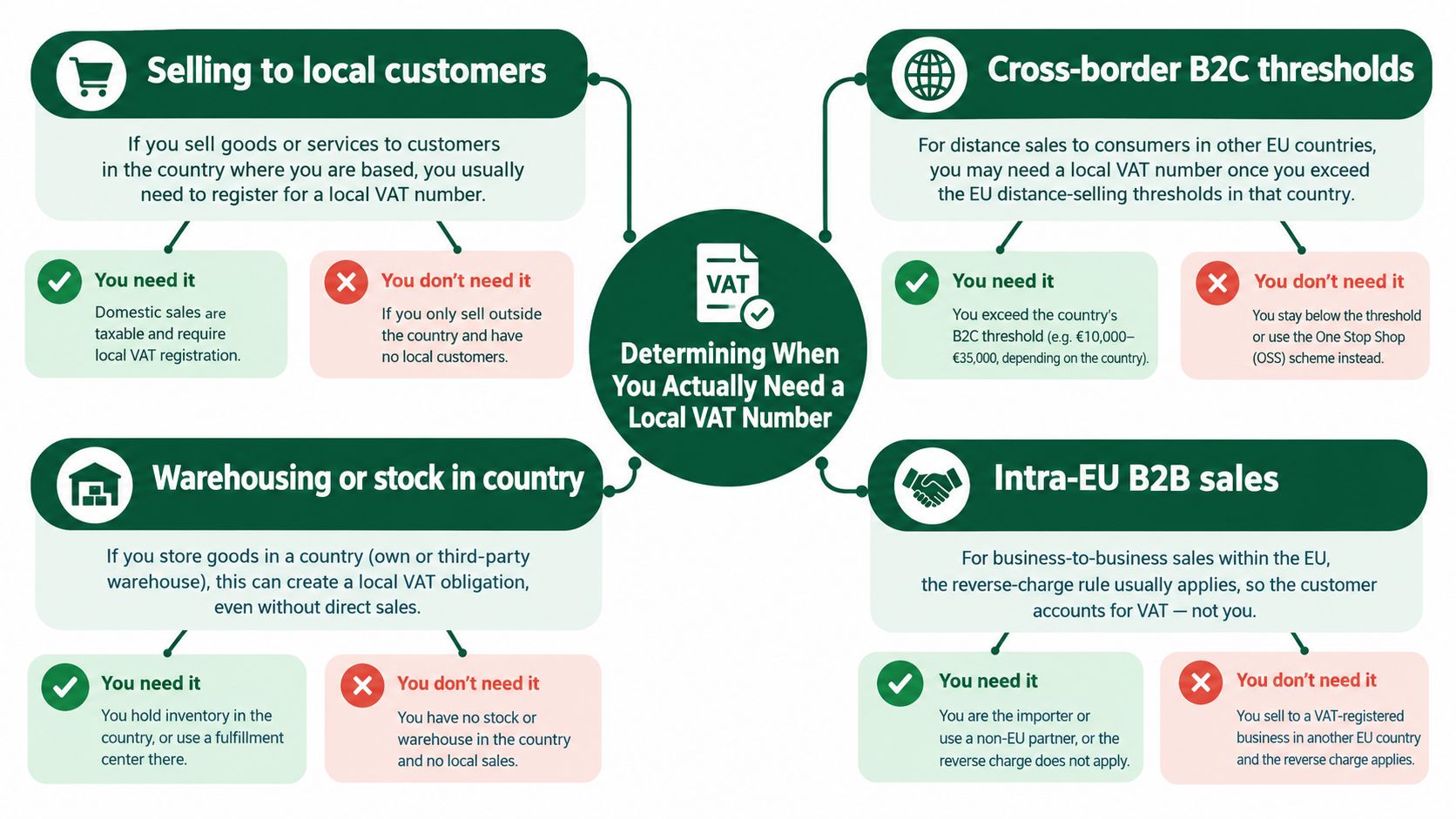
Four operating scenarios to test
Selling to local customers: A domestic sale made from stock already located in a country can create a local obligation. Don't assume OSS covers it just because the final buyer is a consumer.
Cross-border B2C sales: If goods move from your home base to consumers in other EU countries, check whether the sales qualify for OSS and whether the EUR 10,000 threshold changes the place of taxation. The EU VAT registration thresholds guide can help you frame the initial review.
Warehousing or stock in a country: Inventory stored in an Amazon FBA warehouse or another third-party logistics facility is the critical trap for many e-commerce founders. A stock transfer can be a taxable movement even when no customer order has yet been completed.
Intra-EU B2B sales: Reverse-charge treatment may reduce the need to charge VAT on a qualifying B2B invoice, but it doesn't automatically remove every registration obligation. Validate the customer's status, the place of supply, and the reporting requirements.
SaaS founders should separately map subscriptions, implementation services, advertising services, and bundled physical products. A software subscription may follow a different treatment from a device shipped with it. An agency invoicing a VAT-registered business may also face a different result from an agency selling services to consumers.
Before applying: Draw the movement of money, services, and goods on one page. Every arrow should identify the seller, buyer, location, customer type, and stock position.
The correct answer is often a combination: one home-country VAT registration, OSS for qualifying B2C transactions, and additional local registrations where stock or domestic activity requires them. That's far cleaner than registering everywhere first and trying to unwind unnecessary obligations later.
Executing a Fully Remote VAT Setup in Days
A modern setup doesn't require a founder to fly to Sofia, Berlin, or another capital to sign a stack of documents. The process can be completed online when the company provider, notary workflow, banking channel, and tax-registration process all support remote execution.
A practical remote journey begins with identity verification and a review of the proposed business model. The founder provides identification, address evidence, company information, and a clear explanation of expected activities. The provider then prepares incorporation documents, arranges electronic signing through a secure online notary process, and submits the company file to the relevant authorities.
The VAT application should match the incorporation file. If the application describes software consulting but the website, contracts, and invoices describe physical-product sales, the inconsistency can create questions. Prepare the business description, expected customer locations, supplier relationships, payment flows, and stock arrangements before filing.
What the online workflow should include
- Remote identity verification: Directors and shareholders complete the required checks without travelling.
- Company documents: The package may include incorporation certificates, registry extracts, identification documents, and apostilled materials where the authority requires them.
- Business address: A compliant virtual office or registered address supports company administration and official correspondence.
- Banking assistance: The provider helps present the company profile to online payment institutions or Bulgarian banks when an EU IBAN is needed.
- VAT coordination: The VAT application and first reporting setup should align with the company's actual trade.
Online formation and VAT support can be completed within 3 to 5 working days for the provider workflow described by the publisher, but that isn't a universal tax-authority deadline. Actual timing depends on document quality, the jurisdiction, the nature of the business, and whether officials request clarification.
A provider such as FastCorp can coordinate company formation, EU VAT registration, banking assistance, a virtual office, and ongoing accounting through one workflow. That integrated approach is useful when you'd rather avoid sending the same company information separately to a formation agent, bank, accountant, and tax-registration specialist.
The founder's job is to answer questions quickly and keep every record consistent. The provider's job is to prepare a complete file, submit it correctly, and monitor official correspondence.
Avoiding the Documentation Traps That Cause Rejections
A VAT application can fail even when the business itself is legitimate. Tax authorities assess whether the applicant has provided a complete, coherent, and credible file. The European Commission has documented meaningful differences between Member States in refused VAT registration requests, with refusal shares ranging from 0% in Italy to more than 20% in Latvia and Lithuania. Romania reduced its refusal share from 14.5% in 2016 to 2.2% in 2019, while Bulgaria reduced its share from 22.8% to 11.1% and the UK from 11.8% to 4.4%. (European Commission report on VAT registration controls)
Those figures don't mean that one country automatically approves every application. They show why jurisdiction-specific preparation matters. Before filing, identify the local risk-screening approach, check the document standard, and make sure the proposed activity is easy to understand.
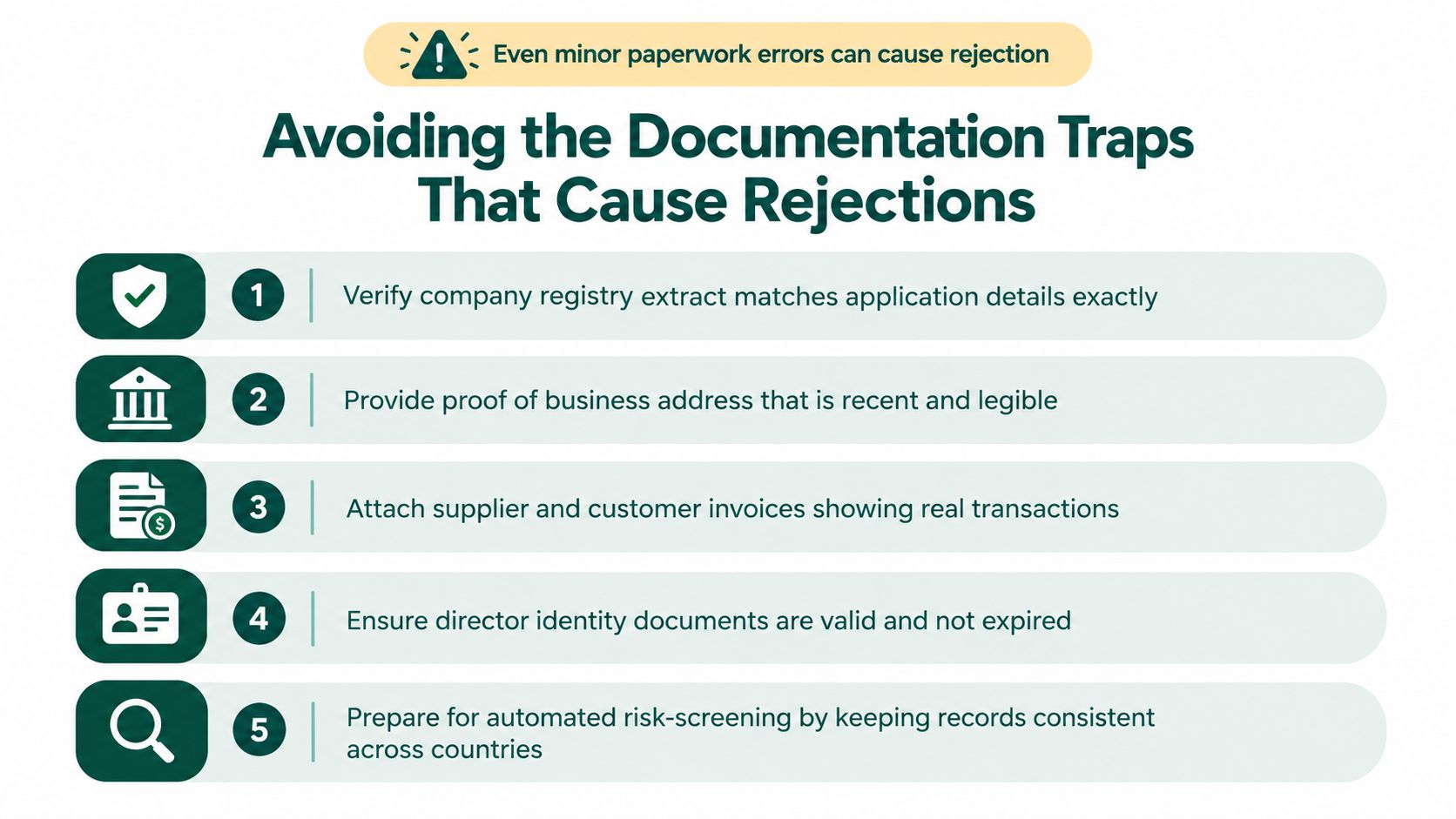
The rejection points I check first
- Company extract: Confirm that the legal name, registered address, directors, and ownership details match across every document.
- Identity documents: Check validity, legibility, signatures, and any certification or apostille requirement.
- Proof of activity: Provide contracts, supplier information, customer correspondence, invoices, or a business plan that reflects real expected trading.
- Address evidence: Use recent, readable proof that supports the registered office and the company's operating explanation.
- Correspondence control: Monitor the tax office mailbox and answer requests promptly. Ignoring a clarification request can stall an otherwise sound application.
Non-resident founders should also check whether the target country requires a fiscal representative. Some jurisdictions impose joint-and-several liability on that representative, which makes the appointment a substantive compliance decision, not a box-ticking exercise. Country-specific portals, certified translations, notarised company documents, and local signatures can add friction even when the application itself is submitted online. (EU OSS registration information)
The file must tell one story. Your website, invoices, contracts, bank profile, registered address, and VAT application should describe the same business.
Use a validation service to confirm whether an issued VAT number is active for intra-EU trade, but don't confuse validation with registration. The European VAT number validation guide is useful for checking the number after issuance and identifying mismatches before invoicing.
Managing Ongoing Compliance and Filing Your Returns
VAT registration is the start of the operating routine, not the finish line. You need a reliable transaction ledger, correctly classified invoices, evidence for exemptions or reverse-charge treatment, and a calendar that tracks every filing obligation.
OSS is designed to keep qualifying cross-border B2C reporting online. A taxable person registered for OSS submits the return electronically in the Member State of identification, and the system supports both EU and non-EU businesses selling qualifying goods or services across the EU. The European Commission also provides online courses for businesses and tax professionals using OSS and IOSS. (European Commission OSS operating guidance)
Build the compliance routine before launch
Record every transaction with the information needed to identify:
- the customer type and country,
- the supply date,
- the product or service category,
- the VAT rate or reverse-charge treatment,
- the dispatch or stock location,
- the invoice and payment reference.
Reconcile payment processors, marketplaces, bank statements, and accounting records regularly. E-commerce businesses should also reconcile warehouse movements because inventory transfers can create obligations that don't appear in the customer-order report.
The European Commission's ViDA reforms are being introduced incrementally. Revised OSS guidance covers changes effective from 1 January 2027, while broader reforms are scheduled from 1 July 2028. The planned Transfer of Own Goods scheme is intended to allow qualifying cross-border stock movements to be reported through OSS from 1 July 2028, replacing today's call-off stock simplification. (European Commission ViDA updates)
That future simplification is important, but it isn't a reason to delay current compliance. Until the relevant rules apply to your transactions, map stock movements under the rules currently in force.
The strongest setup is boring in the best possible way. Your company has the right registrations, your invoices use the correct treatment, your bookkeeping is current, and official correspondence reaches someone who responds. With the right base and a disciplined filing process, European VAT becomes an online operating task rather than a barrier to expansion.
FastCorp helps non-resident founders form Bulgarian companies, coordinate EU VAT registration, arrange banking and virtual-office support, and set up ongoing bookkeeping and VAT filings through a remote workflow. Visit FastCorp to review the online setup and start mapping your EU structure.