Virtual Office Bulgaria: A Practical Guide for Founders
Virtual Office Bulgaria. Explore how a virtual office in Bulgaria works for non-resident founders, covering legal use, pricing, compliance, and how

You're probably reading this from a laptop in another country, trying to register a Bulgarian company without renting an office you'll rarely visit. The form asks for a Bulgarian registered seat and address, and you're wondering whether a Sofia virtual office is a legitimate business solution or just a polished mailbox.
The answer is practical. A virtual office in Bulgaria can provide the street address your company needs, receive official correspondence, and support a remote incorporation process. But it only works when the address is identifiable, the property owner's consent is documented, and someone in Bulgaria reliably handles letters from authorities. A cheap address without operational support can create more risk than it removes.
Table of Contents
- A Founder Setting Up Shop From a Sofa in Lisbon
- Why Bulgaria's Tax Setup Makes the Address Worthwhile
- How a Virtual Office in Bulgaria Actually Works Day to Day
- Documents and Steps to Get Registered Online
- Online Setup Versus Flying to Sofia
- The Gap Between a Registered Address and VAT Approval
- Keeping the Address Compliant After You Incorporate
- Putting It All Together as a Founder
A Founder Setting Up Shop From a Sofa in Lisbon
At 9 p.m. in Lisbon, a founder opens the Bulgarian Commercial Register form. His company will sell software services to European clients, but he has no Bulgarian apartment, office, or local receptionist. The address field is mandatory, so he pastes a Sofia address supplied by a virtual office provider.
That address isn't a decorative line for invoices. It becomes the company's registered seat and official address in Bulgaria. Bulgarian companies must have a registered seat and address on Bulgarian territory, and the address appears in the Commercial Register as the company's formal point of contact. A compliant virtual office supplies a real street address, receives letters, scans them, and forwards them to the founder, as explained in this overview of legal addresses and virtual offices in Bulgaria.
The distinction matters because government correspondence follows the registered address, not the founder's sofa in Lisbon. The Registry Agency, tax authorities, courts, and other official bodies need a dependable place to serve notices and request documents. If nobody receives those letters, a remote founder can miss a deadline without even knowing that a notice arrived.
Practical rule: Treat the virtual office as part of your compliance system, not as a mailbox add-on.
Over the next few days, the founder needs clear answers to three questions:
- Who receives official mail? A named person or staffed provider should accept correspondence and record what arrived.
- Which documents need immediate action? Tax notices, court correspondence, and registration requests should be separated from ordinary commercial mail.
- Can the address be proven? The provider should be able to show the company's right to use a real, identifiable premises.
Bulgaria has also tightened address controls. The 2021 amendments to Commercial Register rules require property-owner consent, and changes to the official address must be filed within seven days, according to this legal guidance on Bulgarian registration addresses. That makes provider quality more important than the prestige of the Sofia street name.
Why Bulgaria's Tax Setup Makes the Address Worthwhile
The address makes sense only if the Bulgarian company structure makes commercial sense. Bulgaria's corporate income tax is a flat 10%, and mandatory VAT registration begins when annual taxable turnover exceeds 100,000 BGN, roughly €51,000 to €55,000 depending on the exchange rate, according to this summary of Bulgarian taxes and company setup.
That combination is attractive for founders comparing EU jurisdictions. The 10% corporate rate is straightforward to model, while the VAT threshold gives smaller businesses room to operate before mandatory registration, assuming their activities and taxable turnover fall within the applicable rules. The threshold isn't a universal exemption from VAT obligations, especially where cross-border services, special schemes, or other registration grounds apply.
A Sofia registered seat is the entry condition for creating the Bulgarian company's local administrative file. It isn't the tax benefit itself, and it doesn't automatically produce VAT approval, banking access, or tax residency for the founder. Those decisions depend on the business model, the company's documents, and the relevant authority's review.
Bulgaria compared with alternatives
The supplied data gives a precise corporate tax rate and VAT threshold for Bulgaria, but it doesn't provide verified figures for Estonia, Cyprus, Ireland, or other comparison jurisdictions. I won't fill that gap with promotional estimates. Use the table as a decision framework, then verify each alternative with a local adviser before incorporating.
| Jurisdiction | Corporate Tax | Dividend / Exit Tax | VAT Registration Threshold | Local Director Required |
|---|---|---|---|---|
| Bulgaria | 10% | Not specified in the verified data | 100,000 BGN taxable turnover | Not specified in the verified data |
| Estonia | Not specified in the verified data | Not specified in the verified data | Not specified in the verified data | Not specified in the verified data |
| Cyprus | Not specified in the verified data | Not specified in the verified data | Not specified in the verified data | Not specified in the verified data |
| Ireland | Not specified in the verified data | Not specified in the verified data | Not specified in the verified data | Not specified in the verified data |
A founder should calculate the tax position before buying an address. The Bulgaria tax rate guide can help frame that conversation, but the registered address still needs to support actual correspondence and administration. If the company has no genuine Bulgarian business rationale, a virtual office won't repair a weak structure.
How a Virtual Office in Bulgaria Actually Works Day to Day
A compliant service starts with the premises, not the scanning software. The address must identify a real location, and the provider should hold evidence that the company has the right to use it. That evidence may take the form of a lease or documented owner consent, which is essential because the address is the official contact point for the Registry Agency and other authorities, as outlined in this incorporation requirements guide.
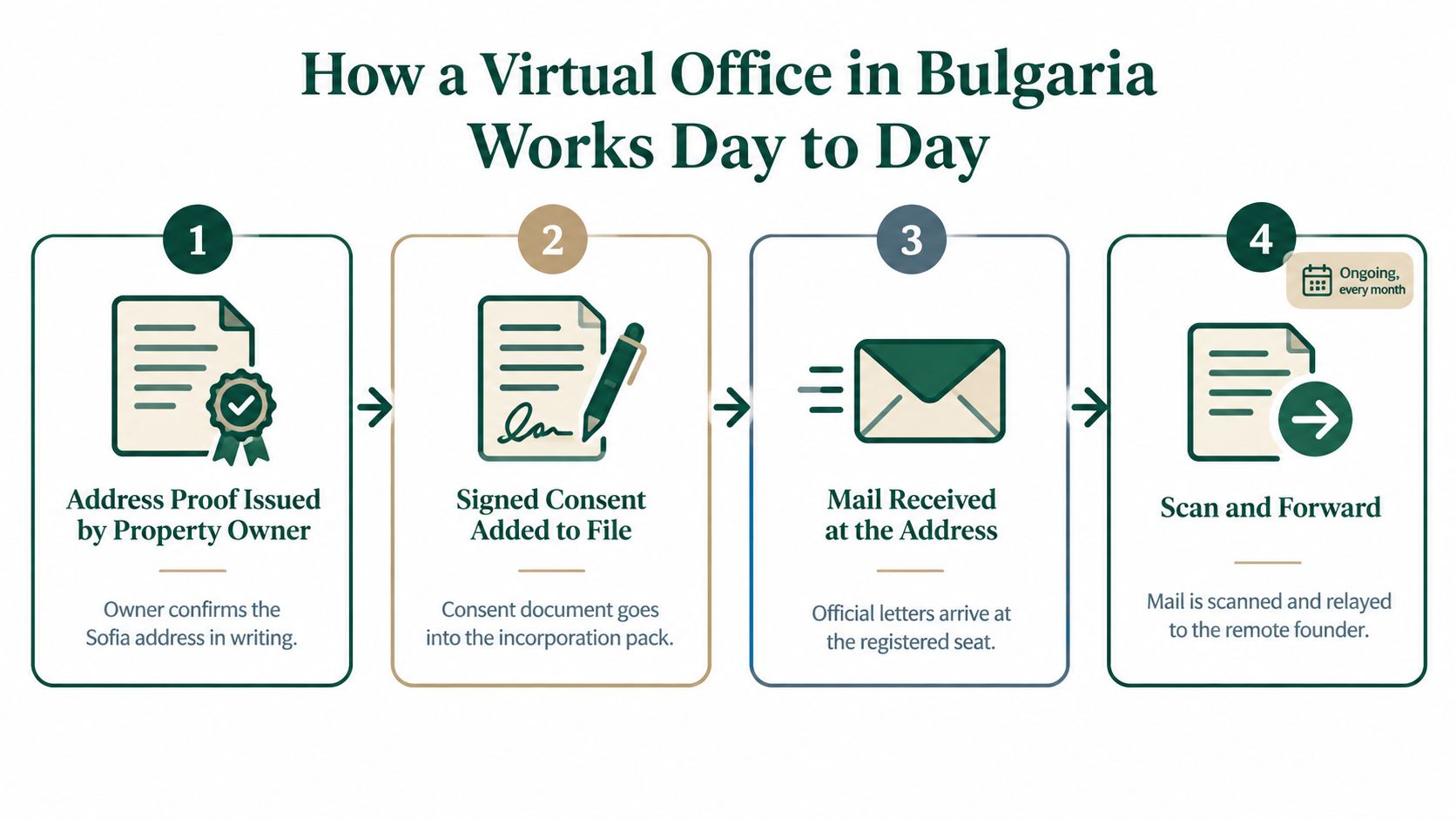
The operating chain
- Address proof comes first. Ask for written confirmation from the property owner or another document proving the company's right to use the premises.
- Consent enters the incorporation file. The filing should reflect the correct legal address and preserve the supporting document.
- Mail arrives at the registered seat. The provider receives official letters addressed to the company, rather than leaving the founder to monitor a Bulgarian location remotely.
- The provider scans and forwards correspondence. Agree in advance whether the service uses email scans, scheduled forwarding, courier delivery, or secure destruction for documents you no longer need.
Don't choose a package that says “mail handling” without explaining the workflow. Ask who opens envelopes, how the provider records arrival, how originals are stored, and how quickly the remote director is notified. A scan is useful only when it arrives early enough for the company to act.
The registered seat can receive correspondence from the Commercial Register, the National Revenue Agency, courts, and other public bodies. VAT and tax administration also depend on a functioning postal address and reliable electronic contact details, as set out in the EU explanation of Bulgarian VAT rules.
A staffed office is the safer choice for a remote company. It gives the company a person who can accept documents, preserve originals, and escalate a notice instead of allowing important mail to sit unattended.
Documents and Steps to Get Registered Online
A founder can complete much of the Bulgarian registration process from abroad, but the application still depends on a properly prepared document file. Gather the papers before authorising a formation provider. Requirements vary with the founder's nationality, company structure, filing representative, and the authority receiving each document.
Confirm these items before submission:
- Identity evidence: A clear passport copy for every relevant founder or director.
- Address evidence: Proof of the founder's home address where the filing or compliance process requires it.
- Certification: Documents issued outside Bulgaria may require notarisation, an apostille, or both.
- Corporate choices: The proposed name, business activities, ownership, management, capital, and registered seat.
- Authority to file: A power of attorney or equivalent authorisation for the person submitting the application.
- Registered-seat evidence: Written consent or another document proving the company's right to use the Bulgarian premises.
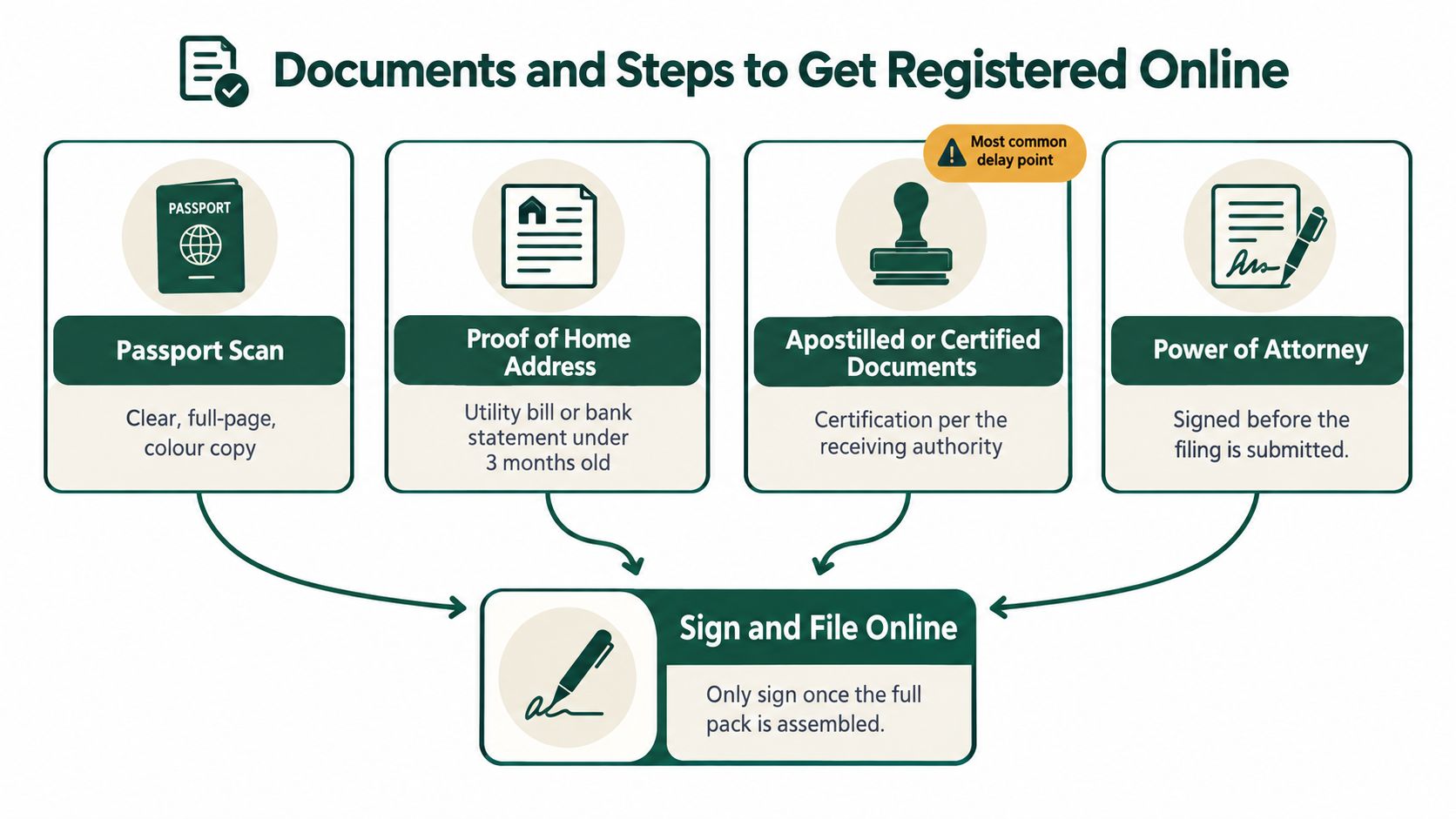
A practical online sequence
- Choose the address and service level. Verify that the provider controls real premises and can issue written evidence of the company's right to use them. The address must remain usable after incorporation, including for tax correspondence or an inspection.
- Review and sign the corporate documents. Sign incorporation papers and authorisations electronically where the procedure accepts that method.
- Complete certification requirements. An electronic signature does not replace an apostille, notarisation, or original document when the receiving authority requires one.
- Submit through the Commercial Register. A qualified electronic signature can be used for electronic filing.
- Check the registry result. Online entry typically takes one to five business days, according to this guide to online Bulgarian company registration.
The electronic filing fee is €28.12, compared with €56.24 for a paper filing, based on the same registration guidance. These are registry fees, not the complete cost of legal, accounting, address, translation, certification, or banking support.
Use the online incorporation process as a controlled document workflow. Ask which papers arrive electronically, which originals the provider retains, and which certified documents must travel by courier. Also confirm how the address supports later VAT preparation, an authority inspection, and the day a letter from Bulgaria's revenue agency arrives. A missing original or poorly documented registered seat can delay the next administrative step after the company already exists.
Online Setup Versus Flying to Sofia
For most non-resident founders, the online route is the rational default. Bulgarian incorporation documents can be signed electronically, and the filing can be handled through electronic procedures without an in-person visit, as described in this guide to electronic company document signing.
Flying to Sofia still has a legitimate use. It makes sense when the founder is relocating, wants to meet an accountant or lawyer personally, needs local business meetings, or has a bank that insists on face-to-face onboarding. It doesn't make sense merely because the founder assumes company registration requires a trip.
Compare the two routes before choosing
| Factor | Online setup | In-person setup |
|---|---|---|
| Founder travel | Not required for the electronic route | Requires travel to Sofia |
| Main advantage | Efficient for remote founders and international teams | Direct meetings and physical document handling |
| Main drawback | Less opportunity for in-person banking and local networking | Travel time and personal attendance |
| Registry filing | Can be submitted electronically | Can be submitted through the applicable filing route |
| Best fit | Testing EU expansion or operating remotely | Relocating or building a Bulgarian local presence |
Bulgaria's electronic registry fee is lower than the paper filing fee, but that difference shouldn't drive the entire decision. The larger issue is whether the founder needs a physical presence for banking, meetings, or identity checks.
My recommendation: Choose online incorporation unless a bank, authority, or commercial plan gives you a specific reason to be in Sofia.
An address provider can also make the online route more practical by receiving originals, forwarding official mail, and keeping the registered seat operational after the filing. Without that support, the founder still has to solve the local correspondence problem from abroad.
The Gap Between a Registered Address and VAT Approval
A Bulgarian virtual office solves one important problem. It gives the company a registered seat that can be used for official correspondence and company registration. It doesn't prove that the company qualifies for VAT, and it doesn't guarantee a bank account.
The Bulgarian National Revenue Agency and EU VAT rules require a functioning address for correspondence. That address helps the company maintain a usable taxpayer file, but VAT readiness is broader than the address. The business model, taxable activities, registration grounds, documents, and ability to receive official notices all matter.
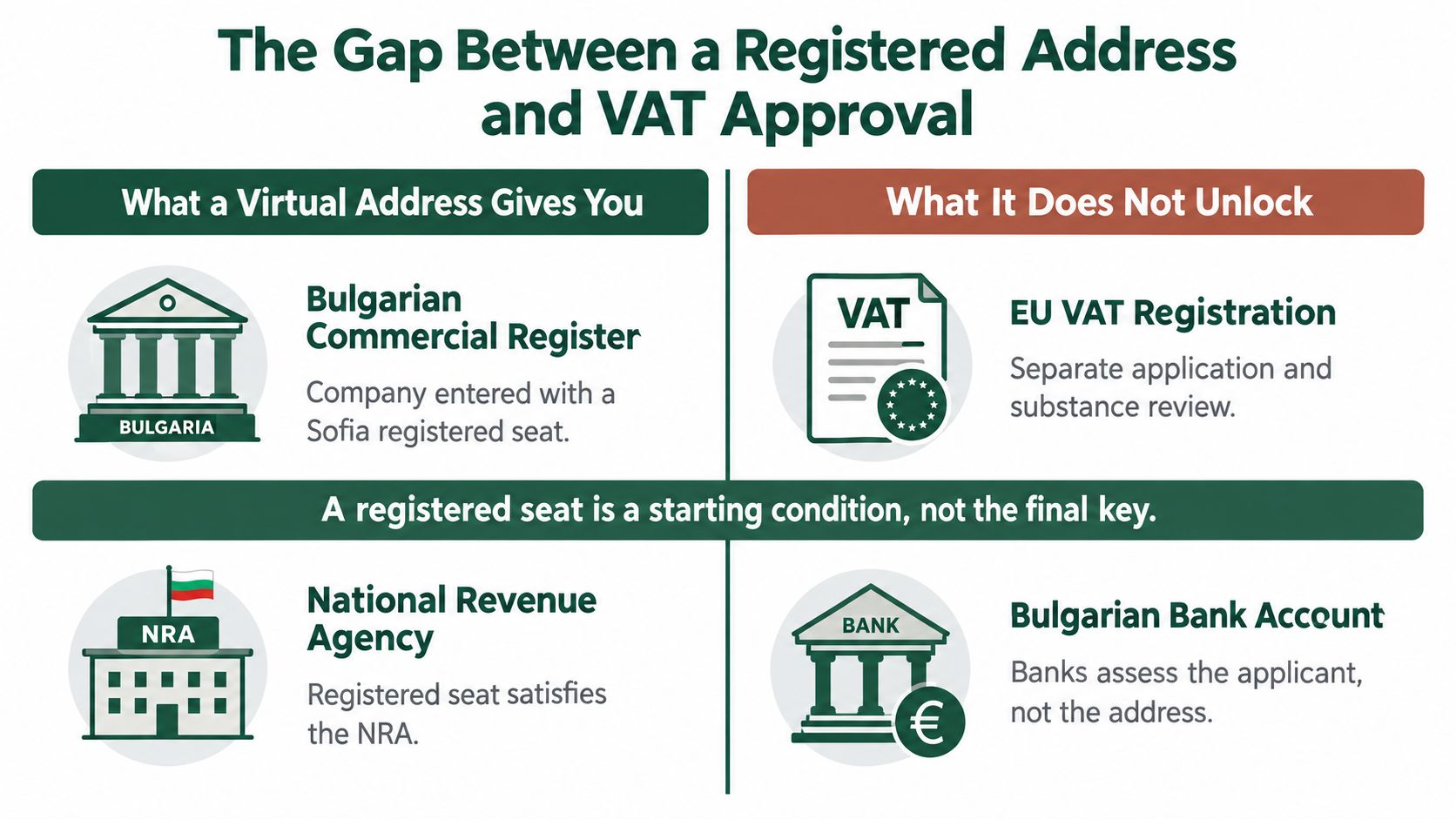
What the address supports
A functioning Sofia address can support:
- Commercial registration: The company has a Bulgarian seat recorded in the Commercial Register.
- Official correspondence: The Registry Agency and tax authorities have a recognised contact point.
- Application administration: The company can maintain a file for VAT or other regulatory processes.
- Notice management: A provider can receive, scan, and forward letters to the remote founder.
What still needs separate review
VAT authorities can assess whether the application matches the company's actual activities and taxpayer file. A founder shouldn't assume that a registered seat alone produces EU VAT access, particularly where the company has little documentation showing how it operates.
Banking follows a similar logic. A Bulgarian company and address may be part of the onboarding file, but the bank or payment provider can ask separate questions about ownership, activity, source of funds, management, and expected transactions.
Read the VAT registration requirements for Bulgaria as a separate compliance workstream, not as an automatic consequence of purchasing a virtual office.
The right sequence is simple: establish the legal seat, prepare the taxpayer file, explain the business model clearly, and then pursue VAT or banking approval. The address gets the company into the process. It doesn't carry the application by itself.
Keeping the Address Compliant After You Incorporate
Registration is the beginning of address management. A company that operates remotely needs a repeatable system for correspondence, document access, and changes to the registered seat. Many cheap virtual office arrangements fail at this stage.
Start with a digital mail log. Record the sender, arrival date, document type, scan location, responsible person, and action taken. The log gives the director and accountant a shared record when an authority asks what happened to a notice.
Four controls worth maintaining
- Mail log: Record every official item and mark whether someone must respond.
- Nominated contact: Authorise one person in Bulgaria to receive official post and coordinate inspection or document requests.
- Document access: Keep scanned copies organised and preserve originals when they have legal value.
- Address monitoring: Review the service agreement and confirm that the provider still accepts correspondence for the company.
Forward official correspondence promptly. A scanned PDF should reach the director and accountant quickly, while originals should be stored or couriered when the document requires them. Don't rely on a provider that only forwards mail when someone happens to check the box.
The registered address is a live compliance control. If it stops receiving mail, the company loses visibility over its own obligations.
If the company moves, file the official address change with the Registry Agency within seven days, as required under the cited Bulgarian registration rules. Then update the National Revenue Agency, municipality, bank, payment providers, accountant, and commercial counterparties that use the address.
Inspection readiness also deserves attention. Keep a clear company identification, a secure place for invoices and corporate records, and a named person who knows where documents are held. These measures don't turn a virtual office into a normal workplace, and they don't remove every compliance obligation, but they make an authority request manageable instead of chaotic.
Putting It All Together as a Founder
Treat the virtual office, tax position, and incorporation process as one decision. Start with the business model. EU service sales, IT contracting, consulting, e-commerce, and holding activities create different tax, VAT, substance, and banking questions. Confirm why the Bulgarian company exists before paying for an address.
Then test the numbers. Bulgaria's 10% corporate tax rate and 100,000 BGN VAT registration threshold may suit an eligible business, but neither replaces a credible operating explanation or proper records. Choose an address provider that can show premises evidence, handle official mail, and name a local contact.
A sequenced action plan
| Step | Action | Timeline | Output |
|---|---|---|---|
| 1 | Confirm the business model, ownership, management, and Bulgarian tax rationale | Before filing | Defined company structure |
| 2 | Choose a Sofia registered address and verify owner-consent evidence | Before signing | Address and supporting documents |
| 3 | Assemble identity, corporate, certification, and filing-authority documents | Before submission | Complete incorporation pack |
| 4 | Sign accepted documents electronically and submit through the Commercial Register | Filing stage | Electronic application |
| 5 | Track the registry decision and company identifier | Typically one to five business days for electronic entry, according to the online registration guidance | Registered Bulgarian company |
| 6 | Prepare separate banking and VAT files | After incorporation | Applications based on the actual business |
| 7 | Start the mail log and quarterly compliance review | Once the address is active | Ongoing correspondence control |
The founder in Lisbon does not need a desk in Sofia. He needs a real registered seat, reliable mail handling, accurate documents, and a realistic plan for VAT and banking. Online incorporation opens access to Bulgaria, while disciplined administration protects the company after registration.
Use the online route for a remote business or an early EU expansion test. Visit Sofia only when the trip serves a clear purpose, such as relocation, local meetings, or a bank requirement. This sequence connects the address to incorporation, VAT readiness, inspections, and the day an official letter arrives from the revenue agency.
FastCorp helps non-resident founders establish Bulgarian companies online, including the Sofia virtual office, incorporation documents, banking assistance, VAT setup, and ongoing compliance support. Visit FastCorp to discuss registered-address requirements and choose a practical route for launching and maintaining a Bulgarian entity.