EU VAT Registration Thresholds: A Practical Country Guide
Compare EU VAT registration thresholds across major markets in 2026. Practical guidance for non-resident founders, cross-border sellers, and e-commerce
A London-based founder ships her first serious batch of orders into Germany. The store dashboard shows €10,001 in cross-border B2C sales, so she starts looking for the next step. Then she learns that her UK VAT number doesn't give her a German VAT position, and that storing inventory in Germany creates a separate obligation from selling to German consumers.
That situation is common because EU VAT registration thresholds aren't one rule. They combine domestic turnover limits, cross-border consumer-sales rules, and special treatment for non-resident businesses. The right answer depends on where your company is established, where goods are stored, where customers are located, and whether your sales qualify for OSS or the newer SME exemption framework.
Table of Contents
- Why EU VAT Registration Thresholds Matter for Non-Resident Founders
- The Three Types of VAT Thresholds You Need to Understand
- How the EU €10,000 Cross-Border Threshold and OSS Work
- Country-by-Country Domestic VAT Registration Thresholds in 2026
- The 2025 Harmonised €85,000 Cap and New Cross-Border SME Rules
- Bulgaria's 2026 Threshold Change and What It Means for Founders
- Why Waiting for a Threshold Can Backfire on Non-Resident Sellers
- Practical Steps to Register for VAT in Another EU Country
- Non-Resident VAT Rules Compared Across Eight Major Markets
- Quick-Reference Checklist Before You Register
- Frequently Asked Questions on EU VAT Thresholds
Why EU VAT Registration Thresholds Matter for Non-Resident Founders
Thresholds decide more than whether you add VAT to an invoice. They can determine when you must register locally, file returns, maintain country-specific records, recover input VAT, or appoint a representative. A founder who treats the headline domestic number as the whole answer can miss a registration trigger created by stock, imports, marketplace arrangements, or cross-border B2C sales.
The first question is where the business has a taxable presence. If inventory sits in a German warehouse, the German domestic rules and non-resident treatment matter even if the company is incorporated in the United Kingdom or another EU country. A local warehouse can create an obligation that has nothing to do with whether domestic sales have reached a turnover ceiling.
The second question concerns consumer sales across EU borders. Since the 2021 reform, the relevant EU-wide limit for intra-EU distance sales of goods and TBE services is €10,000, calculated across the EU rather than separately for every destination. Once the rule applies, OSS can replace a collection of destination-country filings, but it doesn't erase local obligations created by stock or other taxable activities. The European Commission's OSS portal sets out the destination-taxation framework.
The three decisions founders must separate
- Domestic turnover: Has taxable turnover in the country where you operate or hold stock crossed that country's limit?
- Cross-border B2C sales: Has combined intra-EU consumer distance selling and relevant TBE services crossed the EU-wide limit?
- Non-resident activity: Does the country require registration from the first taxable supply because you aren't established there?
Practical rule: Treat every country where you store goods, import goods, or make taxable supplies as a separate VAT review. OSS simplifies eligible reporting. It doesn't turn a warehouse into a tax-free location.
The Three Types of VAT Thresholds You Need to Understand
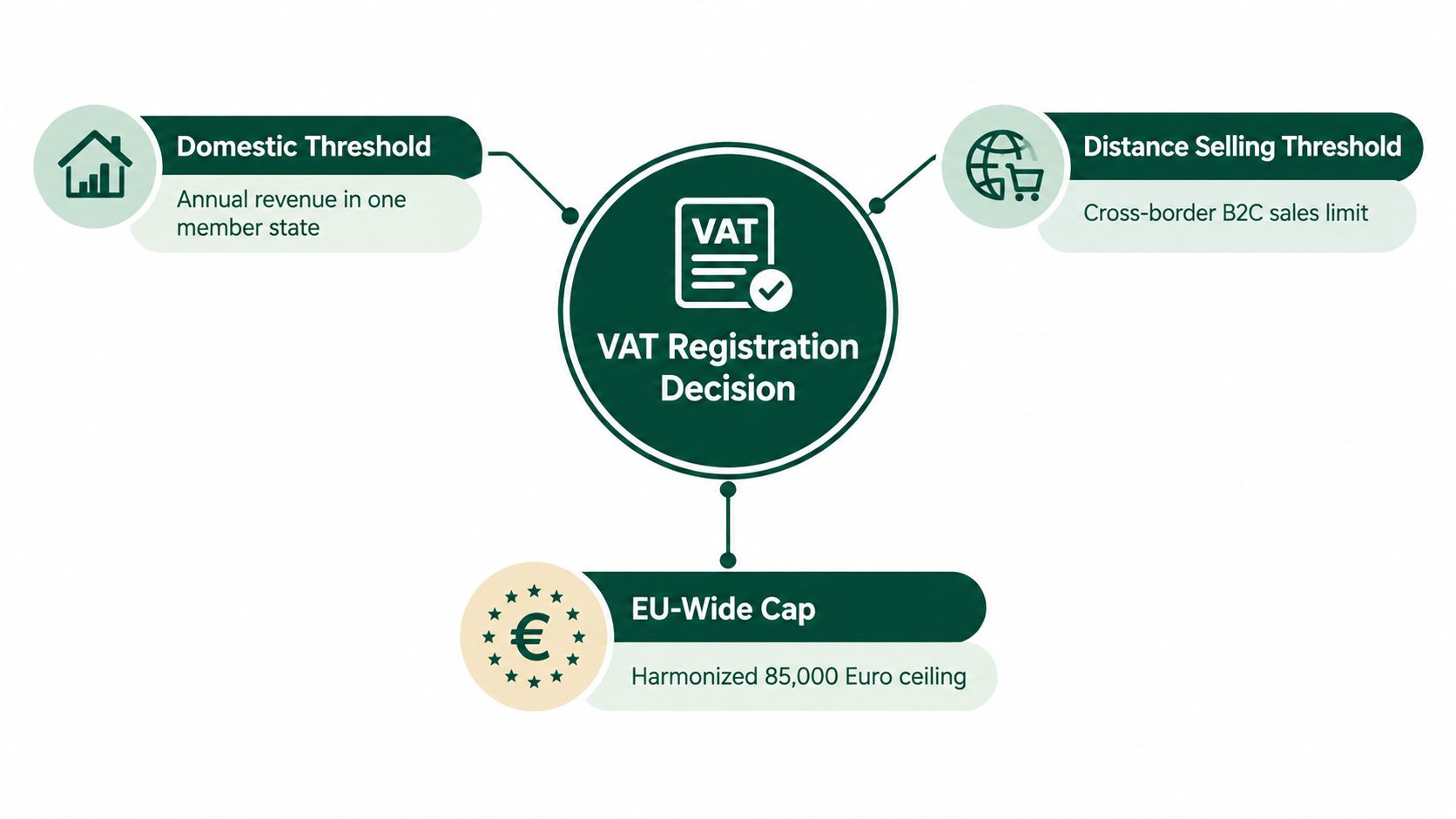
Start by separating domestic thresholds, distance-selling thresholds, and non-resident rules. They answer different questions, use different calculations, and can apply to the same business at the same time.
Domestic turnover thresholds
A domestic threshold generally measures taxable turnover connected with a business's activity in one Member State. The number may allow a small established business to use an exemption below the limit, or it may mark the point at which registration becomes compulsory. It isn't automatically a safe harbour for a foreign company.
The practical test is not just, “How much did I sell?” Ask instead: Which entity made the supply, where did the supply take place, and is the entity established in that country? Service classifications, exempt supplies, capital assets, and special schemes can change the calculation.
Distance selling rules
The old country-by-country distance-selling thresholds disappeared on 1 July 2021, when the EU introduced one €10,000 limit for qualifying intra-EU B2C distance sales and TBE services, as described in this VAT threshold overview. The limit is an EU-wide cross-border test, not a separate allowance for every destination.
Non-resident obligations
A non-resident company can face registration from its first taxable activity even when an established local business could use a domestic exemption. The cited comparison identifies Austria, Belgium, Bulgaria, France, Germany, Greece, Italy, and Latvia as countries with no threshold for non-resident taxable persons, meaning the foreign seller may need to register immediately. See the EU threshold comparison for non-resident rules.
A threshold is therefore not always permission to wait. It may be a ceiling for an exemption, while the non-resident rule functions as a floor. Always test both.
How the EU €10,000 Cross-Border Threshold and OSS Work
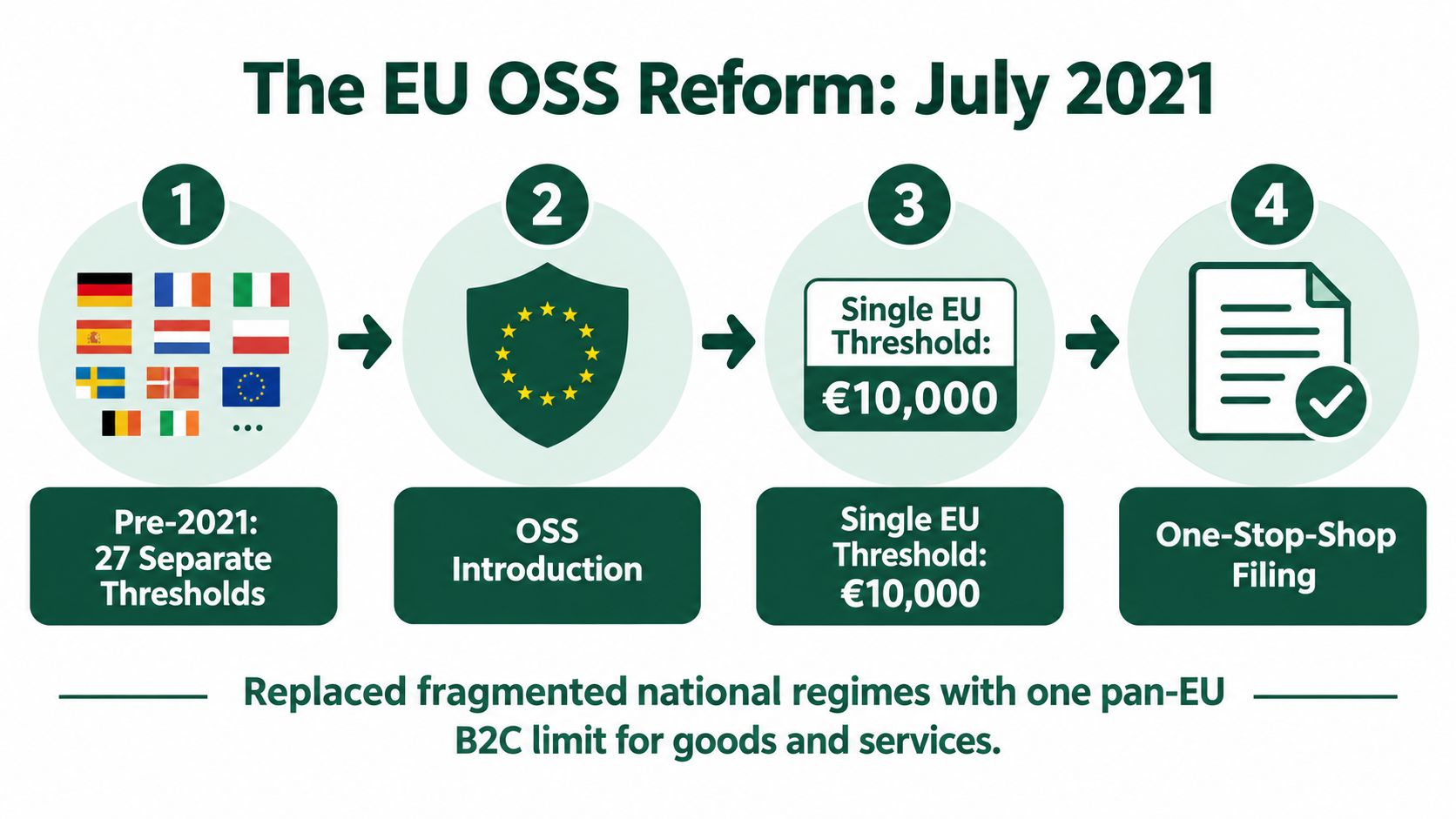
Before July 2021, sellers had to comply with national distance-selling regimes. The reform replaced that fragmented approach with a single EU-wide threshold of €10,000 for qualifying intra-EU B2C distance sales of goods and TBE services. The threshold applies to the combined value of those cross-border supplies in the current and preceding calendar year, not to each country separately. The OSS reform guidance describes the shift from country-by-country thresholds to the unified rule.
Suppose a Dutch business sells €8,000 of consumer goods to Germany and €4,000 to France. Its qualifying cross-border total is above the EU-wide limit. It must charge VAT based on the customer's Member State for the relevant sales and choose a compliance route.
The efficient route is usually OSS. The business registers in one Member State of identification and reports eligible destination-country sales through the OSS return instead of filing separate returns in every consumer destination. It still needs accurate country-level transaction data, VAT-rate mapping, evidence of customer location, and a process for correcting errors.
OSS isn't a universal substitute for local VAT registration. A warehouse, domestic supply, import arrangement, or other local activity may require a local VAT number even while eligible consumer sales remain in OSS. IOSS is a separate import scheme and shouldn't be confused with Union OSS.
For a visual explanation of the mechanics, this OSS reform video provides additional context.
Country-by-Country Domestic VAT Registration Thresholds in 2026
Domestic limits vary sharply, and the headline figure can mislead founders who operate as non-residents. The comparison below uses the verified country examples available for 2026 planning. Where the available data doesn't establish a precise local-currency figure or a specific non-resident rule, the table says so rather than filling the gap with an assumption.
| Country | Domestic Threshold | Local Currency | Non-Resident Rule | OSS Eligible |
|---|---|---|---|---|
| Germany | €25,000 | EUR | No threshold for non-residents | Yes, for eligible B2C sales |
| France | €85,000 for goods and accommodation-related activities, €37,500 for most services | EUR | No threshold for non-residents | Yes, for eligible B2C sales |
| Netherlands | €20,000 | EUR | Verify activity-specific treatment | Yes, for eligible B2C sales |
| Spain | No domestic threshold | EUR | Verify current registration treatment | Yes, for eligible B2C sales |
| Italy | €65,000 in the cited comparison | EUR | No threshold for non-residents | Yes, for eligible B2C sales |
| Poland | Not stated in the verified comparison used here | PLN | Verify current treatment | Yes, for eligible B2C sales |
| Ireland | €75,000 for goods, €37,500 for services | EUR | Verify current treatment | Yes, for eligible B2C sales |
| Sweden | SEK 30,000 | SEK | Verify current treatment | Yes, for eligible B2C sales |
| Czech Republic | Not stated in the verified comparison used here | CZK | Verify current treatment | Yes, for eligible B2C sales |
| Austria | €35,000 in the cited comparison | EUR | No threshold for non-residents | Yes, for eligible B2C sales |
The EU VAT rates and country comparison is useful for the next research step, but don't use a domestic number as a universal answer. The verified comparison also identifies France's service threshold at €37,500, with tolerance ceilings of €93,500 for the relevant goods category and €41,250 for most services. Germany's cited domestic figure is €25,000, while the United Kingdom uses a separate £90,000 registration threshold.
How to read the table
A domestic amount can be a hard mandatory trigger, an exemption ceiling, or one part of a special small-business scheme. A non-resident may have no benefit from the local figure at all. Service providers should be particularly cautious because service-specific thresholds can diverge from goods thresholds, and place-of-supply rules may override a simple turnover calculation.
Use the table to identify questions, not to replace a local review. Confirm the taxable-supply definition, deemed supply date, reporting period, registration effective date, and treatment of stock before filing.
The 2025 Harmonised €85,000 Cap and New Cross-Border SME Rules
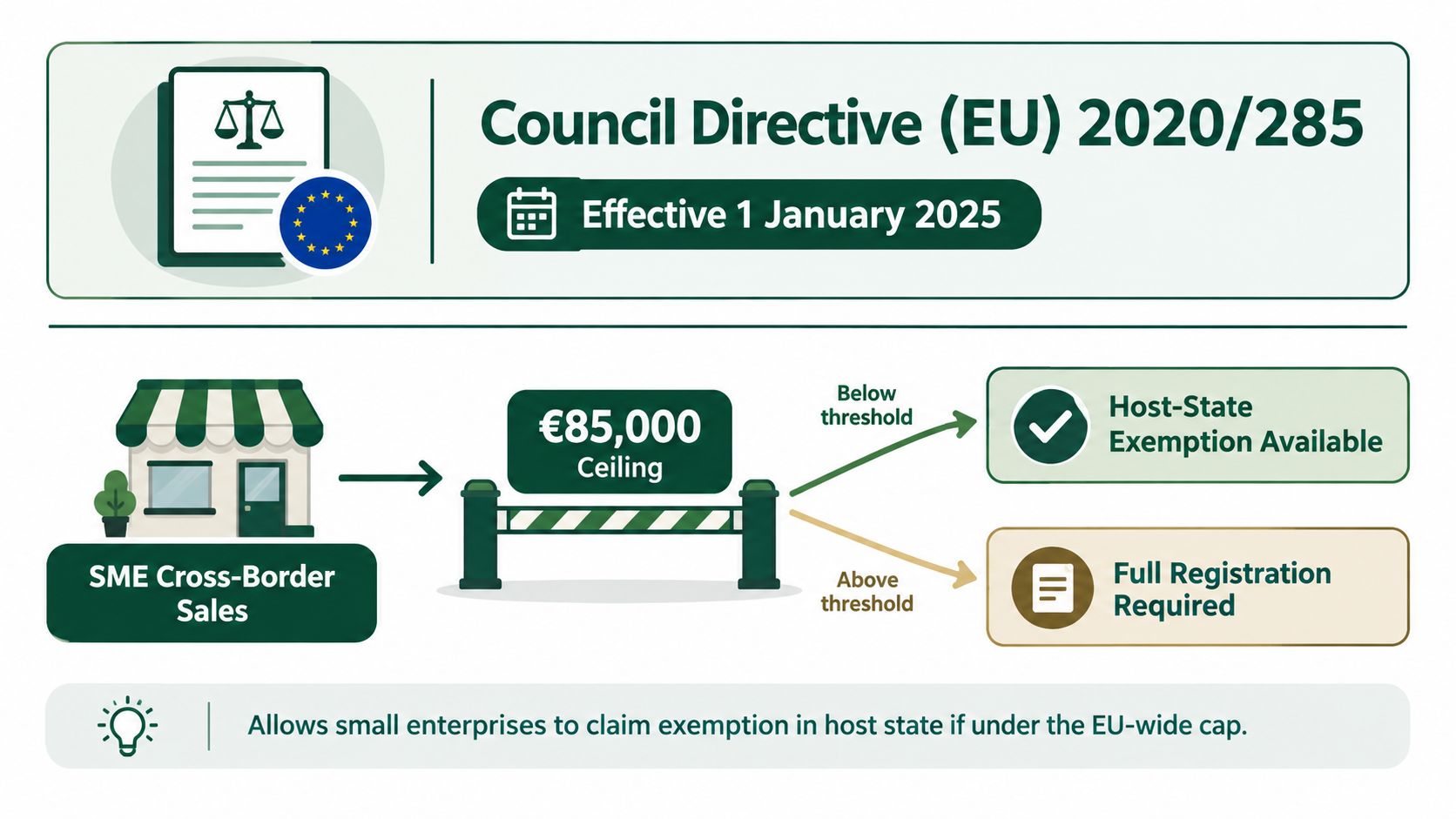
On 1 January 2025, Directive (EU) 2020/285 introduced a harmonised EU small-business framework and capped any Member State's domestic VAT exemption threshold at €85,000. The European Parliament's indirect-taxation factsheet provides the legislative context.
The framework adds a second layer for founders selling into other Member States. An eligible business established in one Member State may use a host-state exemption if it remains below the relevant national threshold and below the €100,000 EU-wide annual turnover threshold under the cross-border SME scheme. The maximum national annual threshold under that scheme is €85,000.
That isn't the same as the OSS threshold. €10,000 concerns destination taxation for qualifying cross-border B2C sales. €100,000 concerns eligibility for a cross-border small-business exemption. Confusing the two can produce the wrong VAT treatment even when the arithmetic is correct.
A French-to-Belgian example
A French SME selling into Belgium must test its French home-state position, its total EU turnover, and the Belgian threshold. If it qualifies, the French tax authority acts as the single contact point for the cross-border SME process, while Belgium grants the relevant exemption under the scheme.
The company still needs to verify whether its supplies fall within the scheme and whether exclusions apply. Distance sales and high-value capital assets can receive different treatment, and intra-Community acquisitions or supplies that require registration can prevent the exemption from working as expected.
The correct decision is layered: home-state turnover, host-state exemption, and EU-wide eligibility. Don't reduce the framework to “register” versus “don't register.”
Bulgaria's 2026 Threshold Change and What It Means for Founders
Bulgaria changed the domestic registration test for established businesses from a rolling twelve-month calculation to a calendar-year test from 1 January 2026. Mandatory registration applies when taxable turnover exceeds €51,130, the equivalent of BGN 100,000, and the filing deadline is seven days after the threshold is exceeded, according to this Bulgaria VAT summary.
The change matters because a rolling test and a calendar-year test create different monitoring routines. A founder who only reviews trailing twelve-month reports can miss the Bulgarian filing window after the rule change. Build a monthly turnover report that separates Bulgarian taxable supplies from OSS-reported consumer sales.
For non-established businesses, Bulgaria effectively has no registration threshold. VAT can be due from the first taxable supply in Bulgaria. OSS may cover eligible cross-border B2C transactions, but it doesn't replace a Bulgarian VAT ID where a local registration trigger applies.
Bulgaria compliance checklist
- Monitor monthly: Track Bulgarian taxable turnover throughout the calendar year.
- Reconcile currencies: Keep the EUR and BGN amounts aligned using the applicable official conversion method.
- Record the breach date: The seven-day filing period starts after the threshold is exceeded.
- Prepare Form VAT-1 materials: Keep corporate, activity, transaction, and representative documents ready for the Bulgarian National Revenue Agency.
- Separate OSS data: Don't assume an OSS report captures domestic Bulgarian obligations.
Founders establishing a Bulgarian company should also understand how the EU VAT identification number process fits into the wider registration and filing setup. Registration is only the start. Invoice logic, bookkeeping, return calendars, and evidence need to work together.
Why Waiting for a Threshold Can Backfire on Non-Resident Sellers
The most dangerous VAT assumption is, “I haven't reached the local turnover threshold, so I don't need to register.” That logic fails when the country gives non-resident taxable persons no threshold. The cited comparison identifies Austria, Belgium, Bulgaria, France, Germany, Greece, Italy, and Latvia as jurisdictions where non-residents may face registration from the first taxable supply.
A foreign seller also needs to separate consumer distance sales from local taxable activity. A company can use OSS for eligible cross-border B2C transactions and still need a local number because it stores stock, makes domestic supplies, or operates through an arrangement that creates local obligations.
What founders should do instead
Register proactively when the operating model clearly creates local taxable activity. That means reviewing warehouses, fulfilment centres, imports, marketplace flows, returns, and B2B invoices before the first shipment, not after a tax authority asks for historic records.
Don't rely on unverified penalty figures or generic promises about low-cost registration. The actual cost of late compliance depends on the country, transaction history, interest, penalties, documentation, and whether the business cooperates promptly. The defensible recommendation is simple: price compliance before launch and compare it with the cost of reconstructing every transaction later.
Advisor's view: A threshold is not a growth target. If your business model creates a local registration obligation on day one, waiting only turns a manageable setup task into a records-and-liability problem.
Marketplaces deserve special attention. Their reporting can expose sales volumes to tax authorities, but marketplace data doesn't automatically prove that your OSS treatment, stock movements, invoices, and local registrations are correct. Reconcile platform reports with warehouse movements and VAT returns every filing period.
Practical Steps to Register for VAT in Another EU Country
VAT registration is often possible online, but the process isn't fully digital everywhere. Guidance on VAT registration requirements notes that applicants commonly need corporate-register evidence, a home-country VAT certificate, identity details for the legal representative, an activity description, the intended effective date, and a signed power of attorney.
Use this workflow:
- Confirm the trigger: Identify the taxable activity, supply type, stock location, customer location, and entity making the sale.
- Verify the entity: Check incorporation documents, tax numbers, registered address, and trading evidence.
- Assemble the file: Prepare the trade-register extract, home-country VAT certificate, representative identity documents, activity description, effective date, and power of attorney.
- Check representation: Determine whether local law requires a fiscal representative or whether a voluntary agent would improve administration.
- Submit correctly: Use the country's online portal where available. Some jurisdictions still require postal submission, so don't promise a completely online process to every client.
- Build the filing system: Configure invoices, transaction coding, evidence storage, VAT-rate checks, and return deadlines before the number arrives.
- Reconcile first filings: Match sales ledgers, purchase invoices, import records, marketplace reports, and OSS data.
Document quality causes more delays than founders expect. Untranslated or improperly authenticated documents, missing beneficial-owner information, incomplete business descriptions, and bank-verification questions can all stop an otherwise straightforward application.
Registration advice: Prepare the evidence file before submitting the form. A complete application is easier to defend and easier for an advisor to track.
Non-Resident VAT Rules Compared Across Eight Major Markets
For non-resident sellers, the default planning assumption in the major markets below is that local registration may be required from the first taxable supply. The exact filing route, representation requirement, and language support still need confirmation for the entity and transaction type.
| Country | Non-Resident Threshold | Fiscal Rep Required | Submission Channel | Typical Processing Time |
|---|---|---|---|---|
| Germany | No threshold, registration may apply from first taxable activity | Depends on establishment and structure | Online or authority-directed process | Varies |
| France | No threshold | Depends on establishment and structure | Online administration may be available | Varies |
| Netherlands | Verify activity-specific treatment | Depends on establishment and structure | Online or form-based process | Varies |
| Spain | Verify current treatment | Depends on entity and activity | Tax authority portal and registration process | Varies |
| Italy | No threshold | Depends on establishment and structure | Tax authority registration process | Varies |
| Poland | Verify current treatment | Depends on entity and activity | Tax authority portal and registration process | Varies |
| Romania | Verify current treatment | Depends on entity and activity | Tax authority portal and registration process | Varies |
| Greece | No threshold | Non-EU entities may require a fiscal representative | Tax authority portal and other required channels | Varies |
Online submission is increasingly common, but it isn't universal. Practical VAT guidance specifically warns that countries such as the Netherlands or Germany may still require postal submission in some circumstances, so the application route should be confirmed before documents are signed and couriered.
The table also shows why a single “EU registration time” is unreliable. Processing depends on the authority, documents, business model, representative status, and whether officials request clarification. Plan the registration before the first taxable transaction that creates the obligation.
Quick-Reference Checklist Before You Register
Run this checklist before submitting an application:
- Locate the customer: Confirm where each customer is established or resident.
- Measure turnover: Calculate the relevant taxable turnover using the applicable period.
- Test OSS: Check whether qualifying cross-border B2C sales and TBE services have crossed the €10,000 EU-wide limit.
- Check the domestic cap: Confirm whether the local exemption threshold applies to your entity.
- Test SME eligibility: Review the €100,000 EU-wide cross-border SME condition and the host-state national limit.
- Separate schemes: Decide whether OSS, IOSS, a local registration, or a combination fits the transaction flow.
- Review non-resident rules: Check whether the country requires registration regardless of turnover.
- Arrange representation: Confirm whether a fiscal representative is required for your entity type.
- Choose the operating model: Compare direct registration with an agent or managed compliance provider.
- Protect recovery rights: Review input VAT recovery, currency conversion, record retention, filing dates, and deregistration rules.
A founder should be able to answer each item with a document, report, or written tax conclusion. If one answer is “we'll work it out after launch,” the launch plan isn't VAT-ready.
Frequently Asked Questions on EU VAT Thresholds
Can a non-resident business recover input VAT?
Often, a registered business can recover eligible input VAT through its local returns. A business without local registration may need a refund route, and the correct process depends on its establishment, transaction type, reciprocity position, and supporting invoices. Where local law requires representation, appoint that representative before filing rather than treating recovery as an afterthought.
When can a business deregister?
Deregistration usually depends on the business no longer meeting the relevant registration conditions, but the procedure and evidence vary by country. Authorities may expect outstanding returns, payment records, corrected invoices, and a clean compliance position before cancelling the number. Don't stop filing merely because sales have fallen.
How should founders convert currencies?
Use the exchange-rate method required by the relevant Member State and apply it consistently to the turnover calculation and returns. Some authorities use transaction-date rates, while others may use prescribed periodic rates. For Bulgaria, the verified guidance identifies the equivalent threshold as BGN 100,000, so maintain a clear EUR and BGN reconciliation in the accounting file.
Should I appoint an agent or register directly?
Direct registration gives you control but leaves your team responsible for applications, translations, filings, corrections, and deadline tracking. A fiscal representative may carry specific legal responsibilities where required, while an administrative agent can handle submissions without replacing your underlying tax obligations. Choose based on liability, language, transaction complexity, and the number of countries involved.
The process is often online and straightforward when the documents and transaction map are ready, but some countries still use postal channels. Start with the facts, not the threshold headline.
FastCorp helps non-resident founders set up Bulgarian companies, coordinate EU VAT registration and filing setup, arrange banking support, and manage ongoing bookkeeping and compliance. If your sales, stock, or services create VAT obligations across Europe, visit FastCorp to discuss the structure and registration steps before trading begins.