Virtual Office Sofia Guide for Non-Resident Founders
A practical guide to virtual office Sofia for non-resident founders, covering registration, compliance, taxes, and how providers like FastCorp handle everything

You're probably comparing incorporation options from a laptop, trying to decide whether Sofia gives you a genuine operating base or merely a respectable address on paper. The distinction matters. A virtual office in Sofia can solve company registration and official correspondence, but it won't automatically solve banking, tax substance, or day-to-day control.
A sensible setup starts with the legal address, then tests the rest of the structure against your actual business. Bulgaria's 10.0% combined statutory corporate income tax rate in 2026 is a strong reason to investigate the jurisdiction, as shown in the European corporate tax comparison, but the address is only the first decision.
Table of Contents
- Why Sofia Keeps Showing Up in EU Company Formation Plans
- What a Virtual Office in Sofia Actually Includes
- The Legal Mechanics Behind a Sofia Registered Address
- Bulgaria Versus Other EU Jurisdictions on Tax
- Running the Whole Setup Online From Anywhere
- Where a Virtual Office Stops Being Enough
- How Different Founders Put a Sofia Virtual Office to Work
- A Founder Checklist Before You Sign With a Sofia Provider
Why Sofia Keeps Showing Up in EU Company Formation Plans
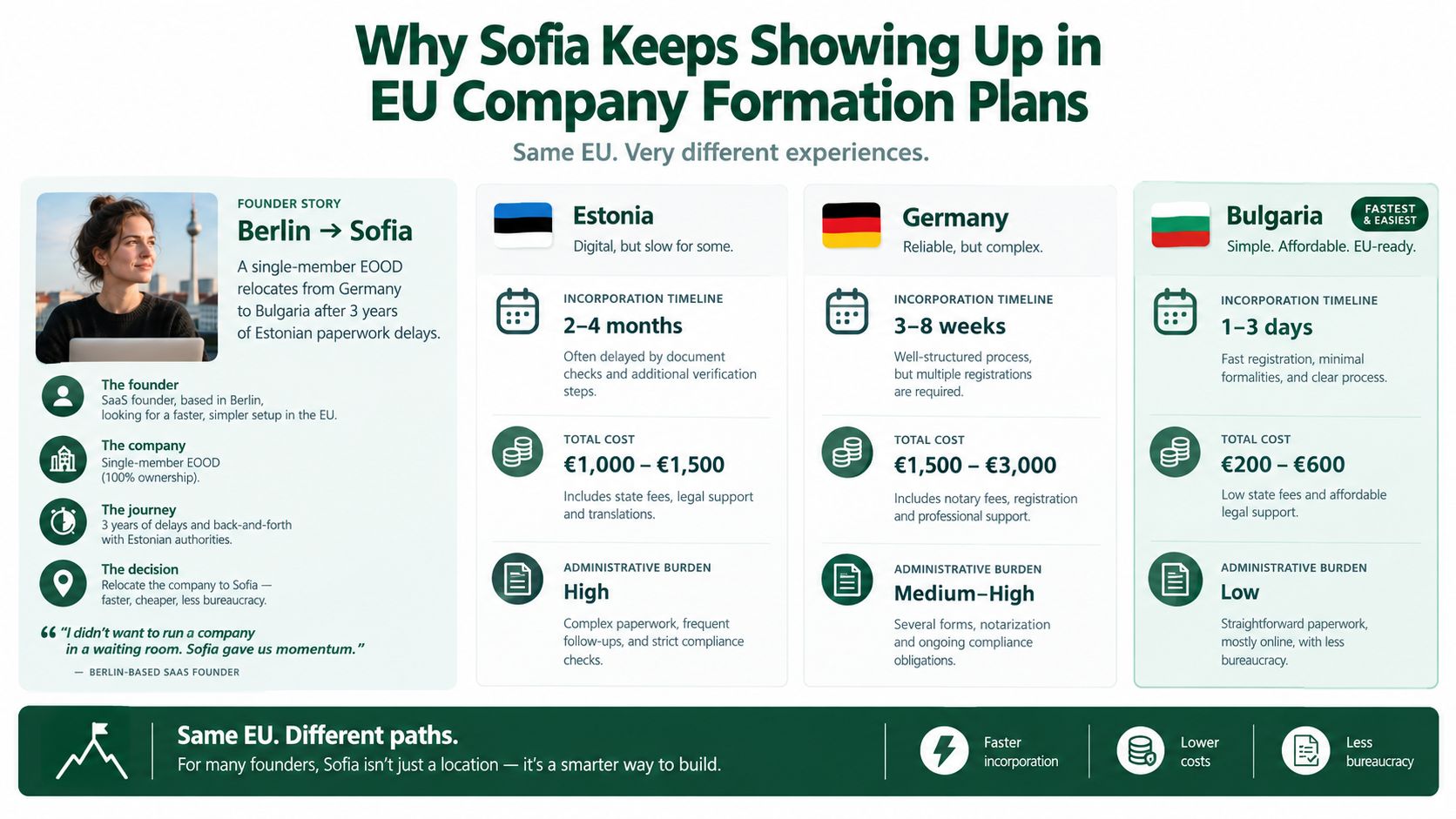
A Berlin-based SaaS founder might reach the same conclusion many non-resident entrepreneurs reach after wrestling with remote administration elsewhere. Her single-member EOOD has become cumbersome to manage from abroad, correspondence keeps moving between advisers, and the promise of a simple digital setup hasn't translated into a simple operating reality. She starts looking at Sofia, not because a capital address sounds impressive, but because the combination of tax, EU access, remote filing, and local professional support is practical.
Sofia attracts this type of founder for four reasons. Bulgaria offers a flat corporate tax regime, the country sits inside the EU single market, applications can be submitted electronically, and the capital has a broad network of accountants, lawyers, banking advisers, and address providers who routinely work with foreign owners.
The online element is more than marketing language. The EU's e-Justice guidance on Bulgarian business registration confirms that applications can be submitted online through the national portal, while the Bulgarian Ministry of Economy supports fully electronic registration where the applicant uses a qualified electronic signature.
The attraction is the combination
Sofia isn't necessarily the cheapest location in the region, and a low tax rate doesn't remove administrative obligations. Its advantage is the combined package:
- Tax efficiency: Bulgaria's statutory corporate income tax rate is 10.0% in 2026, the lowest rate shown in the cited European OECD and EU comparison.
- EU positioning: A Bulgarian company operates from an EU member state and can structure services, invoicing, and commercial relationships across the single market.
- Remote incorporation: Electronic filing and qualified electronic signatures reduce the need for a founder to travel.
- Professional depth: Sofia has advisers who understand Bulgarian filings and communicate with international founders in English.
My advice is to treat Sofia as an operational decision, not a tax-shopping exercise. Start with Bulgaria's tax rate and company setup implications, then ask whether your bank, customers, management arrangements, and document workflow support the structure. A registered address can be the right foundation, but it shouldn't be mistaken for the entire building.
What a Virtual Office in Sofia Actually Includes
A Sofia virtual office normally combines services that founders often confuse. Separate them before you compare providers.
The first layer is the registered address. This is the Sofia location recorded as the company's seat and management address in the Commercial Register. It supports the legal requirement for a real, identifiable address in Bulgaria.
The second layer is mail handling. Staff may accept letters and courier deliveries, notify you, scan documents, forward originals, or archive correspondence. The exact workflow matters more than the phrase “mail handling” in a sales brochure.
The third layer is optional workspace access. Some plans include meeting rooms, hot desks, reception services, or a local telephone number. These extras are useful if you visit Sofia occasionally, but they aren't what makes the address valid for registration.
Compare the service layers
| Feature | Basic | Standard | Premium |
|---|---|---|---|
| Registered Sofia address | Usually included | Included | Included |
| Commercial Register use | Confirm before signing | Usually included | Included with documentation |
| Mail receipt | Basic acceptance | Acceptance and notification | Acceptance, notification, scanning, and forwarding |
| Official correspondence workflow | Provider-dependent | Defined handling process | More structured handling and escalation |
| Meeting room access | Usually excluded | May be available as an add-on | Often included or available by booking |
| Workspace or hot desk | Excluded | Usually excluded | May be available |
| Phone answering | Usually excluded | Optional | May be included |
| Statutory filings | Excluded | Excluded unless separately contracted | Excluded unless separately contracted |
The address is the mandatory layer. Mail handling is the practical layer. Workspace is a credibility and convenience layer.
Don't assume that a virtual office provider acts as your registered agent, accountant, lawyer, or statutory filing representative. Those functions must be stated separately in the service agreement. The plain-language explanation of a virtual address is useful when separating address rights from the additional services a provider may sell.
Practical rule: Buy the mail workflow you need, not the reception package you won't use.
Before signing, ask how quickly scans are sent, whether original documents can be forwarded internationally, who receives restricted deliveries, and what happens when a tax or court document arrives. A cheap address with unreliable correspondence can create more risk than a properly managed standard package.
The Legal Mechanics Behind a Sofia Registered Address
Bulgarian company law treats the registered address as a formal contact point. A company must maintain a real, identifiable physical address in Bulgaria, and that address appears publicly in the Commercial Register. A P.O. box isn't sufficient, and the incorporation file must include proof that the company has the right to use the premises.
The address generally appears in the company's constitutive documents and registration application. It then becomes the location associated with official correspondence, including communications connected with tax, social security, and court matters. The Bulgarian business-register guidance from the EU e-Justice portal describes the requirement for a registered seat and address on Bulgarian territory and supports electronic submission through the national system.

What the provider must support
A competent provider should give you documentation showing your right to use the address. Depending on the structure, that may be a consent declaration, usage-rights document, or landlord-backed confirmation. Your incorporation adviser then submits it with the formation documents and the founder's identification and signature materials.
Check the address at room level. “Central Sofia business centre” is not enough. The file should identify the city, street, building, floor, and office or unit where applicable.
The same address must remain usable after incorporation. It may receive tax correspondence, social security notices, court documents, and requests connected with inspections. Provider stability therefore has legal significance. If the operator moves, loses control of the premises, or stops accepting mail, you may need to update the company record and rebuild the document trail.
The legal address also has limits. It establishes where the company can be contacted, but it doesn't prove that the company is managed, staffed, or economically active there. That distinction becomes decisive when a bank or authority asks for evidence of the business's real operating footprint.
Bulgaria Versus Other EU Jurisdictions on Tax
Bulgaria's headline corporate tax rate is clear. The country's combined statutory corporate income tax rate is 10.0% in 2026, and the cited Tax Foundation comparison places it at the lowest end of the European OECD and EU table.
The comparison becomes less simple once you examine distributions, ownership, treaties, and where management occurs. A company can have a Bulgarian registered seat and still create tax questions in another country if its decisions, people, or commercial activity are concentrated there.
A practical comparison
| Jurisdiction | Corporate Tax Rate | Dividend WHT to Non-Residents | Notes |
|---|---|---|---|
| Bulgaria | 10.0% in 2026 | Depends on recipient, treaty, and applicable exemptions | Low headline rate, but distribution and substance still require review |
| Ireland | Varies by applicable income and company profile | Depends on recipient and treaty position | The effective result depends on the type of income |
| Cyprus | Varies by applicable rules | Depends on recipient and applicable exemptions | Treaty analysis remains important |
| Netherlands | Varies by profit band and circumstances | Depends on ownership, recipient, and exemptions | Participation rules can affect the result |
| Estonia | Uses a different profit-distribution model | Depends on the distribution and recipient | Comparing only headline rates can mislead |
| Germany | Varies through combined corporate and local taxation | Depends on recipient and treaty position | Local taxation affects the overall comparison |
| United Kingdom | Varies by profit level and company circumstances | Depends on the recipient and payment structure | The company's activities and residence position matter |
The table is a decision framework, not a complete tax opinion. Bulgaria's 10% figure applies to corporate income tax. It doesn't automatically describe tax on dividends paid to a non-resident owner, personal tax, VAT, payroll, or a second country's claim over management and profits.
A worked example should therefore begin with your actual profit, ownership chain, distribution policy, and residence position. If a Bulgarian company earns profit but retains it for operations, the analysis differs from a structure that distributes all available profit to an individual owner abroad. Double-tax treaties, EU rules, participation exemptions, and withholding provisions can narrow or widen the apparent difference.
Use the lowest corporate tax rate comparison as a starting point, not as permission to ignore substance. The right question isn't “Which country has the lowest number?” It's “Where can this company be managed and documented consistently?”
Running the Whole Setup Online From Anywhere
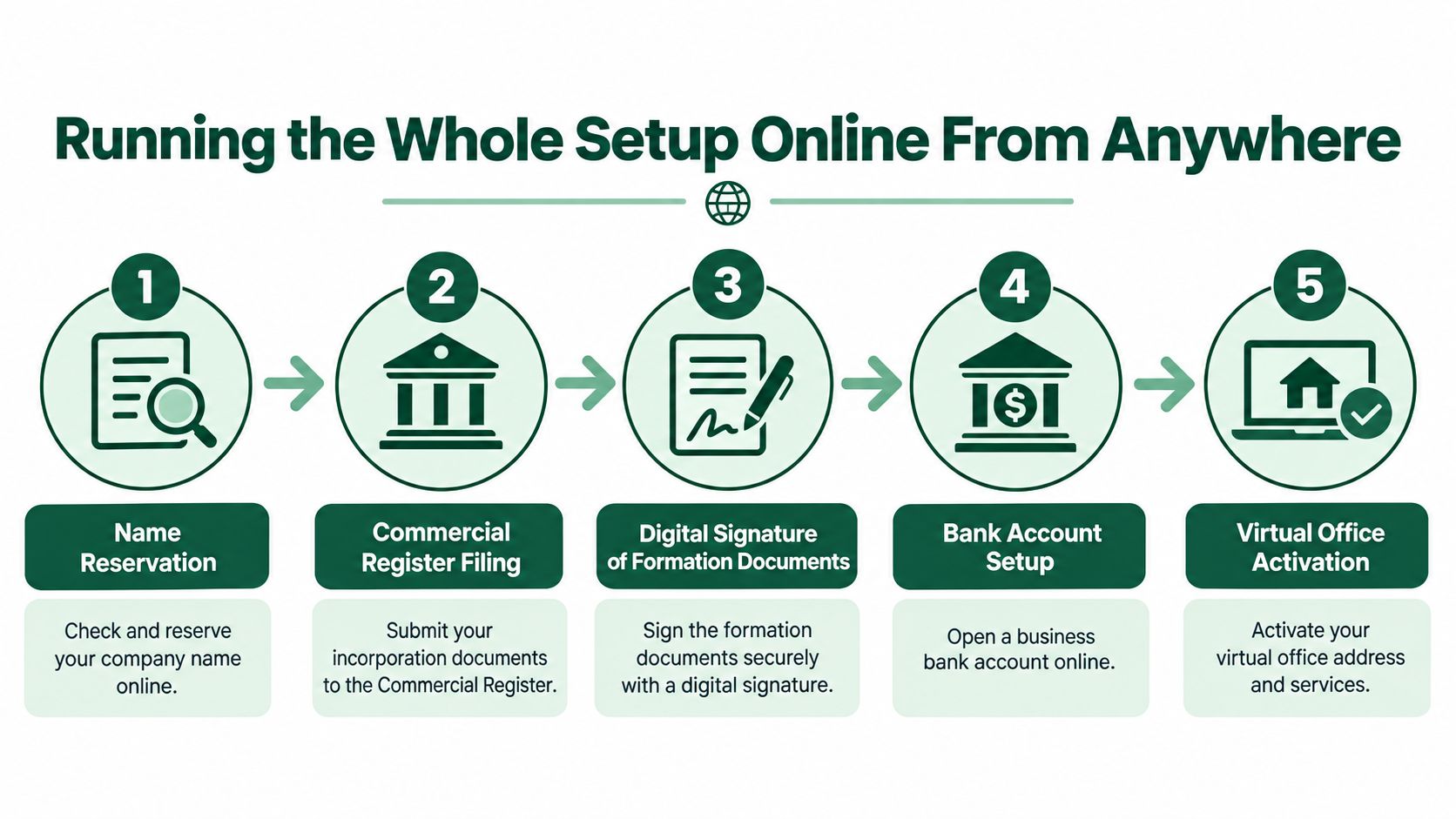
A non-resident founder can complete much of a Bulgarian incorporation remotely. The process is straightforward when the documents, identity checks, address evidence, and signature method are coordinated from the beginning.
The remote workflow
- Choose the legal form and name. Most solo founders compare an EOOD with an OOD, then confirm the proposed company name and business scope.
- Complete identity verification. The adviser checks the founder, director, and beneficial-owner information, often through a secure video process.
- Prepare the formation file. The file normally includes the constitutive documents, address evidence, declarations, identification materials, and banking or capital documentation where required.
- Sign electronically. A qualified electronic signature is used where the process permits it. The Bulgarian Ministry of Economy states that the registration application may be completed entirely electronically when the applicant has a QES.
- Submit and monitor the application. The application goes through the national registration portal, and the adviser handles follow-up requests if the registrar requires clarification.
- Activate the operating setup. After registration, the founder arranges the business account, accounting engagement, VAT work where relevant, and virtual office mail process.
What the founder still has to do
Remote doesn't mean passive. You must provide accurate ownership information, respond to KYC questions, sign documents, explain the business model, and supply evidence when a bank or authority asks for it. Some nationalities or documents may still require additional legalisation, so don't assume every file follows the same route.
The registration system supports online filing and is designed to be accessible without a visit to Sofia. That makes the process easy in a practical sense, but the quality of the result still depends on precise documents and a provider that understands non-resident ownership.
The workflow is usually measured in working days rather than requiring an extended physical presence, but no responsible adviser should promise approval without reviewing nationality, ownership, document quality, and business activity first.
For a visual overview of the process, watch the following introduction:
Where a Virtual Office Stops Being Enough
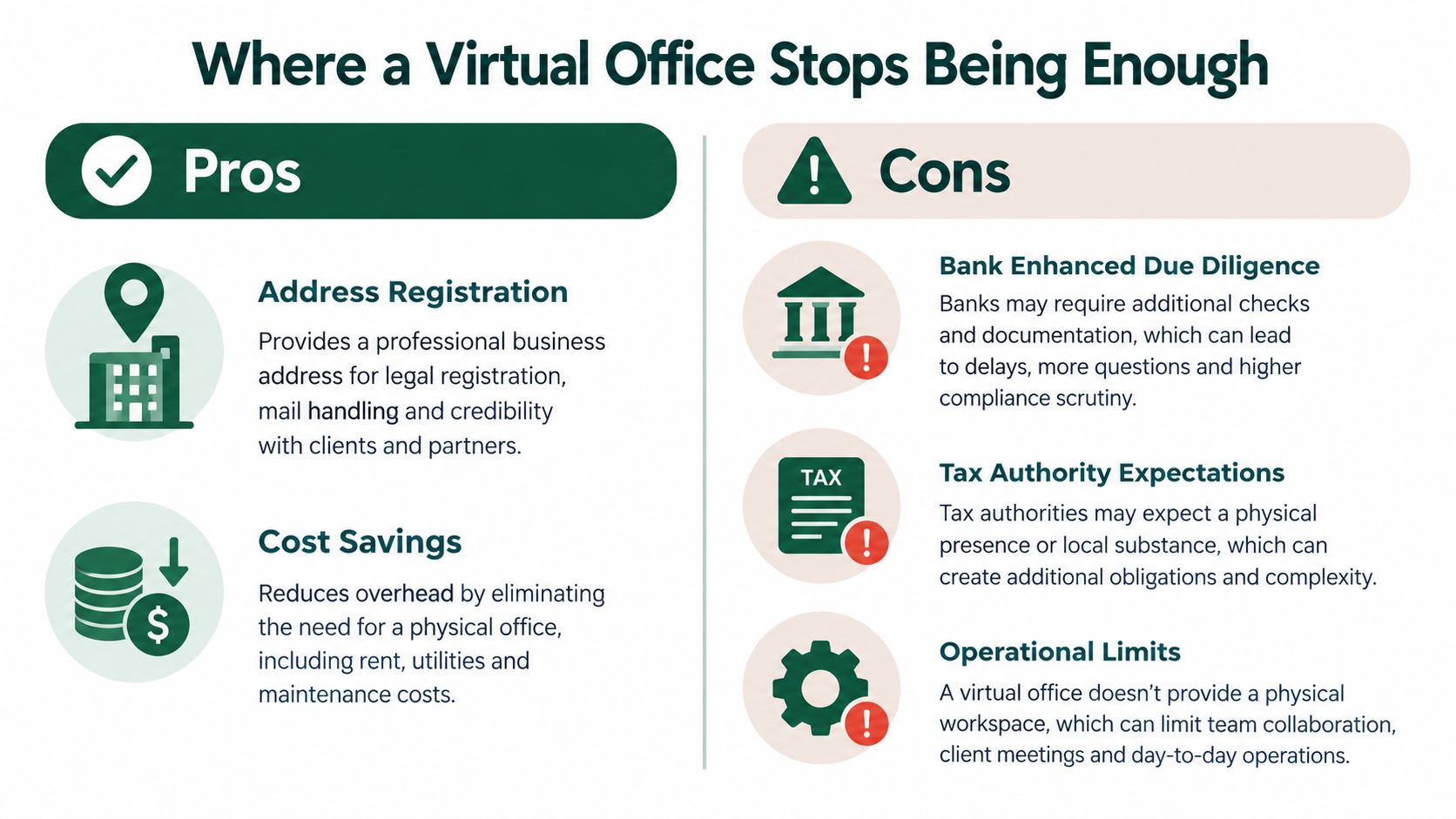
A registered address solves registration. It does not guarantee a bank account, tax acceptance, or commercial credibility.
Banks assess the people behind a company, the business model, expected transactions, customers, source of funds, and management arrangements. A foreign director and beneficial owner using only a Sofia address may face additional questions because the bank wants to understand where decisions are made and how the company operates.
Registered seat versus management reality
The registered seat is the company's formal legal address. The management address and actual place of decision-making describe a different practical question. A provider can supply a compliant registered address without creating employees, local management, premises under your control, or evidence of business activity.
That gap matters for SaaS companies, e-commerce businesses, and consultancies. A bank may ask for contracts, invoices, customer information, website details, projected transactions, and evidence that the director understands the company's operations. A tax authority may also ask why a Bulgarian company exists if all commercial decisions and activity appear to happen elsewhere.
Mail failure is a compliance failure
If nobody reliably accepts and scans official documents, the company can miss deadlines even when the address itself is valid. Ask whether the provider has staff present, how restricted deliveries are handled, whether scans are sent on the day of receipt, and how original documents are stored or forwarded.
VAT obligations for cross-border sales can also require a wider operating explanation. A virtual address may support registration paperwork, but it doesn't replace correct VAT analysis, transaction records, customer evidence, or the management arrangements behind the business.
Choose a coworking or serviced office when you need regular meetings, local staff, controlled access to premises, or a credible place for business activity. For a fully remote founder who only needs registration and dependable correspondence, a virtual office can be sufficient. For a business seeking local substance, it is only one component.
How Different Founders Put a Sofia Virtual Office to Work
The right package depends on what the company does. Four founders can use the same type of Sofia address for completely different reasons.
The direct-to-consumer e-commerce founder
A Shopify founder may keep inventory in the EU, use a German warehouse, and sell to customers across several markets. Sofia can provide the registered seat and a controlled channel for official correspondence, while the warehouse and logistics partner handle fulfilment.
This founder needs address documentation, dependable mail scanning, and VAT coordination. A meeting room is probably irrelevant. The provider should also understand that the Bulgarian address doesn't turn the German warehouse into a Bulgarian operation.
The B2B SaaS founder
A SaaS company with a remote engineering team in several countries may use Sofia for incorporation and EU-based billing administration. The founder might book a meeting room during occasional business travel, but the company's real substance remains distributed across its team and contracts.
The priority is a clean ownership file, clear banking narrative, and consistent accounting records. Optional workspace access helps with meetings, but it isn't evidence of local management by itself.
The solo management consultant
A consultant issuing invoices to EU clients usually values simplicity. The registered seat supports company administration, while a weekly mail digest gives the owner a predictable review cycle.
This arrangement works only if the consultant keeps decision-making, contracts, invoices, bookkeeping, and personal tax obligations aligned. The address can support the structure, but it can't conceal where the consultant performs the work.
The cultural tour operator
A Balkan wine-tour company may need a local address for supplier contracts and bank onboarding, then use the address as an administrative anchor while guides, customers, and suppliers move across borders.
This founder benefits from bank-ready address documents, mail forwarding, and occasional meeting access. The provider should understand the difference between a local commercial presence and a company that merely receives mail in Sofia.
The strongest virtual-office setup matches the company's operating story. If your documents, bank application, website, and correspondence describe different realities, the address won't rescue the application.
A Founder Checklist Before You Sign With a Sofia Provider
Use this list before paying for a Sofia virtual office. Ask for documents and written answers, not verbal reassurance.
- Confirm registration eligibility: Verify that the exact address can be used for company registration, including the building, floor, and office number.
- Request proof-of-address evidence: Ask for a sample document suitable for a bank, and check its language, format, signing method, and issue date.
- Test the mail protocol: Confirm when scans are made, how forwarding works, who signs for restricted deliveries, and how urgent notices are escalated.
- Separate bundled services: Ask whether VAT registration, accounting, Apostille assistance, and document legalisation are included or charged separately.
- Clarify electronic signing: Confirm which documents require a QES, how identity verification works, and whether the provider can witness signing online or in person.
- Inspect the contract: Require a bilingual agreement with clear renewal, cancellation, forwarding, storage, and address-change terms.
- Avoid unnecessary lock-in: Check whether the agreement continues beyond the initial term and how quickly you can move to another address.
- Ask about banking support: Request the exact documents the provider supplies for bank onboarding, then ask whether those documents reflect the company's real management arrangements.
- Check operational fit: Decide whether you need only an address, full mail handling, meeting rooms, or a serviced office.
- Request relevant references: Ask for two recent non-resident founder references in a comparable sector before committing funds.
The best provider is the one that answers these questions precisely. If the salesperson focuses only on a prestigious address and a low monthly fee, keep looking.
FastCorp offers Bulgarian EOOD and OOD incorporation, a Sofia registered business address, remote document signing, EU VAT setup, banking assistance, and ongoing accounting and compliance support. Visit FastCorp to discuss a virtual office structure that matches your registration, banking, and operational requirements.