EU VAT Rate Explained and Compared Across Europe
Compare EU VAT rate by country, why rates differ and what it means for business. Covers standard and reduced rates, OSS and place of supply.
You've launched a subscription, shipped products to several EU countries, or started invoicing clients from abroad. Then a customer asks why their invoice includes one VAT rate while another customer's invoice shows a different one. You check a country table, find a plausible percentage, and discover too late that the customer's location, product category, transaction type, and sales threshold matter more than the country where your company is registered.
That's the trap behind the phrase EU VAT rate. The EU doesn't use one universal rate, and founders can't choose a low-rate country to apply that rate to every sale. A practical setup starts with the correct legal structure, then maps each transaction to the right place-of-supply rule.
This guide gives you a usable comparison of standard and reduced rates, explains why they differ, shows how 2025 and 2026 reforms affect invoices, and turns OSS and threshold rules into a straightforward operating process. Everything can be handled online, and tax comparison with other countries can help you choose a sensible base without confusing corporate tax planning with customer VAT treatment.
Table of Contents
- Introduction to EU VAT Rates for Growing Businesses
- How EU VAT Rates Work and Why They Differ
- EU VAT Rates Compared Across Member States
- What Recent VAT Changes Mean for Your Invoicing
- Place of Supply Rules OSS and Distance Selling Explained
- Real World Use Cases for Different Business Models
- Choosing Your EU VAT Setup and Next Steps Online
Introduction to EU VAT Rates for Growing Businesses
Consider a non-resident founder selling a digital planning tool from an EU company. The company has customers in Germany, France, and Spain. The founder assumes the company's domestic VAT rate belongs on every invoice, but consumer sales of electronically supplied services often follow the customer's location. A second founder, selling physical goods, may face a different result because transport, customer status, and the distance-selling threshold shape the treatment.
The first founder needs a reliable tax decision, not a copied table. The second needs an invoice system that distinguishes domestic sales, intra-EU business sales, and consumer orders. Both need records that support the rate applied and a filing method that doesn't force them to manage every country manually.
The EU framework is harmonized, but the actual rates remain national. Each Member State sets its standard rate within common legal boundaries, and national governments can provide reduced or special treatment for eligible categories. That means a country table is useful for orientation, but it isn't a VAT calculation engine.
The comparison that matters
Start with three questions:
- What are you selling? A physical product, SaaS subscription, consultancy, accommodation service, and restaurant meal may not share the same treatment.
- Who's buying? A consumer and a VAT-registered business can trigger different invoicing rules.
- Where is the customer located? For many cross-border B2C supplies, destination-country VAT applies.
The rate you charge can therefore differ from the rate in your company's home country. This is why founders should separate company location, VAT registration location, and place of supply. They're related, but they're not interchangeable.
Advisor's view: Use a country table to shortlist jurisdictions and test pricing. Use place-of-supply rules to issue the invoice.
The online execution is manageable. An accounting platform can store customer evidence, classify products, apply tax rules, and export return data. OSS can consolidate eligible EU consumer sales into one electronic filing route, which removes much of the administrative friction. The setup becomes easy when you design the workflow before the first cross-border order, rather than fixing invoices after sales begin.
How EU VAT Rates Work and Why They Differ
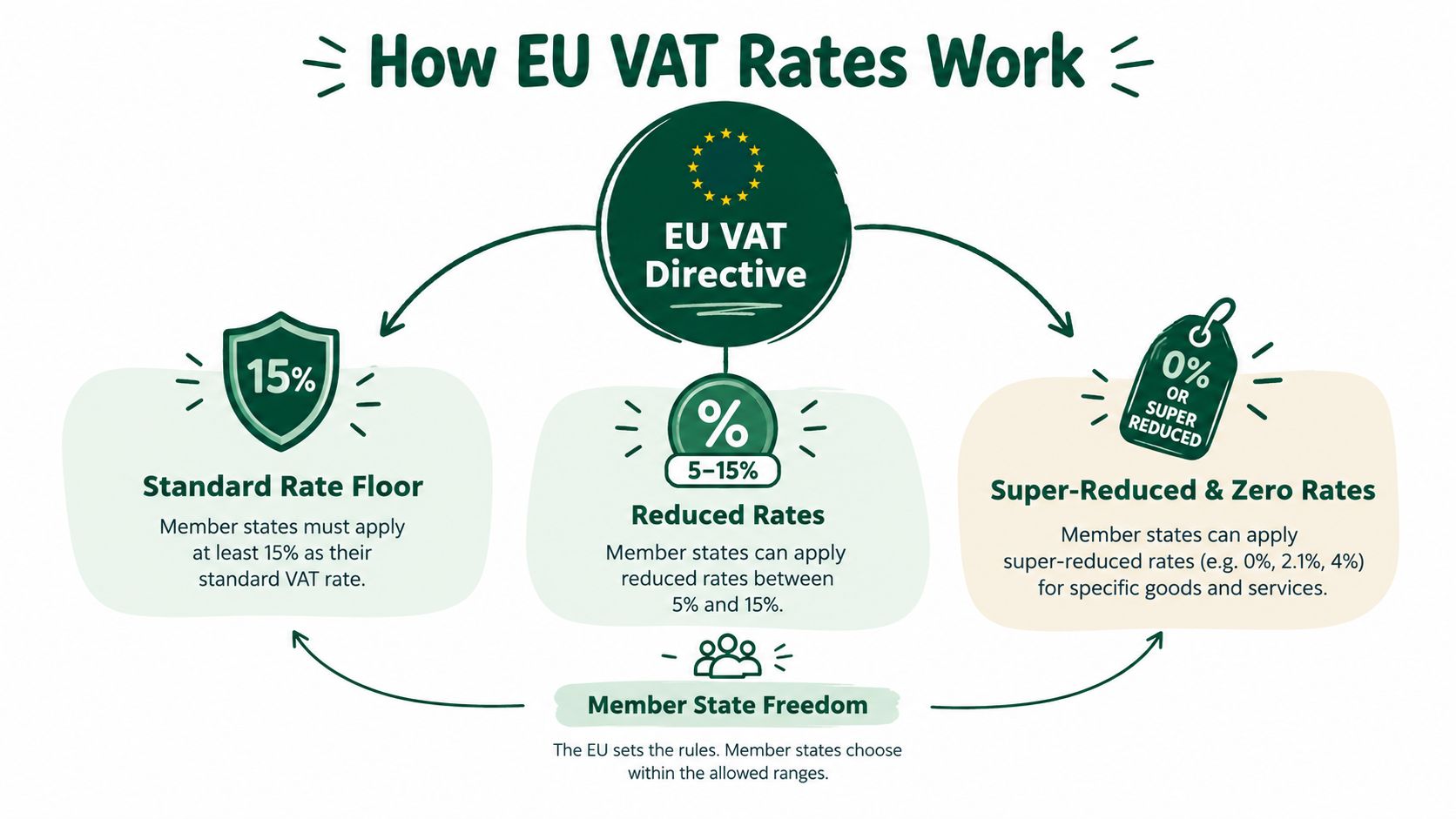
The EU's VAT system balances common rules with national discretion. The VAT Directive requires every Member State to apply a standard rate, but it doesn't impose one identical percentage across the Union. Article 97 of Directive 2006/112/EC set a minimum standard rate of 15% for 1 January 2006 to 31 December 2010, and the European Commission confirms that the standard rate still can't be below 15% today in its explanation of VAT rate rules under the VAT Directive.
That floor creates a shared boundary, not a shared rate. Governments use VAT policy to influence consumption, support selected sectors, or preserve historical treatments. The result is a market where standard rates tend to sit in the low-to-mid 20s, while reduced, super-reduced, and zero rates depend heavily on national implementation.
Why reduced rates create operational complexity
Reduced rates aren't a general discount that a business can apply whenever a product feels essential. Eligibility depends on the national rules and the category covered. Food, books, medicines, transport, hospitality, and other specified supplies can receive different treatment, and the same broad category can split into several subcategories.
The 2022 reform widened Member State flexibility on reduced, super-reduced, and zero rates. That policy flexibility gives governments more room to adjust their VAT base, but it also creates more exceptions for founders to track. A food retailer, hospitality operator, or SaaS company selling digital publications needs product-level tax logic, not a single default rate.
The policy argument is also different from the compliance reality. Governments may use reduced rates for social or economic objectives, but each additional rate complicates product classification, invoice configuration, reporting, and audit support. A founder may price a service correctly and still issue an incorrect invoice if the tax code in the billing system is outdated.
What the average tells you
The 2026 EU average standard VAT rate was 21.9%, according to Tax Foundation's 2026 European VAT rate overview. That average helps benchmark a business model, but it doesn't tell you what to charge on a specific transaction.
Treat the average as a planning reference. Treat the applicable national rate and product rule as the compliance answer.
EU VAT Rates Compared Across Member States
The EU has no single VAT rate. In 2026, standard rates ranged from 17% in Luxembourg to 27% in Hungary, with a 21.9% EU-wide average, while the legal floor remains 15%. The table below gives a practical reference for standard rates and listed reduced rates. Confirm the product-specific treatment before configuring invoices, especially in sectors affected by national reforms.
| Member State | Standard Rate | Reduced Rates | Notes |
|---|---|---|---|
| Austria | 20% | 10%, 13% | Product category determines eligibility |
| Belgium | 21% | 6%, 12% | Some special treatments may apply |
| Bulgaria | 20% | 9% | Verify the exact supply |
| Croatia | 25% | 5%, 13% | Multiple reduced categories |
| Cyprus | 19% | 5%, 9% | Category-specific application |
| Czech Republic | 21% | 12% | Confirm current classification |
| Denmark | 25% | None listed | Standard treatment is broadly used |
| Estonia | 24% | 9%, 13% | Rate updates require monitoring |
| Finland | 25.5% | 10%, 13.5% | Reduced rate changed in 2026 |
| France | 20% | 5.5%, 10% | A 2.1% super-reduced rate exists for selected supplies |
| Germany | 19% | 7% | Restaurant food treatment changed in 2026 |
| Greece | 24% | 6%, 13% | Regional rules may require review |
| Hungary | 27% | 5%, 18% | Highest standard rate in the EU range |
| Ireland | 23% | 9%, 13.5% | Selected super-reduced and zero rates exist |
| Italy | 22% | 5%, 10% | A 4% super-reduced rate exists for selected supplies |
| Latvia | 21% | 5%, 12% | Product-specific |
| Lithuania | 21% | 5%, 12% | Reduced-rate treatment changed in 2026 |
| Luxembourg | 17% | 8% | A 3% super-reduced rate and 14% parking rate exist |
| Malta | 18% | 5%, 7% | A 12% intermediate rate applies narrowly |
| Netherlands | 21% | 9% | Reduced-rate treatment changed in 2026 |
| Poland | 23% | 5%, 8% | Product-specific |
| Portugal | 23% | 6%, 13% | Product and region can matter |
| Romania | 21% | 11% | Standard rate changed in August 2025 |
| Slovakia | 23% | 5%, 19% | Multiple treatments require classification |
| Slovenia | 22% | 5%, 9.5% | Product-specific |
| Spain | 21% | 10% | A 4% super-reduced rate exists for selected supplies |
| Sweden | 25% | 6%, 12% | Product-specific |
The most important comparison is the spread. Luxembourg's standard rate is the lowest listed, while Hungary's is the highest. Germany and Cyprus sit below the 2026 average, whereas Finland, Croatia, Denmark, and Sweden sit above it. That difference affects consumer-facing pricing, but it doesn't automatically determine the rate for cross-border sales.
The headline country rate is only the starting point. The decisive question is which rate applies to the product, customer, and place of supply.
A Bulgarian company, for example, may have a 20% domestic standard rate, while a qualifying cross-border B2B invoice may use reverse charge rather than charging Bulgarian VAT. A consumer sale may require destination-country VAT once the applicable conditions are met. For a second country-by-country reference, consult VAT rates in EU countries, then verify the exact supply classification before publishing prices.
What Recent VAT Changes Mean for Your Invoicing
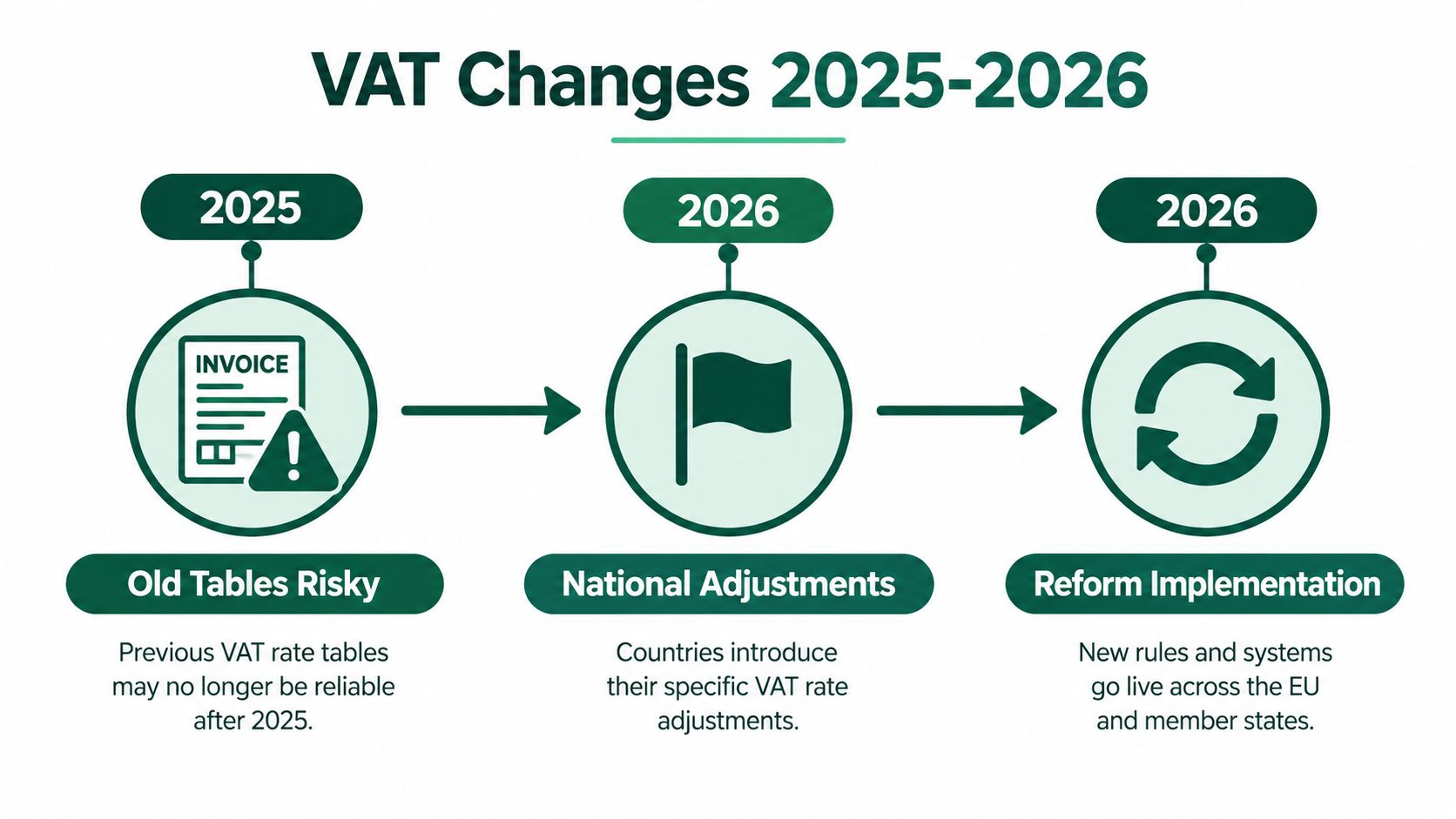
Static VAT tables are dangerous because national governments revise rates and categories while online content remains unchanged. A founder who downloads a spreadsheet, loads it into an ERP, and never reviews it can issue invoices with an obsolete tax code even when the company's sales process hasn't changed.
Recent changes illustrate the problem. Romania raised its standard rate from 19% to 21% in August 2025. Germany moved restaurant food to 7% in 2026, Finland lowered a reduced rate to 13.5% in 2026, and the Netherlands and Lithuania reshaped reduced-rate treatment in 2026, as documented in Numeral's EU VAT rates guide. These aren't theoretical table updates. They can change checkout totals, invoice lines, credit notes, and margin calculations.
Build a rate-change control process
Your invoicing process should handle both rate changes and effective dates. A change can affect orders issued before implementation, invoices issued afterward, refunds tied to earlier transactions, and subscriptions that renew automatically.
Use a simple operating routine:
- Assign ownership: Someone must review official and professional VAT updates for every country where you charge VAT.
- Version tax codes: Keep effective dates in your billing system instead of overwriting an old rate.
- Test checkout logic: Run domestic, B2B, and B2C test transactions after a change.
- Reconcile returns: Compare invoice tax totals with the figures prepared for VAT returns.
- Document classification: Save the rationale for reduced-rate treatment and customer-location evidence.
The compliance gap was still around 19% of theoretical VAT revenue in 2022, according to the European Parliament information cited by Numeral. That figure underlines a practical point for founders: enforcement and collection remain imperfect, so clean internal records still matter. You shouldn't treat gaps in enforcement as permission to take shortcuts.
Protect SaaS and hospitality workflows
SaaS businesses need tax rules connected to customer location and product classification. Hospitality operators need invoice and point-of-sale systems that distinguish restaurant food from other supplies when national rules change. E-commerce sellers need their marketplace, checkout, shipping, and accounting records to agree.
A good system doesn't merely store a rate. It stores the reason the rate applies, the transaction date, customer status, destination, and supporting evidence. That approach makes corrections faster and gives your accountant a defensible audit trail.
Place of Supply Rules OSS and Distance Selling Explained
The correct eu vat rate comes from the transaction map, not from your company's registered address. Begin by identifying the customer as B2B or B2C, then determine the type of supply and the customer's location. For many cross-border B2C sales, the destination principle controls; qualifying intra-EU B2B supplies can use reverse charge or zero-rating when the customer has a valid VAT number.
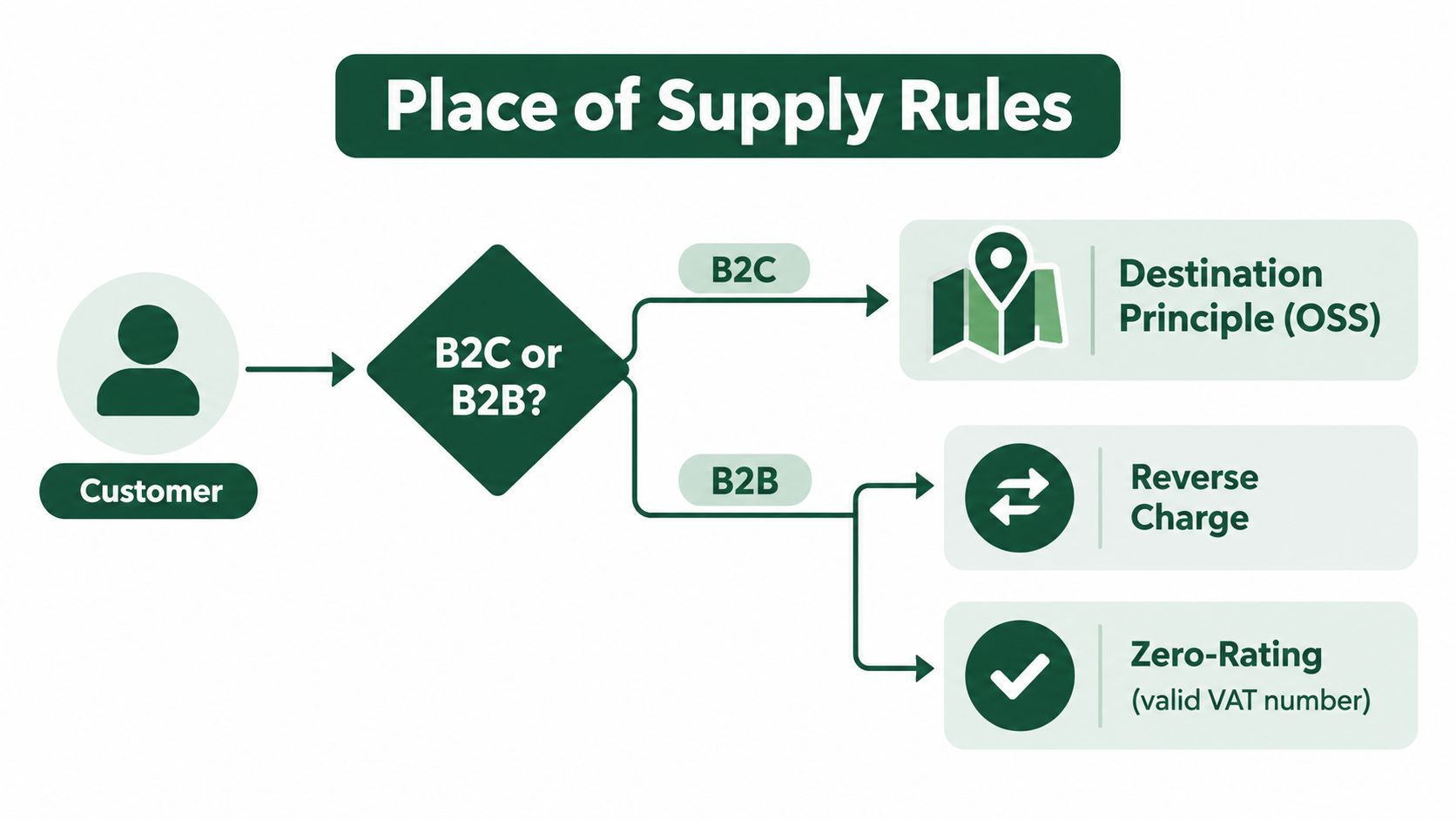
Use this decision matrix
| Sale type | First check | Typical VAT direction | Practical action |
|---|---|---|---|
| Domestic sale | Supplier and customer are in the same Member State | Domestic VAT rules | Apply the correct national product rate |
| Intra-EU B2B | Customer has a valid VAT number | Reverse charge or zero-rating may apply | Validate the number and show the required invoice wording |
| Intra-EU B2C goods | Customer destination and annual threshold | Destination-country VAT may apply | Track customer location and distance sales |
| TBE service to a consumer | Customer location and annual threshold | Destination-country VAT may apply | Retain location evidence and configure destination rules |
| Imported goods | Import status and VAT point | EU import VAT applies | Include import treatment in landed-cost and checkout logic |
For cross-border B2C e-commerce, the EU uses a 10,000 EUR annual threshold. Below it, distance sales and telecommunications, broadcasting, and electronically supplied services, known as TBE services, can be taxed in the supplier's Member State. Above it, the destination-country VAT rate applies, usually requiring compliance in the customer's market, as explained by Your Europe's cross-border VAT guidance.
Make OSS your default for eligible consumer sales
The One Stop Shop, or OSS, lets an eligible seller register in one Member State and declare and pay VAT for EU-wide distance sales through that registration. The Commission describes the process as an electronic system using a quarterly return for sales to final consumers across the EU in its OSS guides.
That means the seller can handle the eligible consumer reporting online instead of creating a separate manual workflow for every destination. OSS doesn't let you choose the rate. It centralizes declaration and payment while you still apply the destination country's correct rate.
For a practical checklist covering registrations and periodic obligations, review VAT filing requirements. Keep customer-location evidence, VAT number checks, invoices, marketplace reports, and OSS calculations together. Also remember that all imported goods into the EU are subject to VAT because the 22 EUR low-value import exemption was removed.
Real World Use Cases for Different Business Models
The same eu vat rate question produces different answers for different business models. A founder shipping goods, selling SaaS, or billing professional clients shouldn't use the same configuration because all three businesses have EU customers.
E-commerce seller shipping across the EU
A Bulgarian online retailer selling physical goods to consumers across the EU should separate domestic orders from cross-border distance sales. The seller needs product classification, destination data, threshold monitoring, and an OSS workflow once destination-country treatment applies.
The practical setup is a tax matrix connected to the checkout. It should pass the customer's country, shipping destination, product code, and order date into the invoice. Marketplaces can add another reporting layer, so reconcile marketplace VAT data with your accounting records rather than assuming the platform's calculation is complete.
SaaS serving consumers and businesses
A SaaS founder faces a sharp split between customer types. A consumer subscription generally requires destination analysis for electronically supplied services, while an intra-EU sale to a VAT-registered business may qualify for reverse charge if the customer's VAT number is valid.
For SaaS, customer verification and location evidence deserve the same attention as the subscription price.
Store the customer's billing details, VAT number where applicable, and the evidence used to establish location. Don't apply a reduced rate because the software supports education, health, or productivity. The product's legal classification controls.
Freelancer billing EU clients
A freelancer invoicing an EU business should first confirm whether the client is VAT registered and whether the service falls under the applicable B2B place-of-supply rule. A valid VAT number can support a reverse-charge treatment, but the freelancer still needs accurate invoice wording, records, and reporting.
A consumer client requires a different analysis. Don't copy the treatment from your B2B template, and don't assume the client's country is irrelevant because your company is established elsewhere.
Agency opening a Sofia presence
An agency expanding into Sofia may consider Bulgaria's 10% corporate tax regime, but corporate tax and customer VAT are separate decisions. A Bulgarian company's domestic VAT setup can be efficient to administer online, yet the agency still needs to determine where each service is supplied and whether the customer is a business or consumer.
Structure choice should serve operations. If the agency needs an EU company, local administration, banking support, and ongoing filings, a Bulgarian base can be worth evaluating. It won't eliminate destination-country VAT where the rules assign VAT to the customer's market.
The core differentiator across all four models is not the lowest table percentage. It's the ability to classify transactions correctly, preserve evidence, update rates quickly, and file through the appropriate channel.
Choosing Your EU VAT Setup and Next Steps Online
Choose your VAT base by matching substance, customers, products, and administration, not by chasing a headline rate. Bulgaria deserves a place on the shortlist for founders who want an EU company, online administration, EU-compliant VAT handling, and access to its 10% corporate tax regime. A higher-rate jurisdiction may still make sense if your management, staff, inventory, or customers are concentrated there.
Use this implementation checklist:
- Map transactions: Separate domestic, intra-EU B2B, intra-EU B2C, TBE services, imports, and exports.
- Classify products: Document the VAT category for each product or service.
- Configure invoices: Add customer-country logic, VAT number validation, reverse-charge wording, and effective dates.
- Assess OSS: Register where eligible and connect the return data to your bookkeeping.
- Set a review calendar: Check rate changes, reduced-rate categories, thresholds, and filing deadlines.
- Verify before launch: Test invoices and checkout outputs with an accountant or VAT adviser.
The European Commission says OSS can reduce red tape by up to 95% for cross-border e-commerce sellers because a business can register once and use a single electronic return to declare and pay VAT for EU consumer sales in one Member State, as described on the European Commission OSS portal.
FastCorp offers Bulgarian company formation, EU VAT registration, banking assistance with an EU IBAN, virtual office services, bookkeeping, VAT returns, and ongoing compliance through an online workflow. The company states that online setup can be completed in 3 to 5 working days, so founders can coordinate incorporation and VAT preparation without travel. Review the VAT registration requirements before choosing the setup route.
FastCorp can help you set up a Bulgarian EU company, coordinate VAT registration, arrange banking support and a virtual office, and manage ongoing VAT filings online. Visit FastCorp to discuss your business model, customer locations, and the VAT workflow you need before your first cross-border invoice.