Offshore Company in Europe: A Practical 2026 Guide
Learn what an offshore company in Europe really means in 2026, compare EU tax regimes, and follow practical advice for compliant, fully online incorporation.
You're sitting in Dubai with customers across Europe, and your current free-zone company is starting to create friction. A European client wants an EU VAT number. A payment provider wants a familiar company profile. Your accountant warns that the country with the lowest advertised tax rate may create the biggest residency and substance problem later.
That's the offshore company in Europe decision in 2026. It isn't a search for secrecy or a zero-tax island. It's a choice between tax efficiency, EU access, banking credibility, remote administration, and the annual cost of maintaining genuine compliance. My recommendation is straightforward: choose an EU jurisdiction when your customers, payment flows, staff, or investors touch Europe, and judge the structure by its operational burden rather than its headline tax rate.
Table of Contents
- What Founders Mean When They Say Offshore in Europe
- How Offshore-Style Company Formation Works in the EU Today
- Comparing the Most Common EU Jurisdictions Side by Side
- Substance, AML, and BEPS Rules You Cannot Ignore
- EU Company Versus Classic Non-EU Offshore Centers
- A Practical Walkthrough of Going Fully Online
- Choosing the Right Setup and Planning the Next 12 Months
What Founders Mean When They Say Offshore in Europe
A founder in Dubai may compare a UAE free-zone company with a Bulgarian EOOD, an Irish private company, or an Estonian OÜ. Calling all four “offshore” hides the decision that matters: which structure provides the required market access and tax treatment without creating an unmanageable compliance burden?
In Europe, offshore usually means an EU-based company that combines tax efficiency with a credible legal environment and remote-friendly administration. It does not mean invisibility. The entity remains subject to beneficial-owner transparency, anti-money-laundering controls, tax reporting, and information exchange. For a non-resident who never wants to fly, the practical test is whether incorporation, banking, accounting, filings, and ongoing governance can be handled remotely.
Europe's offshore architecture is concentrated in established financial centres. A European Parliament study overview identified Luxembourg, Ireland, the Netherlands, the United Kingdom, Switzerland, and other centres as channels for a disproportionate share of cross-border corporate offshore investment. The research also cited about US$2.6 trillion in offshore financial wealth held by Europeans, roughly US$78 billion in annual tax revenue losses, and 17,973 offshore entities in the UK, 10,877 in Luxembourg, and 6,374 in Cyprus in the Panama Papers context. Those figures describe the scale of offshore activity, not a promise that any jurisdiction offers secrecy or zero tax.
Three structures founders commonly confuse
Traditional non-EU centres include the BVI, Seychelles, and Panama. They can suit a narrow holding purpose, yet trading with European customers may bring more banking, payment-processing, and reputation friction. Choose one only when its specific legal or ownership function justifies that friction.
EU low-tax regimes include Bulgaria, Ireland, Cyprus, and Estonia. They operate within EU legal and reporting frameworks and can provide practical access to VAT systems, EU customers, payment providers, and commercial counterparties. Bulgaria is the benchmark I use for a straightforward low-tax EU setup, provided the founder accepts accounting, filings, substance expectations, and the need to document where management takes place.
Conduit hubs route investment through an established financial system rather than holding assets directly. Research published by the Bank for International Settlements identified the Netherlands, the United Kingdom, Ireland, Switzerland, and Singapore as key conduit jurisdictions for global corporate offshore investment. It reported that Luxembourg and Ireland together managed about 40% of cross-border equity and bond holdings, with fund assets of roughly €7.5 trillion, compared with about €2 trillion in Germany and €240 billion in Italy.
Practical rule: If you need an EU VAT number, an EU IBAN, European customers, or investor confidence, “offshore” should mean remote and tax-efficient, not hidden.
My working definition is simple: an offshore-style European company is a transparent EU entity chosen for its tax mechanics, market access, and manageable administration. Compare total annual cost, not just the tax rate. The structure must match where decisions are made, where people work, and where the business earns its income.
How Offshore-Style Company Formation Works in the EU Today
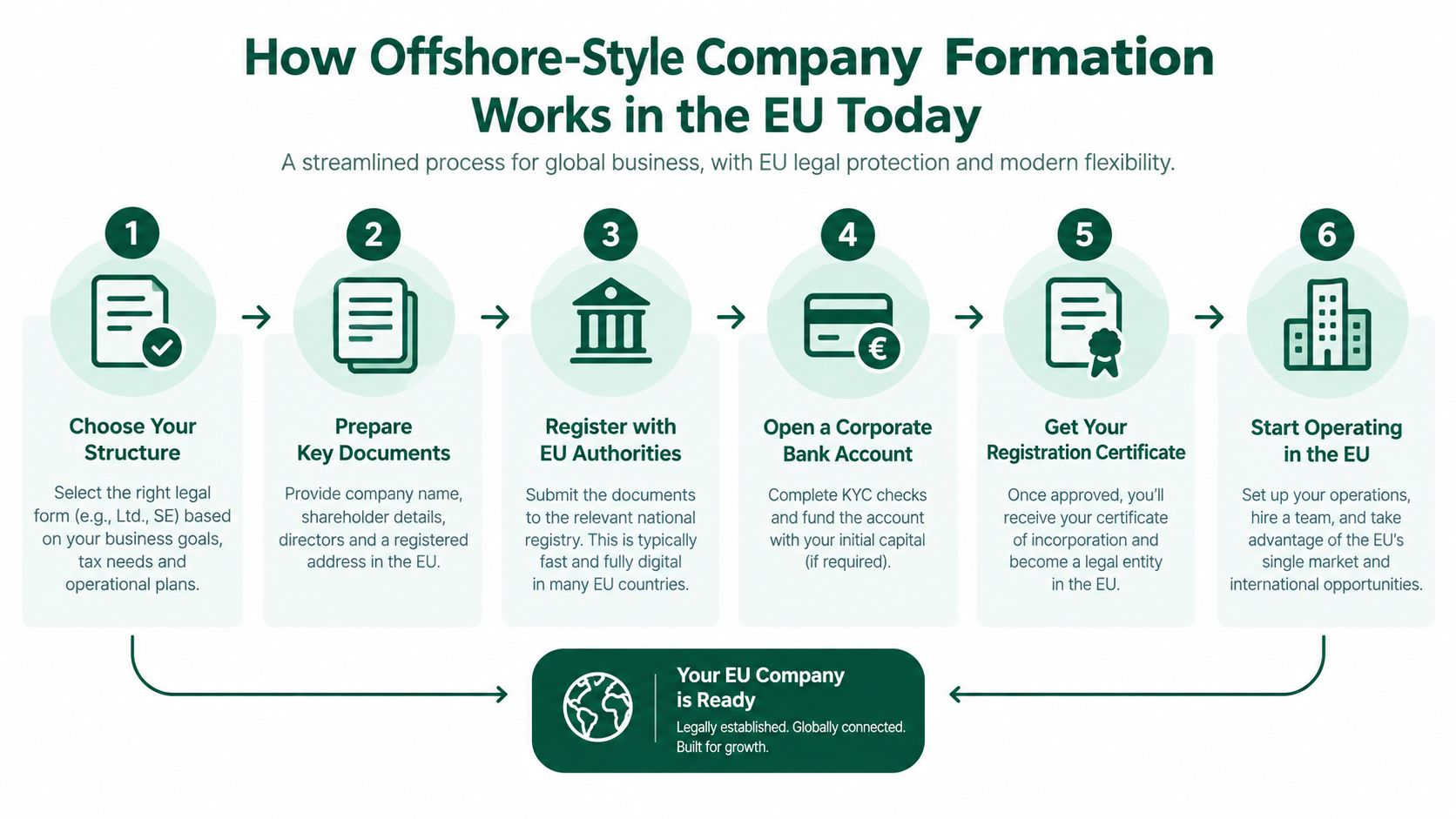
A non-resident founder can form an EU company without flying to the country, but remote incorporation is a regulated process. The formation provider, registry, bank, and tax authority each review different information. Bulgaria is the practical low-tax benchmark, provided the founder can document the business, its management, and its ongoing accounting.
The procedural framework usually covers six areas:
Choose the legal form and jurisdiction. Options may include a Bulgarian EOOD, Irish Private Limited Company, Estonian OÜ, Dutch B.V., or Cypriot Ltd. The decision should follow ownership, management, expected activity, profit distribution, and substance requirements. A low headline tax rate does not settle the question. Annual accounting, filings, registered-office services, banking, and local representation can determine the actual cost.
Assemble the identity file. The registry or agent may request a passport, proof of address, company details, and ownership information. Depending on the jurisdiction and document origin, identity documents or criminal-record certificates may need notarisation, apostilles, translation, or certification.
Pass KYC and source-of-funds review. The beneficial owner must explain the business model, expected transaction flows, customers, suppliers, and funding source. Banks and licensed providers also assess the proposed activity and risk profile. A polished website supports the application, but it cannot replace credible commercial evidence.
Meet registered-office and representation rules. The company needs a registered address. Local law may also require a legal representative, director, tax representative, or company secretary. A virtual office meets an address requirement only. It does not prove that management or operations take place there.
Execute and submit formation documents. Remote identity verification, eIDAS-qualified signatures, and electronic filing can remove the need for travel in standard cases. Unusual ownership structures, notarised resolutions, or registry-specific requirements may still call for original documents or assistance from a local professional.
Treat tax, VAT, and banking as separate workstreams. Incorporation creates the legal entity. It does not guarantee an EU IBAN, VAT approval, banking acceptance, or tax residence in the chosen country. The founder must align the company's tax position with where decisions are made, where work occurs, and where revenue arises.
What “fully online” covers
The European Commission-linked EU Inc. model describes digital incorporation without physical presence or a notary appointment. Its framework uses standard identity and company information, passport and address evidence, digital passport and selfie checks, and a €1 minimum share capital.
That framework shows the direction of EU company formation, not the exact rules of every national registry. A Bulgarian company may still require apostilled documents, translated records, or a representative who handles local filings.
VAT can provide meaningful operational access. One EU VAT registration may support the One Stop Shop, with one return covering distance sales across all 27 EU member states, as explained in this European company formation guide. Eligibility and filing duties depend on the activity and applicable thresholds.
Online formation reduces travel and administration, but it does not eliminate compliance. The founder still needs a defensible structure, complete records, and evidence that the company's substance matches its stated business.
Comparing the Most Common EU Jurisdictions Side by Side
The lowest corporate tax rate rarely produces the lowest total cost. A structure that requires extra directors, extensive bank documentation, local accounting, and repeated evidence of business activity can cost more than a higher-tax option. Compare compliance, substance, residency, banking, and annual administration before choosing a jurisdiction.
| Jurisdiction | Corporate Tax | Dividend Tax | Min. Capital | Substance Expectation | Remote Setup | Banking Difficulty for Non-Residents |
|---|---|---|---|---|---|---|
| Bulgaria | 10% standard corporate income tax | Depends on recipient and structure | Low, confirm current filing requirements | Real activity and management should match the business | High for standard structures | Moderate |
| Ireland | 12.5% on relevant trading income | Depends on recipient and treaty position | Depends on company setup | EEA-resident director or alternative security arrangement may be required | High, with more documentation | Moderate to high |
| Estonia | Tax is triggered on distribution under its mechanics | Distribution mechanics matter | Low, confirm current requirements | Management and activity must be credible | High through digital processes | Moderate |
| Cyprus | 15% corporate tax under current rules | Changed dividend-related rules require review | Depends on company form | Stronger evidence of genuine management and activity | High, but compliance-heavy | Moderate to high |
| Netherlands | Depends on income and applicable rules | Depends on participation, treaty, and recipient | Depends on B.V. setup | High scrutiny for holding and conduit structures | Possible with professional support | Moderate to high |
Bulgaria gives the clearest low-tax benchmark
Bulgaria is my default starting point for a straightforward EU trading or service company. Its standard corporate income tax and personal income tax are both flat 10%, according to the Tax Foundation's European tax policy scorecard. That rate does not create a universal 10% total-tax outcome. Salary, dividends, social security, VAT, the owner's residency, and home-country tax rules still affect the final result.
For a non-resident founder who wants to operate without flying, Bulgaria offers a practical EU-compliant benchmark. Remote incorporation and local professional support can handle much of the paperwork, but the company still needs credible management, records, accounting, and banking preparation. Choose it for a real operating business, not as a paper-only arrangement.
Ireland is a stronger fit when technology reputation, a mature startup ecosystem, and a genuine European operating base matter more than low administration. Non-resident founders must address the EEA-resident director requirement or arrange the alternative Section 137 bond. The non-resident company comparison describes that bond as costing about EUR 1,500 to EUR 2,000 every two years.
Estonia fits founders who plan to retain profits. Its system generally defers company tax on retained profits and applies tax when profits are distributed. The Tax Foundation's corporate tax data lists Estonia at 22% in its 2026 comparison. Compare distribution timing and compliance mechanics rather than relying on a zero-tax headline.
Cyprus has attracted international service and holding structures, but its current rules require careful review. A 2026 jurisdiction comparison notes the 15% corporate tax rate and changes to dividend-related rules. Expect more compliance work than formation marketing usually suggests.
The Netherlands suits larger holding and conduit structures better than a small remote business. Substance scrutiny, banking questions, and professional fees can outweigh treaty and holding advantages.
For a country-by-country review, use this comparison of the best countries to register a company. Base the decision on business activity, customers, owner residency, cash-flow timing, substance requirements, and the banking plan.
Substance, AML, and BEPS Rules You Cannot Ignore
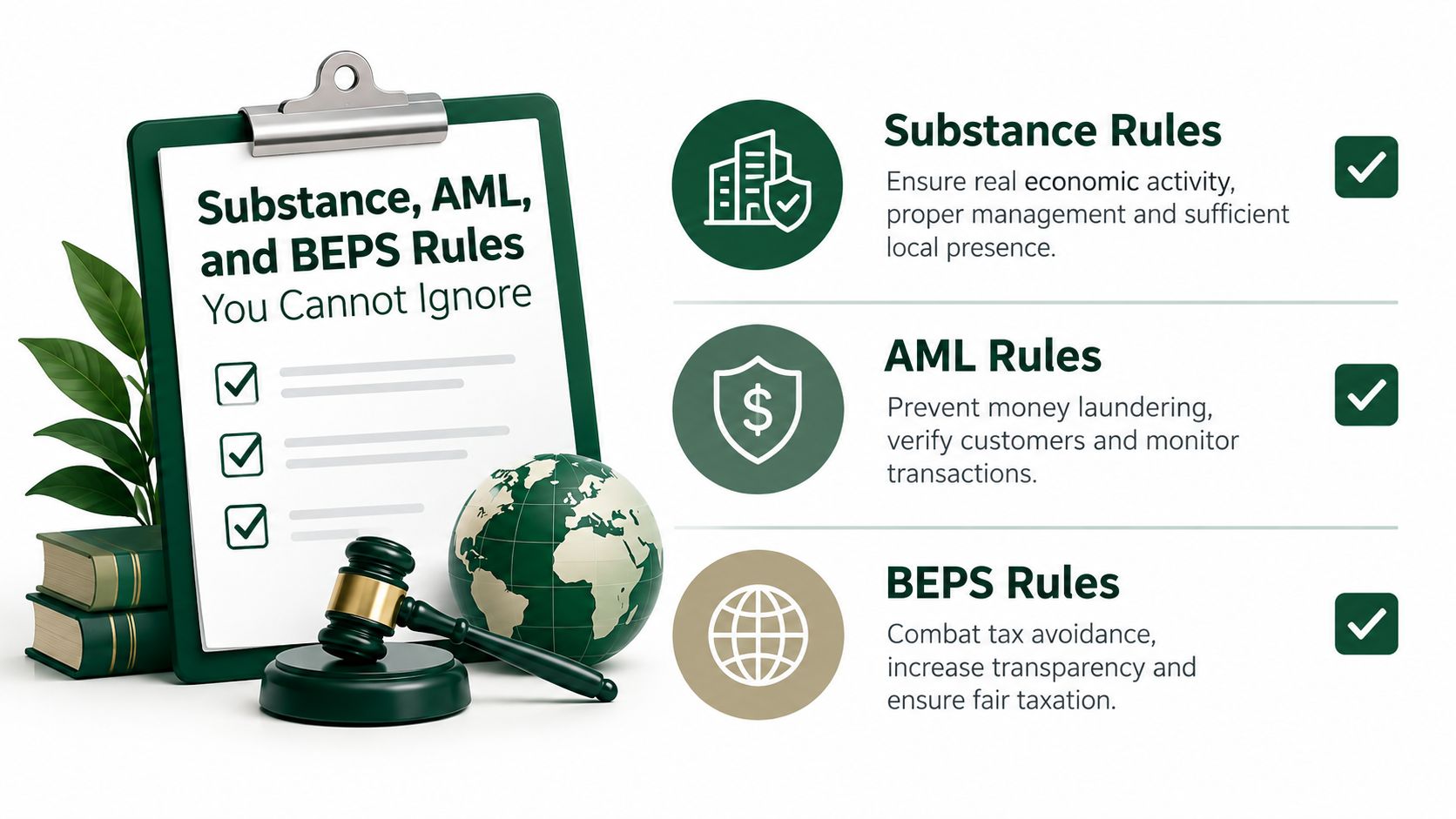
The word “substance” sounds technical, but the practical test is easy to understand: does the company look and operate like the business it claims to be?
A registered address helps. It isn't enough by itself. Tax authorities, banks, and counterparties may examine who makes decisions, where contracts are negotiated, where records are kept, whether local directors or employees are needed, and whether the revenue booked in the company matches its actual economic activity.
Build the compliance file before the bank asks
At incorporation, prepare:
- Beneficial-owner evidence: Passport copies, proof of address, ownership information, and any apostilles or notarisation requested by the registry or bank.
- Business evidence: Website, service descriptions, customer contracts, invoices, supplier details, and a clear explanation of expected transaction flows.
- Source-of-funds records: Bank statements, sale agreements, investment documents, or other evidence showing how the company is funded.
- Management evidence: Board minutes, signed resolutions, contract approvals, and records showing who makes commercial decisions.
- Local administration: Registered office, accountant, annual accounts, tax return process, and beneficial-owner registry updates.
AML checks aren't a one-time inconvenience. A bank can revisit the file when transaction patterns change, when the company enters a regulated sector, or when payments come from higher-risk countries.
BEPS principles target arrangements that separate reported profit from real activity. Walks, such as occasional director meetings or documented visits, can help demonstrate governance, but they're not a substitute for genuine operations. A company managed entirely from another country can still create tax-residency or permanent-establishment questions there.
DAC6 is the disclosure layer for certain cross-border arrangements. Where an arrangement meets defined hallmarks and thresholds, reporting to the relevant tax authority may be required, often within 30 days. Founders shouldn't assume that a formation agent will identify every reportable arrangement after the fact.
Compliance test: Keep enough evidence that an independent reviewer can understand who owned the company, who made decisions, where work occurred, and why the income belongs in that entity.
A sensible maintenance file includes the registered-office agreement, accounting records, a minutes book, annual accounts, corporate tax returns, VAT filings where applicable, beneficial-owner updates, and source-of-funds documentation. This cross-border tax planning guide can help frame the questions, but jurisdiction-specific advice remains necessary when the owner lives outside Europe.
EU Company Versus Classic Non-EU Offshore Centers
For a non-resident founder, the headline tax rate is only one line in the decision. The key comparison is between annual compliance, evidence of substance, payment access, tax residency exposure, and the cost of keeping the company usable. A low-tax entity that cannot pass onboarding or support its operating activity is expensive in practice.
| Criterion | EU Company, such as a Bulgarian EOOD | Classic Non-EU Offshore, such as BVI, Seychelles, or Panama |
|---|---|---|
| Tax approach | EU tax rules, local corporate tax, and possible treaty treatment | Often designed around territorial or low-tax treatment |
| Corporate substance | Required where profits, management, or activity create local or foreign tax questions | May be lighter locally, but home-country and source-country rules still apply |
| Banking for non-residents | Requires KYC and a credible operating profile | Can face stronger de-risking and payment-provider scrutiny |
| EU market reach | Directly aligned with EU commercial and VAT frameworks | No automatic EU establishment or VAT advantage |
| VAT registration | Potentially available where the company is properly established and activity triggers it | Generally not an EU VAT solution |
| Investor and processor reputation | Usually easier to explain to EU customers and regulated counterparties | May require more documentation and commercial explanation |
| Annual recurring cost | Includes accounting, filings, registered office, and possible local requirements | Can be inexpensive for a dormant holding company, but operational services add up |
| Remote administration | Formation and much of the ongoing administration can be handled online, subject to KYC and signature requirements | Often easy to administer remotely, but banking and payment access may be less predictable |
| Best practical use | Trading, SaaS, e-commerce, consulting, hiring, and fundraising connected to Europe | Narrow holding, IP, or dormant purposes where EU access is not central |
A founder selling software or consulting to European customers should assess the full operating chain. The company needs invoices that customers understand, a VAT position that matches its activity, payment processing that supports regular transactions, and accounting records that explain the business. A classic offshore company may reduce local administration while creating extra questions from banks, processors, customers, and the founder's own tax authority.
The same issue appears with residence. Forming a company outside the EU does not move management outside the country where the founder works. If the founder makes decisions, performs services, and controls the business from their home country, that country may examine corporate tax residence, permanent establishment, controlled-foreign-company rules, or tax on worldwide income. The company's place of incorporation does not settle those questions.
The practical cost of each option
A non-EU structure can work for a dormant asset holder or a narrowly defined holding arrangement that has been reviewed for the owner's residence and tax position. It is a poor choice for an active European operation that needs recurring card payments, EU customers, staff, or fundraising.
An EU company brings more visible obligations. Expect accounting, filings, registered-office costs, beneficial-owner administration, and a record of business activity. Those costs buy a structure that European counterparties can usually identify and assess without an extended explanation. Bulgaria is the practical low-tax EU benchmark for founders who want to keep the process remote while operating within an EU framework.
Use the annual total, not the incorporation fee, as the deciding measure. Choose a classic offshore centre for a narrow holding purpose, and choose an EU company for an operating business connected to Europe. A company that fits the activity, management location, and customer base will usually cost less to maintain than a cheaper structure that repeatedly fails compliance checks.
A Practical Walkthrough of Going Fully Online
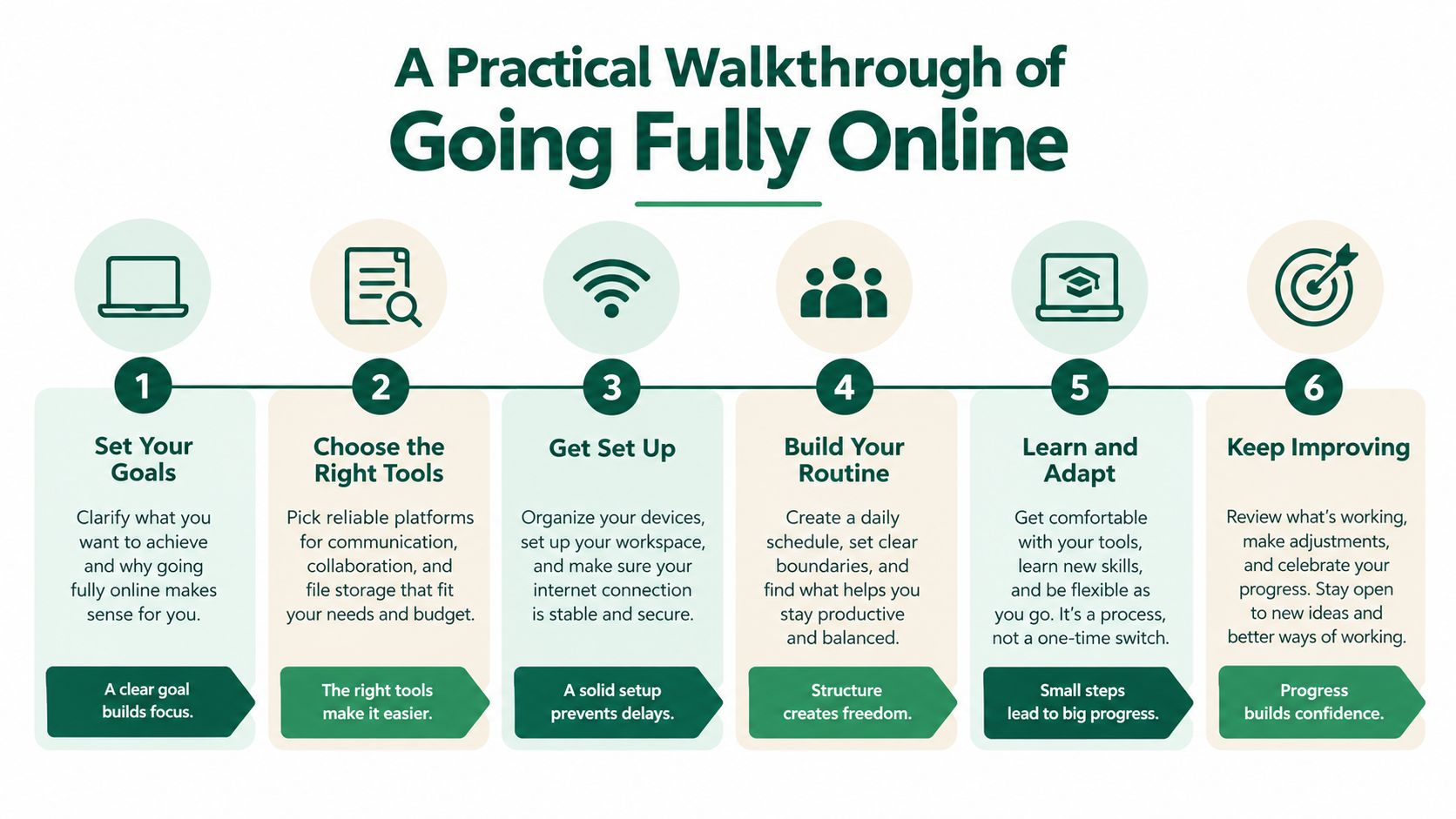
A founder outside Europe can form and run a Bulgarian EOOD without flying to Sofia, but remote incorporation is a managed sequence, not a button. The key test is whether each stage leaves the next provider with usable evidence.
Day 1: Choose an agent that can coordinate formation, registered-office support, accounting, and banking assistance. Before paying, confirm who handles translations, apostilles, beneficial-owner filings, and a rejected application. A Bulgarian company often requires apostilled documents, so the provider must explain the document standard before submission.
Day 3: Your apostille arrives damaged or the registry rejects a filing. Stop the application from being resubmitted blindly. Ask for the exact defect, obtain a replacement from the issuing authority, and have the agent confirm whether a certified translation or notarisation is also required. This is the point at which an apparently remote process can lose time.
Upload the passport, proof of address, ownership details, and business description through the provider's secure channel. Remote KYC should establish who owns and controls the company, what it will do, and how money will move. Keep the original files and delivery records. If documents must be signed with a qualified electronic signature or handled through an accepted online notary process, complete that step before registry submission.
FastCorp describes online Bulgarian incorporation as a 3 to 5 working day service, with an in-person Sofia option taking 2 to 3 working days, according to its company formation information. Registration produces the company's 9-digit UIC number.
What happens after registration
Week 2: Start banking as a separate review, not as an automatic result of incorporation. Submit the incorporation certificate, ownership records, business explanation, expected payment flows, and source-of-funds evidence. If the bank asks for contracts, invoices, or customer details, answer consistently with the original business description. An EU IBAN may be available remotely through a partner bank or electronic-money institution, subject to approval.
Week 4: Have the accountant decide whether VAT registration follows the company's activity and applicable thresholds. Early registration creates reporting work, while late registration can create invoice and compliance problems. Set up bookkeeping before issuing the first invoice, and retain contracts, payment evidence, and management records from the start.
The online company incorporation process is realistic for a non-resident founder who never wants to fly. Physical paperwork can still arise for notarised resolutions, original apostilled documents, regulated activities, or difficult bank questions. Remote formation removes routine travel. It does not remove document standards, KYC, or accountability.
Choosing the Right Setup and Planning the Next 12 Months
A founder who never plans to visit Europe should choose the company around its real operating footprint, not a headline tax rate. For a lean service business serving European customers, Bulgaria is the practical benchmark: low corporate tax, EU status, and administration that can be handled remotely when the activity is properly documented. Ireland suits a technology business prepared to maintain greater substance. Estonia can fit founders who retain profits in the company. The Netherlands or Cyprus belong on the shortlist only for a genuine holding or group structure, after specialist review.
Choose a provider that can explain the full operating model before incorporation. Confirm who handles registry filings, registered-office correspondence, accounting, annual accounts, corporate tax, VAT, and banking applications. Ask how the provider records management decisions, verifies the owner's residence position, and handles a change in business activity. A provider should explain KYC requirements and approval risks, not promise a bank account.
Plan the first year around decisions, not paperwork:
- Month one: Incorporate, secure the company documents and registered office, and submit banking materials that match the business plan.
- Months two and three: Confirm tax and VAT obligations, establish bookkeeping controls, and document the first customer contracts, invoices, and payment flows.
- Months four to six: Reconcile every transaction, keep proof of service delivery, and record where key management decisions are made.
- Month seven: Test the substance file as if an auditor were reviewing it. Gather contracts, board minutes, expense records, address evidence, accounting entries, and explanations for unusual payments.
- Months eight and nine: Review whether the company still matches the owner's residence-country tax position. Correct gaps before annual filings rather than explaining them afterward.
- Month ten: Reassess banking if transaction volumes, countries, currencies, customers, or payment types have changed. Ask whether the existing account still fits, and prepare a fresh application if the bank's risk profile no longer matches the business.
- Months eleven and twelve: Finalise accounts, tax filings, renewals, and the next year's compliance calendar.
The advertised setup fee is only the entry cost. Include registered-office renewal, accounting, tax filings, financial statements, banking support, any local director, payroll, and sector licences. Current EU formation comparisons place annual running costs at about €1,500 in Bulgaria, €2,000 in Estonia, and €3,000 to €5,000 in Cyprus or Ireland, as shown in this jurisdiction cost guide.
Remote administration works for standard incorporation, but filings, accounting records, ownership updates, and tax reviews continue even when the company is inactive. Avoid nominee arrangements, artificial invoices, and jurisdictions selected only for the lowest advertised rate.
FastCorp provides Bulgarian EOOD and OOD incorporation, registered-office services, EU VAT setup, banking assistance, and bookkeeping through an online process. Visit FastCorp to review the formation documents, banking plan, VAT position, and first-year maintenance.