What Is VAT Compliance? a Practical Guide for 2026
What is VAT compliance? Learn registration, invoicing, returns, records and EU cross-border rules, with practical steps and rate comparisons.
VAT compliance means registering where required, charging the right rate, issuing valid invoices, recording every transaction, filing returns on time and paying the VAT due.
You're preparing an invoice for an overseas customer, your accounting software offers several tax codes, and you're not sure whether to charge VAT or apply reverse charge. Meanwhile, a filing deadline is approaching. The solution isn't finding the right online form. It's building a repeatable process that connects the customer's details, the invoice, your ledger and the return.
Table of Contents
- What VAT Compliance Means for Your Business
- Who Must Register for VAT and When
- How VAT Rates Compare Across Countries
- Cross-Border EU Sales and the One Stop Shop
- Issuing Invoices That Pass a Compliance Check
- How to File VAT Returns Online, Step by Step
- Keeping Records That Survive an Audit
- Set Up Your VAT Compliance Plan This Month
What VAT Compliance Means for Your Business
VAT compliance is a continuing responsibility, not a task you finish when your VAT number arrives. Think of VAT as a relay baton your business carries on behalf of the state. You collect tax where required, account for recoverable VAT on eligible purchases, and pass on the net amount.
That distinction matters for cash flow. VAT collected from customers isn't ordinary revenue available to spend without considering the tax liability.
The obligations behind the number
A workable compliance process covers these obligations in order:
- Registering where required.
- Charging the legally applicable rate.
- Issuing compliant invoices.
- Maintaining transaction records.
- Filing periodic VAT returns.
- Paying the net VAT due.
- Supporting claims for input-tax deductions or refunds.
The scale explains why authorities scrutinise this process: across OECD countries, VAT averaged 7.0% of GDP and 20.8% of total tax revenue in 2022, while the VAT Revenue Ratio averaged 0.58, according to the OECD's Consumption Tax Trends 2024. That ratio implies approximately 42% of potential revenue wasn't collected, reflecting exemptions, reduced rates, non-compliance, fraud, insolvencies and administrative weaknesses, not business tax evasion alone.
The practical relationship looks like this:
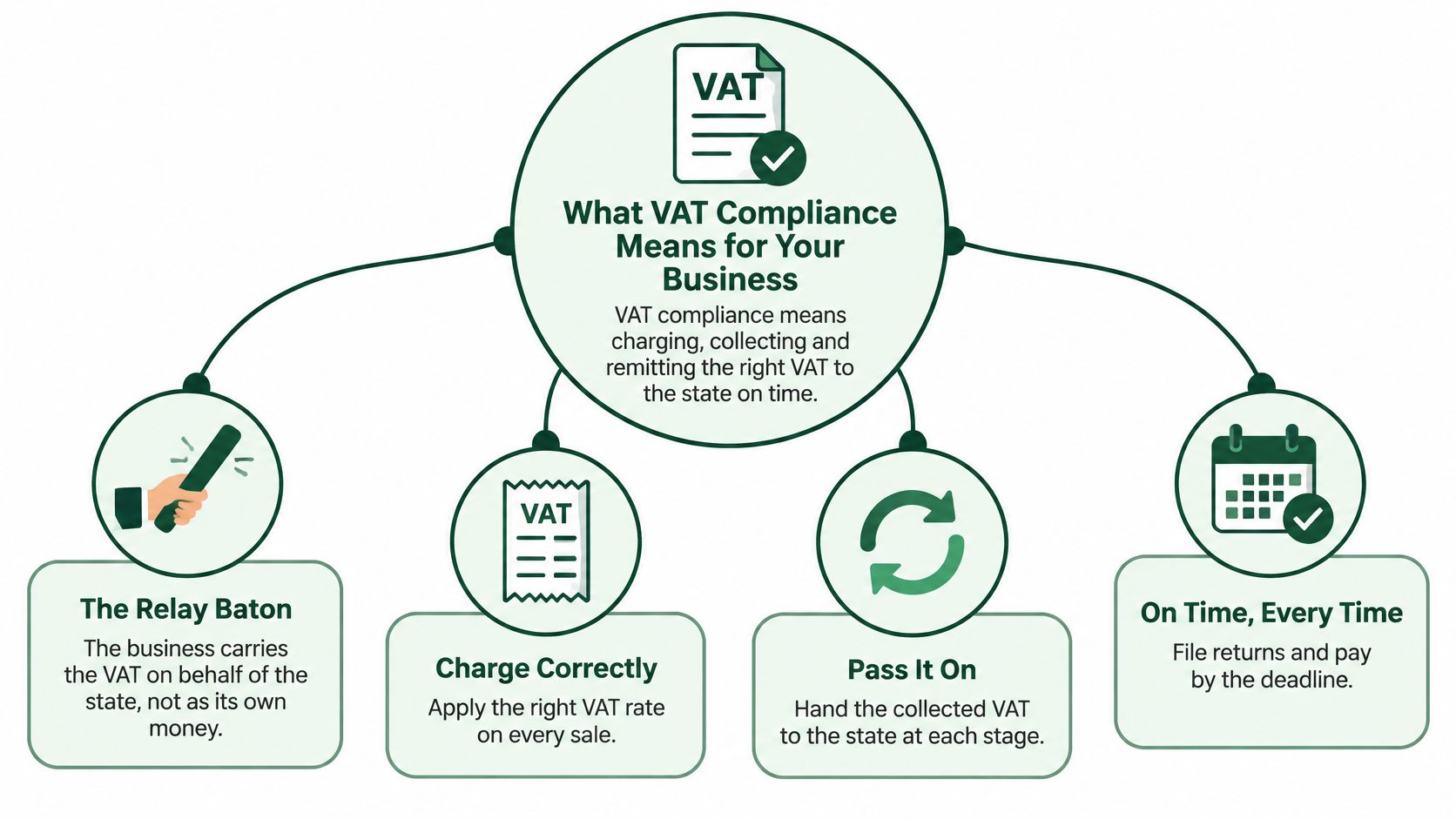
For your business, the important connection is between sales, purchases and evidence. A correct sales invoice doesn't fix an unsupported purchase deduction. Equally, accurate bookkeeping doesn't excuse a missed payment deadline.
Practical rule: Treat the return as the result of your controls, not the place where you first investigate your transactions.
Errors can mean assessments, interest, penalties or denied input-tax recovery. A reliable routine therefore starts before invoicing and continues through reconciliation, submission, payment and record retention.
Who Must Register for VAT and When
The most familiar registration trigger is taxable turnover exceeding the applicable domestic threshold. However, your home-country threshold isn't permission to trade everywhere without checking local requirements. Establishment, stock location, customer type and transaction category can change the result.
Cross-border business services need particular care. The customer may account for VAT through reverse charge, so selling a service abroad doesn't automatically require registration in the customer's country. Check the place-of-supply rule and any exceptions before applying that conclusion.
Consumer goods and digital services follow a different analysis. Destination taxation and special reporting schemes may apply, while non-resident businesses can face registration obligations before a comparable domestic business would.
Build a registration tracker
Use a spreadsheet or your accounting system to maintain:
- Markets served: Record customer countries and countries where you hold stock or operate.
- Supply categories: Separate goods, services, business customers and consumers.
- Relevant turnover: Track sales using each jurisdiction's measurement rules.
- Trigger dates: Record when an obligation arose and the registration deadline.
- Reporting route: Identify domestic registration, an eligible simplification scheme or platform collection.
Use our guide to VAT registration requirements to organise the questions, then confirm the treatment for your activities.
Voluntary registration can help an eligible business recover input VAT, but it also introduces invoicing, reporting and payment duties. It's often more attractive where customers can recover VAT than where consumers judge you entirely on the final price.
Check the platform's role
Under the EU's 2025 VAT in the Digital Age package, platforms will generally collect and remit VAT for certain short-term accommodation and passenger-transport supplies when the underlying provider doesn't charge VAT, with implementation phased rather than immediate, as described in the OECD's compliance-management discussion.
Check whether the platform handles the relevant sales before choosing a registration route. That doesn't automatically eliminate obligations for direct sales or other activities.
If you've already traded without a required registration, get local advice promptly. Don't invent a VAT number or continue charging VAT without authority. Historical liabilities and invoice corrections still need resolving.
How VAT Rates Compare Across Countries
Rate comparison works best as a control check. The number in your tax code has to match the supply location, the product category and the return line before online filing becomes faster.
Standard and main reduced VAT rates in key markets
| Country | Standard rate | Main reduced rates | Practical note |
|---|---|---|---|
| Bulgaria | 20% | 9% | Reduced treatment can apply to qualifying accommodation |
| Germany | 19% | 7% | Reduced treatment covers many food and book sales |
| France | 20% | Category-specific reduced rates | Identify the precise product or service category |
| Spain | 21% | 10%, 4% | Reduced rates cover qualifying food and some services |
| Italy | 22% | 10%, 5%, 4% | Multiple reduced rates by sector |
| Netherlands | 21% | 9% | Main reduced rate requires category checks |
| Ireland | 23% | Category-specific reduced rates | Check tourism categories and effective dates carefully |
| Hungary | 27% | Category-specific reduced rates | Highest standard rate in this table |
| Sweden | 25% | 12%, 6% | Check the applicable food or accommodation category |
| United Kingdom | 20% | 5%, 0% | Non-EU; zero rating covers qualifying essential goods |
Confirm current rates with the relevant tax authority before setting tax codes or filing. A rate table cannot establish whether a particular supply qualifies for reduced treatment. Our EU VAT rate guide gives you a practical starting point for that review.
Location and category work together
The applicable rate follows the place of supply and classification, not the country where you incorporated. A Bulgarian company selling a transaction taxable in Germany may need German VAT treatment. Using the company's domestic rate everywhere is convenient, and it is also where cross-border pricing errors usually start.
A hypothetical Bulgarian hotel booking shows why the category matters. On a €1,000 VAT-exclusive price, qualifying accommodation at the table's 9% rate produces €90 of VAT. The same booking at the listed 20% standard rate produces €200. The arithmetic is easy; proving eligibility is the control.
That difference reaches the commercial model too. With a VAT-exclusive business price, the customer's payable amount changes. With a fixed VAT-inclusive consumer price, a higher applicable rate leaves less revenue for your business before other costs.
Don't choose the lowest plausible rate. Choose the treatment you can support with the product description, supply location and applicable category rule.
Reduced rates can apply to accommodation, food, books, medicines and certain services, yet category boundaries are not interchangeable between countries. Zero rating and exemption also need separate tax codes, separate evidence and separate review.
Treat the rate as a recurring reconciling item. Government-held data increasingly sits beside your own ledger, so the invoice tax code, cross-border classification and return totals need to agree. When they do, filing is mostly confirmation. When they do not, the portal only submits the inconsistency faster.
Before launching a product or entering a market, document the classification decision and the evidence behind it. Review it when the offering, customer location or law changes, instead of assuming the original software setting remains correct indefinitely.
Cross-Border EU Sales and the One Stop Shop
One misclassified sale can route VAT to the wrong country for months before anyone spots it. Cross-border VAT starts with what you sell, who buys it and where the transaction is taxable. The reporting channel follows that decision. Choosing OSS first and forcing every transaction into it reverses the correct order.
Who accounts for VAT and where to report it in EU cross-border cases
| Cross-border case | Who handles the VAT | Where to report |
|---|---|---|
| B2B service bought from another EU country | Customer generally self-accounts through reverse charge | Buyer's domestic VAT return; supplier checks EC Sales List obligations |
| B2C digital service sold to EU consumers | Supplier generally charges the customer-country rate, subject to applicable exceptions | Eligible One Stop Shop return |
| B2C goods above the applicable distance-selling threshold | Supplier charges destination-country VAT | Destination registration or eligible One Stop Shop |
| Goods exported outside the EU | Supplier applies zero rating when conditions and exit evidence support it | Domestic VAT return; retain export evidence |
| B2B goods sent to another EU business | Supplier may apply zero rating when all conditions are met, including buyer identification and movement evidence | Domestic VAT return and applicable EC Sales List |
For a business service purchase, reverse charge means the recipient accounts for the tax. Treat the buyer's self-accounting and the supplier's own reporting duties as separate obligations; satisfying one does not satisfy the other.
For consumer digital services, customer location drives the destination analysis. For consumer goods, check the distance-selling rules and scheme eligibility. For exports, the shipping and exit documentation must support the invoice treatment.
What OSS simplifies
The One Stop Shop gives you a consolidated digital return for eligible cross-border consumer supplies, so you register once rather than in every customer's member state. Suppliers established outside the EU can use the non-Union variant of the scheme for eligible services, which is the route generally used by businesses selling to EU consumers without an EU establishment.
That matters for a non-EU service business, and OSS still leaves domestic registration duties in place wherever the rules require a local number. Goods, services and platform-mediated transactions can also fall under different schemes, so classify each revenue stream before assuming it fits.
For SaaS founders and agencies adding consumer products, the operational questions in our VAT for digital services guide apply directly. A business subscription and a consumer subscription can require different treatment even when the underlying software is identical.
What still needs checking
Maintain destination evidence, distinguish direct sales from marketplace sales, and reconcile refunds to the original transaction. Your accounting export should separate domestic activity, eligible OSS activity and transactions requiring another reporting route.
The filing you submit is no longer the only version of the sale in circulation. Tax authorities increasingly hold counterpart data, such as the customer's reverse-charge entry or a supplier's EC Sales List, alongside whatever you report. Your OSS return moves quickly only when the invoice-level classification behind it already reconciles with those records; a mismatched code turns a fast upload into a correction cycle.
Before expanding, ask a local adviser to review the proposed transaction flow, including fulfilment and customer contracting. Reviewing that diagram before launch is more useful than trying to reconstruct it from invoices after the filing period closes.
Issuing Invoices That Pass a Compliance Check
Classify the sale before issuing the invoice. Establish whether it involves goods or services, a business or consumer, the customer's location, the relevant VAT number, the supply date and the applicable rate or reverse-charge treatment.
The European Commission's VAT for companies factsheet explains that businesses purchasing services from another EU country generally self-account for VAT, while cross-border consumer goods sales generally require destination treatment unless an applicable threshold or special scheme changes the result. These distinctions belong in your invoicing workflow, not in an accountant's memory.
Check the invoice fields
Use a template that checks:
- Supplier and customer details: Correct legal names and addresses.
- VAT identification: Relevant VAT numbers and validation evidence where appropriate.
- Invoice identification: Issue date, unique invoice number and supply date where required.
- Supply description: Enough detail to understand what was delivered.
- Amounts: Net value, applicable VAT rate, VAT amount and payable total.
- Special wording: Reverse-charge or other required treatment statements.
These are core checks, not a universal statement of every country's invoice law. Confirm local requirements, including any structured electronic invoicing obligations.
A reverse-charge scenario
Say a German consultant provides an ordinary business consultancy service to a Bulgarian business. Assuming the general business-service rule applies and the customer's status is established, the German supplier invoices without German VAT and the Bulgarian recipient self-accounts.
Charging German VAT merely because the supplier is German would be the wrong starting point. Equally, entering a customer VAT number doesn't override a special place-of-supply rule.
A professional-looking PDF isn't proof of correct VAT treatment. The customer classification and tax code must be right underneath it.
Configure separate accounting codes for distinct treatments rather than using a catch-all overseas sales code. Test how those codes flow into returns before allowing automated posting.
Keep credit notes linked to the original invoice and preserve the original tax treatment in the correction trail. For purchase invoices, route missing or defective evidence into an exception queue instead of automatically claiming input VAT. Automation works well for repeatable, validated transactions; unusual supplies still need a named reviewer.
How to File VAT Returns Online, Step by Step
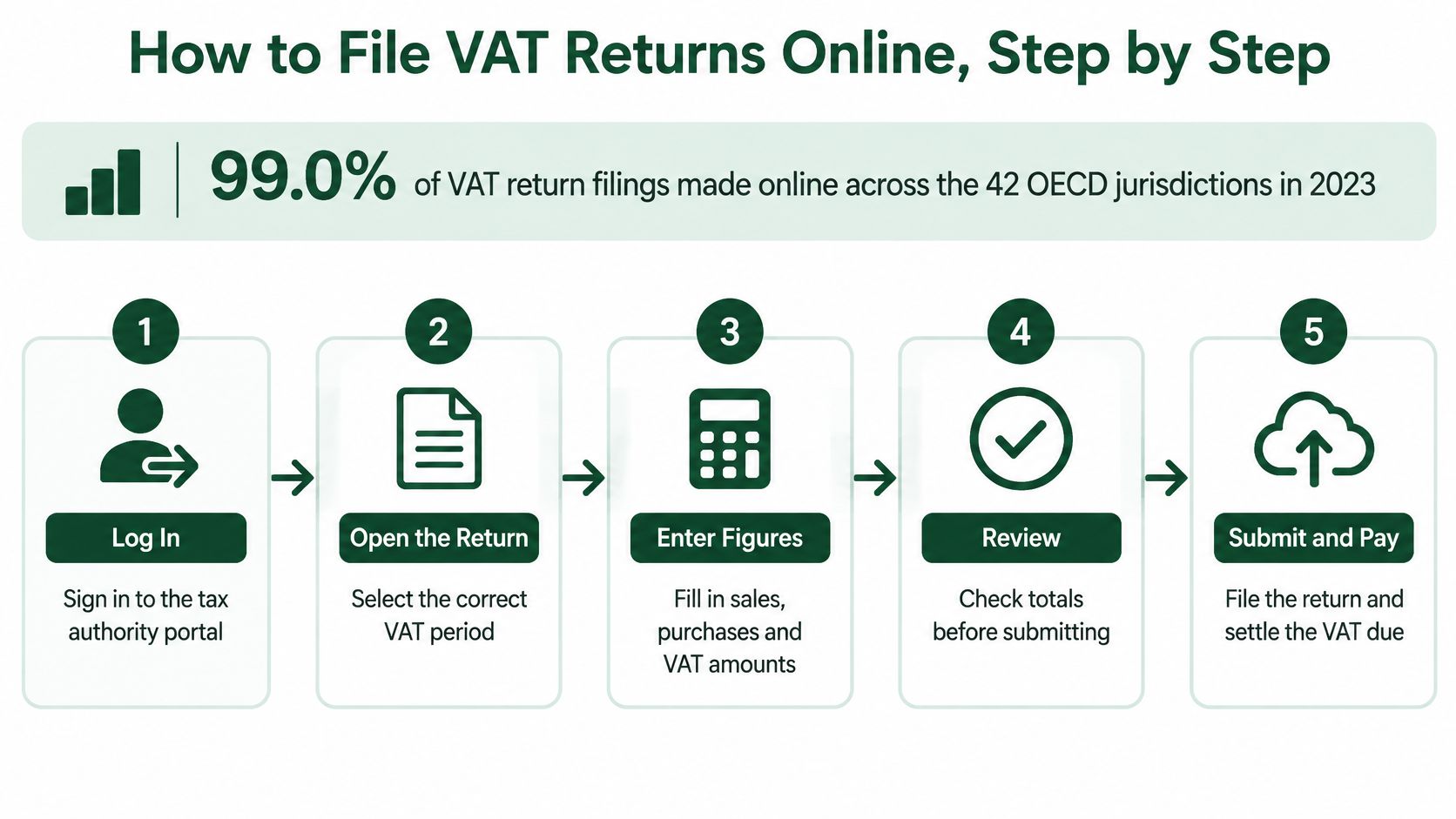
Online filing is now the norm: 99.0% of VAT return filing was online in 2023 across the 42 jurisdictions included in the OECD's VAT series, according to Tax Administration 2025. The submission can be easy once your records and access arrangements are ready, but digital filing doesn't make every underlying decision automatic.
The portal workflow is straightforward:
Complete the checks before submission
- Confirm the period and deadline. Put preparation, review and payment reminders in your calendar. Check your assigned filing frequency rather than assuming every country uses the same schedule.
- Reconcile sales to the ledger. Investigate missing invoices, duplicates and unexplained differences between billing exports and posted revenue.
- Validate input VAT. Hold back unsupported claims and review purchases subject to recovery restrictions.
- Review cross-border treatment. Check exceptions, customer classifications and destination coding.
- Calculate the net position. Deduct recoverable input VAT from output VAT, then apply any relevant adjustments.
- Obtain reviewer approval. Have someone check unusual items and reconciliation differences before you submit.
- File through the authorised channel. Use secure credentials, or compatible software where required, and select the correct period.
- Pay and retain confirmation. Submission and payment are separate tasks. Save the acknowledgement and confirm that the payment uses the correct reference.
Don't assume no VAT payable means no return is required. Check nil-return obligations for every registration and scheme you maintain.
Reconcile government-held figures too
Nearly 40% of tax administrations can prefill VAT returns, and about 30% of those administrations can provide fully prefilled returns, according to the OECD's discussion of data management and standards. Your reviewer therefore needs to compare the ledger with government-held figures, not accept a prefilled total.
A difference might arise from timing, a credit note or missing transaction data. Investigate the cause and document the resolution. Changing your ledger merely to match a portal figure can conceal the original error.
This video provides an additional visual reference for the filing process:
The useful measure of readiness isn't how quickly you can press submit. It's whether you can explain the figures you're submitting.
Keeping Records That Survive an Audit
Records are the evidence behind your return. An auditor needs to connect a declared amount to the underlying supply, invoice, customer and tax treatment. A folder of disconnected PDFs makes that much harder than it needs to be.
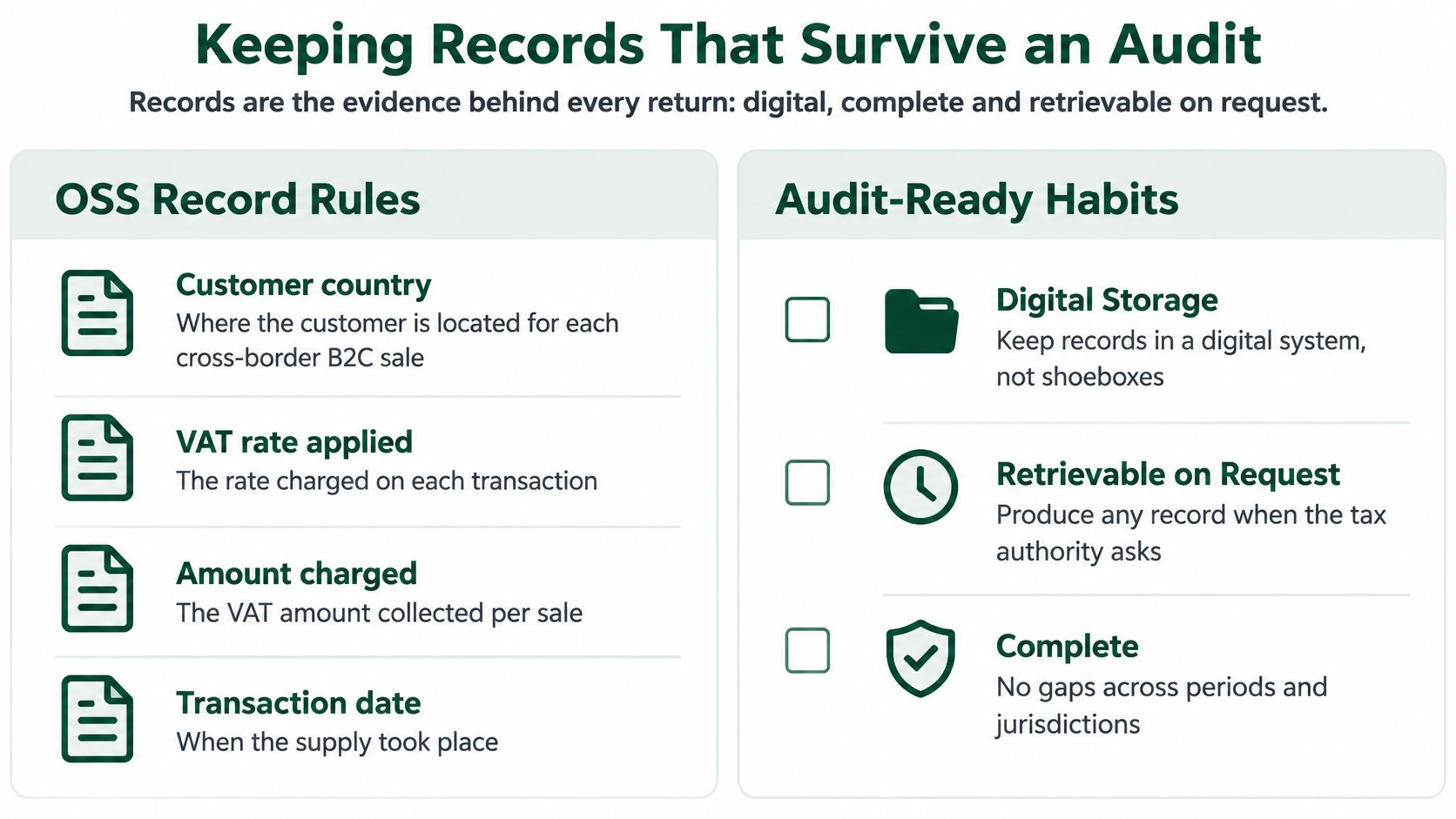
For OSS, records must include the Member State of consumption, supply type, supply date, VAT payable, payments on account and customer-location evidence, and must be retained for 10 years from the end of the transaction year, according to the European Commission's revised OSS guidelines. They must also be electronically available without delay when requested; check the applicable version of the guidance for your reporting period.
Build the archive around the evidence you may need to retrieve:
Preserve the transaction trail
Your billing system should link the customer, product or service, tax rule, rate, currency and reported amount. Preserve corrections through an audit log rather than overwriting the original transaction without explanation.
The UK provides a useful operational comparison: businesses within the scope of Making Tax Digital for VAT must maintain digital records and submit returns through compatible software connected to HMRC. Buying software alone doesn't satisfy the practical need for complete, consistent records.
Use these habits to prevent common failures:
- Avoid omitted sales: Reconcile billing, marketplace statements and ledger entries regularly.
- Prevent unsupported deductions: Link purchase claims to valid supporting invoices.
- Explain unusual treatment: Keep a short decision note for exceptions and cross-border transactions.
- Support exports: Store transport and exit evidence alongside the related invoice.
- Protect access: Maintain backups and test whether another authorised person can retrieve records.
- Catch mismatches: Compare taxable bases, VAT totals, refunds and credit notes before reporting.
An archive is useful only if you can search it. Test retrieval by invoice number, customer, country and reporting period, not merely by the date someone uploaded a file.
Set Up Your VAT Compliance Plan This Month
Start by listing every country you sell into. For each market, record the transaction category, registration position, applicable treatment and reporting route. Give unresolved questions an owner so they don't remain hidden in an email thread.
Next, configure tax codes before the next invoice is issued. Separate goods from services, business customers from consumers, and domestic treatment from destination VAT or reverse charge. Test a sample transaction through invoicing, posting and return preparation.
Decide who owns each control
Choose a digital record system that links invoices to ledger entries and stores customer-location and export evidence. Make sure you can export the records if you change accounting providers.
Set preparation and review dates as well as filing deadlines. Keep a named person responsible for approving unusual transactions, monitoring outstanding evidence and confirming payment.
You can outsource recurring administration without losing visibility. Our company setup package includes an EU VAT number, and our bookkeeping and accounting services include VAT reporting, annual returns, payroll and tax compliance. Ongoing accounting support is optional, so decide who will handle the recurring work before trading begins.
FastCorp isn't a law firm or tax authority. The client remains legally responsible for the company's activities, tax obligations and reporting accuracy, which makes an internal approval process valuable even when someone else prepares the return.
Take action this week
- Map your markets: Identify where you sell and which transactions need a registration or treatment review.
- Choose your digital record system: Check invoice links, evidence storage, export capability and access controls.
- Calendar the first filing: Include preparation, reviewer approval and payment, not just submission.
Online systems make routine administration manageable. With clear ownership and reconciled records, VAT compliance becomes an achievable business process rather than a deadline-driven scramble.
FastCorp offers Bulgarian company formation with EU VAT registration, plus optional ongoing bookkeeping and VAT reporting support. Visit FastCorp to discuss your planned markets and arrange the setup and accounting support your business needs.