European VAT Registration Number Guide for Online Sellers
Learn what a European VAT registration number is, how country prefixes work, and how to register and verify it for cross-border EU trade in 2026.
A European VAT registration number is the country-prefixed identifier a national tax authority issues to a VAT-registered business, and there is no single EU-issued number. Every one of the 27 EU member states issues its own VAT number, so if you're trying to “get an EU VAT number,” you're really registering with a specific country and then using that number for eligible EU trade.
You're probably here because sales into the EU have stopped feeling experimental. Parcels are moving, marketplaces are asking awkward compliance questions, business buyers want a valid VAT ID on the invoice, and you need a setup that works in real life, not just on paper. Good. That's the right moment to get serious, because your European VAT registration number isn't admin clutter. It's the switch that turns on compliant invoicing, cross-border reporting, and clean buyer verification.
Table of Contents
- Why You Need a European VAT Registration Number
- How the Number Is Built and What Each Prefix Means
- Getting Your Number Step by Step Online
- Country Thresholds That Decide When You Must Register
- Verifying Any EU VAT Number Through VIES
- Bulgaria vs Other EU Bases for Non-Resident Founders
- Common Mistakes That Cost Time and Money
- Your Action Checklist for 2026
Why You Need a European VAT Registration Number
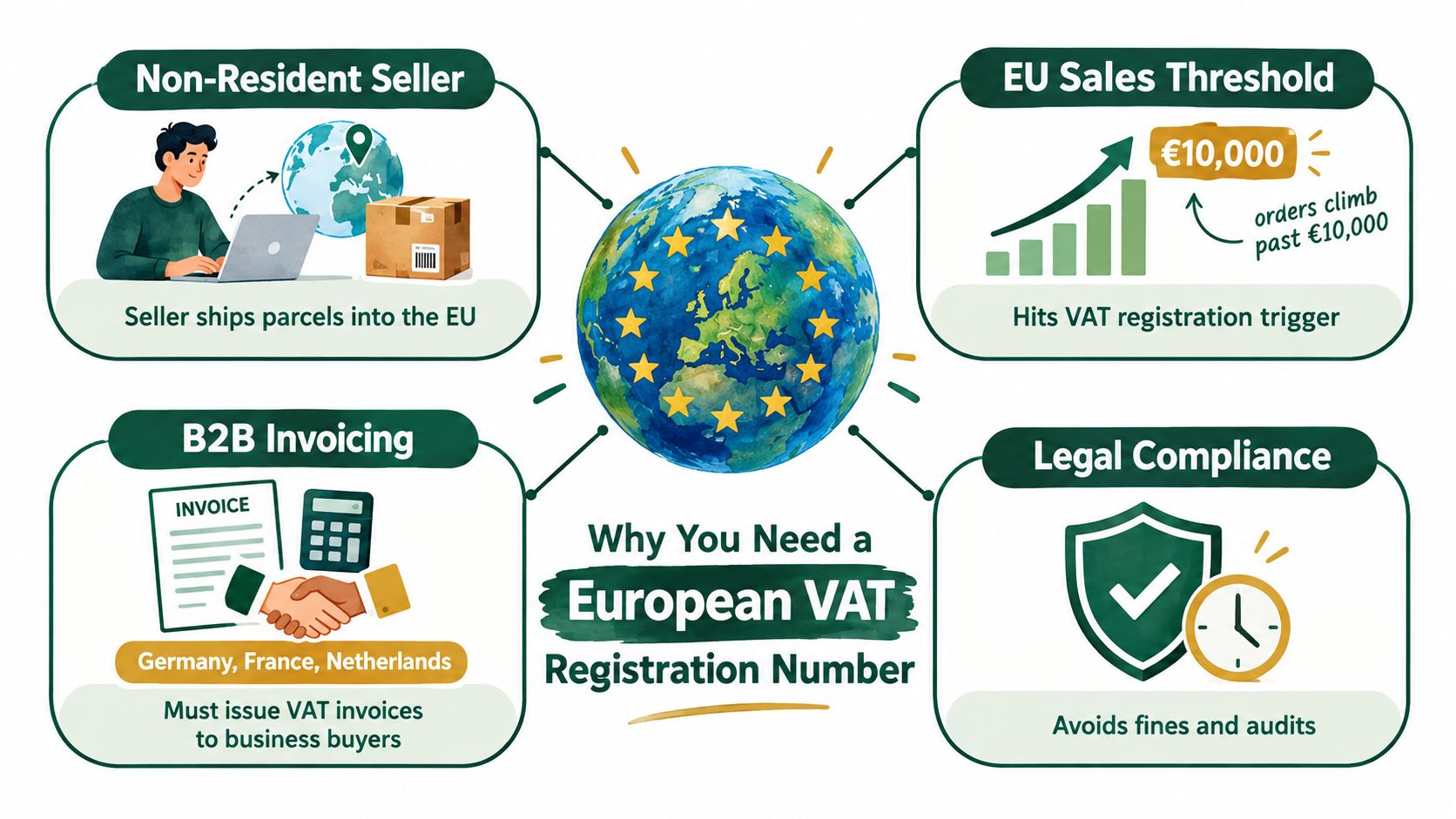
Your first warning usually arrives before your accountant does. A German marketplace asks for a valid VAT ID. A French B2B client rejects your invoice. A fulfilment partner wants tax details before they will receive your stock. At that point, VAT registration is no longer a back-office task. It is blocking sales.
A European VAT registration number is the working tax ID that lets you trade properly inside the EU. You need it to issue compliant invoices, support reverse-charge treatment where it applies, pass buyer and marketplace checks, and file the reports that follow from selling or storing goods in the bloc. The European Commission is clear on the basic rule: VAT numbers are issued by national tax authorities, not by the EU, and they are used across the EU system for trade and verification (European Commission guidance on VAT identification numbers).
The triggers that usually force registration
Founders usually get caught by one of these three triggers first.
- Cross-border consumer sales: If you sell goods or certain services to consumers in other EU member states, your VAT position can change quickly once you move beyond the small-business cross-border limit. The Union OSS system can simplify reporting, but it does not erase the need to assess where registration is required and which sales can be reported through OSS (EU One Stop Shop portal).
- B2B customers who expect a valid VAT ID: Business buyers often will not accept invoices without a VAT number if the transaction is meant to be treated under intra-EU or reverse-charge rules. No valid number often means no payment approval.
- Stock held inside the EU: Warehousing inventory in an EU country, including through marketplace fulfilment programs, often creates an immediate local VAT obligation. Many first-time sellers miss this and discover it only after stock is already moving.
Fresh registrations create another practical issue. A newly issued VAT number may not appear in VIES straight away. That delay is common, and it causes avoidable panic. Marketplaces, suppliers, and B2B customers may still ask you to prove registration while the database catches up, so you need to plan for that gap instead of assuming the number will validate on day one.
What happens if you ignore it
The costs show up fast.
Imports can stall. Marketplace onboarding can stop mid-process. B2B invoices can be rejected or paid late because the customer cannot process them cleanly. If you should have registered earlier, the tax authority can ask for backdated filings, interest, and penalties.
My advice is simple. Register before you expand channels, before you place stock in the EU, and before large buyers start their compliance checks. In 2026, that matters even more for online sellers using OSS. OSS reduces filing friction for eligible cross-border sales, but it does not fix late registration, missing local obligations, or bad invoice data. Your VAT number is an operational asset. Treat it that way.
How the Number Is Built and What Each Prefix Means
A founder gets a VAT certificate, copies the number into Amazon, sends it to a German supplier, and then wonders why one system accepts it while another rejects it. The usual problem is not the tax registration itself. It is bad formatting, the wrong country prefix, or a fresh number that has not yet synced everywhere.
Start with the rule that matters. An EU VAT number is a national tax identifier with a two-letter prefix, followed by the local format set by that country's tax authority. The prefix is not cosmetic. It tells buyers, platforms, and compliance systems which Member State issued the number and which validation rules to apply.
Here is the practical layout founders deal with most often:
| Country | Prefix | Example Format | Notes |
|---|---|---|---|
| Germany | DE | DE123456789 | Numeric body after prefix |
| France | FR | FR12345678901 | Uses its own control logic |
| Netherlands | NL | NL123456789B01 | Often ends with B01 |
| Spain | ES | ESX1234567X | Alphanumeric pattern |
| Italy | IT | IT12345678901 | Eleven-digit numeric body |
| Greece | EL | EL123456789 | Uses EL, not GR |
| Northern Ireland | XI | XI123456789 | Used for EU-facing goods treatment |
If you want a broader primer on structure and usage, FastCorp has a useful explainer on the EU VAT identification number.
Two prefixes cause more trouble than all the others combined.
Greece uses EL, not GR. Founders regularly type GR because it looks intuitive. For VAT work, that is wrong. If you enter GR into a marketplace, ERP, or validator, the number can fail even if the Greek registration is perfectly valid.
Northern Ireland uses XI for certain goods transactions with the EU. That point is narrower than many founders assume. XI matters for EU-facing goods treatment. It does not mean Northern Ireland sits inside the EU VAT system for services in the same way as an EU Member State.
Treat the prefix as routing data. Get it wrong and the rest of the number does not matter.
Format knowledge also has limits. A VAT number can look correct on paper and still create operational friction. Some systems check length only. Others check character pattern. VIES checks whether the number is currently recorded as valid by the issuing authority. Fresh registrations are where founders get caught. The certificate may be issued, but external systems can still lag. In practice, that means you should store the registration notice, use the exact prefix shown by the authority, and expect a short gap before every platform and checker behaves consistently.
Getting Your Number Step by Step Online
You launch an EU store, the first orders come in, and the marketplace asks for a VAT number you cannot use yet. That is the problem. Getting a European VAT registration number is not just an admin task. It sets the start date for charging VAT, affects whether platforms accept your account, and determines whether VIES will recognize you fast enough for trading partners and marketplaces.
The practical registration path
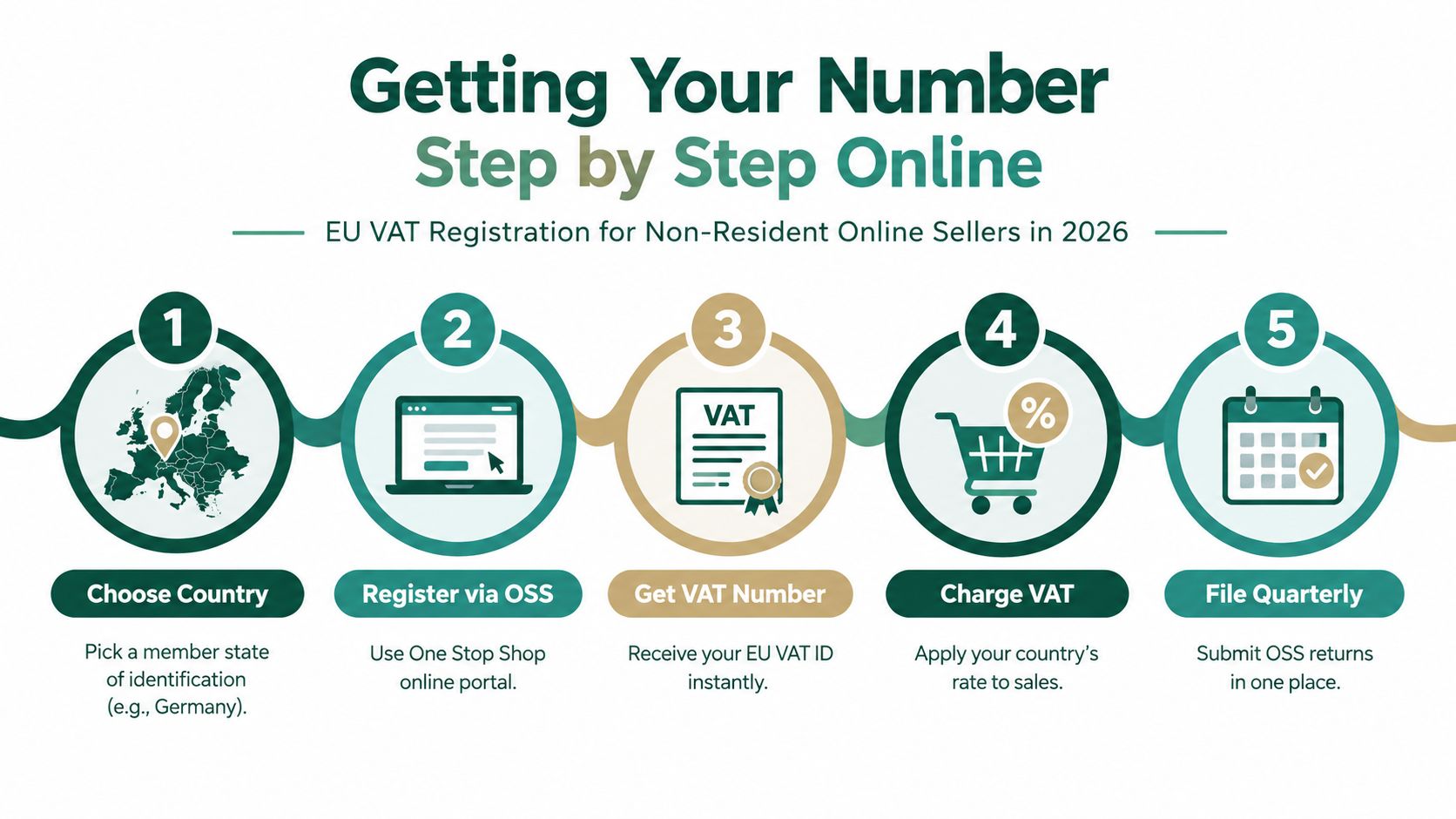
Use this order.
Choose the correct route before you file. If you hold stock in an EU country, import into a country in your own name, or create a fixed establishment, you usually need a local VAT registration there. If you sell cross-border B2C from one EU country into others, OSS may let you report those sales through one member state instead of registering everywhere. In 2026, that distinction matters even more for online sellers. OSS reduces filing spread, but it does not replace every local registration.
Pick your Member State of Identification carefully. Do not choose on instinct. Choose the country where you can complete onboarding, manage portal access, and respond to notices quickly. A bad portal choice slows everything down for months.
Build the document pack properly the first time. Tax offices usually want incorporation records, constitutional documents, director ID, proof of trading activity, a description of supplies, and warehouse or logistics details if goods are involved. Non-resident founders lose time here because names, addresses, and dates do not match across documents. Fix that before submission.
File online through the relevant tax portal. For OSS, registration is made through the tax authority portal in your Member State of Identification, and the effective date usually starts from the first day of the next calendar quarter after you notify the authority. The practical rule is simple. File early, not near quarter end. You can review the official registration flow and timing on Your Europe's OSS guidance.
Plan for the gap between filing, issuance, and live system recognition. Authorities may acknowledge the application before the number is fully active in connected systems. That catches first-time registrants constantly. Your certificate may exist, while a marketplace, supplier, or checker still rejects the number for a short period.
A receipt is not an active registration.
That is why I tell founders to treat the VAT number as a live operational asset from day one. Save the registration notice, the effective date, the exact legal entity name, and the exact prefix shown by the authority. Your finance team, marketplaces, PSPs, and ERP all need the same data set.
If you are comparing setup options, EU VAT registered companies guidance from FastCorp shows how VAT registration work is often bundled with company formation and ongoing compliance support.
One more point for 2026 online sellers. OSS changes the reporting burden, not the underlying facts of your supply chain. If you store inventory in more than one member state, use local fulfillment models, or start importing into the EU under different structures, expect OSS to sit alongside local registrations, not replace them. Founders who miss that point usually discover it after the first platform compliance review or the first rejected invoice.
Country Thresholds That Decide When You Must Register
Founders often ask for one clean “EU threshold.” That's the wrong question. You're dealing with two layers at once: the Union-wide rule for certain cross-border sales, and domestic registration thresholds that still vary by country.
The harmonized framework under Directive (EU) 2020/285 caps any member state's domestic small-business VAT exemption threshold at EUR 85,000 from 1 January 2025, but each country still sets its own local threshold within that ceiling. Reported examples for 2026 include Hungary at HUF 20 million, Poland at PLN 240,000, Romania at RON 395,000, and Belgium approved at EUR 30,000 pending entry into force (country threshold comparison and 2026 changes).
2026 small-business VAT exemption thresholds by EU Member State
| Member State | Threshold (€) | Notes |
|---|---|---|
| EU framework ceiling | 85,000 | Maximum domestic exemption ceiling from 1 January 2025 |
| Belgium | 30,000 | Approved rise pending entry into force |
| Hungary | Local currency threshold | Reported as HUF 20 million for 2026 |
| Poland | Local currency threshold | Reported as PLN 240,000 for 2026 |
| Romania | Local currency threshold | Reported as RON 395,000 for 2026 |
That table isn't exhaustive, and that's deliberate. If you're a non-resident founder, the exact domestic threshold only matters after you ask the right operational question first: are you selling locally, cross-border, or from stored stock?
For a practical overview of registration triggers, this guide on VAT registration requirements is a useful checkpoint.
What these thresholds actually mean for non-residents
Here's the trap. Founders see a domestic threshold and assume it protects them everywhere. It doesn't.
- Domestic exemptions are local tools: They may matter for resident small businesses in that country.
- Cross-border sales follow separate logic: The EUR 10,000 Union threshold for certain cross-border sales changes the analysis for online sellers, as noted earlier.
- Stock location can override comfort assumptions: If you hold inventory in a country, local registration can become relevant even if your sales volume still feels “small.”
Two founders can have the same turnover and end up in completely different compliance positions. One sells from outside the EU into a few consumer markets. The other stores stock in one member state and invoices B2B buyers in another. Same revenue. Different VAT posture.
Verifying Any EU VAT Number Through VIES
A founder gets a fresh VAT number on Tuesday, invoices a German customer on Wednesday, and your finance team checks VIES on Thursday. The result comes back invalid. That does not automatically mean the number is fake. It usually means one of two things. The number was entered under the wrong country prefix, or the national register has not fully synced to VIES yet.
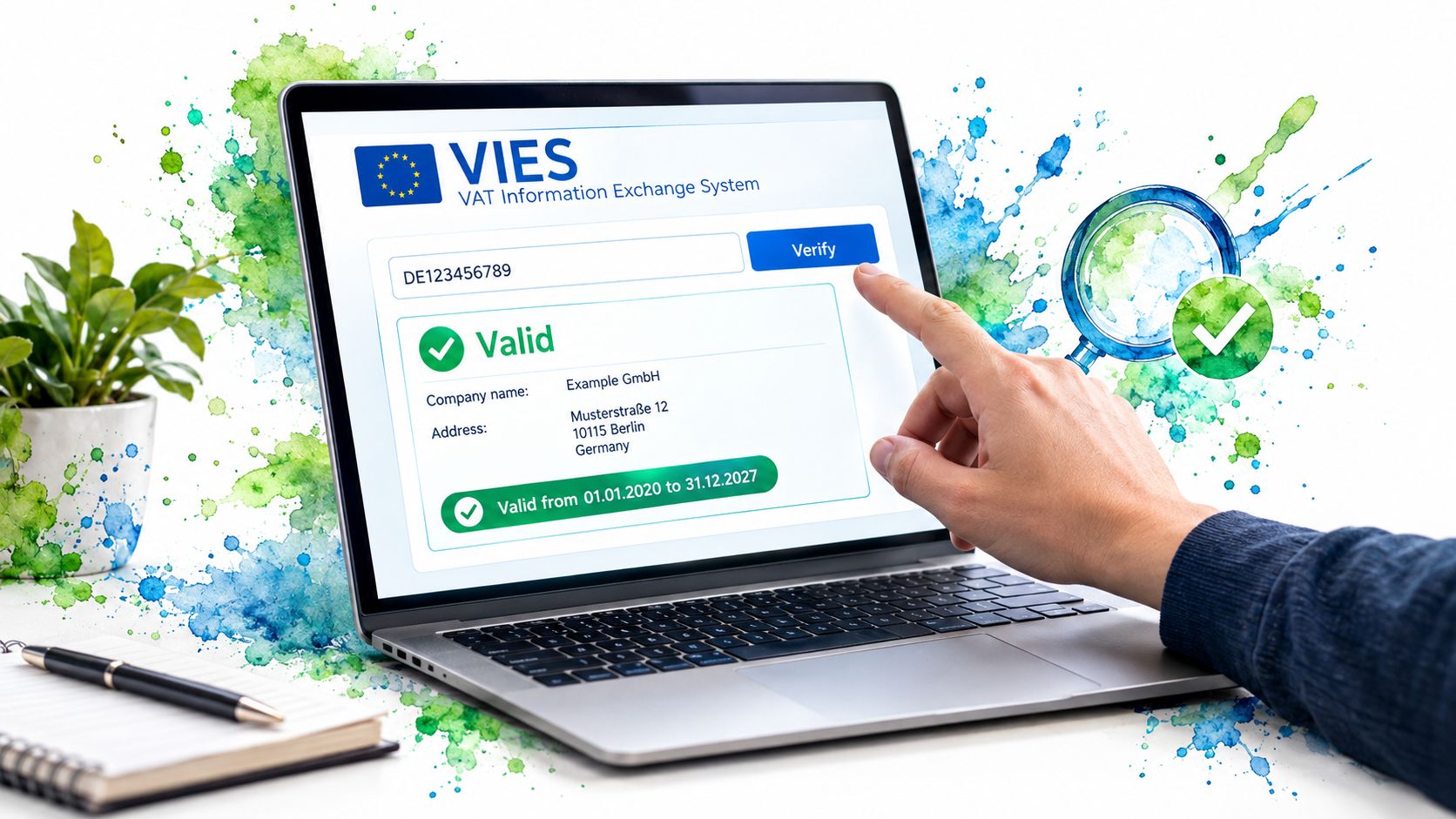
VIES is the official EU check, but use it for what it does. It queries the national VAT register behind the scenes. The European Commission is explicit on that point. VIES is a search engine, not a standalone database (official VIES validation portal).
How to use VIES properly
Run the check the same way every time.
- Choose the issuing country carefully: A valid number will fail if you test it under the wrong member state.
- Keep evidence on the day you check: Save the result as a PDF or screenshot with the date visible.
- Tie the check to the transaction date: That matters far more than a random validation done weeks later.
- Compare the returned details to your customer file: If VIES shows a name or address, match it against the invoice and onboarding documents.
- Escalate failed results with context: Ask for the registration certificate, recent invoice details, and confirmation from the local tax authority if the deal is material.
Fresh numbers are the usual trouble spot. Independent guidance notes that VIES can lag after a new registration and that the result is time-stamped evidence, not a permanent guarantee (practical VIES reliability guidance).
A valid VIES response proves what the system returned at that moment. It does not guarantee the number will remain valid later.
Here's a walkthrough video if you want your finance staff to see the interface before using it in production.
What to do when a number is missing
Do not reject the invoice on the spot.
For a newly issued VAT number, wait, recheck, and collect backup documents. For an older number that still fails, treat it as a risk signal and stop assuming the customer qualifies for zero-rated intra-EU treatment. That is where founders lose money. They rely on a customer's email signature, skip proper validation, and then discover during a VAT review that the exemption evidence was weak.
VIES is also affected by how EU VAT reporting is changing. As OSS use expands for online sellers and e-invoicing controls keep spreading across member states, your VAT number is no longer just a format on an invoice. It is an operational asset tied to checkout logic, tax determination, and audit evidence. In 2026, online sellers should treat VIES checks as part of order flow and customer onboarding, not as an occasional back-office task.
My recommendation is simple. Use VIES first. Then use common sense, onboarding documents, and local confirmation where the transaction value or risk justifies it.
Bulgaria vs Other EU Bases for Non-Resident Founders
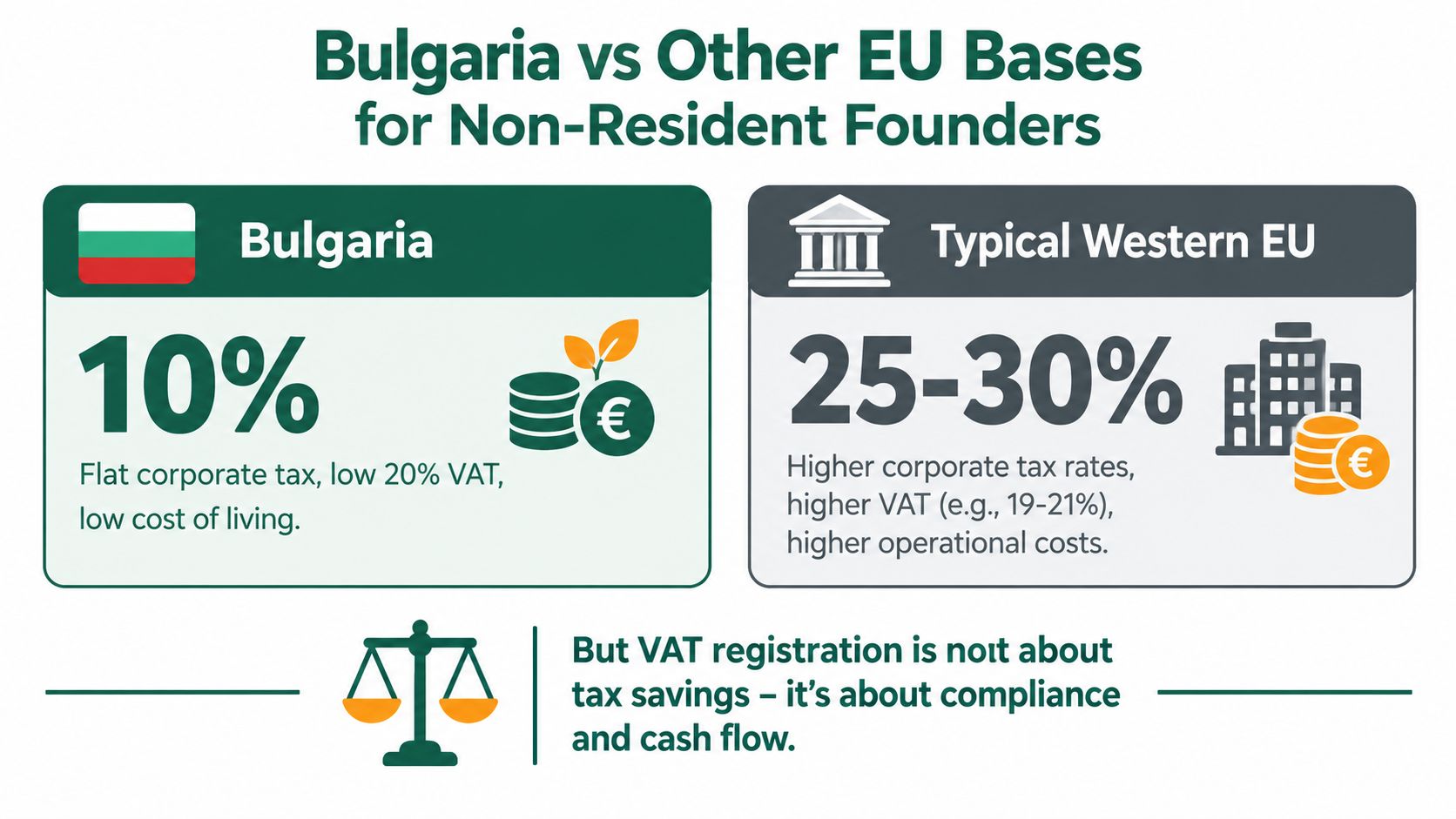
Bulgaria gets attention for the right reason and the wrong reason. The right reason is cost structure. The wrong reason is the fantasy that low corporate tax somehow removes VAT obligations. It doesn't.
Bulgaria's corporate tax rate is 10%, widely cited as the lowest corporate income tax rate in the EU, which makes it attractive for founders choosing an EU base. But the VAT side still turns on your business model and turnover-based registration rules, not on corporate tax alone (Bulgaria business compliance overview).
Why Bulgaria works for some founders
If you want an EU company, a lower corporate tax environment, and a setup that can be handled remotely, Bulgaria is a serious option. The practical appeal is stronger when you pair it with online incorporation, EU IBAN planning, accounting, and VAT administration under one roof.
What Bulgaria does not do is exempt you from OSS, invoice rules, or buyer verification. If you sell cross-border into the EU, you still have to handle VAT properly. If you hold stock in another member state, you still need to assess local registration there.
Comparing Bulgaria with Western EU bases
Founders need discipline.
- Choose Bulgaria if: you want an EU platform company, lower corporate tax, and straightforward remote setup.
- Choose a different base if: your commercial reality is tightly tied to a specific local market, warehouse network, or buyer ecosystem in another member state.
- Don't choose any country on tax headlines alone: your VAT footprint follows your transactions, inventory, and invoicing pattern.
Low corporate tax is nice. Clean VAT execution matters more once your business starts moving goods or billing serious B2B customers.
The best country isn't the one with the best headline rate. It's the one that matches your operating model without creating filing sprawl.
Common Mistakes That Cost Time and Money
The biggest error is treating the European VAT registration number like a one-time formality. It isn't a trophy. It's a live compliance asset.
Tax authorities can deactivate registrations when businesses stop filing properly or ignore official queries. I won't invent a neat universal rule here because there isn't one across the EU. What matters is the pattern. Founders get the number, celebrate, then forget the maintenance. That's how registrations go stale and invoicing gets disrupted later.
The mistakes I see most often
- Using a customer's claimed VAT number without verification: If you don't keep evidence of the VIES result at the time of supply, you weaken your file immediately.
- Quoting the number before the effective date: A certificate with a future start date is not a green light to use the number early.
- Ignoring OSS when it fits the model: Some sellers pile up local registrations when the Union scheme would have simplified a large part of their reporting.
- Using the VAT number on the wrong marketplace flows: Deemed-supplier rules can change who is treated as making the supply for VAT purposes.
- Misreading prefixes: Greece uses EL for VAT purposes. Northern Ireland uses XI only in the relevant EU-facing goods context.
The cost of sloppy evidence
A VAT number alone doesn't defend a position. The evidence around it does.
Keep the certificate, keep the effective date, keep the VIES check, keep the invoice trail. If one piece is missing, disputes get expensive fast.
I'm especially hard on founders who skip process discipline because the fix is cheap. Build one folder per registration. Store the certificate PDF, filings, portal confirmations, VIES evidence, and authority correspondence in one place. That single habit saves ugly cleanup later.
Your Action Checklist for 2026
If you want this under control, don't start with theory. Start with your transaction map.
Do these five things this week
- Map where you sell and where you store stock. List every EU country tied to inventory, B2B invoicing, or sustained B2C sales.
- Classify your exposure. Separate cross-border consumer sales from local sales and stockholding situations.
- Decide between OSS and direct registrations. If cross-border B2C is your main issue, OSS is often the cleanest route. If you store stock locally, direct local obligations may still apply.
- Audit your buyer evidence. Pull recent B2B invoices and check whether you saved VIES validation evidence on the invoice date.
- Create a filing calendar. Add return deadlines, revalidation reminders, and response deadlines for tax authority notices.
The operating habits that keep you safe
Use the VAT number actively, not passively.
- Revalidate customer VAT IDs on each relevant invoice date.
- Archive the proof immediately.
- Check certificate effective dates before your team starts invoicing.
- Review your sales channels quarterly, especially if you add warehousing or marketplaces.
If your setup is still messy, fix the structure before peak trading months arrive. VAT problems are much easier to prevent than to unwind.
Clean VAT handling isn't complicated once you make it operational. It gets complicated when founders delay decisions and let three different sales models pile into one broken workflow.
A European VAT registration number should sit at the center of your EU sales process, not at the edge of it. Register in the right place, document every check, and treat VIES as evidence, not magic. That's how you stay fast without getting sloppy.
FastCorp helps non-resident founders set up Bulgarian companies, obtain EU VAT registration, and keep the ongoing accounting and compliance work aligned with real cross-border trading. If you want one team to handle the company formation side, the VAT setup, and the practical paperwork around it, visit FastCorp.