VAT Returns Explained for Non-Residents Filing Online
VAT returns explained for EU and Bulgarian companies. Learn how filing works, deadlines, penalties, online steps, and how FastCorp handles it all.
You've just had your Bulgarian EOOD approved. A customer invoice is ready to go, your NRA inbox has started sending notifications, and you're looking at an online tax portal from another country, wondering what needs to happen next. For a non-resident founder, the challenge isn't just understanding VAT. It's turning the rules into a reliable digital routine.
VAT returns explained: you report VAT charged to customers, account for eligible VAT paid on business purchases, and settle the difference according to the rules where you're registered. Bulgaria's process is online, but the return still depends on accurate records, correct transaction treatment, and a deadline you can't ignore. This guide covers the calculation, the EU framework, Bulgarian filing, common cross-border issues, and what to delegate so you're not left navigating the form alone.
Table of Contents
- Why VAT Returns Matter From Day One
- What a VAT Return Actually Is
- How the EU VAT System Fits Together
- Bulgaria's Filing Obligations at a Glance
- Bulgaria Versus Other EU VAT Regimes
- The Monthly Online Filing Workflow
- Penalties, Recoveries, and the Cost of Getting It Wrong
- How FastCorp Handles VAT Returns End to End
Why VAT Returns Matter From Day One
The first VAT invoice changes your day-to-day responsibilities. You're no longer just recording revenue. You're tracking tax collected for the authorities, keeping evidence for any VAT you plan to reclaim, and making sure the right figures reach the Bulgarian National Revenue Agency, or NRA, on time.
A VAT return is a periodic report by a registered business. It declares VAT charged on sales and VAT the business can reclaim on eligible purchases. The difference determines whether the business pays tax or may be due a repayment, subject to the applicable rules. The UK government's VAT statistics guidance also distinguishes when a tax liability arises, when it's declared, and when cash is paid. Those events can fall on different dates, so don't treat a filed return as proof that payment has already happened.
For a Bulgarian company, compliance is built around online records and submissions. You'll need to understand which sales and purchases belong in the reporting period, whether a transaction has special cross-border treatment, and whether you also need to report qualifying EU transactions through VIES. The Bulgarian filing deadline is particularly important: registered businesses submit monthly, even when the month had no supplies.
Practical rule: Treat VAT money as a liability while it's in your account. Don't plan to spend it as if it were ordinary working capital.
The aim isn't to make you a tax specialist. It's to help you spot what the return is asking, keep the evidence your accountant needs, and establish a process you can follow from anywhere.
What a VAT Return Actually Is
A VAT return is a reconciliation between output VAT, the tax charged on customer invoices, and input VAT, the tax paid on eligible business purchases. EU guidance on VAT returns describes returns as reporting VAT charged to customers and VAT charged by suppliers, alongside the amount payable or refundable.
Take a simple illustrative example. You issue a consulting invoice for €1,000 before VAT, with 20% VAT, so the customer is charged €200 in VAT. You also pay for a SaaS subscription costing €500 before VAT, with €100 in input VAT. If that purchase is eligible for deduction and the records support the claim, the basic calculation is €200 minus €100, leaving €100 payable.
Output VAT − deductible input VAT = net VAT position
That formula is the starting point, not permission to deduct every tax-bearing expense. A purchase has to qualify under the rules that apply to your registration, and you need appropriate evidence. If an expense is private, exempt, or otherwise non-deductible, do not treat its VAT as recoverable merely because the company paid the invoice. Official UK input-tax guidance illustrates why invoices and the nature of a purchase matter when supporting a claim.
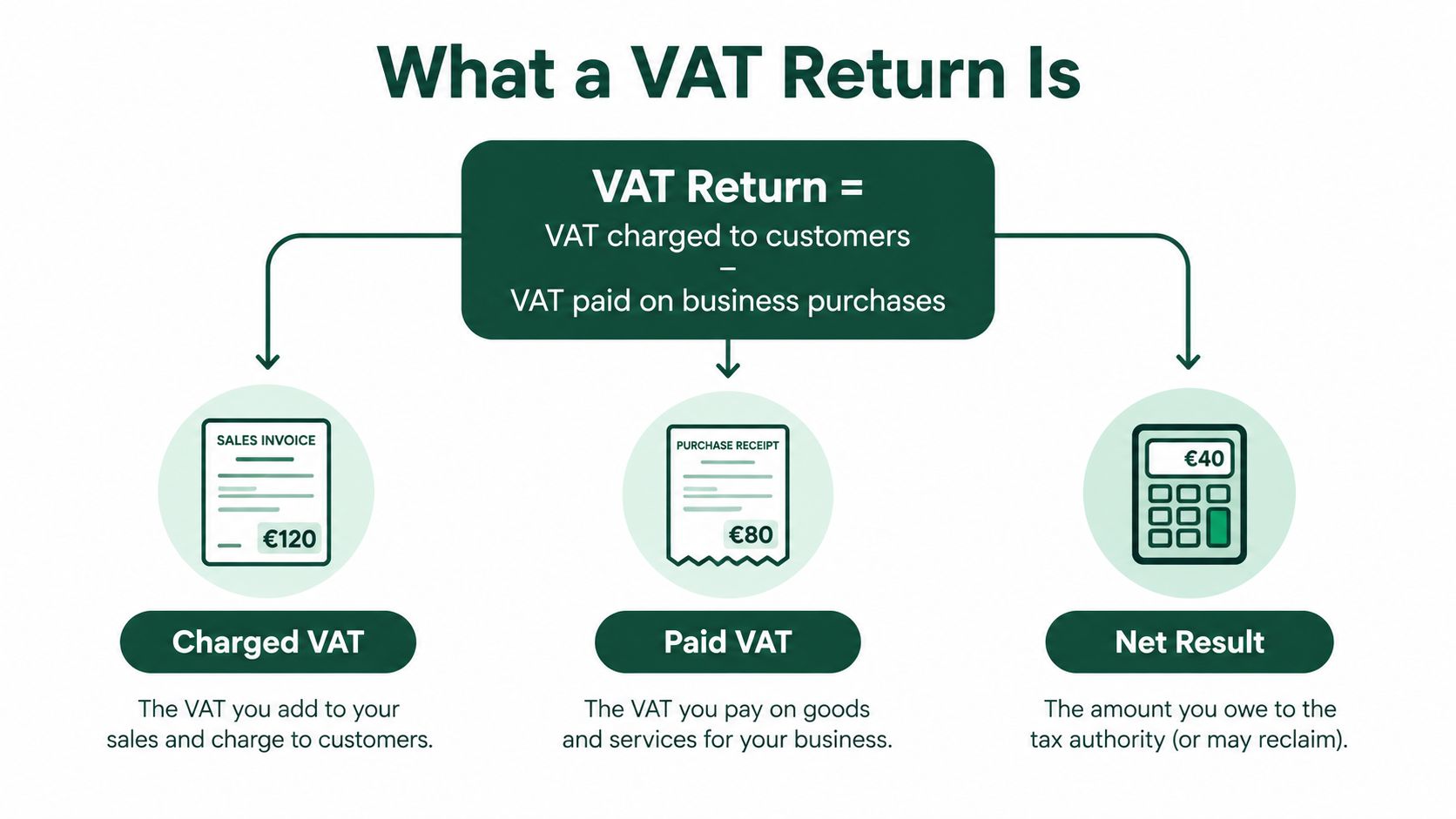
Keep three dates separate in your records. The accrual date is when the liability arises, the declaration date is when you report it, and the cash-receipt date is when payment reaches the authorities. A return reports a liability; it doesn't mean the cash has moved. The repeatable version for your co-founder is simple: charged VAT less eligible paid VAT gives the return's net position, and filing and payment are separate actions.
How the EU VAT System Fits Together
A Bulgarian EOOD sits inside a shared EU VAT framework, but it still follows Bulgarian filing procedures. VAT is a staged consumption tax: businesses charge it on sales, recover eligible VAT on purchases, and account for the net amount through returns. This approach helps avoid taxing the full value of a product repeatedly at every stage of its supply chain.
The common framework has historical roots. In April 1967, the European Economic Community adopted its first two VAT directives, laying the groundwork for a common system to replace different national turnover taxes. The European Commission's VAT history and policy document describes that move toward shared VAT principles. For a founder, the practical point is that common EU concepts don't create one universal filing portal or erase national requirements. Bulgaria sets the process for a Bulgarian registration, while other countries retain their own rules on matters such as rates, deadlines, and administration.
That distinction matters when your Bulgarian business sells to customers in Germany, France, or the Netherlands. You need to classify each transaction correctly, establish which country's rules apply, and keep records that support the treatment. Don't assume that your company's location settles every cross-border VAT question.
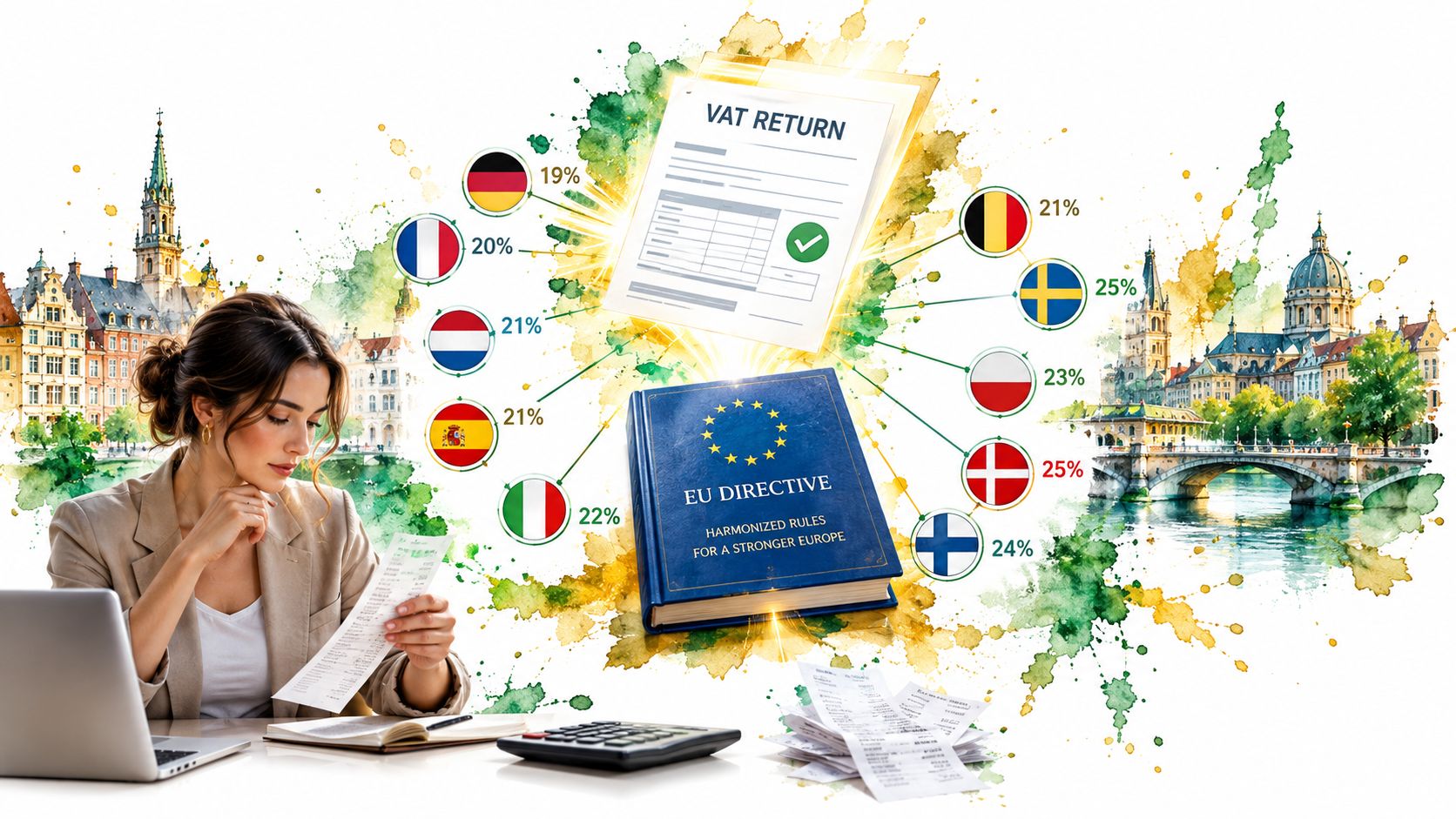
For certain qualifying sales to consumers in other EU countries, the One Stop Shop (OSS) can simplify reporting. A business may use an online portal in its chosen EU country of identification to file a single return and make a payment for transactions covered by the scheme, rather than registering separately in every customer country for those transactions. OSS isn't a replacement for every local VAT return or every cross-border obligation. First identify the customer, classify the supply, check whether OSS applies, then report it through the correct channel. The EU's business VAT guidance outlines this destination-based approach and the differences between transaction types.
Bulgaria's Filing Obligations at a Glance
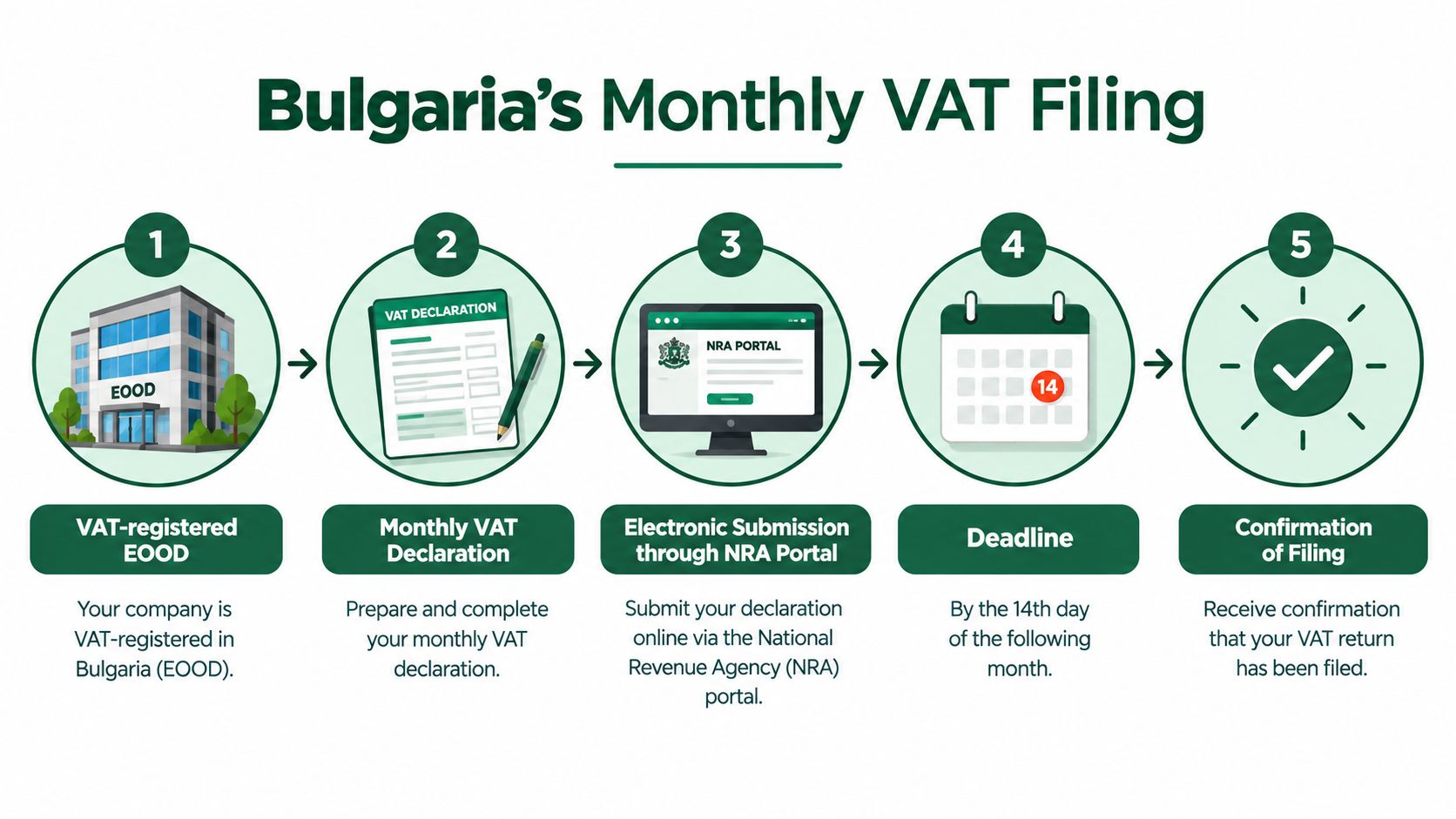
For a VAT-registered Bulgarian EOOD, the routine is monthly and electronic. The company files its VAT declaration through the NRA system by the 14th day of the month after the reporting month. The sales and purchase ledgers go with the return, and a business must still file when it had no supplies during the month. Bulgarian Ministry of Finance guidance sets out the monthly declaration, supporting registers, and applicable VIES filing deadline.
Those ledgers aren't optional paperwork to tidy up later. They show which invoices and purchases support the figures in the declaration. If an invoice lands in the wrong period, goes missing, or has the wrong VAT treatment, both the reported totals and the amount payable can be wrong.
A qualifying intra-community supply can also require a VIES declaration, a separate information filing for specified transactions with EU customers. Service businesses shouldn't assume VIES is only for sellers of physical goods. Check the classification and customer details for cross-border services as well as goods, and confirm whether the transaction triggers a declaration. Bulgarian VAT reporting guidance also confirms that businesses submit the return and ledgers electronically and file VIES when applicable.
In practice, a Bulgarian VAT-registered company should keep its sales and purchase records complete, reconcile the ledgers, submit the return and attachments, pay any resulting balance, and file VIES where required. The exact reason a company must register depends on its circumstances and the applicable rules, so check the position before trading rather than assuming that incorporation alone answers the VAT question. For an overview of the registration step, see FastCorp's guide to VAT registration in Europe.
Bulgaria Versus Other EU VAT Regimes
The VAT calculation follows a shared principle across the EU, but each country runs its own administration. Rates, filing schedules, deadlines, and portals differ, and they change. Before you invoice customers in Germany, Ireland, or the Netherlands, confirm the current requirements with each tax authority or your adviser. Pricing a cross-border offer on a rate you read in an old forum thread is how founders undercharge and then fund the difference themselves.
Four questions tell you where you stand in any EU country:
- Where is your business registered for VAT?
- Where is each transaction treated as taxable?
- What evidence supports that treatment?
- Which return or reporting scheme applies?
A VAT number in one EU country does not cancel obligations created by sales into another. If you sell to a customer in a country where you hold no registration, settle who accounts for the tax before you send the invoice. B2B supplies frequently fall under the reverse charge, so the customer handles the VAT in their own return. Certain B2C distance sales can be reported through the One Stop Shop instead of a local registration. Charging Bulgarian VAT on everything by default gets the treatment wrong in both directions.
Your work in the NRA portal covers Bulgaria only. Everything beyond it lives in other portals, other schemes, or the customer's own return. When FastCorp manages your filings, the team confirms which regime applies to each sale, so you never complete a foreign form yourself.
Treat every cross-border invoice as a two-country question: what Bulgaria expects in the NRA return, and what the customer's country expects from you or from them.
The Monthly Online Filing Workflow
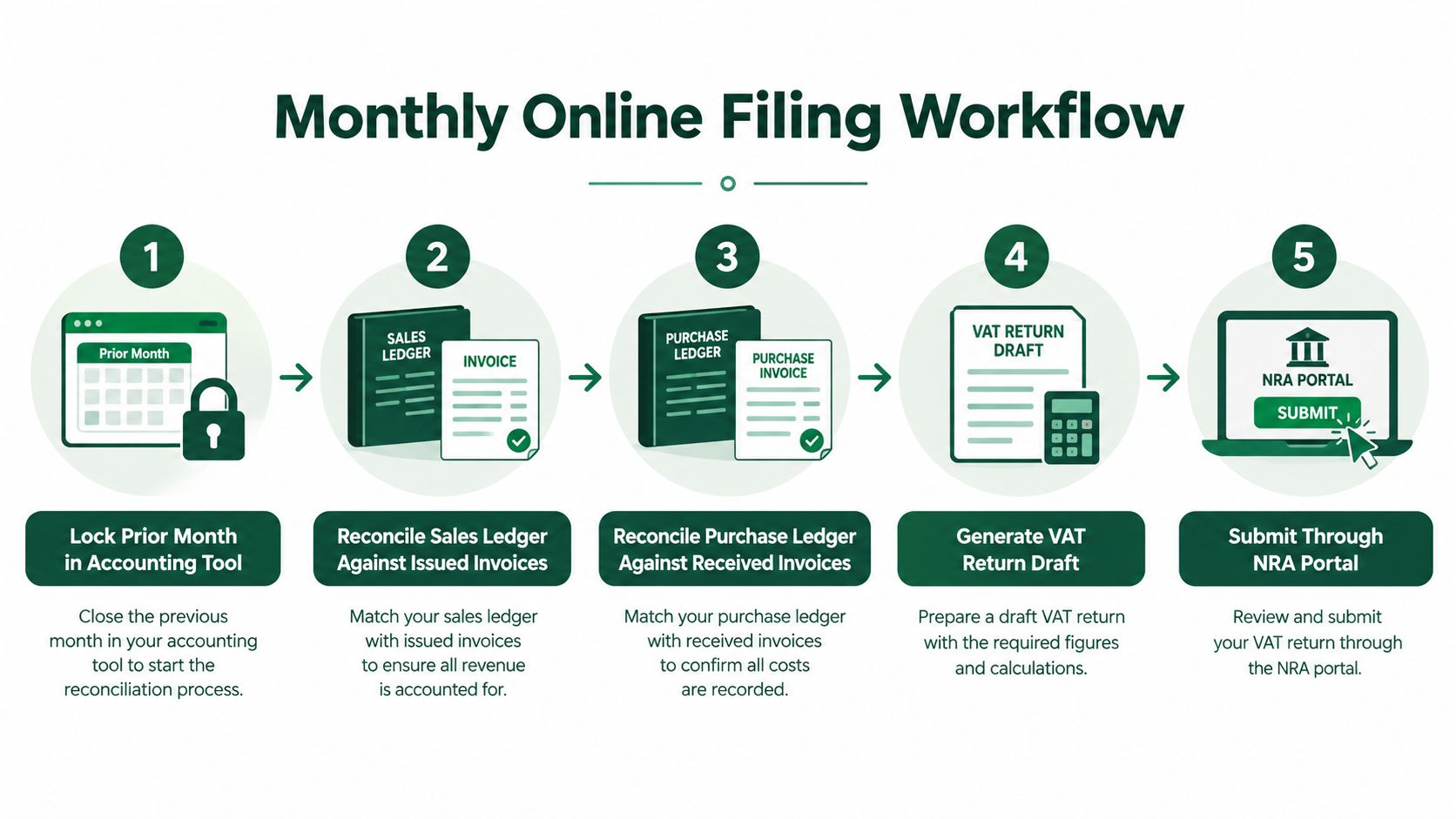
A clean filing starts before you open the NRA portal. Close the reporting month in your accounting tool, then check that the recorded transactions match the documents. The portal submission is the final step of a review, not a substitute for one.
- Lock the period. Stop routine changes to the month's records while you reconcile. If a late invoice needs to be included, document the reason and confirm the correct period.
- Match sales to invoices. Compare the sales ledger with the invoices you issued, and check customer details, invoice dates, tax treatment, and amounts.
- Review purchases and import evidence. Match supplier invoices to the purchase ledger. Separate eligible input VAT from costs that don't support a claim, and keep the records for imports and foreign-currency transactions.
- Check cross-border treatment. Validate EU customer VAT details and review whether a transaction needs reverse-charge treatment or VIES reporting. For help checking customer identifiers, use FastCorp's European VAT number validation guide.
- Prepare and submit. Reconcile output VAT against eligible input VAT, prepare the return and both ledgers, then submit through the NRA system. Arrange payment of any balance by the deadline and file VIES separately when required.
Imported services deserve particular attention. The supplier's location and the nature of the service can affect whether reverse-charge treatment applies, so don't copy the VAT handling from a domestic purchase without checking the transaction. Service businesses selling across borders should also confirm the place-of-supply treatment before sending invoices. These aren't details to settle by looking at the customer's address alone.
A provider should be able to show you how it reconciles invoices to ledgers, handles cross-border classifications, checks VIES triggers, and confirms submission and payment. Many non-resident founders delegate that work to an accountant or bundled compliance provider rather than preparing and submitting the form themselves. The key is to know what's being checked on your behalf.
Penalties, Recoveries, and the Cost of Getting It Wrong
A missed filing or payment can expose a business to penalties and interest under the relevant rules. Poor records can also put a VAT claim at risk, especially when the invoice doesn't support the deduction or the purchase doesn't qualify. The answer isn't to assume every mistake leads to the same outcome. It's to fix errors promptly and get advice on the correction procedure that applies.
Refunds are the other side of the return. If eligible input VAT exceeds output VAT, the result may be a credit or repayment, subject to local verification and carry-forward rules. Accurate ledgers make it easier to support that position. In contrast, an unsupported claim or a return that doesn't match the underlying records can create extra questions and delay resolution.
Don't optimize for the fewest clicks. Optimize for a return you can explain invoice by invoice.
Build a predictable monthly close: keep the records current, flag unusual cross-border transactions, confirm what's due, and retain submission and payment confirmations. If you outsource, ask who reviews the figures, who files, and how you'll be told when the NRA has accepted the submission. Delegation should make the process more visible to you, not less.
How FastCorp Handles VAT Returns End to End
A provider can take over the routine work, but you should still understand the handoffs. FastCorp offers Bulgarian company setup alongside VAT registration, bookkeeping, VAT return preparation and filing, and ongoing compliance support. Its online bookkeeping service is relevant to the work behind the return: organizing the records, reconciling sales and purchases, and preparing recurring reports.
For a non-resident founder, the useful feature is continuity. The same provider can help set up the company and then support the accounting and filings that follow, rather than leaving you to coordinate every task yourself. You supply complete invoices and transaction information; the provider prepares the records and filing, flags questions, and confirms what needs your approval or payment. You should agree in advance how payment is coordinated and who has authority to submit returns on the company's behalf.
FastCorp describes its setup as fully online or in person in Sofia, with company formation, VAT and accounting services available through the same business. Before engaging any provider, ask for a clear scope: whether the service includes the monthly declaration, sales and purchase ledgers, VIES where required, deadline monitoring, and communication about exceptions. No provider can file accurate returns without timely, complete transaction data from you.
Keep this founder checklist close:
- Confirm registration: Check whether and when your business must register for VAT.
- Share records each month: Provide complete sales and purchase invoices, plus information about imports and cross-border transactions.
- Ask about VIES: Confirm whether your EU supplies trigger a separate declaration.
- Verify filing and payment: Make sure the return and any balance are handled by the Bulgarian deadline.
- Review your VAT position: Check whether the return creates an amount due, a credit, or a potential refund, and ask what evidence supports it.
If you want a Bulgarian company with VAT registration, monthly filing, bookkeeping, and ongoing compliance coordinated online, contact FastCorp to discuss what your business needs. Set up the process before the first filing deadline, and make sure you know who will prepare, submit, and confirm each return.