What Is Tax Compliance? a Founder's Guide to Bulgaria
What is tax compliance? Learn the essentials for Bulgarian companies — registration, returns, withholding, recordkeeping, and how ongoing accounting keeps you

You've found Bulgaria's 10% corporate tax rate, compared a few other EU countries, and you're ready to register a company and start invoicing clients. Then someone asks about VAT registration timing, place of supply, payroll withholding, and whether you might create a personal tax obligation where you live. Suddenly the low rate feels like only half the story.
That's exactly where most cross-border founders get caught. Understanding what is tax compliance means shifting from "what rate do I pay?" to "what do I need to register, record, report, prove, and pay, and when?" Once you build that system, almost everything in Bulgaria can be handled online, and compliance becomes a calm monthly routine instead of a yearly scramble.
Table of Contents
- What Tax Compliance Actually Means
- The Five Pillars of Tax Compliance
- The Real Cost of Getting It Wrong
- How Bulgaria Compares to Other EU Countries
- A Cross-Border Company's Compliance Journey
- How Ongoing Accounting Services Keep You Compliant
- Building Compliance Into Your Business From Day One
What Tax Compliance Actually Means
Think of a founder named Jonas. He forms a Bulgarian company, files his first corporate tax return, and happily assumes he's done for the year. Then he learns he should've been filing VAT returns during the year, reconciling his sales ledger, and keeping evidence for every reverse charge invoice. He didn't avoid tax. He just missed the system around it.
Tax compliance is the timely and accurate fulfillment of legal tax obligations, including registering where required, filing returns, reporting correct income or transactions, paying by the deadline, and retaining supporting records. You can see that full definition reflected in the IRS explanation of the tax gap and voluntary compliance, which measures the difference between tax legally owed and tax paid voluntarily and on time.
It's a System, Not a Single Filing
A helpful analogy is navigation. Paying tax is reaching the destination. Compliance is the route, the fuel checks, the logbook, and arriving on schedule. If you arrive late, take the wrong road, or can't show where you've been, you've still got a problem.
A business may owe the correct amount yet remain noncompliant if it files late, misses a VAT declaration, fails to withhold payroll taxes, or can't substantiate reported figures.
For a Bulgarian company, that system usually covers several layers at once:
- Company level: corporate income tax, VAT registration and periodic returns, and accounting records that match your filings.
- Transaction level: correct invoicing, deductibility evidence, customer location and status for VAT, and related party pricing.
- People level: payroll taxes if you hire, and the founder's own residence and reporting duties where they live.
Why the Admin Side Counts
Compliance isn't free of effort, even when the tax itself is simple. The World Bank Paying Taxes 2014 study across 183 economies found a standardized company needed an average of 268 hours per year, made 26.7 payments, and faced an average total tax rate of 43.1% of commercial profits.
That same research showed compliance time had fallen by 55 hours over the preceding nine years, and earlier data linked online filing to about 44 days to comply versus 58 days without it. That's your first practical lesson. Digital filing, clean bookkeeping, and a deadline calendar aren't back office niceties. They're the controls that make low tax usable.
The Five Pillars of Tax Compliance
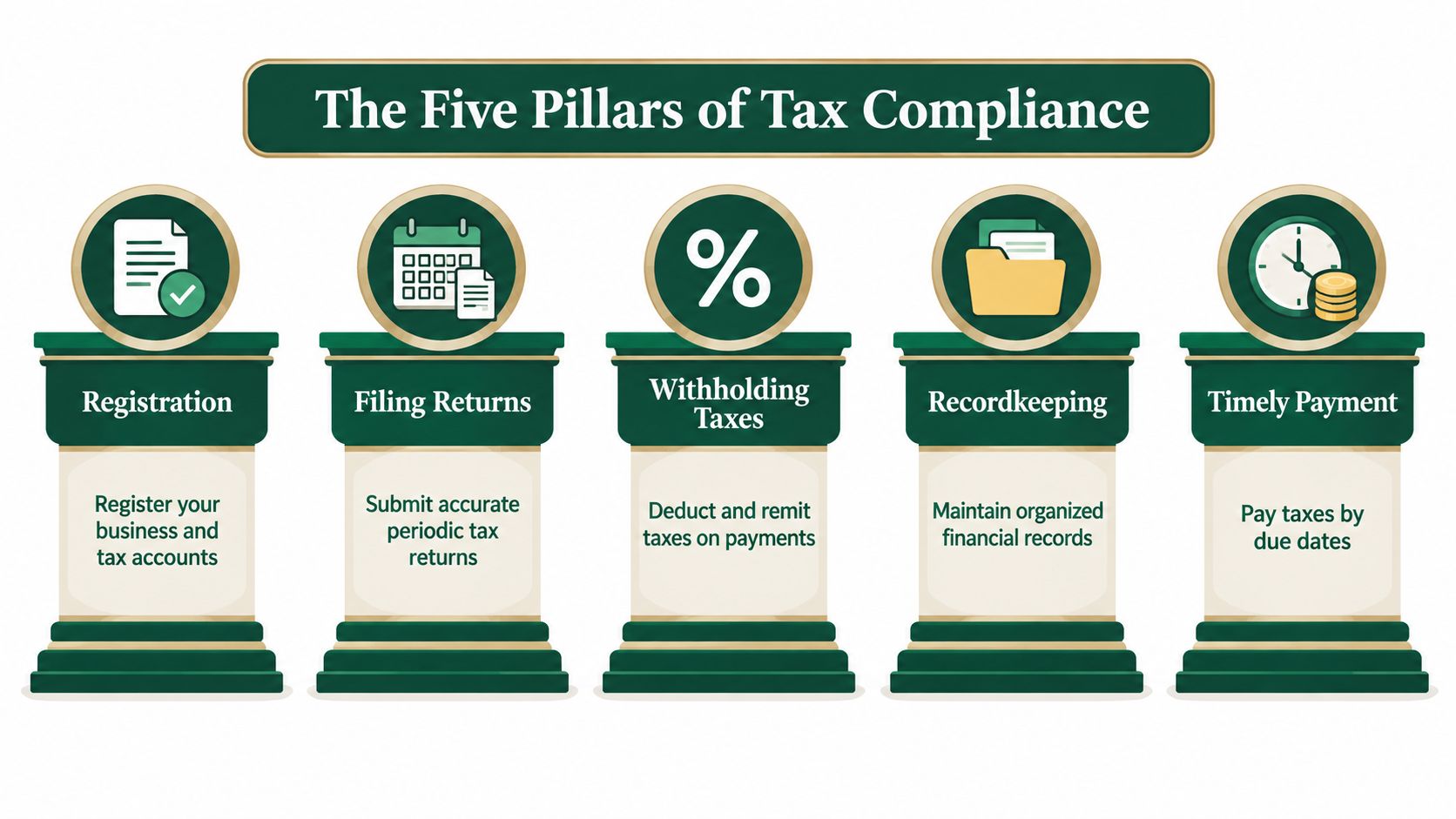
If compliance feels vague, break it into five pillars. Each one stands on its own, and a crack in any single pillar can cause trouble even when the other four look solid.
This hierarchy gives you a simple mental model to check each month:
Registration and Filing Returns
Registration comes first. Before you trade, confirm your legal entity, tax accounts, VAT status, and any payroll registrations. In Bulgaria, timing can surprise nonresidents. A non-Bulgarian entity may need Bulgarian VAT registration seven days before its first taxable Bulgarian supply regardless of turnover, a rule highlighted in Deloitte's 2025 Bulgaria tax highlights.
Filing returns is where you report what happened, at the right frequency. That can mean periodic VAT returns, payroll reporting, and an annual corporate return. If you're new to the annual piece, start by learning what a corporate tax return involves and how it fits the year end process so your monthly work feeds cleanly into it.
Withholding, Records, and Payment
Withholding taxes means you sometimes act as the collector. When you pay employees or certain other recipients, you deduct the required amount and remit it. The company didn't create that tax for itself, but it's responsible for getting it right.
Recordkeeping is the pillar founders underestimate most. A strong monthly control maps every ledger account to its tax treatment, separates non-deductible costs, flags reverse charge transactions, and reconciles VAT output and input registers to the general ledger. Keep who prepared, reviewed, approved, and filed each return. That audit trail turns "we think it's right" into "here's the evidence."
- Invoices and contracts: proof of what you sold, to whom, and where.
- Bank records and payment receipts: proof money moved as reported.
- Filing confirmations: proof you submitted on time.
Timely payment closes the loop. Filing an accurate return but paying late is still a failure. Treat payment references and deadlines as part of the return itself, not an afterthought. When the five pillars work together, your books, returns, and bank tell the same story. That's compliance in practice.
The Real Cost of Getting It Wrong
Getting compliance wrong rarely starts with dramatic evasion. It starts with a missed registration, a miscoded invoice, or sales that don't reconcile. Then interest, penalties, and questions stack up.
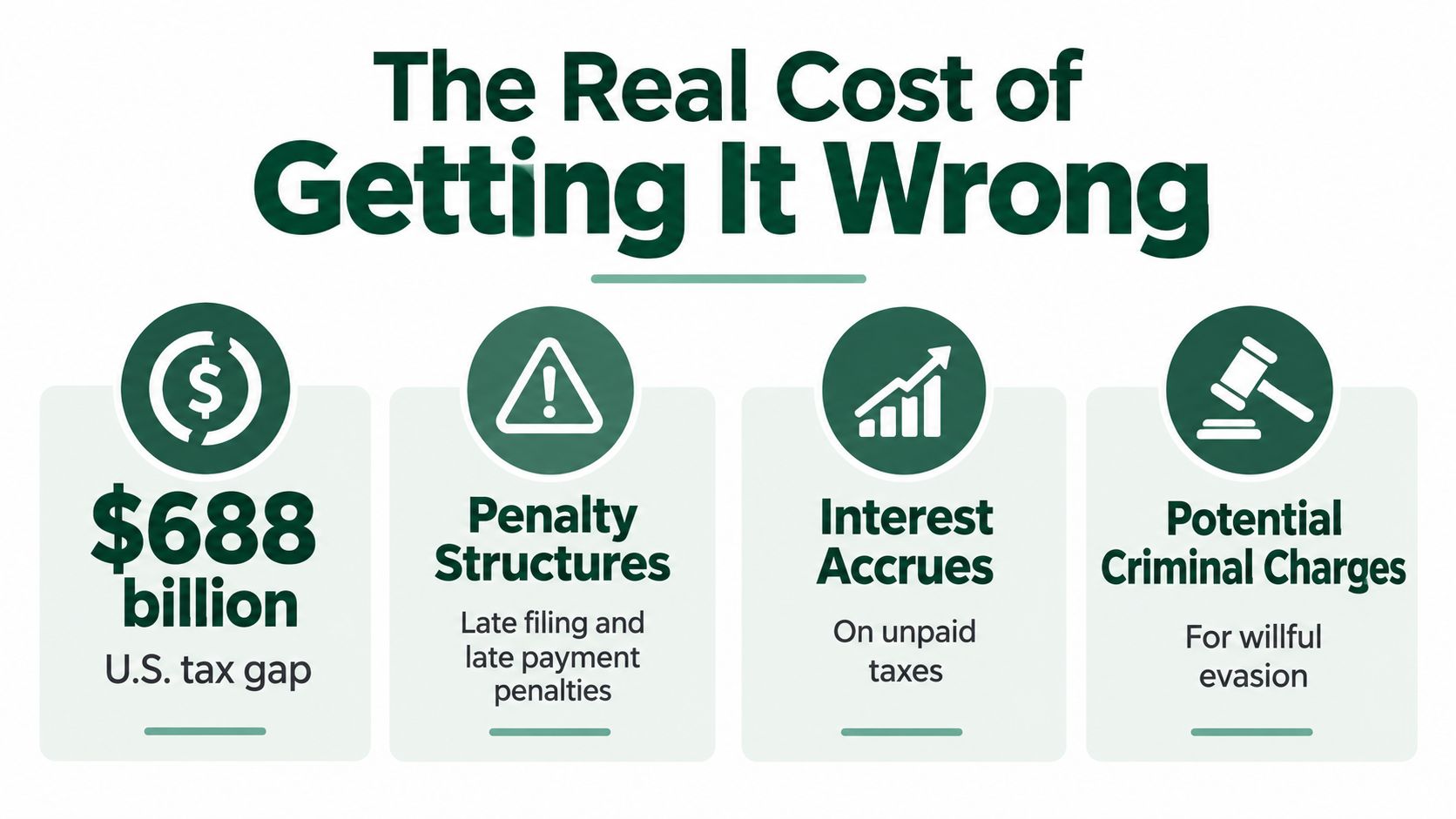
The scale is easier to grasp with real numbers:
What the Tax Gap Teaches a Small Company
For U.S. tax year 2022, the gross tax gap was projected at $696 billion, with a voluntary compliance rate of 85.0%. In plain terms, about $85 of every $100 in true liability was paid correctly and on time, rising to 86.9% after enforcement and late payments.
The breakdown matters more than the headline for your business:
- Nonfiling at $63 billion: returns that never arrived.
- Underreporting at $539 billion: income or transactions reported incorrectly, about 77% of the total gap.
- Underpayment at $94 billion: tax reported but not paid on time.
Underreporting dominates. That tells you where to invest your effort, in accurate declarations and transaction records, not just in remembering to file something.
Practical rule: Most risk lives in classification and evidence, not in the act of submission itself.
Penalties Turn Small Errors Into Material Costs
Under U.S. rules described in the IRS accuracy related penalty guidance, an accuracy related penalty generally equals 20% of the underpayment attributable to negligence, disregard of rules, or a substantial understatement. For individuals, substantial understatement is generally triggered when understated tax exceeds 10% of required tax or USD 5,000, whichever is greater.
VAT shows the same pattern at EU level. The European Commission VAT compliance gap estimate put the 2022 EU gap at EUR 89 billion, equal to 7.0% of total VAT liability, down from 11.2% in 2018 but up 0.4 percentage points from 2021. Errors in place of supply, customer status evidence, VAT numbers, invoicing, and reverse charge treatment can create liability even when your sales total is complete. A small coding mistake, repeated monthly, becomes an audit sized problem.
How Bulgaria Compares to Other EU Countries
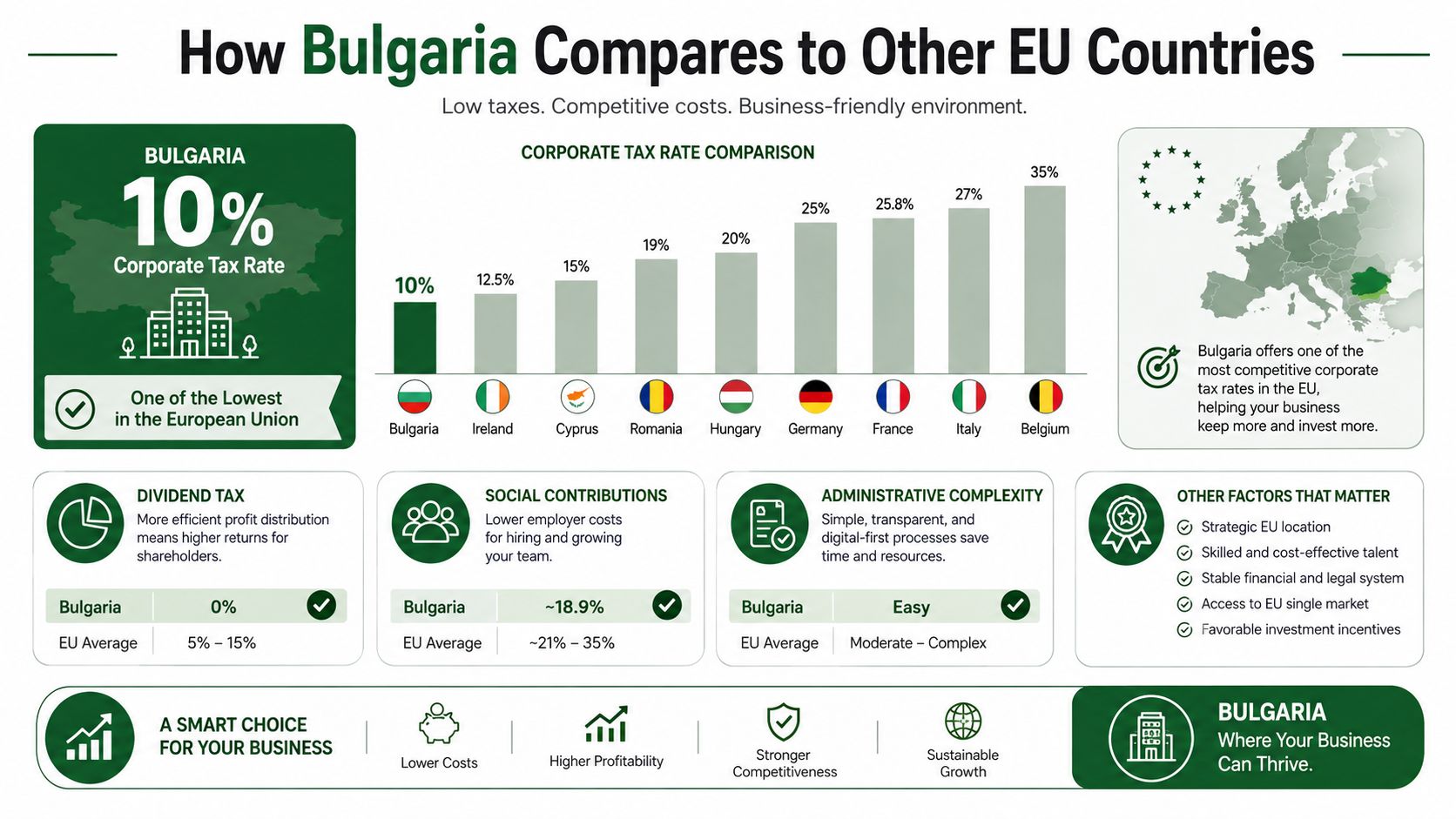
Bulgaria earns attention for a clear reason. Its corporate income tax rate is 10%, and its personal income tax also applies a 10% flat rate, according to Bulgaria in Figures from the Bulgarian Chamber of Commerce and Industry. The corporate rate arrived in 2007 and the personal rate in 2008, so this isn't a temporary promotional regime.
That's a genuine advantage, but smart founders compare more than the rate:
Bulgaria vs Other EU Markets at a Glance
| Metric | Bulgaria | Typical EU Alternative |
|---|---|---|
| Corporate income tax | 10% flat rate | Higher headline rate in many markets |
| Personal income tax | 10% flat rate | Often progressive rates |
| VAT duties | Registration, periodic returns, evidence by customer and supply | Similar VAT logic across the EU |
| Payroll and distributions | Contributions, dividend treatment, shareholder rules apply | Rules vary widely by country |
| Cross border risk | Residence, substance, and permanent establishment still matter | Same questions, different local answers |
Read the Table Like a Founder, Not a Tourist
The rate helps most when the rest of your structure is clean. Your effective burden depends on activities, tax residence, substance, employees, and whether you distribute profits. Dividend taxation, payroll contributions, transfer pricing, and management transactions can change the final picture.
There's also a cross border twist many guides skip. Bulgarian residents may be taxed on worldwide income, while nonresidents generally face tax on Bulgarian source income. The OECD overview of cross border and international tax frames why this gets complex for taxpayers and governments. Your Bulgarian company can be locally compliant while you personally trigger duties where you live and manage the business.
So compare countries in two passes. First, the headline rate. Second, the compliance map for your customers, team, management location, and profit extraction. Bulgaria wins pass one clearly. Pass two is where good advice protects that win.
A Cross-Border Company's Compliance Journey
Meet Maya, a fictional SaaS founder living outside Bulgaria who sells subscriptions to EU business customers. Her journey shows how obligations appear in a logical order when you build step by step.
Her first month is all setup, before the first invoice:

Before Trading and the First Sale
Maya confirms her entity, beneficial owner information, bank records, invoicing rules, and VAT treatment for each customer type. She doesn't assume a turnover threshold protects her. For established persons in Bulgaria, guidance noted a BGN 100,000 threshold for taxable supplies in a preceding 12 month period, with a temporary BGN 166,000 threshold from 1 January to 31 March 2025. Non-Bulgarian entities follow the earlier timing rule for Bulgarian supplies.
For each sale she asks five questions. Who's the customer? Where's the place of supply? Who accounts for VAT? What proof supports zero rating or reverse charge? Which records must she keep? She assigns taxability codes by customer location, customer type, and service classification, then links every invoice to that evidence. If she needs the filing mechanics, she reviews the VAT filing requirements for Bulgarian companies before her first return period closes.
The Monthly Rhythm and Year End
From month two onward, Maya runs a close to return reconciliation. She matches sales invoices, purchase invoices, bank transactions, payroll if she hires a developer, and VAT registers. Discrepancies get investigated before submission, not after a notice arrives.
This short walkthrough helps you visualize that monthly workflow in action:
At year end, there's no panic. Her monthly reconciliations feed the annual accounts and corporate return. Her main pitfalls were never dramatic. They were timing, evidence, and assuming her home country had no interest in a company she managed from her kitchen table. She handled all three early, and that's why the system stayed easy.
How Ongoing Accounting Services Keep You Compliant
You don't need to become a tax technician to stay compliant. You need a repeatable process, clear responsibilities, and someone checking the work before it's filed. That's what ongoing accounting services operationalize for a Bulgarian entity.
What a Good Provider Actually Does Each Month
Start with the calendar. Your provider identifies every applicable tax, registration, filing frequency, payment deadline, and record requirement, then works to that schedule. Bookkeeping, VAT returns, payroll, and annual filings stop being separate surprises and become one connected flow.
A practical service rhythm looks like this:
- Collect and classify: sales and purchase invoices coded by VAT treatment and deductibility.
- Reconcile: ledgers checked against bank data, VAT registers, and payroll records.
- Review and approve: totals, reverse charge items, and payment references checked independently.
- File and archive: returns submitted electronically, confirmations and correspondence stored.
If you want to see how that support is structured in practice, review the scope of ongoing accounting services for Bulgarian companies and compare it against your own transaction types.
Why Online Handling Is Now the Norm
This is the encouraging part. The OECD Tax Administration 2024 report on digital services reports that 97% of surveyed tax administrations allow taxpayers to register online, while online registration, filing, payment, objections, correspondence, and data uploads are available in around 90% or more of administrations. You can often handle compliance remotely through tax portals instead of paper forms.
Usage matches availability. OECD Tax Administration 2025 e-filing data shows approximately 96% of corporate income tax returns and 99% of VAT returns were filed electronically in 2023, compared with nearly 90% for personal income tax.
E-filing makes submission easy. It doesn't make classification, evidence, or payment optional.
Your provider should also verify local specifics, like electronic identification, digital signatures, or a local representative where required. Ask who prepares, who reviews, and where your audit trail lives. If those answers are clear, you've found a system, not just a filing service.
Building Compliance Into Your Business From Day One
Compliance built early feels almost invisible. Compliance retrofitted after a year of messy invoices feels expensive and stressful. The difference isn't talent. It's timing.
Your Day One Action Plan
Before trading, map company level and founder level duties separately. Confirm entity, registrations, bank setup, invoicing rules, and VAT treatment by customer and supplier location. Check management location, employee location, and place of supply, because those facts drive obligations beyond Bulgaria.
During your first month, set up secure online access, bookkeeping software or professional support, and a shared archive for contracts, invoices, filings, receipts, and authority messages. Decide your taxability codes now, while transaction volume is low.
Every month after that, reconcile before you file. The OECD guidance on mandatory electronic filing notes that around three-quarters of jurisdictions make e-filing mandatory for corporate income tax, employer withholding, and VAT. Missing an online deadline can create penalties even where no tax is ultimately due, so calendar discipline matters.
- Keep evidence by default: save customer status proof and VAT numbers with the invoice.
- Separate preparation and review: a second pair of eyes catches coding errors cheaply.
- Review when facts change: new country, new hire, new product, new compliance map.
Think of this as a competitive advantage. Clean records make banking, due diligence, customer onboarding, and future fundraising easier. Clients and partners trust a company that can explain its invoices and produce filings quickly. You chose Bulgaria for a smart rate and EU access. A simple, online, monthly compliance system is how you protect both, and spend your energy on customers instead of corrections.
If you're ready to turn that compliance map into a working Bulgarian company, FastCorp can handle your incorporation, EU VAT registration, bookkeeping, VAT returns, payroll, and annual filings fully online. Visit FastCorp to choose a setup package, share your customer and supplier locations, and get your first filing calendar built before you trade.