VAT for Digital Services: EU Rules and OSS Registration
Learn how VAT for digital services works in the EU: place-of-supply rules, OSS registration, rates by country and practical steps to file online.
For EU consumers, VAT for digital services generally follows the customer's country rate, and you can report eligible cross-border sales through one OSS portal instead of registering in every buyer's country. The expanded OSS system has operated since 1 July 2021.
You've built an app, connected your payment provider and started attracting subscribers abroad. Then your checkout asks which VAT rate to charge, and suddenly a German billing address, a French payment card and a business email address become important. The online administration is straightforward once you've settled those questions. Customer classification and location evidence need careful attention.
Table of Contents
- Who Pays VAT on Digital Services and Where
- Proving Where Your Customer Lives and Whether They Are a Business
- Digital Services VAT Rates Across Key Markets
- Choosing Between OSS and Local VAT Registration
- Invoice Wording, Records and Audit Evidence
- How to Register for OSS and File Your First Return
- Pre-Sale Checklist and Final Checks
Who Pays VAT on Digital Services and Where
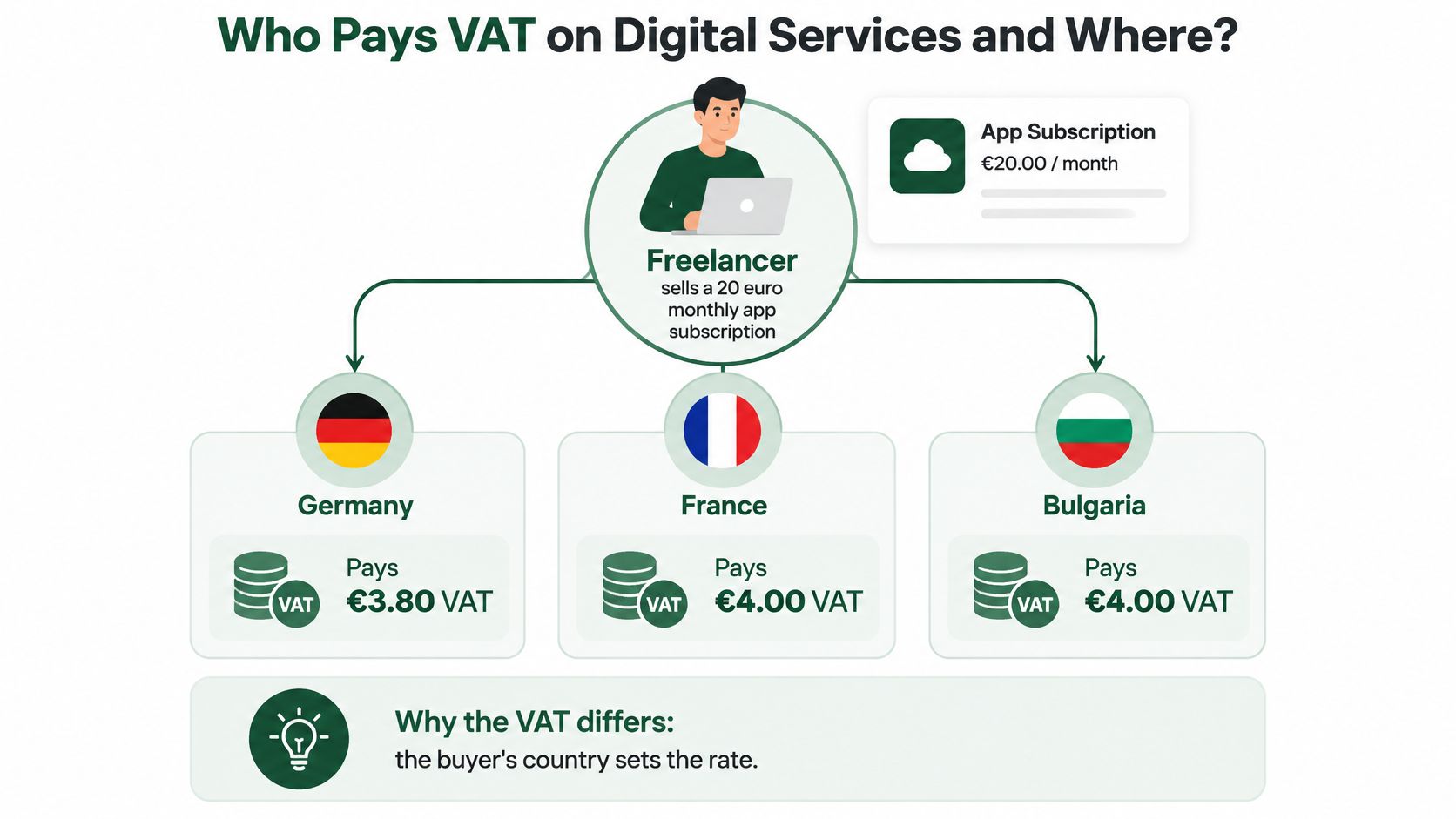
Say a freelancer sells a €20 monthly app subscription before VAT to customers in Germany, France and Bulgaria. Using the standard rates in the comparison below, the German buyer pays €3.80 VAT, while the French and Bulgarian buyers each pay €4.00. The product hasn't changed. The buyer's country determines the tax.
That's the destination principle: consumption tax generally belongs where the customer lives, not where the seller registered the company. Think of an address on a delivery label rather than the shop's postcode. For digital services, however, you need evidence of that destination because nothing physically ships.
The customer's status changes the treatment too. The following table assumes an EU-established seller making cross-border supplies under the normal destination-based rules.
Place of supply and VAT treatment by buyer type
| Buyer | Place of supply | VAT you apply | Where you report |
|---|---|---|---|
| EU consumer (B2C) | Buyer's member state | Rate of the buyer's country | Union OSS in your identification state |
| EU business with valid VAT number (B2B) | Buyer's member state | Normally no seller-charged VAT, customer applies reverse charge | National VAT reporting and EC Sales List where required |
| EU business without valid VAT number | Buyer's member state under the consumer treatment used at checkout | Rate of the buyer's country, treated as B2C unless business status is properly established | Union OSS in your identification state |
| Non-EU business (B2B) | Outside EU scope under the general rule | No EU VAT; check local rules | Relevant domestic disclosures and buyer's local rules |
| Non-EU consumer (B2C) | Outside EU scope for these digital services | No EU VAT; check destination rules | Relevant domestic disclosures and buyer's local rules |
Reverse charge means the business customer accounts for VAT rather than paying VAT collected by the supplier. It isn't a universal exemption, and domestic business sales don't automatically receive the same treatment as cross-border sales.
This visual shows how the buyer's location affects the subscription.
Why the online system exists
The European Commission's OSS overview traces the system from MOSS on 1 January 2015 to the broader OSS on 1 July 2021. These arrangements centralised reporting without replacing each destination country's VAT rate.
Before selling, establish where the buyer lives, whether their business status is supported and whether your rate table is current. Also check whether a small-business exception or special product treatment applies before assuming the general rule covers every transaction.
Proving Where Your Customer Lives and Whether They Are a Business
A customer enters a German billing address, pays with a French-issued card and connects through a VPN. Choosing whichever country produces the lowest tax isn't a defensible process. You need a consistent way to resolve the conflict and preserve the reason for your decision.
Build that process into checkout, not into an accountant's spreadsheet after the sale. Your evidence should show what you knew when the transaction happened.
The practical work happens around the customer record.
Collect signals and resolve disagreements
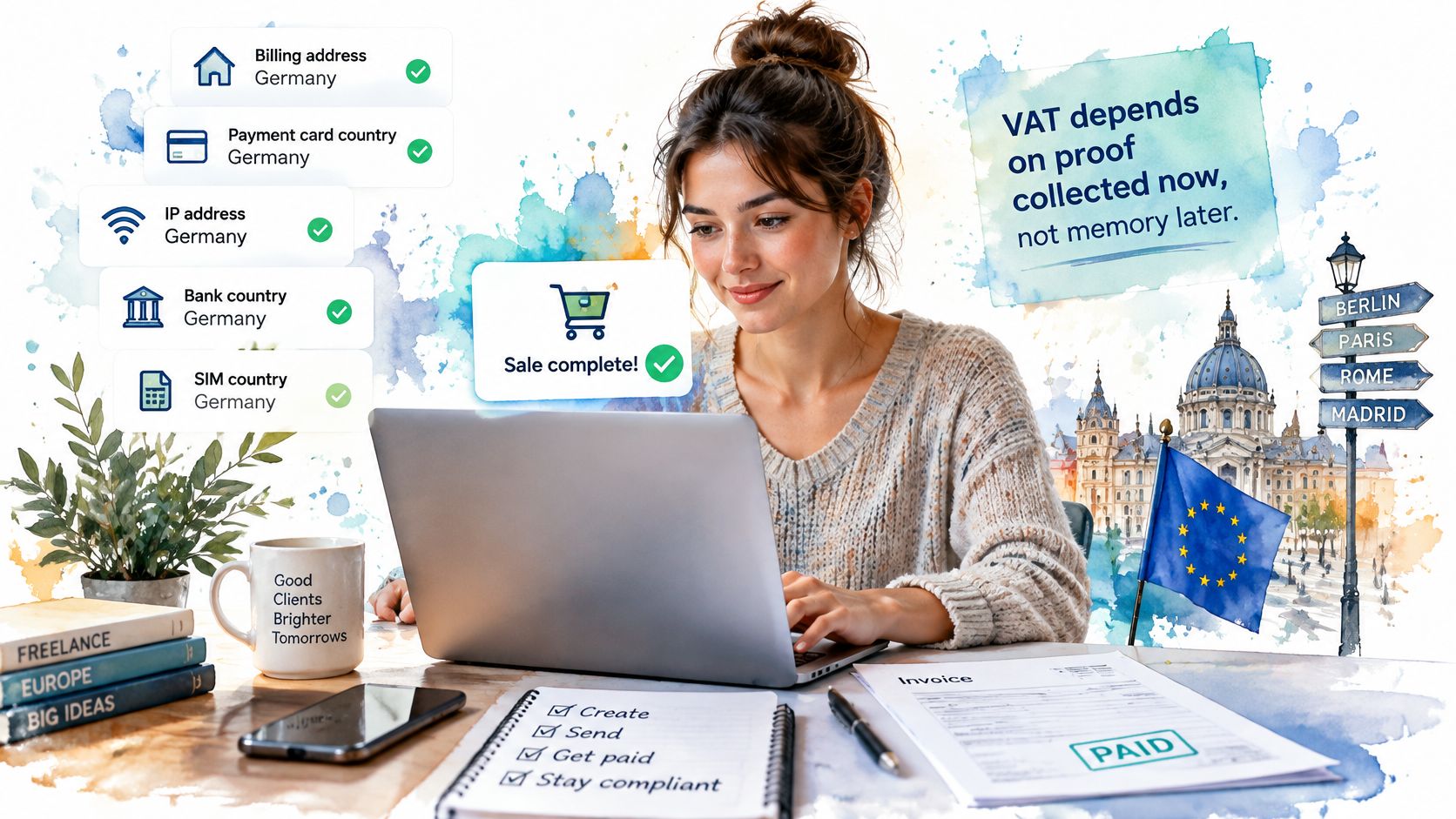
The European Commission's explanatory notes describe customer-location evidence such as billing details, payment information, IP address and SIM-country information. Check the version applicable to your supply date, especially where explanatory material addresses future changes.
For ordinary checkout controls, look for consistent, independent evidence:
- Billing address: Capture the customer's normal residence, not merely a convenient contact address.
- Payment-provider information: Retain the available payment-country or card-issuing-country signal.
- Connection information: Record relevant location information, but don't treat a VPN exit location as conclusive.
- Mobile information: Use SIM-country information when relevant to the service and available lawfully.
When signals agree, store them together with the tax decision. When they conflict, flag the account, request clarification and record the resolution. Specific legal presumptions and evidence exceptions can override a simple agreement-based workflow.
Virtual cards and travelling customers need particular attention. A temporary connection abroad doesn't automatically establish a new residence, and a virtual card may tell you little about where someone normally lives.
Validate business status separately
For an EU business customer, use VIES, the EU VAT-number validation system, and retain the result and timestamp. Our guide to European VAT number validation explains how to make that check part of onboarding.
The OECD International VAT/GST Guidelines support requiring evidence of business status and jurisdiction. A studio's company email address alone isn't enough: without adequate business evidence, keep the account on consumer treatment while you resolve its status.
Use this decision path alongside your checkout review.
Practical rule: Is the buyer a verified business? Where do the reliable location signals point? Which product rate applies there?
For app-store sales, first establish whether you or the intermediary is the legal supplier. That determines whose customer-evidence obligations you're configuring.
Digital Services VAT Rates Across Key Markets
A €20 VAT-inclusive subscription produces different net revenue by destination. At a German rate of 19%, the included VAT is €3.19. At a Bulgarian or French rate of 20%, it is €3.33, rounded to cents. Calculate included VAT as the gross price multiplied by the rate, then divided by one plus the rate.
You can keep one gross price and accept different net revenue, or preserve the net price and set different gross prices by market. The right choice depends on how you want to present prices to customers.
Standard VAT rates and registration routes for digital services
The table shows standard-rate planning figures. Check the product classification and current official rate before filing. The Bulgarian domestic route assumes the seller is established in Bulgaria.
| Market | Standard rate | Route for an EU seller | Key check |
|---|---|---|---|
| Bulgaria | 20% | Domestic VAT return for a Bulgarian seller | Home rate for domestic sales |
| Germany | 19% | Union OSS | Confirm current rate before filing |
| France | 20% | Union OSS | Apply the rate to each French buyer |
| Netherlands | 21% | Union OSS | Apply the rate per buyer country |
| Spain | 21% | Union OSS | Apply the rate per buyer country |
| Italy | 22% | Union OSS | Apply the rate per buyer country |
| Ireland | 23% | Union OSS | Apply the rate per buyer country |
| Hungary | 27% | Union OSS | Highest standard EU rate |
| United Kingdom | 20% | Overseas registration with HMRC | Outside EU OSS |
| Norway | 25% | Foreign supplier VAT scheme | Outside EU OSS |
| Switzerland | 8.1% | Local registration check | Check the registration threshold |
| Australia | 10% GST | Overseas supplier registration | Outside EU OSS |
| New Zealand | 15% GST | Overseas supplier registration check | Outside EU OSS |
| Japan | 10% | Overseas business registration | Platform rules differ |
Use this comparison of VAT rates in EU countries to organise a European pricing review, then confirm the applicable treatment with the relevant tax authority. A standard rate alone does not determine whether a digital publication, educational product, or bundled service qualifies for different treatment.
Compare administration, not just percentages
The OECD's Consumption Tax Trends 2024 reports that all OECD countries with a VAT have introduced rules reflecting recommended standards for online services and digital products supplied by non-resident vendors and marketplaces. The EU offers an integrated filing mechanism; destination-country tax still applies.
An Australian subscriber calls for a separate registration analysis from a French subscriber. For the UK, Norway, Switzerland, New Zealand, and Japan, check local thresholds, covered services, customer-status rules, and platform treatment before enabling sales.
Keep rates in an editable table with effective dates, rather than embedding them in application code. Store product classification separately from customer location, and test subscriptions, refunds, and country changes whenever the tax configuration changes.
Choosing Between OSS and Local VAT Registration
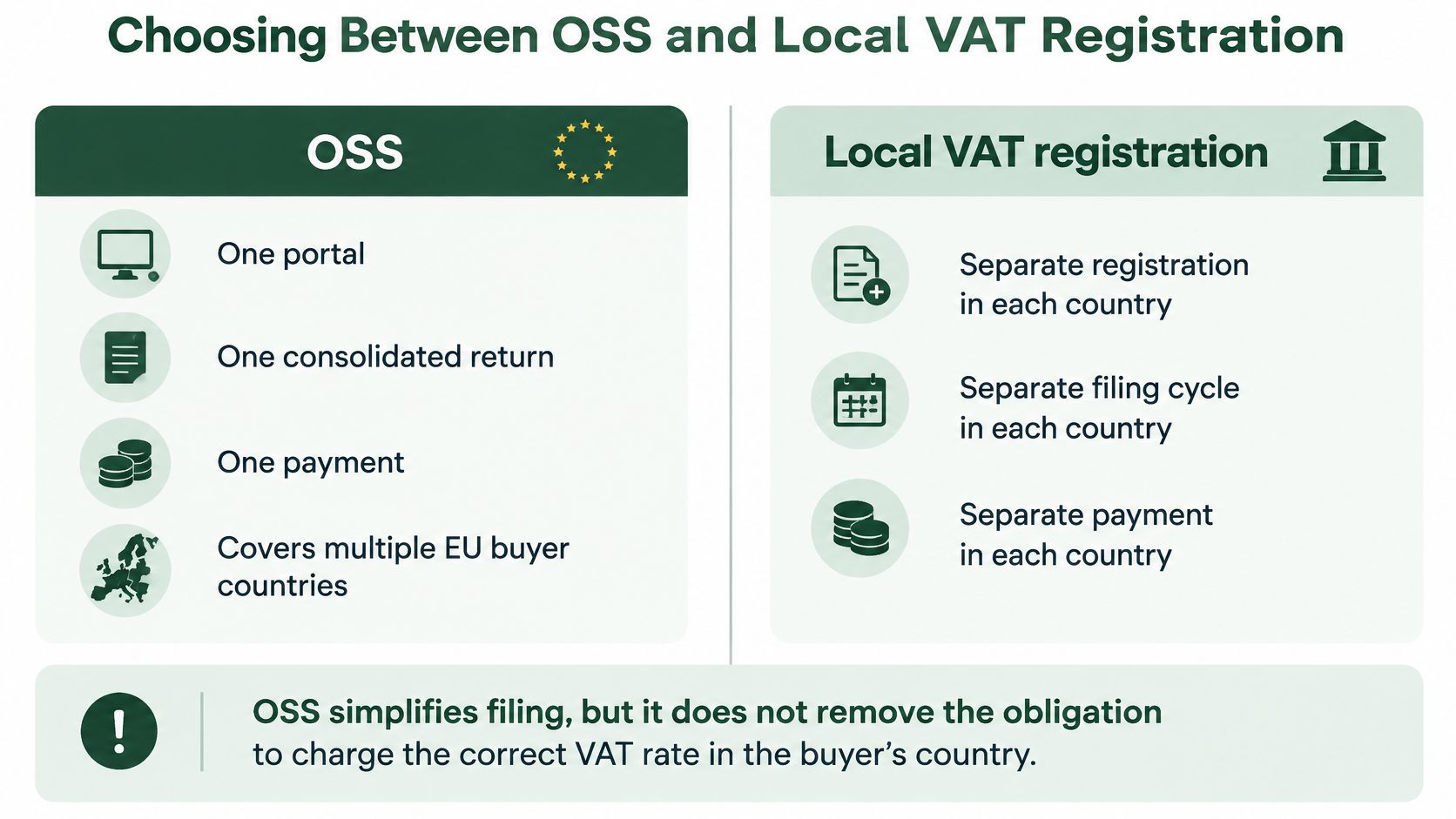
OSS gives you a consolidated online filing route, rather than a separate registration and filing cycle for every eligible EU consumer destination. You still calculate the tax country by country. The simplification concerns administration, not a discount on the VAT owed.
The EU's Your Europe OSS guide explains that Union and Non-Union OSS returns are generally quarterly, with filing and payment due by the end of the following month, including a return when there are no qualifying sales.
Registration routes for digital services sold in the EU
| Route | Who it fits | Returns | Where you file |
|---|---|---|---|
| Union OSS | EU businesses selling B2C digital services to other member states | Quarterly | Identification member state portal |
| Non-Union OSS | Non-EU businesses selling B2C digital services into the EU | Quarterly | Member state chosen for registration |
| Separate national registration | Businesses with a local establishment or domestic obligations requiring registration | Per national schedule | Each member state's tax office |
Say a Bulgarian company sells subscriptions across ten EU countries. It can use Union OSS through Bulgaria for eligible cross-border consumer supplies, while keeping Bulgarian domestic transactions in the appropriate domestic reporting process.
A founder supplying services from outside the EU, without an EU establishment, would examine Non-Union OSS instead. Incorporating an EU company isn't a prerequisite for that scheme, so compare the business reasons for incorporation separately from the convenience of VAT filing.
The distinction is easier to see side by side.
When local obligations remain
An establishment, domestic taxable supplies or other country-specific activities can create obligations outside OSS. Selling to a business customer doesn't, by itself, always require local registration: first determine whether reverse charge applies and whether the seller has another registration trigger.
Import OSS concerns qualifying imported goods, not app subscriptions or SaaS access. Don't choose it merely because your customers purchase online.
OSS can replace destination-country registrations for covered sales. It doesn't replace every VAT obligation your company has.
For founders choosing a Bulgarian EOOD or OOD, FastCorp includes VAT registration in all company formation packages. Our all-in-one service covers company registration, VAT, banking, accounting and a virtual office, with ongoing accounting arranged according to the services selected.
An EU VAT number and an active OSS registration are separate milestones. Complete the relevant OSS enrolment and confirm its effective date before relying on that reporting route.
The quick decision rule is practical: identify the seller's establishment, isolate eligible cross-border consumer services, then list everything outside that category. Use the appropriate OSS scheme for covered transactions and assess local registration only for the remaining obligations.
Invoice Wording, Records and Audit Evidence
An invoice should let an accountant understand why you charged that VAT, without reconstructing the transaction from emails. Configure the customer fields and tax wording before your billing platform starts generating recurring invoices.
For consumer sales, keep the buyer's country, applicable rate, taxable amount and VAT amount in the transaction record. Where you issue an invoice, display the net amount, tax and gross total clearly, subject to the invoicing rules that apply to your scheme.
Build a traceable transaction record
For a qualifying cross-border business sale, capture the customer's VAT number and the validation evidence. Use the appropriate reverse-charge wording, explaining that the customer accounts for VAT, rather than describing the sale as an ordinary zero-rated consumer transaction.
For non-EU sales, use the invoicing treatment required by the destination and your domestic reporting rules. Don't assume an invoice template designed for EU reverse charge works worldwide.
Link the documents through a stable transaction identifier:
- Invoice record: Preserve the original document, tax classification and customer details.
- Payment record: Connect the payment-provider transaction, settlement and any refund.
- Location evidence: Retain the signals supporting the jurisdiction used at checkout.
- Reporting record: Identify the return period and country-and-rate category used.
An app-store payout needs extra reconciliation. The amount reaching your bank may reflect fees, refunds and tax collected by an intermediary, so it isn't automatically your taxable sales total.
Correct records without erasing history
When a customer changes country, establish when the change takes effect. Keep the original evidence and invoice; where a correction is necessary, use the applicable correction process rather than overwriting an issued document without notice.
Test billing across your intended markets before launch. Include a consumer sale, a verified business purchase, a refund and a changed customer address, then check that each produces the expected records.
An auditor should be able to follow the sale from checkout to payment to return without guessing which customer record existed at the time.
Reconcile payment-provider activity against invoices regularly, including gross charges, fees, refunds and timing differences. Confirm the applicable record-retention period and access requirements with your identification state's tax authority, and ensure your billing provider can export the underlying evidence.
How to Register for OSS and File Your First Return
The portal work becomes manageable when your customer and invoice data are ready. The European Commission's OSS guidelines describe electronic reporting by member state of consumption and applicable rate, with payment linked to the return's unique reference number; use the guidance version applicable to your reporting period.
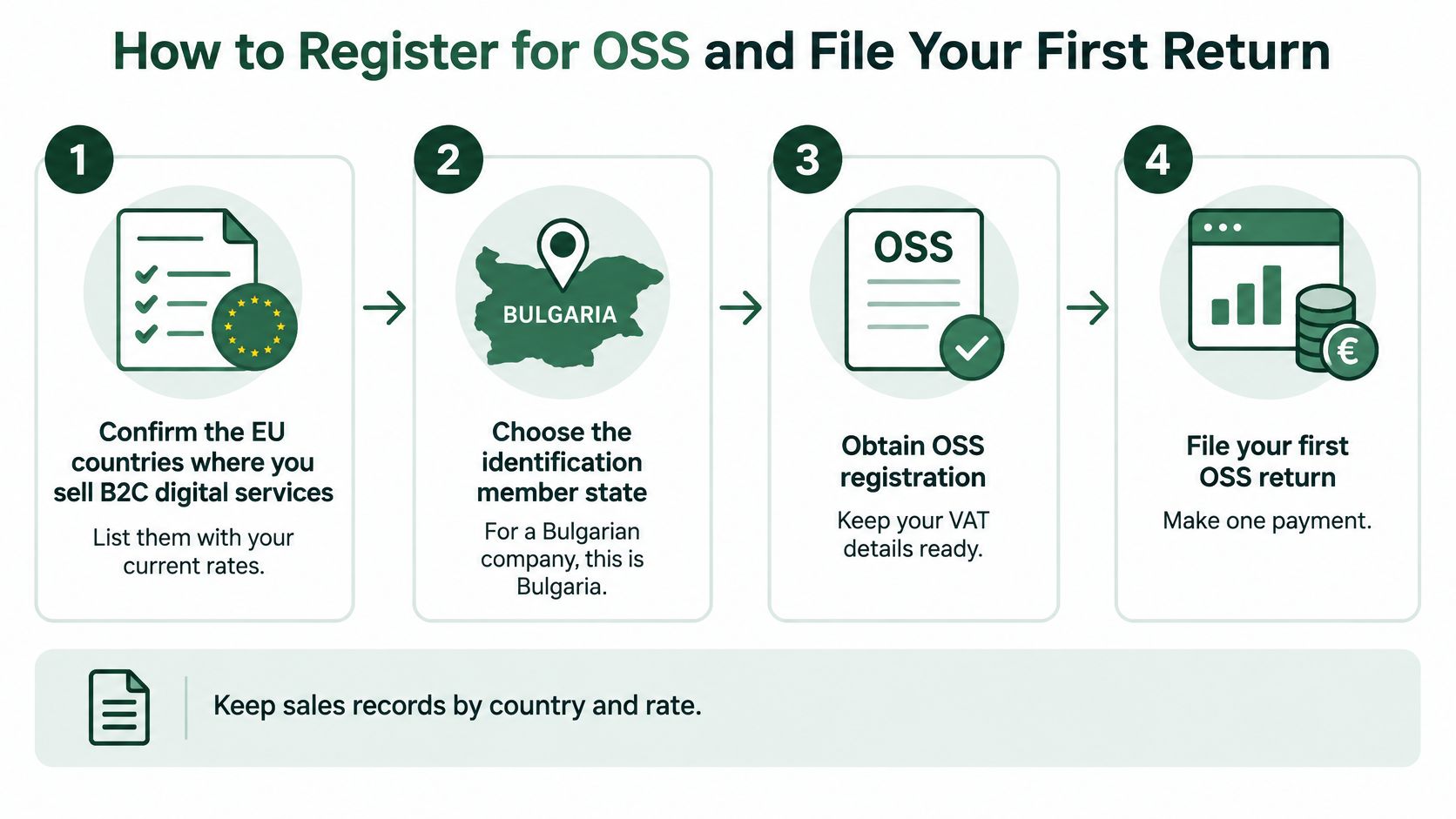
Complete the setup in order
Map your sales. List the EU countries where you expect consumer subscriptions and classify the products. Keep business transactions separate so they don't enter the consumer OSS totals.
Identify the registration state. For a Bulgarian-established company using Union OSS, that's normally Bulgaria. Confirm the legal entity making the supplies before entering portal details.
Prepare the company and VAT details. Our Online package costs €1,750 and includes EOOD or OOD registration, an EU VAT number, bank account, virtual office and business address, apostilled company documents, certificate of incorporation, and all legal and government fees. Fees are exclusive of applicable taxes unless otherwise stated.
Enrol through the OSS portal. Enter the required business information and retain the registration confirmation. Check the effective date rather than assuming enrolment covers earlier transactions.
Configure and test billing. Verify country assignment, product rate, customer status and invoice wording. Include a country-change scenario so recurring subscriptions don't retain an obsolete tax setting.
Preserve transaction-level evidence. Connect invoices, payments, refunds and customer-location records. Export a sample file and check that your accountant can reconcile it without manual reconstruction.
Prepare and pay the return. Aggregate taxable amounts and VAT by destination and rate, then reconcile the totals before submission. Use the assigned payment reference so the authority can allocate your payment correctly.
This process keeps registration and ongoing reporting connected.
Put filing on a calendar
The quarterly calendar is Q1 by 30 April, Q2 by 31 July, Q3 by 31 October and Q4 by 31 January. File a nil return when the scheme requires a return despite no qualifying sales, and don't confuse the payment deadline with your bank's processing time.
Our VAT filing requirements guide helps you distinguish OSS work from domestic compliance. Our bookkeeping and accounting services include VAT reporting, annual returns, payroll and tax compliance, so you can assign ongoing filings rather than manage them alone.
Pre-Sale Checklist and Final Checks
Run a short operational review before opening another market. Start with your live checkout and recent invoices, not just your registration certificates.
Compare the rate configuration against your current price list and confirm the applicable product treatment with each official tax authority. Pull a sample of recent sales and check that the retained location evidence supports the jurisdiction used.
Check the account, channel and owner
- Registration status: Confirm your OSS enrolment is active and that the supplies you intend to report qualify. OSS isn't a separate approval for each destination country.
- Evidence access: Export customer-location and business-validation records now, while the transactions are easy to identify.
- Deadline ownership: Assign a named person to prepare, review, submit and pay each return. Set an advance reminder and include nil-return checks.
- Platform liability: Review the contract and tax documentation for every app store, marketplace and payment channel.
- Non-EU expansion: Complete separate registration checks before enabling buyers in markets outside the EU.
The European Commission's VAT in the Digital Age overview illustrates why platform responsibility must be assessed by transaction and sector. Don't assume every intermediary becomes the legal supplier, or that a payment processor collects your VAT because it handles checkout.
Make online administration easy to maintain
The registration, filing and payment workflow can be handled online. What makes it easy is a clean handover: customer evidence in the billing system, reconciled transaction records and an agreed filing calendar.
If you need a Bulgarian company, our online setup is delivered 100% online, with customer support in English. Once the company and VAT details are in place, complete the appropriate OSS enrolment, test billing and assign the ongoing compliance work.
Don't launch with unresolved tax settings and plan to repair them later. A controlled checkout test is easier than correcting a full cycle of recurring invoices.
FastCorp offers Bulgarian company formation with EU VAT registration, banking support and a virtual office, alongside optional accounting and VAT reporting. Visit FastCorp to arrange your company setup and discuss the OSS registration and billing controls your digital-services business needs.