What Is Included in Bookkeeping Services: A 2026 Guide
Find out what is included in bookkeeping services, from recording and reconciliations to VAT, payroll and tax support, with practical checks for 2026.
You have a quote in your inbox. It says bookkeeping, monthly, and a number, and it tells you almost nothing about what will land on your desk on the third working day of next month.
That's the trap. Two providers can quote the same figure and deliver wildly different work. One posts your invoices and stops. The other reconciles every account, codes VAT correctly, closes the month on a fixed date and hands you a profit and loss statement you can read in five minutes. The difference isn't the price. It's the scope sheet behind it.
Table of Contents
- Core Tasks Included in Bookkeeping Services
- How One Transaction Becomes a Ledger Entry
- How to Run the Monthly Reconciliation and Close
- VAT, Payroll and Management Reporting Support
- What Bookkeeping Services Leave Out
- Bulgaria's Tax Rate Compared With Major European Markets
- Running Your Bookkeeping Online in Bulgaria
- Confirm the Package Covers Your Tasks Before You Pay
Core Tasks Included in Bookkeeping Services
Bookkeeping services are the recurring work that turns everyday money movements into accurate, reportable records, and the test of a good package is whether every movement ends up somewhere you can defend to a tax authority, a lender or your own board.
Think of it as the shoebox of receipts every household keeps, except with a system that proves every euro is accounted for, twice. That double check is old. Venetian friar Luca Pacioli published a 27-page explanation of double-entry bookkeeping in his 1494 Summa de arithmetica, and the recorded history of accounting shows Italian merchants and the Medici bank running the same control principle centuries earlier.
Here is the core package, with what each task covers, how often it runs and what you receive at the end.
| Task | What It Covers | How Often | What You Receive |
|---|---|---|---|
| Transaction recording | Sales, purchases and bank entries posted to the ledger | Weekly or monthly | Up-to-date journals and ledger |
| Expense categorization | Receipts and supplier invoices assigned to accounts | Monthly | Coded expense list |
| Bank reconciliation | Bank and card balances matched to the ledger | Monthly | Reconciled bank statements |
| Accounts receivable and payable | Customer invoices and supplier bills tracked | Monthly | Aged debtor and creditor lists |
| Payroll records | Employee pay, deductions and payments recorded | Each pay run | Payroll journals and payslip records |
| VAT returns | Output and input VAT reconciled before filing | Monthly or quarterly | Filing-ready VAT totals |
| Financial statements | Trial balance, profit and loss and balance sheet | Monthly or annually | Statements for owners and lenders |
| Annual tax support | Year-end adjustments and corporate tax data | Yearly | Tax-ready annual file |
Use that table as the comparison instrument. Put it next to any proposal and tick what's covered. A row that's missing isn't a small omission, because someone still has to do the work, and it will either be you at 11pm or an extra invoice later.
Scope rule: if a provider can't tell you which of these eight rows its monthly fee covers, you don't have a quote yet. You have a number.
Payroll and VAT are the two rows most often sold as add-ons rather than included. That's a legitimate pricing choice, but it has to be visible on the page, not discovered in month three when a filing deadline appears.
How One Transaction Becomes a Ledger Entry
A single invoice looks trivial until you follow it through the books. Here's the desk where that work starts.

Say a freelance designer invoices a client for 1,200 euros, with VAT shown separately on the document. The bookkeeper captures the source invoice, codes the net amount to revenue and the VAT line to the output VAT account, then posts the bank receipt against the customer account when the money arrives. Two weeks later the same designer pays a software subscription from the business account. That becomes an expense entry with the supplier invoice attached, and its VAT goes to the input VAT account.
Double-entry is the reason this works. Every entry has two sides that must balance, like a seesaw, so a miscoded sale doesn't just sit unnoticed. It distorts a control account, the trial balance stops agreeing, and the error surfaces before it reaches a filed return.
What a good service keeps is a chain: sales and purchase journals, the general ledger, accounts receivable and payable subledgers, and the trial balance that proves debits equal credits.
Evidence is the part clients underestimate. European invoicing rules require invoice authenticity, integrity and legibility, and reliable business controls and audit trails are specifically recognised as a way to demonstrate compliance, according to EU Directive 2010/45 on invoicing rules. For VAT-registered businesses, the file should also hold issued and received invoices, credit notes and bank records, all retrievable on request.
That has a hard consequence. An unreconciled bank balance or a missing supplier invoice distorts revenue, deductible costs, VAT payable and year-end profit at the same time. So when you read a proposal, check whether it says it classifies transactions, validates VAT codes and archives documents. If it only says data entry, that's what you'll get.
How to Run the Monthly Reconciliation and Close
A close is a sequence, not a scramble. Run it in the same order every month and it becomes auditable.
- Collect every source document. Sales invoices, supplier bills, payroll journals and receipts go into one folder by a fixed cut-off date. Miss the cut-off and the whole close slips.
- Import the bank and card feeds. Match every line to a ledger entry. Skipping this step is how duplicate feed lines survive for months.
- Clear the unmatched items. Either request the missing invoice or correct the category. Don't park items in a suspense account and hope.
- Reconcile control accounts. Receivables and payables must agree to their subledgers, or the balance sheet is fiction.
- Review accruals, prepayments and depreciation. A subscription paid annually belongs partly in next month's costs, and a laptop bought in March loses value every month after.
- Produce the trial balance. If debits don't equal credits, stop and find it now, not after the statements are issued.
- Issue the profit and loss statement and balance sheet with a short note explaining unusual movements.
Most close problems are small and specific. A bank balance that differs by a few euros is almost always a missing bank fee or a duplicated line in the feed. A forgotten supplier invoice inflates profit and understates VAT payable at the same time, which is the worst kind of error because both figures look plausible.
The infographic below shows the same rhythm in four moves, which is how it should feel once the process is stable.
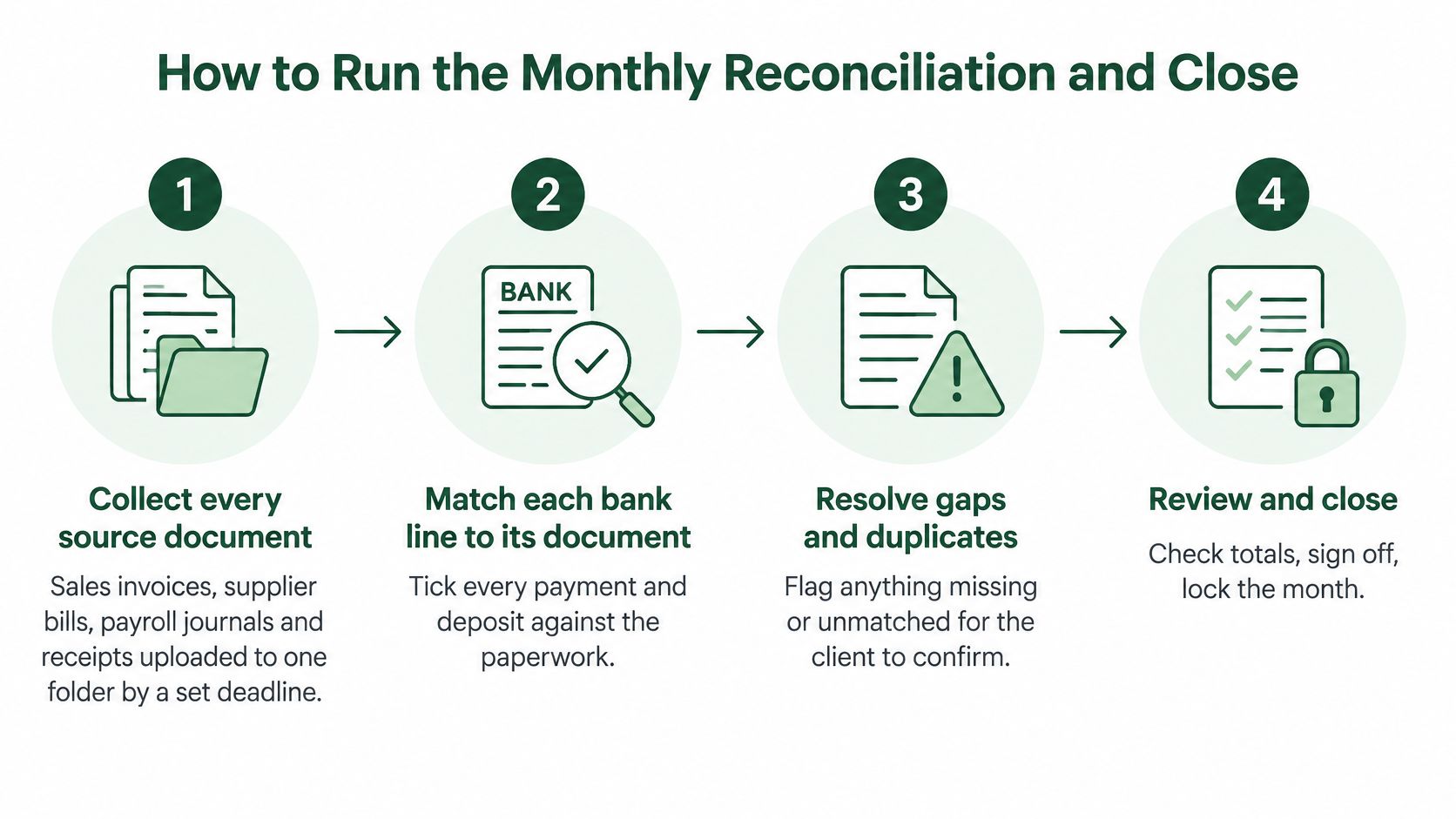
Working deadline: aim to finish the close within the first 10 working days of the following month. That leaves room to file VAT and answer questions before statutory dates, instead of racing them.
VAT, Payroll and Management Reporting Support
VAT support starts with correct coding
Every sale and purchase needs the right VAT treatment before anything is filed. Taxable, zero-rated, exempt, reverse-charge and intra-EU transactions each follow different rules, and one mis-coded line can understate or overstate what you owe.
The monthly routine is straightforward: reconcile output VAT on sales against input VAT on purchases, verify that invoices carry the details the law requires, and produce control totals ready for filing. EU guidance is clear that VAT invoices must contain the taxable-supply details required by VAT law, and VAT-registered businesses generally must show their VAT identification number and the VAT charged, per the European Commission's VAT for businesses guidance. If you sell cross-border through the One Stop Shop, transaction records must be kept for 10 years and made electronically available to tax authorities on request.
Payroll records and journals
Payroll is rarely just a payment run. Gross pay, withholdings, employer contributions and payment records all need to reach the ledger as journals, each pay cycle, or your staff costs will never reconcile to your bank. Adoption is high for a reason: in a 2024 survey of more than 1,000 accounting professionals reported by OnPay's accounting survey, 92% said they helped clients manage employee payments and 68% used payroll software. If you're working out where payroll ends and bookkeeping begins, this explanation of payroll administration covers the split. At FastCorp, bookkeeping and accounting services include VAT reporting, annual returns, payroll and tax compliance.
Management reporting you can read
A monthly profit and loss statement, a cash position and a receivables aging are the minimum. The better question is whether anyone explains them. Automation is pushing routine entry out of the human hours you pay for: in a 2025 survey of 700 accounting professionals, common AI uses included faster client service (33%), reducing bookkeeping errors (33%) and automating routine workflows (32%), according to Xero's 2025 state of the industry report.
Ask for a written list of which VAT and payroll tasks sit inside the monthly fee and which are billed separately. Then run one test this month: take the closing bank balance on your report and compare it to your actual bank app. If they don't match, the reports aren't ready to steer decisions.
What Bookkeeping Services Leave Out
Here's the uncomfortable part. A monthly bookkeeping fee does not mean every accounting obligation is handled.
Common exclusions, unless they're written into the contract, include tax advice, audit representation, statutory filings, VAT registrations, payroll compliance, beneficial-owner reporting, foreign transactions, year-end adjustments and cleanup of prior-period records. Regulatory change is a live pressure here: in the 2025 ICB bookkeeping survey of 813 bookkeepers, 79% identified keeping up with regulatory change as one of their biggest professional challenges, as reported by the Institute of Certified Bookkeepers.
So split responsibility on paper. The bookkeeper prepares records and reconciliations. A licensed accountant or tax adviser reviews and signs off filings. You approve payments and anything that changes your legal position. And late documents get a written rule: what arrives after the cut-off moves to next month.
Ask specifically whether software subscriptions, receipt capture, bank-feed corrections, historical cleanup and ad hoc questions sit inside the price. Ongoing bookkeeping and compliance support is optional at FastCorp, and refunds aren't provided for unused portions of a billing cycle, so the scope you agree is the scope you pay for.
Bulgaria's Tax Rate Compared With Major European Markets
The headline numbers are the easy part to quote and the easiest to misread.
| Country | Combined Statutory Rate (2024) | Gap Versus Bulgaria |
|---|---|---|
| Bulgaria | 10.0% | Baseline |
| France | 25.8% | 15.8 points |
| Germany | 29.9% | 19.9 points |
| United Kingdom | 25.0% | 15 points |
Those are the combined statutory corporate income tax rates for 2024 published by the Tax Foundation's European corporate tax rate data. Bulgaria sits 15.8 percentage points below France, 19.9 below Germany and 15 below the UK.
Put it in euros. On 100,000 euros of taxable profit, a 10% rate produces 10,000 euros of tax. At 25.8% the same profit produces 25,800 euros. That gap is real money for a founder deciding where to retain earnings, before dividend tax and everything else.
Everything else is the catch. The headline rate says nothing about VAT, payroll and social-security costs, withholding taxes, dividend taxation, transfer-pricing rules, tax residence, or whether a given expense meets local deductibility requirements. A 10% rate applied to an inflated profit can cost more than a 25% rate applied to a clean one.
That's where the bookkeeper earns their place. In Bulgaria, deductible costs and VAT recovery stand up only if the ledger behind them is complete and reconciled. The tax outcome is exactly as reliable as the records supporting it.
Ask for the full model: request the complete calculation for your own profile, including dividends and social contributions, before you rely on a headline rate. If you want the wider picture, this overview of corporate tax rates puts the numbers in context.
Running Your Bookkeeping Online in Bulgaria
Online bookkeeping works from anywhere when the input routine is tight: every document lands in one place, in the same week it is issued. That habit matters more than the software. A clean ledger starts with invoices, bank statements, payroll records, receipts and contracts that arrive before the close, not after the numbers have already been reported.
Bulgaria's Accountancy Act requires double-entry bookkeeping and chronological recording of every transaction that changes assets, liabilities, financial position, financial results, cash flows or equity. It also permits accounting documents to be electronic, provided they contain the required information and comply with electronic-document and trust-services rules, as set out in the Bulgarian Accountancy Act. In practice, the legal point is straightforward: digital records are workable, but only if the content, order and audit trail are right.
Use a fixed weekly flow and keep it boring.
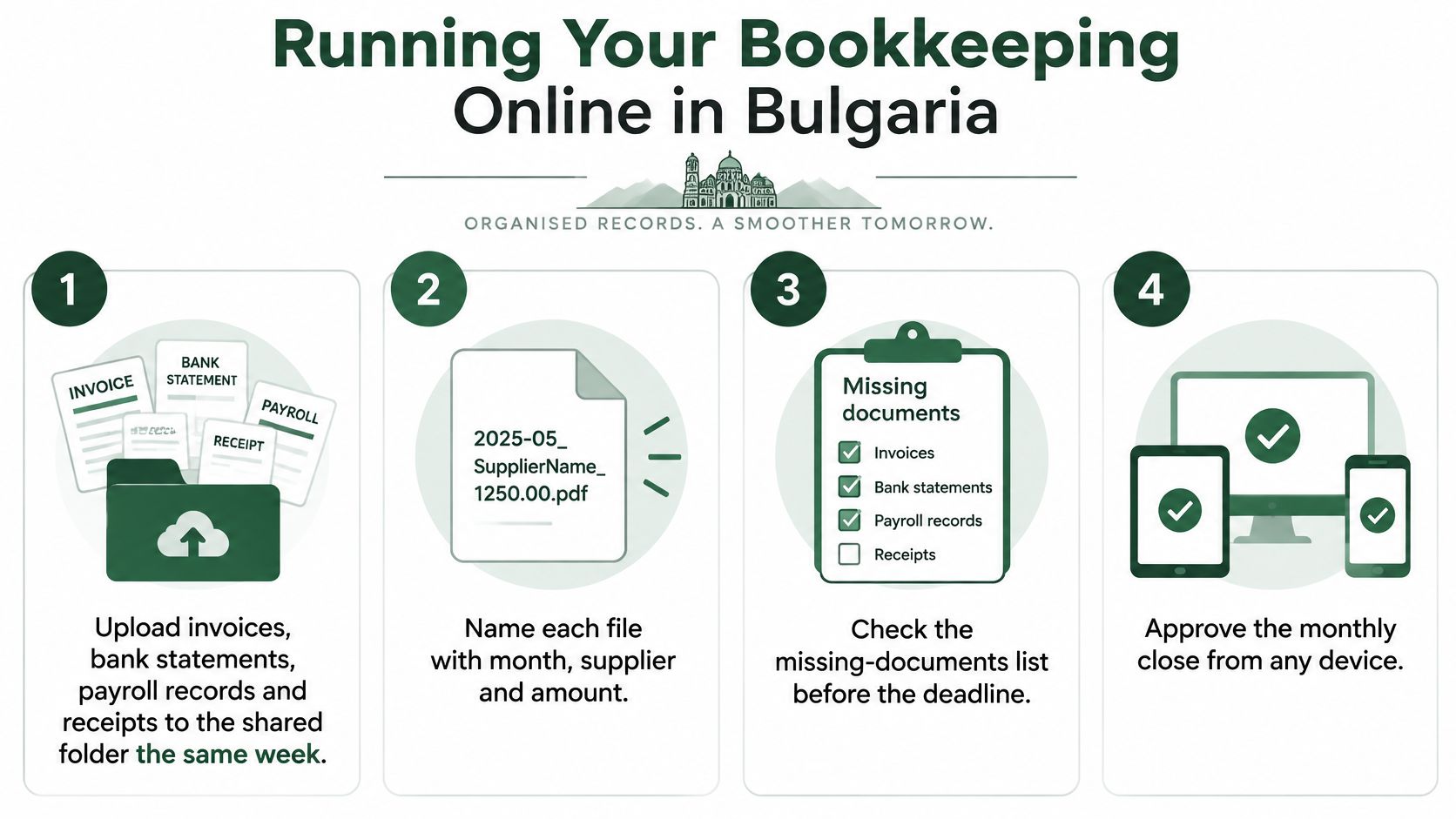
- Upload everything weekly. Invoices, bank statements, payroll records, receipts and contracts go into one shared digital folder.
- Name files consistently. Month, supplier and amount in the filename beats a folder of scans called "doc1".
- Record who did what. Who uploaded, who reviewed, who approved. That audit trail is the difference between a tidy folder and a compliant record.
- Send documents before the internal deadline. Then let the close sequence do its job.
Electronic filing is the normal route. Bulgaria's National Revenue Agency runs an electronic services portal for VAT declarations, and electronic submission is generally expected for VAT obligations. Keep documents retrievable rather than assuming a portal submission covers everything. The return and the evidence behind it are two separate records, and the second one is what supports VAT recovery, deductions and later questions.
The annual timetable needs the same discipline. Companies declare their taxable financial result through an annual corporate tax return, filed from 1 March through 30 June of the following year, electronically only and with a qualified electronic signature, per Ministry of Economy guidance on corporate tax filing. Build a January checklist: year-end ledger close, fixed-asset and bank reconciliations, deductible expense review, annual financial statements, taxable profit calculation, and a test run of the signatory's electronic signature. Finding out in June that the signature does not work is an avoidable crisis.
Keep proof of submission. An uploaded draft is not a filed return, and the receipt is what settles an argument. For a step-by-step walkthrough of the whole cycle, see this guide on how to bookkeeping.
Confirm the Package Covers Your Tasks Before You Pay
In 2025, small businesses typically paid $200 to $600 per month for bookkeeping services, according to Omniga's bookkeeping pricing analysis, and those packages commonly included reconciliations, profit-and-loss reporting, accounts receivable and payable, payroll integration and compliance support.
A price only becomes comparable when the scope matches. So lay every quote against the same eight rows of the core-tasks table, then confirm four things in writing: which exclusions from your scope sheet apply, how often reports arrive, what language support is delivered in, and whether payment is due before work starts.
At FastCorp, all fees are included with no hidden costs, and payment is due in full before services begin. Our Online package at €1,750 covers company registration as an EOOD or OOD, an EU VAT number, a bank account, a virtual office and business address, apostilled company documents, the certificate of incorporation, and all legal and government fees.
Then take the last step today: email each provider the same eight rows and ask for a written scope back. Compare them side by side and the decision makes itself.
Ready to stop guessing what your monthly fee buys? FastCorp sets up Bulgarian limited companies and keeps the books behind them, from invoice recording and bank reconciliation to monthly management reports, VAT returns filed with the National Revenue Agency, annual financial statements and corporate tax returns, all handled online from wherever you work. Visit FastCorp to see how registration, EU VAT and ongoing bookkeeping fit into one scope with no hidden costs.