Corporate Accounting Services in Bulgaria: What to Expect
Corporate accounting services in Bulgaria explained: bookkeeping, VAT, corporate tax, payroll, pricing and a country tax comparison, with practical steps.
You've registered an EOOD in Sofia, opened a business account and sent your first invoice. You expect to deal with the accounts at year-end, then your accountant asks for purchase invoices, payment statements and details of a subscription sold abroad. Suddenly, accounting looks less like an annual form and more like another part of running the company.
That's the right way to approach it. Corporate accounting services work best as a monthly operating system, with clear document deadlines, reliable records and someone responsible for checking the results. For a non-resident founder, the administration can run online without becoming complicated, provided the responsibilities are settled before trading starts.
Table of Contents
- What Corporate Accounting Services Actually Cover
- How the Monthly Accounting Cycle Works Step by Step
- Which VAT Rules Apply to Your Cross-Border Sales
- How Bulgaria's 10% Corporate Tax Compares Internationally
- Costs and Trade-offs
- How to Give Your Accountant Secure Online Access
- Choose Your Setup and Book a Free Consultation
What Corporate Accounting Services Actually Cover
Say your Sofia company sells design services, pays for software and occasionally uses freelance contractors. Recording the money arriving in your account is only the beginning. Your accountant also needs to establish what you sold, which expenses belong to the business and how each transaction affects reporting.
There are four layers of work: recording transactions, filing taxes, reporting results and paying employees correctly. Bookkeeping and accounting services include VAT reporting, annual returns, payroll and tax compliance, but those tasks don't all follow the same calendar.
Core accounting services and how often they recur
| Service | What it covers | How often | Why it matters |
|---|---|---|---|
| Bookkeeping | Recording invoices, bank payments and expenses | Continuous, reconciled monthly | Every later filing depends on clean books |
| VAT returns | Output and input VAT, EU sales reporting | Monthly for most VAT-registered companies | Late or wrong returns create penalties and audit risk |
| Annual financial statements | Balance sheet, income statement and notes | Once a year | Basis for the annual tax return |
| Corporate income tax return | Taxable profit after adjustments | Once a year | Determines corporate tax due |
| Payroll and social security | Salaries, withholdings and contributions | Monthly per employee | Errors reach employees and the authorities quickly |
| Software setup and bank feeds | Connecting accounting tools to bank accounts | One-time setup, then monthly review | Cuts manual entry and speeds the monthly close |
| Compliance package | Applicable services above on one agreed plan | Monthly or annual retainer | One point of contact for every deadline |
Match the scope to the business
Most trading companies need the monthly bookkeeping routine from their first invoice. VAT work starts when the relevant registration and reporting obligations apply, while payroll starts when the company has employment-related obligations. Buying a package doesn't make every service legally necessary.
Keep VAT and profit tax separate. Bulgaria's standard VAT treatment concerns taxable supplies, while corporate income tax concerns taxable company profit after adjustments, not the amount customers pay into your bank account.
A bank feed also isn't a substitute for an invoice. It proves that money moved, but it may not establish the supplier, business purpose or correct tax treatment.
Practical rule: Give your accountant the document that explains the payment, not just the payment itself.
For a quick scope check, list whether the company issues invoices, employs staff or holds several currency accounts. Review every row against those activities, then mark what applies now and what should be activated as the business grows.
How the Monthly Accounting Cycle Works Step by Step
A clean close is a controlled routine, not a spreadsheet scramble. Set a document cut-off, assign preparation and review responsibilities, and keep unresolved items visible until someone resolves them.
Deloitte's analysis of finance automation identifies reconciliation preparation, flux analysis and draft variance commentary as suitable for automation, while preserving human review. That distinction matters: software can prepare a matching suggestion, but a reviewer still needs to decide whether it's correct.
The workflow should be easy for everyone to follow.
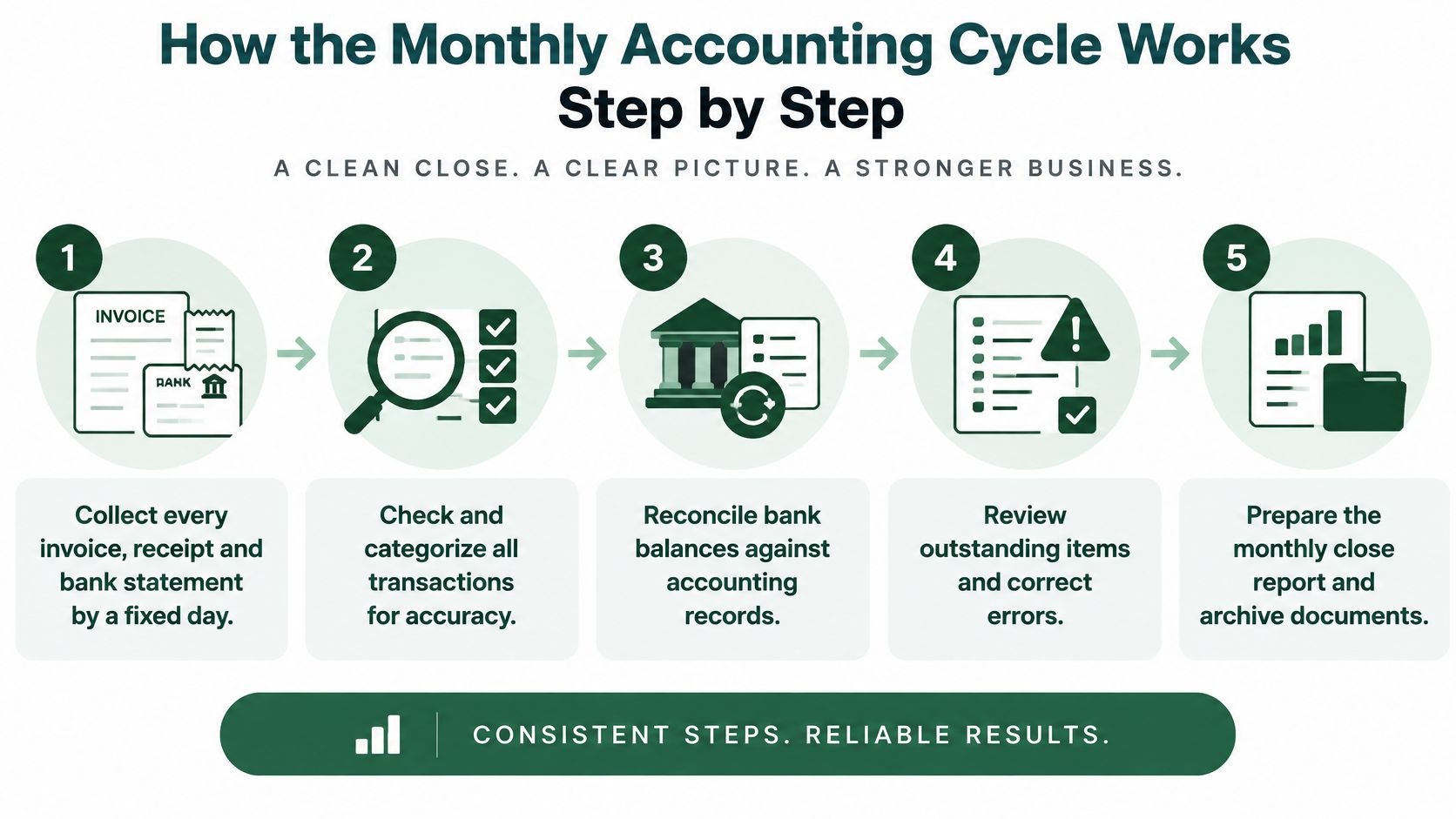
Run the close in a fixed order
Collect the complete document set. Choose an internal cut-off, for example the third working day, for invoices, receipts and statements. The common slip is sending bank statements while leaving supplier invoices in someone's inbox.
Record and classify each transaction. Use consistent ledger accounts, counterparty details and descriptions so similar purchases receive similar treatment. Don't let a software subscription become an unexplained miscellaneous expense.
Reconcile every bank and payment-provider account. Match opening balances, receipts, payments, fees and closing balances to the ledger, including EUR and USD accounts. A net payment from a processor often conceals sales, refunds and charges that need separate entries.
Investigate differences before closing. Agree a review threshold, such as a hypothetical €50 escalation limit, while still resolving smaller unexplained reconciliation differences. A threshold prioritizes review; it doesn't authorize writing off unknown amounts.
Check VAT treatment when entering the invoice. Confirm the supply, customer or supplier status and relevant jurisdiction before posting. Applying the domestic treatment automatically to a foreign supplier invoice is a familiar route to corrections later.
Separate preparation from approval. Have another authorized person review outgoing payments and documents requiring signature. An accountant preparing a payment shouldn't automatically have unrestricted authority to release it.
File and preserve the evidence. Put the applicable VAT deadline in the shared calendar and retain the submitted return, filing acknowledgement and supporting documents. Keep corrections traceable rather than replacing the original file without explanation.
Test the result, not just the checklist
Say a SaaS company receives customer payments in euros and pays hosting charges in dollars. The close should explain processor deductions, currency conversions and outstanding balances, not merely show a plausible profit figure.
Ask for a short close report containing the profit and loss statement, balance sheet, unpaid invoices, tax liabilities and unresolved questions. Healthy books have reconciled balances, documentary support and filings prepared before their deadlines.
We coordinate the accounting work, but FastCorp isn't a law firm or tax authority. The client remains legally responsible for the company's activities, tax obligations and reporting accuracy.
Which VAT Rules Apply to Your Cross-Border Sales
A Sofia software company sells subscriptions to German consumers. A consultant invoices a Dutch business, while an online shop ships products to French households. Each needs a different VAT analysis, even though all of them issue invoices and receive payments online.
The customer's status, location and the nature of the supply matter more than the invoice template. The commercial relationships may look simple, but the accounting needs to distinguish them.

One EU VAT number doesn't mean one simple compliance process. According to the European Commission's update on e-commerce VAT schemes, more than 170,000 businesses used OSS/IOSS by the end of 2024, with €33.1 billion declared through the schemes during 2024. Registration provides access to a reporting mechanism; your transaction records still need to support its use.
Classify the sale before choosing the return
VAT treatment by sale type
| Sale type | VAT treatment | Filing route | Evidence to keep |
|---|---|---|---|
| Domestic sale in Bulgaria | Standard Bulgarian VAT, generally 20 percent | Bulgarian VAT return | Invoice and customer tax details |
| B2B sale to an EU company with a valid VAT number | Generally reverse charge for qualifying services; goods need separate supply conditions checked | Bulgarian VAT return with the applicable sales list | Verified EU VAT number, invoice and relevant transport evidence |
| B2C digital service to EU consumers | Generally the VAT rate of the customer's country, subject to applicable exceptions | Union OSS where applicable | Customer-location evidence, with two supporting pieces where required |
| Export of goods to a non-EU customer | Zero-rated when export conditions and proof are satisfied | Bulgarian VAT return | Customs and transport documents |
| Service to a non-EU business used outside the EU | Generally outside Bulgarian VAT under the general B2B place-of-supply rule, subject to exceptions | Bulgarian VAT reporting as applicable | Contract, business-status evidence and customer location |
The distinction between goods and services is essential. A valid customer VAT number alone doesn't establish that a shipment qualifies for cross-border treatment, and not every service follows the general B2B rule.
For distance sales of goods, monitor the applicable EU-wide threshold and destination-country obligations. Holding stock abroad can also create local registration questions that OSS doesn't remove. Don't configure your checkout around a single domestic rate and leave the accountant to repair the results.
This video provides additional context for the administrative workflow.
Reconcile the commercial records
Match marketplace orders and checkout records to processor settlements, refunds and credit notes. A refund must connect to the original sale so the accountant can correct the appropriate tax treatment rather than recording an unexplained payment.
The OECD's guidance on digital transactional reporting explains why structured invoice data, correction trails and reliable transaction records are central to digital VAT administration. Capture jurisdiction, supply type, currency and the reason for any exemption or reverse charge at entry.
Our guide to VAT returns helps distinguish the filing from the records needed to support it. We handle registration, VAT, banking and bookkeeping for companies we set up, allowing the operating workflow to be settled alongside incorporation.
Before entering a new market, answer who the customer is, where they're located and exactly what you're selling.
How Bulgaria's 10% Corporate Tax Compares Internationally
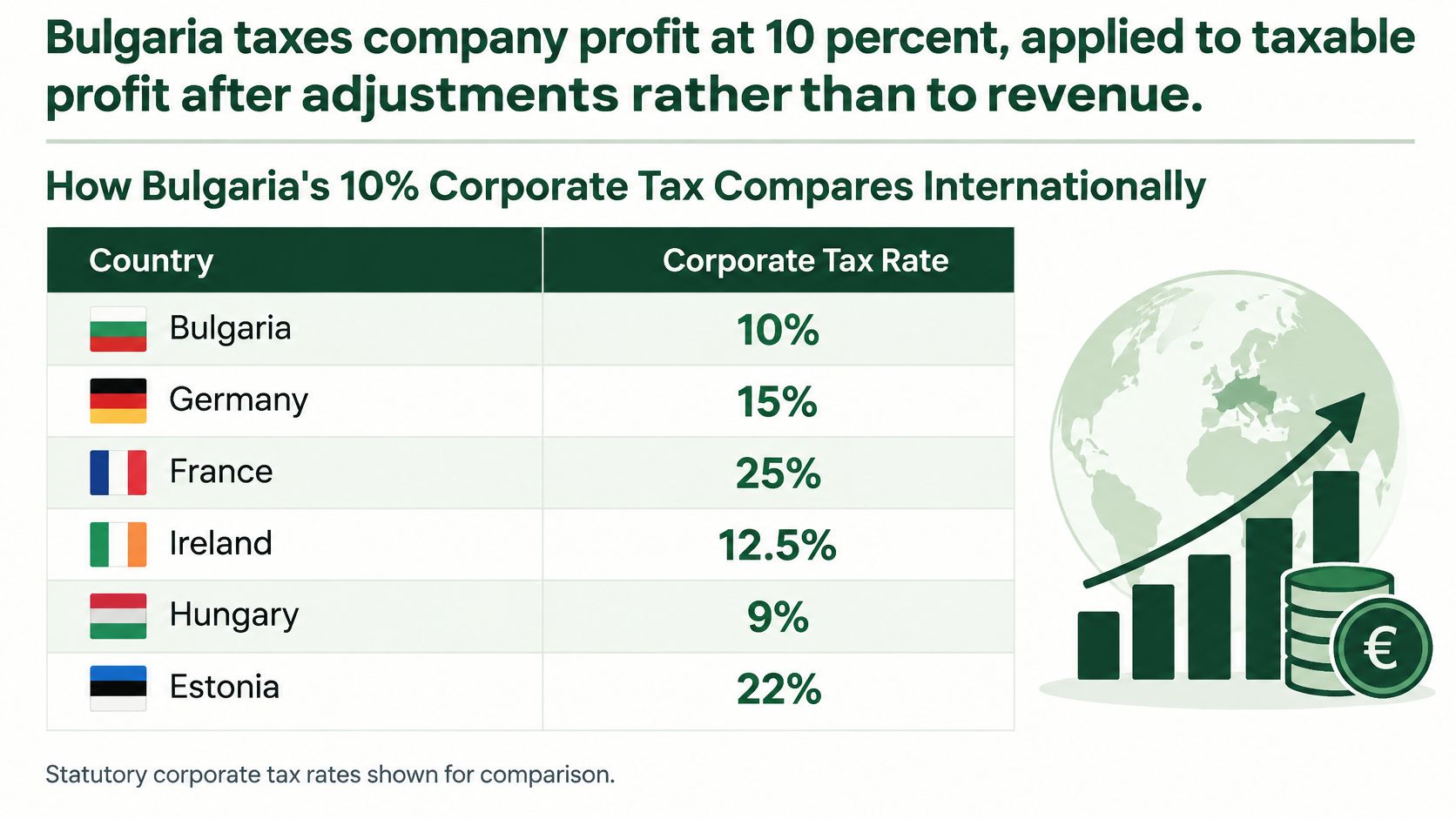
Bulgaria taxes company profit at 10 percent, applied to taxable profit after adjustments rather than to revenue. For a founder choosing a jurisdiction, that's a useful starting point, but it isn't a complete calculation of the money available personally.
The OECD Corporate Income Tax Rates Database distinguishes statutory rates from effective taxation and other corporate-tax indicators; its 2026 summary identifies Hungary, the United Arab Emirates and Barbados as having positive statutory rates of 9 percent. Always check the tax year and whether a comparison uses central-government or combined rates.
Statutory corporate tax rates for comparison
| Country | Statutory corporate rate | Notes for founders |
|---|---|---|
| Bulgaria | 10 percent | Dividend withholding can apply separately |
| Hungary | 9 percent | Check local surcharges and sector rules |
| United Arab Emirates | 9 percent | Check qualifying income and free zone rules |
| Barbados | 9 percent | Check local deductions and minimum tax |
| Ireland | Confirm the applicable trading-income rate | Distinguish trading income from other income |
| United Kingdom | Confirm the applicable main or small-profits rate | Profit level and associated companies matter |
| France | Confirm the applicable standard rate | Check additional surtaxes for large profits |
| United States | 21 percent federal | State taxes added on top |
| Germany | About 30 percent combined | Includes trade tax, which differs by municipality |
This visual offers another way to view headline rates. Central rates and combined burdens should not be treated as interchangeable.
Include the cost of distributing profit
The OECD's Bulgaria tax annex reports a 10 percent corporate income tax rate and 5 percent final dividend withholding in relevant cases. The withholding position needs to be checked against the recipient, ownership conditions, treaty provisions and any applicable EU parent-subsidiary treatment.
Take a hypothetical company with €100,000 of taxable profit. Applying those rates, corporate tax would be €10,000, leaving €90,000; if all of it were distributed and the withholding applied without relief, €4,500 would be withheld, leaving €85,500 before any additional owner-level tax.
Compare what the company earns, what it retains and what the owner receives. Those are different figures.
Keep taxable profit, retained earnings and distributions in separate accounting records. Don't treat a transfer to a shareholder as an ordinary deductible business expense.
Our corporate tax comparison guide supports the wider jurisdiction review. For complex structures, a tax adviser should confirm residence, substance, minimum-tax exposure and the shareholder's home-country position before incorporation.
Costs and Trade-offs
What will corporate accounting services cost, and would hiring someone be cheaper? Compare the operating models before comparing quotes, because a low fee for transaction entry isn't equivalent to a package that includes payroll, tax filings and annual reporting.
Accounting setup options compared
| Option | Cost structure | Best for | Main trade-off |
|---|---|---|---|
| In-house accountant | Salary, employer costs, software and training | Companies with high monthly transaction volume | Fixed cost in quiet months and a single point of failure without cover |
| Outsourced monthly package | Fixed monthly fee for an agreed scope | Small and growing companies | Less daily control, so provider quality matters |
| Hourly or project-based help | Billed per hour or per task | One-off clean-ups and irregular needs | Costs can rise unpredictably |
| All-in-one formation and accounting | Setup fee plus optional ongoing packages | Foreign founders launching a Bulgarian company | Setup and ongoing costs are separate lines |
An employee offers availability and familiarity with daily operations. That can justify the fixed cost when the company needs continuous finance support, but transaction volume alone isn't decisive. Management reporting, inventory and internal approval requirements also affect the workload.
Outsourcing suits founders who need a dependable routine without managing an internal accounting function. The trade-off is that you must deliver complete documents on time and agree how questions will be resolved.
Separate formation from ongoing accounting
Our published company-formation prices are €1,750 online and €1,500 in person, with legal and government fees included in the package. Bookkeeping, tax and full compliance support after setup are optional, so don't treat the incorporation price as an ongoing accounting subscription.
Recurring fees are scoped around monthly transaction volume, payroll headcount, VAT reporting requirements and the number of currency accounts. Cleanup work, historical corrections or an additional reporting requirement should be identified separately rather than discovered on an invoice.
Use our accounting services pricing guide to prepare a like-for-like comparison, then obtain the actual scope and quoted fee in writing before signing.
Resolve these points before committing
- What's included? Confirm whether the fee covers VAT, payroll, annual statements, corporate tax filings and routine questions.
- What triggers extra charges? Define transaction limits, additional employees, historical work and new registrations.
- Who does what by when? Agree document cut-offs, response arrangements and responsibility for approvals.
Compare the fee with your own time, too. A cheaper plan isn't cheaper if you spend evenings rebuilding sales reports, finding missing invoices and chasing filing confirmations.
How to Give Your Accountant Secure Online Access
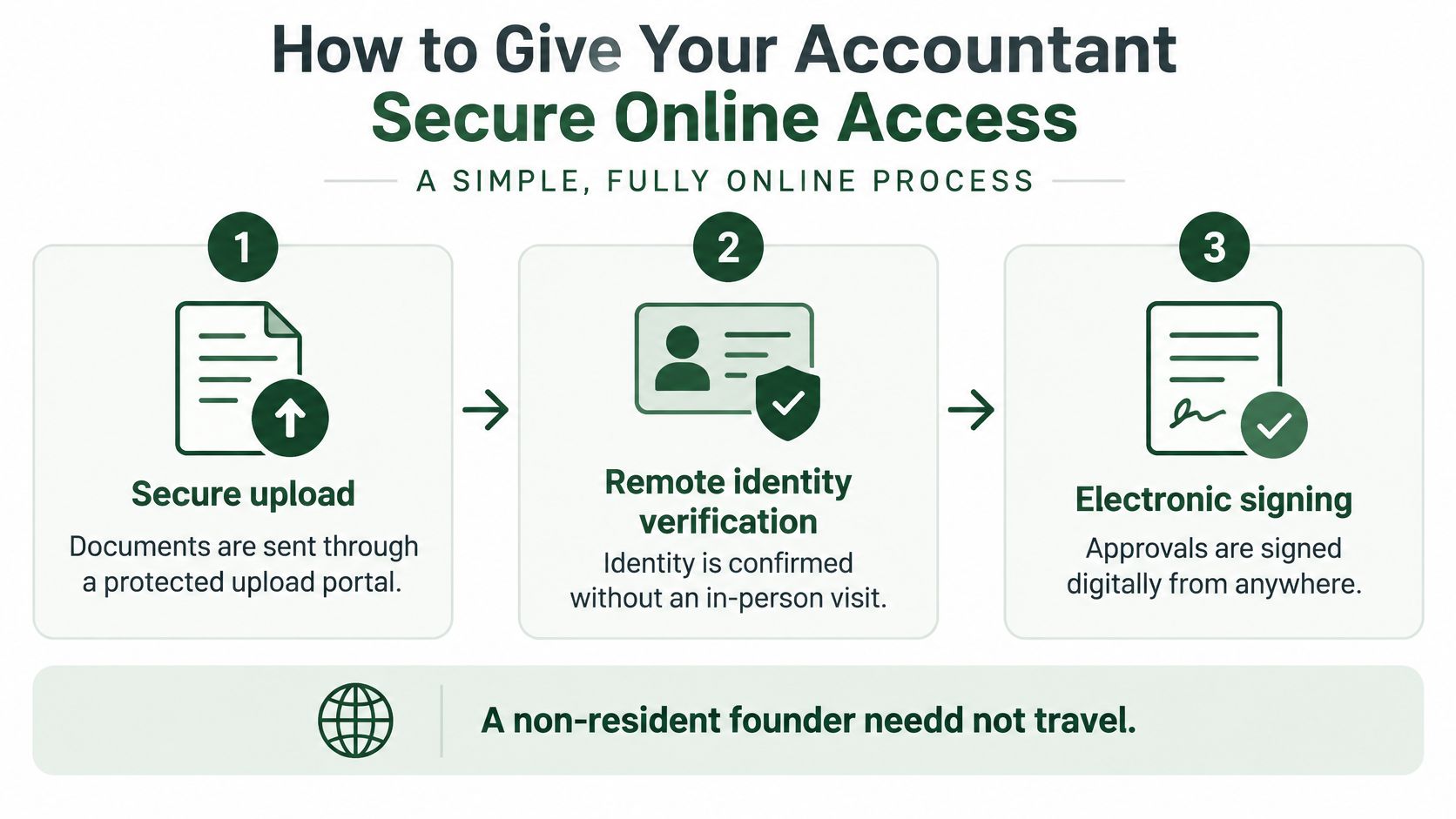
The whole process can run online: documents move through secure upload, identity verification happens remotely and signatures are completed electronically through the applicable signing process. We handle company registration without requiring travel, so a non-resident founder can complete setup without leaving home.
We also handle the company's legal paperwork and compliance through the service workflow, using trusted professionals where needed. Optional ongoing support includes bookkeeping, tax filings and payroll. Keeping the administration online makes it easier, but it doesn't remove the need to control access.
These are the main remote handover stages.
Set permissions before sharing files
A 2025 study published in Frontiers in Education, based on responses from 41 accounting academics, identified gaps in cybersecurity knowledge and accounting-focused cybersecurity education. Accounting competence and secure system administration are related, but you shouldn't assume they're the same skill.
Grant least-privilege access. Create a named account with only the permissions needed for the role, rather than sharing your own login.
Turn on multi-factor authentication for banking, accounting software and cloud storage. This reduces reliance on a password that could be stolen or reused.
Keep payment approval separate. Give the bookkeeper access to records without automatically granting the ability to release money.
Enable audit logs and review unexpected changes each month. Named user accounts make those logs useful when investigating an altered supplier account or deleted document.
Agree document-retention rules. Specify the applicable retention periods by record category, storage location and deletion process with your accountant.
Put breach-notification arrangements in writing. Identify the contact person, escalation route and information needed to contain an incident.
Identify subcontractor access. Establish which accountants, payroll specialists or other service providers can see each category of information.
Prepare the exit procedure before you need it. Include ledger exports, document downloads, filing receipts, payroll records and removal of former users.
Access principle: Make it easy to do authorized work and difficult to make unreviewed changes.
Automation saves administration time, but a compromised account can expose bank details, identity documents and employee information together. Use bank feeds and role-based access instead of sending credentials by email.
The founder should keep the admin rights.
Choose Your Setup and Book a Free Consultation
Choose the service around the company's activities, not just its legal form. A solo consultant, an online retailer and an agency with employees may all use a Bulgarian limited company, but they need different accounting workflows.
Start with the business you're launching. Add capacity when the work changes rather than paying for unused services or leaving essential tasks outside the agreement.
Pick the appropriate starting point
No staff and a modest invoice volume. Start with monthly bookkeeping and the VAT services your transactions require. Make sure the annual reporting work is included or priced separately.
A non-resident founder launching a company. Arrange formation and accounting together so registration, banking assistance and the invoicing workflow are coordinated before trading starts.
Payroll or several currency accounts. Include payroll administration and bank-feed integration explicitly in the written scope. Identify who supplies employee changes and who checks foreign-currency balances.
Prepare for the consultation
FastCorp offers a free consultation for people starting a business, with contact hours Monday to Friday, 9:00 to 18:00 EET. Use it to establish the registration route, required accounting services and the information needed for a written proposal.
Prepare the following:
- Identification details for the relevant individuals.
- Preferred company names and a clear business description.
- Shareholder and director details, including the intended ownership structure.
- Share capital amount for the proposed company.
- Operating details, including customer countries, expected invoice volume, planned staff and currencies.
A useful business description names what you sell and to whom. Software subscriptions to consumers require a different conversation from consulting services supplied to established businesses.
Banking assistance is part of coordinating the setup, but bank account approval cannot be guaranteed because the bank makes the final decision. Outsourced administration also doesn't transfer the company's legal responsibility for tax and reporting.
Book the consultation this week with your business description ready. Ask for a written scope that separates formation, monthly accounting and annual obligations, so you can decide with the full operating cost in view.
FastCorp offers Bulgarian company formation and optional ongoing bookkeeping, VAT, tax filing and payroll support. Visit FastCorp to book a free consultation and agree an accounting setup that matches how your company will trade.