How to Bookkeeping Online Without the Mess
Learn how to bookkeeping online: record transactions, compare EU corporate tax rates, and stay ready for VAT and annual filings in 2026.

Your invoices live in a folder called final final, the bank feed shows twelve transactions you've never opened, and somewhere in your inbox is a receipt for a software subscription you'll need in March. You're a founder, not an accountant, and the books have become the thing you'll definitely do next week.
Online bookkeeping isn't a bigger version of that mess. It's a short, repeatable routine that runs in a browser, ends with numbers you can defend to a tax authority, and takes less time each week than a supermarket run. That routine is what follows: how to bookkeeping as a cross-border founder, from the chart of accounts to the annual corporate return, with Bulgaria's 10% corporate tax rate set beside its neighbours and VAT evidence checked before anyone celebrates a clean bank feed.
You don't need an accounting degree. You need a chart of accounts, six habits, and a Friday half hour.
Table of Contents
- Why Online Bookkeeping Beats a Shoebox of Receipts
- Record Every Transaction in Six Online Steps
- Compare Corporate Tax Before You Close the Year
- Code Cross-Border VAT With the Right Evidence
- Catch Errors Before the Monthly Close
- Choose a Fully Online Bookkeeping Partner
Why Online Bookkeeping Beats a Shoebox of Receipts
A founder can invoice a client in Munich from Sofia, receive payment through Wise and pay a contractor in Lisbon, all without printing a page. The shoebox may be gone, but a bank feed full of unreviewed transactions can leave the same basic question unanswered: what belongs on the company's accounts and tax return?
Bookkeeping turns transactions into records that can be checked. Gross income, deductible costs, VAT charged and the evidence supporting each entry all need a clear place. PDFs and spreadsheets can hold documents or figures, but neither alone explains how a sale, payment or tax balance was recorded.

Consider an invoice for 1,200 euros issued in March. Under accrual bookkeeping, revenue and accounts receivable each rise by 1,200. When the customer pays in April, cash rises and the receivable clears. Debits and credits balance, and the entries support a balance sheet, an income statement and a cash position that can be reviewed.
The method has a long history. Evidence shows merchants in Genoa using double-entry bookkeeping by roughly 1327. Luca Pacioli's 1494 treatise, printed in Venice, described the Venetian method and became the first widely recognized printed accountancy text, as this history of the oldest printed accounting treatise held by Cambridge University Press explains. Cloud software changes where the ledger lives, not the need for entries to balance.
A small cash business may manage with single-entry records. The IRS recordkeeping publication for small business says a business can use either single-entry or double-entry if its system clearly reflects income and expenses, and notes that double-entry provides built-in checks and balances. For a company issuing invoices, charging VAT or paying contractors, double-entry provides a clearer record of what is owed and what has been paid.
The Chart of Accounts a Remote Company Actually Needs
Set up a chart of accounts that distinguishes money held, earned, owed and spent. Then each transaction has a consistent place:
- Bank and payment-platform accounts. Keep Wise, Revolut and Stripe separate in the ledger. A payout between your own accounts is a transfer, not new revenue.
- Accounts receivable and accounts payable. Track unpaid customer invoices and bills so the ledger shows amounts due in both directions.
- Sales by stream. Separate consulting, subscriptions and product sales. Their VAT treatment may differ, so one combined sales line can obscure useful detail.
- Contractors and software. Record these costs separately and retain the supporting documents. Without evidence, an expense is harder to substantiate.
- A VAT control account. Post VAT amounts here and reconcile the balance against the VAT return, rather than relying on a bank total.
- Owner drawings. Record money taken out by the owner separately from business expenses. Treating a drawing as an expense is one of the most common founder errors.
- A suspense account. Use it temporarily for transactions you cannot identify, then investigate them and clear the balance by month-end.
With the accounts in place, online bookkeeping becomes a repeatable review of transactions and supporting records, rather than a search through receipts at filing time.
Record Every Transaction in Six Online Steps
Take one March week at a consultancy that invoices in euros and gets paid through an online account. Six steps, all in the browser, and the week closes clean. The IRS small business recordkeeping guidance sets the standard these steps serve: the books must summarize gross income, deductions, credits, payroll, inventory and asset purchases, and the documents behind them should show the payee, the amount, proof of payment, the date and the business purpose.
Here is the flow in one picture before we walk through it.
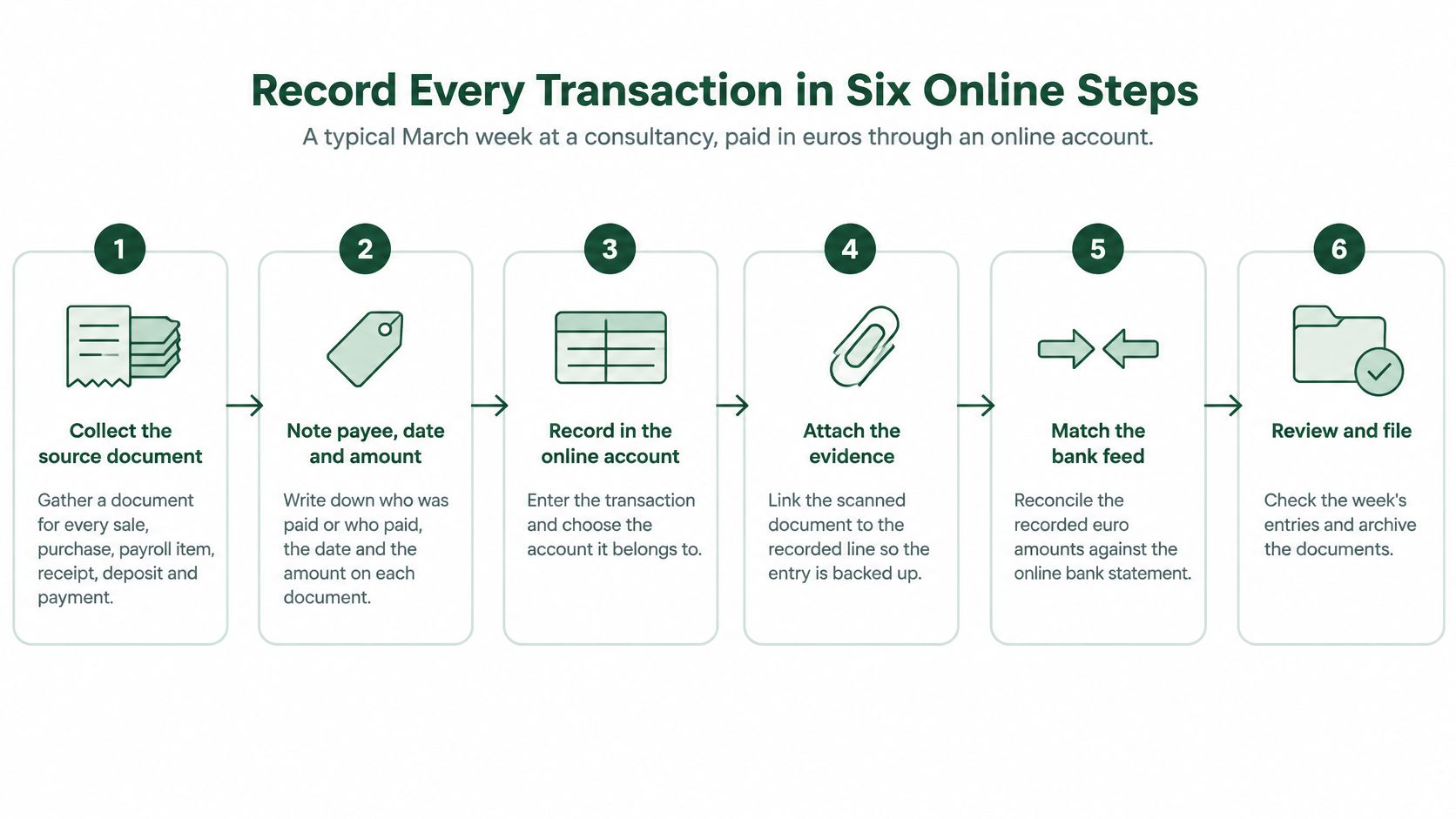
Walk One Euro Week Through All Six Steps
1. Collect a source document for everything. That means the March client invoices, the freelance designer's invoice, the Wise statement, the Adobe receipt and the deposit advice for each payment received. A transaction without a document is a guess with a date on it.
2. Classify it, and settle the VAT treatment before you accept the software's suggestion. The 4,000 euro design fee to the German client goes to consulting revenue with reverse-charge treatment, not to a generic sales line. Bank feeds guess. You decide.
3. Post the double entry. A sale raises revenue and either cash or receivables. An expense raises the cost account and either reduces cash or raises a payable. If the entry won't balance, the classification in step 2 was wrong, and finding that now costs two minutes.
4. Attach the evidence the same day. The PDF or phone photo goes onto the entry while you still remember what it was. A ledger separated from its documents is a story nobody can verify.
5. Reconcile the bank and every payment platform. Monthly at minimum, weekly if cash moves fast: match the ledger to the statement, enter bank fees and missing lines, and explain timing differences until the adjusted balances agree. The IRS guidance asks businesses to reconcile accounts, update journals for items recorded late or incorrectly, and investigate whatever difference remains.
6. Review, then lock. Scan the trial balance, clear suspense to zero, fix negative receivables or payables, approve every unusual journal. Only then close the period.
An imported feed is not finished bookkeeping until tax codes, duplicates, prepayments and currency differences have been checked. If the expense side is where your file falls apart, this guide to tracking business expenses covers the capture habits that feed step one.
If you'd rather watch it than read it, the walkthrough below shows a ledger being cleaned and closed inside a browser.
What a Finished Week Looks Like
By Friday the March file should show every line coded, every line documented, every account reconciled to a statement, and a suspense balance of exactly zero. Ten minutes weekly beats a lost weekend in June, and it keeps the VAT return and the corporate filing inside reach instead of on the horizon.
Compare Corporate Tax Before You Close the Year
A low headline rate is a reason to plan, not a reason to relax. The Tax Foundation's 2024 comparison of combined statutory corporate income tax rates across Europe puts the numbers side by side, and the spread decides how much of your profit you keep after everything else is paid.
| Country | 2024 combined rate | What to remember | Bookkeeping implication |
|---|---|---|---|
| Bulgaria | 10% | Rate hits the tax financial result, not turnover | Keep a tax-adjustment schedule and file electronically from 1 March to 30 June |
| Hungary | 9% | Lower headline rate than Bulgaria | Compare the full burden, not the headline alone |
| Cyprus | 12.5% | Close to Bulgaria but not the same system | Record that country's profit rules separately |
| Ireland | 12.5% | Same headline band as Cyprus | Do not copy Irish treatment onto Bulgarian books |
| Romania | 16% | Higher than Bulgaria | A local taxable presence changes the reserve |
| Poland | 19% | Near the Czech headline | Budget tax from taxable profit, not sales |
| Czech Republic | 19% | Same headline as Poland | Still check payroll and VAT on top |
| United Kingdom | 25% | Above Bulgaria | Convert and document the profit being compared |
| Germany | 29.9% | Far above Bulgaria in this set | A German taxable presence can dwarf the 10% rate |
What the 10 Percent Actually Applies To
Bulgarian corporate tax is calculated on the company's annual tax financial result, not on accounting profit and definitely not on gross revenue. The annual return goes to the National Revenue Agency, and the Bulgarian Ministry of Economy guidance on declaring and paying corporate tax sets the filing window from 1 March to 30 June of the following year, filed electronically with a qualified electronic signature. A company with no activity may be exempt in specified circumstances, so confirm there was something to report before building the return.
Two working habits follow. First, keep a tax-adjustment schedule next to the profit and loss account, listing every item that moves accounting profit to the tax base, so the 10% is applied to the right number. Second, never let the software reserve tax on gross sales. A founder who sets aside 10% of turnover is over-reserving every month and misreading their own runway.
Why the Lowest Headline Rate Is Not the Whole Bill
Hungary's headline rate is lower than Bulgaria's. That alone doesn't make it the better home for a company. Dividend taxation, payroll contributions, VAT obligations, where the company is managed, and where the people work can outweigh a one-point difference in the corporate rate. A comparison built only on the corporate line is a comparison of the easiest number to find, not the most expensive one.
A 10% rate applied to the wrong base costs more than a 19% rate applied to the right one.
I'd treat the corporate rate as the last check, not the first. Build the profit figure, apply the adjustments, then look at the surrounding taxes. If you want the full sequence for the Bulgarian side, this walkthrough of how to do corporate taxes follows the return from taxable result to filing.
Code Cross-Border VAT With the Right Evidence
A clean bank feed does not settle a cross-border VAT question. The right treatment depends on the transaction and the evidence behind it. The European Parliament fact sheet on indirect taxation says the EU cross-border SME VAT scheme has applied since 1 January 2025. Eligible small businesses may use VAT exemptions in other Member States if they stay below the relevant national threshold and the EU-wide annual turnover threshold of EUR 100,000. The same fact sheet states that intra-EU digital reporting requirements are scheduled from 1 July 2030.
For a Sofia company selling across several countries, record which rules apply and when. Do not treat a future reporting requirement as though it already applies.
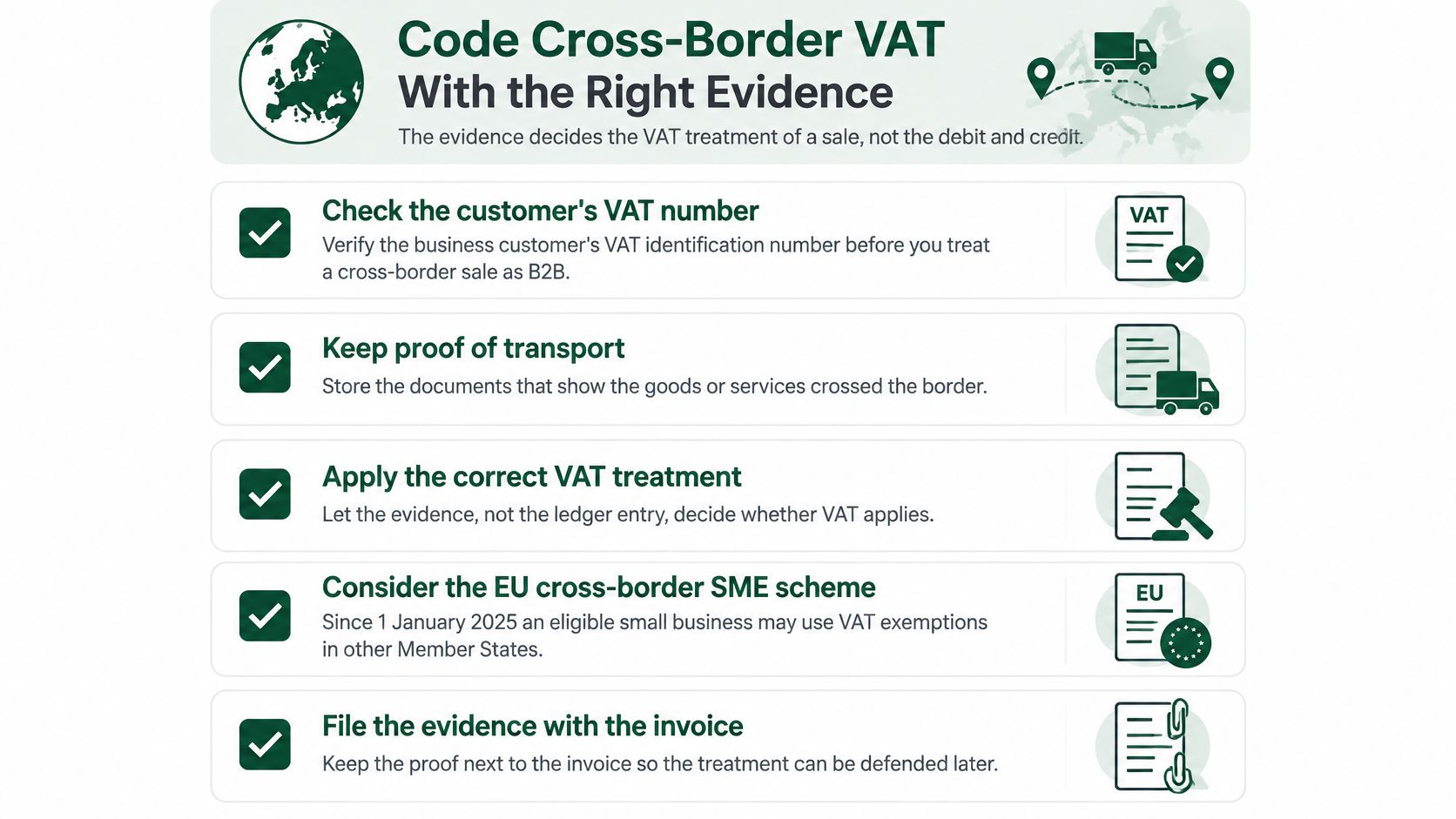
Two Invoices, Two Different Answers
Consider two March sales by the same consultancy. A 4,000 euro design fee billed to a German company with a valid VAT number will normally be treated as a reverse-charge service. Show the customer's VAT number on the invoice, state that the customer accounts for VAT, and retain evidence of the customer's VAT status.
A 49 euro digital product sold to a private customer in France raises a different question. Place-of-supply rules apply, and the sale may require another registration or a scheme return. The ledger entries may look much the same, but the supporting evidence and VAT treatment do not. Check the EU VAT invoice requirements guide for the fields a reverse-charge invoice must include.
Choose Exemption with Your Eyes Open
An exemption can reduce compliance work, but it can also prevent recovery of input VAT on hosting, software, contractors and advertising. If those costs are significant, unrecovered input VAT may outweigh the administrative saving. Compare the likely input VAT you could recover with the work and obligations of registration before choosing.
Evidence rule: The treatment follows the file, so assemble the supporting records before issuing the invoice.
The Monthly Evidence Pack
For each cross-border sale, retain four details: the customer's country, a VAT number check and its date, the invoice wording used, and the return or report where the sale will appear. Keep those records with the invoice and any transport or delivery evidence, in the system connected to your ledger. That way, a later data export can draw on an organized transaction file instead of a scattered chat thread.
Catch Errors Before the Monthly Close
Quality comes from review, not from typing faster. A feed will happily import the same subscription twice, and a founder will happily code a transfer to themselves as a business expense. Neither error announces itself. Controls do.
Where staffing allows, split four duties: who authorizes a payment, who records it, who holds the bank login, and who reviews the month. Role-based software access, sequential invoice numbers, approval thresholds and an immutable audit trail do the rest.
The 2024 ACFE Occupational Fraud Report found that lack of internal controls was the most commonly cited organizational weakness in occupational fraud cases at 32%, while override of existing controls accounted for 19%. The same study associates account reconciliation, management review and document examination with lower median losses and faster detection.
Split Four Duties, Even in a Company of One
The monthly sequence I'd follow: prepare the ledger, reconcile bank and card accounts independently, compare actuals with budget or prior periods, investigate material variances, review manual journals and related-party transactions, then lock the period. Cross-border files need this more than domestic ones, because currency conversion, reverse-charge entries, intercompany balances and settlement timing create differences that a simple cash ledger never shows.
Close standard: No manual journal enters a locked period without a name and a reason attached to it.
Four targets are worth holding every month: 100% reconciliation of operating accounts, 100% document coverage for deductible and VAT-bearing costs, zero unexplained suspense at close, and documented approval for every manual adjustment. These are control targets rather than universal legal requirements, and statutory retention periods vary by jurisdiction.
Feed Exceptions and the Fix Before Close
These five survive a bank import most often, and each one distorts a number a tax office will ask about.
| Exception | What it distorts | Fix before lock |
|---|---|---|
| Duplicated bank feed | Income or expense counted twice | Keep the matched document and remove the duplicate |
| Owner payment coded as an expense | Deductions and profit | Reclass to owner drawings |
| Missing foreign-exchange adjustment | Euro profit on foreign balances | Book the month-end difference |
| Wrong VAT code | The VAT return and input recovery | Recode and refresh the VAT report |
| Unreconciled payment platform | Cash versus payouts, fees, and holds | Reconcile the platform as its own account |
Turn the Close Into a Decision
Once the period locks, produce two numbers a founder can use: cash remaining after setting aside the tax reserve, and money customers still owe. Clean history that answers neither question is expensive decoration, and it's the reason a founder can have tidy books and still be surprised in April.
Choose a Fully Online Bookkeeping Partner
A newly incorporated company has one real decision about the routine above: keep the Friday close in-house or hand it to a specialist. Both work, and neither is free.
Doing it yourself costs time and a subscription. The minimum viable version is to build the chart of accounts, run the six steps across last month's transactions, and reconcile every account before paying for software nobody reviews. If that takes four weekends, the arithmetic changes.
The tools haven't removed the judgement either. A 2025 survey of 813 bookkeepers reported by the Institute of Certified Bookkeepers found cloud accounting had become standard and that automation and AI were entering normal operations, while demand stayed strong because businesses faced compliance complexity and cash-flow pressure. Software moves the work toward reviewing unusual transactions, validating integrations and turning records into cash-flow insight. That is the part founders underestimate when they buy a subscription and expect the books to close themselves.
Two Next Moves, Same Standard
Outsourcing keeps everything online. FastCorp in Sofia handles bookkeeping, VAT reporting, annual returns, payroll and tax compliance after setup, with Petar Mitkov, Accountant at FastCorp, responsible for accounting, reporting and compliance. That ongoing support is optional, so a founder who wants to keep the books can keep them. When a filing date is already close or a first quarter has piled up, booking a free consultation is the fastest way to reach the team.
Either path needs four things ready: the chart of accounts, the latest bank export, a list of open invoices, and the VAT questions raised by the country and customer checks. Both should end with the same file, current, evidenced, and ready for the corporate return window without a flight to Sofia.
FastCorp sets up Bulgarian companies for founders who work from anywhere, then keeps the books in the same browser window: bookkeeping, VAT returns, payroll and the annual corporate filing, handled by a named accountant rather than a shared inbox. If your chart of accounts is still a blank page, or last quarter is sitting in a folder waiting for a free weekend, visit FastCorp and start with a conversation about the file you want closed.