Business Tax Compliance Certificate Explained
Learn what a business tax compliance certificate is, how to get one in Bulgaria online, required documents, and how it compares with tax residence certificates.
A business tax compliance certificate is a formal record confirming whether a company has filed required tax returns and paid taxes on time. In Bulgaria, it generally means the National Revenue Agency document confirming the presence or absence of public liabilities, issued within up to 7 days.
You might be halfway through a tender application when the buyer asks for it. Your Bulgarian company is registered, your accountant handles the filings, and you're running the business from abroad. Suddenly, you need to work out which document they mean, how to request it, and whether a Bulgarian electronic certificate will satisfy someone overseas.
The good news is that Bulgaria offers an online request process. The important part isn't printing another piece of paperwork. It's choosing the right evidence for the question the recipient is asking.
Table of Contents
- Why a Business Tax Compliance Certificate Matters
- What a Business Tax Compliance Certificate Actually Proves
- Where the Certificate Is Used in Real Business Situations
- How to Obtain a Business Tax Compliance Certificate in Bulgaria
- Tax Compliance Certificate vs Tax Residence Certificate
- How Bulgaria Compares on Tax Compliance and Rates
- Documents You Need and How to Keep the Certificate Valid
- Getting Your Certificate and Staying Compliant Year Round
Why a Business Tax Compliance Certificate Matters
Suppose you're preparing a tender submission for your Bulgarian consulting company. The contracting authority asks for evidence of tax compliance, but the checklist doesn't specify the Bulgarian document name. You could request something immediately, or you could first confirm what the authority needs.
Confirming the requirement first is the safer choice. A request about unpaid public liabilities isn't the same as a request about treaty eligibility or tax residence. The distinction matters whether you're dealing with procurement, bank onboarding, a marketplace application, or a licensing file.
A business tax compliance certificate records the tax status covered by the issuing authority, not every aspect of a company's legal or financial health.
For a non-resident founder, the practical challenge is translating the recipient's wording into the correct Bulgarian administrative service. Ask for the document's purpose, required scope, acceptable issue date, and delivery format before applying.

Start with the recipient's checklist
Keep the original request, rather than forwarding your accountant a loose paraphrase. A bank's onboarding message or a tender's document schedule gives your adviser something concrete to assess.
- Clarify the purpose. Is the recipient checking unpaid liabilities, filing history, or eligibility for treaty benefits?
- Confirm the entity. Make sure the request concerns your Bulgarian company, not your personal tax position.
- Agree on presentation. Ask whether the recipient accepts the original electronic document and whether translation or authentication is necessary.
Treat the certificate as evidence for a particular application. That approach helps prevent an otherwise straightforward online request from turning into repeated submissions.
What a Business Tax Compliance Certificate Actually Proves
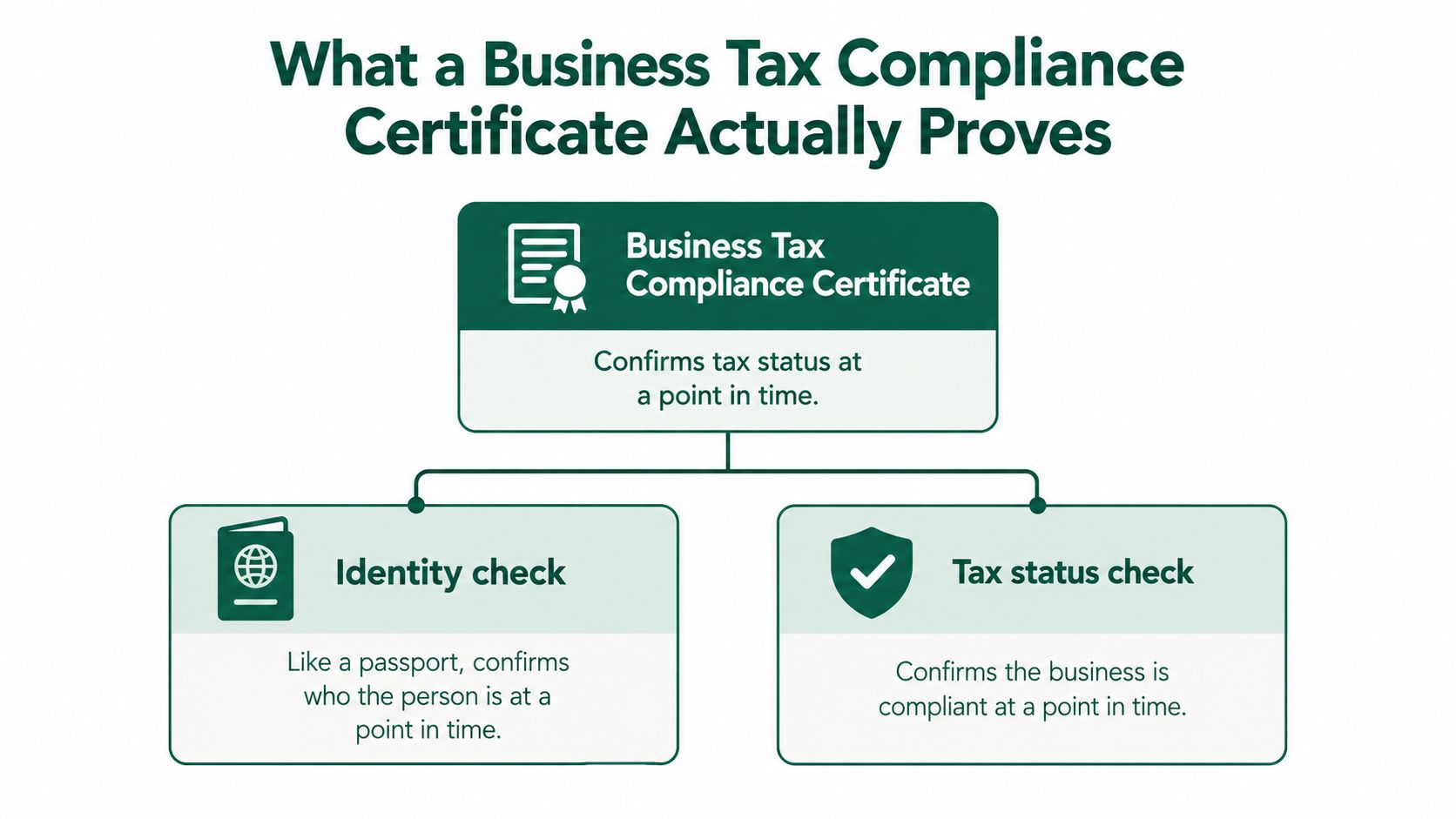
Think of a passport as a useful analogy, with an important limit. A passport establishes identity; a tax certificate establishes a defined tax position. Neither document proves everything someone might want to know about its holder.
The certificate's meaning depends on its scope. Some documents describe recorded liabilities at issuance. Others include historical filing and payment information. The title alone doesn't tell you how much the authority checked.
The distinction between a status document and the underlying obligations is central to understanding tax compliance. Filing returns, calculating liabilities, and making payments are ongoing activities. A certificate is evidence drawn from that administrative record.
A compliance report can include history
The U.S. Internal Revenue Service provides a useful contrast. Its Business Tax Compliance Report, Letter 6574, is available through the taxpayer's online Business Tax Account and includes late payments of federal income, employment, or excise taxes during the previous 4 tax years, plus returns not filed or filed late during the previous 6 years, as explained in the IRS tax compliance report guidance.
That historical coverage can help lenders, contracting authorities, employers, and other institutions assess more than today's balance. It also illustrates why certificates from different jurisdictions shouldn't be treated as interchangeable.
A point-in-time certificate is a snapshot, not a replacement for tax returns, ledgers, or payment records.
When reading any certificate, check the issuing authority, named taxpayer, covered obligations, relevant period, and issue date. Don't assume that a document confirming no recorded debt also confirms that every return was accurate.
Where the Certificate Is Used in Real Business Situations
A founder can receive similar-looking requests from recipients with very different objectives. A contracting authority may focus on public liabilities, while a foreign customer may need evidence supporting withholding-tax treatment.
The following examples are a practical way to interpret a request, not a claim that every institution requires the same paperwork. The recipient's written requirements control what you should submit.
Common Uses of a Business Tax Compliance Certificate
| Use Case | Who Requests It | What They Check |
|---|---|---|
| Public procurement and tenders | Contracting authority or procurement team | Evidence addressing the tender's tax-standing or public-liability requirements |
| Banking and payment onboarding | Bank or payment provider | Tax-standing evidence specified in its onboarding checklist |
| Customer and marketplace checks | Customer, marketplace, or commercial partner | Documentation supporting the company's stated tax position |
| Licensing and regulatory files | Licensing body or regulator | The tax-status evidence required for that application |
For example, if you're applying for an EU IBAN account, don't assume that a certificate is automatically necessary or sufficient. Ask the bank or online provider which evidence it accepts for your company and whether the original electronic version is suitable.
A customer's request deserves the same care. If the customer is asking about withholding tax on an invoice, sending proof of no Bulgarian arrears might answer the wrong question.
Ask what the document must establish
Before commissioning translations or requesting additional paperwork, send a short clarification:
- Required conclusion. Does the recipient need proof of no arrears, a filing record, or tax residence?
- Covered obligations. Must the evidence address corporate income tax, VAT, payroll, or broader public liabilities?
- Acceptance conditions. What issue date, language, signature, and verification method will they accept?
This is particularly useful across borders. A familiar English label such as tax clearance may describe a different administrative document in the recipient's country.
How to Obtain a Business Tax Compliance Certificate in Bulgaria
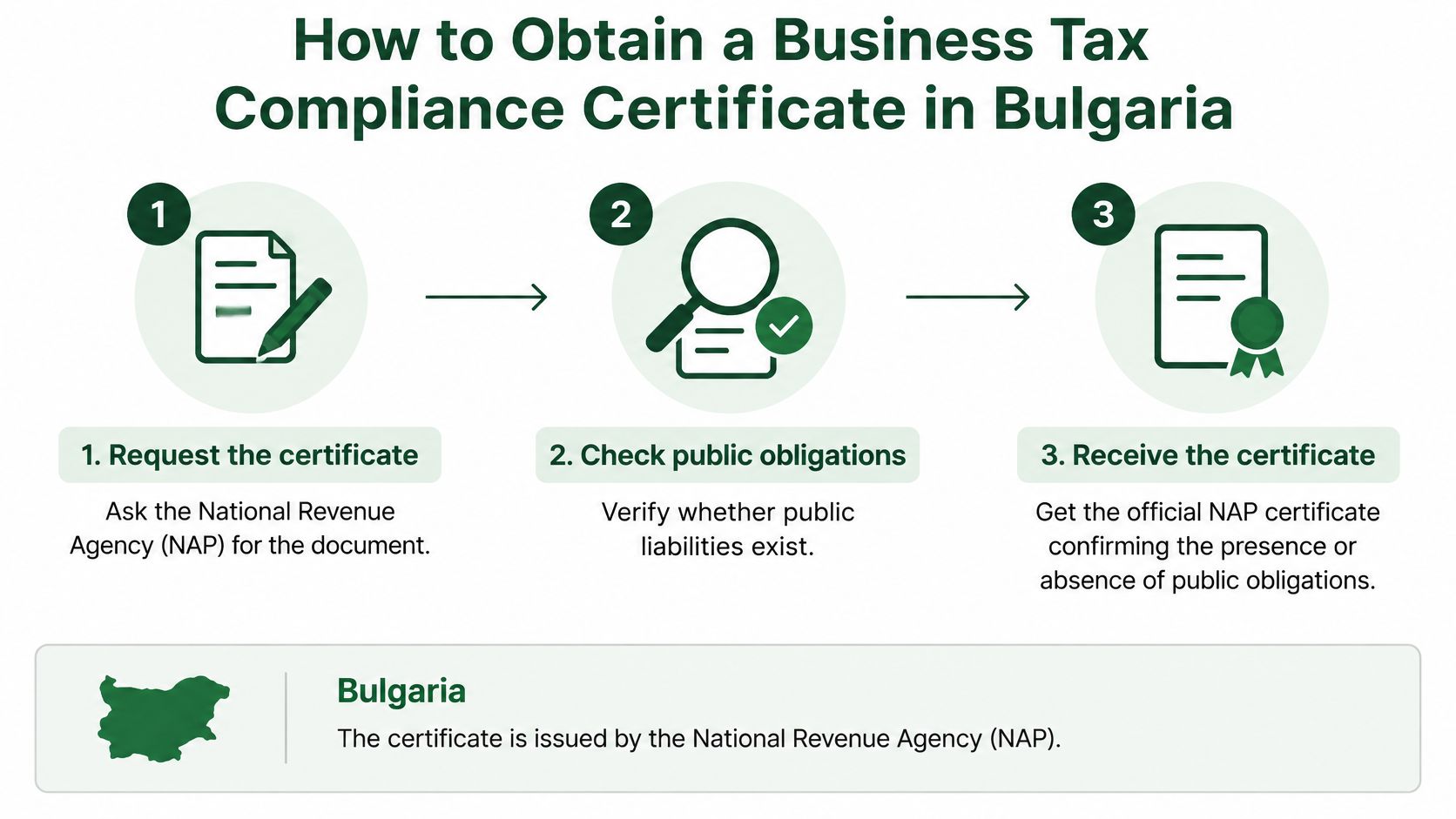
Bulgaria's relevant document is generally the certificate confirming the presence or absence of public liabilities. The National Revenue Agency, commonly called NAP, offers the service to individuals and legal entities registered with it.
The request can be handled online, so you don't need to treat an office visit as the default. With the appropriate access and clear instructions from the recipient, the administrative task can be straightforward.
This is the basic request path:
Choose your submission route
NAP permits applications in person, by licensed post, or electronically through its portal using a qualified electronic signature (QES) or a NAP-issued personal identification code (PIC). Its official public-liabilities certificate service states a deadline of up to 7 days from receipt, extending to up to 14 days when the request goes through a non-competent territorial directorate.
For a remote founder, a sensible workflow is:
- Check access first. Confirm that the electronic credentials and representation arrangements are suitable for the company's application.
- Review the account. Ask your accountant to investigate outstanding entries or payment discrepancies before submission.
- Submit the correct request. Select the service for the presence or absence of public liabilities, rather than relying on an approximate English label.
- Review the issued document. Check the company details and recorded status before forwarding it.
The certificate reflects liabilities recorded in the authority's systems at issuance. It isn't a universal approval of the company's accounting, and it doesn't replace corporate returns, VAT filings, payroll declarations, payment confirmations, or accounting records.
The video below offers additional viewing alongside the official service information:
Keep the electronic original and your application correspondence together. If something looks wrong, resolve the discrepancy rather than sending the certificate with an informal explanation attached.
Tax Compliance Certificate vs Tax Residence Certificate
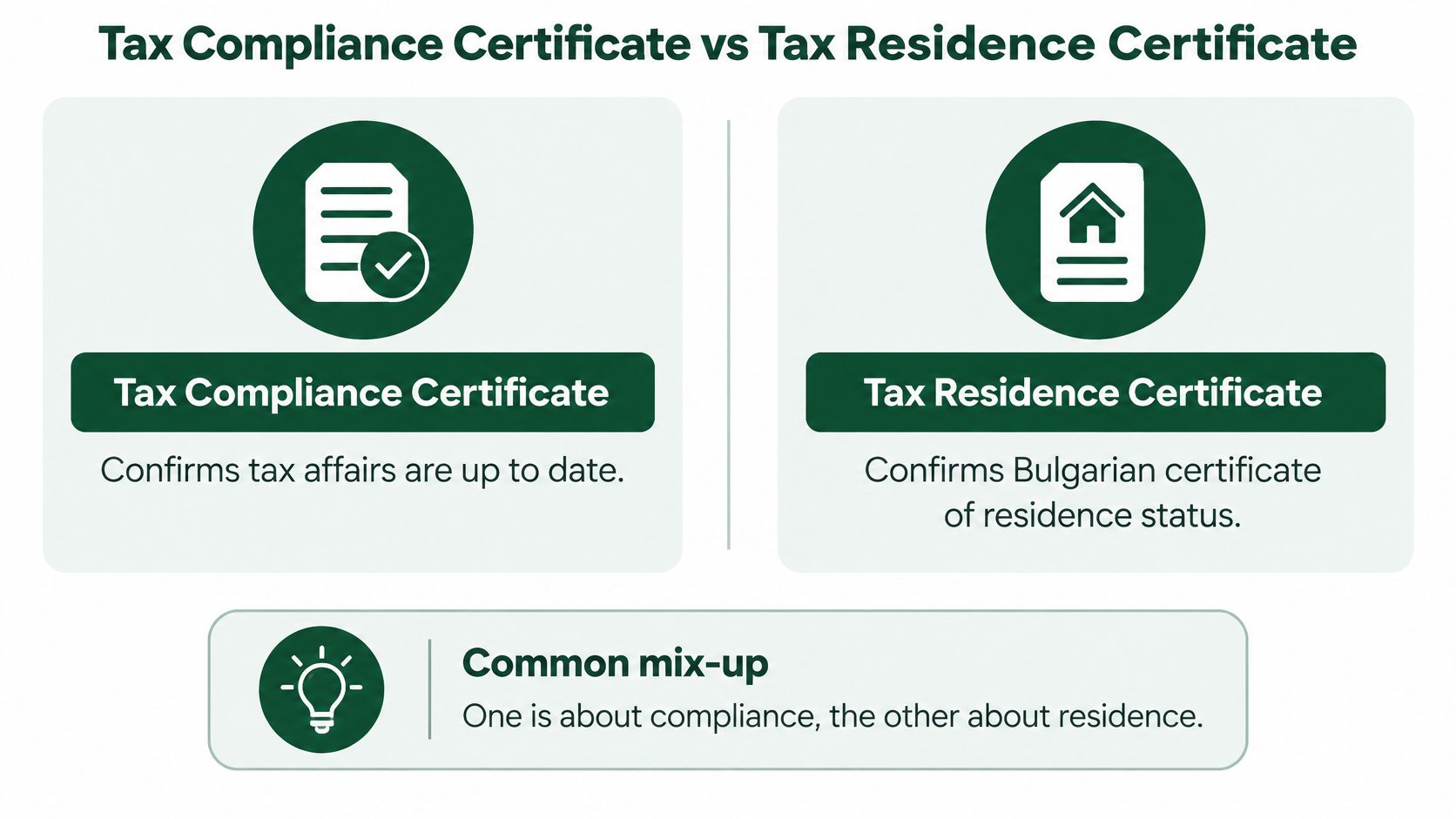
Being tax-compliant is not the same as being tax-resident. This is the distinction to settle before submitting documents to a foreign bank, customer, procurement team, or tax authority.
A tax-clearance document generally addresses whether tax affairs are up to date. A Bulgarian certificate of fiscal residence serves a different purpose: applying a double-tax treaty and confirming residence for tax purposes and taxation of worldwide income in Bulgaria, as reflected in the NAP fiscal-residence documentation.
Choose evidence by purpose
| Recipient's purpose | Document to clarify or request | Important boundary |
|---|---|---|
| Proof of no recorded Bulgarian public liabilities | NAP public-liabilities certificate | Doesn't establish treaty residence |
| Treaty relief or reduced withholding tax | Certificate of tax residence | Doesn't replace evidence of filing and payment |
| Corporate income tax, VAT, or payroll checks | The specifically requested certificate and supporting records | Don't assume a general certificate covers every question |
| Banking, licensing, or procurement | The document specified by the recipient | The application may require additional evidence |
Suppose a foreign customer asks for a residence certificate before applying treaty treatment to a payment. Your company could have no overdue Bulgarian liabilities and still need the separate residence document. Sending clearance evidence instead can leave the customer unable to support the requested withholding treatment.
The reverse is also true: evidence of treaty residence doesn't answer a tender requirement about unpaid public liabilities.
Practical rule: Match the document to the question, not to whichever certificate is easiest to download.
For a closer explanation of the residence document, consult the guide to a tax residency certificate. If you're a non-resident founder, keep your personal position separate from the company's position when discussing the application.
Before sending either certificate abroad, ask whether translation, apostille, legalization, or direct authority-to-authority verification is required. Don't assume those steps are always necessary, but don't discover the requirement after the submission deadline.
How Bulgaria Compares on Tax Compliance and Rates
A headline tax rate works like a shop's sticker price. It tells you something real, but never the full cost of owning the thing. Founders comparing Bulgaria with other EU jurisdictions should weigh the rate, the filing workload, and how easily they can prove compliance when a bank or customer asks.
Tax administrations handle compliance credentials in different ways. Some have run graded certificate schemes that reward strong filers with lighter audit scrutiny, as DFDL's summary of one such program describes. Bulgaria keeps things simpler, and the wider European direction is toward certificates requested and verified online, which is exactly how the NAP e-services process works.
Compare tax systems, not just certificates
For founders considering an EU company, Bulgaria's ordinary corporation-tax rate is 10% of taxable profit, confirmed by the Bulgarian Ministry of Finance. Taxable profit isn't necessarily the same as cash received or the balance in your business account.
The OECD Corporate Tax Statistics comparison places standard corporate rates in an international framework that includes many European jurisdictions near or above 20%. Special minimum-tax rules must be considered separately, including the 15% EU minimum-tax framework applicable to certain Bulgarian entities.
A low headline rate doesn't eliminate compliance work. Compare taxable-profit adjustments, payroll contributions, VAT, withholding taxes, substance requirements, and any applicable special regime. Two jurisdictions with similar rates can demand very different amounts of bookkeeping, and the cheaper rate can lose its appeal if filings pile up.
My practical recommendation is to evaluate both the tax calculation and the administrative workflow. A location is easier to operate from when you understand what must be filed, who will file it, and how you'll produce evidence when a commercial partner asks.
Documents You Need and How to Keep the Certificate Valid
Keep a compliance folder, not just a certificate folder. For a Bulgarian EOOD or OOD serving international customers, the supporting records help your accountant explain what the certificate does, and doesn't, establish.
An entity can have no recorded overdue public liabilities while still having an unfiled or incorrect return that hasn't generated an assessed debt. That's why a clean-looking certificate shouldn't be your only internal compliance check.
Build a usable evidence file
- Issued certificate. Preserve the electronic original, issue date, and related application correspondence.
- Annual corporate return. Keep the latest submitted return and filing confirmation.
- VAT records. Retain VAT returns and ledgers where applicable.
- Employment records. Include payroll and social-security submissions where relevant.
- Payment reconciliations. Keep records connecting amounts due with payments and the authority's account entries.
Recency, formal validity, and recipient acceptance are different questions. A document can accurately describe the position on its issue date while no longer satisfying a bank's requirement for recent evidence. Making a later payment also doesn't rewrite an already issued certificate.
Make electronic evidence usable abroad
Poland permits applications for corporate income tax, VAT, excise, and arrears certificates through its e-Tax Office, illustrating the wider shift toward online tax administration described in the Polish certificate application guidance. Ireland's approach also illustrates a useful distinction: clearance can be available where arrears are covered by an instalment arrangement, so clearance terminology doesn't always mean that no balance exists.
For your Bulgarian document, ask the foreign recipient about:
- Verification. Will it accept the electronic signature, or does it require a current status check or another verification mechanism?
- Language. Is a certified translation necessary?
- Authentication. Does it require an apostille, legalization, or an original in a specified format?
- Freshness. How recent must the certificate be?
The wider direction is toward digitally verifiable credentials using structured data, identifiers, signatures, and validation. But electronic delivery doesn't automatically create cross-border acceptance. Preserve the original file rather than assuming a scan or printed copy carries the same verification features.
Getting Your Certificate and Staying Compliant Year Round
The easiest certificate request is one you've prepared for before a customer asks. Keep your bookkeeping current, reconcile tax payments, and make sure someone can access the company's online tax services when needed.
For the annual cycle, Bulgarian companies generally calculate their taxable financial result for the calendar year, file the annual return, and pay remaining corporation tax by 30 June of the following year. The return is filed from 1 March through 30 June, electronically using a qualified electronic signature, according to the Ministry of Economy's corporate-tax filing guidance.
Give each obligation an owner
Most companies must file, except entities with no activity during the year and no corporate-tax liability under that guidance. Don't assume that limited trading or a quiet bank account automatically means no return is needed.
Use a shared calendar and agree responsibilities with your accountant:
- Founder responsibilities. Supply invoices, contracts, bank records, and explanations of unusual transactions.
- Accounting responsibilities. Prepare reconciliations, assess filing obligations, and flag missing information.
- Submission responsibilities. Confirm who signs, who files, and where filing acknowledgements are stored.
- Certificate responsibilities. Keep the recipient's requirements alongside the issued document.
The guide to corporate tax filing deadlines can help you organize the annual timetable. Treat certificate requests as part of that ongoing workflow, rather than a separate emergency.
Coordinate support without confusing the issuer
You can manage the request yourself, use your existing Bulgarian accountant, or work with a provider that coordinates bookkeeping, annual returns, VAT reporting, payroll, and certificate-request support. A single point of contact can make document collection simpler, provided the scope and responsibilities are clear.
The certificate itself still comes from NAP, not from your adviser. Before appointing anyone, confirm who will submit the application, review the result, and help resolve any recorded discrepancy.
Your next step today is simple: send the recipient's exact request to your accountant and ask them to confirm the document type, online access arrangements, and acceptance conditions before applying.
FastCorp offers Bulgarian company formation and ongoing accounting support, including bookkeeping, VAT reporting, payroll, and annual tax filings. Visit FastCorp with the certificate request you've received to discuss the appropriate NAP document and how to coordinate it with your company's compliance records.