What Is Payroll Administration? a Bulgaria Guide for 2026
Learn what is payroll administration, its core tasks, Bulgarian tax and social-security rules, and practical steps to run payroll correctly online.
You've agreed a salary with your first employee in Bulgaria, and payday is approaching. Then the questions start: Is the agreed amount gross or net? What does the company pay on top? Who submits the declarations, and how do you know they've been accepted?
The good news is that the workflow can be handled online and made straightforward. The important part is connecting the salary calculation, approvals, bank payments and compliance records, rather than treating each as a separate job.
Table of Contents
- Payroll Administration Defined in Plain Terms
- The Payroll Cycle From Timesheet to Payslip
- Bulgarian Payroll Rates Every Employer Should Know
- How Bulgaria's Payroll Burden Compares Abroad
- Compliance Calendar, Records and Responsibility
- Common Payroll Mistakes and How to Fix Them
- Start Payroll Online With a Clear Checklist
Payroll Administration Defined in Plain Terms
Payroll administration is the structured process of calculating employee pay, withholding taxes, accounting for employer contributions, issuing wages and submitting required reports to public authorities. If you're asking what is payroll administration, the simplest answer is this: it's everything needed to turn employment terms into correct, documented pay.
Say you hire a developer for your Bulgarian company. The employment contract supplies the agreed salary, but the payroll administrator must also check approved leave, additional compensation, employee information and applicable deductions before authorizing payment.
The administrator keeps four amounts separate:
- Gross pay: The employee's earnings before employee deductions.
- Employee deductions: Amounts withheld for statutory contributions, income tax and other authorized deductions.
- Employer liabilities: Contributions and other obligations the company pays in addition to gross salary.
- Net pay: The amount the employee receives after deductions.
Why the bank transfer isn't the whole job
For a Bulgarian employer, payroll includes the pay run, statutory social-security and health contributions, employment income tax, the accounting entry and periodic filings. The employee's bank payment is only one output.
The accountant needs a traceable explanation of the expense and liabilities. The employee needs a clear payslip. Public authorities need the relevant declarations and payments, while management needs to understand the full cost of employing the person.
The desk work behind a successful pay run connects all those records.

The tax wedge measures the difference between an employer's total labour cost and an employee's take-home pay, incorporating the tax and contribution components described in the OECD's Taxing Wages overview. That's the useful framework for international comparisons, rather than headline income-tax rates alone.
Practical rule: Every payroll figure should lead back to an approved input, a calculation or a payment record.
Payroll also belongs within the company's wider corporate accounting services, so salary expenses and outstanding liabilities reach the books correctly. Understanding the cycle, Bulgarian rates, international comparison, compliance calendar, common mistakes and online setup gives you a practical way to supervise the whole process.
The Payroll Cycle From Timesheet to Payslip
A dependable pay run follows a repeatable sequence. The administrator prepares the calculation, an authorized reviewer checks exceptions, and the payment approver releases the approved amounts.
The diagram summarizes the main stages, while the procedure below separates the additional control points.
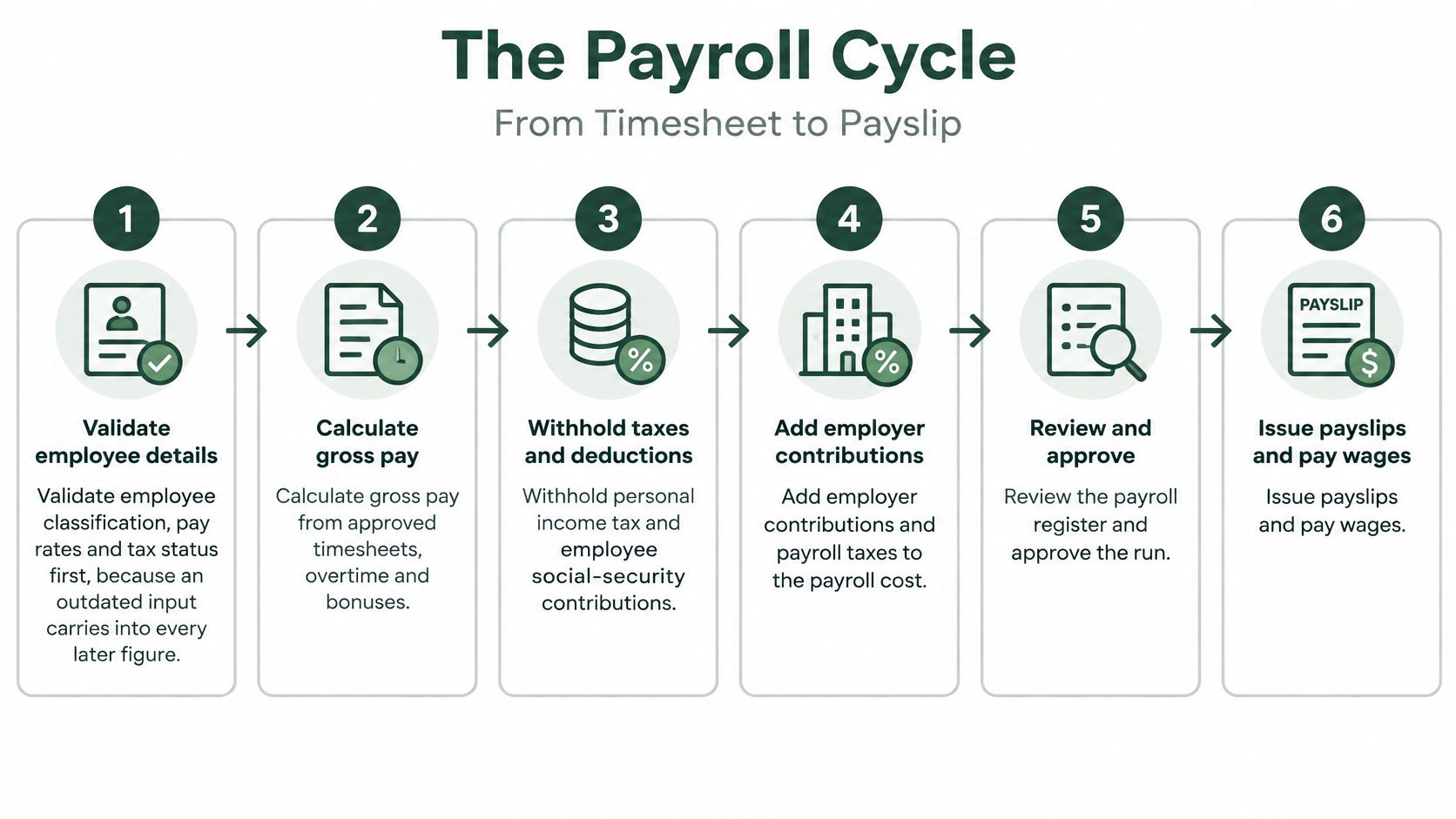
Follow the inputs through to payment
Validate employee records first. Check classification, contractual pay rate, tax status and active employment dates against authorized records. A duplicate employee profile can otherwise produce duplicate calculations before anyone notices.
Apply approved pay inputs. Enter hours, overtime, bonuses, benefits and leave, with a separate reviewer approving variable compensation. A bonus entered from an informal message rather than an approved instruction is a common weak point.
Calculate gross-to-net wages. Build gross earnings, identify the relevant contribution and tax bases, and calculate the resulting take-home amount. Don't assume every benefit receives the same treatment as ordinary salary.
Record employee withholdings. Separate income tax and employee social-security and health contributions from the amount payable to the employee. An outdated tax setting can leave the arithmetic internally consistent but legally incorrect.
Record employer liabilities. Calculate employer contributions and any applicable employer-side payroll taxes separately from employee deductions. Omitting this step understates the cost of employment even when the employee receives the right payment.
Lock the pay-period cutoff. Stop unreviewed changes after approval and route late adjustments through a documented exception process. A last-minute timesheet edit can otherwise make the bank file disagree with the approved calculation.
Release wages and issue payslips. Match the payment file to the approved payroll register before release, then reconcile actual bank transactions afterward. An old payment file is an avoidable cause of paying the wrong amount.
Post the accounting entry and prepare filings. Transfer salary expenses, employee payables and statutory liabilities to the general ledger. Check the reporting outputs against the approved payroll rather than assuming the export is complete.
Use the payroll register as the control point
The payroll register brings gross wages, taxable wages, employee withholdings, employer taxes and net payments into a single reviewable record. It should also support the journal entry, so the administrator can explain how the calculation becomes an accounting expense and a set of liabilities.
Employment-tax instructions illustrate why employee withholdings and employer obligations require separate treatment, including in the IRS instructions for Form 944. Those are US rules, not Bulgarian settings, but the distinction is useful when designing the workflow.
For a visual walkthrough alongside your checklist, use the following video.
A clean cycle ends with matching totals, documented approvals and resolved exceptions. If a variance remains unexplained, the administrator should identify its owner and resolution before calling the run complete.
Bulgarian Payroll Rates Every Employer Should Know
Bulgarian payroll contribution and tax rates
| Item | Rate | Paid by | How it applies |
|---|---|---|---|
| Employer social-security and health contributions | 18.92%–19.62% | Employer | Added on top of gross salary as employer cost |
| Employee social-security and health contributions | 13.78% | Employee | Withheld from gross pay before tax |
| Total mandatory contributions | 32.70%–33.40% | Split between both | Combined employer and employee share of gross remuneration |
| Personal income tax | 10% flat | Employee | Calculated on gross remuneration after statutory deductions |
The Bulgarian Ministry of Economy and Industry's remuneration and insurance guidance sets out these general contribution shares and the 10% flat employment income-tax rate. Its insurance breakdown includes pension insurance, additional mandatory pension insurance for people born after 1960, sickness and maternity insurance, unemployment insurance and 8% health insurance.
The central distinction is who pays, not just the combined percentage. The employee share reduces take-home pay, while the employer share adds to the company's cost without reducing the agreed gross salary.
A worked gross-to-net example
Take a hypothetical 2,000 BGN gross salary, using the employee contribution share and lower employer rate in the table. This is a simplified BGN-denominated teaching example, not a statement about the currency to use for a current payroll payment.
Assume the full illustrative salary is subject to the stated contributions, with no additional adjustments, reliefs or special treatment.
| Calculation | Worked amount |
|---|---|
| Gross salary | 2,000.00 BGN |
| Employee contributions, 2,000 × 13.78% | 275.60 BGN |
| Income-tax base, 2,000 − 275.60 | 1,724.40 BGN |
| Income tax, 1,724.40 × 10% | 172.44 BGN |
| Net pay, 2,000 − 275.60 − 172.44 | 1,551.96 BGN |
| Employer contributions, 2,000 × 18.92% | 378.40 BGN |
| Total employer cost, 2,000 + 378.40 | 2,378.40 BGN |
These are arithmetic outputs from the hypothetical salary and the ministry-published rates, rather than additional statutory figures. They show why neither gross salary nor take-home pay alone describes the company's employment cost.
Notice the order: employee contributions come off before calculating income tax. Applying the income-tax percentage directly to gross salary would give the wrong answer in this simplified example.
What to check before using the rates
An administrator must confirm the employee's insurance category, applicable contribution base, current thresholds and treatment of benefits. A published general rate table isn't a substitute for checking the rules that apply to the actual employee and pay period.
Monthly payroll software can make these calculations easy to repeat. Configure the rules correctly, inspect the calculation breakdown and save the approved result, rather than accepting a net figure with no explanation.
How Bulgaria's Payroll Burden Compares Abroad
A low headline income-tax rate can make labour look cheaper than it is. For a single worker without children earning the average wage in 2024, the OECD's Taxing Wages 2025 reports an OECD average tax wedge of 34.9% and the figures below. A tax wedge works like the full price tag on employment, because it includes the parts paid by the employer and the parts withheld from the employee.
Tax wedge for a single average-wage worker, 2024
| Country | Tax wedge (2024) | What drives the burden |
|---|---|---|
| Belgium | 52.6% | Highest in the OECD sample for a single average-wage worker |
| Germany | 47.9% | High employer and employee social-security contributions |
| France | 47.2% | High employer social-security contributions |
| Italy | 47.1% | High employer and employee contributions |
| Austria | 47.0% | High social-security contributions |
| OECD average | 34.9% | Average across OECD countries |
| Bulgaria | Structure-only: 10% flat income tax plus 32.70%–33.40% mandatory contributions | Context only, not an OECD-calculated wedge |
The OECD figures use the same worker profile, so they can be compared with each other. Bulgaria's row is shown for context only. Its structure is described in terms of income tax and mandatory contributions, while the OECD wedge is measured against total employer labour cost. Treating those as identical would be like comparing a recipe with the final invoice.
Compare the same denominator
The tax wedge is a share of total employer labour cost. Contribution rates expressed as a share of gross remuneration use a different denominator, so adding Bulgaria's contribution percentage to its income-tax percentage will not produce a comparable result.
Imagine gross pay as the ingredient list and employer cost as the finished dish. The employee sees net pay after contributions and income tax. The employer budgets gross pay plus employer contributions. The wedge looks at the whole plate, which is why it can reveal a heavier burden than a headline income-tax rate suggests.
The distinction is easier to see when the components are separated visually.
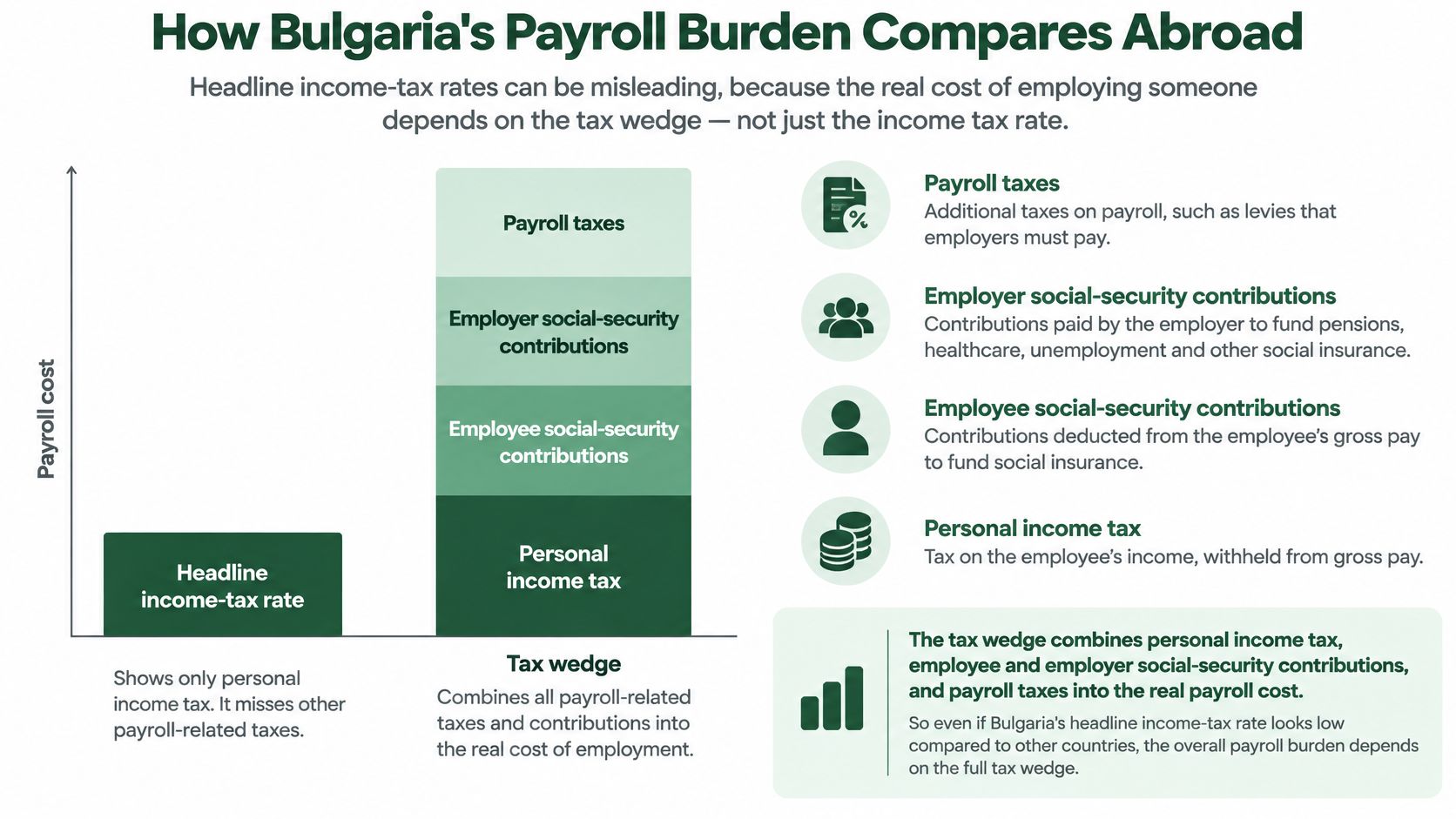
For hiring decisions, the wedge is more informative because it captures both sides of payroll. Employer contributions raise the amount a company must budget. Employee contributions and income tax reduce what the employee receives. Similar income-tax rates can therefore sit alongside quite different employment costs.
Compare equivalent workers and equivalent cost measures, not attractive percentages taken from different tax bases.
Turn a comparison into a hiring budget
Say you're deciding where to employ a customer-support specialist. Ask for a local gross-to-net calculation and an employer-cost estimate based on the same compensation assumptions, rather than comparing the advertised salary alone.
Keep benefits, working arrangements and employee circumstances consistent where possible. Then distinguish mandatory payroll costs from optional benefits and administrative service fees, so you can see what explains the difference. This turns the comparison from a slogan into a budget line.
For cross-border teams, calculate each country separately. A Bulgarian company should never apply Bulgarian payroll settings to someone working abroad without checking the relevant local employment-tax and social-insurance framework. Payroll settings are local controls, and each jurisdiction needs its own calculation, filing path and evidence trail.
Compliance Calendar, Records and Responsibility
Payroll administration continues between paydays. Between one pay run and the next, someone must monitor employee changes, prepare upcoming declarations, confirm that payments reached the right authority and close outstanding corrections.
The dependency chain is straightforward: calculate the liability arising from pay, remit it by the applicable statutory deadline, report it through the required return and preserve evidence that each task was completed. Payment deadlines and filing deadlines are separate controls. A paid liability does not satisfy the reporting obligation, and an accepted return does not prove the money arrived. Each event produces its own confirmation, and each confirmation belongs in the calendar.
As a short US illustration, the IRS employment-tax guidance describes quarterly Form 941 reporting, annual Form 940 federal unemployment reporting and annual Form W-2 wage reporting; it also explains that employers generally remain responsible for returns, deposits and payments when a third party performs the work. The Bulgarian forms and authorities differ, but the pattern transfers: recurring reporting events, each with a deadline and a proof of completion.
Build a calendar someone actually owns
For Bulgarian payroll, check every filing deadline, payment deadline and receiving authority against current Bulgarian rules before you activate the calendar, and don't copy foreign deadlines or assume an old calendar remains valid.
Each calendar entry should identify:
- The obligation: Name the return, payment or employee statement.
- The responsible person: Assign a preparer, approver and backup.
- The dependency: Specify which payroll report or calculation is needed first.
- The completion evidence: Require a payment confirmation or accepted filing acknowledgment.
- The escalation route: State who acts if a submission is rejected or a deadline is at risk.
Without a named owner, a calendar entry is only a reminder. A guide to payroll reporting requirements can help organize the reporting questions, while the operational calendar still needs checking against current local rules.
Preserve evidence, not just finished payslips
Keep payroll registers, tax calculations, payment confirmations, filing acknowledgments, employee master-data change logs and correction records. Store them in a controlled location with access appropriate to sensitive salary, identity and bank information. These records answer the questions that surface months later: an employee querying net pay, a reconciliation that fails to clear, an authority asking how a reported figure was derived.
The cycle's reconciliations also need evidence of review. Preserve the payroll-to-bank and payroll-to-ledger checks, then add tax-liability-to-remittance checks and year-to-date comparisons against statutory reporting totals.
Ownership check: A task isn't complete because it was sent to an accountant. It's complete when the named owner has the required confirmation.
Employee location deserves its own monitoring process. If a Bulgarian employee plans to work temporarily from another country, record the location and proposed dates before the move, then assess whether local payroll, reporting or social-insurance obligations arise.
Outsourcing can distribute the work, yet responsibility remains with the employer. The employer must align processing with Bulgarian employment, social-security, income-tax and reporting rules while separately assessing obligations wherever employees physically work.
Common Payroll Mistakes and How to Fix Them
Start with the errors that spread furthest: outdated employee tax information and duplicate employee records. They can affect wages, contribution calculations, payments and filings together, so correcting the employee's bank transfer alone may leave other records wrong.
A useful investigation begins with the first visible symptom. Ask what the employee, bank reconciliation or statutory notice is telling you, then trace that symptom back to the source record.
Common payroll mistakes, symptoms and fixes
| Mistake | First symptom | Fix |
|---|---|---|
| Outdated employee tax status | Net pay differs from the payslip the employee expects | Update the record, then correct through a controlled reversal or off-cycle payroll |
| Duplicate employee record | Two payments or two contribution lines for one person | Merge the records under a controlled process and reconcile the payroll register to the bank |
| Misclassified taxable benefit | Tax withheld does not match the benefit listed | Reclassify the benefit and recalculate the affected periods |
| Variable pay without approval | Bonus or overtime appears with no source document | Require maker-checker approval before the pay-period cutoff |
| Bank details changed without checks | Pay sent to an unexpected account | Verify changes through a separate trusted channel and log each change |
| Historical data edited directly | Totals in filings no longer match the ledger | Use a logged correction instead of editing closed periods |
| Bulgarian rules applied to foreign staff | Contributions calculated for an employee in another country | Calculate each country separately and check the local framework first |
Make the immediate fix safe
For bank-detail changes, call the employee using an already verified number, not a number supplied in the change request. Record who verified the instruction and who approved it before replacing the payment details.
For unsupported bonuses or overtime, introduce an approval field that the reviewer must complete before the cutoff. Don't let the payroll administrator infer authorization from a spreadsheet containing an amount.
An unexpected net figure isn't proof that payroll is wrong. Compare the contract, approved changes and calculation breakdown before deciding whether the issue is an error or an employee misunderstanding.
Separate prevention from historical correction
Access controls, trusted-channel verification, documented approvals and a locked cutoff can be introduced immediately. They protect the next pay run, but they don't repair previous calculations.
Tax-status errors, benefit misclassification, duplicate records and cross-border mistakes require a review of affected periods. Identify which employees, payments, contribution liabilities and filings changed, then document the correction route and communicate clearly with anyone whose pay is affected.
Keep the original evidence. Deleting a duplicate or overwriting a closed calculation without a trace can make it harder to explain what happened and prove that the final position is correct.
Start Payroll Online With a Clear Checklist
A prepared Bulgarian payroll setup can be organized online within a normal working week when the necessary records, credentials and approvals are ready. Treat that as a practical planning scenario, not a guaranteed service timeline: missing employee information or unresolved cross-border questions can delay readiness.
Document collection, calculation review, approval and reporting coordination can all take place online. The workflow becomes easy to manage when everyone knows what to submit and who approves the result.
Prepare the first live run
Check employment inputs against signed contracts. Confirm each employee's classification, pay rate and tax status, then collect verified bank details and relevant supporting records.
Configure current Bulgarian rules. Load the employee and employer contribution settings and flat income-tax treatment described in the rates table, checking that the system's settings are current for the actual pay period.
Set the cutoff and lock date. Tell managers when hours, leave and adjustments are due, and decide how late submissions will be handled.
Separate preparation from approval. Name who submits variable pay and who authorizes overtime, bonuses and other adjustments.
Agree the payment reconciliation routine. Match the proposed bank-file total to the approved payroll register before release, then confirm the bank's actual execution afterward.
Assign the compliance calendar. Give every filing and payment a named owner, backup and required completion record.
Test a complete pay period. Check that the register, ledger entry and payslips agree before approving the first live run.
This checklist is easier to follow when the supporting documents sit in a controlled online workflow.
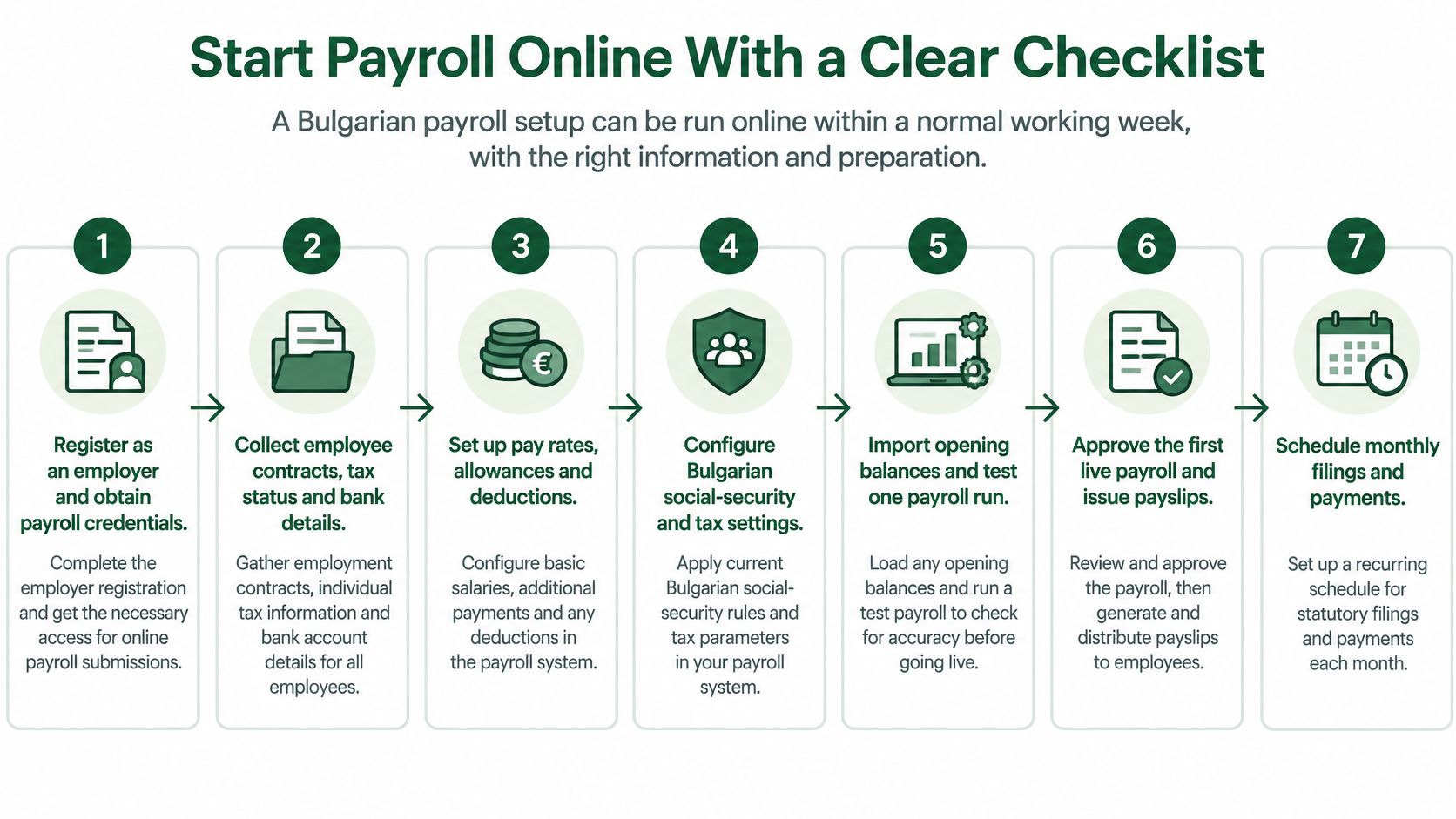
Choose who operates the process
You can run payroll in-house using an online system or assign processing tasks to an external accounting provider. Compare payroll management tools by their calculation visibility, approval controls, reporting outputs and audit trails, not just how quickly they generate a payslip.
At FastCorp, our ongoing compliance support includes bookkeeping, tax filings and payroll, and we fully handle legal paperwork and compliance for the customer's company. Record the agreed division of payroll tasks in writing, including the information and approvals the employer must supply.
Before releasing the first real payment file, work through the checklist with the person approving payroll. Resolve unexplained differences, confirm the filing owners and save the approval alongside the final register.
FastCorp offers payroll administration alongside bookkeeping and tax filings, helping connect employee pay with your Bulgarian company's compliance obligations. Visit FastCorp to discuss your employee setup, reporting needs and the responsibilities to agree before your first pay run.