Virtual Offices Meaning: What It Is and How It Works
Virtual offices meaning explained: what a virtual office includes, how it differs from a physical office, and what it cannot do for your company.

The registration form asks for a business address. The bank asks for one too. A client wants to courier a signed contract somewhere other than your flat. You have a company to run, not an office to lease, and putting your home on a public register is not appealing.
A virtual office fills that practical gap. It is a business address and administrative service that gives a company a professional presence without renting a full-time desk. The model is simpler than the history: serviced offices existed for decades, and remote work made the address-only version common. The address, mail handling and reception support are real, but they are not the same as occupying the space.
That distinction matters because an address alone proves less than founders expect. A virtual office can receive a letter and lend credibility to a website. It does not establish tax residence, and it may not satisfy a bank's onboarding team or a registry's legal acceptance checks. Treat it as one useful piece of a setup, not a substitute for the registrations, substance and permissions your business needs.
Table of Contents
- What a Virtual Office Means and What It Includes
- Why Virtual Offices Grew Into a Standard Business Tool
- Virtual Office, Physical Office or Registered Address Compared
- Corporate Tax Rates Across Countries and Where Virtual Offices Fit
- Practical Checks Before You Choose a Virtual Office
- Misconceptions That Can Cost Founders Money
- Decide Whether a Virtual Office Fits Your Company
What a Virtual Office Means and What It Includes
A virtual office rents the parts of an office that other people see and leaves out the part that costs the most. Clients, banks and registries deal with an address, a signature on a delivered letter and a room to sit in. None of them deal with the desk you occupy from nine to six.
Think of a hotel front desk. You check in, collect messages, book a meeting room for the afternoon, and your name appears on the guest list. Guests use the building all day, yet nobody assumes the building belongs to them. A virtual office runs on the same principle. The address and the reception service are real. The desk isn't yours.
Presence without occupancy
The encyclopedic account of virtual offices frames the model as one that separates a company's professional presence from its employees' daily physical location. Instead of leasing a dedicated office, a business receives a commercial address, mail receipt and forwarding, telephone or receptionist support, and access to meeting rooms when needed, which cuts the capital and fixed overhead of a conventional lease while keeping an externally visible presence.
The nuance founders skip sits in the second half of that idea. The company does have a physical location. It just doesn't need to occupy it continuously.
The City of London's trading standards guidance says the same thing with fewer syllables, describing an address rented for business use even though the customer isn't physically present there, with mail either collected or forwarded.
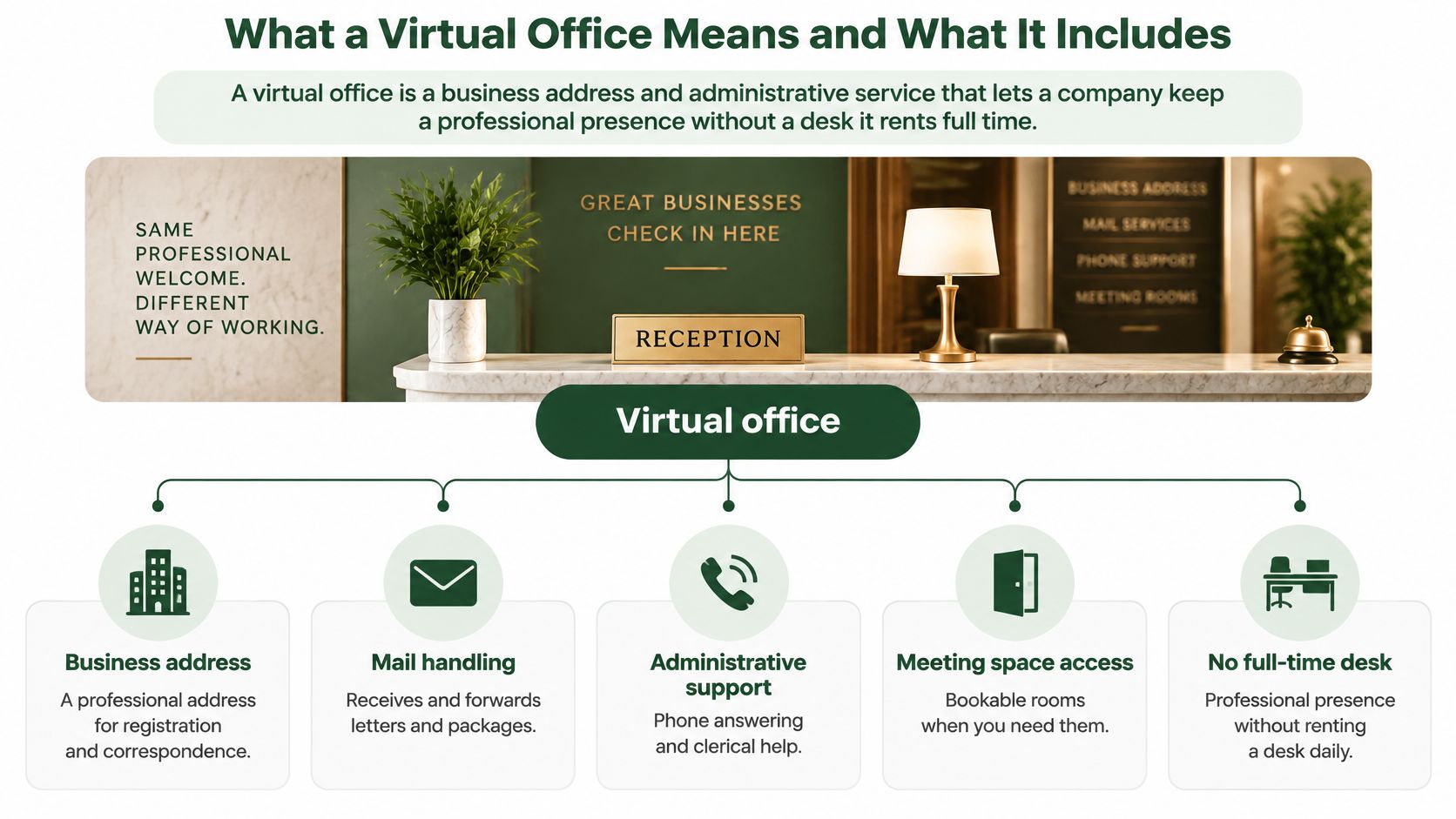
The five services in a typical plan
Most providers bundle the same components, and each one carries a condition worth reading before you sign.
| Service | What it gives you | Limit to check |
|---|---|---|
| Business address | A public commercial street address for correspondence and listings | Not a place where staff work daily |
| Mail receipt and forwarding | Post collected, scanned or forwarded to you | Forwarding alone may not meet statutory deadlines |
| Phone answering or receptionist | Calls answered in the company name | Scope varies by provider, so ask what's included |
| Meeting room access | Rooms booked when clients visit | Available on demand, not continuously |
| Registered office | The address used in the company register | Accepted only where the registry and local law allow it |
The mail row deserves a second look, because it hides the most common failure. If a tax notice arrives on the 3rd and reaches you on the 20th, a statutory deadline may already have passed. A provider that scans and alerts you the day something arrives behaves very differently from one that forwards post once a month.
What a virtual office doesn't include. Three things get confused with the service itself. There's no daily workspace, so a founder who needs a desk and a monitor should look at coworking instead. There are no employees at the address, which matters the moment a bank asks who works there. And there's no automatic legal status, because acceptance is granted by a registry, a tax office or a bank, never by the provider.
A quick test: if you need an address, mail handling and the occasional meeting room, but not a desk every day, a virtual office fits its own definition. If the work itself has to happen inside a building, it doesn't.
Why Virtual Offices Grew Into a Standard Business Tool
Say a two-person translation studio in Lisbon wins a contract with a manufacturer in Stuttgart. Neither founder wants to move. The client wants invoices carrying a company address, the bank wants a registered office on file, and someone has to sign for a courier envelope arriving on a Tuesday. The studio's answer isn't an office. It's a service that holds the address and handles the post.
That demand pattern has a date. In the United States, telework represented approximately 50% of paid work hours between April and December 2020, compared with about 5% before the pandemic, and the account of virtual workplaces also reports a synthesis finding that 88% of office workers worldwide worked from home during the pandemic. Teams scattered first, then discovered that scattered teams still need a formal front door.
The model itself isn't a pandemic invention. Serviced offices predate remote work by decades, and the address-plus-services package extended that older infrastructure to people who never intended to sit in it.
The distinction that makes everything else make sense is this. Remote work concerns where people perform their tasks. A virtual office concerns how a business keeps an identifiable operational presence. One is about desks, the other is about being findable, reachable and on the record.
That's why a virtual office is better described as infrastructure for a remote business than as a digital mailbox. It supplies the formal or public-facing location, mail administration, call handling and occasional meeting capacity that a distributed team still needs, and it does so without requiring anyone to commute to it.
The caution comes last, and it's the one that costs money when ignored: legal acceptance of a virtual address for incorporation, tax registration, licensing or regulated activities varies by jurisdiction. Demand made these services common. Common doesn't mean accepted by the specific institution you're about to deal with.
Virtual Office, Physical Office or Registered Address Compared
Four options show up when a founder needs an address, and they behave differently the moment an institution asks for evidence. Compare them on the criteria that decide the question.
| Criterion | Virtual office | Physical office | Registered address only |
|---|---|---|---|
| Who uses the space | Founder or staff work remotely, and the address handles mail and visitors | Staff work on site | Nobody works there |
| Official correspondence | Yes, if the provider handles it promptly | Yes | Yes, for statutory notices |
| Meeting space | Rooms on demand | Permanent desks and meeting rooms | None |
| Proves staff or management on site | No | Yes | No |
| Legal acceptance as registered office | Only where the registry and local law allow it, so verify before filing | Usually yes, if the lease permits commercial use | Only if the provider is authorised to receive service |
Read the fourth row twice. A virtual office doesn't prove that staff or management sit in the building, and neither does a registered address on its own. Only a physical office does that, and even then only for the uses its lease allows.
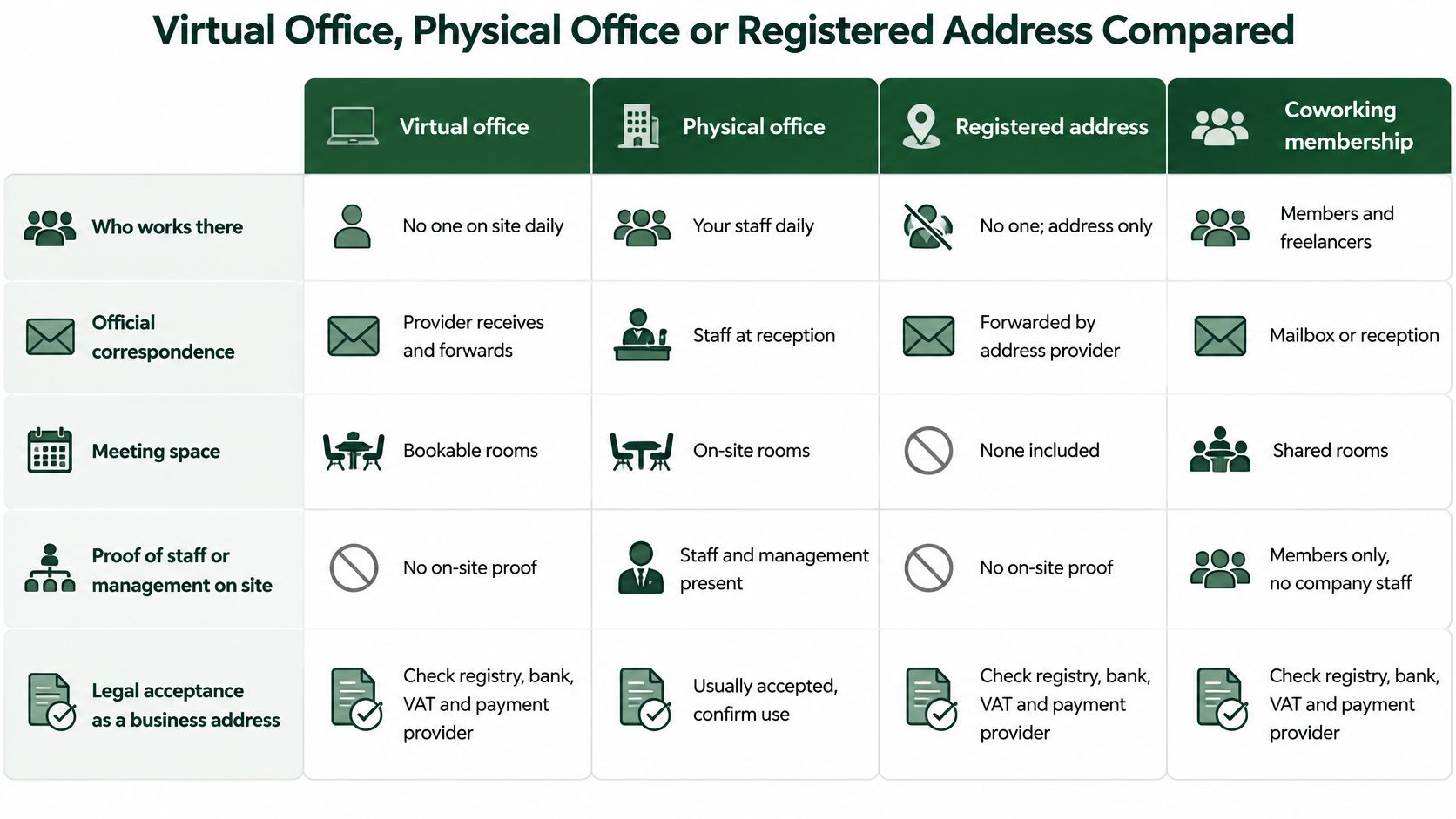
Three addresses people blur into one
Most confusion disappears once you separate three concepts that all sound like "the company address".
The registered office is where official notices go. The correspondence or trading address is where routine business mail and couriers land. The place of effective management is where the people who run the company make decisions, and it's the one tax authorities care about.
EUIPO's trade mark guidelines define a legal address as the company's registered headquarters or registered head office, and state that a forwarding or virtual address alone is insufficient unless it can be proven as the company's registered address. That's a trade mark filing rule, but the logic travels.
Can one address do every job at once
Founders ask whether a single virtual address can serve company registration, a business bank account, VAT registration, licensing and a Google Business Profile simultaneously. The honest answer is that it isn't universally yes. Each registry, bank, tax authority and platform applies its own evidence rules and its own physical-presence tests.
Regus's guide to legal considerations puts the split plainly: a company must usually supply a registered address when it incorporates, but that address doesn't need to be where employees work or where the main trading happens. That's precisely why the checks are worth running, and why authorities sometimes have to be notified when the address changes.
One trap deserves its own line. A P.O. box or a generic mail-forwarding service may not satisfy legal-address requirements, because a box number isn't a premises where a document can be delivered and acknowledged.
Which option fits which founder
Remote founder needing a registered address and mail handling: a virtual office fits, provided the registry and bank accept the specific address.
Team that must work on site: a physical office, because no address service gives you colleagues at desks.
Business that only needs a place for statutory letters: a registered address service is enough until a client or a bank asks for more.
Corporate Tax Rates Across Countries and Where Virtual Offices Fit
Bulgaria's headline rate is why many founders look at Sofia first. Put the numbers side by side before assuming the address does any work for you.
| Country | Combined statutory corporate tax rate 2025 |
|---|---|
| Bulgaria | 10% |
| Cyprus | 12.5% |
| Ireland | 12.5% |
| United Kingdom (lower standard threshold) | 19% |
| Austria | 23% |
| Belgium | 25% |
| EU average | 21.5% |
The Tax Foundation's 2025 comparison of European corporate tax rates is the source for every figure in that table, including Bulgaria's flat 10% of taxable profit.
The gap between 10% and 25% is easy to underestimate until you run it. A company with €100,000 of taxable profit pays about €10,000 at 10% and about €25,000 at 25%. On €300,000 the difference is €45,000 a year, which is a hire or a product launch.
The headline rate is one line of a longer bill. Bookkeeping quality and deductible expenses change the taxable result. VAT, payroll contributions and dividend withholding sit outside the corporate rate entirely. Tax residence, transfer pricing and permanent-establishment status decide whether the rate applies to your profit at all. Residence and permanent-establishment status turn on where management decisions are made and where the business operates, not on how much profit is retained or distributed.
A virtual office sets none of those dials. It supports registration and correspondence, and its influence stops there. It does not establish tax residence. A mailing address is not a taxable presence. It does not prove substance to a bank or tax authority on its own. Compare the full chain rather than the headline, and let the address do only the job it was bought for. Our walkthrough of corporate tax rates across Europe follows that chain country by country.
Practical Checks Before You Choose a Virtual Office
The service is simple to buy and harder to rely on, so treat the purchase as a compliance decision rather than a stationery order. HMRC's anti-money-laundering guidance is useful here because it refuses to dress the term up: "virtual office" is a generic commercial term rather than a defined legal category, and the activity that carries regulatory weight is the provision of a registered office, business address, correspondence address or administrative address.
Run these six checks before you pay.
- Confirm acceptance for your specific purpose. Ask the Bulgarian registry, the bank, the VAT process and your payment provider whether they accept the address for what you're doing, because each one assesses evidence differently.
- Read the permitted uses in the agreement. Company registration, official correspondence, mail receipt, forwarding and visitor access should all be spelled out, since anything unlisted can be refused later.
- Name an authorised recipient and date-stamp the intake. Statutory deadlines run from the date a notice is received, not the date you open the scan, so a scan-and-alert workflow on government post is worth paying for.
- Keep originals where they're required. Banks, courts, notaries and tax authorities sometimes want paper, and a PDF of a notarised document won't always do.
- Check the provider's own record-keeping. Identity, beneficial-owner, authorisation and mail-handling records are things reputable operators hold, because municipal controls in some major markets require virtual-office operators to register clients and retain identification and address evidence.
- Make every document match. The registry entry, the bank file and the tax filings should show the same address, in the same format, or the mismatch becomes a query.
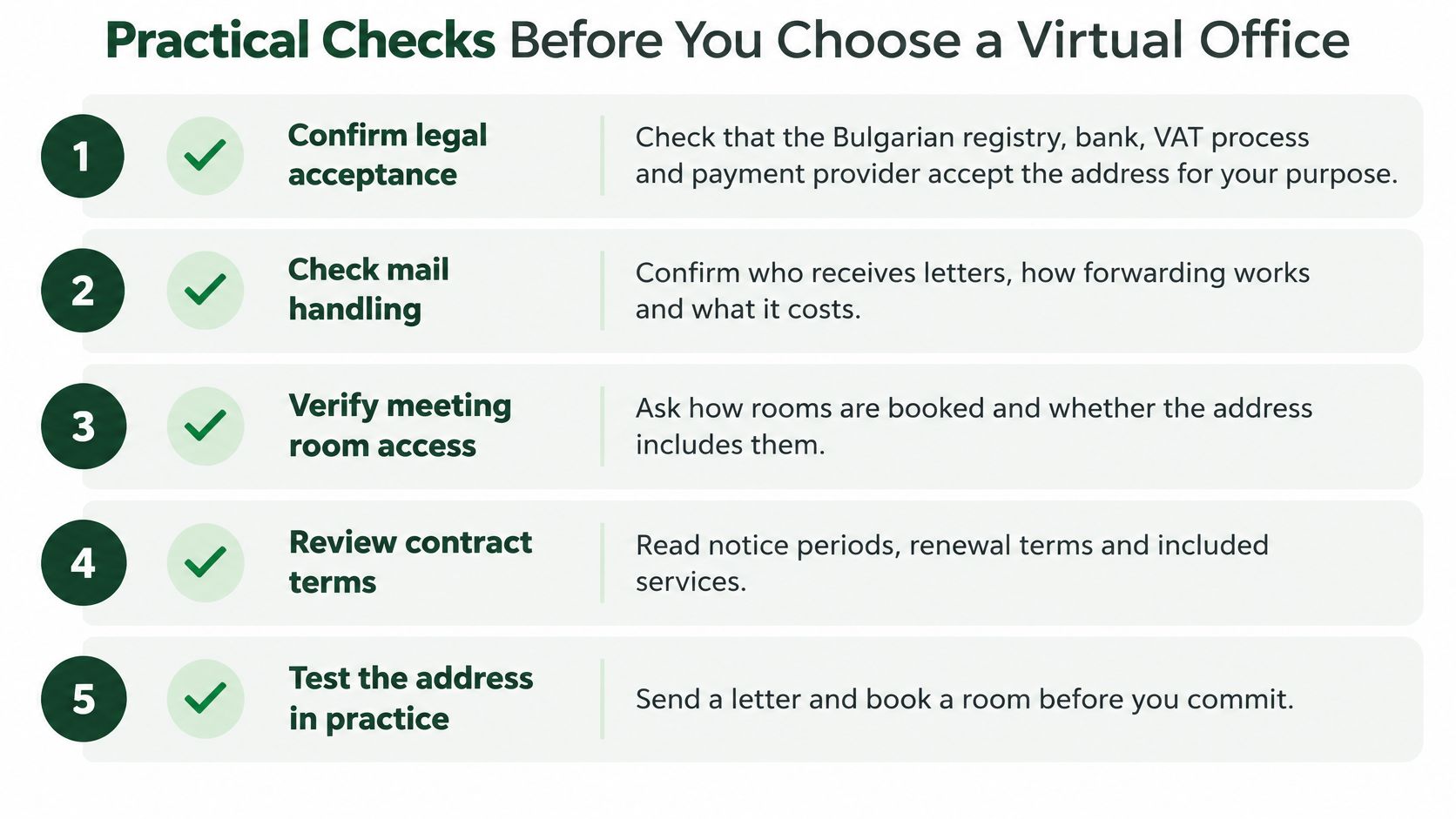
Here's a one-week test that settles more than any brochure: send a letter to the address and time the scan, then email a question and time the reply. If the answer takes four days in the quiet season, it won't arrive faster when a tax notice needs a response.
If you're still mapping the filing sequence, our guide to registering a company online shows where the address check lands in the process.
Misconceptions That Can Cost Founders Money
Four beliefs cause most of the damage, and each one is easy to correct once it's named.
"A Bulgarian virtual office means my company or I pay tax in Bulgaria." A registered address doesn't by itself determine tax residency or establish economic substance. As an EU-focused guide to virtual addresses explains, those questions turn on where management decisions are made and where the business operates, not on where the post is opened.
"The mailing address proves where my online business is managed." It doesn't. An address records where letters go, and a bank or tax inspector reading a file can see the difference between a correspondence point and a decision-making team. If your company sells into another country, read up on what permanent establishment means before assuming an address settles anything.
"One address works everywhere." Registries, banks, tax authorities and platforms apply different evidence rules and different physical-presence tests, so the same address can pass a company registry and fail a payment provider's onboarding review in the same week.
"The cheapest, fastest setup is the safest." An address used as a substitute for real operational evidence raises compliance risk rather than lowering it. Speed is a virtue in filing and a liability in substance.
The habit that replaces all four: keep records of where decisions are made, who signs contracts, where staff and assets sit, and which address appears on which document. Those four answers explain more to a bank than any lease ever will.
None of this makes a virtual office a bad idea. It makes it a specific one. It can support registered correspondence, incorporation and an administrative presence. It cannot guarantee tax residency, banking approval or immunity from another country's tax rules, and a provider who implies otherwise is selling you something you can't use.
Decide Whether a Virtual Office Fits Your Company
The decision rule is short. A virtual office fits if you need a registered address, mail handling and occasional meeting space, but no daily workplace. If you need the daily workplace, nothing in this category substitutes for it.
For the founders who pass that test, the build runs as a sequence, and none of it requires a flight.
- Prepare the paperwork. Identity documents, beneficial-owner information, constitutional documents and a secure electronic-signature method come first, because everything downstream waits on them.
- Choose the company form. An EOOD or an OOD, then confirm whether notarisation, apostilles or sworn translations apply to your documents.
- Verify identity and sign remotely. A scheduled online session with a notary handles this in a sitting.
- Open the business bank account. Banking is separate onboarding with its own checks, so expect it to run on its own clock.
- Start trading once the registry issues the documents. Your certificate of incorporation is the starting gun, not the bank account.
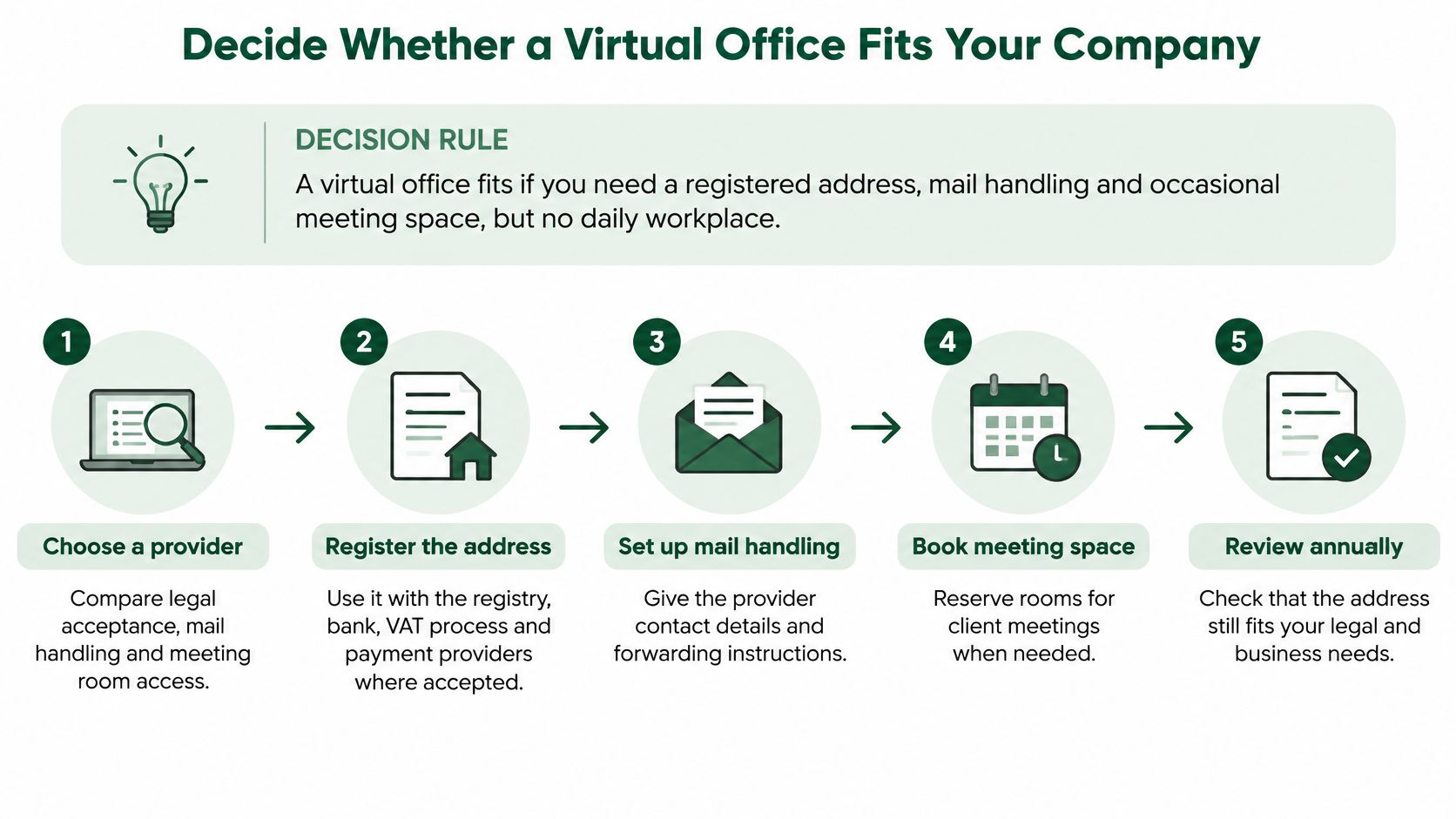
The legal footing is stronger than most founders expect. The EU directive on online company formation requires Member States to enable company formation online without applicants appearing in person before the relevant authority or intermediary, subject to statutory safeguards, and it recognises qualifying electronic-identification methods issued by another Member State. What it doesn't promise is that every downstream step finishes at the same speed. Notarisation, bank onboarding and enhanced anti-money-laundering checks can still take their own time.
At FastCorp, the online setup is fully remote and requires no travel. Our virtual office address is provided for company registration and official correspondence, and remote company formation takes 3–5 working days once all required documents and payments are received, with banking and notarised steps following their own timelines.
One action for today: list the documents you already hold, decide which address use you need (registration, correspondence, or both), and talk it through before you file rather than after.
A virtual office gives you a real Sofia address, mail handling and a registered presence without a lease, and pairing it with the right formation route is where most founders lose the weeks. At FastCorp we handle Bulgarian company registration, EU VAT, banking support, accounting and the virtual office as one remote workflow, so the address your registry sees and the address your accountant files under are the same one. Bring your documents and your questions, and we'll map the sequence for your company before you commit to anything.