Virtual Office Address in Bulgaria Explained
Learn what a virtual office address does for a Bulgarian company, how the 10% tax compares, and how to get one fully online.

You're ready to open a Bulgarian company, but you're running the business from somewhere else. You don't need a permanent desk in Sofia. You need an address that belongs on the company register, someone dependable to receive official letters, and a clear answer about what the arrangement means for banking and tax.
A virtual office address can solve the address and correspondence problem without adding an unnecessary office lease. The smart move is to buy a documented service, not just a respectable-looking line on your invoices.
Table of Contents
- What a Virtual Office Address Is
- Practical Checks Before You Subscribe
- Bulgaria Company Tax Against Other Countries
- Why the Address Does Not Set Tax Residence
- Proof Banks and Registries Usually Request
- Set Up the Address Online with FastCorp
What a Virtual Office Address Is
A virtual office address is a real commercial street address that a company can use as its registered office, with staff receiving official post on its behalf while the founder works elsewhere. You don't have to occupy a desk for the address service to be useful.
Think of a hotel front desk. A letter can reach reception while the guest is out of the building. The important part isn't whether the guest is sitting upstairs, but whether someone receives the letter, records its arrival, and gets it to the right person.
For a Bulgarian EOOD or OOD, the registered address is the physical location entered in the commercial register. Court, tax, banking, and registrar correspondence needs a dependable route from that location to someone acting for the company.
Which address can do the company job
| Address type | Physical premises | Fit for Bulgarian registered office | Mail handling | Typical bank reaction |
|---|---|---|---|---|
| Staffed virtual office | Commercial building with reception | Yes, when the contract allows company registration | Logged, scanned, and forwarded to the founder | Often accepted with a service agreement, subject to bank checks |
| PO box | Post-office box only | No, not a substitute for a physical registered office | Founder collects or pays for forwarding | Usually rejected as the business premises address |
| Commercial mail drop | Counter that receives post | Rarely suitable when the service provides mail only | Forwarding without a company presence | Often treated as insufficient evidence of operations |
| Director home address | Private residence | Sometimes, if the law and register accept its use | Founder handles post personally | Raises privacy and address-consistency questions |
| Coworking day pass | Shared workspace | Only with a right-to-use contract in the company name | Reception handles post only where the agreement includes it | Requires a contract granting business-address use |
My recommendation is a staffed virtual office with explicit registration rights. It's the clearest starting point when you want incorporation, VAT correspondence, and bank onboarding to use the same address. Acceptance for one purpose doesn't guarantee acceptance for the others, so have each use confirmed.
A coworking day pass is a particularly easy mistake. Paying to sit in a shared workspace doesn't automatically give your company permission to register there or leave official correspondence with reception.
Separate the services you're buying
The address has several jobs, and the provider should explain them separately:
- Registered office: Permission to put the physical address into the company's official records.
- Mail handling: A process for receiving, logging, scanning, forwarding, and retaining correspondence.
- Local business presence: Reception or meeting facilities you can use, where included.
Don't assume telephone answering, meeting rooms, or coworking access comes with the address. Equally, don't pay for those extras if your business only needs reliable company administration.
This is an established commercial service, not a niche workaround. Kings Research estimates that the address segment generated USD 11.52 billion in revenue in 2025 within the global virtual office market. That's a market-research estimate, not an official count of registered offices, but it illustrates the commercial importance of address services for remote businesses.
Practical rule: Buy the right to use the premises and a reliable correspondence process, not simply an address you like the look of.
A virtual office isn't a second home, and it isn't proof that your team or management works in Sofia. Describe it accurately to customers and institutions. A company can have a lawful registered office there without claiming that its developers, directors, inventory, or daily operations are in the same building.
The useful question is straightforward: Can this provider support the legal and administrative purpose for which I need the address? A polished website or prestigious postcode can't answer that. The contract and the people handling your post can.
Practical Checks Before You Subscribe
Treat the subscription as an operating arrangement. Before you pay, ask the provider to explain what happens when an important letter arrives while you're abroad.
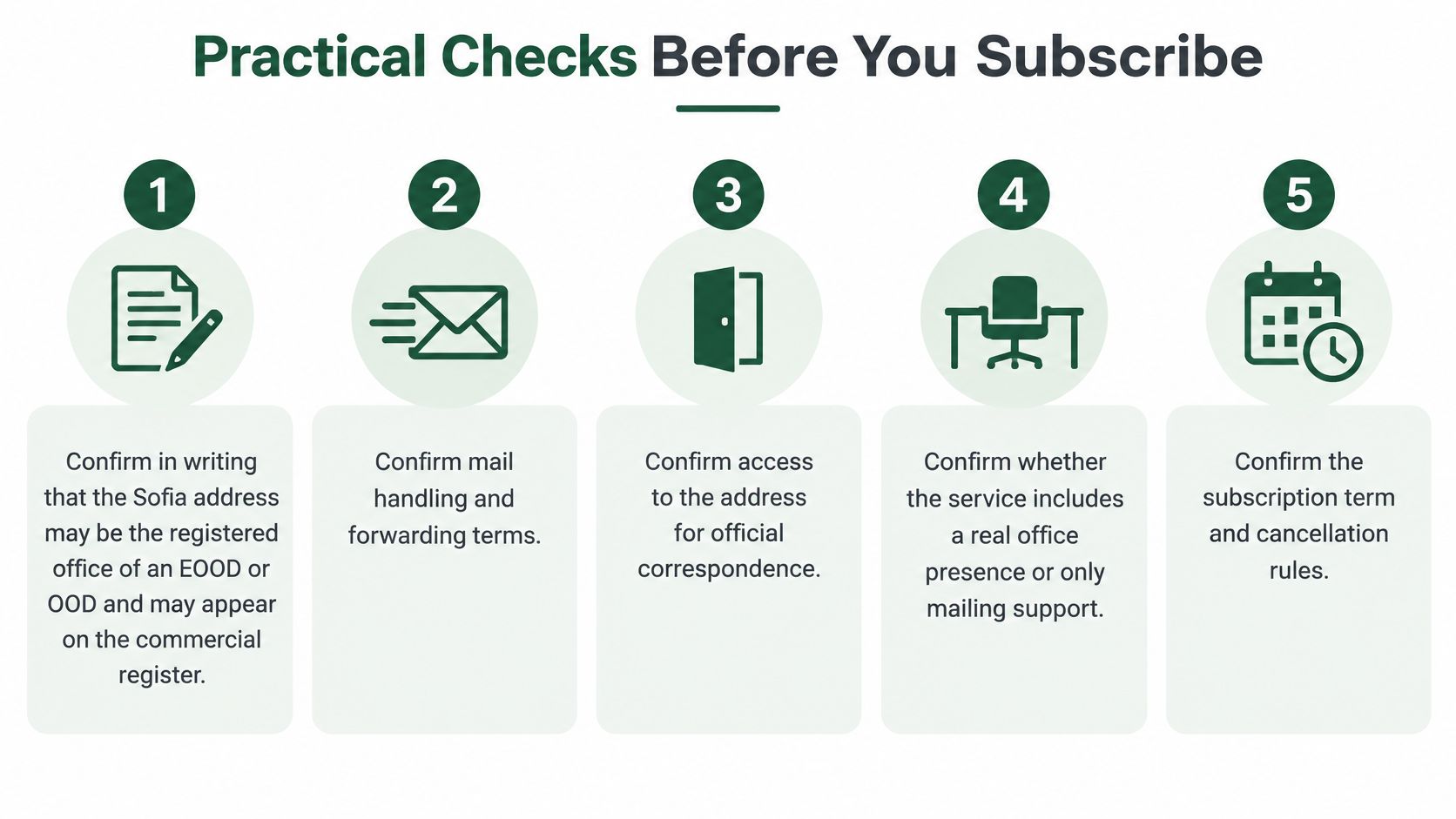
Follow this subscription routine
Confirm registration rights in writing. Ask whether the Sofia address may be the registered office of your EOOD or OOD and appear in the commercial register. A general promise of business-address use is too vague. The failure to avoid is buying mailing support and discovering that company registration isn't included.
Identify who receives formal letters. Get the name or role of the person authorised to accept registered and court correspondence, plus the scan-and-notify turnaround on business days. Ask who covers absences and holidays. A provider's holiday doesn't suspend your company's responsibilities, and an unread tax letter can become a missed deadline.
Price forwarding and original-document storage. Ask about courier charges, storage fees, retention periods, and the procedure before documents are destroyed or returned. A PDF scan isn't the same as keeping the original that a bank, accountant, or authority may later request.
Standardise the address text. Use the same street, building, floor, office identifier, and postcode across incorporation papers, VAT correspondence, and bank forms. Agree on a consistent transliteration where needed. Unnecessary differences create verification questions and avoidable corrections.
Agree on the exit procedure. Confirm the subscription term, cancellation rules, and who handles an address change with the commercial register and tax administration. Also establish what happens to letters arriving after cancellation. You don't want the old provider ending service before the replacement address is properly recorded.
What a workable arrangement looks like
You should leave onboarding with a service agreement in the company's name, a named mail contact, a document-retention period, and written escalation instructions. Keep those records beside your incorporation documents, not buried in a sales email thread.
Set up a shared compliance calendar with your accountant. When statutory post arrives, record its receipt, assign an owner, and add the response deadline after checking the document's requirements. Don't assume that scanning or forwarding changes when a legal deadline starts.
For sensitive correspondence, ask how scans are delivered and who can access them. A secure document folder with controlled permissions is preferable to forwarding company records through personal messaging accounts.
Refuse any offer that can't answer these checks before payment. A provider who explains the process clearly is giving you something more valuable than a convenient address: a usable administrative service.
Bulgaria Company Tax Against Other Countries
Statutory corporate rates founders compare with Bulgaria
| Country or benchmark | Statutory corporate rate | How to read it |
|---|---|---|
| Bulgaria | 10% | Company tax on a Bulgarian company's taxable profits |
| OECD combined average, 2025 | 24.2% | Average statutory combined corporate rate, not a bill any one founder pays |
| France | 36.1% | High headline company rate in the same comparison |
| Colombia | 35% | High headline company rate outside Europe |
| Portugal | 30.5% | Higher EU headline rate than Bulgaria |
| Ireland | 12.5% | Familiar low European trading-company rate, still above Bulgaria |
| Hungary | 9% | Lower headline rate than Bulgaria, so Bulgaria isn't always the lowest |
The rates above come from the 2025 international comparison described by the Tax Foundation, which places Bulgaria's 10% corporate income-tax rate below the 24.2% OECD combined average, while Hungary's 9% rate is lower still.
For a founder planning to retain profits inside the business, that difference deserves attention. Less company-level tax can leave more of the company's taxable profit available for product development, equipment, hiring, or working capital.
But compare like with like. A statutory corporate rate applies to taxable profits under the relevant rules, not automatically to turnover, cash received, or whatever balance appears in the bank account.
The headline rate isn't your total bill
Build your comparison around what the business and its owner will do:
- Profit distributions: Consider how dividends will be treated where the shareholder is tax-resident.
- People costs: Include salary taxation, payroll administration, and social-security obligations.
- Trading obligations: Assess VAT registration, filings, and the treatment of cross-border supplies.
- International payments: Check withholding taxes and related-party pricing where relevant.
- Administration: Budget for bookkeeping, annual filings, and maintaining accurate company records.
Don't compare a Bulgarian company retaining its profits with a foreign sole trader withdrawing all earnings for personal spending. Those are different arrangements, and a rate-only comparison hides the difference.
The wider gap isn't imaginary. The OECD's Corporate Tax Statistics 2025 reports that 26 of 145 jurisdictions had statutory corporate income-tax rates of at least 30%. Nevertheless, statutory rates don't measure every founder's effective tax burden.
Compare the company's retained profit and the owner's spendable income separately. They answer different financial questions.
A useful planning exercise is to prepare separate forecasts for retaining earnings, paying yourself a salary, and distributing profits. Ask your accountant to include the owner's home-country treatment rather than stopping at the Bulgarian company return.
For a broader country-by-country starting point, use the corporate tax rates comparison. Then narrow the analysis to your customers, employees, ownership, and distribution plans.
Bulgaria can be attractive when the structure matches the business. If you live, work, and make decisions elsewhere, foreign-company and personal-tax consequences can reduce or erase the apparent saving. Choose the structure around the operating plan, not around the smallest percentage in a table.
Why the Address Does Not Set Tax Residence
A Sofia virtual office address isn't an EU tax passport. It can reduce administrative friction and provide a lawful registered office, but it doesn't choose your personal tax residence or remove tax connections where you work.
That distinction matters most when incorporation feels easy. Completing documents remotely doesn't mean the business has stopped being relevant to the country where you live and make decisions.

Remote work needs its own assessment
OECD-related guidance summarised by KPMG says working from a fixed location for less than 50% of total annual working time generally doesn't make it a place of business, while 50% or more still doesn't automatically create a permanent establishment. Commercial activity, permanence, and the nature of the work must also be examined.
Don't turn that guidance into a universal safe-harbour rule. It concerns a particular permanent-establishment assessment, not blanket permission to ignore personal residence, company residence, payroll, or local filing obligations.
Examine the actual sources of exposure
- Management and control: Where do you approve contracts, direct the business, and make board or day-to-day decisions? A Sofia mailing address doesn't relocate those actions.
- A foreign home office: Regularly running the company from your home abroad needs a separate review, even when every official letter arrives in Bulgaria.
- Agency activity: Someone habitually concluding contracts for the company in another country may create exposure there.
- Local operations: Staff, customer-facing work, or a warehouse can establish connections that the registered address alone never created.
Say you run a SaaS company from your home outside Bulgaria. Your company records may correctly show Sofia, while your working routine raises questions in your home country. The honest answer is to document that routine and have it assessed, not to describe the virtual office as your operating headquarters.
Keep a short management record showing where decisions are taken, where people work, and whether activities in another country are merely preparatory or auxiliary. Preserve supporting agreements and minutes that reflect reality.
Your company documents and your working habits should tell the same story.
Large multinational groups may also fall within the OECD global minimum-tax framework. A smaller founder-led company can be outside that framework and still owe tax abroad because of its owner's residence or its business activities.
A tax residency certificate is a separate documentation topic, not something to infer from an address subscription. Before moving intellectual property, hiring abroad, or invoicing related companies, have a cross-border tax adviser review the arrangement before you treat the online setup as finished.
Proof Banks and Registries Usually Request
Address acceptance is an evidence problem, not a sticker on the building. A registry may record your registered office while a bank, marketplace, or payment institution still asks where the business operates and why its payments make commercial sense.
LegalClarity's business-address verification guidance explains why a virtual office may need to represent more than mail forwarding. Institutions may examine the commercial premises, service agreement, staffed reception, meeting-space access where claimed, and consistency across company documents.
Assemble a usable evidence pack
Prepare these documents in this order:
- Service agreement in the company's name, showing the address and permitted uses.
- Proof of the right to use the premises, supplied or supported by the provider.
- Written authority to collect and scan mail, including formal correspondence.
- Passport and residential-address proof for the relevant individuals.
- A short business description explaining what you sell and to whom.
- An expected transaction profile covering payment types, countries, currencies, and the commercial reason for transfers.
- A management-location note explaining where the company is directed.
Keep the pack current and legible. If you claim meeting-room access, be ready to show that entitlement rather than relying on photographs from the provider's website.
A shared address isn't automatically disqualifying, but an address used by many companies can invite extra questions. Explain the service clearly. Don't imply that a rented correspondence address is a dedicated office occupied by your employees.
How the evidence changes by business
For a SaaS founder, the registered address is only part of the explanation. The application should also identify where the product team works, who owns the software, and how subscription receipts reach the company.
For a consultant, the description should match the contracts and invoices. If you say you provide marketing advice, payment references and supporting agreements shouldn't suggest an unrelated trading activity.
For an e-commerce seller, the expected transaction profile should fit marketplace sales, supplier payments, refunds, and fulfilment arrangements. Explain where stock is stored instead of allowing the bank to assume that the Sofia registered office is also a warehouse.
A foreign director, customers abroad, and a Bulgarian company aren't contradictory. The problem is an explanation that conflicts with the documents, or country information that changes from form to form.
Registry information also needs maintenance. Cyprus's business registry has called on companies to refresh registered-office and workplace details, illustrating why founders shouldn't treat address records as a one-time task.
Use the business bank account documents guide to prepare for onboarding. Assemble the evidence before applying, rather than trying to reconstruct it after a rejection or a request for enhanced due diligence.
Set Up the Address Online with FastCorp
The online route is the sensible default if you don't need to travel to Sofia. FastCorp provides Bulgarian company formation for non-resident founders, with a Sofia virtual office and registered address available within an end-to-end workflow.
You can also compare that coordinated approach with arranging incorporation, an address provider, and accounting separately. The advantage of using one provider is practical: fewer handovers and a clearer owner for each administrative task.
FastCorp formation packages
| Package | Typical time | What is included |
|---|---|---|
| Fully online formation | 3 to 5 working days | €1,750, with legal and government fees included |
| In-person formation in Sofia | 2 to 3 working days | €1,500, with legal and government fees included, plus airport pickup |
These are the provider's published package terms and typical formation timelines, not a guarantee that separate banking or VAT reviews will finish on the same schedule. Confirm the current quote, the address-renewal terms, and any optional services before instructing the setup.
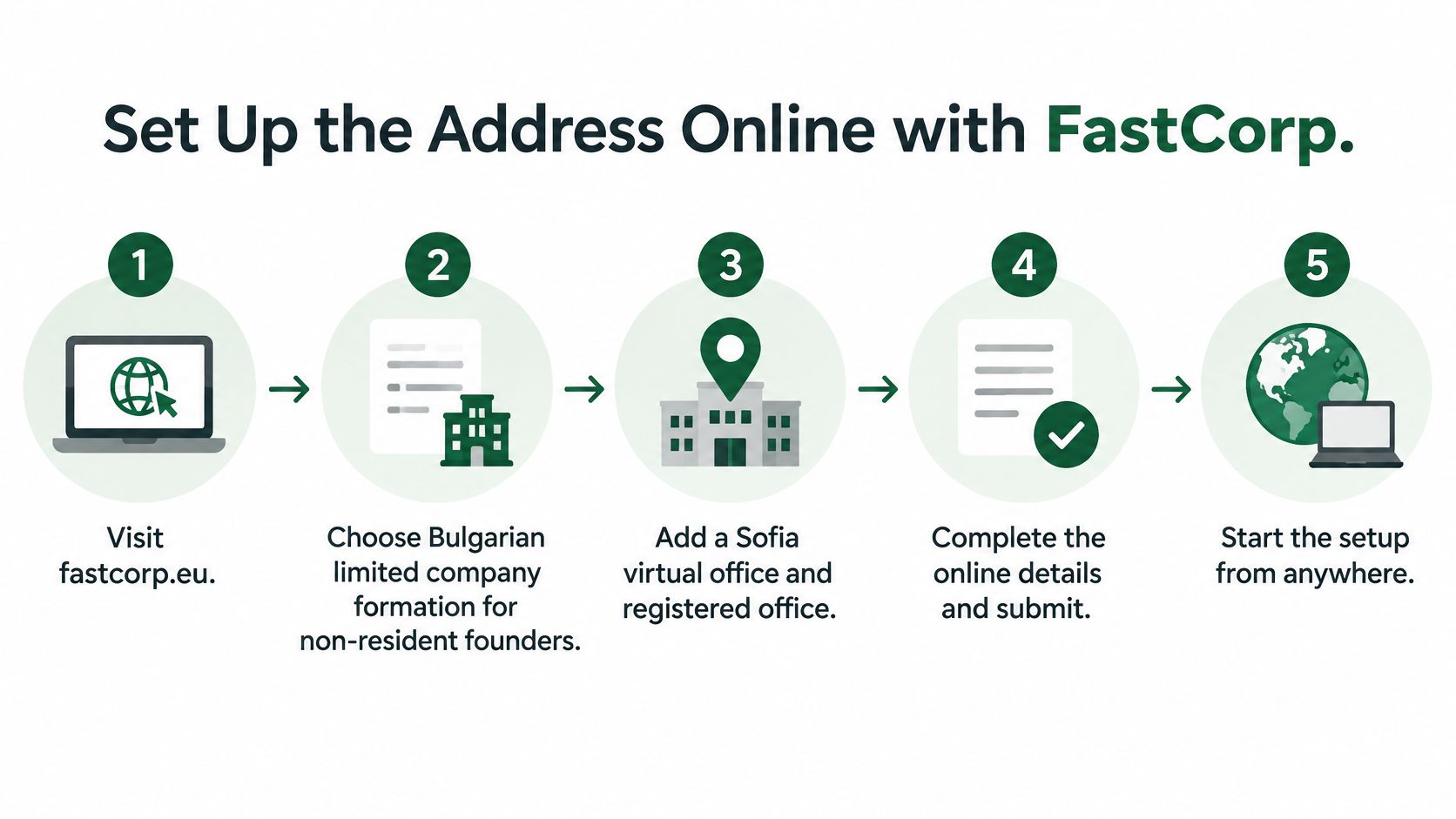
Follow the online formation path
Choose your formation route. Select fully online incorporation or an in-person appointment in Sofia. No travel is required for the online option.
Prepare your personal and ownership information. Have your passport, residential-address proof, ownership details, business description, and source-of-funds evidence ready. Clear documents make remote administration much easier.
Complete identity checks and signing. Follow the remote verification and electronic-signing process. Ask in writing which documents need notarisation or an apostille and which originals, if any, must be couriered. Online handling should mean clear coordination, not uncertainty about document formalities.
Receive and organise the company records. Check the EOOD or OOD details, Sofia registered address, and incorporation papers. Confirm mail receipt and scan-and-notify arrangements, then store the records securely for your accountant and banking applications.
Add the services your trading plan needs. Arrange EU VAT registration, bookkeeping, payroll where relevant, and banking assistance for an EU IBAN. Banking support helps you prepare and apply, but it isn't a promise that every institution will approve the company.
The process can be easy because the administration is centralised. You still need to answer identity, ownership, and business-activity questions accurately, and respond when an authority or financial institution needs clarification.
Start when the address rights are clear, the mail rules are written down, and your tax adviser has reviewed where you live and make decisions. If any of those pieces is missing, close the gap first. A short preparation phase is preferable to correcting an unsuitable structure after you've begun trading.
FastCorp offers Bulgarian company formation, a Sofia virtual office and registered address, plus accounting, VAT, and banking assistance for non-resident founders. Visit FastCorp to request the online setup checklist and a written quote covering your address, mail handling, and ongoing compliance needs.