What Is Permanent Establishment? a Founder's Tax Guide
What is permanent establishment? Learn the OECD test, real SaaS and ecommerce examples, Bulgaria's 10% tax and steps to avoid an unintended PE.
A company can trigger tax obligations abroad without opening a branch. A sales employee works from another country, a consultant spends time at a client's site, or a local representative signs contracts. The key question is whether the company has established a taxable business presence there.
Countries often rely on the OECD model that most tax treaties follow to decide whether a foreign company has crossed that line.
For founders, the practical check is simple: where do people work, who signs contracts, and where are business decisions made? Company registration, a virtual office, or an invoice address alone does not settle those questions.
Review those three points before hiring abroad, assigning contract authority, or changing where management works. Keep a record of the arrangements and reassess when they change.
Table of Contents
- What a Permanent Establishment Means in Plain Terms
- The Three-Part Test Behind Every PE Decision
- How PE Plays Out for SaaS, Ecommerce and Consulting
- Remote Workers and Local Agents That Trigger a PE
- Bulgaria Versus Other Countries on PE and Tax
- How to Avoid an Unintended PE Step by Step
- Choose Your Setup and Next Step
What a Permanent Establishment Means in Plain Terms
Picture a street seller and a shop. The seller walks up with a bag, takes an order, and leaves. The shop has a door, shelves, and staff who come back tomorrow. The tax authority can point at the shop. It often can't point at the seller.
That picture is the whole idea. Under Article 5 of the OECD Model Tax Convention, a permanent establishment is a "fixed place of business" through which an enterprise's business is wholly or partly carried on. The definition needs three things together: a business location, enough fixed or enduring character, and business activity conducted through that location.
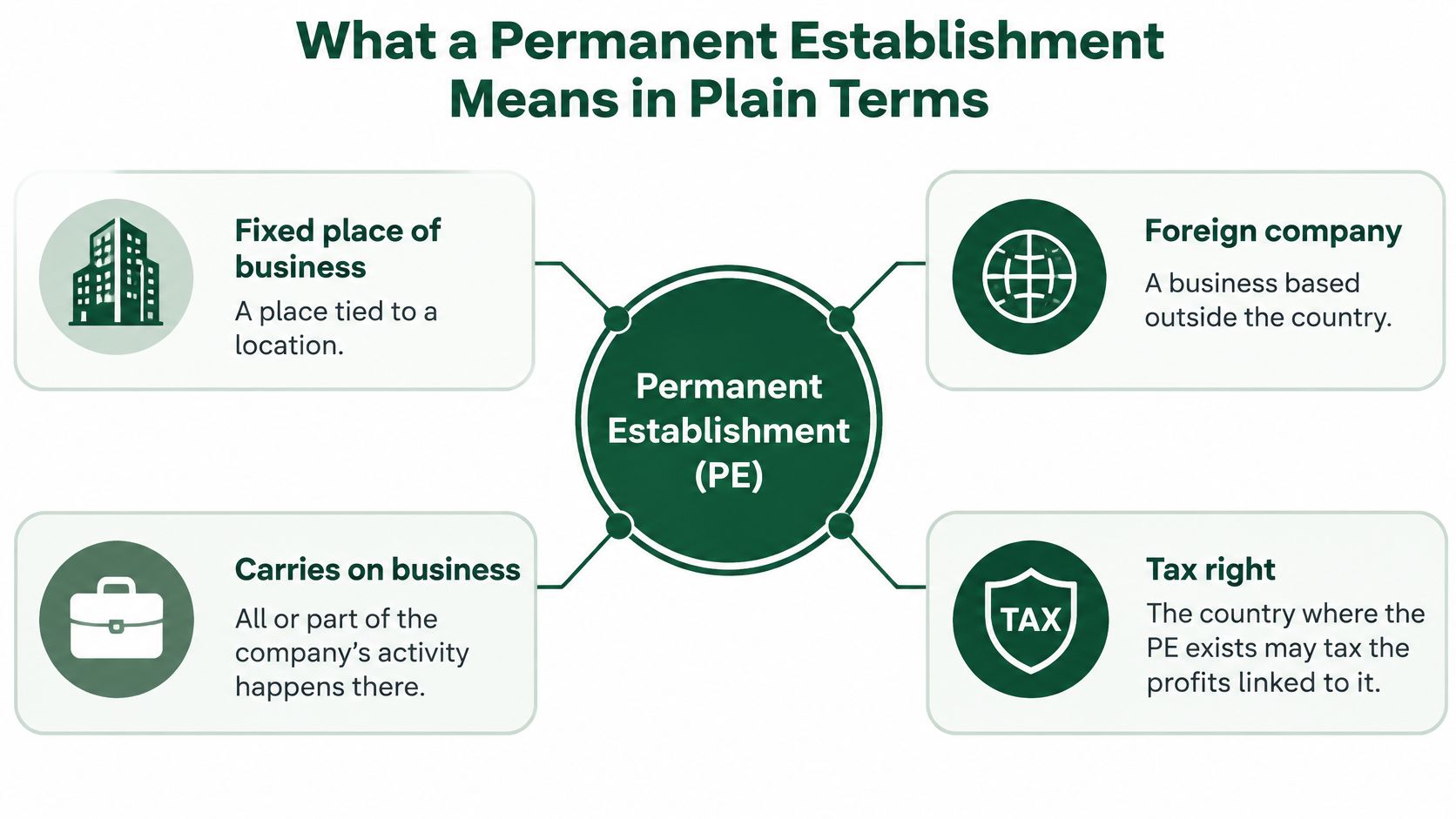
The OECD model lists the footprints everyone recognizes.
- Place of management: the room where key calls get made.
- Branch or office: a site the company uses as its own.
- Factory or workshop: production, not a mailbox.
- Mine or other extraction site: a location tied to the resource itself.
A PE is not a separate legal company. It's a taxable connection. The source country can allocate profits that are economically connected with the local establishment and tax them there. Your Bulgarian company stays one legal person. The other country claims a slice of the profit that belongs to the activity on its soil.
Selling is not the same as settling
Sending invoices to customers in Germany, the UK, or the US does not, by itself, create a PE. The decisive issue is whether the enterprise has a sufficiently established business presence under the treaty and the local law. For a Bulgarian company with non-resident owners, that question decides whether profits must be attributed to another country and reported there, even though the company is registered in Bulgaria. A subsidiary, a branch, employees, agents, or an office can each change filing duties and profit attribution.
PE is the real business footprint, not the country named on the invoice.
The Three-Part Test Behind Every PE Decision
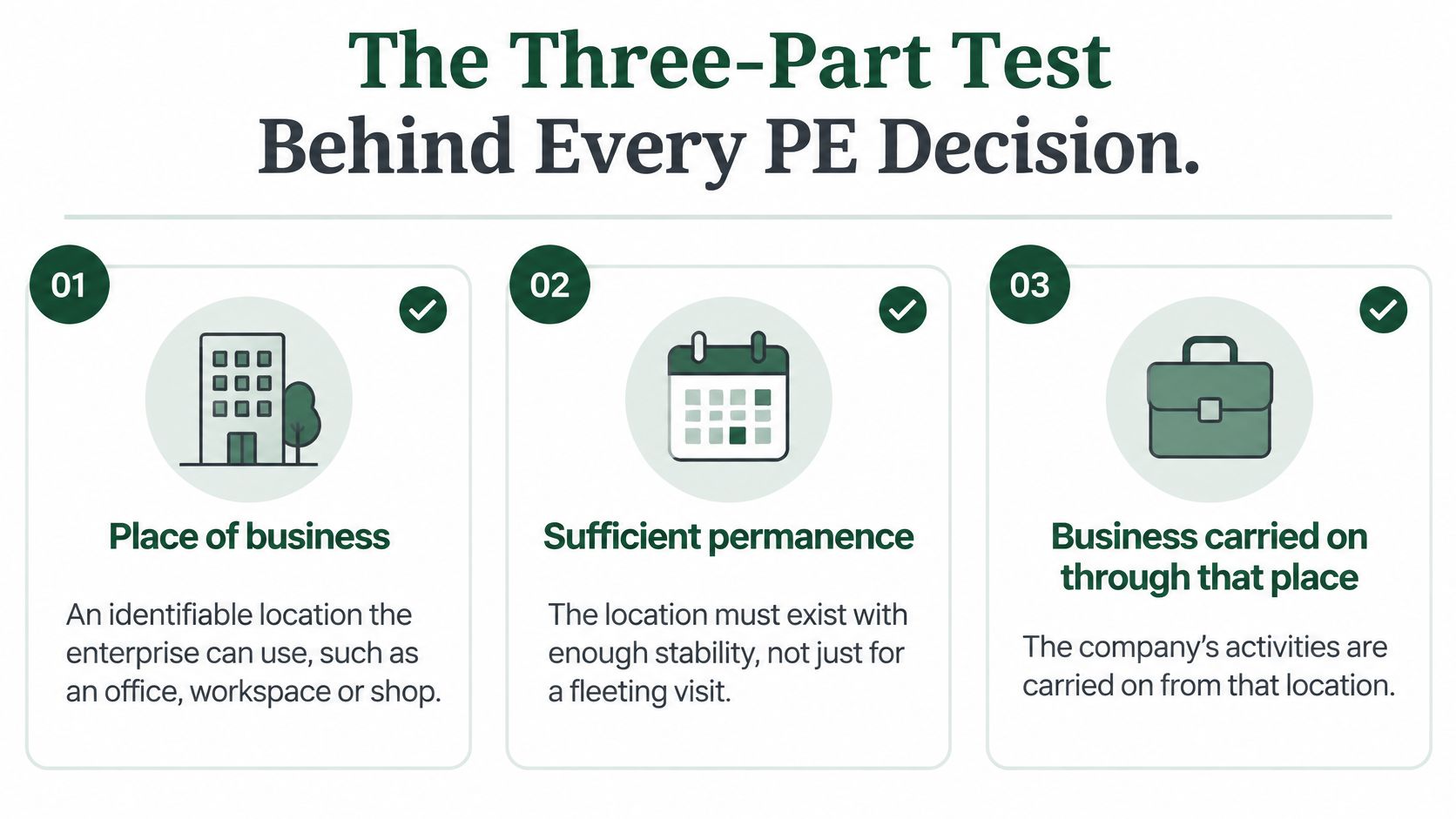
Registration is not the test. A tax number is not the test. A virtual office is not the test. The OECD Model Tax Convention uses three cumulative elements, and you need all three.
Place, permanence, and the work itself
1. Is there a place of business? An identifiable location the enterprise can use. An office, a workspace, a shop, or a desk that is at the company's disposal. A hotel room for one meeting usually fails this.
2. Is it permanent enough? The location needs geographic and temporal permanence. A one-day visit doesn't qualify. A site that is continuously available, and used again and again, starts to look fixed even if nobody signed a long lease.
3. Is the business carried on through it? Core revenue work happens there. Negotiating sales, delivering the service customers pay for, or managing operations. Admin sitting in the background is a different story.
The OECD also carves out preparatory or auxiliary activity. Facilities used only for storage, display, delivery, purchasing, or information collection can stay outside the threshold, but only while the overall activity remains preparatory or auxiliary. A warehouse that also takes orders has left that lane.
Merely registering a company, obtaining a tax number, or holding a virtual office does not by itself establish that substantive business is conducted through premises in the jurisdiction. Map where personnel work, where management decisions occur, which premises are available, and whether revenue-generating functions happen there. A local address used for administration only is low risk. The same address is high risk when local staff negotiate sales, deliver core services, manage operations, or use dedicated premises.
A yes or no self-check
Run these before you hire or renew a desk.
- Do staff work from a location abroad? Yes or no.
- Who signs contracts? Home office, or someone on the ground.
- Where are decisions taken? Board and pricing calls, not the email footer.
- Which premises are used, and for what? Storage only, or the work customers pay for.
Practical rule: Any yes on core activity means the setup needs a deeper review before you add headcount.
How PE Plays Out for SaaS, Ecommerce and Consulting
The same cross-border setup can produce different PE risks depending on who works locally, who can bind the company, and what happens at the location. Use the table to identify the facts that matter for each business model.
| Business Model | Activity Abroad | PE Risk | What Changes the Answer |
|---|---|---|---|
| SaaS | Customers sign up online, with no staff in the country | Low | Local servers alone rarely create a PE; local sales staff could |
| SaaS | Sales manager negotiates and closes deals locally for six months | High | Contract authority and recurring presence raise the risk |
| SaaS | Support engineer helps existing clients remotely | Low | The risk is lower if core revenue activity remains offshore |
| Ecommerce | Stock held by a third-party warehouse for storage only | Low to medium | Check that the warehouse is used for storage and shipping, not sales |
| Ecommerce | Owned stock managed and sold by local staff | High | Local staff are running core sales activity from a local site |
| Consulting | Consultant delivers a short on-site project | Medium | Duration, recurrence and where core services are performed matter |
| Consulting | Rented office where partners negotiate and sign contracts | High | Fixed premises are used for core revenue activity |
Where the danger sits
SaaS with a local closer. A Bulgarian SaaS company places a sales manager in another country. For six months, the manager meets prospects, negotiates prices and closes deals. That combination creates high risk: the person is regularly present and has authority to conclude contracts. If the role is limited to supporting existing customers while pricing and signatures remain with directors in Bulgaria, the risk is lower. A local data center with no sales activity on site rarely creates a PE on its own.
Ecommerce with local sellers. A third-party warehouse used only to store and ship goods may remain auxiliary. Check whether anyone at the site takes orders or performs other sales functions. If local staff manage and sell owned stock, they are conducting core business activity from a local site, which raises the risk.
Consulting from a rented room. A short on-site project warrants a closer look. The duration, repeat visits and location of the core service all matter. If partners rent an office to negotiate and sign contracts, they are using fixed premises for revenue-generating work. Treat that as high risk, not just a travel cost.
Time tests that are not a free pass
There is no universal day count for permanence. The OECD explanatory material indicates that a place of business maintained for less than six months will not normally be considered sufficiently permanent. That is a benchmark, not a safe harbor. Repeated visits, an available location or core work carried out there can still warrant review.
Construction and installation projects often have a separate treaty threshold. Under the OECD Model Tax Convention, a building site, construction project or installation project generally becomes a PE only when it lasts more than 12 months. Older bilateral treaties sometimes set shorter project thresholds, so check the applicable treaty before relying on the 12-month benchmark. For consulting and installation work, also assess recurrence, contract authority and where the work is performed.
For each activity, record the dates, the person's role, whether they can bind the company, and which premises they use.
Remote Workers and Local Agents That Trigger a PE
The myth is simple and wrong. Any foreign login does not create a PE. The absence of a lease doesn't clear you either.
The 2025 update to the OECD Model Tax Convention puts the question where it belongs. Is the foreign location a fixed place through which the enterprise's business is wholly or partly carried on, and does the enterprise have a commercial reason for the person being there? Working from a home or other location in another jurisdiction for less than 50% of total working time during a 12-month period will generally not satisfy the permanence indicator by itself. At or above 50%, the result is still not automatic. You still assess local customer or supplier activity, business development, and whether the enterprise effectively uses the premises.
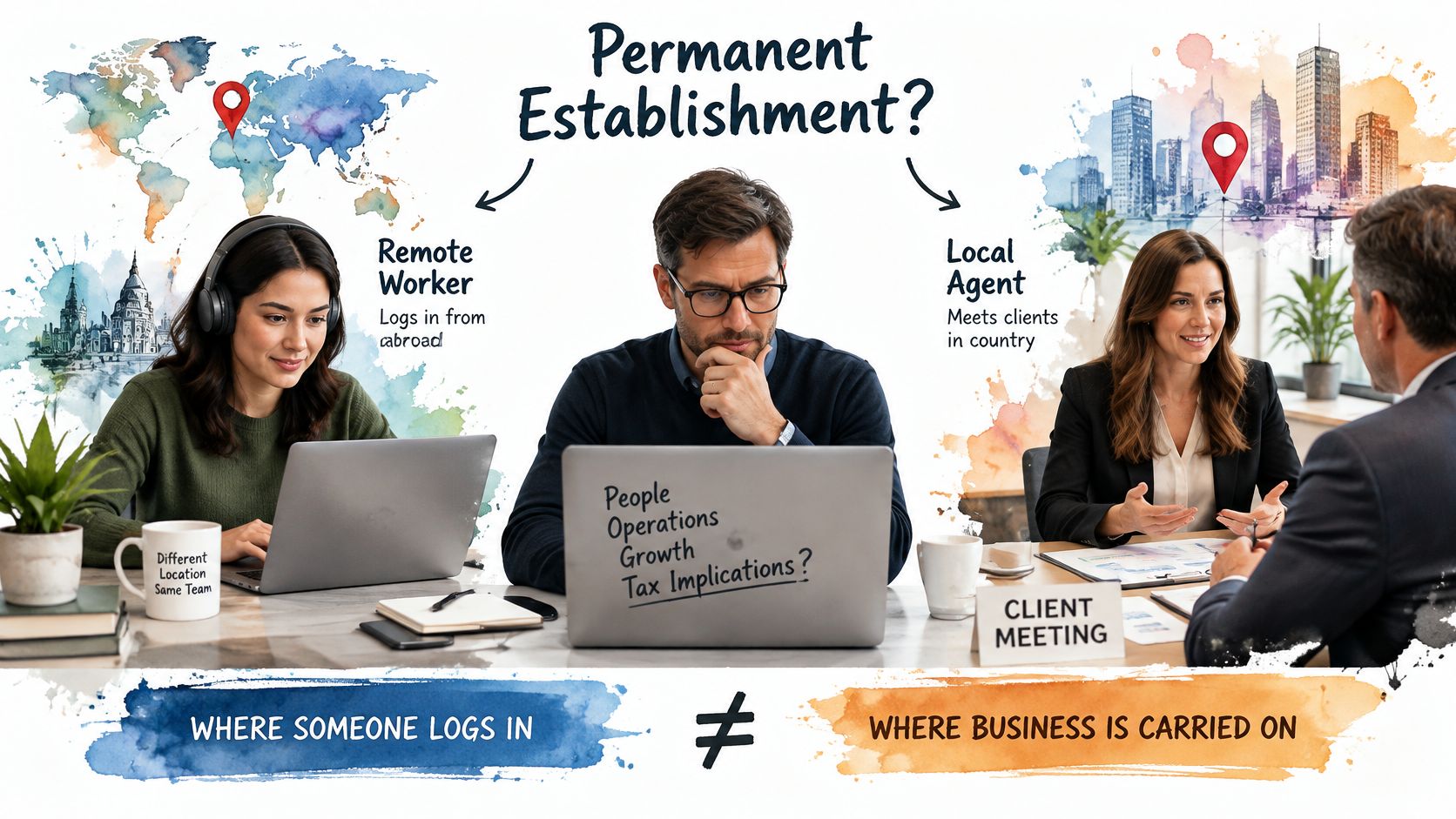
A Bulgarian company, a virtual office, or a remote employee should not be judged with an "any foreign work equals PE" rule.
Personal convenience or a commercial posting
Separate the two patterns before you write a policy.
- Personal convenience: the worker relocated for family reasons, chose the home office, and doesn't meet local customers because you asked them to. You didn't require that city, and you don't pay for a dedicated room there.
- Employer-driven presence: you require the workspace, you pay for it, or you assign clients in that country. The location is part of how you sell, not where someone happens to sleep.
A home office can fail the fixed-place test and still create trouble through what the person does.
The agent who never needs an office
A local representative who habitually concludes contracts in the company's name can create a PE with no lease at all. Habit is the word that matters. One signed deal on a trip is not a pattern. A rep who prices, negotiates, and closes every month is carrying on your business there. Keep signature, discount limits, and final terms with directors in Bulgaria if you want that pattern to stay preparatory. If local hiring also means local pay, line the role up with your payroll reporting requirements so employment filings don't race ahead of the tax analysis.
Document why the person is abroad and what they actually do. Those records decide the dispute, not the job title.
Bulgaria Versus Other Countries on PE and Tax
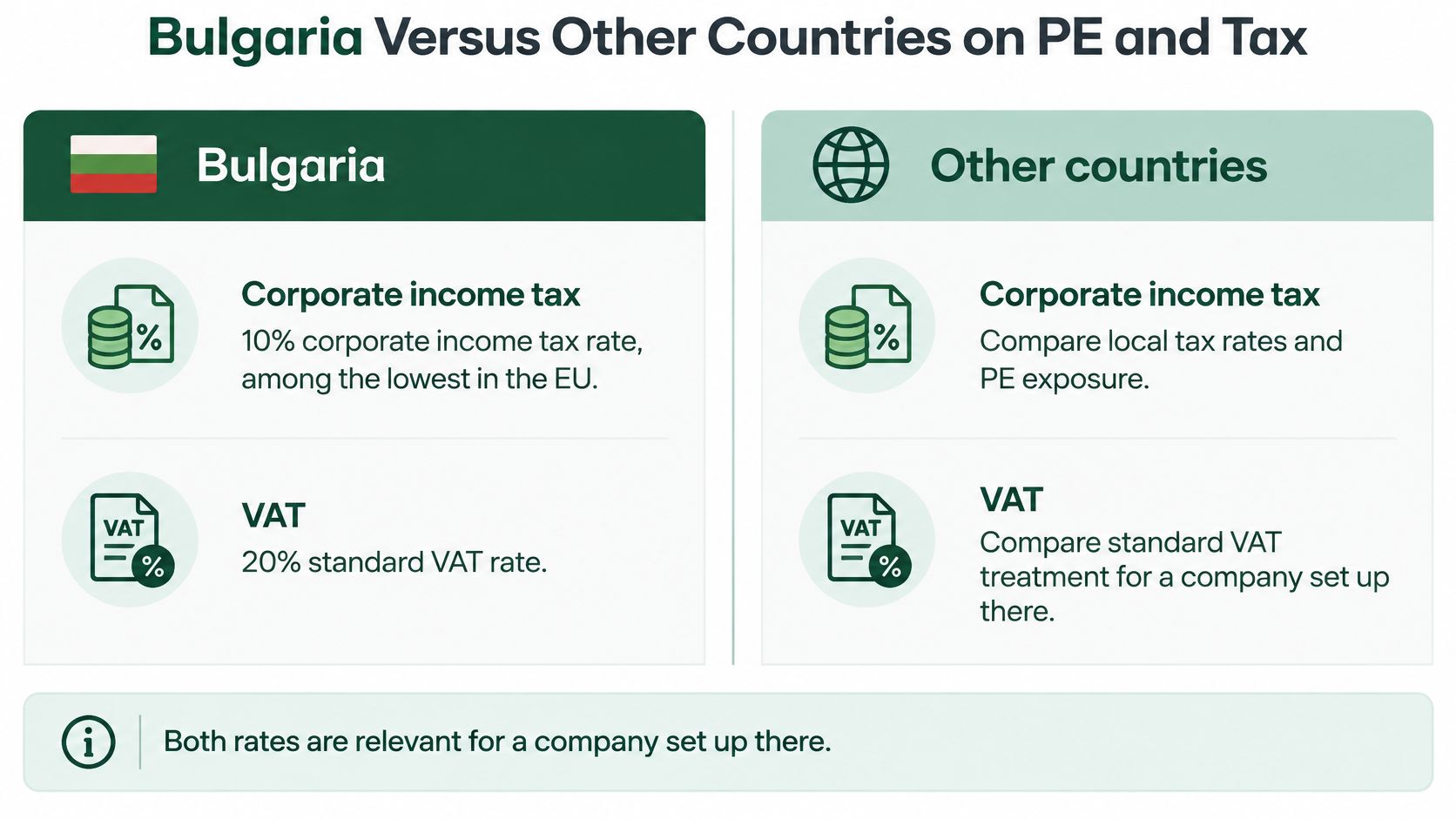
A Bulgarian company can benefit from Bulgaria's 10% corporate tax rate, but that rate does not protect it from tax in another country. If people work there, make key decisions there, or habitually conclude contracts there, that country may have a claim to tax profits attributable to a permanent establishment (PE). The risk depends on what the business does locally, not where it is incorporated.
| Country | Headline Corporate Tax Rate | PE Planning Note |
|---|---|---|
| Bulgaria | 10% | Domestic rules and treaty network apply; filings go to the National Revenue Agency (NRA). |
| Ireland | 12.5% | Treaty-based PE rules; check the bilateral treaty. |
| Cyprus | 15% | Treaty-based PE rules; check the bilateral treaty. |
| Netherlands | 25.8% | Treaty-based PE rules; check the bilateral treaty. |
| United Kingdom | 25% | Treaty-based PE rules; check the bilateral treaty. |
| Germany | About 30% combined | Treaty-based PE rules; local trade tax applies. |
| United States | 21% federal | Treaty-based PE rules; state tax rules differ. |
Use corporate tax rates by country as a starting comparison, then confirm the current rate and applicable rules before filing. Corporate rates alone do not show what tax a business will owe: local taxes, treaty provisions, profit attribution, and compliance obligations can change the result.
The model is a framework, not a statute
Tax treaties allocate taxing rights between particular countries. Article 5 addresses whether a PE exists; treaty terms and local law then shape registration, profit attribution, filing deadlines, and tax due. Compare the fixed-place rules, dependent-agent wording, construction or service provisions, exemptions for preparatory activities, and profit-attribution method. The same workspace or business activity can produce different results under different treaties.
For a Bulgarian company, domestic rules and the relevant treaty determine how a foreign PE is treated. The National Revenue Agency (NRA) handles Bulgarian filings, and many registrations and returns can be completed online. Online incorporation and accounting administration can simplify Bulgarian compliance, but they do not remove PE exposure in another country.
For SaaS, ecommerce, and consulting businesses, test the operating model rather than relying on the company's registered address. Identify where people work, who signs contracts, and where business decisions are made. Before establishing a local presence or assigning contract authority, get a written treaty analysis and set a regular compliance review.
Check the bilateral treaty before opening a presence in another country, and confirm the applicable rates before filing.
How to Avoid an Unintended PE Step by Step
Run this routine once this quarter, then again whenever someone moves or you take space. Each step has a slip we see founders make when the file is thin. Broader choices on where profit should sit belong in your cross-border tax planning, not in a last-minute email to the accountant.
Map every place people work. Include home offices, coworking desks, and client sites abroad. The slip is the salesperson who "just works from home" in another country and never appears on the org chart as foreign.
Log locations and days. Do it for each employee and contractor, and keep the log as long as you keep accounting records. The slip is an employee who works from a foreign home for half the year while nobody tracks the days.
Pin down where decisions are taken. Record board and management decisions in Bulgaria when that is where they happen. The slip is a country manager who prices deals from a kitchen table while the minutes still say Sofia.
Review contract authority. Decide who may negotiate and who may sign, and keep local representatives in preparatory roles. The slip is a local representative who signs deals without approval because the customer was in a hurry.
Test storage, display, and purchasing. Confirm the foreign activity is auxiliary and not the revenue engine. The slip is a "warehouse" whose staff also take orders and arrange delivery terms.
Get a written treaty analysis. Do it for each country with real activity before you hire or open premises. The slip is expanding on a blog summary of a model treaty that your actual treaty doesn't follow.
Keep a calendar of recurring presence. Leases, coworking agreements, and travel records belong in the same folder. The slip is a series of short trips that, added up, look like a permanent desk.
Review on a rhythm. Every six months, and again whenever staffing or premises change. The slip is a clean file from last January and a different company by June.
What a clean file looks like
One dated map. People, premises, and decisions, each with a date and a one-line description of the work. If a reviewer can see why someone is abroad and what they cannot sign, you are in a defensible place. If the answer is "we think they're mostly in Bulgaria," you are not.
Choose Your Setup and Next Step
Decide this week whether the current setup is low risk or needs a treaty review before you grow.
Low-risk path. You sell online only. No staff, no premises, and no contract-signing agents abroad. Nobody spends long stretches working from another country. Keep selling, keep the logs, and don't add a local closer without rerunning the three checks: where people work, who signs, and where decisions are made.
Pause path. Staff spend long periods abroad, a foreign office exists, or a local agent signs contracts. Stop hiring and stop opening premises there until you have a written treaty analysis. Growth on top of an untested footprint is how back tax starts.
A Bulgarian company can be a practical starting point, and we handle formation fully online with no travel. The online package is €1,750 and includes EOOD or OOD registration, an EU VAT number, a bank account, a virtual office and business address, apostilled company documents, a certificate of incorporation, and legal and government fees. Remote formation takes 3 to 5 working days after all documents and payments are received. Confirm the current timeline and inclusions with us before you pay.
A Bulgarian entity with a virtual office is a starting point, not a PE shield. It works only alongside the records and reviews above. Gather the three facts, where people work, who signs contracts, and where decisions are made, and review them with a tax adviser before the next hire or the next local office.
FastCorp sets up Bulgarian limited companies fully online for founders who want an EU company, VAT, banking, and a virtual office without turning that address into an accidental taxable footprint abroad. If you're ready to form the company and keep the PE file tight from day one, visit FastCorp and tell us where your people work.