Can I Register a Company Online? Bulgaria Steps for 2026
Can I register a company online in Bulgaria? See remote ID options, documents, costs, 3-5 day timelines and tax rates.
Yes, non-residents can register a Bulgarian EOOD or OOD fully online without travelling, if they hold a Qualified Electronic Signature or pass an approved remote identity check, and with FastCorp the setup takes 3 to 5 working days once documents and payment are complete. That's the part that surprises most founders. The company itself is often the easy bit. What stalls trading is the bank account, the VAT decision, and a mismatch in beneficial-owner details that nobody checked until after incorporation.
If you're asking can I register a company online and start invoicing from abroad, separate two jobs from the start. Legal formation puts your company in the register. Operational readiness means you can get paid, charge the right VAT, and prove who owns the business. Do both together and Bulgaria is fast and refreshingly simple. Do them in the wrong order and you'll own a registered company that still can't trade.
Table of Contents
- Yes, Non-Residents Can Register a Company Online
- Costs and Timelines to Budget Before You File
- How to Register a Company Online Step by Step
- What to Do After Registration Before You Trade
- Bulgaria Tax Rate Compared With Other Countries
- Choose Your Route
Yes, Non-Residents Can Register a Company Online
Yes. You don't need a flight to Sofia to register a Bulgarian EOOD for a single owner or an OOD for several owners. You do need to prove who you are and sign in a way the registry accepts. Online registration removes the trip, it doesn't remove the legal inputs. The company still needs accurate ownership details, a registered office, declarations, a valid signature, and the filing fee.
The cleanest route is a Qualified Electronic Signature (QES). Bulgaria's official SME guidance on choice of legal form and registration confirms that registration can be completed entirely online when the applicant has a QES, with filing through the Registry Agency's Commercial Register. That guidance lists a minimum share capital of BGN 2 (approximately €1), an electronic company-name reservation fee of BGN 20, and an electronic Registry Agency filing fee of BGN 55.
A QES matters because it does more than scribble your name on a PDF. It links the signer to a verified identity and shows if a document was altered after signing. An ordinary e-signature doesn't give the registry that same assurance.
Say a consultant in Dubai already holds a QES. She signs the incorporation act, manager resolution, and declarations on her laptop, we submit the package electronically, and she receives the certificate without leaving home. A founder in the same position without a QES isn't stuck. He can verify remotely where that method is accepted for his case, or appoint an authorised representative under a notarised power of attorney.
Remote Identity Routes for Non-Resident Founders
| Route | When It Fits | What to Prepare |
|---|---|---|
| Qualified Electronic Signature (QES) | Founder already holds a QES and can sign digitally | QES certificate and a signing device |
| Remote identity verification via a secure online notary | Founder cannot sign with a QES but can complete remote verification | Valid passport and confirmation from the provider that the method is accepted for the case |
| Notarised power of attorney | Founder cannot sign remotely and appoints an authorised representative | Notary, apostille where required, representative details |
| In-person signing in Sofia | Founder can visit or prefers face-to-face signing | Passport and a visit to the FastCorp office in Sofia |
Run one check before you promise yourself a fully remote setup. Confirm that every founder, manager, and authorised representative can meet the QES or approved remote-signing requirement, and that every shareholder's full legal name, date of birth, and address match their passport exactly. One person who can't sign remotely changes the whole route, so find that out on day one, not at the filing stage.
Costs and Timelines to Budget Before You File
Start with the official numbers, because they're strikingly low. Then budget like an operator, not a tourist. The state fees are only your entry ticket. Notarisation, banking, accounting, and VAT work are what keep the company usable.
Bulgarian Company Registration Costs
| Cost Item | Amount | Notes |
|---|---|---|
| Minimum share capital | BGN 2 (about €1) | Legal minimum for an EOOD or OOD |
| Electronic name reservation | BGN 20 | Paid before filing the application |
| Electronic Registry Agency filing | BGN 55 (€28.12) | Paper filing costs BGN 110 (€56.24) |
| Notarised manager consent | Quoted by the notary per document | Set by the notary and document complexity |
| Bank certificate of deposited capital | Charged under your bank's fee schedule | Set by your bank |
| Translation and apostille | Priced per page and per document | Only where documents are needed abroad |
| FastCorp Online package | €1,750 | Registration, EU VAT number, bank account, virtual office, apostilled documents, certificate of incorporation and all legal and government fees |
| FastCorp In-person package | €1,500 | Visit to the Sofia office, includes airport pickup |
The euro figures line up with the lev amounts. The InvestBulgaria guide to setting up a company states that a Bulgarian limited liability company requires only €1 in capital and that the Commercial Register fee is €28.12 for online filing versus €56.24 on paper. It also identifies the Commercial Register as the authority that issues your unique identification number, the EIK.
For most non-residents, the packaged price is the honest comparison. Our Online package at €1,750 covers registration, EU VAT number, bank account, virtual office and business address, apostilled documents, certificate of incorporation, and all legal and government fees. The in-person package at €1,500 covers the same core setup in Sofia and includes airport pickup. Paying the €28.12 filing fee yourself looks cheaper until you price your own time, a QES, notarisation, translations, and correcting a rejected filing.
Timelines Worth Planning Around
- Online with us: 3 to 5 working days after all documents and payments arrive.
- In person in Sofia: 2 to 3 working days.
- Registry review alone: a complete initial application is reviewed quickly once filed, which is why preparation decides your real timeline.
- Do-it-yourself from abroad: document preparation, signatures, and the capital account stretch the total well beyond the registry's own review, especially if a correction is ordered.
My recommendation is blunt. Budget separately from month one for banking, accounting, VAT returns, payroll if you hire, and annual tax reporting. A €1 capital requirement gets you incorporated. It doesn't run a compliant company from abroad, and founders who treat the filing fee as the full cost are the ones scrambling at their first VAT deadline.
How to Register a Company Online Step by Step
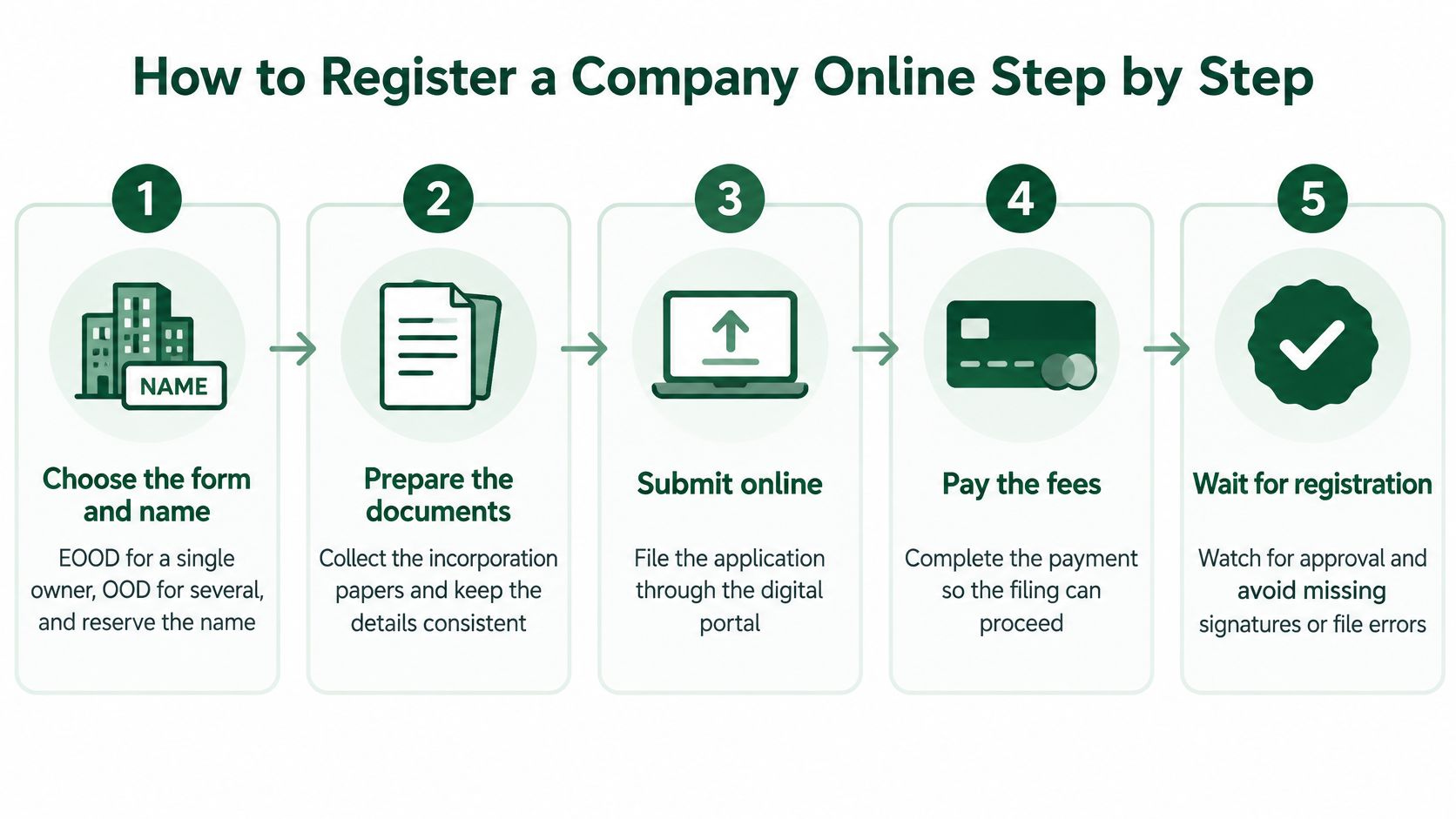
Here's the exact sequence, with the mistake that usually costs founders a week at each step. Follow it in order and the filing itself becomes almost boring, which is what you want.
Choose the form and reserve the name. Pick an EOOD if you're the sole owner, an OOD if there are two or more shareholders. Reserve the name electronically before filing. Our intake takes about five minutes to capture your company name, structure, and members. The common slip is picking a name that's already taken or too close to an existing company, so give us two or three alternatives in order of preference.
Prepare the incorporation act or articles and the manager resolution. These documents state who owns what, who manages the company, and what it does. The registry checks them closely. Keep the business description broad enough to cover what you'll sell, because amending it later means another filing.
Deposit the share capital and get the bank certificate. You can set capital at the legal minimum, then obtain a bank certificate confirming the deposit. This is the attachment most often missing from first attempts. No certificate, no registration, however polished the rest of the package looks.
Get the manager's notarised consent and signature specimen. The manager must consent to the appointment and provide a notarised signature sample. This is usually the slowest offline step for non-residents, so book it early rather than after everything else is ready.
Sign with a QES or complete the approved remote identity check. Match the signing method to the identity route you confirmed at the start. A signature that doesn't match the specimen, or a signer who was never verified, stops the filing cold.
Submit online and pay the electronic filing fee. Electronic filing costs half the paper fee, and the package goes to the Commercial Register in one submission. Double-check that every attachment opens, is legible, and matches the names in the application before you hit submit.
Receive the EIK and incorporation certificate electronically. The EIK is your company's unique identification number and the essential key to banking and VAT. Download and store the certificate somewhere you'll find it again, because every provider will ask for it.
The document list and fee gap are set out in World Bank guidance on starting a business in Bulgaria, which states that the Bulgarian Registry Agency fee is BGN 55 for electronic registration compared with BGN 110 for paper filing, and that the application must include the articles or association agreement, the resolution appointing the manager, the manager's notarized consent and signature specimen, and a bank certificate confirming deposited capital. The same guidance says that, since 1 January 2016, initial company-registration applications should be reviewed by the Commercial Register by the end of the next business day after submission.
Practical rule: Prepare every attachment before you file, and check that the electronic signature, notarisation, fee payment, and capital-deposit evidence all match the application. A missing document triggers correction instructions, and the clock effectively restarts.
One detail founders abroad often need afterwards is legalised paperwork for a foreign bank or authority. Our guide to what apostilled documents are and when you need them explains how that certification works. Success at this stage looks simple. Your complete application is reviewed by the end of the next business day, the EIK is issued, and the company is ready for its bank and VAT steps.
What to Do After Registration Before You Trade
A registered company is not a trading company. EU rules permit fully online establishment of private limited companies, including preparing constitutional documents and entering the business register, but the Council document on EU company law and the once-only principle makes clear that authorities may separately require tax identification, VAT identification, social-security information, and beneficial-owner data. Registration doesn't switch those on automatically.
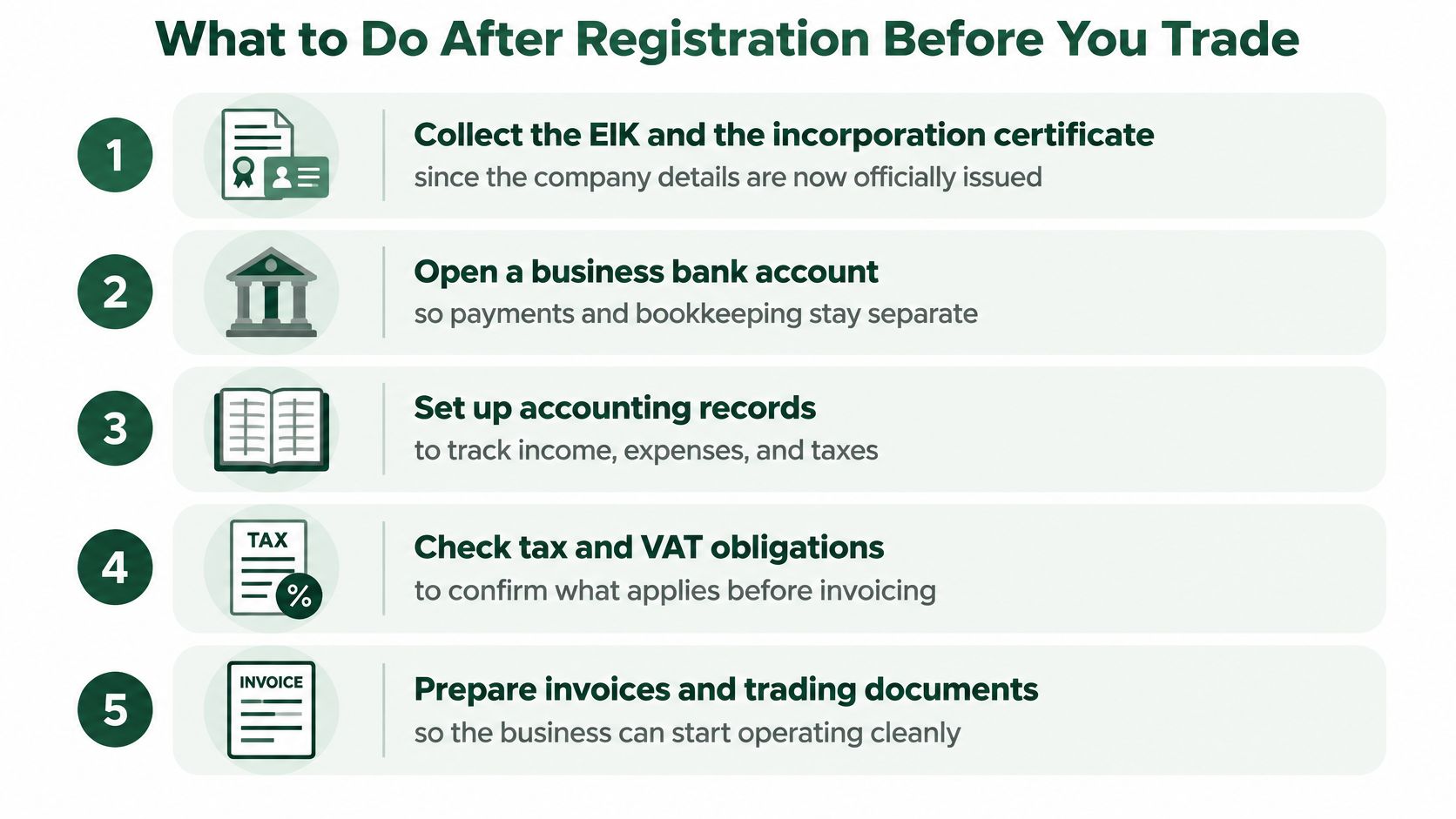
Work through this checklist before you send your first invoice.
Collect the EIK and incorporation certificate. Every bank, payment provider, and serious client will ask for them. Keep clean digital copies ready to send.
Open the company bank account. You can use an online provider such as Revolut, Wise, UniCredit, or Paysera, or a Bulgarian bank. Once incorporation is complete, we help you open the account online or locally in about an hour. Our walkthrough on opening a business bank account online covers what providers check.
Decide on VAT registration as its own decision. VAT registration is included in all our formation packages, but whether and when you register affects your pricing and filings. Decide based on who your customers are and where they're located, not as an afterthought.
Confirm tax and social-security registration status. Don't assume every registration flowed from incorporation. Confirm what's active before you pay anyone, including yourself.
Keep beneficial-owner information identical everywhere. The ownership chart you give the company register must match what the bank, the VAT application, and your accounting records say. Say a founder's chart lists a nominee shareholder while his bank application names him as sole owner. Onboarding stalls until he explains the discrepancy and produces documents that agree. Banks read inconsistency as risk.
Set up bookkeeping from month one. Open your accounting records, invoice numbering, and expense process before revenue arrives. Rebuilding six months of messy records costs far more than starting clean.
Legal formation is not operational readiness. Your company can exist in the register while it still has no usable bank account, no VAT number, and no compliant way to invoice.
Two final practical points. Online doesn't mean anonymous, and it doesn't mean paperless everywhere, because banks and foreign counterparties can still ask for notarised or apostilled evidence. And check the registered-office requirement before filing, since your application needs a Bulgarian address. A virtual office supplies one when the provider's arrangement is accepted for registration and official correspondence.
Bulgaria Tax Rate Compared With Other Countries
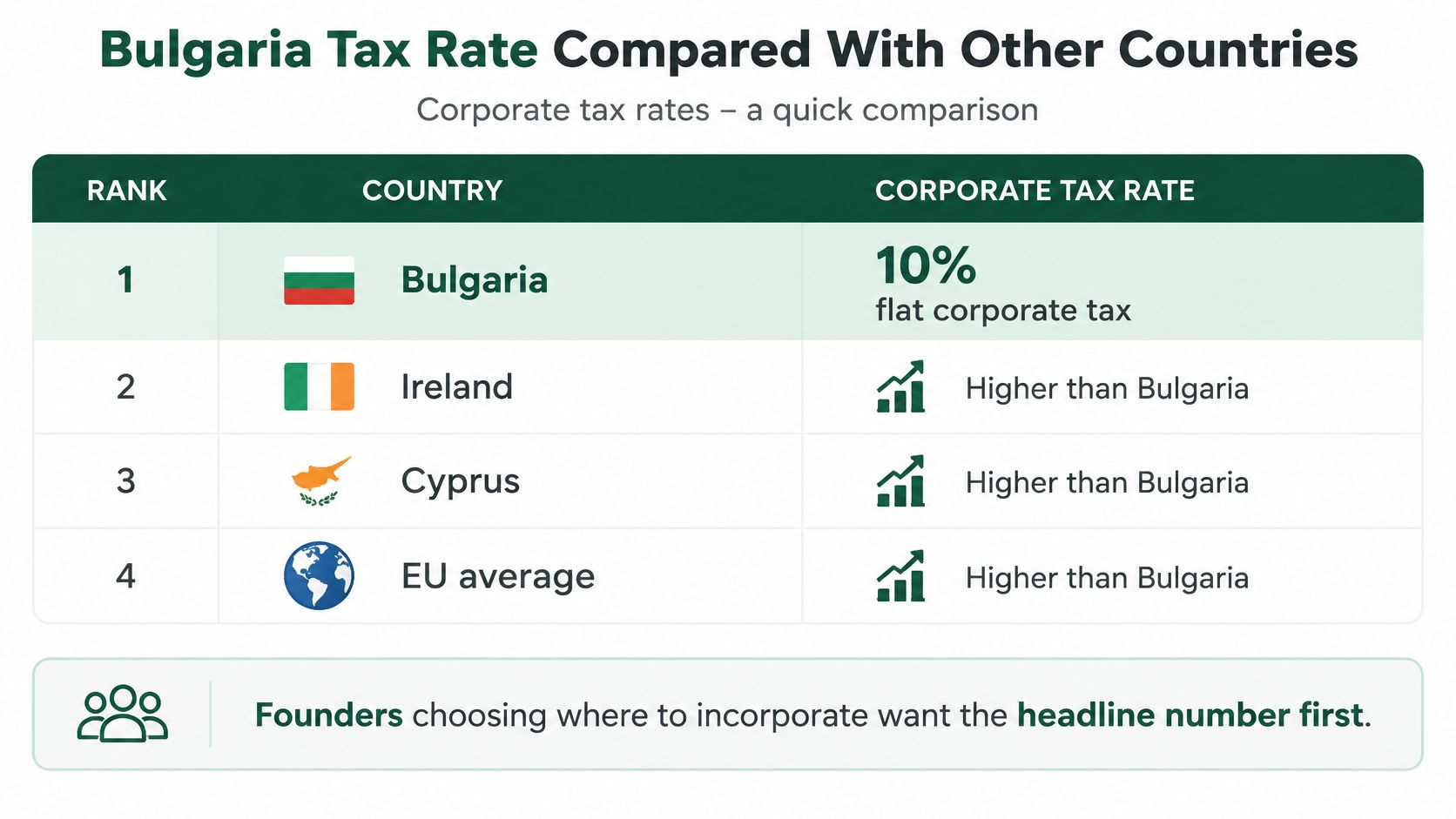
Bulgaria's 10% flat corporate tax is one of the lowest headline rates in the EU. That number gets founders' attention, and it should. It is also where most comparisons stop too early.
Headline Corporate Tax Rates Compared
| Country | Headline Corporate Tax Rate | What to Note |
|---|---|---|
| Bulgaria | 10% flat | Among the lowest rates in the EU, with low entry costs |
| Hungary | 9% | Local business tax can add to the headline rate |
| Ireland | 12.5% on trading income | Applies to trading income |
| Cyprus | 15% | Headline rate for companies |
| United Kingdom | 25% main rate | 19% small profits rate applies to smaller profits |
| Netherlands | 19% lower band, 25.8% above it | Two-band structure, with the lower band up to €200,000 |
| Germany | About 30% combined | Includes trade tax, which varies by municipality |
| United States | 21% federal | Most states add their own corporate tax |
Our deeper breakdown of corporate tax rates across popular jurisdictions shows how these headline figures compare in practice. Read the table as a starting point, not a verdict. Hungary's 9% looks unbeatable until local business tax enters the picture. Germany's combined rate shifts from city to city because trade tax is municipal. The Netherlands rewards smaller profits with its lower band up to €200,000, then charges the higher rate beyond it.
Bulgaria's advantage is the combination: a 10% flat rate, €1 minimum capital, low registry fees, EU membership, and an EU VAT number, all handled online. The 10% applies to company profit. It does not cover what it costs to run the company from abroad. Banking, accounting, VAT filings, and your home-country tax position all sit outside the headline number. A company can be registered in 3 to 5 business days and still stall at bank, VAT, or beneficial-owner checks if those are not prepared in advance.
Three Checks Before the Rate Decides for You
- Confirm where the company is managed. If you run everything from your home country, that country may claim the company as tax resident there. A Bulgarian registration does not override management-and-control rules abroad.
- Check tax on dividends in your home country. Money taxed at 10% in Bulgaria can still be taxed again when you pay it to yourself. Model the full path from company profit to your personal account.
- Decide on voluntary VAT registration before filing. FastCorp includes VAT registration in every company formation package, but it is still a separate commercial decision. Register because your customers and suppliers make it worthwhile, not because the form offers it.
Rates and thresholds change, and the right structure depends on your residence, your clients, and where decisions are really made. Check the current rules with an adviser who knows both Bulgaria and your home country before you commit. On headline rate, Bulgaria wins this comparison for most small international businesses. On total cost of operating from abroad, run the numbers yourself.
Choose Your Route
Most founders assume in-person is safer. You fly in, sign in front of a human, shake hands, done. Test that assumption against the facts and it usually falls apart. The registry doesn't grade your application on whether you were physically in Sofia. It grades documents, signatures, and identity evidence. A clean online filing beats a messy in-person one every time.
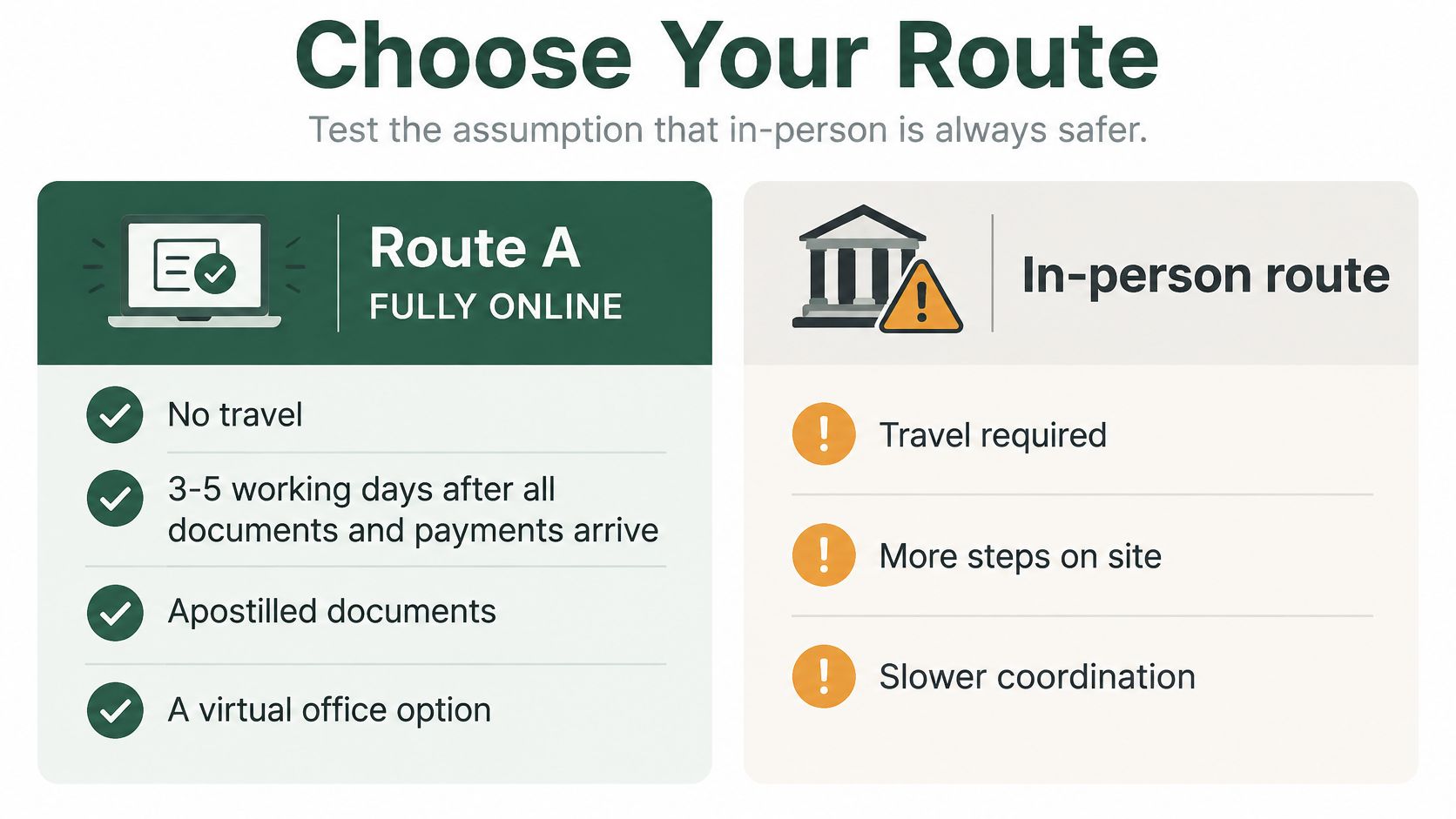
Route A Fully Online
No travel at all. The setup takes 3 to 5 working days after all documents and payments arrive, and the €1,750 package includes apostilled documents and a virtual office. For a founder outside Bulgaria, this is the default I'd recommend. You spend your week running your business while we draft, file, and chase the registry.
The limit is real, though. This route depends on a QES or an approved remote identity check, and on clean uploads from your side. One missing bank certificate or an unreadable passport scan slows everything, because there's no desk to walk up to. If you're organised and responsive on email, you'll never feel that limit.
Route B In Person in Sofia
You visit our Sofia office and complete the setup face to face in 2 to 3 working days. The €1,500 package includes company registration, EU VAT number, bank account, virtual office and business address, certificate of incorporation, all legal and government fees, and a complimentary airport pickup. Signing in the room suits founders who don't have a QES and can't verify remotely, or who want staff beside them to resolve questions on the spot.
The limit is the trip itself. The package is €250 cheaper, but one return flight, two nights in a hotel, and two days away from your business can cost more than that gap. If you're already planning to be in Sofia, the maths flips and in-person becomes the smarter buy.
The Decision Rule
- If you hold a QES or can verify remotely and you're outside Bulgaria, choose online. You'll get the same legal result without the travel bill.
- If you're already in Sofia or you cannot verify remotely, choose in person. Forcing a remote route that your identity documents can't support wastes more time than a short trip.
Before you commit, gather what we collect for every registration so neither route stalls. Have your ID details, preferred company names, business description, shareholder and director details, and share capital amount ready. Then submit the intake form, complete checkout, and send the company documents. The whole process starts with a short form about you, followed by payment, and then the formation details.
One honest warning from walking founders through both routes. The expensive mistakes aren't dramatic. They're a shareholder who mentions a second passport late, a manager who books the notary for next week, or a name choice that's taken with no backup prepared. Fix those three things up front and either route runs smoothly.
The cheapest route is the one that avoids a second trip.
So ask yourself the question in its practical form. Can I register a company online, in the EU, at a 10% tax rate, without leaving home? Yes, provided your identity route is confirmed and your documents are complete before filing. Everything is handled online, and it's easy once those two conditions are met. Choose online if you can sign remotely, choose Sofia if you can't, and start with your paperwork in order either way.
Ready to register your Bulgarian EOOD or OOD without the flight, the paperwork chase, or the guesswork on VAT and banking? We handle the full setup online in 3 to 5 working days, including your EU VAT number, bank account, virtual office, and apostilled documents, or we complete it with you in person at our Sofia office. Start your application today at FastCorp and trade from a compliant EU company within the week.