Virtual Office Registered Address: A Founder's Guide
Learn how a virtual office registered address helps startups establish an EU presence, stay compliant, and build credibility with clients and investors.

A virtual office registered address provides a real physical street address for official mail and company registration while keeping your home address off public records. In Bulgaria, the setup can support incorporation, EU VAT administration, banking assistance, and ongoing compliance through one online workflow, while the United States and United Kingdom often require separate arrangements for registration, banking, or tax.
You're probably looking at a familiar trade-off. You want an EU company, a credible business address, and access to practical banking and tax administration, but you don't want to lease an office you'll barely use or publish your home address in a public register. The address looks like a simple form field until a bank asks where the business operates, a tax authority requests evidence, or a regulator checks whether official notices can reach a real person.
That's where the split-address reality matters. An address may work for incorporation but fail during bank onboarding. It may receive tax correspondence but not satisfy a registered-agent rule. Bulgaria can be strategically attractive because an integrated formation provider can combine a Sofia registered address with incorporation, VAT, banking assistance, and compliance support in one process.
Table of Contents
- What Is a Virtual Office Registered Address?
- Legal and Compliance Implications in the EU
- Virtual Office vs Physical Office and Tax Comparison
- Use Cases for Non-Resident Founders
- How to Obtain a Virtual Office in Bulgaria
- Pricing and Service Considerations
- Common Misconceptions About Virtual Addresses
- Conclusion and Next Steps
What Is a Virtual Office Registered Address?
A non-resident founder often starts with a practical problem: the company needs a local address, but the founder lives elsewhere and works remotely. A virtual office registered address solves that problem by assigning the company a real physical street address for registration, official correspondence, and business identity, without requiring a full-time leased office.
That distinction matters. This isn't a postal box or an address invented for a website footer. A suitable provider gives you an address connected to a physical business location where official mail can be received and handled. In the UK, the registered office is the company's official public address, and historical address changes may remain visible on the public register for the company's life and for 20 years after dissolution, according to Regus's explanation of registered office addresses.
The privacy benefit is immediate. Your home address stays out of the public company record, while clients, authorities, and counterparties see a professional commercial location instead. For a founder operating across borders, that address also becomes part of the company's long-term identity, so choosing a provider deserves more care than selecting the cheapest mailbox service.
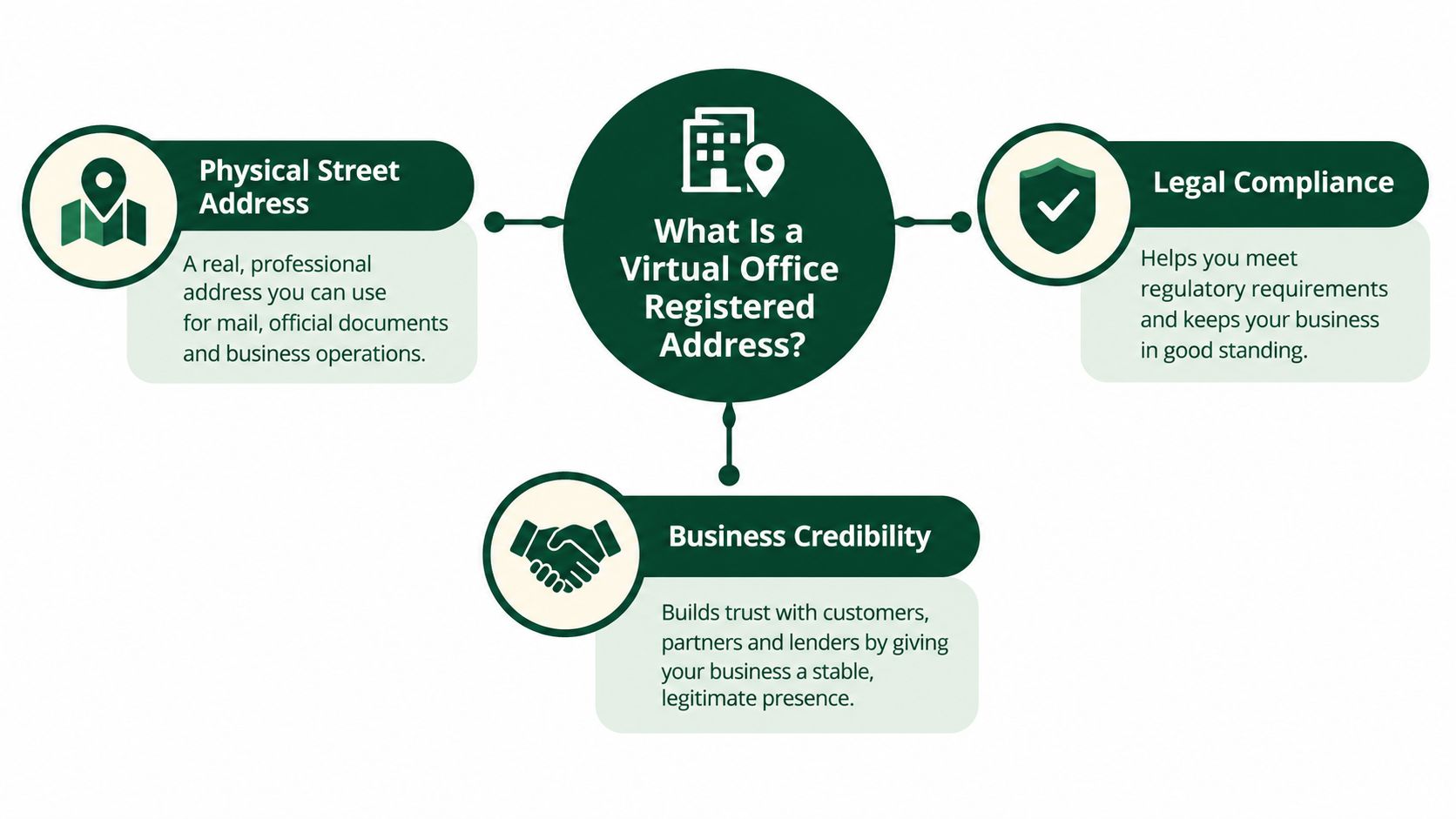
What the address actually provides
A useful service should cover three practical functions:
- Physical presence: A real street location receives official letters and government notices.
- Registration support: The address can be used for company formation where local rules permit it.
- Operational credibility: Your invoices, website, contracts, and correspondence show a business location rather than a private residence.
The phrase still needs jurisdictional qualification. Some countries allow a virtual office for company registration, while others require additional premises, a dedicated desk, or proof that the company has the right to use the address. FastCorp's guide to virtual offices in Europe is useful as a starting point, but the exact legal use must always be checked against the company's jurisdiction and activity.
Practical rule: Buy the legal function you need, not the label on the package. “Virtual office” can mean mail handling, registered office service, meeting space, or all three.
Legal and Compliance Implications in the EU
A registered address sits inside the company's compliance system. Authorities and financial institutions want more than a location printed on incorporation documents. They need confidence that official notices can reach someone responsible for the company and that the provider maintains appropriate records.
The UK illustrates this clearly. Under the Money Laundering Regulations 2017, providing a registered office or business correspondence address through a virtual office is treated as a regulated service within the trust or company service provider framework, as explained in the HMRC Economic Crime Supervision Handbook. That means customer due diligence and record-testing obligations apply to the service provider.
What regulators and banks may examine
A credible address should be:
- Active and monitored: Mail shouldn't sit unnoticed until a filing deadline passes.
- Reachable: The provider must be capable of receiving official notices and escalating them to you.
- Documented: You should have an agreement or other evidence showing your right to use the address.
- Consistent: The address should match the details used in incorporation, VAT records, banking applications, and contracts unless there's a clear reason for a difference.
- Suitable for the jurisdiction: A service accepted for a registered office may not satisfy a local licensing or tax requirement.
The compliance risk is operational, not merely theoretical. If the provider forwards mail slowly, fails to identify legal correspondence, or cannot confirm your authority to use the premises, the company may miss a notice or struggle to answer a verification request. A strong provider therefore becomes part of your control environment, not just a branding vendor.
Bulgaria and the one-address objective
Bulgaria is attractive to founders who want an EU structure supported by a registered address and coordinated administration. The practical advantage is the possibility of arranging incorporation, a Sofia virtual office, VAT administration, banking assistance, and ongoing compliance through one workflow rather than assembling separate suppliers.
That doesn't remove the need for bank-specific checks. A bank may still ask about ownership, business activity, customers, expected transactions, and the company's actual operating model. The address supports the application, but it doesn't replace proper KYC evidence or a credible explanation of how the business works.
For broader operational guidance, FastCorp's business compliance resource provides a relevant reference point. The decision standard is simple: choose an address that remains usable when a regulator, tax authority, or bank asks a second question.
Virtual Office vs Physical Office and Tax Comparison
A full office lease gives you control, dedicated space, and a visible operating base. It also ties the business to rent, utilities, furnishing, access arrangements, and a location you may not need every day. A virtual office is lighter, but it works best when the team operates remotely and needs official presence more often than permanent desks.
| Feature/Country | Virtual Office, for example Bulgaria | Physical Office, for example Germany |
|---|---|---|
| Registration role | Can support company registration where local rules accept the address | Usually supports registration through dedicated premises |
| Commitment | Flexible service arrangement, subject to provider terms | Lease and premises commitment |
| Daily workspace | Usually limited to optional meeting or coworking access | Dedicated space for staff and visitors |
| Mail handling | Provider receives and manages official correspondence | Company receives mail directly |
| Privacy | Keeps a founder's home address off public records where accepted | Uses the business premises as the public location |
| Tax position | Bulgaria has a 10% corporate tax regime, as described by FastCorp | Tax treatment depends on the company's actual structure, activity, and German obligations |
| Cross-border administration | Can combine address, incorporation, VAT, banking assistance, and compliance through a specialist provider | Often requires separate local advisors and premises administration |
Bulgaria's 10% corporate tax is a major reason international founders compare it with other EU locations. The rate alone doesn't decide tax residence, permanent establishment, payroll, VAT, or substance questions. Your management, people, contracts, customers, and actual activity still matter, so a low headline rate should be treated as a planning input rather than a promise of automatic tax savings.
Country rules are not interchangeable
The UK allows a virtual office for a registered office in many cases, but the address must be in the same part of the UK as the incorporation and must satisfy the applicable address test, according to country-specific guidance for non-UK residents. Ireland, the Netherlands, and Taiwan are described in that guidance as jurisdictions where a physical address may be required or a virtual office alone may not be enough.
The United States is more fragmented. Most states require a registered agent or registered office with a physical in-state street address where someone can receive service of process and official notices. A virtual address or P.O. box may therefore work for routine business mail while failing for the registered-agent role, as explained by InCorp's guidance on virtual addresses for LLCs.
A virtual office can reduce premises overhead, but it can't erase local legal requirements or the difference between a registered address and a real operating location.
Use Cases for Non-Resident Founders
A freelance consultant may need a company address for contracts and invoices but spend the year working from different countries. Publishing a home address creates privacy concerns, while leasing an office adds an obligation that doesn't match the way the consultant works. A registered address gives the company a stable point for official correspondence without pretending that the founder needs a permanent desk.
An e-commerce founder faces a different problem. Suppliers, payment partners, tax administrators, and customers may all expect consistent company details. The address helps create that consistency, but the provider must explain whether it handles packages, returns, and time-sensitive notices. A letter-only service may be inadequate for a business whose operations generate physical deliveries.

Three founder scenarios
- The remote freelancer: Uses the address for company registration, official mail, invoices, and privacy protection. The key check is whether the provider supplies usable documentation for banking and tax onboarding.
- The online retailer: Needs reliable mail and package handling, plus a clear returns process. The registered address should not be confused with a warehouse or fulfillment location.
- The SaaS agency: Wants an EU presence for contracts, VAT administration, and client confidence while its team works remotely. Banking teams may still ask for customer contracts, website details, ownership documents, and evidence of actual business activity.
Agencies and service firms also use virtual offices when entering a market before committing to local premises. That approach lets the founder test demand, sign contracts, and build administrative infrastructure without taking on a lease prematurely. It works when the company is honest about where its people work and keeps its address records consistent.
The common thread is not the industry. It's the need for a stable legal address without a full-time office. Bulgaria is especially relevant when the founder wants that address coordinated with incorporation, EU VAT work, banking assistance, and accounting rather than managed as an isolated mail product.
How to Obtain a Virtual Office in Bulgaria
The cleanest setup starts with the business structure, not the address. Decide whether you need a Bulgarian limited company, an EU VAT registration, banking assistance, bookkeeping, or only a correspondence address. That scope determines which documents the provider needs and prevents you from buying a service that solves only the first form.
FastCorp is a company formation and accounting provider specializing in Bulgarian limited companies for global founders. It provides end-to-end incorporation, EU VAT registration, banking assistance, virtual office, and ongoing compliance services, with the process completed fully online in 3–5 working days or in person in Sofia, based on the supplied company information.
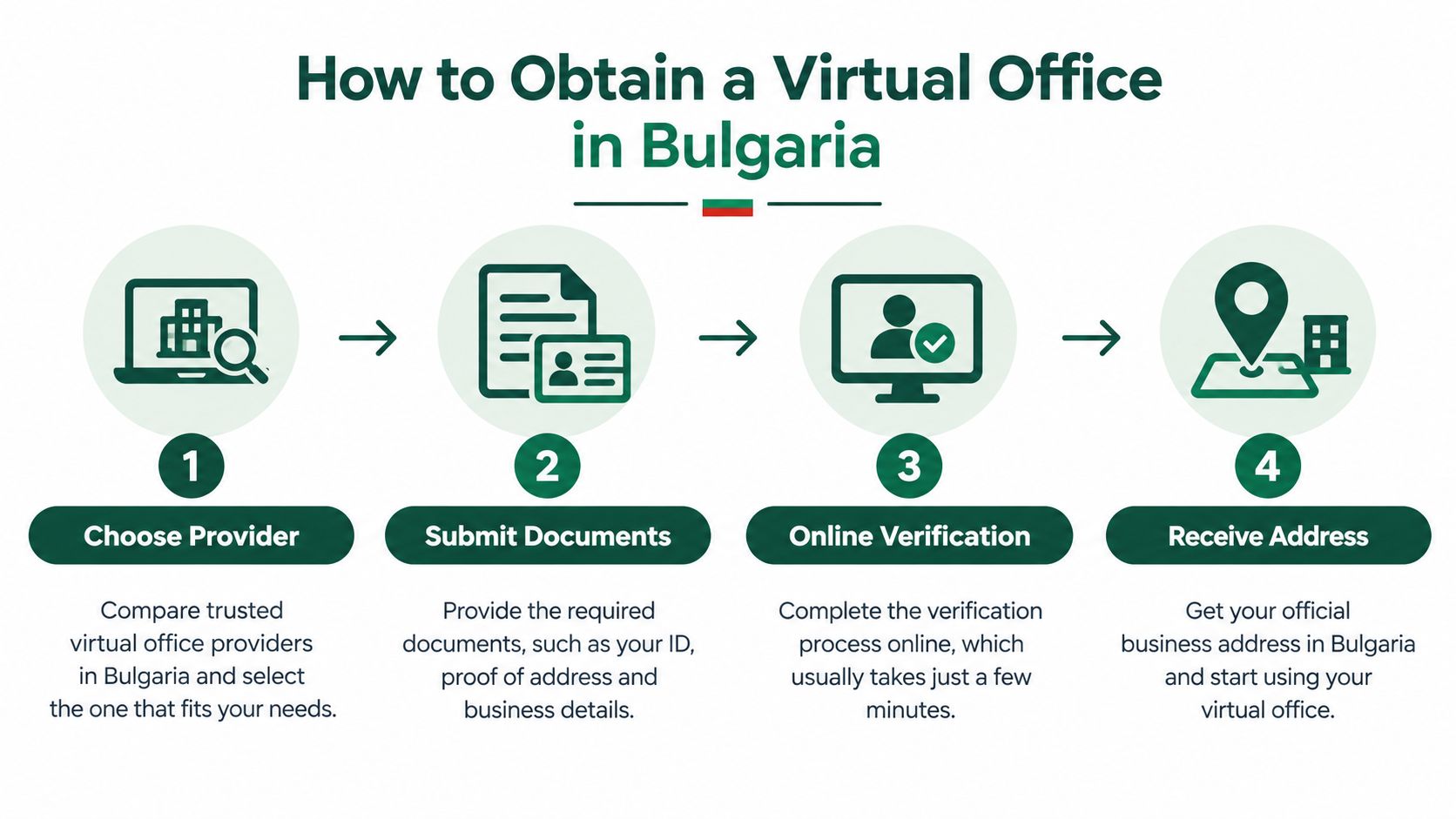
A practical four-step process
- Choose the right scope. Confirm whether the package covers incorporation, registered business address, VAT, banking assistance, and continuing accounting. Ask which services are included and which require separate approvals.
- Submit company and identity documents. Prepare ownership information, identification, proposed company details, and any activity description needed for the formation file. Clear documents reduce follow-up.
- Complete remote verification and signing. The online route uses remote identity verification and secure online notary processes, so the founder doesn't need to travel to Bulgaria.
- Receive the address and corporate documents. Once the company and address arrangements are completed, use the approved details consistently across banking, VAT, invoices, and official correspondence.
The online process is designed for founders who want everything handled remotely. An in-person route is also available in Sofia, with the supplied service information describing completion in 2–3 working days and complimentary airport pickup for the in-person package.
A video walkthrough can help you understand the general workflow before speaking with a provider:
Before you sign, ask who monitors incoming notices, how documents reach you, whether the address can be used for the intended registration, and what evidence the bank may request. For further formation context, see FastCorp's company registration guide for Bulgaria.
Pricing and Service Considerations
The headline price matters less than the boundary of the package. A low-cost address can become expensive if incorporation, VAT registration, banking assistance, translations, notarisation, bookkeeping, and government charges are all billed separately. Before comparing providers, write down the complete outcome you need and ask each provider to map its fees to that list.
FastCorp's supplied package information lists €1,750 for online setup and €1,500 for in-person setup, with legal and government fees included in the package description. Those amounts should still be confirmed directly because package scope and public fees can change.
What to compare before committing
- Formation coverage: Does the service include the corporate documents and filings needed to establish the Bulgarian company?
- Address rights: Can the provider document your right to use the Sofia address for the intended purpose?
- VAT administration: Does the package include EU VAT registration and the setup needed for ongoing filings?
- Banking assistance: Is the provider helping with introductions and documentation, or promising an account it can't control?
- Accounting continuity: Who handles bookkeeping, VAT returns, annual corporate tax filings, payroll administration, and statutory reporting?
- Communication: How quickly will you be told about official correspondence, missing documents, or bank questions?
The real value of an integrated provider is coordination. One team can keep the company name, ownership records, address, VAT file, bank application, and accounting setup aligned. That reduces the risk of submitting inconsistent information to different institutions.
Don't treat client satisfaction claims or incorporation volume as substitutes for due diligence. Ask for the engagement terms, cancellation rules, service boundaries, response process, and the exact responsibilities that remain with you. The right package is the one that makes compliance visible and manageable after incorporation, not merely the one that gets an address onto the first application.
Common Misconceptions About Virtual Addresses
The most damaging misconception is that a virtual address is just a P.O. box with better branding. A compliant service should connect the address to a real physical location, support official correspondence, and provide evidence that the company can use the premises for the stated purpose.
The second misconception is that one address automatically works everywhere. In the United States, a virtual office commonly doesn't replace the physical in-state address required for registered-agent duties. In banking, KYC teams may ask for a verifiable operating address even when a company registrar accepts the virtual office.

The appropriate-address test
Recent UK guidance emphasizes that a registered office must be an appropriate address, meaning it can reasonably be expected to bring documents to the attention of a person acting for the company. A forwarding-only mailbox may not meet that standard. Grosvenor St Paul's guidance on virtual office requirements highlights why older advice that treats virtual offices and P.O. boxes as interchangeable can mislead founders.
The practical test is straightforward:
- Can someone receive official delivery at the location?
- Does the provider acknowledge or monitor that delivery?
- Can the provider show that you're entitled to use the address?
- Will the address withstand questions from Companies House, a tax authority, or a bank?
- Are you using it only for an approved purpose?
If the answer is unclear, don't file first and investigate later. Ask the provider for written confirmation of permitted use and maintain a separate operating-address explanation for banking or tax checks where required.
Conclusion and Next Steps
A virtual office registered address is valuable because it separates your company's public identity from your private home while giving official correspondence a real place to land. Its limits are just as important. Registration, banking, tax, and licensing may apply different tests, and the address that works for one purpose may fail for another.
Bulgaria offers a practical strategic hub for founders who want a coordinated EU setup, a Sofia registered address, online administration, and access to a 10% corporate tax regime. The safeguard is disciplined documentation: confirm the address function, keep ownership and activity records consistent, monitor mail, and answer bank or authority questions with evidence.
Start by listing every use case, then ask a provider to confirm which address handles each one. If the arrangement requires separate addresses, plan that from the beginning rather than discovering the gap during onboarding.
FastCorp supports global founders with Bulgarian company formation, EU VAT registration, banking assistance, a Sofia virtual office registered address, and ongoing accounting and compliance. Review the available setup options and start the process online through FastCorp.