Tax Residency Certificate Guide for Non-Residents
Learn what a tax residency certificate is, why non-residents need it for treaty relief, and how to get one quickly online with FastCorp support.

Your foreign client has paid, but the amount reaching your account is smaller than the invoice. Their finance team explains that withholding tax was deducted because they didn't have acceptable treaty documentation on file. You've got company registration papers and a business address, but neither answers the question they're asking: where is the recipient resident for tax purposes?
For founders using a Bulgarian company, the practical starting point is the National Revenue Agency's application process, not a complicated treaty diagram. Get the residence position right, prepare the right evidence, and use the online route where you have the necessary credentials. The administration can be straightforward. The mistake is treating incorporation, personal residence, and treaty eligibility as the same thing.
Table of Contents
- What a Tax Residency Certificate Actually Does
- Who Counts as Tax Resident and Why It Matters
- How Withholding Tax Relief Works in Practice
- Bulgaria vs the UK, Germany, and the United States
- Getting Your Bulgarian Tax Residency Certificate Online
- How FastCorp Handles the Certificate as Part of Your Setup
- Practical Checklist Before You Apply
What a Tax Residency Certificate Actually Does
A tax residency certificate is an official document from a jurisdiction's tax authority confirming that an individual or entity is resident there for tax purposes during a specified period. Its practical purpose is to support a claim under a double-tax treaty or a domestic withholding-tax relief procedure. The OECD's guidance on documentation for withholding-tax relief explains the role of residence certificates in those claims.
It isn't a visa, a citizenship document, or a substitute for establishing tax residence. Nor should you send a rental agreement and assume the foreign payer will treat it as equivalent. The payer needs evidence of a tax status, not merely evidence that you can receive mail somewhere.
Start with the recipient and the payment
Before applying, establish who needs the certificate. If a company receives the income, investigate the company's treaty position. If you personally receive it, investigate yours. Don't place a shareholder's certificate into a company's payment file merely because the shareholder owns the business.
Then ask the foreign payer what documentation they require before releasing the payment:
- Income category: Identify whether the payment is a dividend, interest, royalty, service payment, or something else.
- Relevant period: Establish which tax year the claim concerns.
- Receiving authority: Confirm whether the certificate goes to the withholding agent, the tax authority, or both under the applicable procedure.
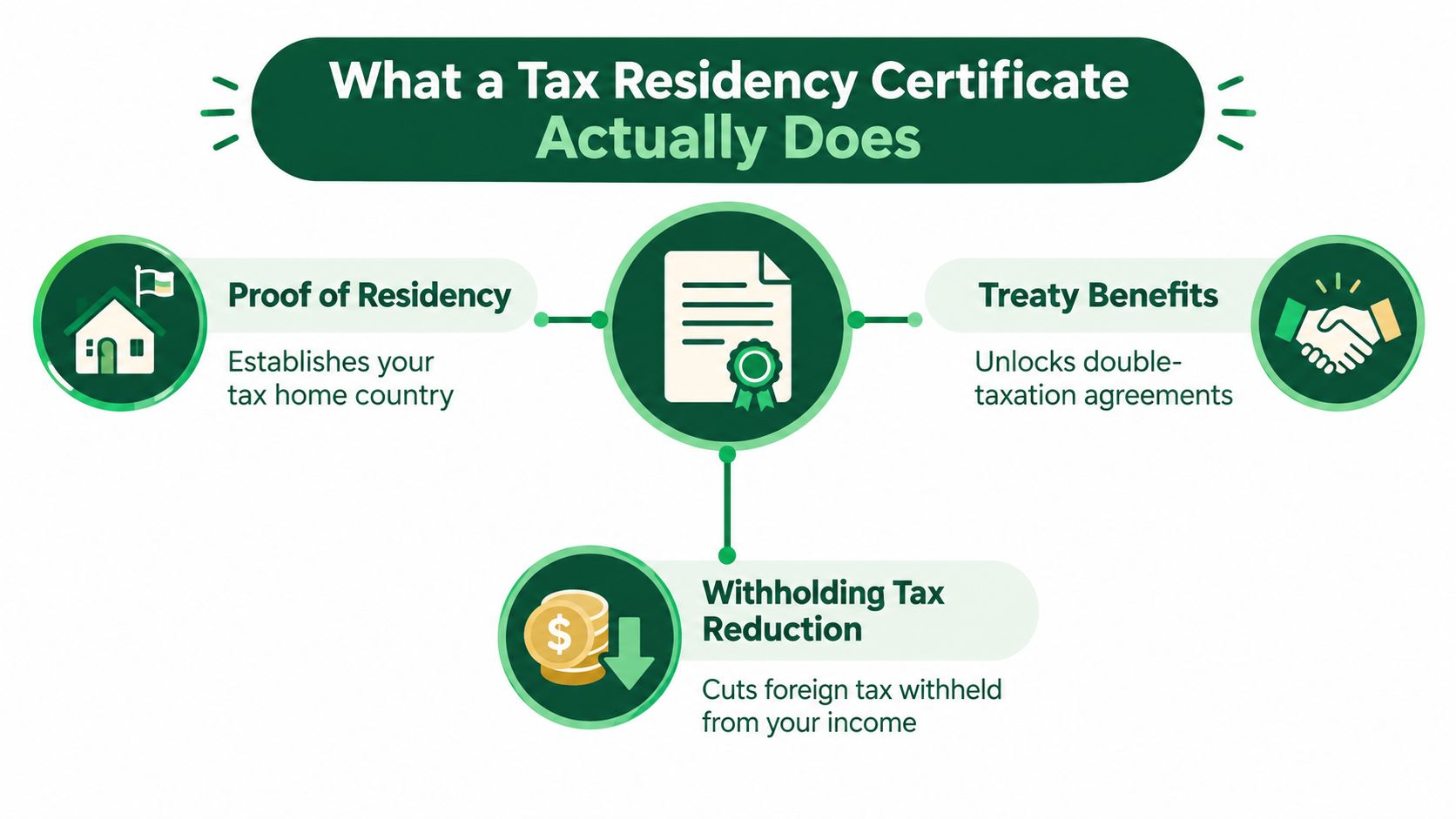
The distinction between evidence and entitlement matters. A certificate supports the residence element of a claim; it doesn't independently grant an exemption or establish that every treaty condition has been satisfied.
This illustration separates the document's evidentiary purpose from its potential tax effect.
My recommendation is simple: ask about withholding documentation when you agree the payment terms, not when you chase a missing balance.
Who Counts as Tax Resident and Why It Matters
Being a non-resident founder doesn't tell us where you or your company belongs for tax purposes. It only describes your relationship to a particular country. Keep the founder's position and the company's position in separate files from the beginning.
Tax residence is determined under each jurisdiction's domestic law. An individual or entity can satisfy the domestic residence rules of more than one jurisdiction at the same time, and citizenship or permission to live somewhere doesn't automatically establish tax residence. The OECD's explanation of tax-residence rules makes those distinctions clear.
Having the right to live in Bulgaria isn't the same as being resident there for tax purposes.
Assess your actual connections
For individuals, Bulgaria's rules include spending more than 183 days in Bulgaria during the relevant period or having a centre of vital interests there, as described in the Bulgarian tax-residency procedure. The assessment therefore isn't limited to counting days. Personal and economic connections can matter too.
Prepare your position before completing the application. I recommend maintaining a residence file that separates physical-presence evidence from evidence of personal and economic ties. That makes it easier to see whether your explanation is coherent or whether you're relying too heavily on a registered address.
- For the founder: Review where you live and where your personal and economic relationships are concentrated.
- For the company: Assess the entity under the applicable corporate residence rules rather than borrowing the founder's answer.
- For competing claims: Identify whether another country also treats the same taxpayer as resident, then examine the relevant treaty's residence tie-breaker provisions.
Don't treat an NRA application as a way to resolve an unexamined conflict with your previous country. Settle the underlying analysis first.
The requested period also needs to match the payment. An official document can be genuine and still be unsuitable for a particular claim because it certifies the wrong year. Your objective isn't to obtain a stamped document. It's to obtain evidence that supports the residence position you're relying on.
How Withholding Tax Relief Works in Practice
Consider a Bulgarian EOOD paying a dividend to a shareholder who is tax-resident abroad. The shareholder's residence jurisdiction supplies the relevant certificate for that shareholder's claim. A Bulgarian certificate for the paying company doesn't establish the foreign shareholder's eligibility.
The payment sequence is useful, but don't treat a generic diagram as a statement of Bulgaria's dividend withholding rate.
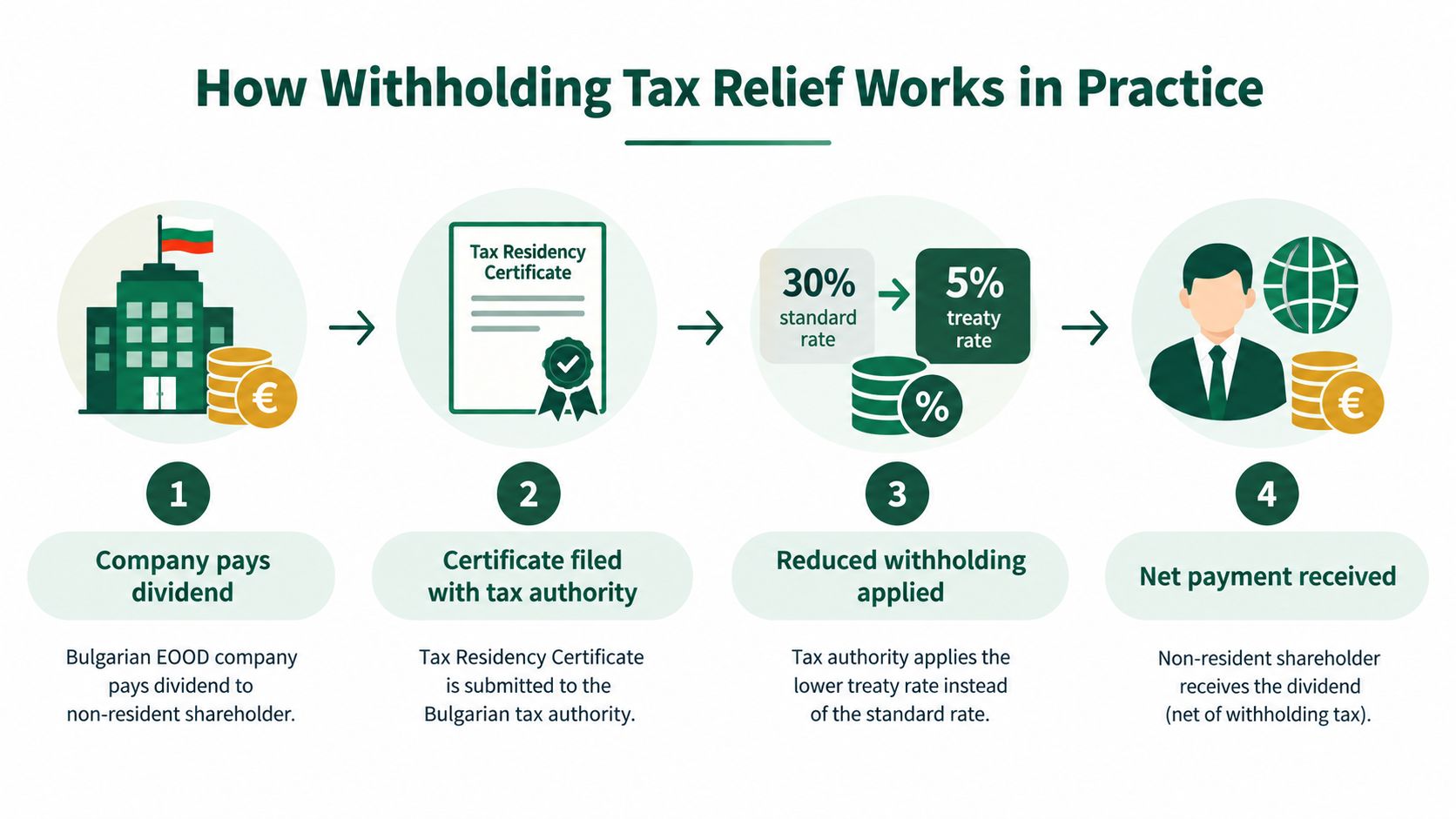
Compare the legal rates before calculating the payment
The payer first identifies the applicable domestic withholding treatment. It then checks whether a treaty provides a lower rate for that income category and whether the recipient satisfies the conditions. If the required documentation is accepted in time, the payer can apply the available relief under the relevant procedure.
There's no universal treaty rate. The IRS guidance on certification for treaty purposes explains that treaty provisions can reduce withholding on income paid to eligible U.S. residents, sometimes to 0%. It also identifies Form 8802 as the mandatory application for Form 6166, the computer-generated residence letter printed on U.S. Department of the Treasury stationery.
For your own payment, write down the domestic rate and the verified treaty rate before estimating the net amount. Don't import a rate from another country or another income category. If relief isn't applied at payment, investigate the available refund procedure rather than assuming the deduction is automatically recoverable.
Use a cross-border tax-planning review to connect the recipient, income category, treaty conditions, and payer's documentation requirements. The cash-flow benefit comes from an accepted claim, not from possessing the certificate alone.
For a visual walkthrough of the payment and documentation sequence, watch the accompanying explanation.
Bulgaria vs the UK, Germany, and the United States
Compare administrative processes separately from tax outcomes. An accessible certificate procedure is valuable, but it doesn't tell you what treaty rate applies to a particular payment. Choose the structure on its merits, then assess how reliably you can maintain its documentation.
Bulgaria offers a central NRA process with electronic filing using a qualified electronic signature or an NRA-issued personal identification code. The UK uses HMRC's dedicated application route, while Germany depends more heavily on the competent local Finanzamt. These differences are described in this comparison of certificate application channels.
Tax Residency Certificate Process Across Four Jurisdictions
| Jurisdiction | Issuing Authority | Online Channel | Typical Processing | Key Identifier |
|---|---|---|---|---|
| Bulgaria | National Revenue Agency | NRA electronic services using a qualified signature or NRA personal code; OKd-273 application | Up to seven days, or up to 14 through another NRA office, under the Bulgarian procedure cited above | Applicant's tax identification details |
| United Kingdom | HM Revenue & Customs | Online RES1 route for companies, partnerships, and public bodies | Confirm with HMRC before scheduling a payment | Applicant's relevant tax reference |
| Germany | Competent local Finanzamt | Local-office procedure, commonly postal or in person rather than a centralized national route | Confirm with the competent office | Applicant's tax identification details |
| United States | Internal Revenue Service | Mandatory Form 8802 application; don't assume an online-only certificate process | Confirm the current IRS processing guidance | Taxpayer identity on Form 6166 |
Bulgaria's stated procedure charges no issuance fee, as the Bulgarian guidance cited earlier explains. That's a useful administrative advantage, though it doesn't mean professional assistance or other document services are necessarily free.
Make the comparison useful
For a founder already equipped with electronic credentials and a clear residence file, I'd favour Bulgaria's centralized route over organizing correspondence with an unfamiliar local office. That's an administrative judgment, not a promise of approval or a claim that every Bulgarian application is easier than every UK application.
The strongest comparison is operational: who signs, where the application goes, what evidence is needed, and whether the receiving payer accepts the resulting document. Keep your Bulgarian tax-rate assessment separate from this process comparison. A convenient filing channel and a favourable tax result are different questions.
Getting Your Bulgarian Tax Residency Certificate Online
Use the NRA electronic-services portal if you have the required credentials and supporting evidence. The application is commonly identified as OKd-273, and it should specify the foreign destination country and tax year. Electronic filing removes the need to choose the postal or counter route, but it doesn't remove the residence assessment.
The following visual summarizes the administrative sequence. Plan against the NRA procedure described earlier, rather than treating an illustration's estimated turnaround as a guaranteed deadline.
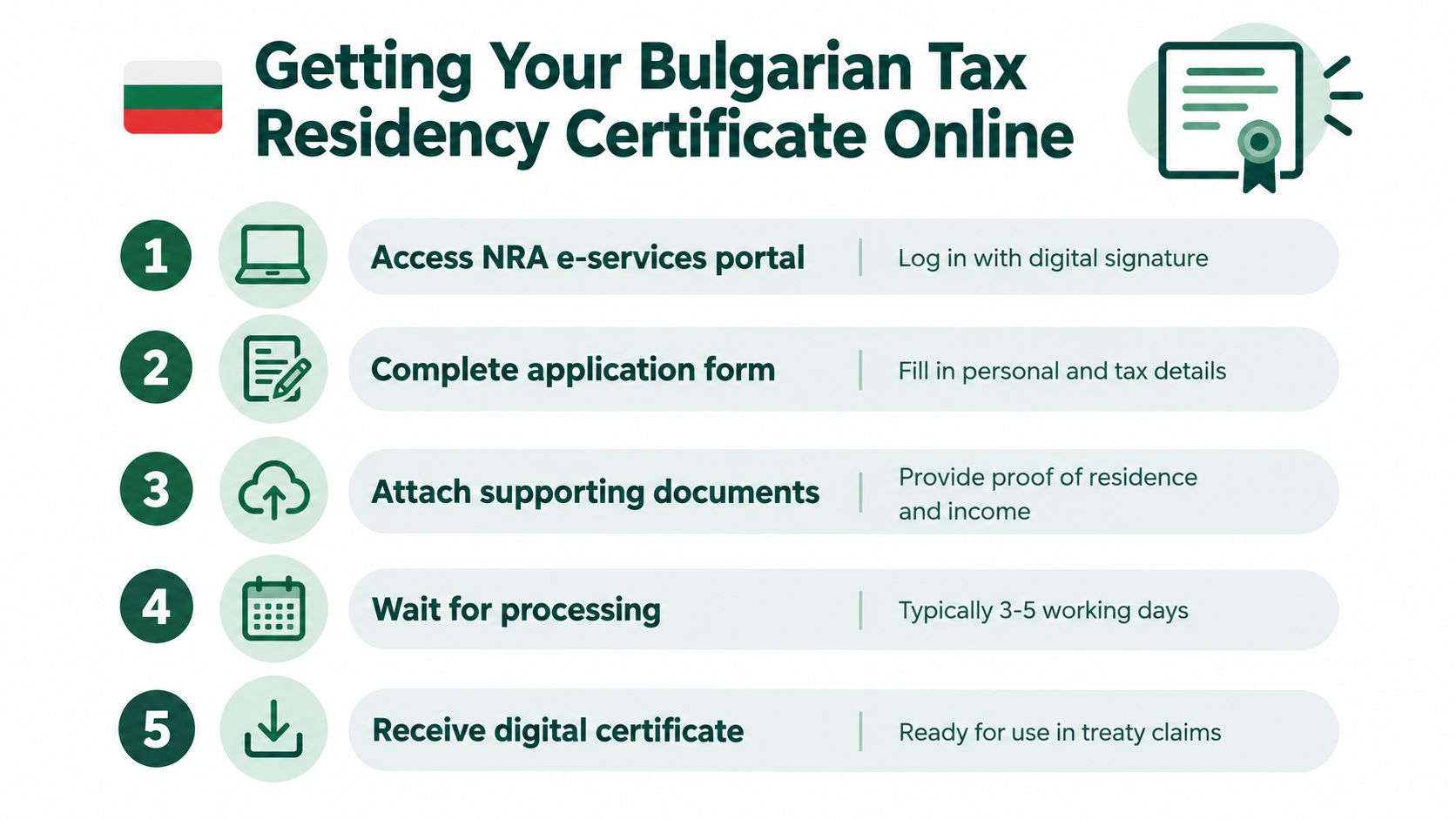
Prepare, submit, and check
Confirm Bulgarian tax residence. Establish whether the applicant is you or the company, then assess that taxpayer's position. Don't begin with whichever name is easiest to put on the form.
Prepare identity and address evidence. Assemble documents supporting the application and, where relevant, physical presence or personal and economic ties. Keep the evidence organized so you can answer follow-up questions consistently.
Complete OKd-273. Enter the destination country and requested tax year deliberately. Use the applicant's legal details, not a trading name that differs from the payer's records.
Check the signing credentials. Use a qualified electronic signature or NRA-issued personal identification code through the permitted electronic route. Verify access before a payment deadline creates pressure.
Submit through the appropriate channel. Online filing is available; post and in-person submission remain alternatives. Retain the submission record and a copy of what you sent.
Monitor the application. Use the processing benchmark established above for planning, while allowing time to address any evidentiary questions. Don't promise a payer an issue date before the application is ready.
Match the issued certificate to the payment file. Check the legal name, address, tax identification number, and validity period against the foreign withholding agent's records before sending it.
Avoidable mistake: A certificate for the wrong destination country or tax year may leave the payer without acceptable documentation for the intended claim.
Online filing is the easy part when the preparation is sound. My advice is to complete the recipient and period checks before signing, then repeat the identity check when the certificate arrives.
How FastCorp Handles the Certificate as Part of Your Setup
Treat incorporation support and certificate issuance as separate engagements. FastCorp provides Bulgarian company formation and ongoing accounting services. The NRA issues the tax residency certificate, and an incorporation package does not automatically include an OKd-273 application or establish treaty eligibility.
Its company formation and compliance offering includes corporate document preparation, banking assistance, a registered business address, remote identity verification and signing through an online notary, and ongoing bookkeeping and filings. These services help organize company information for a later certificate request. Confirm in advance whether certificate preparation and submission are included in your engagement.
The website describes the broader setup service, not an NRA approval process.

Define the handover clearly
Online notarization covers document signing; the NRA electronic-signature credential authorizes you to file OKd-273. Confirm who will sign the application, what authority that person needs, and whether your existing access is sufficient.
- Provider responsibilities: Agree who prepares the application, checks corporate identifiers, handles correspondence, and delivers the issued certificate.
- Client responsibilities: Provide accurate residence information, destination-country details, the relevant period, and evidence the provider cannot supply.
- Payer responsibilities: Confirm the foreign payer's acceptance requirements and submission deadline.
You can file yourself, hire a tax adviser, or ask your formation and accounting provider to coordinate the application. Assign one person to own the process rather than relying on a loosely defined package.
Bookkeeping, VAT filings, payroll, and statutory reporting can sit within the same compliance relationship. Use that relationship to track certificate renewals and keep payment documents organized. Company registration may finish before the NRA processes the certificate, so plan those timelines separately.
Practical Checklist Before You Apply
Treat the tax residency certificate as a controlled tax document. Give it an owner, retain the supporting application, and link it to the payment or treaty claim for which it was obtained. A document saved somewhere in an email thread isn't a reliable compliance process.
Before submitting, check the following:
- Applicant and residence position: Confirm whose income is involved and whether the Bulgarian residence analysis supports that applicant.
- Destination and period: Match the request to the foreign country and tax year relevant to the claim.
- Evidence file: Gather identity, address, and residence-supporting documents before opening the application.
- Submission access: Establish who will complete OKd-273 and use the qualified signature or NRA code.
- Acceptance and storage: Check the payer's requirements and retain the certificate alongside the associated treaty documentation.
A certificate documents residence for a defined period. It doesn't, by itself, eliminate filing obligations in another jurisdiction.
Ask about document authentication before ordering extra services. If the receiving authority requires it, review the document apostille process and establish which document needs authentication. Don't assume that every cross-border use requires the same treatment.
Finally, set a reminder to review the file before the next relevant payment. Recheck changes in residence, taxpayer details, and payer requirements rather than forwarding an old attachment automatically. The strongest workflow is prepared before payment, with the applicant, adviser, and withholding agent clear about their respective responsibilities.
FastCorp offers remote Bulgarian company formation and ongoing accounting support for cross-border founders. Visit FastCorp to discuss your setup and ask specifically whether NRA certificate preparation, submission, and renewal coordination can be included in your engagement.