Business Bank Account Documents Required: EU Guide 2026
Everything you need to know about the business bank account documents required for EOOD/OOD in Bulgaria and online EU IBAN services. Complete reference.
You've registered the company, collected passports, downloaded the incorporation certificate, and opened a folder called “Banking.” Then the bank asks for an ownership chart, source-of-funds evidence, details about expected payments, and documents for a holding company you hadn't considered relevant. The problem usually isn't that one certificate is missing. It's that the application doesn't yet explain the business as a credible, traceable operation.
For non-resident founders, business bank account documents required are best treated as one connected compliance file. The bank needs to understand the company's legal existence, who controls it, what it does, how money will move, and why the declared activity makes commercial sense. That's the approval strategy.
Table of Contents
- The Hidden Logic Behind Business Bank Account Documents Required
- Why Document Preparation Drives Application Success
- Corporate Documents Every Business Needs to Submit
- Navigating Beneficial Ownership and Legalization Rules
- Choosing Between Online IBAN Services and Local Banks
- How Bulgarian Incorporation Simplifies Your Banking Access
- Mastering Remote Identity Verification Procedures
- Tax Comparison of Bulgaria Versus Other European Jurisdictions
- Building a Winning Application Narrative
- Quick Reference for Your Business Bank Account Documents Required Checklist
The Hidden Logic Behind Business Bank Account Documents Required
A founder once approaches the process with a simple plan: obtain the registry extract, scan the passport, upload the articles, and wait. The application then stalls because the registered office doesn't match one form, the ownership chart stops at an intermediate company, and nobody has explained why a Bulgarian company expects payments from several countries. More certificates won't automatically solve that problem.
Banks operate under anti-money-laundering and counter-terrorist-financing obligations. The European Banking Authority's risk-factor guidance expects institutions to identify the legal-entity customer, establish its beneficial owners, document the information collected, and take reasonable measures to verify it. That means your file must connect legal facts to commercial reality.

The approval question behind every document
A compliance officer is effectively asking:
- Does the company exist? Registry evidence and constitutional documents answer this.
- Who controls it? Ownership charts, shareholder records, and identification documents provide the chain.
- Who may act for it? Resolutions, director records, and signatory evidence establish authority.
- What will the account do? A business narrative describes customers, suppliers, countries, currencies, and transaction types.
- Where will the money come from? Contracts, accounts, tax records, or founder source-of-funds evidence support legitimacy.
Practical rule: A smaller file with consistent, current, explained documents is usually stronger than a large folder of disconnected scans.
The right mindset is simple. Don't ask only, “What documents does the bank list?” Ask, “Could a reviewer understand this company without calling me three times?” That shift turns compliance preparation into a competitive advantage.
Why Document Preparation Drives Application Success
Banks don't collect documents for administrative decoration. They use them to build a risk profile from several connected facts: legal existence, ownership and control, management authority, business purpose, and the expected source and movement of funds.
The EBA guidance issued on 30 July 2021 emphasizes customer identification, beneficial-owner verification, business-wide risk assessment, identity verification, and enhanced due diligence where risk is higher. The practical consequence is important for founders. A company registration certificate proves that an entity exists, but it doesn't explain who ultimately controls it or whether its planned transactions fit its stated business.
The evidence chain
Start with the company. Provide the legal name, legal form, registration number, registered office, constitutional documents, and reliable registry information. Then move to people. The bank needs identification for directors, authorized signatories, and ultimate beneficial owners, not only the person who uploads the application.
Ownership evidence must also work through intermediate entities. If a founder owns a Bulgarian company through another company, the bank may request registry extracts and ownership records for that intermediary. A beneficial-ownership register can help, but the EBA treats it as part of a broader verification process, not necessarily as sufficient proof by itself.
The final layer is money. UK financial-crime compliance guidance identifies company records, identity documents, and evidence of legitimate funds as major evidence groups. Depending on the case, that may include tax returns, audited accounts, payslips, public deeds, or account statements. For a new company, contracts, projected cash flows, founder wealth evidence, and a clear explanation of expected payment flows can serve as practical supporting material, subject to the provider's requirements.
Before submission, use a document-review workflow that checks names, dates, ownership percentages, and missing signatures. Teams handling complex agreements may also find it useful to browse AI contract review features when contracts form part of the commercial explanation.
Corporate Documents Every Business Needs to Submit
Build the corporate identity file before opening the banking form. For a Bulgarian EOOD or OOD, the efficient baseline is a current Bulgarian Commercial Register extract, incorporation or registry certificate, articles or incorporation agreement, tax identification details where applicable, registered-office evidence, and identification for directors and authorized signatories.
A certificate of incorporation proves formation. A registry extract shows current status and often confirms the company's representatives and registered information. Some providers accept one as the primary document, while others request both because formation and current authority answer different questions.
The core file
- Formation evidence: Certificate of incorporation or equivalent registry certificate, plus a current registry extract.
- Company identity: Legal name, legal form, registration number, tax number where applicable, and registered and principal business addresses.
- Constitutional rules: Articles of association, incorporation agreement, or equivalent documents showing how the company is governed.
- Authority evidence: Director records, authorized-signatory details, and a board or shareholder resolution authorizing the account where requested.
- Address support: Registered-office evidence and, where relevant, material showing why the address is commercially credible.
- Activity evidence: A concise business memo supported by contracts, invoices, website details, product materials, or a business plan.
UBB's business-account terms require current Commercial Register or Bulstat evidence, generally issued within one month of the application, together with constitutional documents. The UBB business-account terms also illustrate why foreign companies need equivalent evidence proving valid formation and continued existence under their home law.
Run a consistency audit
Compare every file before uploading. The company spelling, address, ownership percentages, director names, and signatory powers must match across registry records, passports, resolutions, and the application. An old address or different transliteration can trigger clarification and enhanced review even when the underlying company is legitimate.
Keep the final package organized by category, use clear filenames, and avoid sending unexplained duplicates. The objective is not maximum volume. It's a file that a reviewer can verify quickly.
Navigating Beneficial Ownership and Legalization Rules
A file can look complete and still fail at beneficial ownership. The usual problem is not missing paper. It is a weak control story. If a reviewer cannot trace who ultimately owns the company, who directs it, and why the structure makes commercial sense, the application slows down fast.
Build that story from the top down. Start with the Bulgarian company, then map every intermediate entity until you reach each real individual owner. A signed ownership chart works well if it shows percentages where relevant, control rights where ownership is indirect, and the exact path from the applicant to the ultimate beneficial owners. Support it with registry extracts or shareholder records for each layer, then add passports or national IDs, residential addresses, nationality, and birth details for the ultimate owners.
Some structures need more than a chart. Trusts, nominees, foundations, politically exposed persons, and cases where influence sits close to an applicable threshold usually trigger closer review. The same applies where control comes through voting rights, contractual rights, or another arrangement rather than plain share ownership. State that clearly and attach the evidence that proves it. Under the EU anti-money-laundering framework, beneficial-owner information must be adequate, accurate, and current.
Legalization creates a second approval test. A foreign document may be genuine and still unusable if it reaches the bank in the wrong form. Depending on the country of issue and the bank's working language, you may need a certified copy, apostille, legalization, or certified translation. A plain scan often fails because authenticity has not been established to the bank's standard.
Handle the sequence carefully. Get a recent official document first. Confirm what the receiving bank accepts before paying for certification. Then arrange any apostille or legalization, followed by certified translation if required. Submit the original document together with the certification, apostille, and translation, and check that names, spellings, and ownership details match throughout. This practical guide on how to apostille documents helps you get the order right. Do not legalize an outdated document.
Choosing Between Online IBAN Services and Local Banks
The right provider depends on how money will enter and leave the business, not on which application looks shortest. An online IBAN solution can suit a digital consultancy, SaaS company, or international service business that needs remote access, electronic payments, and a straightforward operating account. A traditional Bulgarian bank may suit a company that values local service, broader financial products, cash handling, or a longer-term relationship.
| Consideration | Online IBAN provider | Traditional Bulgarian bank |
|---|---|---|
| Onboarding | Remote application and digital identification may be available | More extensive documentary review is common |
| Operating style | Strong fit for digital payments and remote teams | Useful when local interaction or branch support matters |
| Complex structures | Activity filters and risk appetite vary | May examine ownership and commercial substance in greater depth |
| Transaction profile | Check supported countries, currencies, and limits | Discuss expected volumes and payment corridors in advance |
| Services | Often integrated with payment tools | May offer broader local banking services |
Online doesn't mean unregulated or automatic. Providers still identify the company, managers, representatives, and actual owners, and they may request source-of-funds evidence or an explanation of foreign activity. Traditional banks can be slower for layered ownership, remote signatories, virtual offices, or sectors such as e-commerce, crypto, payments, and international trade.
Choose the route that matches your transaction profile. A fast application is unhelpful if the provider later restricts the payments your business depends on.
Review EU business bank account options alongside the provider's country coverage, supported currencies, payment types, compliance requirements, and escalation process. Compare the operational fit, not just the onboarding interface.
How Bulgarian Incorporation Simplifies Your Banking Access
A Bulgarian EOOD or OOD gives the bank a locally registered legal entity that can be checked against Bulgaria's Commercial Register. That doesn't guarantee acceptance, but it gives the reviewer a reliable starting point for confirming the company's legal existence, representatives, and current status.
The corporate file should still include constitutional documents, director and signatory identification, beneficial-owner evidence, registered-office information, and a description of the intended activity. A virtual office can support the registered-address requirement, but the application should explain the actual operating model. If the company serves international customers remotely, say so. If founders live outside Bulgaria, identify where management occurs and why the Bulgarian entity is commercially appropriate.

Remote access with a local record
UBB states that remote identification and electronic registration are available for legal entities and sole proprietors entered in Bulgaria's Commercial Register or Register of Non-profit Legal Entities. The applicant still has to provide the required data and allow the institution to identify the business, representatives, managers, and actual owners.
That combination is useful for non-resident founders. The registry reduces uncertainty about the entity, while remote onboarding reduces the need to travel. It works best when registry information is current, ownership is uncomplicated, identity documents are accepted, and the founder can complete the required electronic process.
The European Central Bank material on remote identification reinforces the practical point: digital onboarding changes the channel, not the compliance standard.
Mastering Remote Identity Verification Procedures
Remote onboarding is straightforward when the identity file and corporate records are ready before the video or electronic-signature stage. It becomes frustrating when a founder discovers during verification that the passport is expired, the ownership details differ from the registry, or the signatory lacks clear authority.
Use this sequence:
- Confirm eligibility. Check that the company is entered in the relevant Bulgarian register and that the provider accepts non-resident directors and owners.
- Prepare identity evidence. Keep accepted passports or national IDs, residential-address information, and beneficial-owner details available for every required person.
- Complete the digital check. Follow the provider's identity workflow, including document capture, liveness or video checks where used, and any electronic-signature requirement.
- Submit authority evidence. Upload the resolution, power of attorney, or registry evidence showing who may operate the account.
- Answer the business questions consistently. The expected countries, payment types, customer profile, and source of funds should match the written business memo.
Remote identity verification doesn't remove the possibility of extra questions. Foreign owners, layered structures, unusual transaction patterns, and higher-risk jurisdictions can lead to enhanced due diligence.
A provider's identity verification solutions can be useful when several directors or owners need to complete the process from different locations. Treat electronic signing as a regulated control, not merely a convenience feature.
Tax Comparison of Bulgaria Versus Other European Jurisdictions
Founders often fixate on the headline rate, then get stuck later when the bank asks why the Bulgarian company exists and how profits will be earned there. Tax choice affects banking because it shapes the credibility of your operating story.
Bulgaria's standard corporate-income-tax rate is 10%. The U.S. State Department's Bulgaria investment climate information also notes that some entities can fall within a 15% rate under the EU Global Minimum Tax Directive. That is why I treat tax comparisons as a filter, not a decision by themselves.
For a quick benchmark, the Tax Foundation's 2025 European corporate-tax comparison places Hungary at 9%, Bulgaria at 10%, and Cyprus and Ireland at 12.5%.
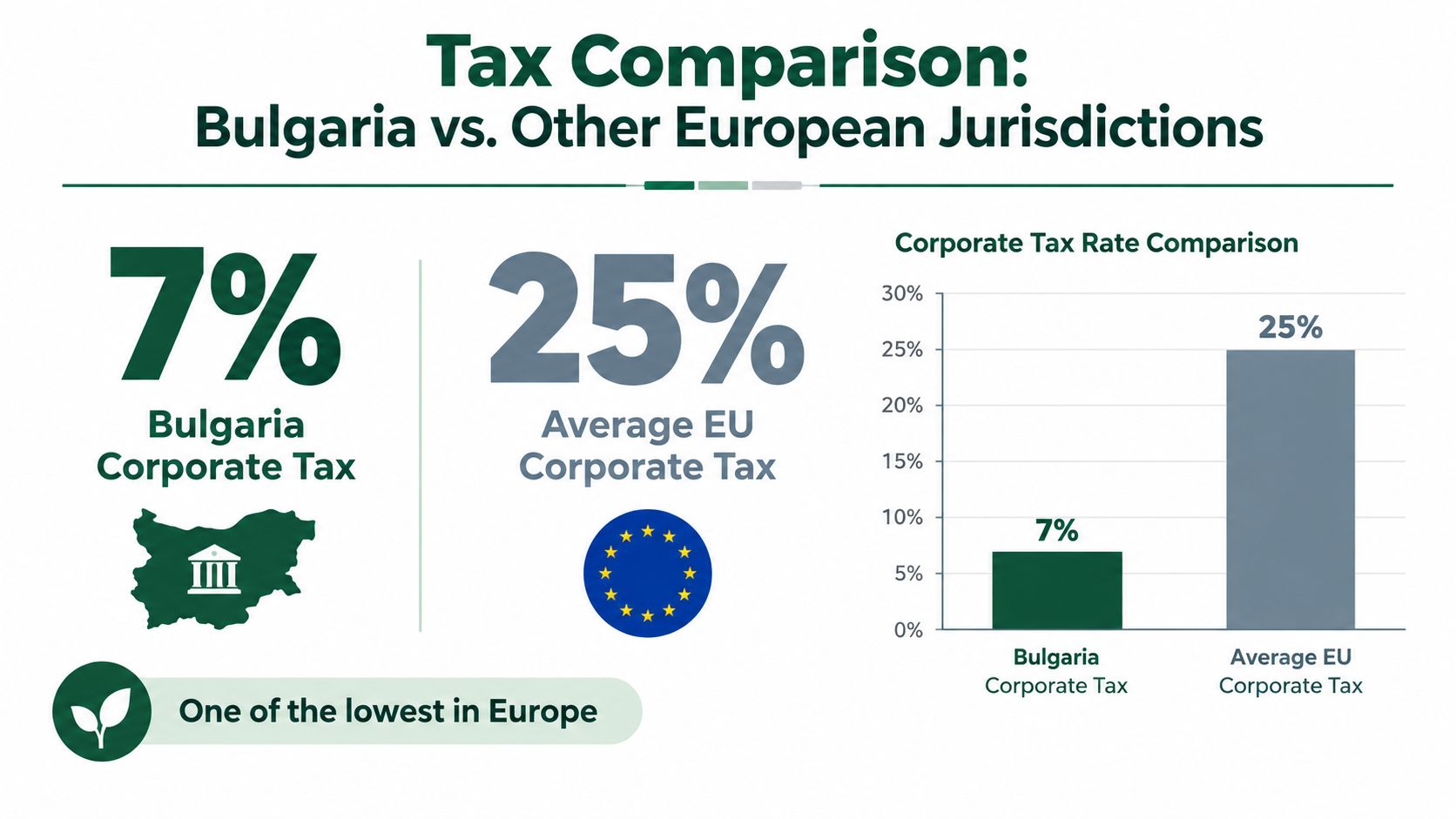
That comparison helps. It does not answer the approval question. Compliance teams want to see whether the tax position matches the business model, the management footprint, and the expected money flows.
A sensible jurisdiction review usually covers profit taxation, dividend withholding, VAT and other indirect taxes, payroll and social contributions, substance and transfer pricing, and permanent-establishment risk. Those items determine the actual operating burden, not the headline company rate alone.
Founders make expensive mistakes. A low rate looks attractive, but weak substance, unclear management control, or cross-border activity booked in the wrong entity can create tax exposure and make the banking file harder to defend.
Bulgaria can still be a strong option. The advantage holds when the structure reflects real operations, and when the account application explains clearly who earns the revenue, from where, and why Bulgaria is the right commercial base.
Building a Winning Application Narrative
An approval file often fails for a simple reason. The documents are valid, but the reviewer still cannot see the business. A good narrative fixes that by turning separate papers into one credible story about how money will enter, why it will leave, and who is controlling the activity.
I tell founders to prepare a one-page memo that answers five points in plain language: what the company sells, who pays, who gets paid, why Bulgaria is the operating base, and why the first transactions will look the way they do. If a reviewer can repeat that story after a quick read, the file is doing its job.
Wording matters more than applicants expect.
Rejected style: “International consulting services, various clients, global payments expected.”
Approved style: “Bulgarian company providing UX and product research to EU and UK SaaS clients under signed monthly service agreements. Incoming EUR invoices from clients in Germany, the Netherlands, and the UK. Outgoing payments for Bulgarian administration, founder salary, and specialist contractors in Poland.”
The second version gives compliance something to test against contracts, invoices, counterparties, and account activity.
Some facts never appear clearly in formal records. A registry extract does not explain a virtual office. Articles do not explain why revenue starts before local hiring. A passport does not explain why the founder is injecting funds before customer receipts begin. Put those answers in the memo, not in a follow-up email after the file is questioned.
Include the points below, but write them as short statements rather than a generic list of attachments:
- Business purpose: the actual service or product, and the commercial reason for using the Bulgarian entity.
- Expected activity: incoming and outgoing payment types, currencies, countries, and main counterparties.
- Commercial evidence: contracts, proposals, invoices, website pages, product materials, or other proof that trade is real.
- Funding explanation: founder capital, investment, or operating revenue, with supporting evidence.
- Management model: who makes decisions, where they work, and who can authorize payments.
The RBI's KYC framework reflects the same principle. Banks verify legal status, authority, ownership and control, and ultimate beneficial owners, not just incorporation paperwork. For a new company, use substitute proof that makes the first six months of activity understandable.
Quick Reference for Your Business Bank Account Documents Required Checklist
Use this final review before submitting anything. The file should be complete enough to answer the bank's questions without forcing the reviewer to reconstruct the business from unrelated attachments.
Identity and legal existence
- Registry evidence: Current Bulgarian Commercial Register extract or equivalent foreign registry proof.
- Formation records: Certificate of incorporation, registry certificate, articles, or incorporation agreement.
- Company details: Legal name, legal form, registration number, tax number where applicable, and registered and principal addresses.
- People and authority: Passports or national IDs for directors, authorized signatories, and ultimate beneficial owners, plus authority evidence.
- Ownership chain: Signed chart, intermediary-company records, and control explanations where ownership isn't direct.
- Document formalities: Apostilles, legalization, certified copies, and certified translations where required.
Commercial and financial explanation
- Activity memo: Describe products or services, customers, suppliers, countries, currencies, and transaction types.
- Expected profile: Explain projected payment flows and why they fit the company's declared purpose.
- Source of funds: Add contracts, tax records, accounts, statements, founder wealth evidence, or other relevant proof.
- Consistency check: Match names, addresses, ownership, dates, and signatory powers across every file.
Combine related records into a clear package rather than sending scattered attachments. If the bank accepts a consolidated file, tools that merge multiple PDFs can help you create a readable submission, but don't hide important distinctions by merging documents without useful filenames or bookmarks.
Choose the provider after reviewing your transaction profile. Online onboarding is convenient and can be completed remotely for eligible Bulgarian companies, while a local bank may provide a better fit for cash, complex services, or a relationship-based operating model. Neither route removes AML checks.
FastCorp helps non-resident founders form Bulgarian EOOD or OOD companies, prepare corporate and apostilled documents, complete remote identity verification, and obtain assistance with online-provider or Bulgarian-bank onboarding. Visit FastCorp to discuss a complete compliance file, registered address, VAT setup, and ongoing accounting support for your business bank account application.