LLC vs Ltd Compared for Global Founders
Compare LLC vs Ltd structures: US LLC, UK Ltd and Bulgarian EOOD on liability, 2026 tax rates and easy online formation.
A US LLC can be a separate legal business without being a separate taxpayer for federal income-tax purposes. That's the counterintuitive starting point for LLC vs Ltd: the letters after your company name don't determine your tax bill. Your incorporation country, tax classification and personal tax residence matter far more.
For global founders, the best choice isn't automatically American or British. A Bulgarian EOOD or OOD deserves a place on the shortlist when you need an EU company, VAT registration and European banking. But choose the tax-residence strategy before you buy the formation package.
Table of Contents
- LLC vs Ltd Side by Side for 2026
- What an LLC and an Ltd Really Are
- Corporate Tax Compared Across Countries
- Tax Residence Rules That Override the Label
- Founder Situations and the Better Fit
- Form the Company Fully Online
- Start the Company That Matches Your Plan
LLC vs Ltd Side by Side for 2026
The country and tax treatment matter more than the suffix. Start with this comparison, then test the practical fit before paying a registration fee.
US LLC, UK Ltd and Bulgarian limited companies compared
| Structure | Owners | Liability | Default tax | 2026 headline rate | Typical online formation |
|---|---|---|---|---|---|
| US LLC | One or more members | Members generally not liable for entity debts | Disregarded if one member; partnership if two or more; corporate treatment by election | No federal entity income tax under pass-through treatment; 21% federal with C corporation treatment | State filing; processing speed and fee set by the state |
| UK Ltd | One or more shareholders | Liability limited to unpaid shares | Company pays UK Corporation Tax | 25.0% headline rate | Usually within 24 hours through the official online service |
| Bulgarian EOOD | One owner | Single-owner limited liability company | Company pays Bulgarian corporate tax | 10.0% | Fully online in about 3–5 working days through our service |
| Bulgarian OOD | Two or more owners | Multi-owner limited liability company | Company pays Bulgarian corporate tax | 10.0% | Fully online in about 3–5 working days, or in person in Sofia |
These are headline comparisons, not personal tax quotations. The US corporate figure excludes state tax, and pass-through treatment doesn't mean the owner pays no tax. Likewise, a corporate rate doesn't include everything an owner might owe when withdrawing profits.
Practical rule: All four structures offer limited liability. Tax treatment, paperwork and operational fit are the real decision points.
Shortlist for the business you'll actually run
Start with owner count and commercial needs. A solo founder considering Bulgaria starts with an EOOD; co-founders start with an OOD. A business operating domestically in America should first evaluate a domestic LLC, rather than assume a foreign company will improve its position.
Customer location helps narrow the options, but it isn't a tax-residence test. Ask what your customers need from invoices, which banking providers will support your activity, and whether contracts require a local company.
The LLC is certainly mainstream: the Delaware Division of Corporations recorded 211,464 newly formed LLCs in 2024, representing 72.9% of all new business entities in the state. That's evidence of widespread use, not evidence that Delaware is the right jurisdiction for every international founder.
Before committing, compare these operational requirements:
- Payments: Confirm that your intended bank or payment provider accepts your activity, ownership and residence.
- Contracts: Check whether clients require a particular jurisdiction, VAT status or registered address.
- Ownership: Agree on control, profit rights and exits before filing.
- Administration: Identify who will maintain records and prepare recurring filings.
Don't pay a formation fee until the residence analysis supports your shortlist. A quick registration is useful only when the company fits the business behind it.
What an LLC and an Ltd Really Are
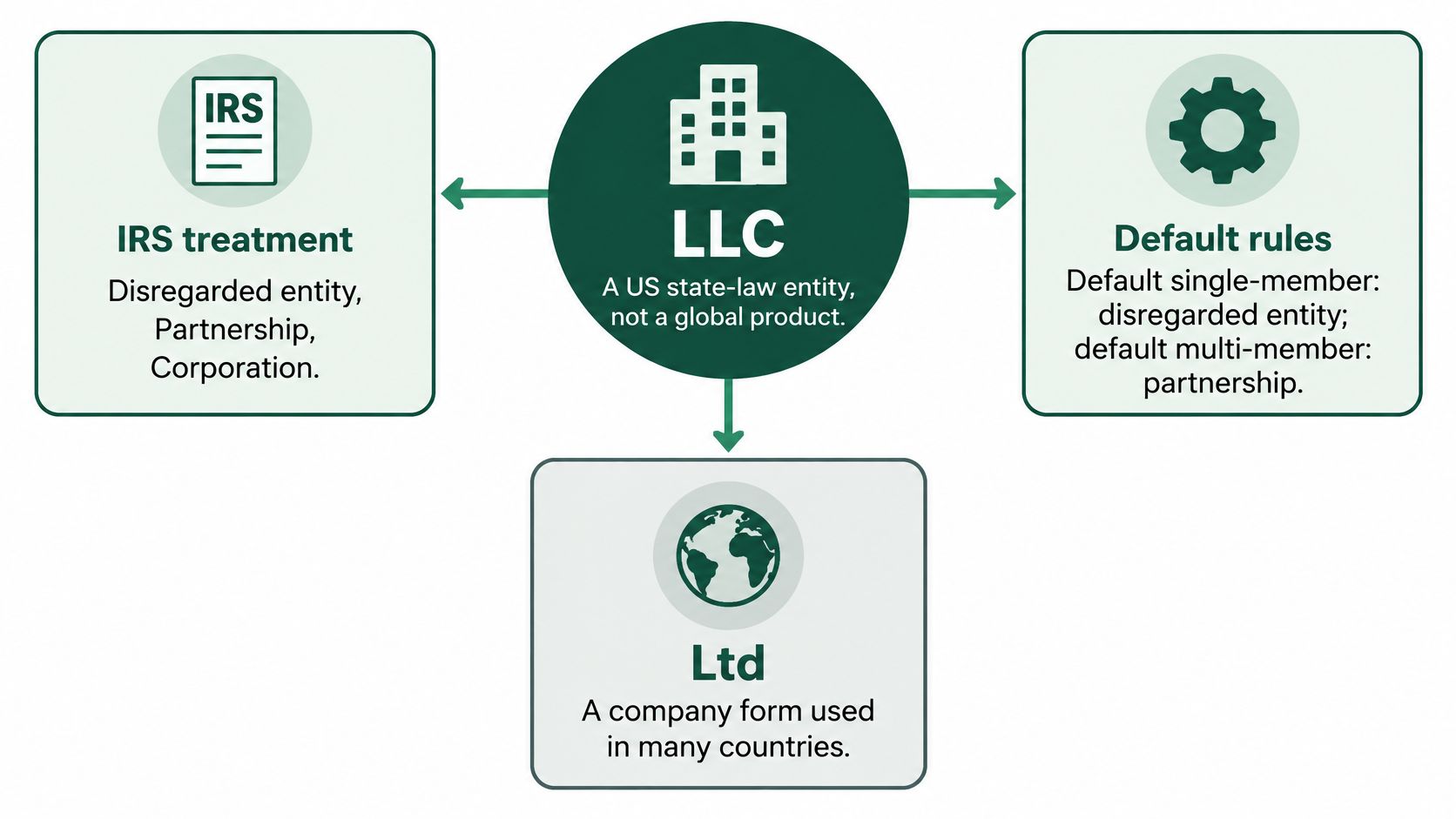
An LLC is a US state-law entity, not a globally standardized product. Its legal existence and federal tax classification are separate questions, which is why two LLCs can have different reporting obligations.
The IRS's business-structure analysis describes the distinction between LLC organization and tax treatment: an LLC may be treated as a disregarded entity, partnership or corporation. The usual starting rules are straightforward:
- Single-member LLC: Generally disregarded for federal income-tax purposes.
- Multi-member LLC: Generally treated as a partnership.
- Corporate election: An eligible LLC can elect corporate treatment using Form 8832.
Passing profits through to owners doesn't, by itself, remove the legal liability shield. Members generally aren't personally liable for entity debts, and a disregarded LLC can still be treated as a separate employer for employment-tax purposes.
Ltd describes a company, not a worldwide tax election
A UK private company limited by shares is incorporated under the Companies Act framework. It's a separate legal person with company-level tax and filing obligations, rather than the same federal classification menu available to an American LLC.
Its familiarity reflects its scale. Companies House statistics reported 5,350,759 companies on the register at the end of the financial year ending in 2024, up 4.6%, with 890,684 incorporations during that year; private limited companies have represented more than 95% of registered corporate bodies continuously since financial year 2005.
Bulgaria uses different names for comparable limited-liability structures. An EOOD has one owner, while an OOD has multiple owners. Non-resident founders use these forms to establish an EU company and pursue EU VAT registration, but incorporation and VAT registration remain distinct administrative processes.
Don't translate a suffix and assume the law follows. Write down the country of incorporation, number of owners and home-country treatment of the entity before choosing. Those facts are more useful than a generic argument about which abbreviation sounds more established.
Corporate Tax Compared Across Countries
2026 corporate tax rates founders should compare
| Place and form | 2026 statutory corporate rate | Who is taxed first | Extra check |
|---|---|---|---|
| Bulgaria EOOD or OOD | 10.0% | The company | Dividend or withholding tax, VAT and home-country rules |
| United Kingdom Ltd | 25.0% | The company | Salary versus dividend and VAT registration |
| Hungary company | 9% | The company | Substance, withholding and residence |
| Ireland company | 12.5% | The company | Trading rate versus other income and residence |
| Cyprus company | 12.5% | The company | Residency and distribution rules |
| US LLC pass-through | No federal entity income tax by default | The owner or owners | Self-employment tax, state tax and home-country classification |
| US LLC taxed as a corporation | 21% federal with C corporation treatment | The company | State tax plus tax when profits are distributed |
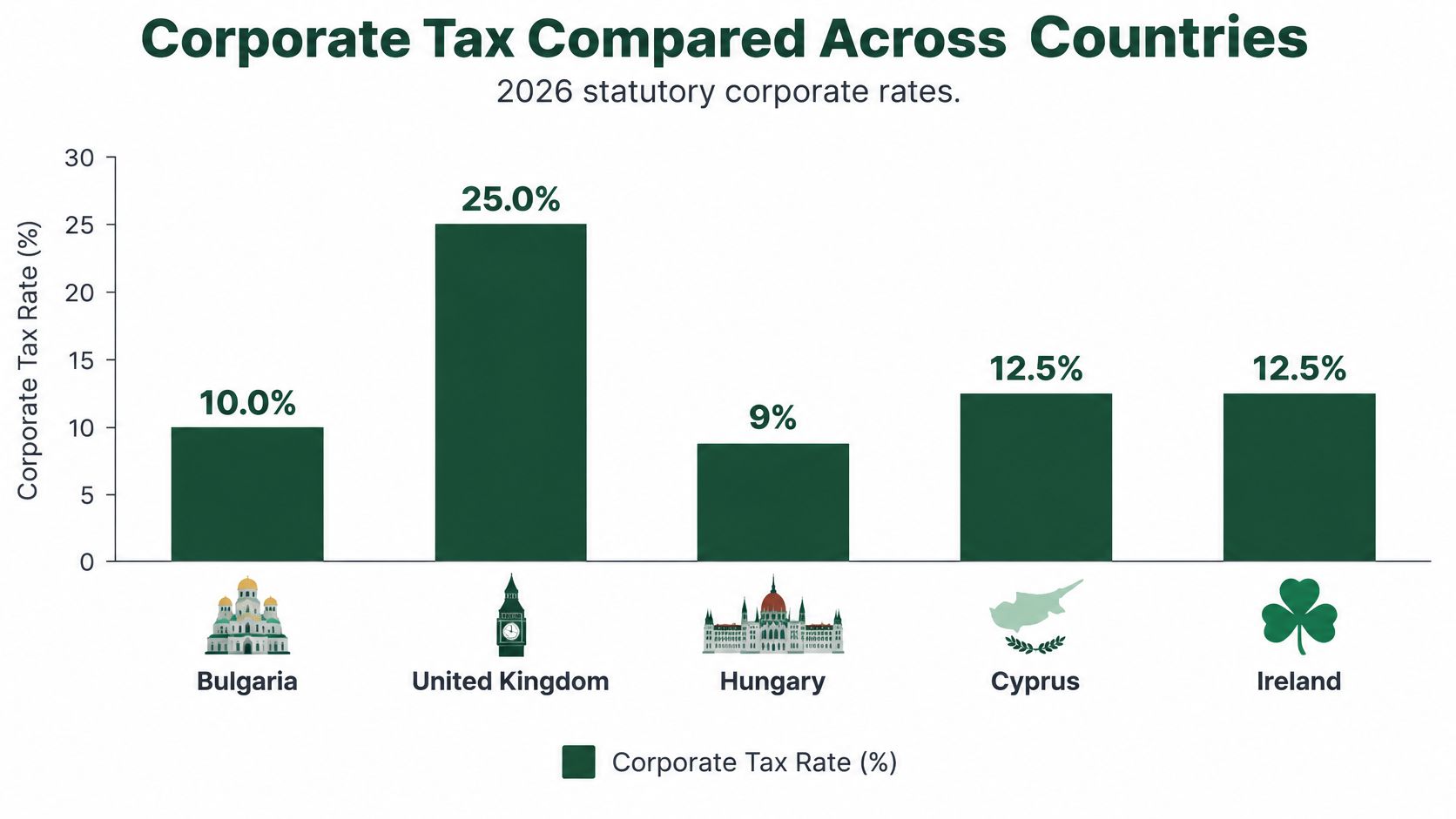
The Tax Foundation's European corporate-rate comparison lists the 2026 combined statutory rates as 10.0% for Bulgaria, 25.0% for the United Kingdom, 9% for Hungary, and 12.5% for Cyprus and Ireland. These are comparison points, not promises that every category of income or every company pays the headline rate.
Compare money you can use, not just company profit
For a pass-through LLC, start with the owner's tax position. Don't compare its absence of federal entity income tax with a foreign company's corporate rate and declare the LLC free of tax.
For a UK Ltd, the company pays tax on its profits, and the owner may face further tax when taking salary or dividends. The UK government's limited-company setup guidance also identifies VAT registration when the applicable conditions are met, so invoicing needs its own review.
A Bulgarian company can be attractive when you intend to retain profits for hiring, software or expansion. But you still need an extraction plan: what happens when the company pays you, and which country taxes that payment?
A low corporate rate does not, by itself, determine the owner's personal tax bill or the group's total tax burden.
Hungary, Ireland and Cyprus provide useful context. Bulgaria isn't the only European jurisdiction with a low headline rate, and selecting the smallest percentage without considering management, banking and distributions is poor planning.
Build a calculation that includes:
- Company tax: Identify the taxable profit and applicable regime.
- Profit extraction: Compare salary, dividends and any withholding.
- VAT: Check registration, invoicing and customer-location rules.
- Payroll: Include employment taxes and social contributions where relevant.
- Home-country exposure: Test foreign-company income and worldwide-income rules.
Use cross-border tax planning to evaluate those layers together. Model both retained profits and money withdrawn for living costs, because the preferred structure can change between those scenarios.
Budget for the annual work
A UK Ltd needs annual accounts, a confirmation statement and its Corporation Tax return. A US LLC must meet its state's applicable reporting requirements and the federal filings required by its classification and ownership.
A Bulgarian EOOD or OOD prepares annual financial statements, files its corporate tax return and maintains VAT reporting where registered. Compare annual operating costs as seriously as formation costs, and test residence before treating any headline rate as your final result.
Tax Residence Rules That Override the Label
Ask these questions before choosing a jurisdiction:
- Management: Where will you make day-to-day and strategic decisions?
- Owner residence: Where are you personally tax-resident?
- Customers: Where are buyers located, and where will you deliver the work?
- Classification: Will your home country look through the company or tax it separately?
Treat the answers as a decision tree. If you'll manage the business from your home country, investigate that country's company-residence and taxable-presence rules first. If the company's classification differs between countries, resolve that mismatch before calculating savings.
An American classification doesn't bind another country
The IRS's LLC guidance establishes the American classification framework, but foreign tax authorities apply their own rules. UK HMRC generally regards US LLCs as taxable entities rather than fiscally transparent, which can affect when a UK-resident owner is taxed and whether foreign-tax relief is available.
That's a serious reason not to buy an LLC on the strength of an online claim about tax-free foreign income. A structure that works cleanly for an American-resident owner may produce a different result for someone living in Britain.
The same practical concern applies to European companies. A Bulgarian or UK company managed from another country can create residence or taxable-presence issues there. A registered address alone doesn't establish where you run the business.
Residence warning: Read incorporation country and tax classification together. Neither LLC nor Ltd determines the final tax bill.
Keep director decisions, contracts and banking consistent with genuine operations. Don't manufacture paperwork to suggest management takes place somewhere it doesn't.
Ask a local tax adviser about controlled-foreign-company rules, worldwide income and VAT obligations before relying on a foreign company's rate. A tax residency certificate can support relevant applications, but it doesn't replace the underlying residence analysis.
We can coordinate formation and administration, but FastCorp is not a law firm or tax authority. You remain legally responsible for your company's activities, tax obligations and reporting accuracy.
Only proceed to a structure recommendation once these questions have workable answers. If they don't, pause the incorporation rather than pay to create a problem you'll later need to unwind.
Founder Situations and the Better Fit
For a US-resident founder serving mainly American customers, start with a domestic LLC. It's the sensible baseline when pass-through reporting suits your circumstances and you don't need a foreign operating company.
Don't elect corporate taxation because it sounds more impressive. Ask an accountant to compare retained earnings, payroll, distributions and annual administration before changing the classification.

British business or European operating base
A founder living in Britain, invoicing British clients and running the business there should generally choose a UK Ltd. Accept the company-tax and salary-or-dividend planning that comes with it, rather than adding an overseas entity without a commercial reason.
For a non-resident consultant, creator, agency or SaaS founder seeking an EU operating company, a Bulgarian EOOD is a strong option for solo ownership; an OOD fits co-founders. The recommendation holds when real management can support the Bulgarian structure and the founder's home-country treatment has been checked.
We support freelancers and consultants, service-based business owners, creators and influencers, digital nomads and remote founders, dropshippers, and tech entrepreneurs. For these businesses, coordinated VAT registration, an EU IBAN option and bookkeeping can matter more operationally than the company suffix.
Cases where the answer becomes sharper
- E-commerce with a Sofia presence: If you need a registered address, apostilled documents and ongoing bookkeeping, our coordinated registration, VAT and annual-filing support keeps those tasks with one provider. Check stock locations and sales flows before deciding the VAT setup.
- Short-term UK contracting: A touring, media or events business that only needs a British contracting vehicle shouldn't form a Bulgarian company solely for its rate. Choose the entity that fits the contract and intended lifespan.
- US citizens living abroad: A foreign company can add reporting without removing US tax exposure. Obtain advice on worldwide-income obligations before treating overseas incorporation as a tax solution.
- Co-founders in different countries: Agree where decisions will be made and how owners will be paid. Ownership percentages alone won't resolve conflicting residence rules.
Choose the country where you will manage the company and where customers and banking arrangements support your operation. Use tax rates to choose within that defensible shortlist, not to invent one.
Form the Company Fully Online
Online formation can be straightforward when you prepare the details first. Our Bulgarian registration service can be completed without travel, so you can handle setup without leaving home.
Prepare before submitting
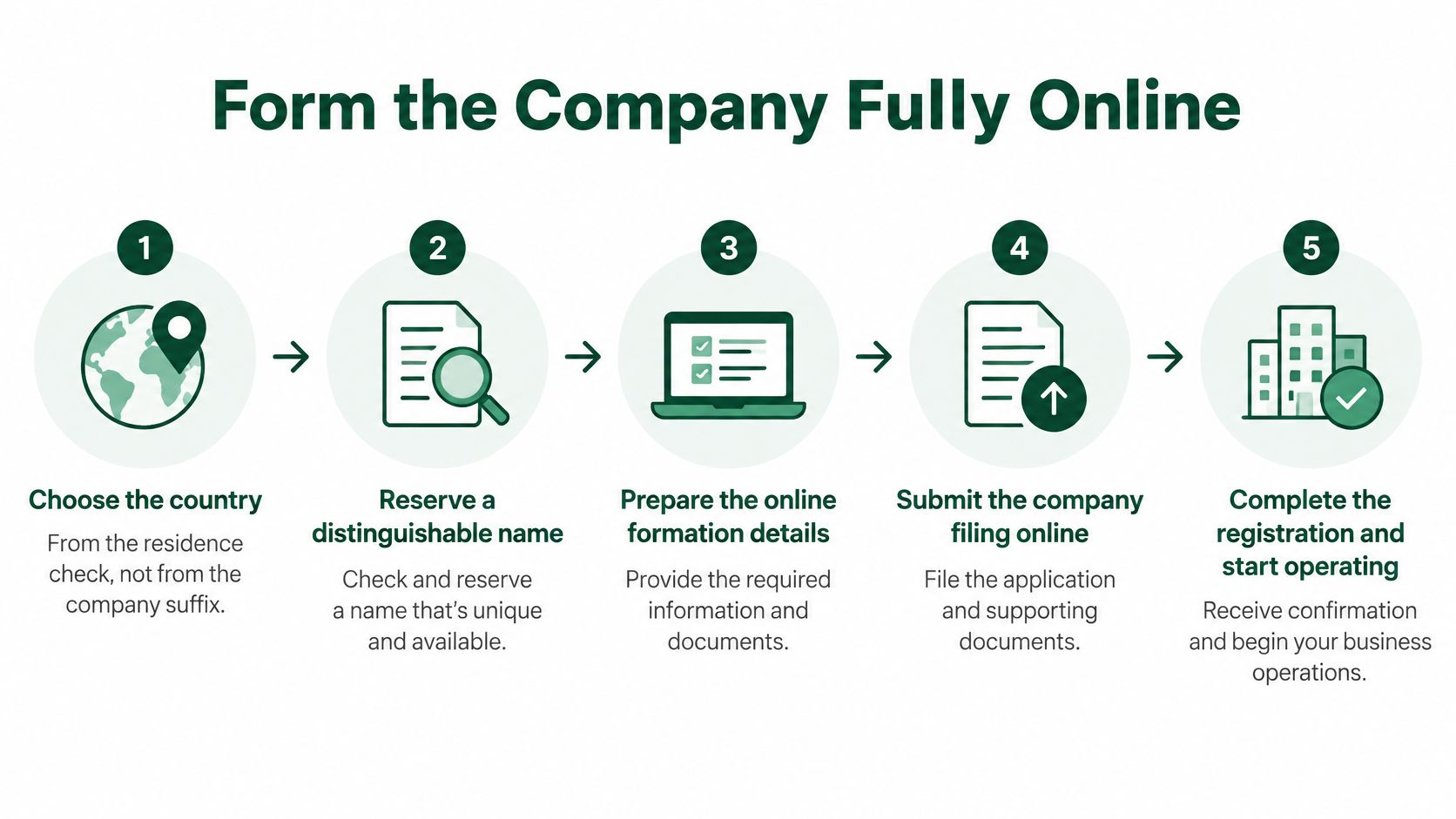
- Choose the country from the residence check. Establish the tax rationale before choosing a suffix or package.
- Choose a distinguishable name and describe the activity. Check availability, reserve it where appropriate, and explain what you'll sell in plain language.
- Collect the formation details. Prepare passport or ID information, owner and director names, ownership percentages and share capital.
- Arrange a registered office. Use an address that can receive official correspondence and ensure someone will handle it.
- File and pay through the appropriate digital route. Use the official registry service or coordinated company formation services covering the administrative work you need.
Online formation cost and speed
| Route | Price | Stated speed | Included beyond the certificate |
|---|---|---|---|
| UK GOV.UK private limited company | £100 | Usually within 24 hours | Corporation Tax setup unless dormant |
| Companies House web-incorporation help figure | £15 | Email in about two days after acceptance | Registry route only; verify the live fee |
| FastCorp online EOOD or OOD | €1,750 | 3–5 working days | EU VAT number, bank-account support, Sofia virtual office and business address, apostilled documents, legal and government fees |
| Our in-person Sofia package | €1,500 | 2–3 working days | EU VAT number, bank-account support, virtual office and business address, legal and government fees, airport pickup; no apostille included |
The official GOV.UK registration service states a £100 fee, payable by debit or credit card, with registration usually completed within 24 hours and Corporation Tax setup generally included unless dormant. A separate Companies House web-incorporation help page states £15 and an email in approximately two days after acceptance, so verify the live route and fee before paying.
Registry charges aren't comparable with a package that includes address services, VAT work and supporting documents. Both our Bulgarian packages include a certificate of incorporation; the online package also includes apostilled company documents, while the in-person route includes complimentary airport pickup.
Finish the operating setup
- Save your registration records. Keep the certificate, company number, tax references and ownership documents in a secure shared folder.
- Calendar the recurring obligations. Assign responsibility for accounts, company filings, tax returns and VAT dates before sending the first invoice.
Banking assistance includes support with suitable providers, but onboarding remains subject to their checks. Digital filing makes submission easier; it doesn't cancel statutory accounts, tax returns or accurate recordkeeping.
Start the Company That Matches Your Plan
Stay with a US LLC when your life, customers and tax home are in the United States and pass-through treatment suits your business.
Form a UK Ltd when the operation is British and counterparties expect a company registered at Companies House.
Choose a Bulgarian EOOD or OOD when you want an EU company, VAT registration and European banking arrangements, and you can support the structure with appropriate management and compliance.
Turn the choice into an operating plan
For the Bulgarian route, we handle registration, VAT, banking assistance and bookkeeping together. Use the formation cost table to compare remote setup with visiting Sofia, rather than comparing a registry-only fee with a broader service package.
Before starting, record your intended incorporation country, owner count and home-country classification. Then prepare the proposed name, business activity, ownership details and capital so the formation documents reflect how you'll operate.
Our process starts with a short online form about you, followed by checkout and payment. You then submit the company details needed for formation. We also offer a free consultation for people starting a business, which is a useful first step when you're still deciding whether Bulgaria fits.
- Proceed when the facts align: Your management plan, banking needs and tax advice support the chosen jurisdiction.
- Pause when residence is unresolved: If management will remain in a higher-tax home country, get personal tax advice before paying.
- Keep responsibility clear: We aren't a law firm, and you remain responsible for the company's tax obligations and reporting.
No filing speed fixes a residence problem. Choose a structure you can operate properly, not merely one you can register quickly.
If a Bulgarian EOOD or OOD fits your LLC vs Ltd decision, visit FastCorp to arrange a free consultation about online formation, VAT registration, banking assistance and bookkeeping. Bring your owner details, proposed activity and management location so we can help you identify the practical setup steps before you commit.