Virtual Office Address and Phone Number: A 2026 Guide
Set up a virtual office address and phone number in Sofia: what it covers, FastCorp package prices, tax comparison and compliance checks for 2026.

You're sitting in Berlin, Dubai, or London with EU customers ready to pay, and you're stuck on a stupidly practical problem. You need a Bulgarian company, an address that won't be your home, and a phone number that doesn't scream personal mobile. You don't need desks, chairs, or a lease you'll visit twice a year.
That's exactly where a virtual office address and phone number earns its money. Used properly, it's lean business infrastructure. Used blindly, it's a source of rejected listings, missed tax letters, and false confidence about residency. My advice is simple. Buy it for the three jobs it does, which are legal registration, reliable mail handling, and professional call handling. Don't buy it as proof that you trade from an office you don't occupy.
Everything around it can be handled online, from formation to filings, and that's the attraction. The setup is easy. Running it cleanly is where founders need a system, not optimism.
Table of Contents
- What a Virtual Office Address and Phone Number Include
- FastCorp Packages, Prices and Setup Timelines
- Three Founder Scenarios Where a Sofia Address Pays Off
- How Bulgaria's 10% Tax Compares With Other Countries
- Compliance Checks for a Registered Address in Sofia
- How to Run Calls, Mail and Filings From Anywhere
What a Virtual Office Address and Phone Number Include
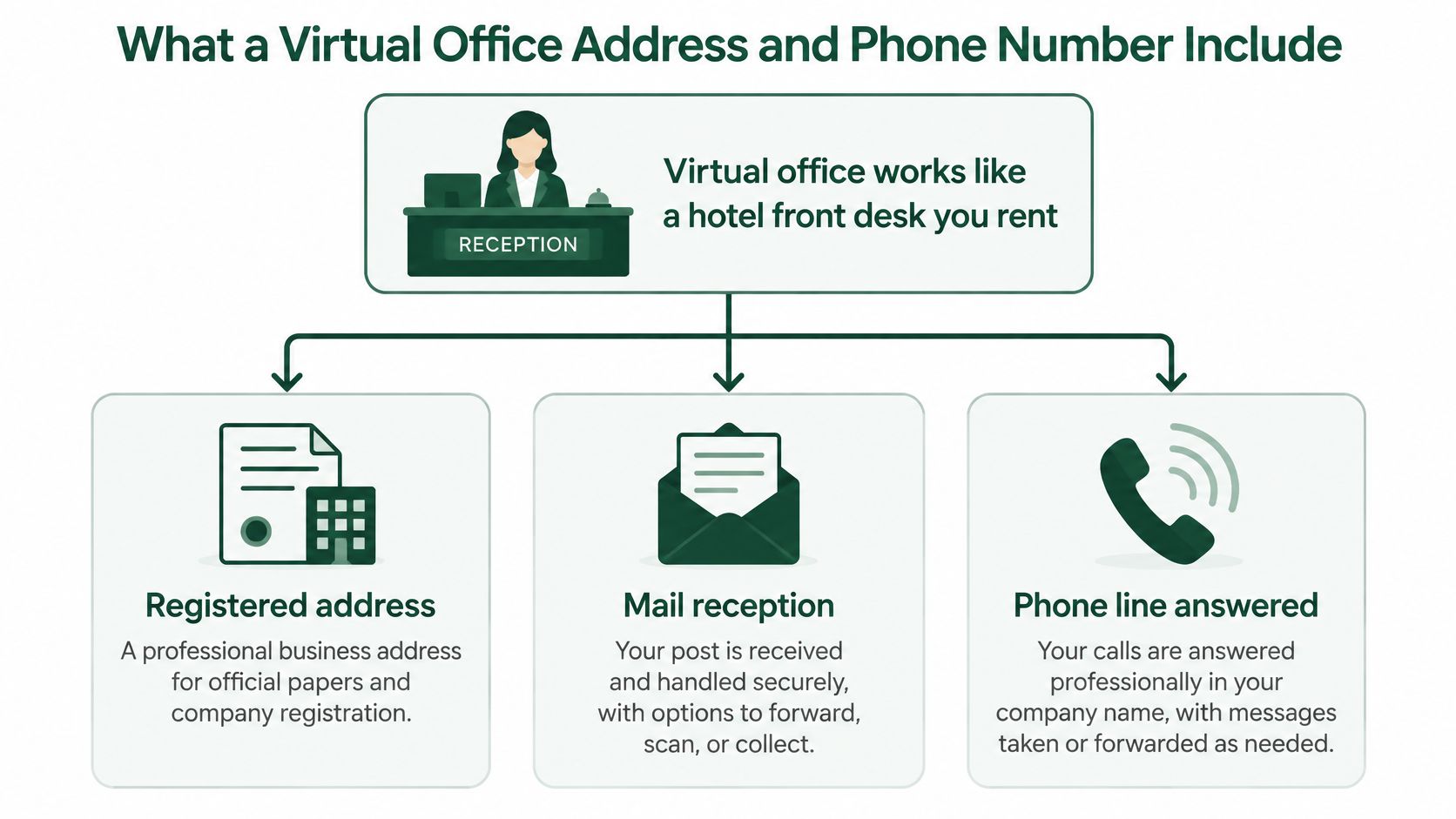
Think of a virtual office as a hotel front desk you rent. Staff receive your post, answer in your company name, and pass messages to you. You don't get a room of your own, and you shouldn't pretend you do.
The Four Components to Get in Writing
- Registered business address. This address appears on legal and public records and receives official correspondence. It's the company's legal base, which is different from claiming you have staff working there daily.
- Mail and document intake. Post is received, logged, and either forwarded or scanned to you. Ask who signs for deliveries, how quickly scans arrive, and what audit trail proves receipt.
- Local business phone number. You get call answering, forwarding to your mobile, and voicemail delivered to email. Confirm business hours, failover routing, and what happens when your mobile is unreachable.
- Meeting access where included. Some packages let you book a room. If it's not written into your package, assume it isn't included and don't invite clients on that assumption.
The market context explains why providers bundle these pieces. The Kings Research virtual office market report valued the global virtual office market at approximately USD 35.56 billion in 2025 and projected USD 93.69 billion by 2033. Address-related services alone generated approximately USD 11.52 billion in 2025, which tells you the address remains central even for remote teams.
If a provider cannot name each component in writing, ask for the list before paying.
Know the limits before you sign. An address proves a legal base for correspondence, not a staffed workplace. A Bulgarian number improves access and continuity, but it doesn't prove Bulgarian tax residence or a local workforce. That distinction protects you with banks, platforms, and authorities.
FastCorp Packages, Prices and Setup Timelines
Start with the table, because the decision is mostly about travel and speed.
FastCorp setup packages compared
| Package | Setup Mode | Timeline | Included Extras |
|---|---|---|---|
| Online formation | Fully online, no travel needed | 3 to 5 working days | Legal and government fees included |
| In-person formation in Sofia | In person in Sofia | 2 to 3 working days | Legal and government fees included; complimentary airport pickup |
The headline prices are clear. Fully online formation costs €1,750, and in-person formation in Sofia costs €1,500, with legal and government fees included in both. That €250 difference favours the Sofia route, but don't choose on price alone if flights and hotels wipe out the saving.
My Decision Rule
Choose online if you live outside Bulgaria or can't travel without disrupting work. You'll trade a little speed for zero travel, and 3 to 5 working days is still fast enough for most launches. Choose in person if you can be in Sofia for the appointment and want to trade sooner. You also get the practical benefit of handling identity steps face to face.
Read the FastCorp guide to company formation services alongside any quote so you can separate one-off formation work from recurring services. That separation matters more than the formation fee over a full year.
What the Formation Price May Not Cover
Ask directly whether the virtual office address and phone service are billed monthly after formation. Ask whether bookkeeping, VAT returns, annual corporate tax filings, and payroll are priced separately, because formation and ongoing compliance are different jobs. A cheap start with vague monthly fees isn't cheap.
Before paying, confirm these points in writing:
- Address suitability. Which address service applies to your registration type, and is it accepted for your intended registration and tax purposes?
- Recurring fees. Are address and phone fees included for a period, or charged monthly from day one?
- Number control. How do call forwarding and number porting work, and can you port the number out if you leave?
- Electronic access. Who holds the electronic signature or approved login, and who can act if that person is unavailable?
- Public listing limits. Will the address alone support a Google Business Profile? Usually it will not, for reasons covered in the scenarios below.
Practical rule: Write your recurring fee questions before requesting a quote, not after you've already decided you like the timeline.
Then request your quote with those answers ready and match the 3 to 5 or 2 to 3 working day timeline to your real start date. If a customer contract starts Monday, don't rely on a best case completion date. Build in buffer for bank onboarding and document checks.
Three Founder Scenarios Where a Sofia Address Pays Off
Scenarios make the value concrete, so start with the setups that work.

Three Setups That Make Sense
Say a non-resident SaaS founder in Berlin sells to EU customers who expect a local number. Calls to the Sofia line forward to her mobile during working hours, and voicemail arrives by email the same day. A customer in another time zone gets a professional greeting and a callback, not a personal mobile ringing at midnight.
A touring events company needs a Sofia presence for a three month season. It puts the address on invoices and contracts, gives vendors a local number, and avoids signing a lease for a short run. When the season ends, the company keeps the correspondence address without paying for empty space.
An e-commerce founder needs a Bulgarian company address for registration paperwork and a banking onboarding file. He doesn't plan to run a shop from Sofia. The address handles official post while stock, fulfilment, and daily operations stay elsewhere, which is an honest and workable split.
This short video adds useful context on how remote founders use this kind of setup in practice.
The Google Boundary You Must Respect
Don't confuse registration use with a customer-facing listing. Google's Business Profile eligibility guidelines state that a location used only as a virtual office cannot be used for a Google Business Profile. Coworking generally qualifies only with permanent signage, customers received on site, and staffed business hours, while remote mailboxes and PO box style addresses are excluded.
Online-only businesses that never meet customers in person may be ineligible altogether. Use the Sofia address for registration and correspondence. If you serve customers in person in an area, hide the address and use a service-area listing instead. That's the safer route, and it's the one I recommend.
How Bulgaria's 10% Tax Compares With Other Countries
Headline rates start the conversation, but they don't finish it.
Headline corporate income tax rates, selected countries
| Country | Headline Corporate Rate | Key Qualifier |
|---|---|---|
| Bulgaria | 10% | Applies to taxable profit; calendar-year tax period |
| Hungary | 9% | Local business tax applies on top |
| Ireland | 12.5% | Trading income rate |
| France | 25% | Standard rate; reduced rate for small profits |
| Netherlands | 19% to 25.8% | Two-band rate depending on profit level |
| United Kingdom | 25% | Main rate, with lower rates for small profits |
| Germany | About 30% | Combined federal, solidarity and trade tax; varies by municipality |
| United States | 21% | Plus state corporate taxes |
These are reference values to check against official sources in 2026 before you rely on them for a filing decision. For Bulgaria, the Bulgarian Ministry of Finance corporate tax page confirms a 10% corporate tax rate and a calendar year tax period under the Corporate Income Tax Act. That rate applies to taxable profit, not gross revenue.
Menu Price Versus Final Bill
Treat the headline rate as the menu price and the effective burden as the final bill. Deductible expenses and accounting adjustments change taxable profit. Dividends to you, withholding taxes, VAT treatment, and your personal tax residence change what you keep. VAT is a separate tax, not corporate income tax, so don't blend them into one imaginary rate.
Don't call Bulgaria the lowest flat rate in the EU, because Hungary's 9% headline is lower. Hungary's local business tax and Germany's trade tax also show why a single national number can understate the full bill. A country that looks expensive on paper can win after deductions, and a cheap headline can lose once personal tax is added.
Use a three line comparison for each candidate country:
- Headline rate. Write the current corporate rate and any local tax on top.
- Estimated taxable profit. Model revenue minus realistic deductible costs, not best case costs.
- Founder exposure. Add dividend, salary, and personal residence consequences before choosing.
Work through the FastCorp comparison of corporate tax rates with those three lines open. If Bulgaria still wins on the full bill, you've got a strong case. If it only wins on the headline, keep looking.
Compliance Checks for a Registered Address in Sofia
Run these six checks before you rely on any Sofia address:
- Registration fit. The address is accepted for your intended registration and tax purposes.
- Daily monitoring. Statutory letters are checked every working day, not when someone remembers.
- Escalation window. Court, tax, and regulator notices reach you or your accountant within a fixed window, such as 24 hours.
- Taxable profit records. Accounting records support a tax calculation, not just an accounting profit figure.
- Electronic filing access. The company can file with a qualified electronic signature when deadlines arrive.
- Advance payment tracking. Turnover is monitored so quarterly obligations don't surprise you.
Deadlines That Drive the System
Bulgarian corporate tax deadlines and obligations
| Obligation | Timing | What It Means for a Virtual Office |
|---|---|---|
| Annual corporate tax return | Filed between 1 March and 30 June of the following year | Must be filed electronically with a qualified electronic signature |
| Tax payment | By 30 June | Paid by bank transfer; the registered address does not change the payment process |
| Quarterly advance payments | During the year, quarterly | May apply if turnover exceeded BGN 300,000 in the year before the previous year |
Those dates come from the Bulgarian government guidance on declaring and paying corporate tax, which sets the annual return window between 1 March and 30 June and payment by bank transfer by 30 June. It also flags quarterly advance payments for companies whose turnover exceeded BGN 300,000 in the year before the previous year.
A registered address receives the letter. It does not do your accounting.
That point deserves emphasis. Bulgaria applies 10% to taxable profit, based on the annual tax-financial result under the Corporate Income Tax Act. You still need complete records, a tax calculation process, electronic filing capability, and deadline monitoring. Use the FastCorp business compliance guide to turn those duties into a calendar with named owners.
My strong recommendation is to assign one person to read scanned post and one backup for holidays. Missed regulator mail is rarely a technology failure. It's usually an ownership failure, and that's fixable on day one.
How to Run Calls, Mail and Filings From Anywhere
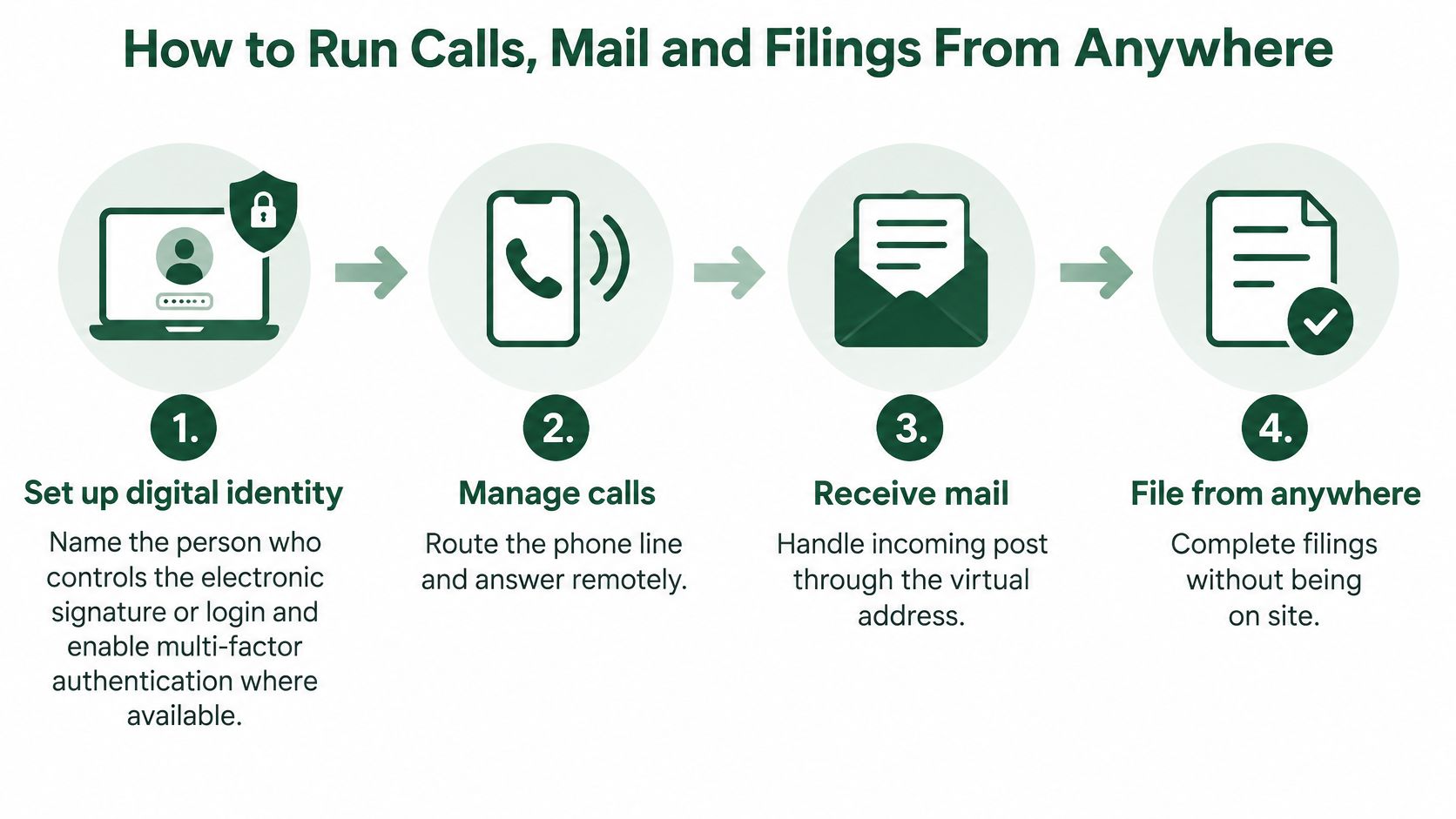
Remote operations work when every handoff has a named owner and a tested backup.
Set Up the Workflow in Seven Steps
- Set up digital identity. Name who controls the electronic signature or login, enable multi-factor authentication where available, and record every certificate expiry date. The OECD report on tax administration digitalisation reports that close to 90% of tax administrations said more than 80% of businesses use a digital identity to access online services, so treat access as core compliance.
- Authorise your accountant in writing. Grant online access before the first filing, while there's no deadline pressure. Document what the accountant can submit, view, and pay on the company's behalf.
- Configure call routing. Forward calls to your mobile, add a backup number for failover, set business hours, and turn on voicemail to email. Ask before signing whether the number can be ported out, because losing a published number is painful.
- Check recording consent and greeting. Use a greeting that states the company name clearly. If you record calls, confirm the consent wording and storage rules that apply to your callers.
- Fix the mail rule. Agree same day or next day scanning for every letter. Name the person who reads scans, files them, and escalates anything from a court, tax office, or regulator.
- Set deadline alerts. Put 30 June and each advance payment date into a shared calendar with early warnings. Alerts should go to you and your accountant, not to a mailbox nobody checks.
- Test everything. Call the number from a mobile abroad, confirm voicemail reaches your email, and send a test letter to confirm scanning works. Fix failures now while they're merely embarrassing.
The most common mistake is an accountant with no written authorisation. Everything looks handled online until a deadline is close and the accountant can't legally file for you. Sort the paperwork first, then enjoy how easy the online process feels.
If you're ready to form a Bulgarian company with a Sofia registered address, professional phone handling, banking support, and ongoing accounting handled online, talk to FastCorp about the €1,750 online route or the €1,500 in-person option. Bring your questions on recurring address fees, number porting, and electronic signature control, and you'll get a setup that's fast, honest about its limits, and built to run from anywhere.