Virtual Business Address: A Founder's EU Shortcut
Get a virtual business address in the EU with no physical lease. Perfect for non-resident founders who need a professional presence fast.

A virtual business address can give an international founder a legal commercial presence in the EU without physical office costs, but Bulgaria's 10% corporate income tax rate does not make that address the same as a registered agent address. The address can support registration, correspondence, and a professional public presence, but only if you assign it the role local authorities and banks permit.
You've found a Bulgarian accountant, chosen a company name, and started preparing identity documents. Then a bank asks for your operating address, the company registry asks for a registered office, and a government letter arrives at an address you rarely check. A cheap mailing solution suddenly becomes a compliance problem.
That confusion is avoidable. Treat a virtual business address as business infrastructure, not as a decorative line on an invoice. Bulgaria is a useful proving ground because it combines an accessible EU company environment with a flat 10% corporate income tax rate, while still requiring founders to separate legal, tax, banking, and operational address requirements. Bulgaria's corporate tax position is summarized by PwC.
Table of Contents
- What a Virtual Business Address Actually Is
- Registered Address vs Mailing Address
- Why Non-Resident Founders Choose Bulgaria
- How to Set Up Your Address Online
- FastCorp Virtual Office in Sofia
- Compliance and Tax Filing Essentials
What a Virtual Business Address Actually Is
A founder in Canada, the United Kingdom, or the Middle East may want an EU company without renting an office in Sofia. The commercial reason is straightforward. Clients need a stable business contact, suppliers need a reliable invoicing address, and public records need a formal location. The founder may still perform daily work from home, a coworking space, or several countries throughout the year.
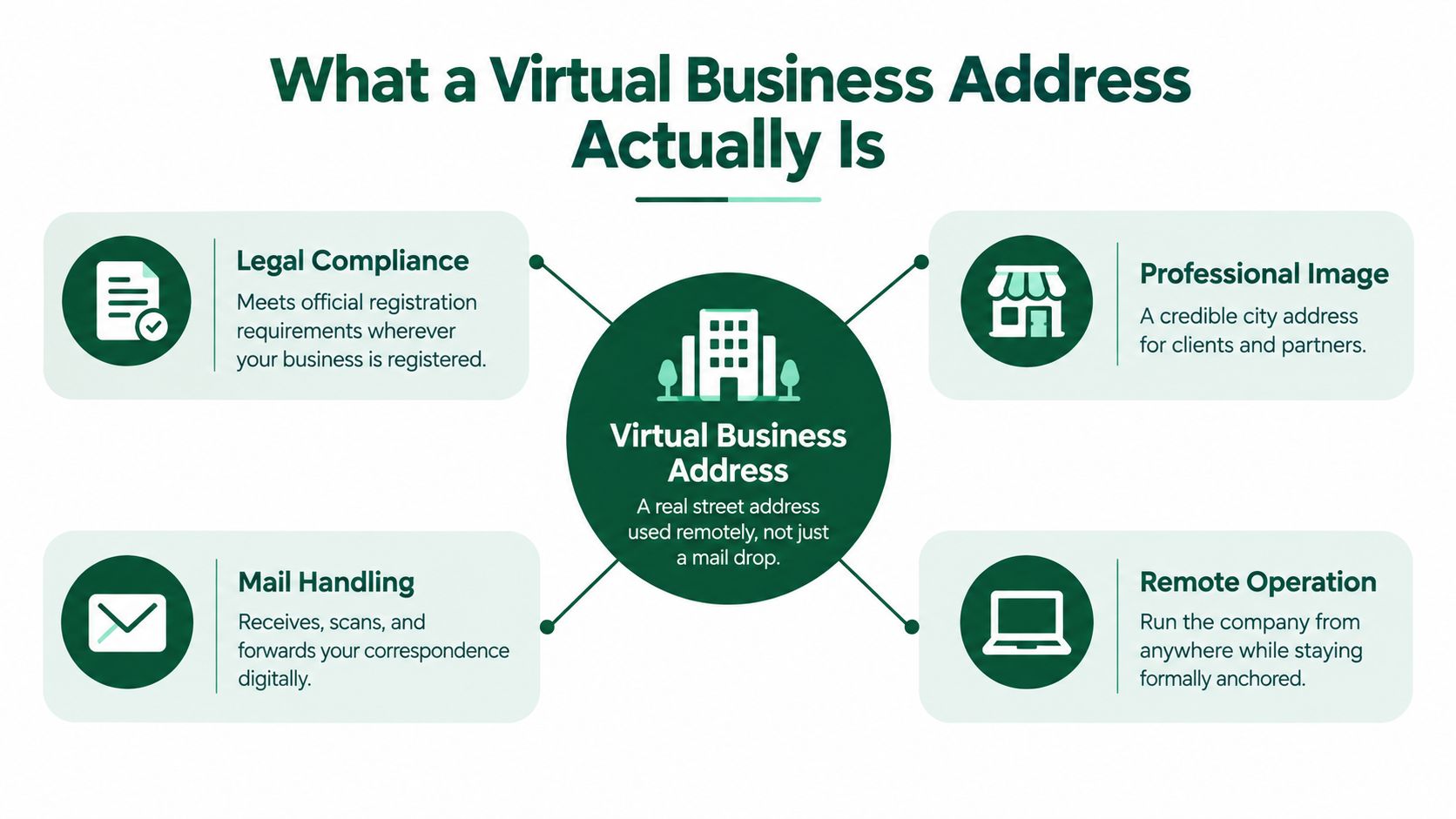
A virtual business address connects those realities. It gives the company a commercial street address, receives correspondence, and can provide scanning or forwarding so the director can manage documents remotely. It creates a public-facing business presence without forcing the company to pay for premises that nobody uses every day.
That doesn't mean the service is a mail drop. A properly designed arrangement can support company registration, official correspondence, branding, and document control. The value lies in separating the founder's private residence from the company's public contact point while preserving a dependable route for formal notices.
The service layer matters
Suppose an overseas consultant registers a Bulgarian company and lists a Sofia address on contracts. A client sends a signed agreement there. The tax administration sends a notice. A bank requests a document connected to the company profile. If the provider only places letters in an unattended box, the founder still carries the operational risk.
A serious provider should define:
- Receipt procedures, including who accepts official letters and how deliveries are recorded.
- Digital access, such as scanning and secure document sharing.
- Forwarding rules, so the founder can choose where and how often documents are sent.
- Escalation, so urgent government or legal correspondence reaches a responsible person quickly.
- Address continuity, so the business doesn't lose its public contact point unexpectedly.
The global virtual-office market has expanded during the 2020s, but published estimates differ because researchers include different services. One estimate values the market at USD 35.56 billion in 2025 and projects USD 93.69 billion by 2033, while another values it at USD 24.6 billion in 2025 and forecasts USD 52.3 billion by 2034. These figures are directional, not directly comparable, as explained in the Kings Research overview of the virtual-office market.
Practical rule: Choose the address service for the documents it can safely handle, not for how polished the address looks on your website.
The distinction becomes especially important for a non-resident founder. A Sofia address may provide a formal commercial anchor, but it doesn't prove that the director lives in Bulgaria, that employees work there, or that management decisions occur there. Those are separate legal and tax questions.
A virtual address is therefore most useful when it supports three things at once: a credible public identity, controlled correspondence, and accurate disclosure of where the company is actually managed. It reduces office overhead, but it doesn't remove the company's statutory responsibilities.
Registered Address vs Mailing Address
The most dangerous mistake is assuming that every business address performs the same legal function. It doesn't. A registered office is usually the location designated for official company correspondence and legal notices. A mailing address handles routine letters, invoices, bank statements, and other commercial communication.
Some providers can support both roles. Others provide only a commercial mailing address. Your contract must say which one you're buying.
| Address type | Main purpose | What to verify |
|---|---|---|
| Registered office | Official company notices and statutory correspondence | Whether the authority accepts the address and whether notices are monitored |
| Registered agent address | Service of process and legally required agent availability | Whether a separate in-state physical address and business-hours presence are required |
| Mailing address | Routine correspondence, invoices, and client contact | Scanning, forwarding, retention, and package procedures |
| Principal place of business | Where the business is actually operated or managed | Whether the company can accurately document its real activity |
| Tax or banking address | Address requested for tax administration or customer due diligence | Whether the authority or institution accepts a virtual facility for that purpose |
The United States illustrates the boundary clearly. A virtual office may provide a commercial street address and mail handling, but it doesn't automatically replace a registered agent. In Colorado, a commercial mail address or post-office box cannot satisfy the registered agent's required physical location. The agent must maintain a genuine street address in the formation state, remain available during normal business hours, and accept service of process in person. The cross-border company registration guidance from VJM Global explains why founders need to check these roles separately.
The United Kingdom shows the same principle
The UK registered office must be a physical address in the same UK country where the company is incorporated. It must also be an appropriate address, meaning correspondence should reasonably reach someone acting for the company and the sender should be able to obtain confirmation of delivery. A Royal Mail PO Box cannot be used. The UK government incorporation guidance sets out these requirements.
Bulgaria has its own statutory framework, so don't copy a UK or US assumption into a Bulgarian filing. Use the same decision discipline instead. Ask whether the Sofia address can be used as the registered office, whether it receives official notices, whether a separate tax correspondence address is needed, and whether the bank accepts it for due diligence.
A mailing address can be perfectly suitable for routine business and still fail as a registered office. The reverse can also happen. An address may satisfy company-registration rules but be unsuitable as proof of the founder's residence or actual place of management.
A virtual address protects privacy. It doesn't give you permission to describe a mailing facility as a physical operating site.
Before signing, request written confirmation of four points:
- The address is accepted for the intended company-registration purpose.
- Official correspondence is received, logged, and escalated.
- Registered-agent obligations, if applicable, are handled separately.
- Banks, payment providers, and tax authorities can be told accurately what the address represents.
For a detailed explanation of how these functions differ, review this guide to virtual office and registered address requirements. Use it as a checklist, then confirm the final position with the relevant authority or adviser.
Why Non-Resident Founders Choose Bulgaria
Bulgaria attracts international founders because it offers an EU company framework with a flat 10% corporate income tax rate for ordinary corporate income. That is a useful screening point for a consultant, software business, agency, or e-commerce operator comparing jurisdictions. It isn't the complete tax answer.
The founder's personal residence, management activity, dividend withdrawals, employees, VAT position, social-security obligations, and permanent-establishment exposure can all affect the result. A Sofia virtual address alone doesn't transfer management or taxable activity from another country to Bulgaria.
The address supports the structure, not the tax result
A non-resident founder may use a Bulgarian registered address for company correspondence while working remotely elsewhere. That arrangement can be commercially sensible, provided the company describes it accurately. The address can support formal registration, document receipt, invoicing, and communication with service providers. It cannot be presented as proof that the founder, staff, or daily operations physically sit in Sofia.
Financial institutions apply the same logic. They assess the address alongside beneficial ownership, identity, business purpose, expected transaction activity, and evidence of operations. The FATF customer-due-diligence material identifies the registered office and, where different, the principal place of business as relevant customer information. Banks also verify information independently and monitor transactions against the stated business profile.
That means your address records should agree across the company documents, ownership file, invoices, contracts, accounting records, and bank application. Inconsistent information creates more friction than a modestly priced compliant service ever will.
Bulgaria vs Other EU Markets
| Feature | Bulgaria | Common EU Alternative |
|---|---|---|
| Corporate income tax | Flat 10% for ordinary corporate income | Rate and total burden vary by jurisdiction and company circumstances |
| Public business presence | A Sofia address can provide a formal EU contact point when accepted for the intended use | A local commercial or registered address may be required, with rules differing by country |
| Remote administration | Registration, correspondence, accounting, and filings can be managed digitally when identity and authorization procedures are in place | Digital access varies, and local representation may still be necessary |
| Banking and VAT | A registered company can seek banking and VAT support, subject to separate due diligence and eligibility | Acceptance depends on the bank, activity, substance, and local rules |
| Main risk | Treating a registered address as proof of Bulgarian management or tax residence | Assuming a local address overrides substance, residence, or permanent-establishment rules |
The headline tax rate deserves context. Bulgaria's tax summary also notes that large multinational groups may be affected by EU global minimum-tax implementation and related top-up mechanisms. Founders should compare the total outcome, not just the corporate rate.
The practical advantage is administrative focus. Bulgaria supports online tax registration, filing, payment, correspondence, and document uploading, which makes remote administration workable when the company assigns responsibility and retains records. The OECD discussion of digital tax administration services supports that broader operational direction.
My recommendation is direct. Consider Bulgaria when you want an EU company and can maintain a coherent cross-border compliance profile. Don't choose it solely because a virtual address is inexpensive or because the tax rate looks attractive in isolation.
How to Set Up Your Address Online
The setup is straightforward when you treat it as a verification exercise rather than a form-buying exercise. You don't need to visit an office merely to receive correspondence, but you do need to establish who you are, what the address will be used for, and who will monitor official documents.

Start with the permitted use
Ask the provider to identify whether the address supports:
- Company registration, including the specific entity and jurisdiction.
- Official correspondence, with a named process for urgent notices.
- Tax communication, including whether documents are scanned and retained.
- Banking applications, while recognizing that each bank makes its own decision.
- Public business contact, including invoices, contracts, and website details.
Don't accept a generic statement that the address is “business ready.” You need to know whether it is a registered office, a mailing facility, a principal place of business, or a combination with defined limits.
Complete identity verification
The provider should verify the director and beneficial owner through secure digital identity checks and document signing. Prepare incorporation details, identity documents, ownership information, and a clear description of the business activity. Banks and regulated providers may request the same information again, so keep one consistent corporate information pack.
Then read the contract. Confirm the address term, renewal process, mail-scanning quality, forwarding costs, document retention, privacy controls, and procedures for government or legal notices. If the contract is vague about official correspondence, don't use the service as your registered office.
You can also review this guide to setting up a virtual office in Europe for practical questions to raise during provider selection.
Build the digital workflow
A good online process follows a simple sequence:
- Select the address role. Decide whether you need registration, correspondence, or both.
- Verify identity remotely. Submit documents through the provider's secure process.
- Approve the service terms. Check renewal, scanning, forwarding, and notice-handling clauses.
- Create access permissions. Give the accountant or authorized administrator access where appropriate.
- Set forwarding rules. Separate urgent official notices from ordinary mail.
- Record every document. Store scans with dates, source, deadline, and the person responsible.
- Update counterparties. Use the same approved address across contracts, invoices, banking records, and company materials.
The entire workflow is handled online in many modern setups, which makes it practical for founders who live outside Bulgaria. Online administration is easy only when someone remains accountable. A scanned notice still needs a decision, a deadline, and evidence of the response.
Watch the workflow in action before committing to a provider:
The cheapest plan is rarely the safest if it omits notice escalation or reliable document retention. Choose the service that gives you visibility over the correspondence your company must act on.
FastCorp Virtual Office in Sofia
A useful model combines the virtual office with the rest of the company's administrative setup instead of treating the address as an isolated subscription. FastCorp offers online Bulgarian company formation, EU VAT registration support, banking assistance, a Sofia virtual office, accounting, and ongoing compliance through one workflow. The online setup is presented as completed within 3–5 working days, while an in-person Sofia route is available within 2–3 working days.
That structure suits a founder who wants to move quickly but still needs someone to coordinate documents. The company can be incorporated, the business address arranged, and the accounting process prepared without requiring the founder to travel for the online option. Remote identity verification and electronic document signing keep the initial process digital.

What to test before choosing an end-to-end provider
Don't judge an integrated service only by its formation timeline. Ask how the address operates after incorporation, because that is when official notices and banking requests begin arriving.
Check whether the package includes:
- A Sofia business address suitable for the intended registration and correspondence purpose.
- Mail scanning and forwarding, with a clear process for urgent documents.
- Corporate document preparation, including incorporation records and apostilled documents where required.
- VAT registration and filing setup, with responsibility assigned to an accounting contact.
- Banking assistance, without assuming that any provider can guarantee account approval.
- Bookkeeping and annual filings, supported by a calendar and document trail.
- Payroll and statutory reporting, if the company later hires staff.
The advantage of one provider is coordination. The same corporate details can flow from formation documents into the virtual-office record, accounting file, VAT work, and banking support. That reduces the chance that one adviser uses a different business description or address category from another.
The limitation is equally important. An end-to-end provider doesn't change the underlying legal distinctions. It can't turn a correspondence address into proof of substance, and it can't guarantee that a bank will accept the company. You should still ask exactly what the Sofia address represents and which obligations remain with the director.
For a non-resident founder, the right arrangement is one that combines speed with a clear audit trail. You should know where official mail goes, who opens or scans it, who alerts you, and where the final records are stored. That is more valuable than a polished setup promise with no post-incorporation process.
Compliance and Tax Filing Essentials
Your virtual office is only useful if the company keeps it active and monitored. Maintain a central register for official notices, accounting documents, bank statements, invoices, contracts, and proof of submitted filings. Keep the registered address, operating address, director details, ownership records, and banking profile consistent.
Bulgaria's corporate income-tax return is due from 1 March through 30 June of the following year, with final payment due by 30 June. Estimated payments may be required monthly or quarterly, and VAT and payroll duties must be tracked separately. The PwC Bulgaria tax calendar provides the relevant timing framework.
Use this operating checklist:
- Monitor promptly: Scan and classify every official notice on receipt.
- Assign ownership: Name the person responsible for each deadline.
- Reconcile regularly: Match bank transactions, invoices, and accounting records.
- Preserve evidence: Keep submitted returns, payment confirmations, and source documents.
- Review annually: Confirm that the address still meets the company's legal and operational needs.
A digital process is easy to manage when responsibilities are explicit. Use this corporate tax filing deadline guide to build the calendar, then confirm VAT, payroll, dividend, and cross-border obligations with your accountant.
FastCorp combines Bulgarian company formation, a Sofia virtual business address, EU VAT support, banking assistance, and ongoing accounting in an online workflow designed for international founders. Visit FastCorp to review the setup options and choose an address arrangement that supports your EU presence without confusing correspondence with statutory compliance.