Virtual Office Europe: A Practical Guide for Founders
Virtual office Europe explained for non-resident founders. Learn benefits, legal requirements, tax impact, costs, and how to choose a compliant provider.

You're probably in the same spot as most non-resident founders I speak with. You've got the product, the market, maybe even customers waiting, but your EU company setup stalls on one boring detail: the address. Not your home address. Not a random mailbox. A registered seat that a commercial registry, tax office, bank, and payment provider will all accept without starting a compliance fire.
That's why the virtual office Europe question matters so much. Founders often treat it like admin. It isn't. It's the first compliance decision in your EU setup, and bad choices here keep showing up later in VAT registration, bank onboarding, and tax reviews.
Table of Contents
- Why a Virtual Office in Europe Matters for Non-Resident Founders
- What a Virtual Office in Europe Actually Is
- The European Virtual Office Market at a Glance
- Tax Reality Check Across Key European Jurisdictions
- Legal and Compliance Mechanics You Must Understand
- How an Online Setup Actually Works in Practice
- How to Choose the Right Virtual Office Provider
- Making the Right Choice for Your EU Footprint
Why a Virtual Office in Europe Matters for Non-Resident Founders
A founder in Lagos, Toronto, or Dubai can build an EU-facing SaaS from a laptop. They still can't register a local EU company without an acceptable local address in the target jurisdiction. That's the friction point.
The registered address comes before almost everything else. You need it for incorporation documents, official correspondence, and the basic credibility checks that banks and payment providers run. If that address looks weak, inaccessible, or purely nominal, the whole structure starts to look weak.
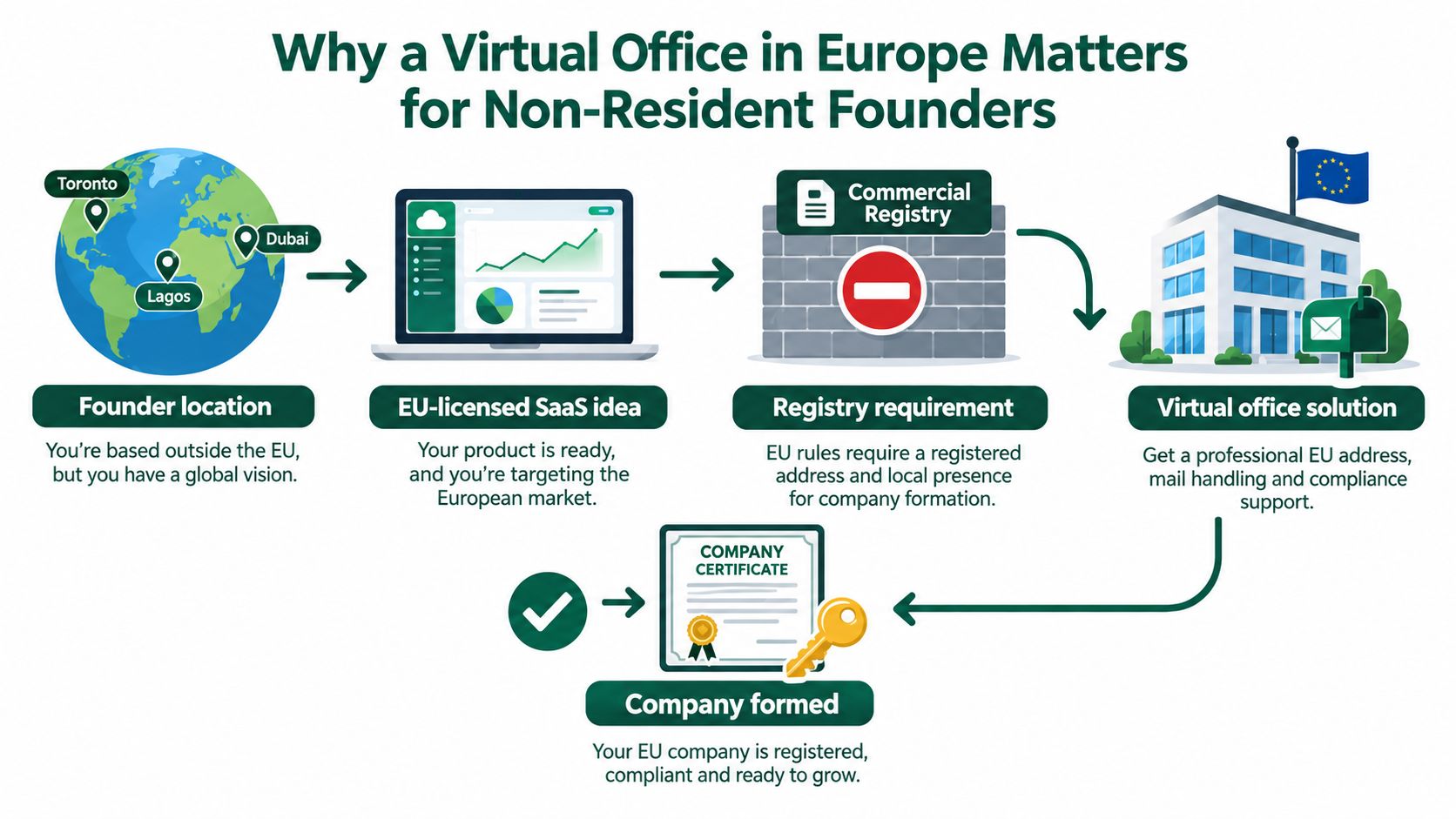
The address is the keystone
Most founders don't need leased premises on day one. They need an address that can survive scrutiny. In Europe, that usually means a serviceable location with mail handling, reliable reachability, and paperwork that proves your right to use it.
German guidance is useful here because it states the issue plainly. A virtual office can work for company and tax purposes only if it qualifies as a ladungsfähige Anschrift, meaning official documents can be physically served and post can be received, as explained in this German virtual office address guide. That's the test across much of Europe, even if the local legal wording changes.
Why founders choose virtual offices
A proper virtual office solves three practical problems at once:
- Incorporation speed: You can move faster than if you start negotiating physical premises first.
- Lower fixed overhead: You avoid paying for space you won't use.
- Compliance packaging: A serious provider gives you the contract trail, mail flow, and address legitimacy that registries and banks want to see.
Practical rule: Pick the address first. Then build your company, VAT, and banking file around it.
If you're setting up from abroad, this is the point where non-resident company formation in Europe stops being theory and becomes a document game. The founders who get through it smoothly choose a jurisdiction and a provider together. The ones who struggle buy a cheap address first and try to fix the compliance story later.
What a Virtual Office in Europe Actually Is
A virtual office in Europe is a compliance tool. You use it to put a valid address on your company record, receive official mail, and show banks, VAT offices, and registries that someone can reach the business at that address.
That is the standard that matters.
If a provider is selling prestige, coworking photos, or cheap mail forwarding, ignore it. For a non-resident founder, the useful question is simpler. Will this address hold up when the company registry checks serviceability, when the bank runs AML review, and when the tax office sends a letter that needs an answer on time?
At minimum, the service should cover three functions:
- Registered seat: The legal address shown in the company register.
- Official correspondence handling: Receipt of mail from tax authorities, courts, registries, banks, and payment providers.
- Mail logging and forwarding: A documented process for scanning, forwarding, and recording incoming post.
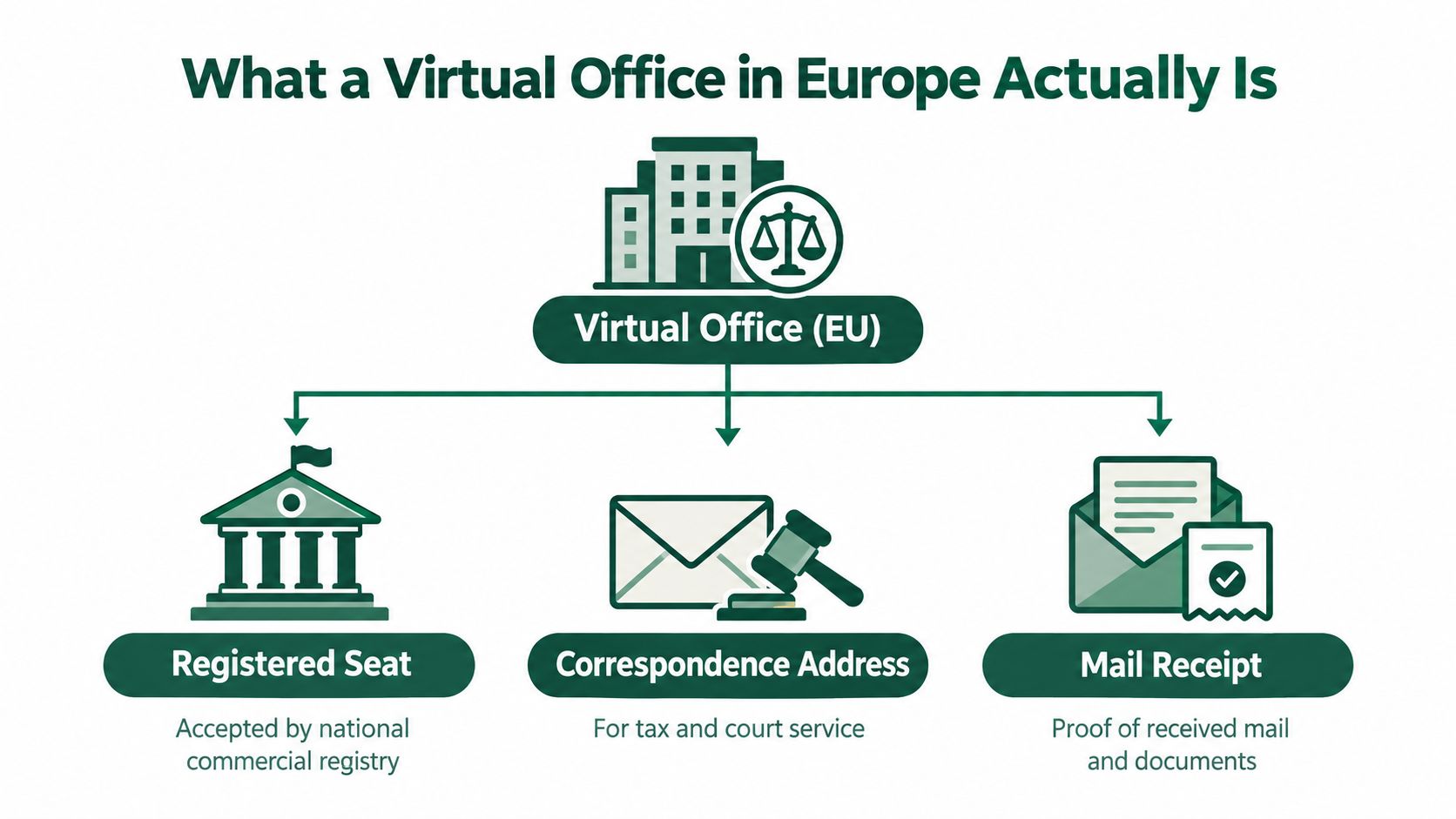
What you are buying
Buy the address package that fits the filing you need to pass, not the one with the nicest brochure.
A registered seat is enough for some incorporations. It is not enough for every bank review or VAT file. In Germany and the Netherlands, weak address setups get flagged quickly if the provider cannot prove real mail handling and authorized use. In Estonia, the formal setup can be faster, but banks and payment institutions still test whether the company has a believable operating profile. In Spain and Italy, delays often come from tax registration and document checks, not from the address alone. The address still matters because missed mail creates missed deadlines.
Founders often confuse a virtual office with business substance. Those are different things. A virtual office gives you legal reachability. It does not give you local management, employees, decision-making presence, or a fixed place of business for tax analysis.
That distinction drives real outcomes:
- Commercial registries check whether the company can be legally served at the address.
- Banks and EMI providers check whether the setup looks credible under AML rules.
- Tax offices may ask whether the company only has a registered address or has created a taxable presence, VAT footprint, or permanent establishment risk.
Here is the practical difference between common service tiers:
| Service tier | What it usually includes | Good for | Common failure |
|---|---|---|---|
| Mailbox only | Basic post receipt or forwarding | Very limited use | Fails bank or tax review because the setup looks superficial |
| Registered office plus mail | Company seat, official mail handling, contract support | Most non-resident formations | Problems if the provider cannot prove serviceability or respond quickly |
| Full back office | Registered seat plus accounting, tax, formation, admin support | Founders who want one coordinated compliance file | More onboarding checks, but fewer gaps later |
My recommendation is blunt. Do not buy a mailing product and call it a virtual office. If your provider cannot explain how they handle registry mail, tax letters, bank checks, and proof-of-address requests, the service is too weak for a serious EU company setup.
The European Virtual Office Market at a Glance
This isn't a fringe service anymore. Europe is one of the core regions in the global market for virtual offices. One market report estimates Europe held about 27.3% of global share in 2025 and projects 15.9% CAGR through 2034, according to Dataintelo's virtual office market report. Another 2024 study values the global market at USD 16.2555 billion, with Europe holding more than 30% of revenue, or about USD 4.87665 billion, and growing at 12.7% CAGR from 2024 to 2031, according to Market Research Future's virtual office market study.
That scale matters for founders. It means Europe has a mature provider ecosystem. You can find serious operators in high-cost hubs and low-cost jurisdictions, and the service quality gap between them is huge.
Mature market, mixed quality
A crowded market gives you options. It also creates noise. Some providers run compliance-grade registered office services. Others are reselling cheap addresses that may get you through one filing but fail later when the bank, tax office, or payment processor asks for more.
That's why I don't tell founders to shop by city prestige. London, Amsterdam, Berlin, Sofia, Tallinn, and Dublin all have usable providers. The question isn't whether the city sounds impressive. The question is whether the provider can support your filing, VAT narrative, and AML profile.
European Virtual Office Hubs Pricing and Service Profile
| City | Typical Monthly Fee (EUR) | Registered Seat Accepted | Mail Forwarding | VAT/Formation Bundle |
|---|---|---|---|---|
| London | Varies by provider | Often yes with proper contract | Usually available | Sometimes |
| Amsterdam | Varies by provider | Often yes with proper contract | Usually available | Less commonly bundled |
| Berlin | Varies by provider | Depends heavily on serviceability | Usually available | Sometimes |
| Sofia | Varies by provider | Commonly offered for local formations | Usually available | Often bundled |
| Tallinn | Varies by provider | Commonly offered | Usually available | Often bundled |
| Dublin | Varies by provider | Often yes with proper support | Usually available | Sometimes |
Cheap addresses in expensive cities often create expensive problems later.
My view is simple. Western European providers often price for compliance handling. Providers in lower-cost jurisdictions are more likely to package formation, VAT support, and accounting in one workflow. For non-resident founders, the bundled model is usually easier to operate.
Tax Reality Check Across Key European Jurisdictions
Most founders compare jurisdictions backwards. They start with brand-name countries, then ask whether they can reduce tax later. That's a mistake. Start with the tax position, then ask whether the virtual office setup supports it.
For straightforward service, consulting, agency, and SaaS models, Bulgaria deserves more attention than it gets. Bulgaria's statutory corporate income tax rate is 10%, and Tax Foundation's 2026 Europe data places it among the lowest in Europe. The same source shows an integrated corporate income tax rate for dividends of 14.5%, as shown in Tax Foundation's Europe corporate tax data.
Bulgaria stands out for tax and online setup
That's the structural reason so many non-resident founders pair a Bulgarian company with a Sofia virtual office. The tax comparison to other countries is very good. It isn't marketing fluff. It changes the math for retained profit and distributions.
Bulgaria also has a practical advantage that too many founders ignore. Everything can be handled online for EOOD and OOD filings through the Commercial Register using a Qualified Electronic Signature, with electronic filing fees of EUR 28.12 versus EUR 56.24 on paper, and the UIC is typically issued within a few business days, according to this Bulgarian online registration guide. That's one of the easiest remote setup paths in the EU.
If you want the broader context, I'd also review this breakdown of lowest corporate tax rates in Europe.
Corporate Tax and VAT Snapshot Six EU Jurisdictions
| Jurisdiction | Corporate Tax | Dividend WHT | VAT Rate | VAT OSS Threshold |
|---|---|---|---|---|
| Bulgaria | 10% | Not covered here as a standalone rate. Integrated rate for dividends shown as 14.5% via Tax Foundation source | Varies under local VAT rules | Depends on applicable regime |
| Ireland | Higher than Bulgaria in typical comparison | Depends on structure and treaties | Varies under local VAT rules | Depends on applicable regime |
| Estonia | Higher than Bulgaria in typical comparison framework depending on profit treatment | Depends on structure | Varies under local VAT rules | Depends on applicable regime |
| Germany | Typically above Bulgaria | Depends on structure and treaties | Varies under local VAT rules | Depends on applicable regime |
| Netherlands | Typically above Bulgaria | Depends on structure and treaties | Varies under local VAT rules | Depends on applicable regime |
| Cyprus | Often considered tax-efficient, but must be judged with substance requirements | Depends on structure | Varies under local VAT rules | Depends on applicable regime |
I'm deliberately not pretending the table alone answers the decision. It doesn't. Raw rates don't save you if your tax residence position is weak, your transfer pricing file is missing, or your profit allocation story falls apart under review.
Substance beats brochure tax rates
Countries like Ireland and the Netherlands can make sense in the right operating model. But a virtual office with no genuine commercial story is weak support for substance. If your staff, management, contracts, and execution all sit elsewhere, don't expect a glossy address to fix that.
If profits matter, your structure has to survive tax residency questions, not just look tidy on incorporation day.
Legal and Compliance Mechanics You Must Understand
Most DIY founders get blindsided. They think the virtual office is the easy part, then friction starts when the provider, registry, tax office, or bank begins checking identity, beneficial ownership, and the legitimacy of the address.
A valid address is only one layer. The company file also has to work as a compliance file.
The address must be legally usable
A virtual office provider should be able to show why the address is valid for company use. That usually means a contract, clear authority to provide the service, and a procedure for receiving official correspondence. If the provider acts like these documents are “internal only,” take that as a warning sign.
In Bulgaria, a company must have a registered seat and address in Bulgaria, and neutral guidance on Sofia virtual offices notes that a professional virtual office can satisfy this requirement because the address is used for official correspondence with the Commercial Register, the National Revenue Agency, courts, and counterparties, as described in this Sofia virtual office overview. That's the basic legal mechanism that makes remote formation practical.
AML changes the whole onboarding process
Once the provider does more than passive mail forwarding, AML obligations can become very real. Polish AML commentary is especially direct on this point. It states that virtual office operators are subject to AML rules, including customer due diligence, beneficial-owner verification, ongoing monitoring, recordkeeping, suspicious-transaction reporting in certain cases above EUR 15,000, and record retention for five years, according to this Poland virtual office AML commentary.
That's why compliant providers ask for more than a passport. They may ask for shareholder documents, source-of-funds explanations, business model summaries, and operating counterparties. Founders often complain about this. They shouldn't. A provider that performs proper checks is much more useful when a bank later reviews the structure.
Registered seat is not the same as taxable presence
One of the most misunderstood issues in virtual office Europe setups is the line between an address and actual tax presence. There is no single EU-level law specifically regulating telework, and different countries keep updating local rules and workplace obligations, as outlined in Eurofound's report on telework in the EU and recent regulatory updates.
That matters because where management sits, where staff work, and where commercial control happens can affect permanent-establishment and compliance questions. A registered office helps you form the company. It does not automatically settle where the business is carried on.
How an Online Setup Actually Works in Practice
The good news is that a proper setup is usually straightforward if you use a jurisdiction and provider that are built for remote founders. The bad news is that people still confuse “setup completed” with “company fully operational.” Those are not the same thing.
Here's what the sequence usually looks like in real life.
The setup sequence
A founder chooses the jurisdiction first, then the provider. The provider sends the virtual office contract, KYC checklist, and formation engagement documents. The founder signs digitally, uploads ID, proof of address, and any shareholder documents, and answers basic business-model questions.
Then the provider runs onboarding checks. If the file is clean, the provider issues the address paperwork needed for incorporation. That paperwork feeds directly into the company registration filing.
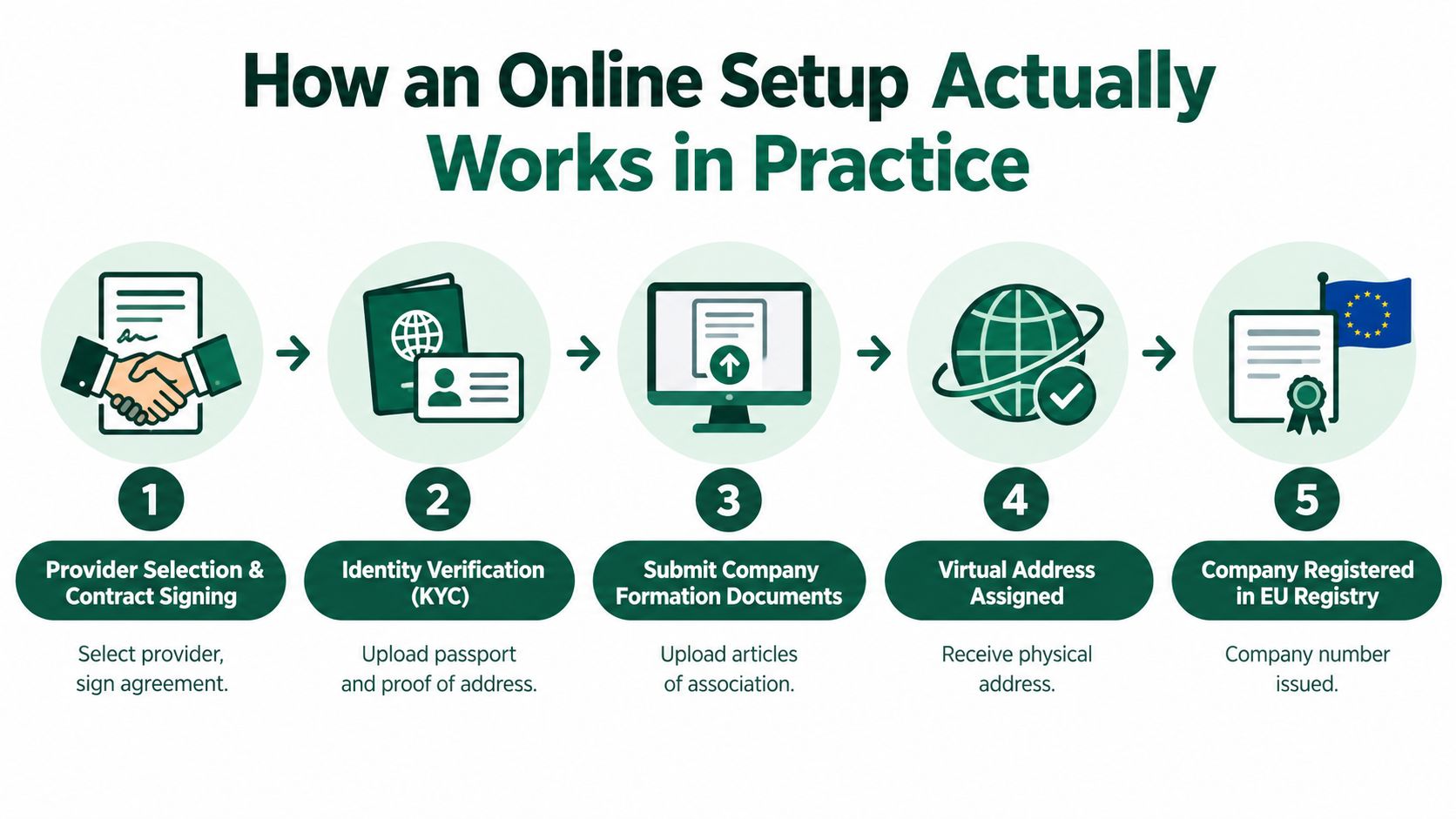
Where the timeline is fast
Bulgaria is a good example of a route because the filing can be handled online and the company can typically be formed in a matter of working days when the documents are in order. For founders who want an operating model with one workflow, FastCorp is one option that handles Bulgarian incorporation, virtual office, VAT support, banking assistance, and accounting in a single remote process. If you want a broader view of the process, review this guide to online company registration in Europe.
Where delays actually happen
The usual delays are not in the registry filing itself. They happen in these areas:
- Document mismatch: Names, spellings, or shareholder data don't match across documents.
- Apostille or legalization chain: Some non-resident files need extra document formalities.
- Bank compliance review: Banks often move slower than registries.
- VAT review: Tax offices may ask follow-up questions about activity, clients, and expected transactions.
A company can be registered before it is bankable. Founders need to plan for both.
The practical lesson is simple. Treat online setup as a chain, not a single event. A virtual address, registration certificate, VAT position, and bank account all need to line up. If one part is weak, the others slow down.
How to Choose the Right Virtual Office Provider
This decision is easier when you stop looking at brand language and start stress-testing the provider like a bank would.
Most providers sell convenience. You should buy defensibility.
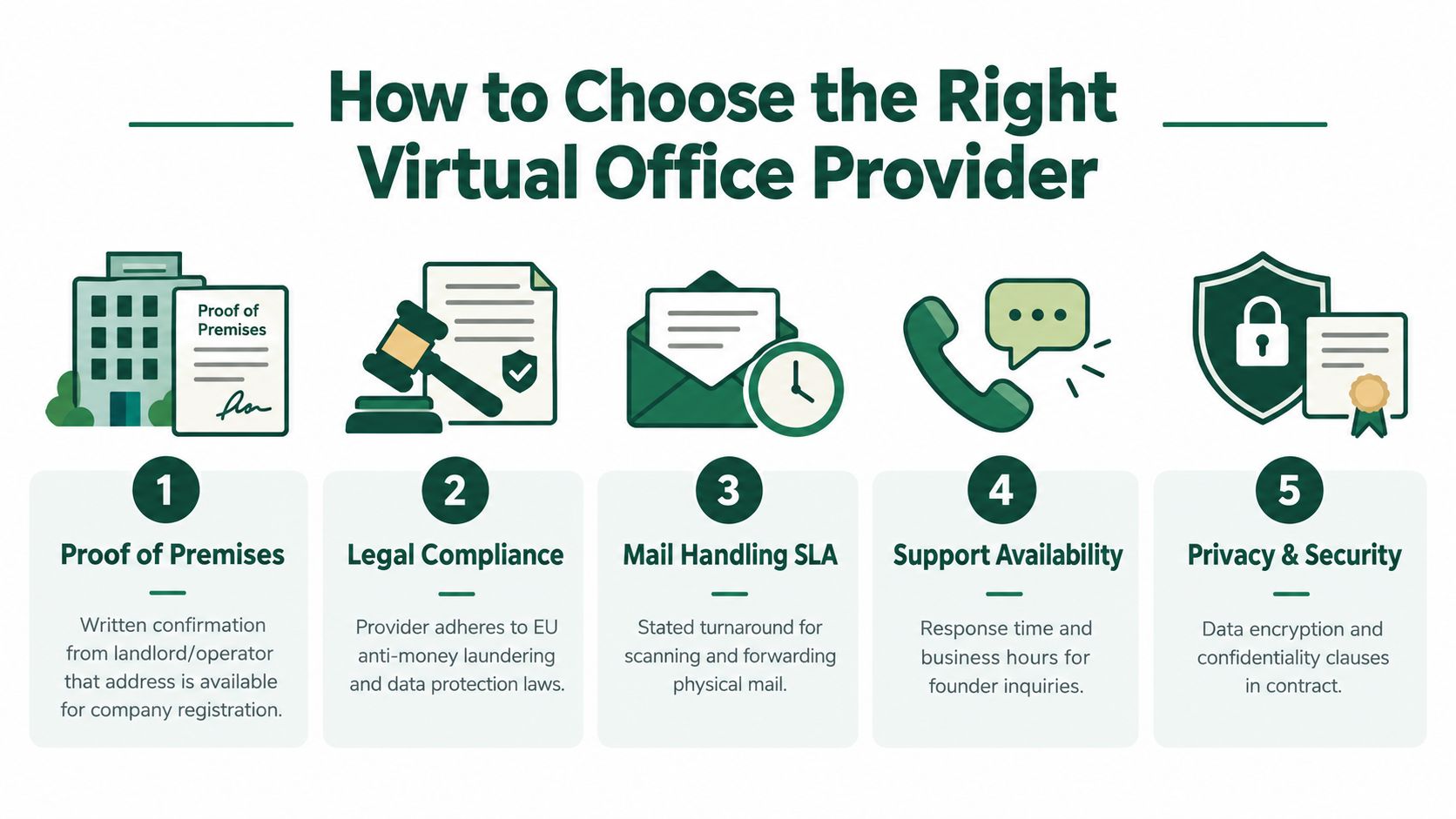
The five checks that matter
- Proof of premises: Ask whether the operator is authorized to provide company registration use at that address. If they hesitate, move on.
- Mail handling process: Ask how official mail is logged, scanned, forwarded, and stored. You want a chain of custody, not a casual promise.
- AML posture: Ask what onboarding documents they require. Easy onboarding sounds nice until a bank rejects the company because the service provider's file was flimsy.
- Service of process handling: Confirm what happens if a court, tax office, or regulator serves notice there.
- Contract clarity: Check renewal terms, exit clauses, forwarding fees, and extra charges for tax or VAT support.
Red flags I see all the time
Some offers are bad on their face. If a provider advertises a prestigious Western European address at an unrealistically low monthly fee, assume you're looking at a nominal mailbox product. Those offers often fail when banks ask for proof of operational legitimacy.
Another red flag is vague language around registration use. “Suitable for business” is not enough. You want explicit confirmation that the address can be used for incorporation and official correspondence under local practice.
A third problem is support quality. If they take two days to answer a presale question, expect worse once official post starts arriving.
Ask one hard question before you sign: “If a bank asks me to prove the address is genuinely usable for my company, what documents will you give me?”
Test the provider against your actual use case
If you're opening a SaaS company with non-EU owners, say that. If you need VAT registration quickly, say that. If you'll apply for an EU IBAN right after incorporation, say that too.
The right provider for a freelancer isn't always the right provider for a higher-risk cross-border structure. The cheapest address is usually priced cheaply for a reason.
Making the Right Choice for Your EU Footprint
Start with the constraint that matters. Your virtual office must clear registry acceptance, AML onboarding, and banking scrutiny. If it fails any one of those, the setup is weak no matter how nice the city name looks on your website footer.
For many non-resident service and SaaS founders, Bulgaria is hard to ignore. The tax comparison to other countries is strong, the setup can be handled online, and the formation path is relatively simple. That doesn't mean Bulgaria is right for everyone. If your operation needs heavier local substance, local hiring, or a specific investor-facing jurisdiction, another country may fit better.
The practical decision framework
Use this three-step filter this week:
- Shortlist the jurisdiction by business model. Service business, SaaS, e-commerce, holding, or IP-heavy operations do not all belong in the same place.
- Ask at least two providers for proof. Request confirmation of premises, registration usability, mail handling method, and the exact contract terms.
- Run the bank story before you file. Don't wait until after incorporation to discover your address package is too thin for onboarding.
If your real priority is speed, low friction, and a clean compliance path, avoid overengineering. A simple structure with a credible address beats a clever structure with a weak paper trail.
Founders waste weeks fixing cheap decisions. A rejected bank application, a failed VAT file, or a registry rework costs more than paying for a proper setup from the start.
FastCorp helps non-resident founders set up Bulgarian companies fully online, including the registered business address, virtual office, VAT support, banking assistance, and ongoing compliance. If you want an EU structure that matches this article's practical approach, visit FastCorp.