Corporate Tax Filing Deadlines: 2026 Bulgaria Guide
Stay compliant with corporate tax filing deadlines in Bulgaria for 2026. Learn key dates, penalties, and filing tips for your business.

You've incorporated your Bulgarian company, the Trade Register extract is in your inbox, and you assume the hard part is over. It isn't. The hard part starts when the first real deadline arrives before your bank setup, VAT registration, bookkeeping flow, and payroll process are ready.
That's why most guides on corporate tax filing deadlines are too shallow. They list dates. Founders don't miss deadlines because they can't read a calendar. They miss them because the upstream work wasn't done early enough. In Bulgaria, that matters more than many foreign founders expect, because the filing rhythm is tighter and more calendar-driven than what many people know from the UK, the US, or Canada.
If you're a non-resident founder, think of this less as a tax article and more as an operations map. The date is never the problem. The problem is whether your invoices, bank records, payroll data, VAT journals, and signatures are ready in time to file online.
Table of Contents
- Why Bulgaria's Filing Calendar Feels Different for New Founders
- Annual Corporate Tax Returns and Quarterly Advance Payments
- Monthly VAT Returns and the First-Filing Trap for Newly Registered Companies
- Payroll, Social Contributions, and Year-End Statutory Filings
- How Bulgaria Compares to the UK, US, Germany, UAE, and Singapore
- Penalties, Late Filing Costs, and the Extension Options That Actually Work
- A Practical Online Compliance Checklist and How FastCorp Handles Each Step
Why Bulgaria's Filing Calendar Feels Different for New Founders
You register the company on Monday. By Friday, you are asking when the tax deadlines start. Wrong question. The question that decides whether you file on time in Bulgaria is whether your bank account, invoicing flow, VAT position, payroll setup, and NRA access are ready before the first reporting month closes.
That is why Bulgaria catches non-resident founders off guard. In the UK and Canada, founders often work with filing timetables that feel more spread out and more closely tied to the company's year-end. Bulgaria is more calendar-driven in practice. The pressure shows up earlier, because several filing duties only work if the upstream admin was finished on time.
Where operational readiness breaks down
Here is what causes missed deadlines in a new Bulgarian company:
- Banking starts the clock in practice: Your accountant cannot book cleanly from screenshots and partial statements. If the account opens late, bookkeeping starts late, and every later filing gets compressed.
- VAT registration changes the whole workload: If your model requires Bulgarian VAT registration early, the filing rhythm becomes monthly fast. Founders often focus on the registration date and ignore the first return that follows almost immediately.
- Payroll creates instant recurring compliance: The moment you pay a manager under a management contract or hire staff, you add monthly declarations, contribution payments, and cut-off dates that do not care that the company is new.
- Portal access and signatures decide whether "online filing" is possible: Bulgaria is efficient once the e-services access is active. Before that, you are still collecting powers of attorney, signature tools, and registration details.
Practical rule: Count from the day your company can bank, invoice, exchange documents with the accountant, and sign filings online. The incorporation date matters less than founders assume.
This is the part many deadline guides miss. They give you dates in isolation. A founder cannot use a filing date if the supporting process behind it is still half-built. In Bulgaria, the tax calendar is tied directly to operations. In the UK, US, Germany, UAE, and Singapore, you can often feel more runway before the first major pressure point. In Bulgaria, the runway is shorter once VAT or payroll enters the picture.
Why foreign habits create trouble
Founders used to HMRC or IRS timing often expect a longer cleanup window. That habit creates expensive mistakes in Bulgaria. If February arrives and your prior-year bank movements, expense documents, or related-party records are still incomplete, annual filing season becomes a scramble.
The good news is simple. Bulgaria is manageable for founders who set up the upstream pieces early and keep the books current. It is unpleasant for founders who treat compliance as a date problem instead of an operations problem.
Annual Corporate Tax Returns and Quarterly Advance Payments
Corporate tax is where most founders focus first, and rightly so. In Bulgaria, the annual return and the cash payment matter more than the theory.
The working model is simple. Your company closes the year, you finalize the accounts, calculate the profit, file the annual corporate declaration, and settle the tax. After that, you deal with advance payments during the next year. If your books are clean, the filing itself is not difficult. If your books are still messy in March, everything becomes stressful.
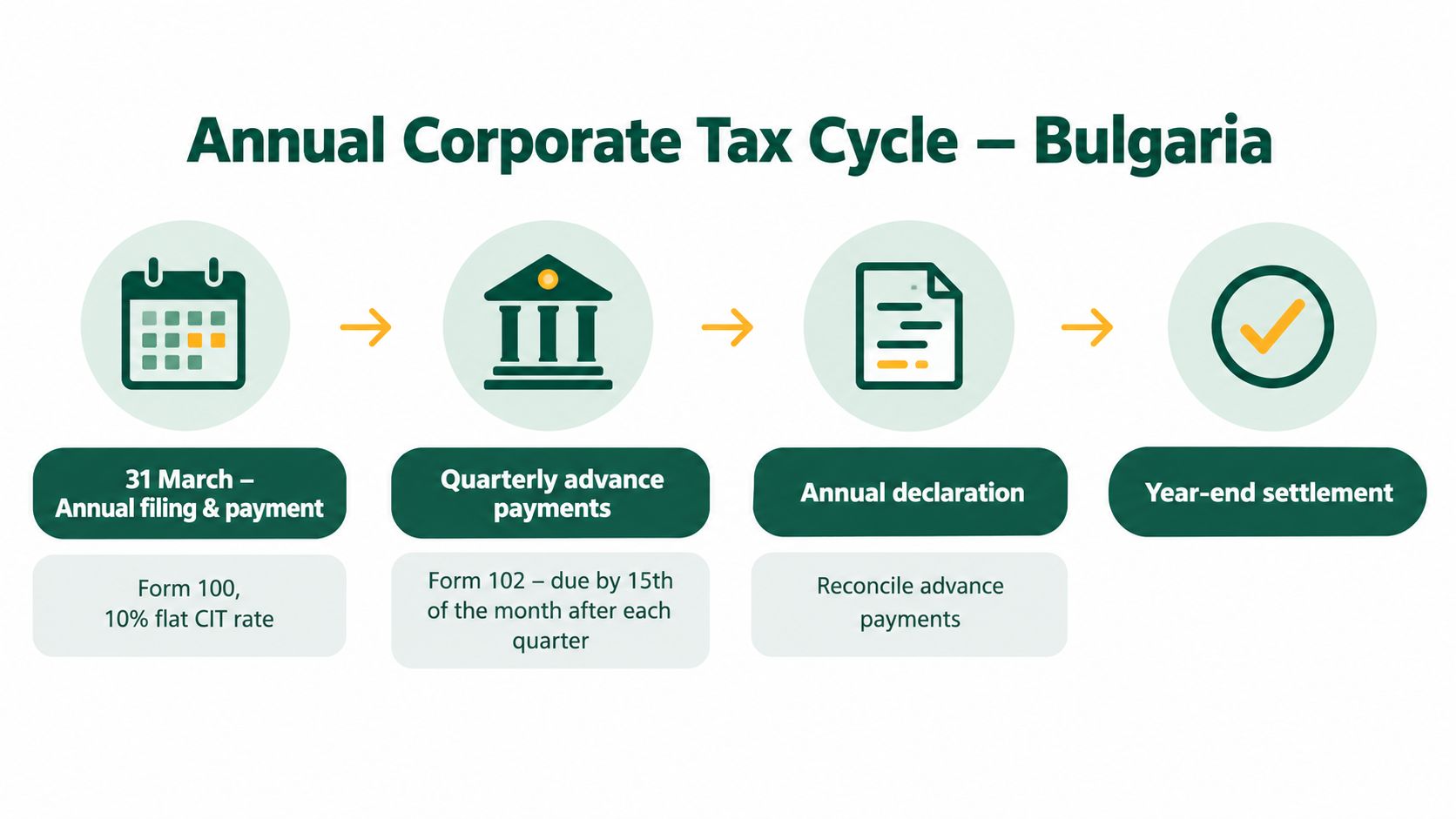
The annual cycle founders should actually follow
Use this rhythm:
- Close the books by mid-February. Bank statements, revenue recognition, expense coding, and related-party items should already be reconciled.
- Review the draft profit figure. Don't wait until the filing week to discover missing invoices or unsupported expenses.
- Approve the financials internally. Even owner-managed companies should document this cleanly.
- File through the NRA portal. Bulgaria's online handling is one of the easier parts of the process once access is in place.
For a plain-language overview of what the annual filing is doing, this guide on what a corporate tax return is is useful for first-time founders.
A concrete example
Bulgaria's corporate income tax rate is 10%. So if a company earns BGN 200,000 profit, the annual tax is BGN 20,000. If that amount is then split into four equal quarterly advances, the company would pay BGN 5,000 per quarter.
This is the part founders often underestimate. The tax amount is one issue. The scheduling is the other. If you don't set aside cash during the year, quarter-end arrives and you start funding tax from operating money.
Close your books before you think about filing. Filing is the last step. Most late corporate returns are bookkeeping failures wearing a tax costume.
Where founders slip
Three mistakes show up constantly:
- Late year-end cleanup: Missing supplier invoices, unreconciled payment processor statements, or director expenses still sitting in a private account.
- No advance-payment planning: The company earns well, but nobody parks cash for the next installment.
- Portal dependency on one person: If only one accountant or director has filing access, you've created a single point of failure.
If you want the simplest possible setup, make corporate tax a February job, not a March panic. That one habit changes everything.
Monthly VAT Returns and the First-Filing Trap for Newly Registered Companies
VAT is where newly incorporated companies get caught first. Not because the return is complicated, but because the first filing comes earlier than expected and often arrives before the founder has a proper invoice trail, supplier file, or posting routine.
A new Bulgarian company can start trading quickly. That's good for business and bad for sloppy administration. Once registration is active, the reporting clock starts whether you claimed input VAT or not.
Why the first VAT month catches people out
A founder often assumes the first “real” tax event is the annual corporate return. Wrong. For many businesses, the first meaningful recurring compliance deadline is VAT.
If your Bulgarian company issues its first VAT-relevant invoice in February after registration, you may already be looking at a March filing cycle. That means your invoice format, customer data, supplier documents, and bookkeeping entries need to be correct almost immediately.
The practical burden is not the form itself. The burden is feeding accurate data into it.
What has to happen before the filing date
| Filing obligation | Form | Due date | Required upstream task |
|---|---|---|---|
| Monthly VAT return | Form VATA | By the 14th of the following month | Issue compliant invoices, post sales and purchase journals, reconcile supplier VAT |
| Intra-EU recapitulative declaration | VIES | By the 20th | Confirm customer VAT numbers, match intra-EU supplies to invoice records |
| First filing after new registration | Form VATA | First active cycle after registration | Confirm registration date, separate pre- and post-registration transactions |
For founders dealing with cross-border sales, this overview of VAT filing requirements helps frame the workflow properly.
The registration trap
The trap is timing. If you wait until after trading starts to think about VAT, you'll spend your first filing cycle cleaning up preventable mistakes. In practice, that means:
- Sales invoices need the correct company and VAT details from day one
- Supplier invoices must be collected immediately
- Your accountant needs access to documents during the month, not after it ends
- If you have intra-EU activity, VIES adds another moving part
For non-resident founders, my advice is blunt. If the business model obviously needs VAT, set it up before the first invoice if possible. It's cleaner, easier, and far cheaper than repairing the first reporting period afterward.
Payroll, Social Contributions, and Year-End Statutory Filings
Payroll changes the compliance calendar completely. A company with no staff and simple sales has one rhythm. The moment you hire, appoint, or start paying people through payroll, you move into a monthly discipline that doesn't tolerate improvisation.
Most founders think payroll means “calculate salary and send money.” That's amateur thinking. Payroll means contract setup, registrations, contribution calculations, declarations, payment timing, and year-end reporting.
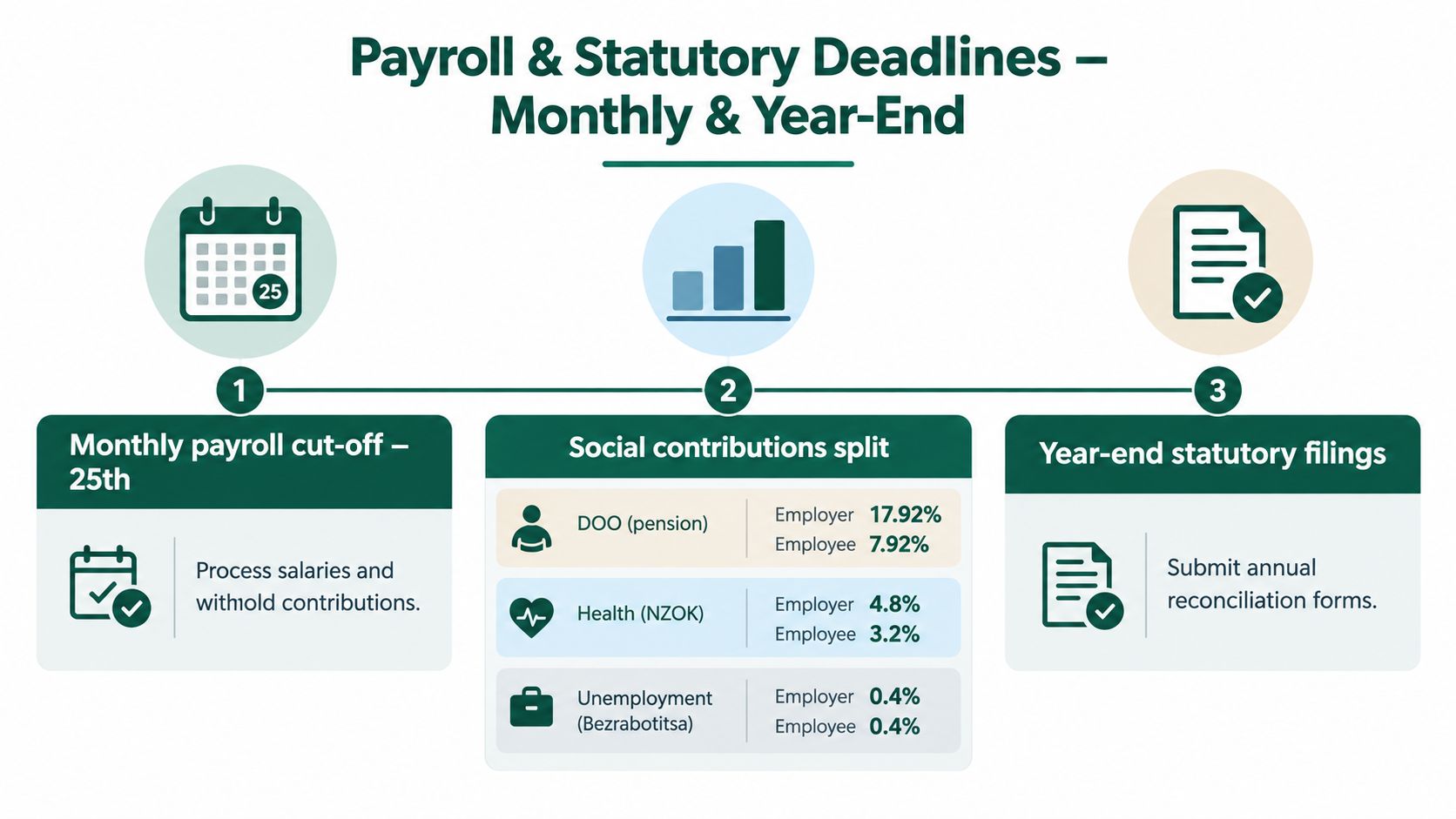
The monthly sequence that actually matters
For a non-resident founder, the practical order is usually this:
- Register the employment relationship properly
- Make sure payroll data is complete before the monthly cut-off
- Pay salary and contributions on schedule
- File the required electronic declarations
- Store support documents cleanly for later checks
If your payroll vendor or accountant isn't controlling this sequence, somebody in the company has to. If nobody owns it, mistakes are guaranteed.
Why payroll problems spread into other areas
Payroll is not isolated. It touches your bank account, monthly bookkeeping, annual accounts, and director records. A single bad month creates follow-on errors in expense recognition, liabilities, and year-end balances.
Founders also forget the simple practical obstacles:
- A working Bulgarian or EU-friendly bank flow is needed before the first salary run
- Director status and registration details need to match the actual arrangement
- Leave, sick days, and variable pay need records, not verbal explanations
- Year-end statutory filings arrive whether or not your internal records are tidy
If you hire before the compliance plumbing is installed, payroll becomes your first recurring crisis.
Year-end filings are broader than tax
The annual cycle doesn't stop with corporate income tax. You also need to think about the Annual Financial Statements and the filing with the Registry Agency by 30 June, plus the broader statutory reporting package around company activity and employment records.
This is why I push founders to build one calendar, not three separate ones. Tax, VAT, payroll, and statutory reporting all rely on the same raw material. Accurate books, timely documents, and one person clearly responsible for pushing each filing through the online system.
How Bulgaria Compares to the UK, US, Germany, UAE, and Singapore
A non-resident founder usually learns this comparison the hard way. The return date looks manageable on paper, then the blocker turns out to be something earlier: bank access is still not live, VAT registration started late, payroll data is sitting with a local provider, or the director still cannot sign in the tax portal. That is why simple date tables mislead. The date is the easy part. The upstream work decides whether you can file on time.
Bulgaria sits in an unusual middle ground. The tax rate is low, the online filing setup is workable, and the calendar becomes predictable once the company is configured properly. The trade-off is stricter monthly discipline. You do not get much room to drift and sort it out later.
The comparison founders actually need
| Country | Corporate Tax Rate | Annual Filing Deadline | Advance Payments | VAT / GST registration trigger | Payroll filing rhythm |
|---|---|---|---|---|---|
| Bulgaria | 10% | Annual corporate tax return and tax payment are typically handled by 30 June for the prior year | Quarterly advance payments often apply once the company reaches the relevant threshold and is not newly exempt | Mandatory VAT registration can be triggered by turnover, intra-EU activity, or specific cross-border cases. Timing depends on the activity, not only revenue | Monthly payroll tax and social contribution reporting is the norm |
| UK | Corporation tax applies at UK rates depending on profit level | Company Tax Return is due 12 months after the end of the accounting period. Corporation Tax is usually due earlier, as noted above in the article | Large companies can face instalment rules. Smaller companies usually pay in one cycle | The UK VAT registration threshold is £90,000 | Real Time Information reporting runs with each payroll cycle, usually on or before payment to employees |
| US | Federal corporate tax rate is not the point here. The bigger issue is filing complexity across federal and state levels | A regular corporation generally files by the 15th day of the fourth month after tax year-end, with an automatic six-month filing extension available under the IRS Form 1120 instructions | Estimated tax payments are commonly quarterly for corporations that expect tax due | Sales tax is state-based, not a single national VAT system. Registration depends on nexus rules in each state | Federal payroll deposits can be monthly or semiweekly, with quarterly payroll returns as a standard layer on top |
| Germany | Corporate taxation is split across corporate income tax, trade tax, and solidarity surcharge in practice | A 2026 guide says self-filed corporate returns are generally due by 31 July, while filings with a tax advisor can extend to 28 February of the following year, according to this Germany deadline guide | Quarterly prepayments are standard in practice | VAT registration does not run on a simple high threshold model for many operating businesses. It often starts early once taxable activity begins | Wage tax filings are usually monthly, quarterly, or annually depending on payroll size, with social insurance running on its own recurring timetable |
| UAE | 9% in the materials referenced | For a financial year ending 31 December 2025, filing and payment are due by 30 September 2026, reflecting the rule that returns are due within nine months of period end in the UAE corporate tax filing guide | Filing and payment are combined in that framework | VAT registration depends on taxable supplies thresholds under the UAE VAT regime | No classic income tax payroll withholding system applies in the same way founders know from Europe or the US, but wage protection and labour compliance still matter |
| Singapore | Corporate tax is low by developed-market standards, but the process has its own sequence | All companies must file their YA 2026 Corporate Income Tax Return by 30 Nov 2026 through the online portal, according to the Singapore corporate filing season page | Estimated chargeable income filing comes earlier in the cycle for many companies | GST registration depends on taxable turnover tests and, in some cases, expected future turnover | Payroll tax withholding does not mirror the Bulgarian model, but employer reporting still has annual compliance steps |
What this comparison actually means
Bulgaria is faster than the UK, Germany, UAE, and Singapore at forcing discipline into the books. That is the difference. In those systems, a founder may have more post-year-end breathing room on the corporate return itself. In Bulgaria, monthly VAT, monthly payroll reporting, and the practical need for clean bookkeeping push the work earlier.
The UK gives more separation between tax payment and return filing, but founders there still get caught by payroll submissions and VAT registration once trading starts. The US gives filing extensions more freely, yet that does not remove estimated taxes, payroll deposits, or state registrations. Germany often allows more time if a tax advisor files, but the paperwork burden is heavier. The UAE looks relaxed on the annual filing date, although that matters less if your operating model still depends on bank onboarding, visas, and VAT setup. Singapore is efficient, but efficient systems punish founders who assume efficiency means flexibility.
Where Bulgaria is stronger
For a small founder-led company selling into the EU, Bulgaria is often the cleaner operating base.
- The corporate tax rate is easy to budget
- The filing pattern becomes repetitive once the portal access, accounting flow, and bank process are set up
- EU VAT mechanics are familiar to accountants who already handle cross-border trade
- You can run a lean structure without inheriting the multi-layer tax complexity common in the US or Germany
Where founders get caught
The trap is not usually the annual corporate return. The trap is everything that has to happen first.
If VAT registration starts late, your first monthly filings arrive before your internal process is stable. If the bank workflow is clumsy, payroll and tax payments get delayed even when the return is ready. If bookkeeping is postponed for three or four months, Bulgaria stops feeling simple very quickly.
That is why Bulgaria works best for founders who accept one rule from day one: monthly discipline beats year-end heroics. In the UK or Singapore, you may survive longer with messy internals before the annual filing exposes the problem. In Bulgaria, the system exposes it earlier. For a serious founder, that is a strength, not a weakness.
Penalties, Late Filing Costs, and the Extension Options That Actually Work
A non-resident founder usually does not miss the deadline because the tax form was hard. The miss happens earlier. Portal access was never set up properly. The bank signer was traveling when the tax payment had to go out. Payroll numbers were still being corrected. The accountant was waiting for missing invoices from two months ago. By the time anyone looks at the filing date, the problem is already old.
That is why penalty planning in Bulgaria should start upstream. If you want to avoid late corporate tax, fix year-end bookkeeping in January and close bank reconciliations before the annual return window gets crowded. If you want to avoid VAT penalties, do not treat registration as an isolated legal step. Your first VAT filing arrives whether your invoice flow, document collection, and portal access are ready or not. If you want payroll and social contribution deadlines to stay boring, lock payroll cut-off dates before month-end and make sure the payment account can move funds on time.
Founders who compare Bulgaria with the UK, US, Germany, UAE, or Singapore often focus on the penalty number. That is the wrong comparison. The useful comparison is the failure point. In the UK, a late filing often starts with Companies House or HMRC access and sloppy internal handoff. In the US, it is often incomplete books and late tax estimates. In the UAE, founders get caught by assuming a new tax system will be forgiving. Bulgaria has its own pattern. The filing calendar is manageable, but it punishes weak monthly process faster than some founders expect.
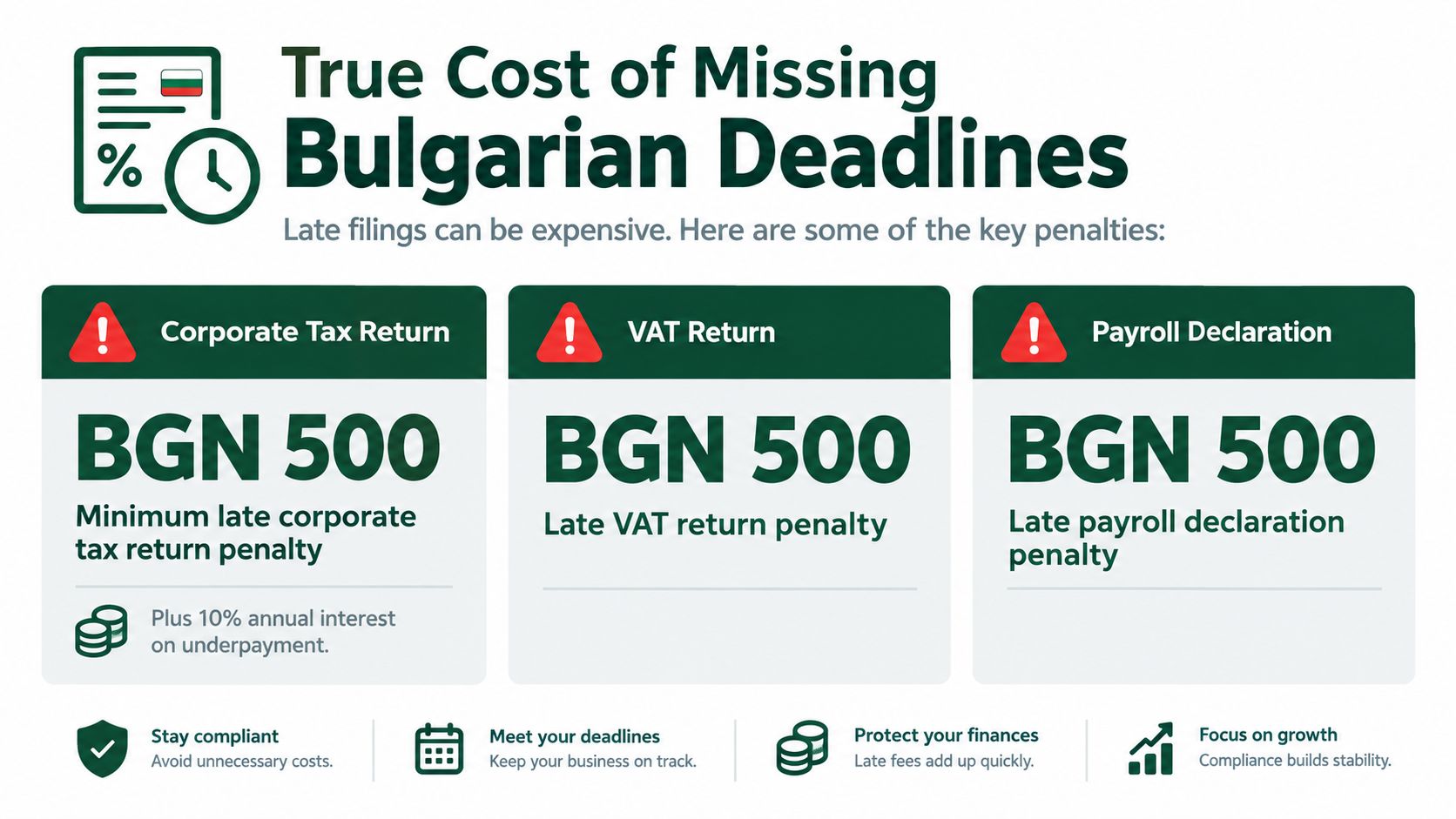
What actually works when you're late
Start with the return or declaration that stops the clock. Do not wait for perfect books if a filing can be submitted and corrected properly afterward under local procedure.
Then deal with the task that caused the miss.
- If the tax return is ready but unpaid, fix banking authority and payment execution first
- If VAT is late, reconstruct the sales and purchase ledger month by month, not from a year-end summary
- If payroll filings slipped, reconcile employee data, leave records, and contribution bases before sending amendments
- If access to the e-services portal is the bottleneck, solve the authorization issue immediately instead of letting the accountant chase documents they cannot file
Extensions help less than founders hope. In Bulgaria, the practical answer is usually not “ask for more time” but “file correctly, fast, with a documented trail.” Other countries may have more formal extension habits, especially for corporate returns, but even there the extension usually delays the filing task, not the upstream accounting, payment, or recordkeeping work that caused the problem in the first place.
Three habits save money and arguments with the authorities:
- Keep submission receipts the same day each filing is made
- Store payment confirmations separately from the accounting file
- Write down who approves tax payments, and what happens if that person is abroad or unavailable
And three habits create repeat problems:
- Letting the accountant discover missing documents at the deadline
- Treating an inactive month as a month with no compliance work
- Assuming a small tax balance means the authority will ignore delay
This short video is worth watching if you want a practical sense of the risk mindset around tax deadlines and clean filing discipline.
The founder's correct attitude
Late filing usually starts as an operations failure. Tax is just where it becomes visible.
Handle it that way. Rebuild the missing records, submit what is due, pay what can be paid immediately, and keep written proof of every step. Founders who do this early usually contain the damage. Founders who debate, delay, or improvise stories to fit the books usually turn a routine fix into a credibility problem.
A Practical Online Compliance Checklist and How FastCorp Handles Each Step
You are in Berlin or Dubai, it is the 12th of the month, and your Bulgarian accountant is asking for bank statements, payroll inputs, and two supplier invoices that are still sitting in someone's inbox. That is how deadlines get missed in practice. Not because the date was unclear, but because the work that feeds the filing was not finished early enough.
That is the difference between a founder who files cleanly from abroad and one who lives in deadline panic. The filing itself is usually the easy part. The hard part is getting the bank access, VAT documents, payroll changes, and approval chain lined up in time. Countries like Singapore have trained founders to expect clean online workflows. Bulgaria can work well online too, but only if the records are centralized and someone owns the calendar before the due date shows up.
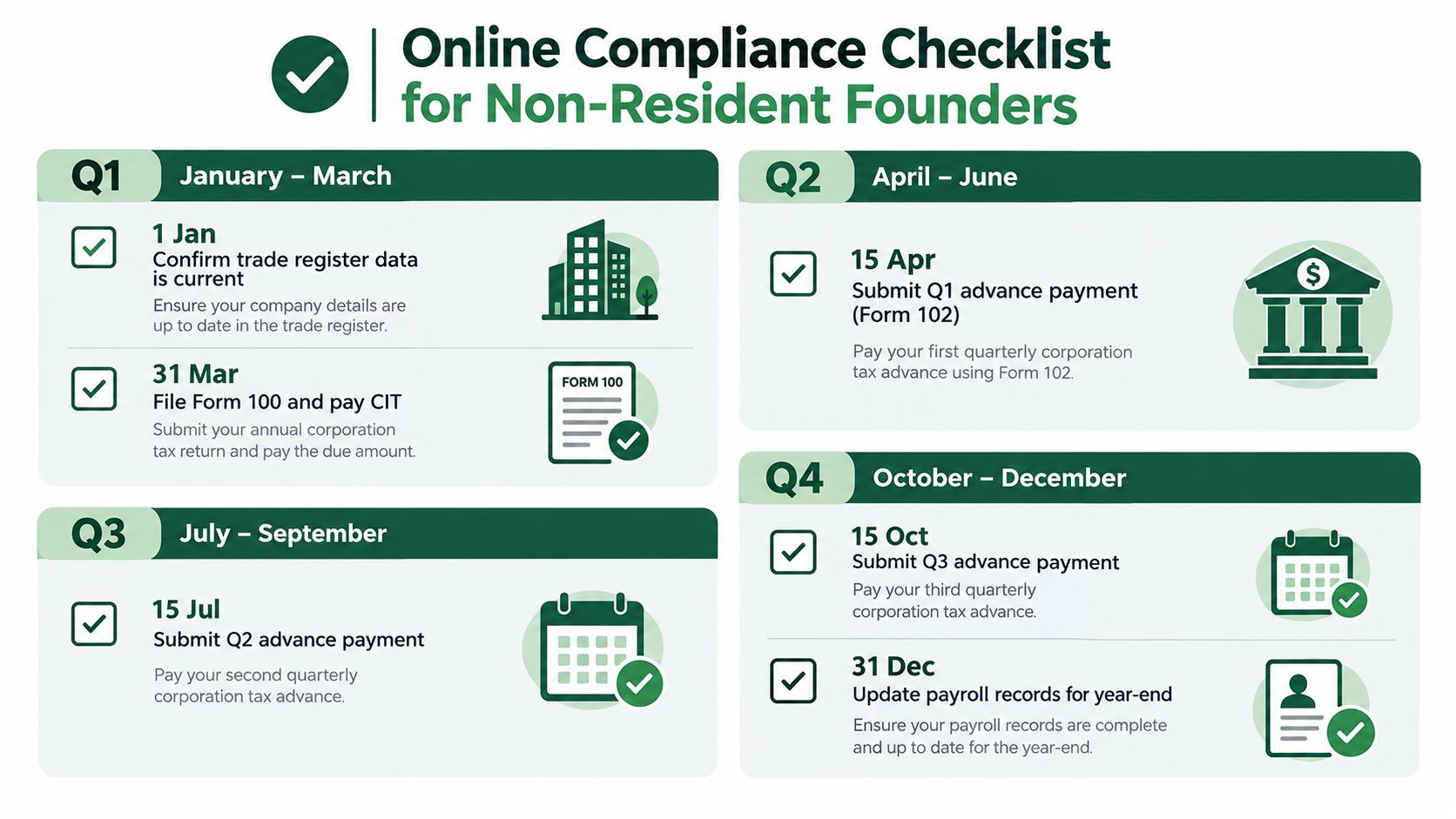
The quarter-by-quarter rhythm
Run one master compliance file. One calendar, one document folder, one person responsible for chasing missing items.
Q1
- Check access before filing season starts: Confirm NRA portal access, e-signature validity, trade register details, company address, and who can approve submissions.
- Close the prior year properly: Finish bank reconciliations, collect missing invoices, and clear director loan entries while the trail is still fresh.
- Draft the annual corporate tax position early: If something is wrong, March is the time to fix it. Not the final week before submission.
Q2
- Treat VAT as a monthly collection job: Gather sales and purchase documents during the month. Waiting until month-end is how founders create avoidable errors.
- Freeze payroll inputs before the cutoff: New hires, bonuses, sick leave, and terminations need to reach accounting on time or the payroll run becomes a repair job.
- Reserve cash for tax and contributions: Do not fund Bulgarian tax payments with last-minute personal transfers from abroad.
Q3
- Reconcile quarter-end balances: Focus on receivables, payables, intercompany entries, and anything involving the founder personally.
- Review cross-border VAT treatment: Reverse charge, intra-EU supply logic, and place-of-supply mistakes often start small and become expensive later.
- Prepare review-ready support files: If the NRA asks a question, you should be able to send one clean folder within the hour.
Q4
- Clean the ledger before year-end pressure starts: December fixes are cheaper than rebuilding the whole year in March.
- Review payroll and contractor status: Misclassified work arrangements usually surface at the worst possible time, during annual reporting.
- Check the archive: Bank statements, contracts, board decisions, invoices, and payment proofs should all be easy to find.
What to delegate and what to watch yourself
Do not waste your time filing every form personally. Control the inputs, the timing, and the approvals.
For a non-resident company, one provider can usually handle incorporation documents, registered address, e-services setup, bookkeeping, VAT registration, VAT and VIES filings, payroll calculations, social contribution filings, annual tax returns, dividend paperwork, and banking readiness support. FastCorp is one example of a provider handling those formation and ongoing compliance tasks for Bulgarian companies. If you want the reporting side explained in plain language, their guide on what statutory reporting means in practice is a useful companion.
The founder's minimum job
Keep these five items under your direct control:
- Approve unusual transactions before money moves
- Send documents the same week they are created
- Review monthly numbers, not just annual results
- Keep cash set aside for VAT, payroll, and tax
- Answer accounting questions quickly
Do that, and Bulgarian online compliance is manageable from abroad.
Ignore it, and the deadline date becomes the least important part of the problem.
If you want Bulgaria without the usual deadline chaos, FastCorp can handle the setup, VAT, bookkeeping, payroll, and annual filing workflow in one place so your corporate tax filing deadlines are manageable from abroad. You still need to send documents on time and make decisions quickly, but you will not need to build the compliance system from scratch.