Business Bank Account for New Business: 2026 Guide
Business bank account for new business: compare fees, features, and approval times to open the right account for your startup in 2026.
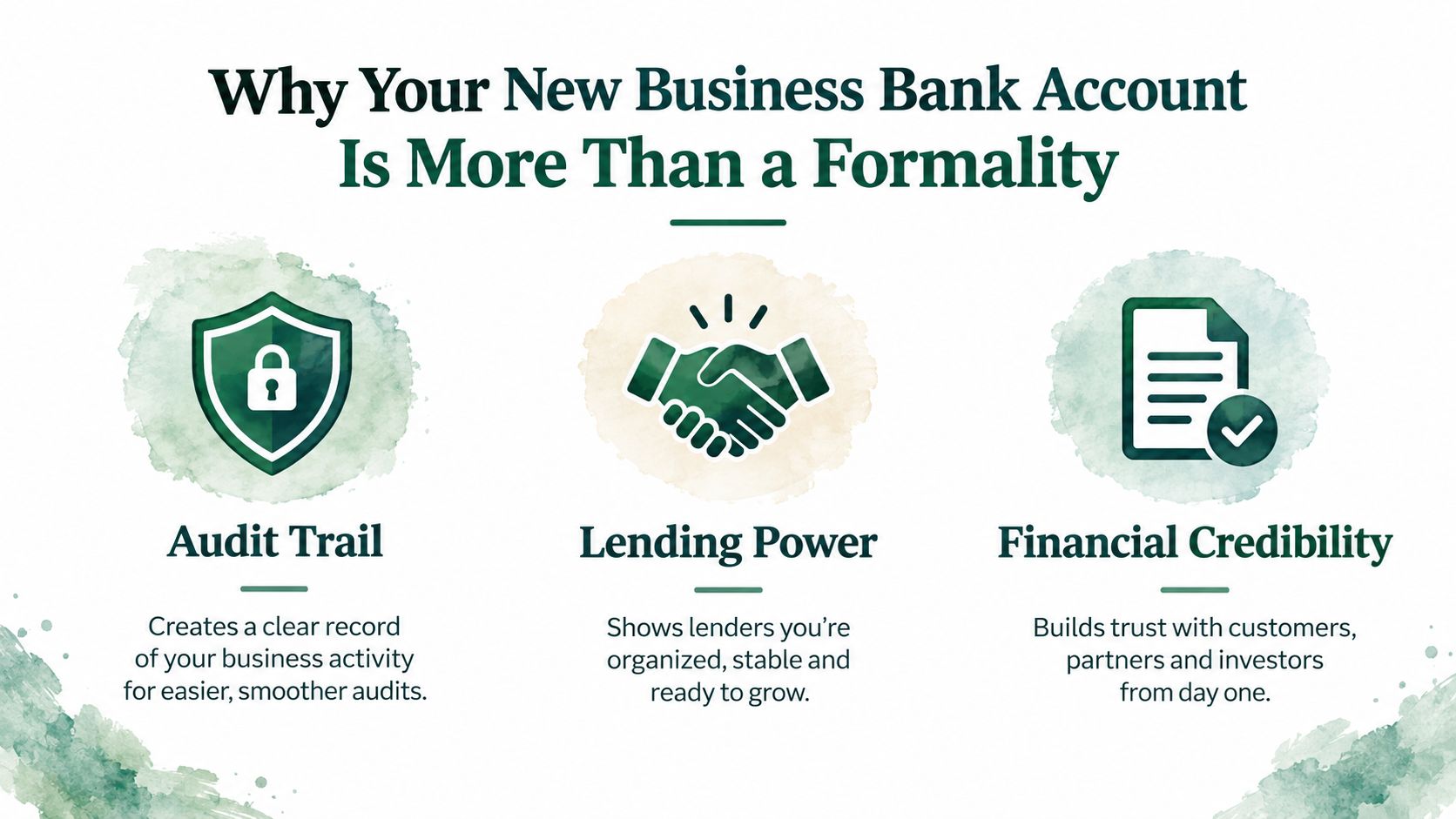
Incorporation doesn't give you banking. That's the most popular, and most dangerous, advice new founders repeat back to me. A certificate proves a company exists. It doesn't prove a bank or payment institution will accept it, keep it, or let it move money without friction. Choose a business bank account for new business the way you'd choose a jurisdiction, not the way you'd pick a logo. The account becomes your audit trail, your tax evidence, and the story a lender, marketplace, or compliance analyst reads later.
Table of Contents
- Why Your New Business Bank Account Is More Than a Formality
- Choosing the Right Provider for Your New Business
- Preparing Your Documents Before You Apply
- Remote Verification and the Online KYC Flow
- Realistic Timelines and What Each Milestone Looks Like
- Comparing Tax Environments for New Businesses
- Keeping Your Business Bank Account Healthy After Approval
Why Your New Business Bank Account Is More Than a Formality
Stop treating the account as the paperwork you finish after registration. It's the infrastructure that decides whether clients can pay you cleanly, whether VAT and payroll records reconcile, and whether your company looks real during due diligence. A personal IBAN or a wallet in someone else's name creates messy accounting, weak liability separation, and uncomfortable questions the first time a customer, tax adviser, or provider asks who received the money.
Digital access is now normal, not a bonus feature. The OECD's 2025 Digital for SMEs Survey covered SMEs in 10 OECD countries and found that 58% of surveyed SMEs used financial services from fully digital fintech providers, with 43% reporting online banking and 42% reporting payment processing, according to the OECD SME Digitalisation for Competitiveness report. That same data shows only 2% to 4% used fully digital platforms for access to capital. Read that correctly. Digital providers are strong for accounts and payments. Credit is a different conversation, and it still leans heavily on documented banking history.
Who Actually Runs Into This First
A Canadian freelancer invoicing EU clients needs a clean EUR route, invoices in the company name, and statements an accountant can reconcile without chasing screenshots. Payment reliability matters more than a card design. A Singapore based SaaS founder receiving Stripe payouts needs the payout name, company name, and tax records to match, plus a provider that understands recurring cross border receipts instead of flagging normal revenue as strange.
A Pakistani agency owner registering an OOD in Sofia to serve EU customers needs something else again. That founder needs non resident onboarding that works, EU payment rails, and a transaction profile that explains client countries before the first transfer arrives. A touring production company has venues, contractors, deposits, and payroll across borders. For that business, proof of contracts and predictable payment explanations matter as much as speed.
Your account isn't where money sits. It's the evidence file your company builds every day, whether you're managing it deliberately or not.
The Lending Argument Founders Underestimate
Open early and use the account consistently, because lenders can't underwrite a story you never recorded. The Federal Reserve's 2023 Small Business Credit Survey found 37% of small employer firms had applied in the previous 12 months for a loan, line of credit, or merchant cash advance, with 44% of applicants applying to large banks and 28% to small banks, as reported in the Federal Reserve Consumer and Community Context publication. Small banks approved at least some financing for 75% of applicants, compared with 66% at large banks.
That doesn't guarantee a new company gets credit. It proves why banks matter and why a dedicated account helps. Customer receipts, supplier payments, tax payments, payroll, and cash flow become auditable instead of reconstructed from personal statements. Financial statements look credible. Bookkeeping gets simpler. A future working capital request starts from records, not optimism.
Don't buy the idea that approval ends scrutiny. Providers can later request invoices, contracts, source of funds evidence, tax information, or explanations for unusual cross border payments. Legitimate SaaS revenue, e commerce payouts, agency retainers, and marketplace settlements can resemble higher risk patterns to automated monitoring if you haven't documented them. Your job is to make normal activity easy to verify.
Choosing the Right Provider for Your New Business
Pick for fit first, speed second. I want two questions answered before you upload a passport. Does this provider openly support your founder residence, company country, activity, currencies, and payment rails? And what happens when a payment needs a human review? If support can't explain escalation, monitoring, safeguarding, and termination procedures in plain language, you're not looking at stability. You're looking at a fast application form.
Provider Types for a New Business Bank Account
| Provider Type | Typical Onboarding | Non-Resident Friendly | Payment Rails | Post-Approval Stability |
|---|---|---|---|---|
| Fully online neo-bank | Remote forms, digital identity checks, document uploads | Often broader, but sharply limited by risk appetite | Strong app controls, SEPA and multi currency options vary | Fast to open, can be more sensitive to automated transaction flags |
| Traditional Bulgarian bank | Branch involvement is more common, deeper local review | More selective, local substance can help | Local IBAN, SEPA, branch services, payroll familiarity | Relationship based, slower changes, paperwork can be heavier |
| Hybrid fintech | Online application with manual compliance review | Middle ground, depends on sectors and countries served | EU IBAN with multi currency and platform payout support | Better when your profile matches their stated target customer |
Names such as Revolut, Wise, UniCredit, and Paysera come up often in EU setups. Don't shortlist by brand recognition. Shortlist by permitted activities, unsupported countries, currency accounts, incoming payment rules, card controls, accounting exports, and whether marketplace or processor payouts are accepted in the company name. Read the prohibited business list before you apply, not after a decline.
Use conservative expectations. UK FCA data showed reporting firms' central ranges for business account application declines ran from 0.2% to 11.4%, while business basic account denial ranges ran from 1.0% to 35.7%, in the FCA UK Payment Accounts Access and Closures report. That's not a global benchmark. It's a warning against assuming every provider sees risk the same way.
My recommendation is simple. Apply first where your profile fits cleanly, keep a second compliant option in reserve, and don't route material customer funds into an untested setup. Fast onboarding that collapses at the first large invoice isn't fast. It's deferred disruption.
Preparing Your Documents Before You Apply
Most avoidable delays are self inflicted. Founders upload a folder of PDFs and call it preparation. Banks don't review folders. They review consistency. Your legal name, registered address, directors, shareholders, and ultimate beneficial owners must tell the same story everywhere.
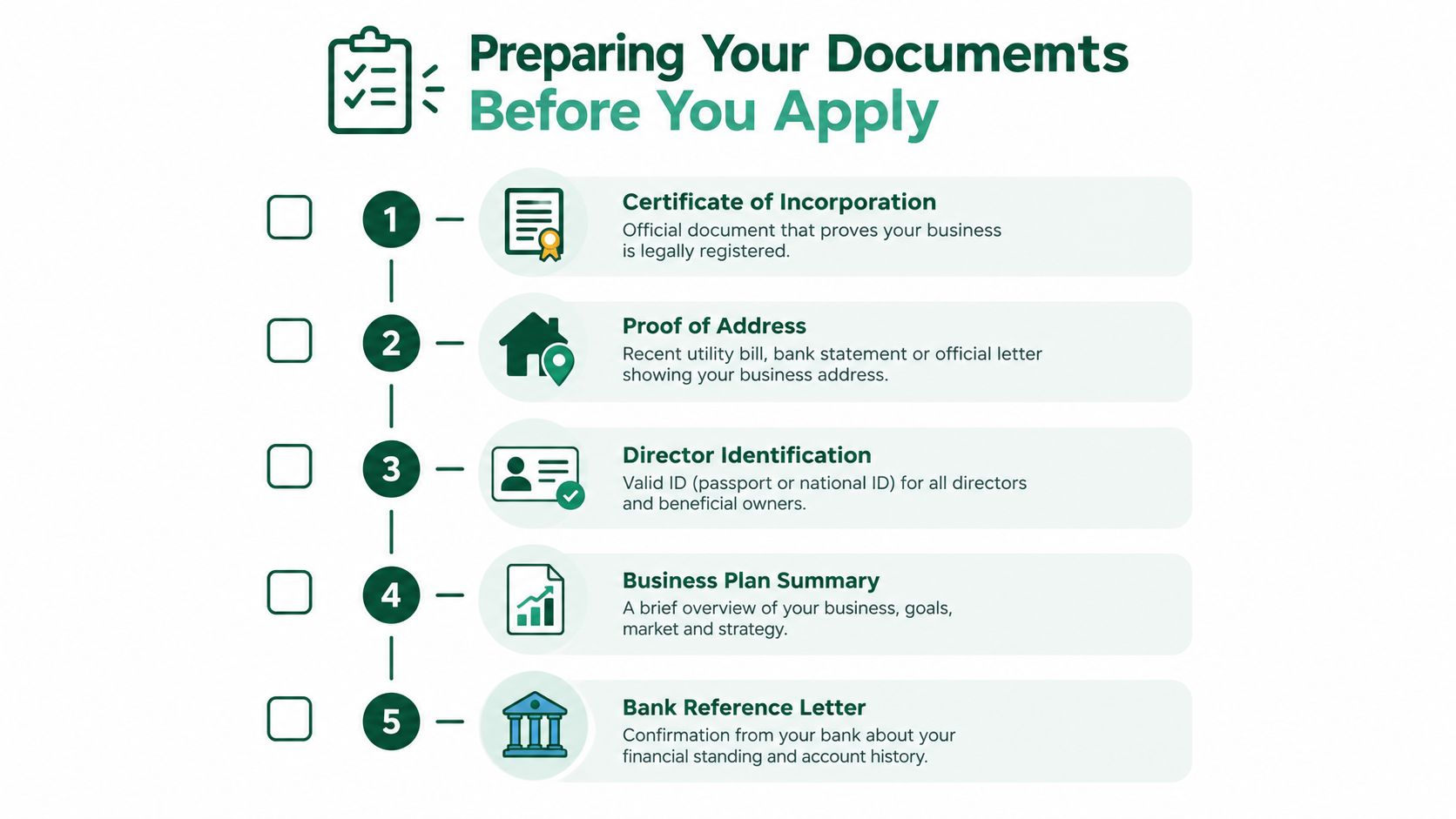
Build the pack in this order:
- Company foundation: Certificate of incorporation, constitutional documents, registered office evidence, and tax or VAT identifiers where available.
- Ownership control: A current ownership chart, shareholder ledger, UBO register details, and identification plus address evidence for directors and UBOs.
- Commercial reality: Website evidence, draft or signed contracts, sample invoices, platform screenshots, or a concise business plan showing what you sell and to whom.
- Transaction profile: One page covering expected customers, countries, currencies, payment counterparties, typical invoice size, and expected volumes.
- Source of funds: A short explanation of startup capital and early revenue, supported by documents you can produce.
FATF standards require financial institutions to identify and verify customers, take reasonable measures to verify beneficial owners, and understand ownership and control structures when establishing a business relationship, as set out in the FATF Guidance on Transparency and Beneficial Ownership. That is why vague answers fail. Consulting, marketing, trading, or IT services tells a reviewer almost nothing.
Pre-submission rule: If your transaction profile wouldn't make sense to a stranger in two minutes, rewrite it before a compliance analyst has to guess.
Check transliterations letter by letter. Reconcile the UBO register, shareholder ledger, and application form. Don't use a residential address without evidence. Don't project volumes that contradict a brand new company with no contracts. Unexplained nominee or layered ownership invites manual review. A document control checklist won't guarantee approval, because every institution applies its own risk appetite, but it'll remove the errors you control.
Remote Verification and the Online KYC Flow
Remote verification usually starts with identity capture, liveness checks, document uploads, and questions about ownership and activity. The image below captures the part founders recognize, the phone based check during a digital signing process.

What happens next matters more. A reviewer compares your documents against registries, checks names and addresses, tests whether the stated activity matches your website and contracts, and asks follow up questions where the story has gaps. E signatures and secure online notary sessions can remove travel, but they don't remove judgment. Recent banking research identifies onboarding difficulty as a challenge for 37% of surveyed banking executives, noted in the FIS 2025 Global State of Digital Business Banking report. Providers feel the friction too, which is why clear files move faster.
The video that follows gives useful context on the verification experience founders should expect before account activation.
Answer through the same verified contact channel and answer the exact question asked. If they request proof for one UBO address, don't send six unrelated files. If your first client contract is unsigned, say so and provide the proposal, email trail, or platform evidence instead. Good identity verification solutions reduce friction, but consistency is what gets you through manual review.
Don't assume online means no follow up. The World Bank counts a procedure as online only when the platform functions without major issues, most entrepreneurs use it, and no in person follow up is required, as explained in its Starting a Business FAQ. Ask what's remote, what's separate, and what still needs verification.
Realistic Timelines and What Each Milestone Looks Like
The advertised formation timeline is not your banking timeline. Treating them as one date is how founders promise clients an IBAN they don't have, delay first invoices, and scramble to reroute payroll. Plan the sequence, then plan your commercial commitments around it.
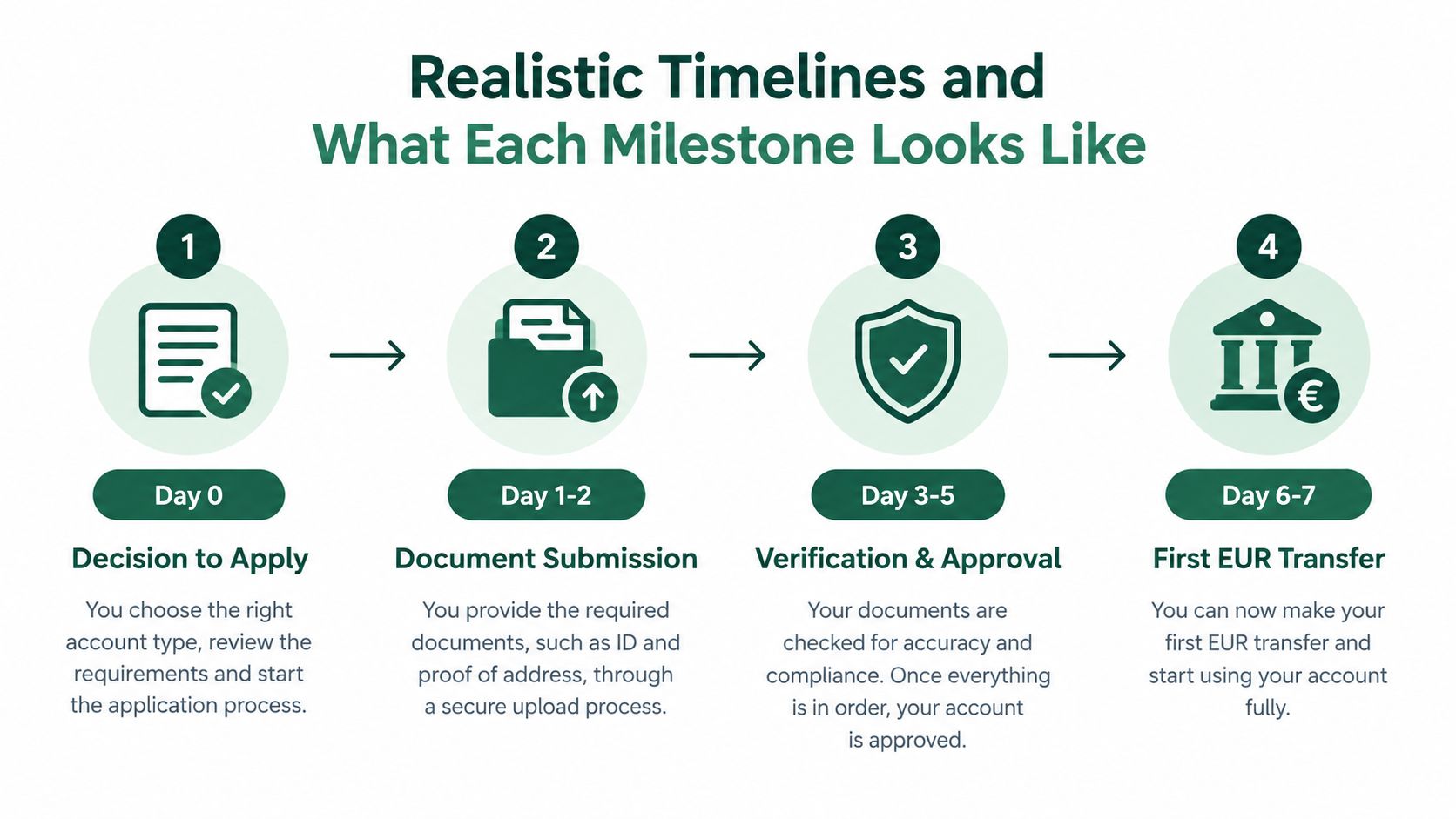
Start with incorporation and registered office setup, then UBO and tax steps, document preparation, provider submission, compliance review, activation, and a small test transfer. Each stage has a different owner. Registries control company records. Tax authorities control identifiers. You control document quality and response speed. The provider controls risk approval. Nobody serious can guarantee every stage.
Digital systems can cut friction sharply when registries, tax authorities, and payment steps connect properly. World Bank research gives a Belgium comparison of €140 for online registration versus €2,004 for paper based registration, described in its World Bank Open Knowledge Repository publication. That's a strong case for electronic filing, timestamped receipts, and secure signatures. It is not proof that banking approval arrives with the incorporation certificate.
Where Days Disappear
- Name mismatches: A passport, registry extract, and application form that don't match force manual correction.
- Thin activity evidence: Reviewers pause when a new company expects international volume but shows no client pipeline.
- Slow replies: Every unanswered clarification resets attention and pushes your file behind cleaner applications.
- Separate registrations: Beneficial owner disclosure, tax registration, identity verification, payment, and certificate issuance may be distinct procedures even on one website.
Build slack before your first material receipt. Confirm the IBAN name format, test a small EUR transfer, check statement exports, and connect accounting before you tell every client to switch payment details.
Comparing Tax Environments for New Businesses
Headline tax rates are useful. They're also abused. A low corporate rate doesn't erase founder tax residence, permanent establishment exposure, withholding tax, payroll costs, VAT duties, or dividend treatment. If a provider sells you a country on one number and won't discuss those layers, walk away.
Bulgaria's headline corporate income tax rate is a flat 10%, compared with the 21% federal corporate rate in the United States and the 25% standard rate commonly associated with Germany, as summarized in the PwC Bulgaria Corporate Taxes on Corporate Income summary. Non resident companies are generally taxed on Bulgarian source income through a permanent establishment and or withholding tax, depending on circumstances. Ireland is often placed in the same comparison set by EU founders, but you still need the same residence and substance analysis there. Don't import a headline into your forecast until an adviser maps where management, customers, revenue, and personal residence sit.
Ask four questions in order. Where is the company tax resident? Where are you personally tax resident? Could your activity create a permanent establishment somewhere else? How will profits reach you, and what withholding or personal tax applies then? Those answers decide whether Bulgaria's 10% rate improves your overall position or adds a second compliance system.
Online tax administration now supports that discipline. OECD data report 98.3% of tax administrations provide online taxpayer registration, while 87.0% provide online corporate income tax registration and 92.0% provide online VAT registration, according to the OECD Tax Administration 2025 Registration and Identification chapter. Keep digital copies of filings, payment confirmations, identity checks, and tax correspondence in one controlled file. You'll reuse them for banking, VAT, accounting, and renewals. If you want the wider comparison framework, start with these corporate tax rates and then test the result against your own residence position.
Where a Formation Provider Fits
For founders choosing Bulgaria, FastCorp forms an EOOD or OOD fully online in 3 to 5 working days or in person in Sofia in 2 to 3 working days, and can coordinate VAT registration, a Sofia virtual office and registered address, banking assistance through partner providers, bookkeeping, VAT returns, and annual filings. Its stated packages are €1,750 online and €1,500 in person, with legal and government fees included per package, plus optional airport pickup for the in person route and remote online notary support for the online route.
Use that kind of service for execution and coordination, not as a substitute for tax advice. Formation, banking onboarding, VAT setup, and accounting should point to the same company details and transaction story. That coordination is practical value. Everything can be handled online and very easily when the documents are clean, and that's the enthusiastic part I stand behind. The tax result still depends on your facts, not on a sales page.
Decision test: Choose the structure you can explain, document, and operate every month, not the one with the most attractive isolated rate.
Keeping Your Business Bank Account Healthy After Approval
Approval is a starting line with monitoring attached. Providers compare what you do with what you said you'd do. When volumes, countries, counterparties, or payment types drift without explanation, reviews follow. That's not persecution. It's ongoing customer due diligence.
Maintain a live evidence file from day one:
- Client proof: Signed contracts, proposals, platform statements, invoices, and delivery records.
- Company proof: Ownership records, registry extracts, tax registrations, VAT filings, and updated director or UBO changes.
- Payment proof: Source of funds notes, processor reports, refund records, and explanations for one off large transfers.
- Operating proof: Supplier agreements, payroll records, lease or virtual office documents, and major expense invoices.
Separate operating money, tax reserves, and payroll reserves so a review or temporary restriction doesn't turn into missed obligations. That separation also improves daily decisions, and it's central to learning how to manage cash flow without guessing your real available balance. Review monthly patterns against the onboarding forecast. If a new marketplace, country, or unusually large client payment is coming, contact the provider before the money lands and attach the contract.
Never split transactions to evade thresholds. Never describe the business generically to stay under the radar. If activity changes materially, update the profile. Keep the company name consistent across invoices, processor accounts, contracts, and the bank account. The founders who keep accounts healthy aren't lucky. They're boring in the best possible way, predictable, documented, and quick to explain change.
Ready to pair a Bulgarian EOOD or OOD with banking onboarding that's prepared for real KYC review, not just a fast application? Visit FastCorp to compare the fully online and in person Sofia setup routes, including VAT registration, registered address, banking assistance, and ongoing accounting. Bring your document pack and transaction profile, and start with a structure you can keep operating confidently after approval.