Bookkeeping Services Online for EU and Bulgarian Companies
Bookkeeping Services Online. Discover how online bookkeeping services help EU founders manage VAT, payroll, and corporate tax with ease. A practical guide
You've registered a Bulgarian company from abroad, opened a business account, and started invoicing clients across Europe. Then, late at night, a notification arrives about a VAT filing. The portal is unfamiliar, the company's UIC number is buried in an email, and the bank wants beneficial-owner documents before it will release the next payment.
That's the point at which many non-resident founders discover that incorporation is only the beginning. Bookkeeping services online can make the administration remote and convenient, but convenience only matters when the underlying records, approvals, and filings are correct. A clean dashboard isn't proof of compliance.
For an EU-registered Bulgarian company, the right online bookkeeping setup should give you a reliable digital back office, a named human reviewer, and a clear division of responsibility. It should also make every VAT figure and annual account traceable back to the original invoice, bank movement, or payment-platform settlement.
Table of Contents
- A Founder's First Week With an EU Company
- What Online Bookkeeping Services Actually Do
- Bulgaria Versus Other EU Jurisdictions on Tax
- Inside a Monthly Online Bookkeeping Workflow
- Onboarding With FastCorp Step by Step
- How to Compare and Choose the Right Provider
- Where Automation Stops and Human Control Starts
- Your Next Steps and the Road Ahead
A Founder's First Week With an EU Company
A German developer I'll call Lukas opens his laptop at 11pm after a full day of client work. He sees an unfiled VAT notification, an unfamiliar Bulgarian tax code, and a request from the bank for beneficial-owner paperwork. His invoices were paid in euros, but the accounting records need to distinguish transaction currency from reporting currency. His payment provider shows one balance, the bank shows another, and nobody has explained which figure belongs in the ledger.
The small problems arrive together. There's no local phone line for a quick call with an institution. A payroll registration appears to require Bulgarian identification details. The company's UIC and EIK are somewhere in the incorporation folder, while the founder is still deciding whether Stripe, PayPal, and the corporate bank should feed into one accounting system or remain separate.

This isn't an unusual failure of intelligence. It's a failure of ownership and workflow. The founder assumes that company formation, banking, VAT registration, bookkeeping, and tax filing are one connected service. In practice, they're different processes that must exchange the same documents and data without gaps.
Practical rule: If you can't identify who owns the next filing, who reviews it, and where the supporting evidence is stored, the process isn't online compliance. It's a queue of unresolved tasks.
The rest of the setup should answer the questions Lukas is facing. What does the service record? Which transactions does the accountant review? How are EU sales classified? What does the founder approve personally? How does the provider prove that a submitted return matches the source records?
The answer isn't to create more spreadsheets. It's to build a controlled remote back office from the first transaction, with secure document exchange, connected systems, monthly reconciliations, and a calendar of Bulgarian obligations.
What Online Bookkeeping Services Actually Do
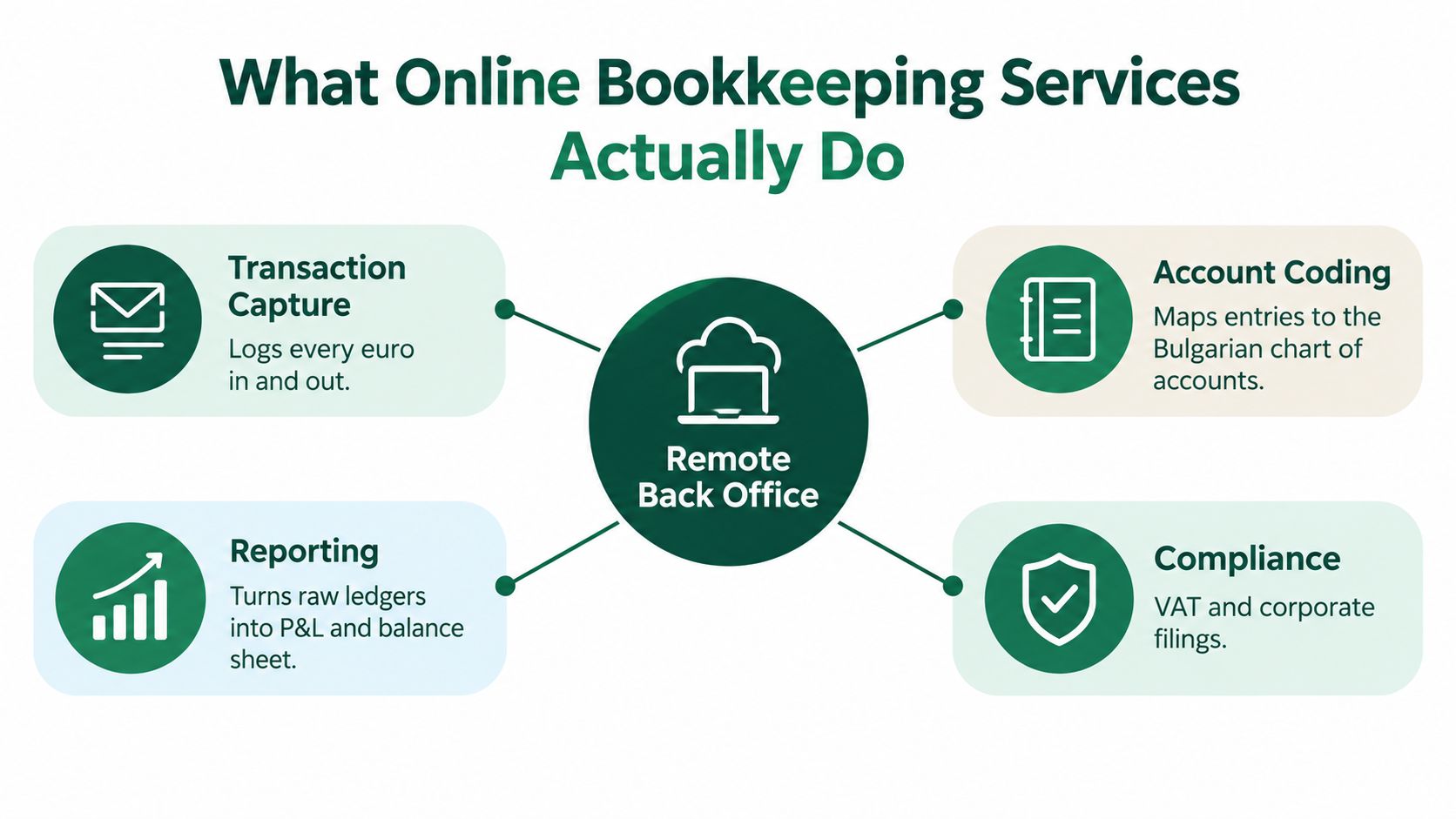
Online bookkeeping is a remote back-office function. It collects financial documents and transaction data, records each movement in the company ledger, assigns the correct accounting treatment, reconciles balances, and prepares the information needed for statutory reporting.
Think of it as a chain rather than a software subscription. The bank feed supplies movements. Receipt capture stores evidence. The ledger maps each entry to the Bulgarian chart of accounts. Reporting turns those entries into management information. Compliance work uses the reviewed records for VAT and corporate filings.
A credible service should cover these building blocks:
- Transaction capture: Bank accounts, cards, payment processors, ecommerce platforms, and expense tools should feed the ledger through controlled integrations.
- Document collection: Supplier invoices, customer invoices, credit notes, contracts, payroll records, and receipts should sit in a central repository with access controls.
- Account coding: Each entry needs a classification that reflects its commercial purpose, tax treatment, currency, and relationship to the company.
- Reconciliation: The bookkeeper must compare ledger balances with bank statements, payment-platform reports, supplier records, and customer receipts.
- VAT maintenance: The service should maintain VAT records, flag missing evidence, classify relevant transactions, and prepare the required return data.
- Monthly closing: A close process should identify unreconciled items, failed integrations, unusual entries, and missing documents before management reports are issued.
- Payroll journals: Where the company has employees or directors receiving remuneration, payroll calculations and postings need separate review.
- Annual reporting: The provider should prepare annual financial statements and corporate tax information from a complete ledger.
- Human sign-off: Software can suggest coding and identify exceptions. A qualified accountant must review the result.
The distinction between bookkeeping and accounting matters. Bookkeeping records and reconciles the activity. Accounting professionals interpret the records, review tax treatment, prepare filings, and deal with compliance-sensitive judgments. You need both functions if the company sells across borders or uses several payment channels.
Cloud delivery also changes access. The cloud accounting market data describes a broader move away from locally installed systems, with small and medium-sized businesses representing a substantial share of users. For a non-resident founder, that shift is practical. Financial records, invoices, reports, and supporting documents can be shared with an external professional without maintaining an accounting installation in Bulgaria.
The important question isn't whether the provider uses modern software. Ask whether the provider can show you the monthly deliverable, the exception report, the document trail, and the name of the person responsible for review.
Bulgaria Versus Other EU Jurisdictions on Tax
A non-resident founder can run an EU-registered Bulgarian company from abroad, but the tax advantage only helps if the bookkeeping and filings are correct. Bulgaria's headline position is clear: the Ministry of Finance identifies a 10% corporate income tax rate, and the tax year follows the calendar year. Companies generally submit the annual corporate return between March and June of the following year, subject to applicable exceptions and conditions. For a fuller breakdown, see our analysis of Bulgaria's tax rate.
Use the Bulgarian Ministry of Finance tax information as the starting point. It does not replace a review of the company's VAT registration, payroll, withholding obligations, or the founder's personal-tax position.
Ireland, the Netherlands, and Germany can all suit international founders, but they create different administration requirements. A headline corporate rate is only one line in the decision. VAT treatment, payroll, substance, accounting records, banking, annual filings, related-party transactions, and the founder's tax residence can change the result.
Tax and Compliance Comparison: Bulgaria and Ireland
| Metric | Bulgaria EOOD | Ireland Ltd |
|---|---|---|
| Company structure | An EOOD suits a single shareholder and can be administered with support from a Bulgarian accountant. | An Ltd is commonly used for a single-owner company and follows Irish incorporation and accounting processes. |
| Corporate tax | Bulgaria has a 10% corporate income tax rate. | The applicable rate depends on the company's activities and tax classification, so the provider must calculate the position from the actual business model. |
| VAT | Registration and reporting depend on the company's activities, transactions, and registration status. | Registration and filing duties depend on the business and taxable supplies. |
| Payroll | The director's remuneration, social-security position, and any employee payroll require local review. | Director remuneration and employment status require Irish review. |
| Remote administration | Online document exchange can support a non-resident founder, provided records, approvals, and filing evidence remain retrievable. | Remote operation is possible, while Irish compliance responsibilities remain with the company and its advisers. |
The table gives a useful starting comparison, not a universal answer. A Bulgarian EOOD may be simpler for a sole shareholder who wants a lower headline corporate rate and remote coordination. An Irish Ltd may be the better fit where the business already has Irish operations, staff, customers, or management substance. The Netherlands BV and German UG bring their own incorporation, administration, payroll, and reporting requirements. Choose the jurisdiction that matches the company's real activity, not the one with the most attractive isolated number.
The founder's tax residence deserves separate attention. A Bulgarian company does not automatically make a non-resident founder a Bulgarian tax resident, and remote management from another country can create questions about management, payroll, or taxable presence. The bookkeeping provider should ask where the founder works, where decisions are made, where staff operate, and where customers and suppliers are located.
Bulgaria's practical advantage is the combination of a low corporate rate, a single-shareholder structure, and bookkeeping that can be coordinated online. Its weakness is equally clear: the accountant must understand Bulgarian records and EU transactions. A low rate does not correct a wrongly classified invoice, missing support, incorrect VAT treatment, or payroll handled in the wrong jurisdiction.
Digitisation also changes the accountant's role rather than removing it. U.S. labour data recorded by the Federal Reserve records approximately 1,321,600 jobs in 2025, compared with 1,189,500 in 2021, across accounting, tax preparation, bookkeeping, and payroll services. For a Bulgarian company run by a founder abroad, that supports a practical conclusion: software can move documents and flag discrepancies, but a qualified professional still needs to review classifications, filings, and cross-border consequences.
Inside a Monthly Online Bookkeeping Workflow
A Bulgarian EOOD should run a repeatable monthly cycle. The founder uploads or connects the source data, the software imports transactions, and the accountant investigates anything that doesn't reconcile. The service shouldn't just produce a green dashboard.
Capture and reconciliation
Bank and card feeds import transactions into the cloud ledger. Payment processors require separate attention because a payout often combines gross sales, processing fees, refunds, chargebacks, and currency conversion. The bookkeeper should match the settlement report to the bank receipt rather than record the payout as uncomplicated revenue.
Supplier invoices and customer receipts then support the coding. Each transaction needs a clear account, tax treatment, currency treatment, and document reference. Missing invoices should appear on an exception list, not disappear into a suspense account.
VAT and payroll preparation
For VAT-registered companies, the system must preserve a digital audit trail. The United Kingdom's Making Tax Digital guidance provides a useful operational benchmark: transaction-level records should support the VAT return, and connected systems should exchange data through digital links rather than manual copy-and-paste.
That principle matters for Bulgarian companies using ecommerce, banking, payroll, and payment tools. The accountant should review:
- Domestic transactions: Confirm the correct local treatment and supporting invoice.
- EU business sales: Validate the customer's status, location, and evidence supporting the treatment.
- Reverse-charge entries: Check that the transaction has been classified consistently in both the sales or purchase records and the VAT reporting.
- Imports and non-EU sales: Separate customs and VAT evidence from ordinary supplier documentation.
- Payroll: Confirm employee or director records, payroll journals, and payment instructions before processing.
The software can import data and propose classifications. It can't decide whether a founder's personal expense belongs in the company or whether a customer's evidence supports a particular VAT position.
Close and filing control
At month-end, the accountant reconciles bank and payment-platform balances, reviews open items, checks fixed assets and depreciation, and issues management reports. The close should include a written list of unresolved matters and the person responsible for clearing each one.
VAT and annual corporate obligations must be placed on a shared calendar. For online sellers, the European Commission's VAT One Stop Shop guidance explains how OSS can centralise covered cross-border B2C declarations and payments in one Member State. Your bookkeeping system still needs to separate domestic sales, EU B2B transactions, EU B2C transactions, and non-EU sales, then reconcile the OSS figures to the sales ledger.
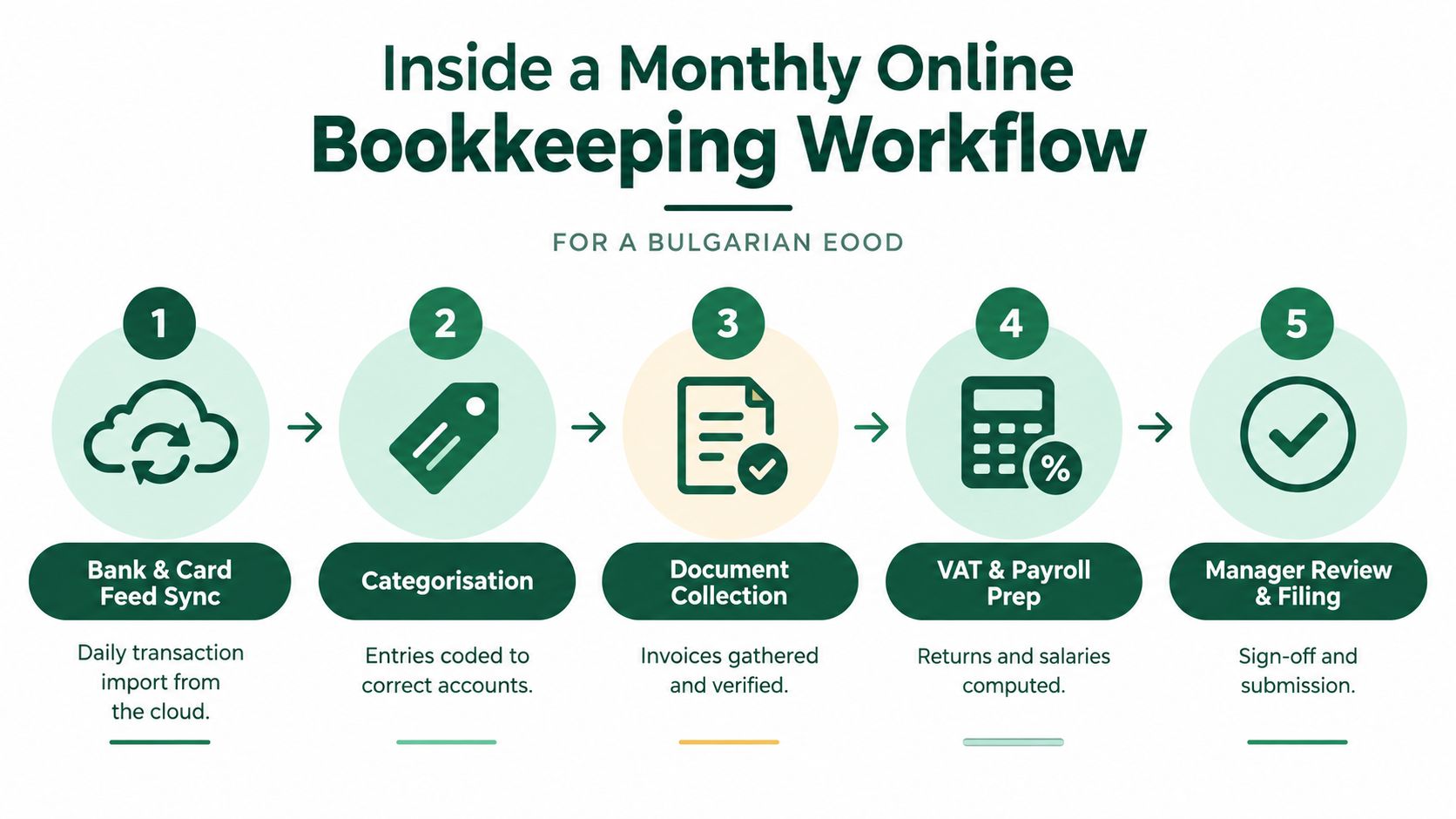
Software handles imports, reminders, and recurring calculations. A qualified accountant reviews exceptions, tax classifications, reconciliations, and filing evidence. That split is the difference between automation and controlled automation.
Onboarding With FastCorp Step by Step
A non-resident founder should expect onboarding to begin with identity and ownership evidence, not with a software login. The provider needs enough information to form the company correctly, establish the bookkeeping file, and understand how the business will trade.
First, establish the facts
The initial discovery call should identify the shareholder, director, business activity, expected customers, payment channels, staff plans, VAT position, and intended banking route. The founder normally provides a passport, proof of address, business description, and ownership information. If a representative will act on the founder's behalf, the provider may require a power of attorney with the appropriate certification or apostille.
Don't send documents through scattered email threads. Use a secure portal and ask where the records will be stored, who can access them, and how approvals will be recorded.
Second, form the Bulgarian company
The legal team prepares the incorporation documents for the Bulgarian Commercial Register and obtains the company identifiers, including the UIC and EIK used in administration. The founder reviews the ownership and management documents, signs them through the agreed process, and confirms the registered address.
The company structure should match the actual business. A single-shareholder EOOD can be appropriate for one owner, while an OOD may suit multiple shareholders. The accounting setup must reflect that structure from the opening entry.
Third, establish banking and payment channels
The founder provides ownership documents, business information, and the expected transaction profile. The provider assists with an account application through a Bulgarian or EEA banking route that supports the company's operations.
Banking approval isn't guaranteed by incorporation. Compliance teams may ask about customers, suppliers, source of funds, business model, and expected countries of activity. Prepare clear answers before the application starts.
Fourth, configure the cloud ledger
The accountant creates the chart of accounts around the company's actual activity. Integrations may include the bank, Stripe, PayPal, an ecommerce platform, expense capture, and payroll tools. Each connection should be tested with real transaction types, including refunds, fees, foreign-currency settlements, and transfers between accounts.
The founder provides access through controlled permissions, not by sharing a master password. The accountant confirms the mapping rules and documents which system is the source of truth for each data category.
Fifth, run the first close and filing
The first month should be treated as a controlled parallel process. The provider collects opening balances, checks historic documents, reconciles imported activity, reviews VAT registration status, and prepares the first applicable filing.
A reliable timeline depends on document completeness, authority processing, banking checks, and the company's transaction complexity. Don't accept a promise based only on an incorporation target. Ask for milestones, owner actions, dependencies, and the date on which the first reviewed monthly pack will be delivered.
How to Compare and Choose the Right Provider
Price is a filter, not a selection method. A cheap package that excludes VAT work, payroll, catch-up bookkeeping, or year-end reporting can cost more once the missing tasks appear.
Use a scoring sheet and make the provider answer the same questions in writing. The FastCorp accounting services overview is one example of the type of scope a founder should examine, including bookkeeping, VAT filings, annual reporting, and payroll support. Compare the actual deliverable, not the label attached to the package.
Online Bookkeeping Provider Comparison Criteria
| Criterion | What to look for | Red flag |
|---|---|---|
| Pricing transparency | A clear monthly scope, treatment of transaction volume, extra fees, setup work, payroll, VAT, annual accounts, and EUR invoicing. | The provider gives a low entry price but won't define exclusions. |
| Software stack | A ledger that supports the business model, multi-currency records, bank feeds, ecommerce, Stripe, PayPal, and document capture. | The service depends on manual spreadsheet imports for core activity. |
| Local compliance | A team that understands Bulgarian accounting, VAT, annual reporting, payroll, and cross-border transactions. | The provider offers generic international bookkeeping without naming the local reviewer. |
| Data protection | EU-based processing where appropriate, a GDPR-compliant data processing agreement, two-factor authentication, and role-based access. | Staff share logins or the provider can't explain retention and access controls. |
| Human review | A named accountant, documented month-end close, exception reporting, and a response arrangement that overlaps with your timezone. | No supervising accountant and no sample monthly deliverable. |
| Evidence trail | Source documents, timestamps, mapping logic, reconciliation status, and filing confirmations remain retrievable. | The provider sends only a dashboard and cannot show how figures trace to source records. |
Score the categories according to your risk. A simple service business may place more weight on predictable pricing and responsive review. An ecommerce company should give greater weight to payment-platform reconciliation, VAT classification, OSS evidence, and multi-currency handling.
Ask for a sample monthly management pack before signing. It should show more than profit and loss. Look for a balance sheet, reconciliation status, missing-document list, VAT working papers, unusual-item commentary, and clear approval points.
The provider should be able to explain the company's numbers to you without hiding behind the software.
Also ask what happens when a bank feed fails, a transaction is duplicated, a customer changes country, a refund arrives after month-end, or tax rules change. These events reveal the operating quality of the service faster than a polished sales presentation.
Where Automation Stops and Human Control Starts
A fully online service doesn't mean a fully hands-off company. The founder can delegate recording, reconciliation, report preparation, and filing administration. The founder can't delegate every commercial and ownership decision.
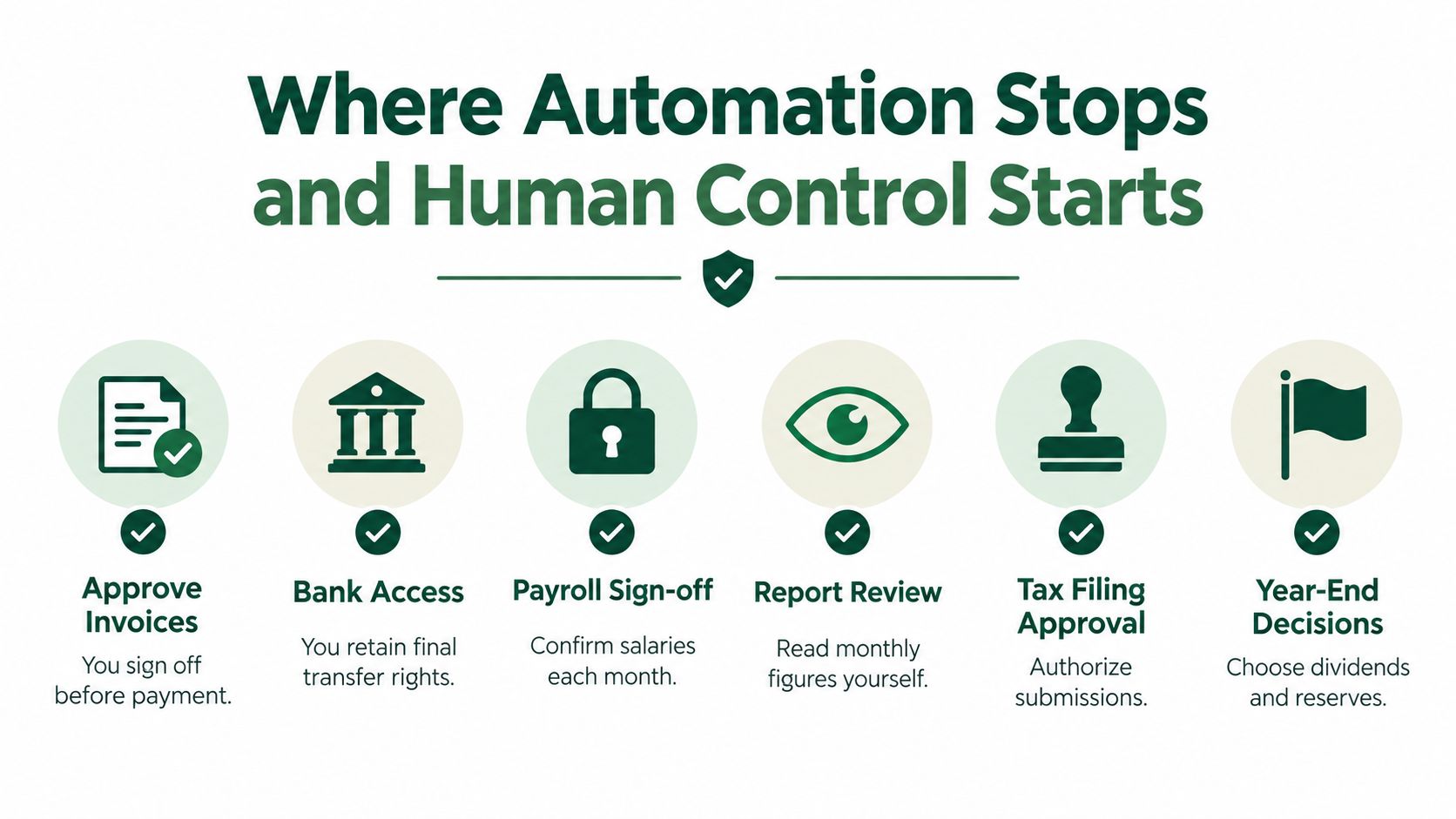
Keep control of the following:
- Payment approval: Confirm invoices and payment runs before money leaves the company account.
- Bank permissions: Retain final transfer rights and review who has access to banking tools.
- Payroll sign-off: Approve salaries, director remuneration, deductions, and the payment list.
- Management reports: Read the monthly figures and ask about unexplained movements.
- VAT submissions: Review the summary and supporting schedules before authorising submission.
- Year-end decisions: Decide how profits, reserves, dividends, and founder withdrawals will be handled.
Automation is useful when the rule is stable and the exception is visible. It becomes dangerous when the system accepts a bad assumption without flagging it. A recurring invoice can be posted correctly for months and then fail when the customer changes location or the payment processor changes its settlement format.
A provider also can't repair a late invoice that the founder never issued, reconcile a Stripe balance that has never been checked against payouts, or decide whether a personal withdrawal is salary, dividend, expense reimbursement, or an amount due from the shareholder. Those are decisions with tax, legal, and company-law consequences.
The role of automation in accounting should therefore be defined in the engagement terms. The software captures and flags. The accountant reviews and advises. The founder approves transactions, confirms business facts, and remains responsible for ownership, substance, and commercial decisions.
Online tax administration makes this division more important, not less. The OECD's Tax Administration 2025 report describes widespread electronic filing and broader digital interaction between taxpayers and administrations. Bulgaria's corporate return process includes electronic filing requirements for companies, so the provider must preserve submission evidence while the founder keeps an approval trail.
Your Next Steps and the Road Ahead
Choose the entity first, then match bookkeeping scope to the company's real obligations. A Bulgarian EOOD selling services to EU businesses needs a different control design from an ecommerce company collecting payments through several marketplaces. Don't buy a generic package and hope the accountant will discover the gaps later.
Use this decision sequence:
- Define the operating model: List customers, countries, currencies, payment providers, staff, contractors, inventory, and expected transaction types.
- Map the compliance work: Separate bookkeeping, VAT, payroll, annual accounts, corporate tax, OSS, and any cross-border reporting.
- Stress-test the provider: Request a sample monthly pack, ask who reviews the records, and test how exceptions are handled.
- Keep founder controls: Approve payments, review reports, confirm VAT classifications, and retain access to the evidence.
Take three actions this week. Ask each shortlisted provider for a sample monthly report. Put the next Bulgarian VAT, payroll, annual reporting, and corporate-tax dates on your personal calendar. Then audit every bank and payment integration, checking whether balances, fees, refunds, and currency conversions reconcile to the ledger.
Bulgaria's compliance environment is becoming more digital, with official company and tax processes increasingly supported online. The World Bank's Bulgaria business assessment.pdf) describes online company registration and connections between registration, tax, and social-security information. That convenience only works when identity checks, signatures, documents, permissions, and filing confirmations remain available for later review.
The right provider will help you operate remotely without making the company invisible to its own owner. Select a service that connects the records, the local rules, and the human decisions.
FastCorp provides Bulgarian company formation, EU VAT setup, banking assistance, remote bookkeeping, VAT returns, payroll support, and annual corporate reporting for non-resident founders. Visit FastCorp to discuss a fully online compliance setup for your Bulgarian company.