Reverse Charge VAT in the EU: A Clear Guide for 2026
Reverse Charge VAT explained for EU B2B deals: who pays, how to invoice in Bulgaria, country comparisons and the mistakes to avoid.
Under reverse charge VAT, the customer, not the supplier, calculates and reports the VAT, and the supplier invoices without charging it.
You're about to pay an overseas consultant, or your first EU business customer has asked for an invoice without VAT. Your accounting software offers several tax codes, and choosing “no VAT” feels simpler than deciding which one is legally correct. The manageable approach is to identify where the service is taxable, who accounts for it, and what evidence you need, before touching the invoice template.
Table of Contents
- Who Pays VAT in a Reverse Charge Deal
- When Reverse Charge Applies and When It Does Not
- How the Reverse Charge Math Works in Practice
- How to Invoice Report and Correct a Reverse Charge Supply
- Reverse Charge Rules Compared Across Countries
- Set Up Reverse Charge Reporting with FastCorp
Who Pays VAT in a Reverse Charge Deal
The buyer takes over the VAT reporting duty. Think of it as moving the tax paperwork to the other side of the transaction, not removing the tax itself. The OECD International VAT/GST Guidelines describe reverse charge as switching the obligation to pay tax from the supplier to the customer.
For ordinary cross-border business services, this often means the customer handles VAT in the country where it belongs. A Bulgarian company buying qualifying consulting, agency or SaaS services therefore needs to do more than pay the supplier's net invoice.
Who accounts for VAT in common Bulgarian scenarios
The table assumes ordinary taxable services under the general place-of-supply rules. The Bulgarian purchase examples use the 20% applicable rate illustrated in the worked calculation below, rather than suggesting every service attracts that rate.
| Scenario | Who accounts for VAT | Rate applied | Invoice treatment |
|---|---|---|---|
| Bulgarian company buys B2B services from an EU-established supplier | Bulgarian customer self-accounts | 20% Bulgarian rate for the qualifying standard-rated service | Supplier invoice with no VAT and reverse charge wording |
| Bulgarian company buys B2B services from a non-EU supplier | Bulgarian customer self-accounts where Bulgaria is the place of supply | 20% Bulgarian rate for the qualifying standard-rated service | Supplier invoice with no Bulgarian VAT; customer reports it |
| Bulgarian company sells B2B services to a VAT-registered customer in another EU country | Customer self-accounts in its own country | Customer's applicable local rate, not charged by the Bulgarian company | Reverse charge wording plus both VAT numbers |
| Bulgarian company sells to a private customer in another EU country | Not reverse charge; consumer VAT rules apply | Customer-country rate where destination taxation applies; otherwise the rate set by the applicable consumer rule | Standard invoice, checked against consumer rules |
The consumer row needs particular care. A foreign address doesn't automatically make a service taxable in the customer's country, just as it doesn't automatically justify removing VAT.
A quick business-status test
Before selecting a row, ask:
- Customer status: Is the customer a VAT-registered business?
- Business use: Is this a business-to-business service?
- Supplier location: Is the supplier established elsewhere?
Answering yes identifies a likely cross-border B2B route, subject to the service-specific exceptions. Use our guide to European VAT number validation to establish a repeatable checking process, rather than accepting a number printed in an email signature.
When Reverse Charge Applies and When It Does Not
Reverse charge is a B2B tool, not a foreign-customer discount. The European Parliament's briefing on the reverse charge mechanism explains the customer's self-accounting role and why the mechanism isn't a general solution for consumer transactions.
Run the following checks when onboarding a customer and whenever the transaction changes. A reusable customer record makes this easy, but don't let yesterday's classification decide today's invoice automatically.
The checks that determine treatment
Establish that the customer is a taxable business. Record its legal name, business address and the capacity in which it buys the service. An individual can operate a business, so a personal name alone doesn't settle the question.
Check the relevant VAT identification. For an EU customer, validate its VAT number in VIES and retain the result. A failed validation needs investigation, not an automatic conclusion that the customer is a consumer.
Classify the service. General-rule consulting and professional services are a useful starting point, but the contract must support that classification. Describe what you supply, not merely the label your payment processor uses.
Exclude private purchases. A business owner buying something personally isn't necessarily acting as a taxable business for that purchase. Ask which entity is contracting and whether it's buying for business purposes.
Test the exceptions. A fixed establishment, services connected with real estate, admission to events or passenger transport can change the analysis. Establish where the relevant activity occurs and which establishment receives the service.
Apply the checks to real transactions
Say a Bulgarian company purchases software support from a non-EU provider. The supplier's location outside the EU doesn't, by itself, prevent Bulgarian self-accounting; the important question is whether Bulgaria is the place of supply and the relevant liability rule applies.
A non-established supplier selling to a VAT-registered customer needs the same transaction analysis. Registration evidence helps establish customer status, but it doesn't turn an exceptional service into a general-rule service.
For a freelancer serving both businesses and individuals, separate the customer categories in the accounting system. If you sell subscriptions or downloadable products, check the distinctions in VAT for digital services before applying a single tax code across your customer list.
Domestic transactions need a separate sector check. EU countries can implement targeted reverse charge for areas such as construction, immovable-property transactions and waste or used materials, as explained in the European Commission's VAT analysis.
Practical rule: Settle business status and place of supply before deciding what wording belongs on the invoice.
How the Reverse Charge Math Works in Practice
A €10,000 consulting invoice from a German consultant to a Bulgarian VAT-registered EOOD shows why reverse charge is a reporting duty. Assuming the service qualifies and the applicable Bulgarian rate is 20%, the customer records €2,000 output VAT and, with full deduction rights, €2,000 input VAT. The entries can offset each other in the return, but both still have to be calculated, coded and reported correctly.
The supplier's invoice format does not choose the rate. The Bulgarian customer applies the rate appropriate to the taxable service where the tax is due, which is why comparing countries starts with the place-of-supply rule rather than the headline VAT rate.
Follow the invoice through the accounts
The consultant issues the net invoice. It contains the agreed consulting fee, no supplier-charged VAT and the words “Reverse charge.” The Bulgarian company pays the contractual amount to the consultant.
The Bulgarian company calculates output VAT. Its accountant uses the €10,000 purchase value and the applicable local rate to record the €2,000 tax for which the customer is responsible.
The company assesses input-tax deduction. If the purchase qualifies for full deduction, the corresponding €2,000 input VAT goes into the same return. The right to deduct must be supported by the transaction and its business use.
The return includes both entries. With equal output and deductible input VAT, the reverse-charge entries produce no net VAT cash payment. They still belong in the reporting records because the tax authority needs to see the taxable purchase and the related deduction.
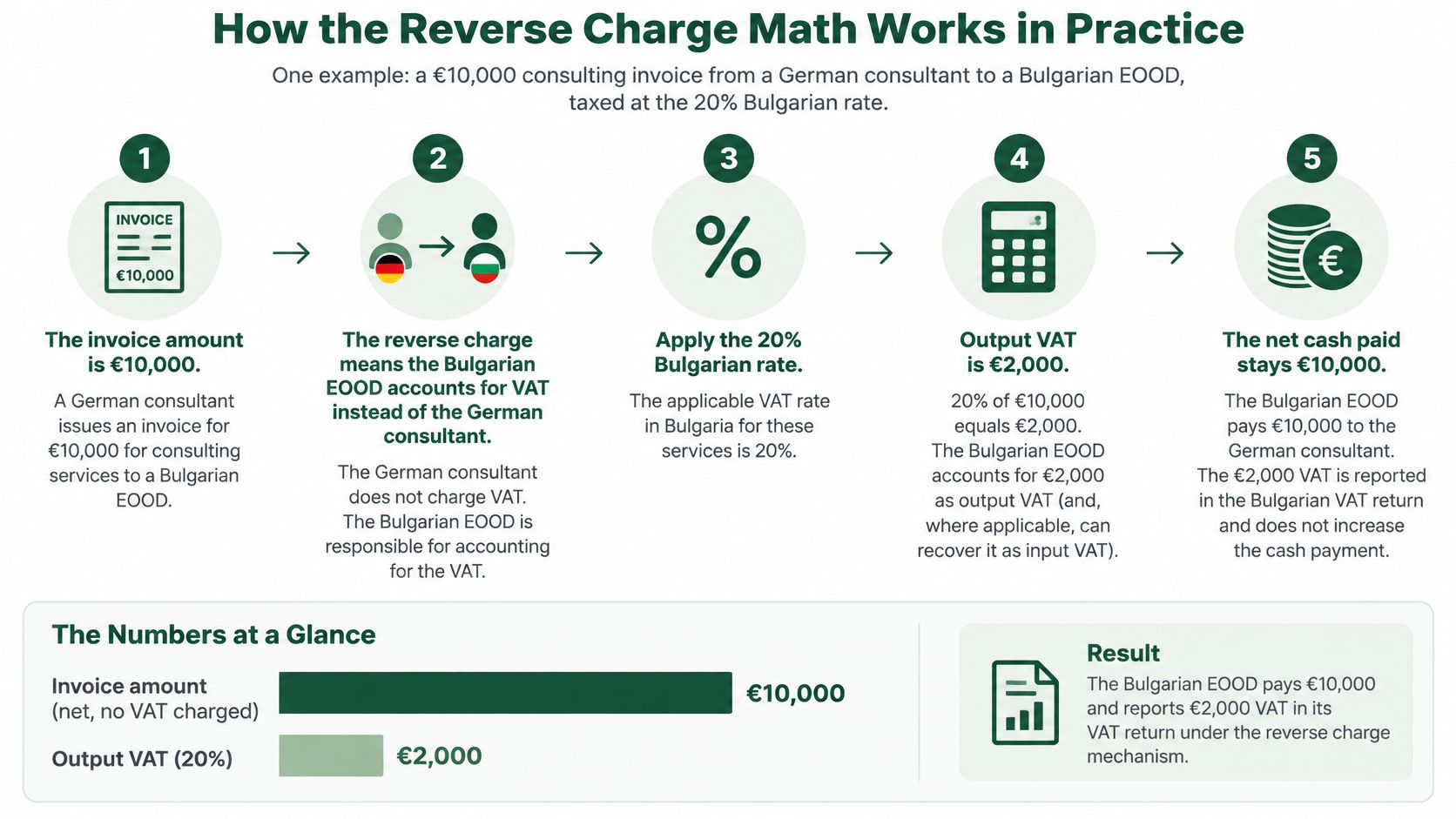
The diagram's net-payment outcome assumes full deduction. A buyer with restricted deduction rights will have a different result.
Where a real VAT cost arises
A partly exempt business may only deduct part of the input VAT. It still calculates the full output-tax liability on the purchase. Once the permitted deduction percentage is applied, any non-deductible portion remains as a real VAT cost.
That distinction matters when budgeting for overseas advice, software or agency services. A supplier invoice without VAT can look cheaper than a domestic invoice while leaving the buyer with an irrecoverable tax cost through its own return.
Use these calculations in your working paper:
- Output VAT: Net invoice value multiplied by the applicable VAT rate.
- Deductible input VAT: Calculated VAT multiplied by the permitted deduction percentage.
- Net VAT cost: Output VAT less deductible input VAT.
Work through the same calculation for both domestic and overseas purchases. Once the place of supply confirms that the buyer accounts for the tax, the applicable local rate and deduction percentage determine whether the transaction is cash-neutral or creates a cost.
Do not enter an assumed deduction percentage to make the return balance. Confirm whether the purchase relates to taxable activities, exempt activities or shared overheads, and apply the appropriate local deduction method.
A balanced VAT entry is an accounting result, not permission to skip the transaction.
Before filing, rerun the calculation using your own invoice value, applicable rate and deduction entitlement. Keep that calculation with the purchase record so another accountant can understand the treatment without reconstructing the transaction.
How to Invoice Report and Correct a Reverse Charge Supply
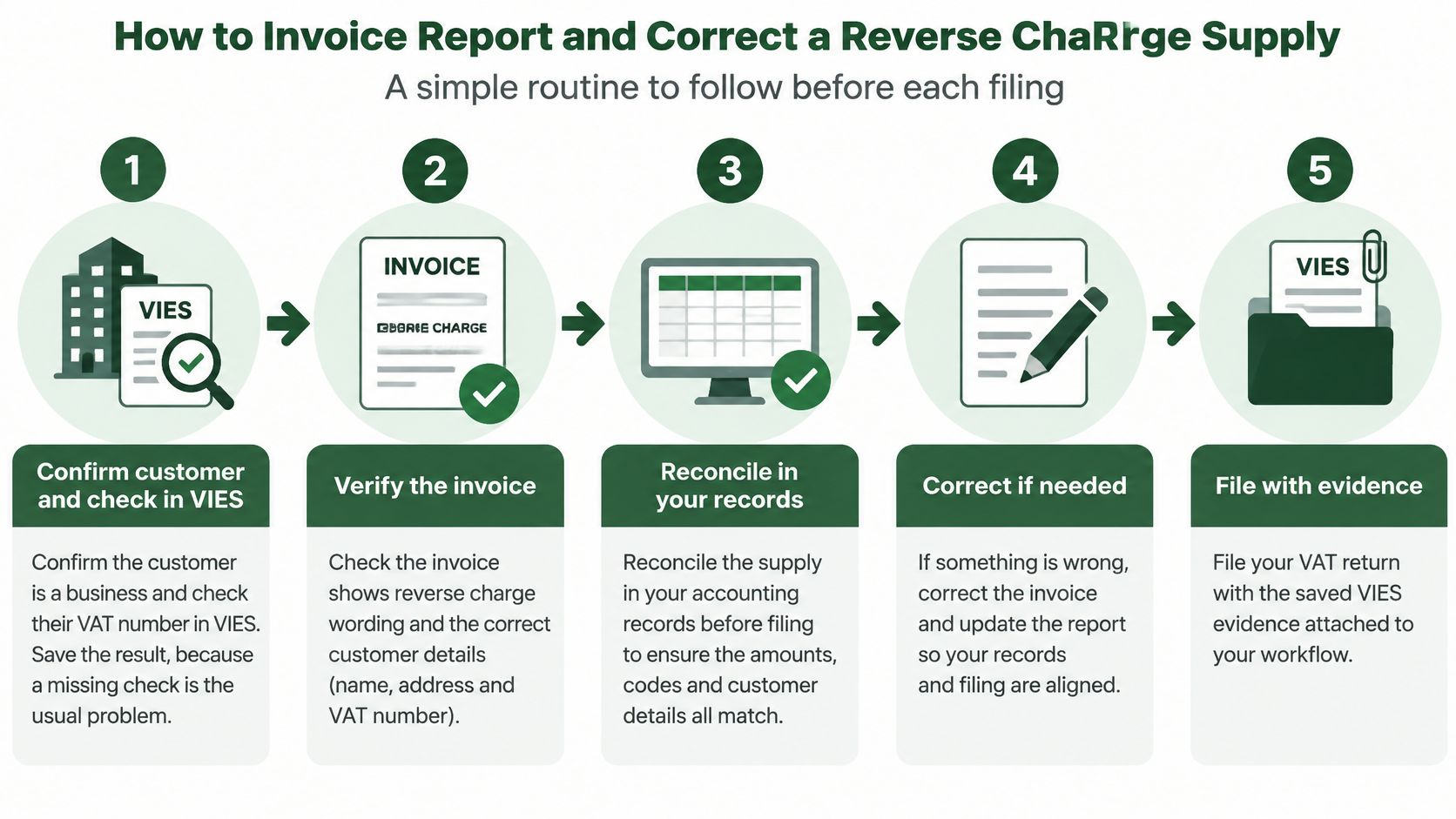
A reliable reverse-charge workflow connects customer evidence, the invoice and the VAT return. Reverse charge is a reporting duty first: the wording on the invoice means nothing if the customer entity is wrong or the transaction sits under the wrong tax code.
You can manage the routine online using VIES, invoicing software, a document folder and the relevant electronic filing system. Once the classifications are agreed, the recurring work is straightforward. Someone still needs to review exceptions.
A routine to use before filing
Confirm the business customer and save the validation. Check the EU VAT number in VIES and retain the dated result with the customer record. If the name or address doesn't align with the contract, resolve the discrepancy before relying on it.
Write down the place-of-supply decision. Record the service category, the contracting entities and any establishment involved. A short explanation is more useful than an unexplained tax-code selection.
Prepare the invoice. Include the date, invoice identification, supplier and customer details, relevant VAT numbers, service description and net amount. Show no supplier-charged VAT where reverse charge applies, and include “Reverse charge”; add “triangular transaction” only for the relevant triangular-trade case.
Record the buyer's tax entries separately. Use distinct accounting codes for reverse-charge output VAT and deductible input VAT. Don't classify the purchase as an ordinary VAT-free expense just because the supplier hasn't collected tax.
Prepare the relevant reports. Include qualifying outgoing EU supplies in the recapitulative statement, often called the EC Sales List, where required. An incoming purchase isn't automatically an outgoing EC Sales List item.
Correct the document and the reporting together. Use the locally required correction process, which may involve a credit note and replacement invoice. If the original reverse-charge classification remains correct, preserve it on the correction; if the classification was wrong, correct that too.
Keep the evidence together. Store the contract, customer-status evidence, VIES result, invoice, calculation and any correction correspondence. Use a consistent transaction reference so the records are easy to retrieve.
Steps 5 and 6 are where this routine meets the return itself. Our guide to how VAT returns work explains the reporting framework behind that reconciliation.
Common reverse charge mistakes, consequences and fixes
The corrections below assume you've first confirmed the transaction qualifies for reverse charge. Don't remove valid VAT merely because the customer has requested a net invoice.
| Mistake | Consequence | Fix |
|---|---|---|
| VAT charged on an EU B2B invoice that qualifies for reverse charge | Client overpays and the return may be wrong | Remove the VAT through the proper correction process and add reverse charge wording |
| Customer VAT number never checked | Treatment lacks supporting evidence on audit | Validate in VIES, investigate discrepancies and save the result with the invoice |
| Reverse charge wording missing | Invoice is not compliant | Issue a corrected invoice with the required wording |
| Reverse charge applied to a private customer | Wrong tax and weak compliance | Confirm business status and VAT identification first, then correct the consumer treatment |
| VAT return and VIES reporting data do not match | Possible audit query and correction work | Reconcile the relevant reports before each filing |
An absent validation record doesn't automatically prove the tax treatment was wrong. It does leave you with avoidable evidence work, especially if the customer has since changed its registration or trading details.
Prepare for digital reporting without confusing the dates
The EU adopted the VAT in the Digital Age package on 11 March 2025. EU-wide cross-border B2B digital reporting is scheduled to apply from 1 July 2030, according to the European Parliament's legislative tracker. National systems may impose earlier requirements, so treat the EU date as an outer deadline rather than a start signal.
Start with clean customer master data, separate tax codes and traceable corrections. Those controls help with current returns and leave less manual repair work when reporting requirements change.
Reverse Charge Rules Compared Across Countries
Compare place of supply and liability rules before comparing headline rates. A company's incorporation country doesn't automatically determine the VAT treatment on every invoice it issues or receives.
For a founder choosing between Bulgaria and another jurisdiction, the useful comparison is transactional: where are the customers, what services do they buy, and who reports the tax? Domestic reverse-charge categories then need a separate national check, because each country picks its own list.
Standard VAT rates and reverse charge focus in five countries
Read the rate column as the standard rate most goods and services attract. Reduced rates and exemptions still apply to specific categories, so confirm the classification for your supply date before filing.
| Country | Standard VAT rate | Reverse charge focus |
|---|---|---|
| Bulgaria | 20% | Cross-border B2B services; domestic reverse charge for listed goods and sectors |
| Germany | 19% | Cross-border B2B services; domestic reverse charge in construction and listed goods |
| Netherlands | 21% | Cross-border B2B services; domestic reverse charge in listed categories |
| Ireland | 23% | Cross-border B2B services; domestic reverse charge in construction and listed goods |
| United Kingdom | 20% | Imported B2B services where the UK is the place of supply; domestic reverse charge in construction |
The rates sit within a few points of each other, yet the reporting exposure differs by transaction type. That's why the practical distinction is between general cross-border service rules and domestic rules for specified transactions. Don't copy a construction tax code from one jurisdiction into another company's accounting file without checking local conditions first.
A UK purchase shows why jurisdiction matters
A UK business buying services from an overseas supplier works under the imported-service conditions in HMRC's VAT Notice 741A: the place of supply is the UK, the supplier sits outside the UK, the customer belongs in the UK and the supply isn't exempt. Meet those conditions and the customer accounts for the VAT.
Change the service to one connected with property elsewhere, and the first question becomes where that particular service is taxable. The foreign supplier's address alone can't answer it.
A Bulgarian business buying from a non-EU provider faces the same logic: identify the receiving establishment and service category before deciding how to report the purchase. A customer with establishments in different countries needs more care than a customer with a single operating location.
Founder's test: Compare the VAT cost of your actual customer and supplier mix, not the rate printed beside a country's name.
Full input-tax recovery can shrink a rate difference to a reporting duty rather than a real cost. Restricted recovery, consumer sales and extra registration obligations can make it decisive, so match the structure to the transactions you'll run.
Set Up Reverse Charge Reporting with FastCorp
Start with your current invoice list, not an application for another VAT number. Export your cross-border sales and purchases, identify the contracting entities, and mark each transaction against the relevant Bulgarian scenario.
Give unresolved items a named owner. A missing customer-status check, an uncertain establishment or an incorrectly charged invoice needs a decision before the filing deadline, not another spreadsheet tab.
Turn the invoice list into an operating process
- Customer records: Keep legal names, addresses, VAT identification and validation evidence together.
- Transaction mapping: Separate purchases from sales and business customers from private buyers.
- Live corrections: Flag invoices that charge VAT incorrectly or omit the required reverse-charge wording.
- Reporting ownership: Agree who prepares the entries, who reviews exceptions and who authorizes the return.
For a new Bulgarian company, our formation package includes an EU VAT number, and remote formation takes 3–5 working days after all required documents and payments are received. The formation process is handled online, so there's no in-person trip for that step; ongoing bookkeeping and VAT reporting can be arranged separately.
Keep registration and reporting responsibilities distinct
The formation package doesn't itself file your recurring VAT return. You still need customer validation, a defensible place-of-supply decision, accurate invoices and the appropriate output- and input-tax reporting.
We're not a law firm or tax authority. The client remains legally responsible for the company's activities, tax obligations and reporting accuracy, even where an accountant prepares the filings.
Ask a qualified adviser to review partly exempt activities, fixed establishments, real-estate services, events and triangular transactions before the first affected invoice. For routine qualifying services, an agreed tax-code map and a tidy evidence folder make the online process much easier to maintain.
FastCorp offers online Bulgarian company formation with an EU VAT number, alongside separately arranged bookkeeping and VAT reporting support. Visit FastCorp with your current customer and supplier invoice list to discuss the setup and reporting workflow your cross-border business needs.