Digital Nomad Company: How to Set Up Remotely in Bulgaria
Plan your Digital Nomad Company in Bulgaria: 10% corporate tax, EU VAT, banking and a fully online setup. Compare countries before you decide.
You spent the last year invoicing from a laptop in Lisbon, then Tbilisi, then a spare room back home. Clients pay on time, the work is real, and the admin is a mess. You want one EU company, one invoice header, and no office you never sit in. A digital nomad company can do that. The trap is treating the company tax rate as your personal tax bill. Those are two different costs, and you should see both before you sign anything.
Table of Contents
- Which Country Fits a Digital Nomad Company
- The Tax Trap Behind a Low Headline Rate
- Bulgarian Company Pros and Cons for Nomads
- How to Register Your Company Remotely Step by Step
- Set Up VAT and Banking Before Your First Invoice
- Choose Your Setup Route and Launch This Month
Which Country Fits a Digital Nomad Company
Say you are a freelancer who worked from three countries this year and you want one EU company without a permanent office. Distance is not the barrier. We serve entrepreneurs worldwide, so the paperwork can start from wherever you are sitting.
Start the shortlist with Bulgaria's 10% flat corporate income tax. The Bulgarian Ministry of Economy guidance on corporate tax states that the tax is calculated on the company's annual tax profit, not its accounting profit, and that the annual return and payment are generally due by 30 June of the following year. One rate and one deadline beat a progressive ladder or a federal-plus-regional stack.
A low headline rate is only one input. If you pull profits out as dividends, the tax on that extraction can matter more than the company rate itself. Use the table to compare the company layer, then test residence and dividend treatment before you file anything. Every figure below is a headline rate. Confirm it on the official page for that country in the year you file.
| Jurisdiction | Headline corporate tax | Best fit for a nomad company |
|---|---|---|
| Bulgaria | 10% flat | Low-cost EU base with a fully online setup |
| Ireland | 12.5% on trading income | Established EU hub for software and digital services |
| Hungary | 9%, plus local business tax | Low rate, with local business tax added on top |
| Estonia | 0% on retained profits | Founders who reinvest profits in the company |
| UK | 25% main rate | Large market, higher compliance and running costs |
| Germany | about 30% combined | Strong market, heavy tax and compliance load |
How to read the table
Shortlist two, then stop. Bulgaria wins on a simple flat rate and a fully online path. Ireland suits a software product that already looks like an Irish trading company. Hungary's 9% looks close until local business tax lands on top. Estonia suits founders who leave cash inside the company, because the bill arrives when profits are distributed. The UK and Germany buy a bigger home market and charge more tax and admin for it.
Practical rule: Pick the country whose rate you can live with after dividends, not the country with the smallest number on a landing page.
If you want a wider country screen before you commit, our guide on the best country to register a company walks through the same trade-off outside this Bulgaria-first view. I would shortlist Bulgaria and one alternative, then answer the personal-tax questions in the next part before anyone reserves a name.
The Tax Trap Behind a Low Headline Rate
The late question is the right one. If you form a Bulgarian company, where do you personally owe tax, and could your activity create a taxable presence somewhere else?
A lot of founders assume a low company rate ends the personal tax problem. It doesn't. A visa lets you live and work remotely. It does not switch off tax at home or in the host country. A 2025 Global Citizen Solutions review of 64 digital-nomad jurisdictions found that 53% use worldwide taxation, only 17% use territorial systems, and 6% offer hybrid nomad-specific treatment. Day-count tests and personal-ties tests can keep you resident where you left, and work done abroad can pull payroll or a permanent establishment onto the company.
Six tests before you incorporate
Run these in order. Skipping one is how people get a surprise assessment.
- Residence. Count days and look at home, family, and where you live. A short stay under a simple day count does not automatically make you non-resident.
- Management decisions. Note the country where you approve contracts, hire people, and set prices. That place can matter more than the city on the certificate.
- Customer location. A client in the same country where you sit for months is a different risk from a client you never visit.
- Place of work. The desk you use for most of the year is part of the story, even if the company is registered in Sofia.
- Treaty ties. A tax treaty may split taxing rights. It rarely erases them.
- Real substance. A registered address and an EU IBAN do not prove that management happens in Bulgaria.
Say you run a Bulgarian EOOD from your home country for most of the year. You can stay tax resident there even though the company sits on the Sofia register. The company may owe Bulgarian corporate tax on its profits. You may still owe personal tax where you live, on salary or dividends, and a client country may ask whether you created a taxable presence. Read how a permanent establishment is tested before you treat a virtual office as a shield.
Answer three things on paper before you incorporate: how many days you spend in each country, where contracts are signed and decisions are made, and whether your clients are local to a country where you work.
If those answers are messy, fix the travel pattern or the signing authority first. Incorporating on top of a messy pattern just gives the tax authority a cleaner file.
Bulgarian Company Pros and Cons for Nomads
We set these companies up for freelancers and consultants, service-business owners, creators, remote founders, dropshippers, and tech founders. The same form does not fit every one of them. Scan the trade-off before you pick a structure.
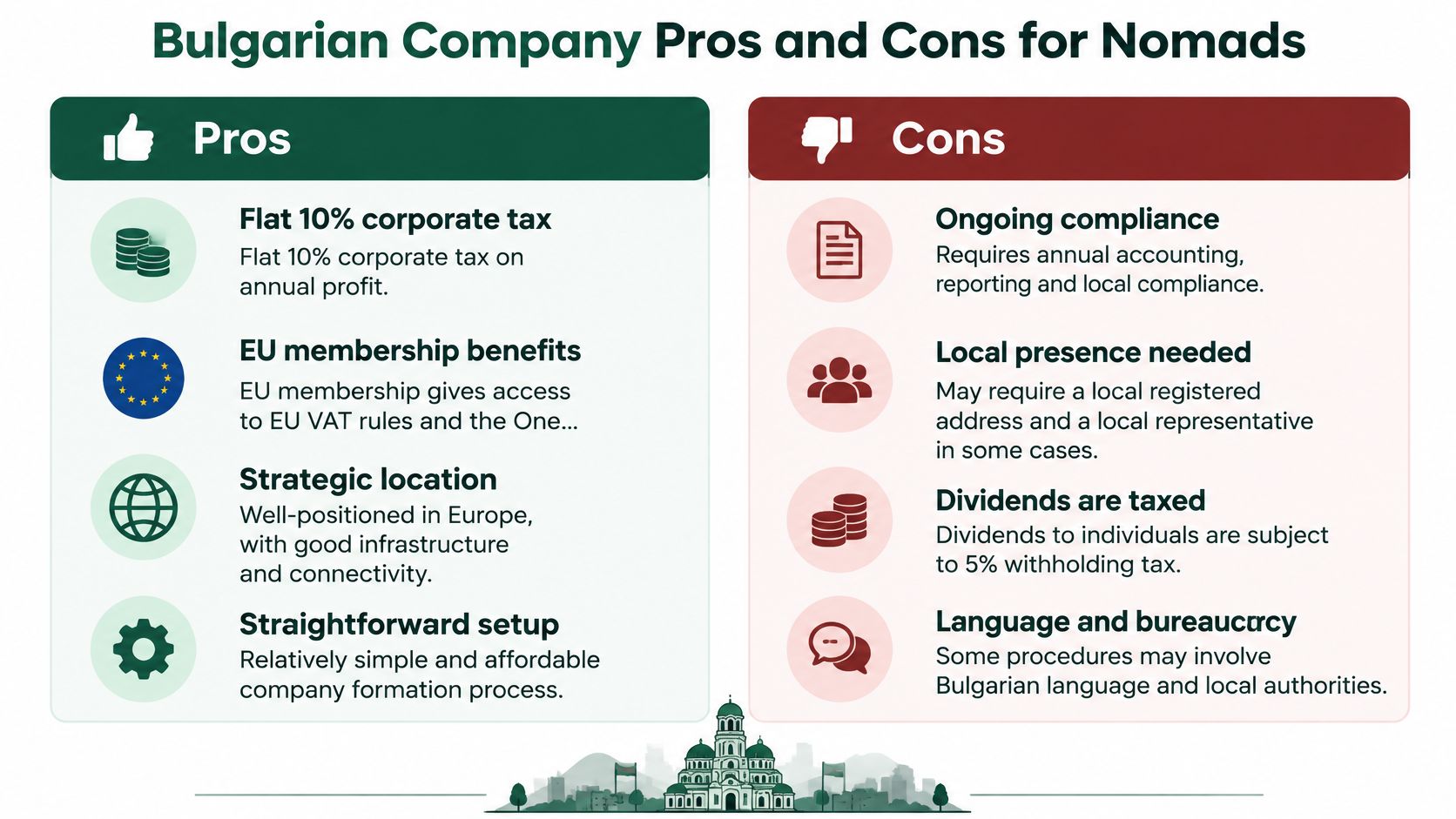
Pros
- Flat company tax on annual profit. The company layer stays simple. Your personal layer is a separate bill, covered by the residence tests above.
- EU membership. You get EU VAT rules and the One Stop Shop instead of inventing a workaround for European clients.
- Fully online formation in 3–5 working days. You do not book a flight to sign the founding papers.
- English-language support. Onboarding, questions, and document checks run in English, which matters when your co-founder is in another time zone.
Which form to choose
An EOOD suits one owner. An OOD suits several shareholders. We set up either, remotely or in person. One owner who wants clean liability and a single invoice header should not add a silent partner just to look bigger.
Cons
- The company rate is not your total cost. Salaries and dividends are taxed in your hands. Budget both layers.
- A one-person company still needs real management. Bookkeeping, annual filings, and actual decisions do not disappear because you are the only shareholder.
- A registered address does not prove substance. If every decision happens in another country, the address will not carry the argument.
- Employed nomads should check payroll first. If your employer can keep you on payroll while you work abroad, a company may add cost without benefit.
- Teams hit payroll questions before the first hire. Contractors in several countries can create payroll and permanent-establishment issues. Map that before you send an offer.
This short walk-through shows how the online and in-person routes feel once the documents start moving.
Verdict. A Bulgarian company suits founders with EU or international clients who earn enough for the company layer and its compliance costs to pay off. Freelancers with small, local incomes often do better as sole traders in the country where they already live. If you are employed and your employer will keep the contract, stay on that payroll until a lawyer in your home country says otherwise.
How to Register Your Company Remotely Step by Step
You can finish this without leaving home. We handle the registration so you are not standing in a queue in Sofia, and remote formation takes 3–5 working days once every document and payment is in. The register itself is built for electronic filing. What slows founders down is the paperwork: missing ID copies, unclear shareholder details, or a form nobody signed.
The Ministry of Economy business handbook walks through checking and reserving a company name through the Commercial Register, the same register that takes incorporation filings and certificate orders electronically. Filing online also costs less than filing on paper, and the minimum share capital is nominal. That is why the online route needs no travel, as long as the founding documents, identity, and beneficial-owner details are ready.
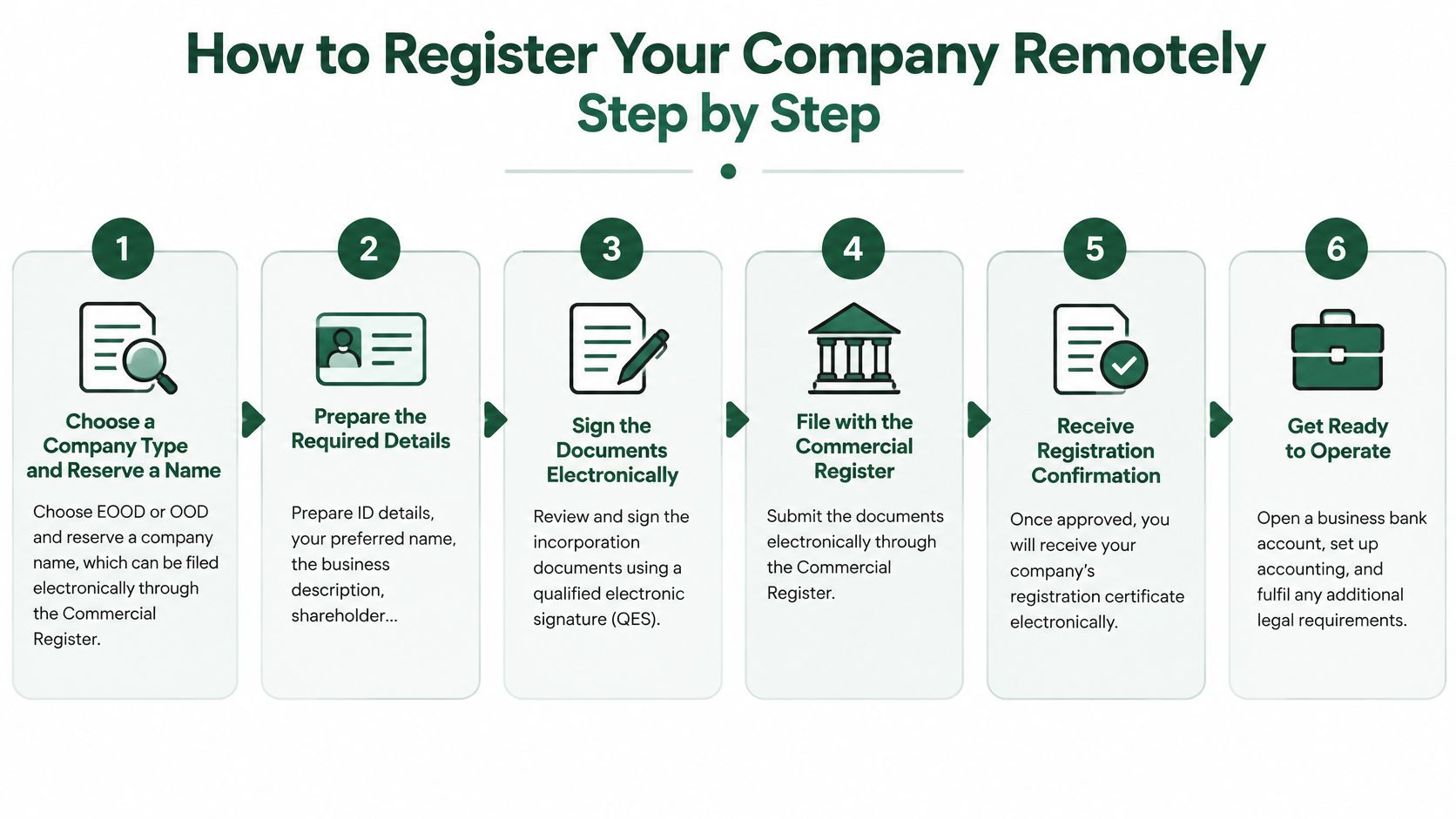
The seven steps
1. Choose EOOD or OOD and reserve the name. EOOD is the single-member form; OOD works when more than one shareholder comes in. File the name electronically through the Commercial Register. Do this first, because a taken name stops everything else and a near-match can be rejected even when you thought it was unique.
2. Send the onboarding pack. We collect ID details, your preferred names, the business description, shareholder and director details, and the share capital amount. Vague activity descriptions are the usual slip. "Consulting" is weaker than "software implementation for EU retailers."
3. Verify your identity and sign. Use a secure online notary, or appoint an authorised representative. Unsigned deeds and cropped passport scans are the delays that cost days. A clear photo of every passport page beats a screenshot.
4. Fund the capital. The required share capital is a token amount. Still transfer exactly the figure written into the deed, because a mismatch between the deed and the payment holds the file.
5. Pay the register fee. Electronic submission is the cheaper option and the path that keeps you at home. Pay from an account whose holder name matches the shareholder, so the receipt is easy to tie to the file.
6. Wait for registration. Remote formation takes 3–5 working days after every document and payment is received. Chasing the register before the file is complete does not speed it up. A complete pack on Monday is faster than a partial pack you "finish later."
7. Collect the Certificate of Incorporation and apostilles. Your bank or a larger client will ask for these. Order them with the registration, not three weeks later when an invoice is already late. Apostille timing is the one step that can add days even when the company itself is already on the register.
Each step works remotely because the register, the notary, and the payment all accept electronic evidence. The slip is almost always a document, not the distance.
Keep one folder with passport scans, the signed deed, the fee receipt, and the certificate. You will reuse that folder for the bank and for your first accountant handover. And keep one honest caveat in view: the register entry is the easy part, because where the company profits and your own pay are taxed depends on where you live and work.
Set Up VAT and Banking Before Your First Invoice
A registered company can still bill its first client wrong. Incorporation puts you on the Bulgarian register; VAT decides what goes on the invoice, and that decision follows your customers and turnover, not the 10% corporate rate.
Compulsory VAT registration applies once taxable turnover passes the Bulgarian registration threshold. Voluntary registration is possible earlier, and some founders register voluntarily so EU business clients see a VAT number from day one. For qualifying cross-border EU distance sales, the European Commission's OSS explanatory notes describe how the One Stop Shop lets an established business declare and pay VAT through one portal instead of registering in every customer country.
Before you invoice, write down the customer location, the transaction type, the place-of-supply evidence, and how often you must file. For SaaS and downloadable products the place-of-supply rules are stricter than for a local workshop; our guide to VAT for digital services walks through those cases.
| Your situation | VAT step | What to note |
|---|---|---|
| Turnover below the Bulgarian registration threshold | No mandatory Bulgarian VAT registration | Voluntary registration is possible |
| Turnover above the Bulgarian registration threshold | Bulgarian VAT registration becomes compulsory | Register once the threshold is exceeded |
| EU business clients (B2B services) | Invoice with your Bulgarian VAT number and reverse-charge wording | Confirm place-of-supply rules for each invoice |
| EU consumers above the cross-border distance threshold | Register for the One Stop Shop | Declare and pay through one portal |
| Non-EU customers | Usually outside EU VAT scope | Keep evidence of the customer location |
Open the account, then test one invoice
After the Certificate of Incorporation is issued, open a business account with a Bulgarian bank or an online provider that issues an EU IBAN. The setup package includes an EU account, and we help clients onboard with providers such as Revolut, Wise, UniCredit and Paysera. Before you pick one, compare monthly fees, the currencies you get paid in, and whether remote onboarding accepts a director who does not live in Bulgaria.
Then run this sequence in order.
- Open the account in the company name, not your personal name.
- Set the invoice template with your Bulgarian VAT number and reverse-charge wording where the table says it applies.
- Send one test invoice to an EU business client and confirm they can pay the IBAN before you scale.
A test invoice catches a wrong legal name, a missing VAT line, or a bank that still has the account on review. Fixing that on invoice number one is cheap. Fixing it on invoice number forty is not.
Choose Your Setup Route and Launch This Month
A founder in Lisbon once spent more on flights and a hotel to sign papers in person than the entire company setup cost. Pick your route by travel plans, not by a feeling that in-person is "more real."
Online setup costs €1,750 and runs 100% remotely, with no travel required. Once all required documents and payments are in, formation takes 3–5 working days. The package covers company registration as an EOOD or OOD, an EU VAT number, a bank account, a virtual office and business address, apostilled company documents, the Certificate of Incorporation, and all legal and government fees.
In-person setup costs €1,500 and includes a visit to the FastCorp office in Sofia, where you complete the setup face-to-face, plus a complimentary airport pickup. It covers registration, the EU VAT number, a bank account, a virtual office and business address, the certificate, and all legal and government fees.
You save €250 on paper. You also buy flights, a hotel, and days away from client work. I would take the online route unless you are already going to be in Sofia or you specifically want to sit across a desk from the team. The €250 gap does not pay for a trip.
Check four things before you sign
- Tax residence plan. You know which country is likely to treat you as resident this year, because the 10% Bulgarian corporate rate does not settle where you personally owe tax.
- Days in each country. You can produce a simple log if someone asks.
- Who signs and manages. The person with authority is named, and you know where they sit.
- Whether clients are EU-based. That choice drives VAT wording on day one.
Your next step is concrete. Complete the onboarding questionnaire, prepare your ID, company name preferences, and share capital figure, and book the bank setup in the same week so the company can invoice once the certificate lands. Waiting on the bank until "after launch" is how founders end up with a company that cannot get paid.
A Bulgarian company is a practical EU base when the clients and the compliance budget are there. It is a poor costume for a small local freelance practice or for an employee whose payroll already works. If the four checks above are clean, start the file this month rather than collecting another year of mixed invoices.
FastCorp sets up Bulgarian limited companies for remote founders, covering registration, EU VAT, an EU bank account, a virtual office, and the filings that follow. If you want that digital nomad company live without a flight to Sofia, start with the online route and have your ID ready. Visit FastCorp to begin onboarding.