Non Resident Company Tax: Bulgaria's 10% Rate Explained
Non Resident Company Tax made clear: when a foreign founder becomes taxable, how Bulgaria's 10% rate works, and how to stay compliant online.
Ask around about non resident company tax and you'll hear the same confident answer: register the company in a low-tax country, invoice from there, and the tax question disappears. It's cheap, it's simple, and it's only half right.
Bulgaria's 10% corporate rate is real, and the filing routine really is online from start to finish. Neither fact decides where your profits get taxed. Tax authorities don't ask where your company was registered. They ask where it's run, where it's sold from, and who does the work.
Table of Contents
- Why Incorporating Abroad Does Not End Your Tax Bill
- When a Foreign Founder Creates a Taxable Presence
- Your Tax Exposure at a Glance
- Bulgaria's 10% Corporate Tax and the Annual Return
- How to Stay Compliant Online from Abroad
- Bulgaria Compared with Other European Tax Rates
- Choosing Your Next Step with Confidence
Why Incorporating Abroad Does Not End Your Tax Bill
Take the founder who lives in one country, sells software to clients across the EU from a laptop, and wonders whether a Sofia company settles the whole tax question. The picture below is the setup many founders have in mind.

The situation has a second layer, and it's the one that costs money. The UN Model Double Taxation Convention is explicit that incorporation in one country does not automatically eliminate tax exposure in another. A Bulgarian company owned or managed by non-residents can still create taxable obligations elsewhere if it keeps an office, a dependent agent, or a comparable operating presence there.
Two separate questions decide your bill, assessed under different rules. Corporate tax follows business profit and the presence you create. VAT follows where your supplies are made and who buys them. A company can owe one without the other, which is why treating "non-resident company" as one all-purpose tax status produces expensive mistakes.
The rule that matters: registration decides where your company exists. Operating reality decides where its profit is taxed.
Three things fix that gap. You get an exposure table so you can find your own row, a plain explanation of permanent establishment (the concept that decides most of these cases), and an online compliance routine you can run from anywhere. There's a bonus for founders choosing a base: a straight comparison of Bulgaria against Hungary, Ireland, Poland, Germany and the rest.
One honest caveat before you read on. What follows is practical guidance built for founders running real businesses from laptops, not personal legal advice. Confirm the final position for your own structure with a tax adviser. A tax residency certificate is often the first document you'll need when two countries both want to tax the same profit.
When a Foreign Founder Creates a Taxable Presence
Think of a website as a catalogue posted to customers abroad. It shows what you sell and takes orders, and nobody would call the catalogue itself a shop. A permanent establishment is the shop: a counter, staff, stock, and someone able to close a deal on the spot. Most non-resident company tax disputes come down to which of the two you built.
Here's the distinction in one picture.
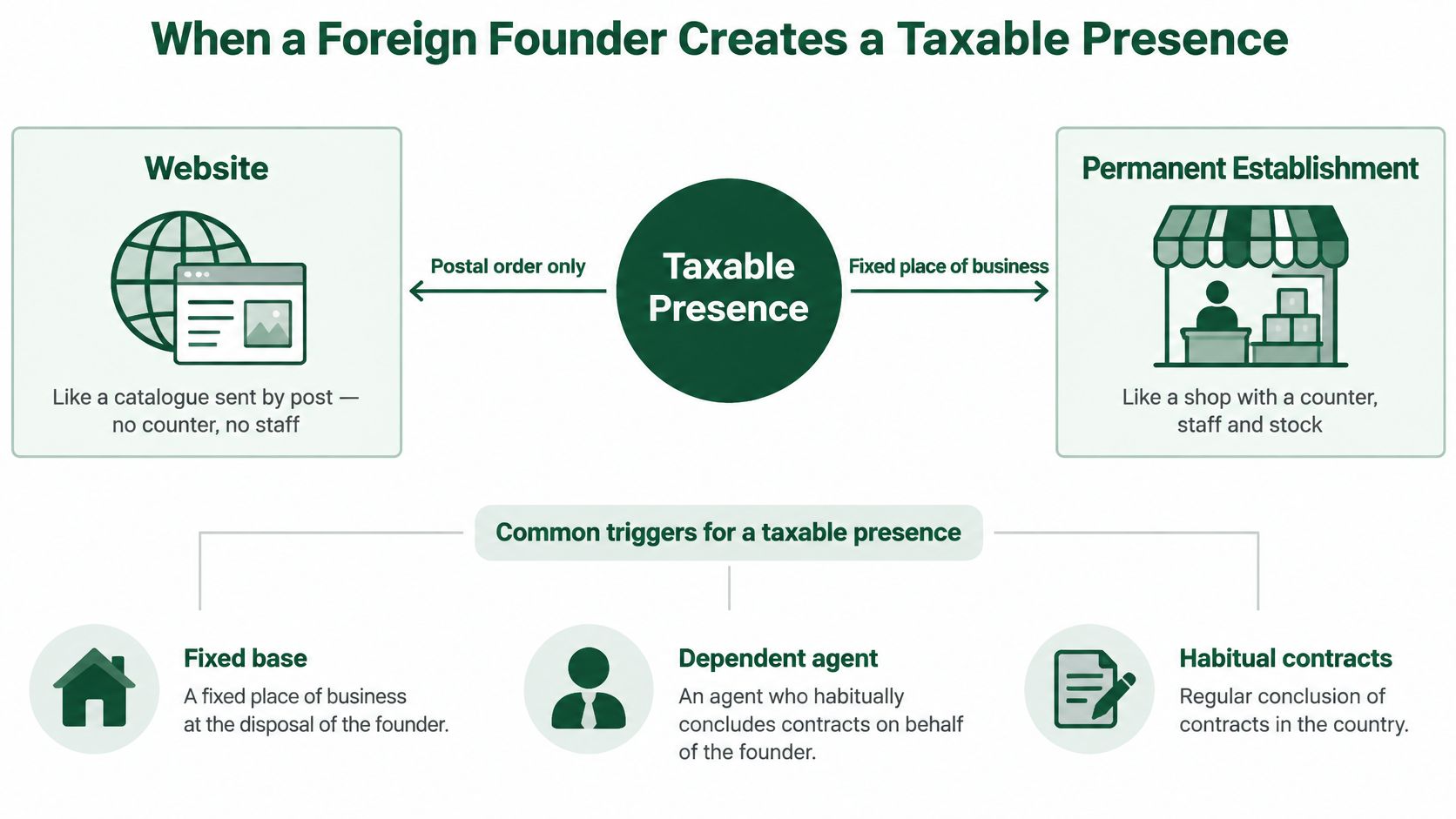
The legal trigger is a sufficient business presence, not a sale. Under Article 7 of the OECD Model Tax Convention, business profits become taxable in another country when they're attributable to a permanent establishment, meaning a fixed place of business or, in many treaties, a dependent agent who habitually concludes contracts for you. That structure caps the exposure: the country taxes the profit attached to the presence, not your worldwide income.
Three setups that decide the answer
You answer client emails from home and do nothing else. A laptop and a kitchen table are a thin presence on their own. The OECD's 2025 consultation on the global mobility of individuals treats a home office used for under 50% of a worker's time across a 12-month period as less likely to form a fixed place of business, and it pointedly refuses to say that crossing 50% creates one automatically. What counts is whether the work is commercial, productive and regular, and whether it connects to local customers or staff.
Your local contractor signs sales agreements. This is the dependent-agent trigger, and it's the one founders miss. If someone in the country regularly negotiates and signs for you, the presence question moves from "where is my desk" to "who is binding my company", and the answer is far less comfortable.
You rent a desk and your team works there every day. A fixed place of business, in the plainest sense, especially when pricing, hiring and delivery all happen from that address.
When a permanent establishment exists, the profit attributed to it comes from its activities: functions performed, assets used, risks assumed. A desk where a contractor answers support tickets looks nothing like a desk where a manager sets pricing and closes deals. The way authorities test this is by looking at who really controls the business, not at what the service agreement calls itself.
Residence is the second front
Presence isn't the only way in. A company is generally resident where its place of effective management sits, so a founder who runs the business and makes the decisions from abroad can create residence in that country, not just a permanent establishment. When both countries claim residence, the treaty tie-breaker decides, and it usually looks at where substantive decisions happen rather than where the paperwork was signed. The full mechanics sit in this guide to what a permanent establishment is.
Four questions settle most of it: who sells, who signs the contracts, where the decisions happen, and who performs the work. Write the answers down, date them, and file them with your minutes.
Your Tax Exposure at a Glance
Find the row that matches how your company runs today, then read across. The table maps both exposures side by side so you can see where your setup sits before anyone asks.
| Situation | Corporate tax exposure | VAT exposure | Records to keep |
|---|---|---|---|
| Owner abroad, sales handled remotely, no local staff | Usually low, but assess permanent establishment risk | Usually outside Bulgarian VAT where business customers abroad bear the place-of-supply rule | Contracts and evidence of customer location |
| Owner abroad working from home and closing deals | Higher if the work is regular, commercial and connected with local customers | Follows customer location and place-of-supply rules | Work logs, management minutes and decision records |
| Local employee or dependent agent signing contracts in Bulgaria | Likely a permanent establishment, with profits attributed to Bulgaria | Assessed per transaction | Payroll, agent contracts and profit allocation |
| Virtual office address only, no operations | Generally administrative and not a permanent establishment on its own | Assessed separately on actual supplies | Virtual office agreement and proof of no operating activity |
| Dormant company with no operations and no tax liability | Annual return may be exempt | Usually no VAT activity | Evidence of dormancy and nil transactions |
Read across, not down. The corporate tax column and the VAT column answer different questions, and one doesn't drag the other along. A foreign enterprise can face corporate income tax on profit linked to a permanent establishment, withholding tax on dividends, interest or royalties paid from the source country, and VAT on local supplies. That's precisely why the OECD's corporate tax statistics programme tracks 135 jurisdictions instead of publishing one global rate.
Why the home-office row moves up
Row two is where most founders get caught. A home office used occasionally for email is thin. A home office where you close deals, set prices and manage delivery is commercial, regular and tied to a market, and that's the combination that raises attribution risk. The question isn't how many days you sat there. It's what you did while you sat there.
Rows four and five are quieter than they look
A virtual office is administrative infrastructure. It gives you a registered address and somewhere for official post, and on its own it doesn't create an operating location. Keep the agreement anyway, plus proof that no staff, stock or selling happens from it. A dormant company can fall inside the annual return exemption, but only if you can show the year was empty.
Corporate tax and VAT stay separate questions throughout, so a company can carry one without the other. Pick your row, then collect the records for that row first, before you touch anything else.
Bulgaria's 10% Corporate Tax and the Annual Return
This is the number that brings founders to Sofia. Bulgaria applies a 10% corporate income tax to company profits, and the corporate tax profile for Bulgaria confirms both the rate and the filing machinery behind it.
The rate applies to taxable profit, not to turnover. Revenue minus deductible costs, adjusted for tax rules, then multiplied by 10%. Two founders with identical invoices can pay very different amounts depending on what they can substantiate, which is why bookkeeping quality matters more than the headline number.
The annual cycle in dated steps
Early in the year: close the books for the previous year, reconcile the bank account, and gather invoices, contracts and payroll records.
Between 1 March and 30 June: prepare and file the annual corporate tax return with the National Revenue Agency. The window is fixed, so a spring draft beats a June scramble every time.
By 30 June: pay the tax due, after crediting any advance payments you've made during the year.
Signature and payment: returns go in electronically with a qualified electronic signature, and the tax moves by bank transfer. Nothing in that sequence requires a visit to a Bulgarian tax office.
Keep the dates somewhere you'll see them. The full corporate tax filing deadlines calendar pairs well with your own accounting close date, and having both in the diary early is what stops the June scramble.
Companies with no operations and no corporate tax liability are generally exempt from filing the annual return, subject to the statutory conditions. Don't assume it applies to you. A dormant year still needs evidence that nothing happened.
The rate is also the product of a long shift. The OECD's Corporate Tax Statistics identify Bulgaria among the jurisdictions that reduced its statutory corporate income tax rate by at least 20 percentage points between 2000 and 2025. Note what that measures: the standard headline rate, not a promise about your effective burden.
Where transfer pricing fits
Payments between your company and anyone related to it, management fees, IP licences, intercompany sales, must be priced as if the parties were independent. The OECD's arm's-length principle ties taxable profit to the economic contribution of each jurisdiction through functions, assets and risks. The practical version: put your own service charges in a written agreement, invoice them consistently every month, and keep evidence the service was delivered. A founder charging a management fee with no contract, no invoices and no meeting notes is inviting a question.
How to Stay Compliant Online from Abroad
Everything below runs from a laptop. The sequence matters more than the software.
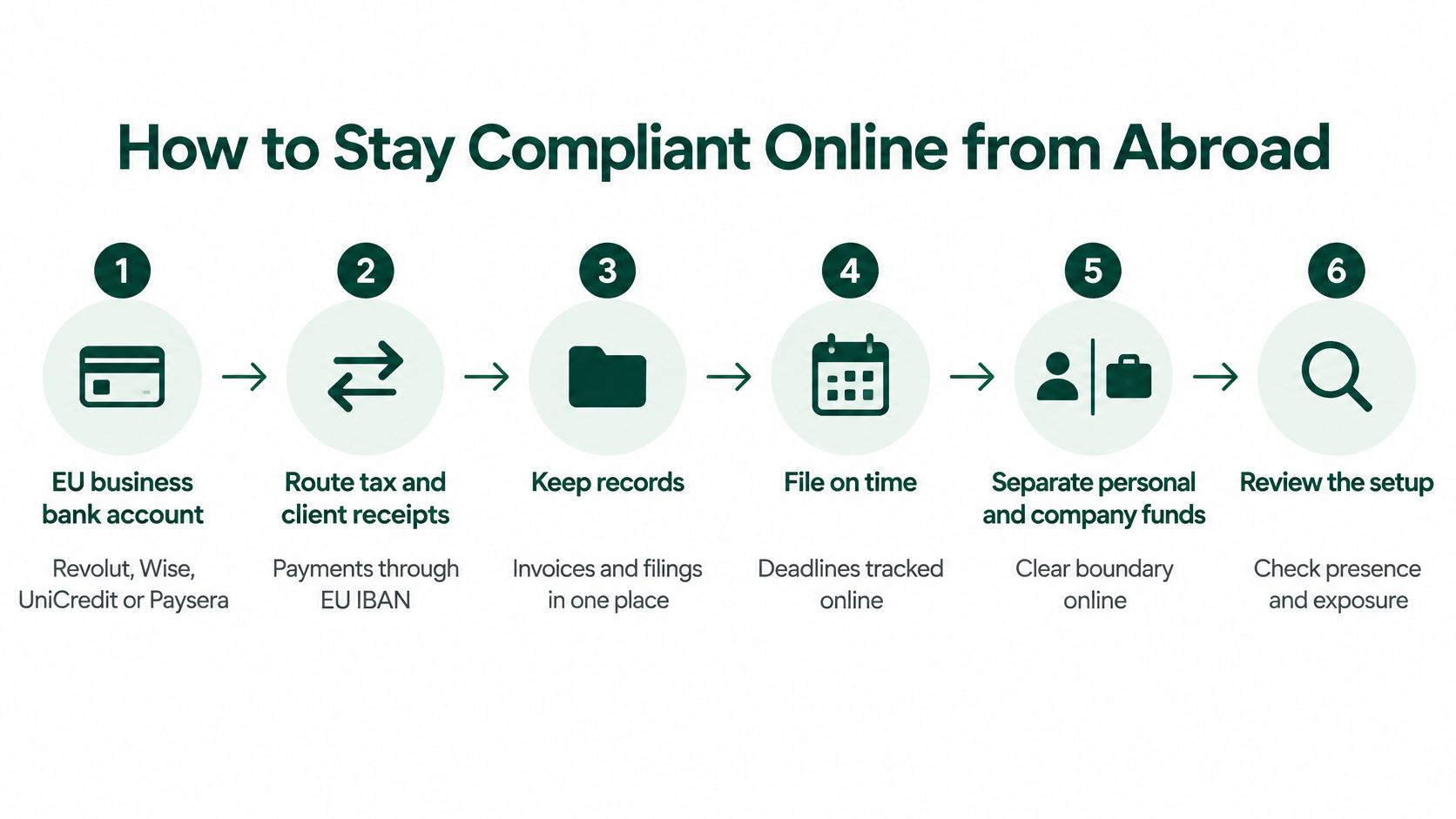
The six-step routine
Open an EU business bank account. Revolut, Wise, UniCredit and Paysera all work well for a Bulgarian company and give you an EU IBAN, so client receipts and tax payments run through one place. The common slip is letting a client pay into your personal account "just this once", which then needs explaining in three languages.
Register for VAT where your transactions require it. Keep customer location evidence for every invoice: the contract, the billing address, the IP log, whatever proves where the buyer sits. The common slip is assuming a foreign customer removes the analysis. EU VAT registration is included in all our company formation packages, so this step rarely needs a separate project.
Keep the trail that supports your presence position. Contracts, management minutes, and a dated log of where decisions are made. If a tax authority asks why your Sofia company shouldn't be resident where you live, this file is your answer.
Record every month, not every December. Bank statements, payroll if you have staff, agent payments, subscriptions, travel. Monthly entries take twenty minutes. Reconstructing a year takes a week you don't have in June.
Prepare the annual return early and sign it electronically. A qualified electronic signature before 30 June is the whole submission ritual. Skipping the signature step until the last week is the single most common delay.
Pay by bank transfer and keep the confirmation. Payment proof closes the loop and matters if a credit or an advance payment is ever questioned.
Run one review a year. If a new person starts signing contracts, or you open a new market with local staff, re-run the exposure table before the next filing rather than after a letter arrives.
None of this needs travel. We handle company registration without the customer leaving home, and the same online workflow covers the filings that follow.
Bulgaria Compared with Other European Tax Rates
This comparison usually decides the question. The table below lists statutory corporate rates across the markets founders shortlist, sorted from the lowest, based on the OECD's corporate tax statistics.
| Country | Statutory corporate tax rate | Gap versus Bulgaria |
|---|---|---|
| Hungary | 9% | -1 point |
| Bulgaria | 10% | 0 points |
| Cyprus | 12.5% | +2.5 points |
| Ireland | 12.5% | +2.5 points |
| Romania | 16% | +6 points |
| Poland | 19% | +9 points |
| Czechia | 21% | +11 points |
| France | 25.8% | +15.8 points |
| Germany | 29.9% | +19.9 points |
| Malta | 35% | +25 points |
Here's the same ranking in bar form.
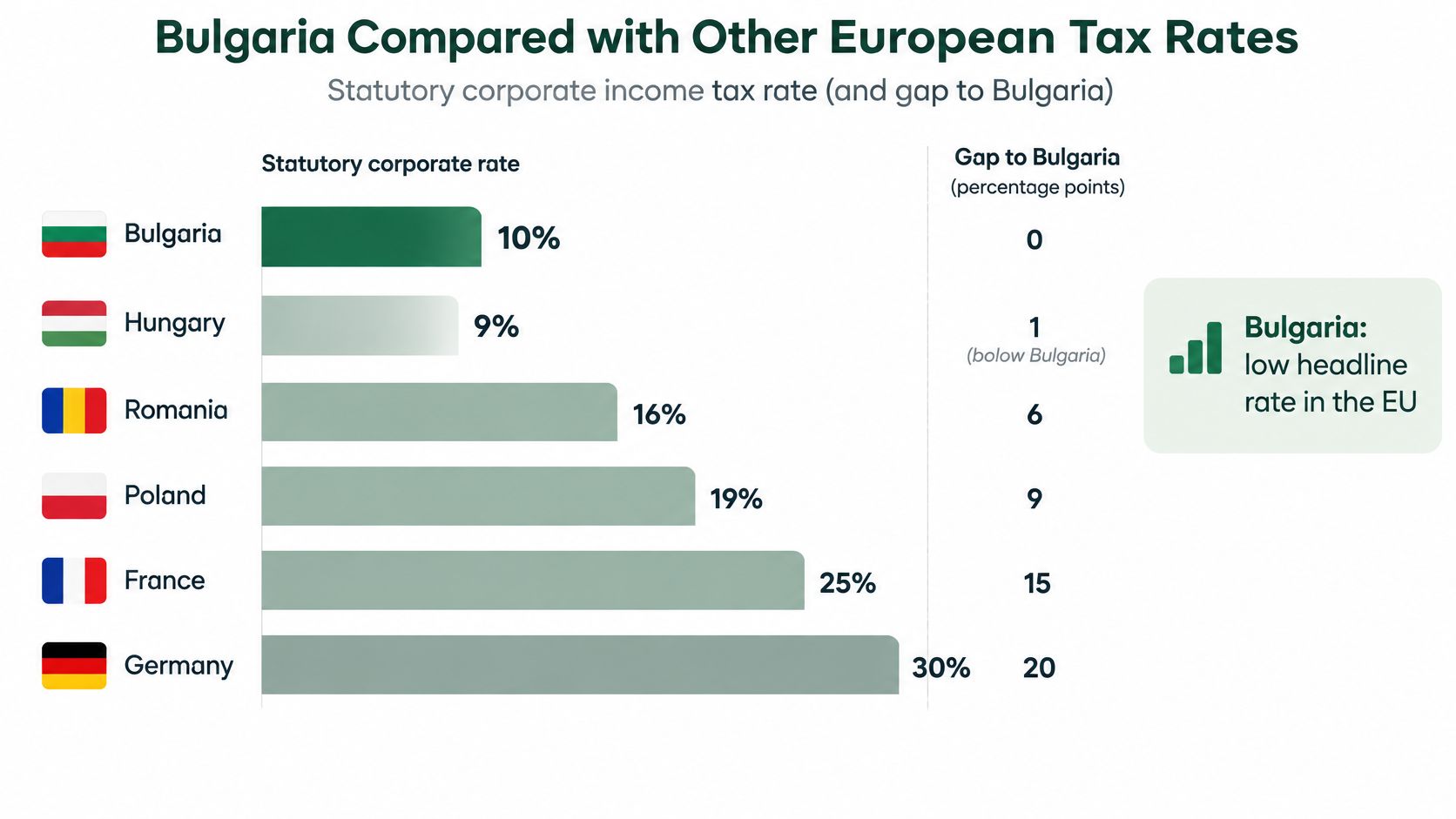
Bulgaria sits second from the bottom. Hungary is a single point lower, Cyprus and Ireland sit 2.5 points higher, and a French or German market costs roughly two to three times Bulgaria's rate before you've earned a euro of profit. At a €100,000 profit, that gap alone is worth around €16,000 a year against France and nearly €20,000 against Germany.
One warning before you celebrate. These rates apply to profit the company earns and is entitled to tax in that country. Bulgaria's 10% is only yours if the business is run, sold and staffed in a way that keeps its tax residence there. Incorporate in Sofia while making every decision from a home office in Munich, and Germany's 29.9% can follow the company anyway. The table tells you the prize. Your exposure position decides whether you collect it.
What the headline rate leaves out
A statutory rate is one line in a longer calculation. It ignores dividend taxation when you take money out, payroll taxes if you hire, VAT obligations across each market, permanent establishment exposure, substance requirements, and the tax rules in your own country of residence.
Take a founder resident in a high-tax country who pays herself a dividend from the Sofia company. The company's 10% is only the first layer. Her home country may tax that dividend personally, at rates that have nothing to do with Bulgaria.
Compare three numbers, not one: the corporate rate, the tax on getting profit out, and the personal tax where you actually live.
That's why the honest answer to "is Bulgaria cheaper" is: almost always on the corporate line, sometimes dramatically, and never without checking the other two.
Choosing Your Next Step with Confidence
Work through this before any filing, not after.
Match your row. Run the exposure table against how the business operates this month, not how you described it at incorporation.
Write down the decision map. Who signs contracts, who negotiates with clients, where strategic calls are made. Names and places, not job titles.
Confirm VAT per market. List every country where customers sit and check the place-of-supply rule for each one.
Put 30 June in the diary as a payment deadline, with the return drafted in spring, and start collecting records for that filing now.
Book one review with a tax adviser before you change the structure, hire locally, or start running the business regularly from a home office.
Which row you land in decides the move. A remote founder with no local presence can usually stay on the online routine: register, invoice, file by 30 June, keep the records. A founder with local staff, a dependent agent, or a regular home-office business should get a documented permanent establishment analysis before the next filing, not after a letter arrives.
If you want setup and filings handled together, FastCorp offers that as one option. Remote formation takes 3 to 5 working days once documents and payments are received, and the Online package at €1,750 covers company registration as an EOOD or OOD, an EU VAT number, a bank account, a virtual office and business address, apostilled company documents, the certificate of incorporation and all legal and government fees. Confirm scope, price and timing directly with the provider. FastCorp isn't a law firm or a tax authority, so the company and its owners remain responsible for the company's activities, tax obligations and reporting accuracy.
FastCorp sets up Bulgarian limited companies for founders who live elsewhere, combining registration, EU VAT registration, banking assistance and ongoing bookkeeping in a single online workflow, so the exposure map you've just built can be run from your own desk. If your row points to a Sofia company, you can start today and have the entity trading within days. Visit FastCorp to see the current packages and begin the process.