Annual Filing in Bulgaria: Deadlines and Rules for 2026
Annual filing in Bulgaria explained: deadlines, required documents, tax comparison and easy online steps for 2026.

It's late January. Your EOOD traded through its first full year, invoices went out, VAT returns went in on time, and year-end still feels like somebody else's problem. Then the first email lands asking for bank statements and a fixed-asset list, and you realise the Bulgarian filing year has already started without you.
Here's the part that should cheer you up. Almost none of this requires a queue, a courier or a trip to Sofia. The whole cycle, from ledger close to Commercial Register publication, runs online with a qualified electronic signature and a scanner. What it does require is a calendar with three separate tracks on it, because Bulgaria doesn't have one annual filing deadline. It has a season.
Table of Contents
- Annual Filing Deadlines in Bulgaria at a Glance
- What an Annual Filing Requires and Why It Matters
- Filing Step by Step and the Mistakes That Derail It
- What to Do With a Dormant or Zero-Activity Company
- How Bulgaria's Tax Rate Compares Across the EU
- Your Next Steps for the Filing Calendar
Annual Filing Deadlines in Bulgaria at a Glance
Bulgaria's filing year is one connected calendar, not a single finish line. The Commercial Register, the National Statistical Institute and the National Revenue Agency each take a different document, on its own statutory deadline, and each issues its own confirmation. Clear one track and you have cleared exactly one.
Each submission has its own window. Confirm the current dates on the official Commercial Register, NSI and NRA portals before the year closes. Last year's diary is a poor guide.
| Annual submission | Who it applies to | Deadline window | Where it is filed |
|---|---|---|---|
| Annual financial statements | Traders publishing statutory accounts | Statutory window published on the Commercial Register portal | Commercial Register |
| Annual statistical accounts | Companies reporting statistics | Statutory window published on the NSI portal | National Statistical Institute (NSI) |
| Consolidated statistical accounts | Groups reporting consolidated statistics | Statutory window published on the NSI portal | National Statistical Institute (NSI) |
| Annual corporate tax return | Companies with a calendar-year accounting period | Statutory window published on the NRA portal, final tax payment in that same window, filed electronically with a QES | National Revenue Agency (NRA) |
A normal trading company usually faces three of these four submissions: the financial statements, the statistical accounts and the corporate tax return. Consolidated statistical accounts apply to groups, not to a standalone EOOD. The tax return still needs a signed-off ledger before anyone can file it.
Read the corporate tax return as one cell on that calendar, not as the whole tax picture. VAT, payroll and the annual return all sit on the same year. A low headline corporate rate does not shrink the other filings, and it does not move their deadlines.
The register publication feels like the main event because it is the public one. That is how companies get caught. The register can look tidy while the statistical accounts never went in.
Practical rule: three submissions, three owners, three receipts. A Commercial Register confirmation proves nothing about the NSI, and neither proves the tax return went in.
Name a person for each date. A shared inbox is how a window gets missed. Set the internal target two weeks ahead of each legal deadline. Validation errors and missing notes take days to fix. The receipt saved to a folder is the only evidence that survives a change of accountant.
What an Annual Filing Requires and Why It Matters
Treat the annual filing as a health check, not a form. Once a year your books get opened, examined and shown to anyone with a legitimate reason to look, and the audience is wider than the tax office.

It does two jobs in one document set. It discharges your statutory duties to the revenue agency, the statistics institute and the commercial register, and it demonstrates to outsiders that the company is still legally and financially alive. Those two jobs have different audiences and different consequences when they go wrong.
What a missing filing looks like from outside
Say a Sofia EOOD is owned by a founder living in Lisbon. The company has been quiet for eight months, then a distributor wants to place a large first order. Before signing, their finance team pulls the company's file from the register and finds the last set of published accounts is two years old. The order stalls. Nobody fined the founder yet, but the company just failed a test it never knew it was sitting.
Financial information in the EU isn't collected for the tax office alone. It's published for creditors, investors, employees and commercial partners, and it stays in the register long after any tax deadline has passed.
That public-facing logic comes straight from EU company law. EU guidance on company financial reporting requires annual financial statements to contain, at minimum, a balance sheet, a profit-and-loss account and notes to the financial statements, published by each company in the relevant national business register.
Size decides the package, so test it first
Before you assemble anything, classify the company. The EU summary of the rules on comparable and clear financial statements sets out the micro, small, medium-sized and large categories by balance sheet total, net turnover and average employees, and confirms that public-interest entities and medium-sized or large undertakings generally require a statutory audit, while qualifying micro and small companies may receive national simplifications.
| Size category | How it is classified | Usual audit position | Disclosure position |
|---|---|---|---|
| Micro undertaking | Balance sheet total, net turnover and average staff all at or below the national micro thresholds | Statutory audit usually not required | Often qualifies for national simplifications |
| Small undertaking | Above the micro thresholds and at or below the national small thresholds on the same three measures | Statutory audit usually not required | Simplifications may apply under national rules |
| Medium-sized undertaking | Above the small thresholds and at or below the national medium thresholds | Statutory audit generally required | Full notes and disclosures |
| Large undertaking | Above the medium thresholds on any of the three measures | Statutory audit generally required | Full notes and disclosures |
Confirm the current national figures with your accountant before you build the package, because Bulgaria applies the EU categories through its own thresholds. Get the category wrong and you either over-disclose for nothing or, far worse, file a set of statements that is timely and technically incomplete.
The documents to gather before you start
- Trial balance and general ledger for the full financial year, locked so late entries can't shift the numbers after you've started
- Bank statements and reconciliations for every account, including payment provider balances
- VAT control accounts and all returns for the period, matched line by line to the ledger
- Sales and purchase invoices, stored digitally with the ones above your materiality threshold easy to retrieve
- Fixed-asset register with additions, disposals and depreciation for the year
- Related-party schedule covering loans, management fees and anything charged between connected companies
- Payroll records and any social-security filings for the year
- Shareholder and director details, plus the prior year's published statements for comparatives
Our walkthrough on how to prepare financial statements covers the assembly order, which is worth reading before you touch a single note.
One thing to be clear about: a missing note or a wrongly applied exemption can make a filing that arrived on time still incomplete. FastCorp isn't a law firm or a tax authority, and the company stays legally responsible for its activities, tax obligations and the accuracy of what gets reported.
Filing Step by Step and the Mistakes That Derail It
It is late May. The ledger is closed, the notes are drafted, and the return is ready to leave a laptop. Then the qualified electronic signature fails because nobody tested it in the first quarter. That is the Bulgarian filing year: one connected calendar, not a single date on a reminder.
The 2026 cycle runs online from end to end. The Ministry of Economy's page on declaring and paying the annual corporate tax is explicit that the return is filed electronically with the NRA and authenticated with a qualified electronic signature (QES).
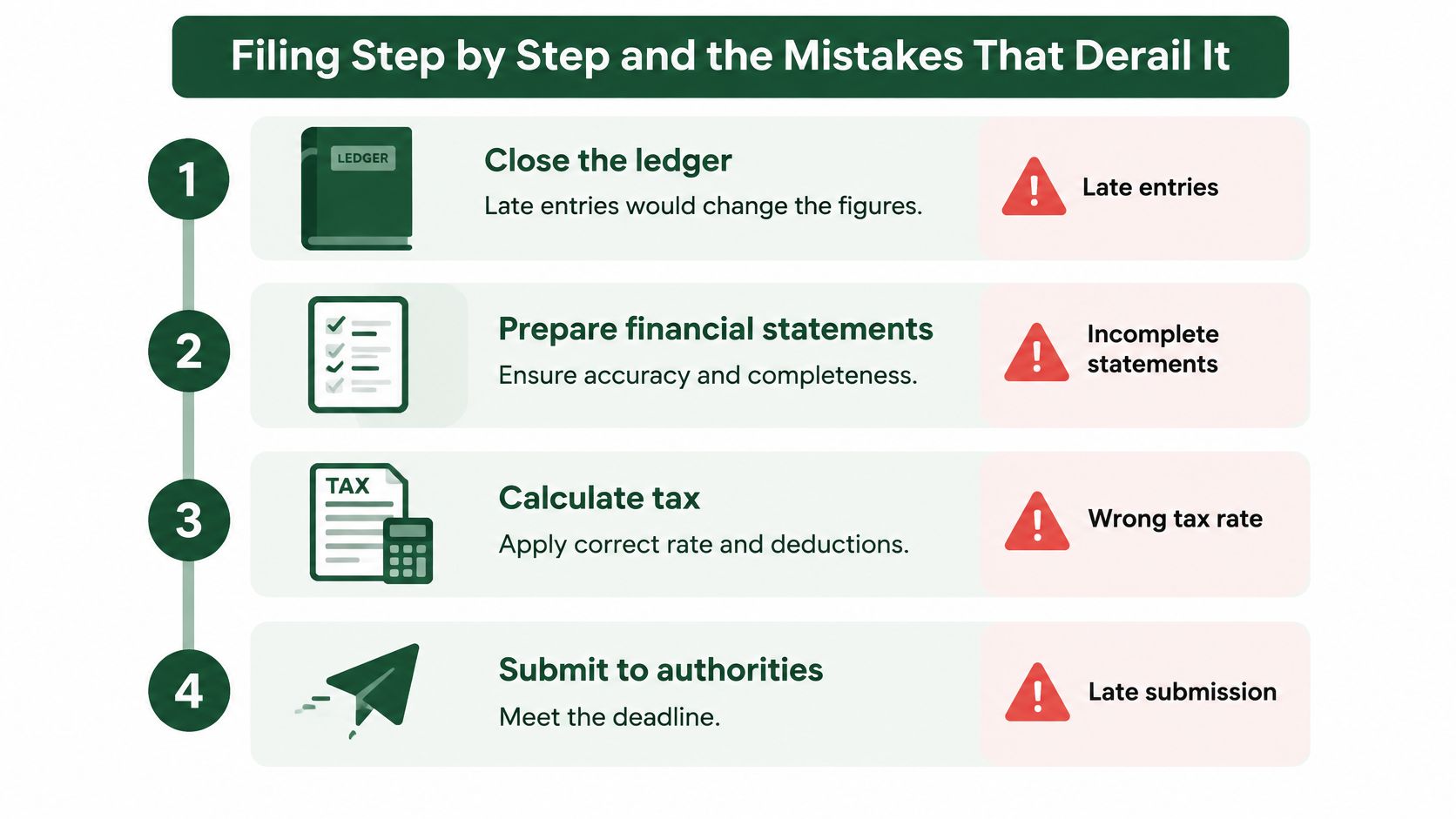
- Close the ledger. Lock the accounting period so no entry can land after the figures are fixed. Reconciling in September, after the statements are already public, is the mistake this step stops.
- Reconcile the bank and the VAT control accounts. Match every VAT return and payroll record to the ledger before anything is published. Unmatched VAT accounts are a frequent reason a set of accounts has to be reopened.
- Verify the related-party and fixed-asset schedules. Loans from the founder, management fees to a sister company and a half-depreciated laptop all need a paper trail. Skip this and the notes will not tie back to the balance sheet.
- Fix the size category. It sets the disclosure level and possibly the audit obligation. A guess produces either an unnecessary audit or an incomplete filing.
- Build the balance sheet, the profit-and-loss account and the notes. Work from the trial balance outward, not from last year's file inward. Last year's mistakes copy themselves forward.
- Calculate taxable profit under Bulgarian rules. Start from accounting profit, apply the tax adjustments and document every deductible cost. Bulgaria's 10% corporate tax rate is an input to that calculation, not the full tax picture: VAT, payroll and the later publication dates still sit on the same year. Our explainer on what a corporate tax return actually contains walks through the line items if this is the first return.
- Confirm the QES works, then file. Test the signature in the first quarter, well before you need it. Submit the return to the NRA inside the 1 March to 30 June window, and aim for weeks early so a validation error can still be fixed. An expired certificate in late June is not a small problem.
- Publish the statements and file the statistics. Register publication happens by 30 September. The NSI statistical accounts have their own windows and their own owner. One person can do both. Both still need a diary entry.
- Save every confirmation receipt. Download the acknowledgement from each portal into a single folder named for the financial year. A bank, an auditor or a buyer will ask for that file.
Practical rule: the most expensive mistake in this process isn't a wrong number. It's a signature certificate that nobody thought to test until the filing window was three days from closing.
The pace depends on you as much as on the firm doing the filing. Send the bank exports, the invoice archive and the payroll summary as soon as they are requested. Every day a document sits in an inbox is a day taken off the buffer before a statutory deadline. Drafting through to submission is handled for the company.
Here is the workflow in motion, from ledger close to submission.
What to Do With a Dormant or Zero-Activity Company
A company with no transactions is not a company with no obligations. That assumption turns a clean structure into a late-filing record, and it's worth twenty minutes of checking before you rely on it.
Run three checks in this order.
Is the company dormant for the year in question? Dormant has a specific meaning tied to the absence of material transactions, and a single bank fee or a director's loan can take you out of it. Read the ledger, don't rely on memory.
Does a non-activity declaration apply? Bulgarian rules provide for declarations and other submissions connected to inactivity, and which one applies depends on your circumstances. Confirm it rather than assuming silence equals compliance.
Which windows still run? The register publication date in the autumn and the NSI statistical window in the spring don't disappear because the profit-and-loss account is empty. A company can be fully compliant in one channel and late in the other.
Write the conclusion down with a date and an owner, and note the source you relied on. If the company's position changes mid-year, through a first invoice, a new director or a change of registered address, update the calendar that same week, because the filing position moves with it.
Get a qualified adviser to confirm the position before you build a year on it. The cost of the question is trivial next to the cost of the answer being wrong.
How Bulgaria's Tax Rate Compares Across the EU
A founder taxed at Germany's listed 29.9% corporate rate looks at the same profit inside a Bulgarian company and sees 10%. That gap is the start of the comparison, not the whole of it.
The Tax Foundation's 2025 comparison of European corporate income tax rates puts the European average at 21.5%. Against that 21.5% European average reported by the Tax Foundation, a Bulgarian company keeps about 90% of its pre-tax profit at the corporate level, compared with about 78.5% at the average rate.
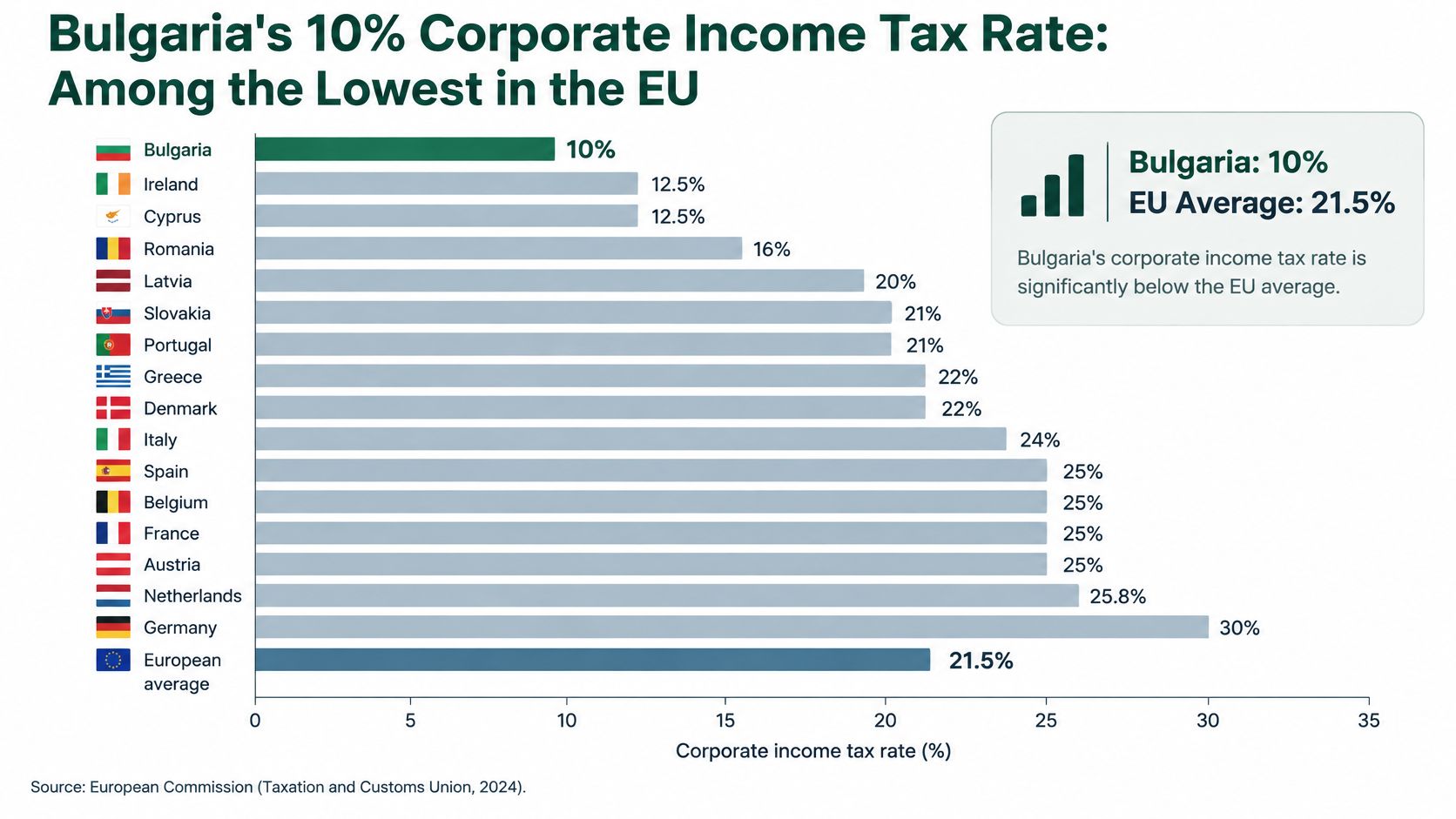
| Country | Headline corporate tax rate |
|---|---|
| Hungary | 9% |
| Bulgaria | 10% |
| Ireland | 12.5% |
| Cyprus | 12.5% |
| Romania | 16% |
| Poland | 19% |
| United Kingdom | 25% |
| Spain | 25% |
| Germany | 29.9% |
| Malta | 35% |
| Tax Foundation European average (all countries) | 21.5% |
Hungary at 9% and Cyprus at 12.5% sit in the same low band. Those headline figures come from the OECD's 2025 Corporate Tax Statistics on statutory corporate income tax rates, which defines them as the standard rates used to compare corporate tax across jurisdictions and over time. That edition covered 145 jurisdictions and found that 26 had rates of at least 30%.
A headline rate is not an effective rate. Read Bulgaria's 10% against the full tax picture across the EU, not as one number on a rate card.
Ask what happens to the profit after the company tax. If you live in Germany, map how Bulgarian profits reach you personally. Dividend treatment and the applicable treaty sit between the company's 10% and your own position. Then price payroll taxes and social security on salary, VAT on sales, transfer-pricing exposure on intercompany charges, a permanent establishment in a country where you work, and the expenses Bulgaria lets you deduct.
Calculate taxable profit under Bulgarian rules first. Compare that overall burden with your home-country rules and any tax treaty. The company's filings still belong to the company, whatever the headline rate. Our breakdown of why Bulgaria's rate sits where it does in Europe goes further on the structure.
Your Next Steps for the Filing Calendar
Take the calendar and put a name against each line. Register publication by 30 September, NSI statistical accounts in their spring window, and the NRA return between 1 March and 30 June. Then set an internal target two weeks before each legal date and treat the internal date as the binding one.
Go through the document list and mark every item as available, missing or pending. Missing items get chased this week, not in May. Anything held by a bank or a former accountant gets requested in writing so there's a trail.
Check the signature. Confirm that whoever will sign the return has working QES access before March, because the return can't be submitted without it and certificates expire, get reissued and occasionally stop working for reasons nobody predicts.
Then keep the receipts together. One folder per financial year, one PDF per submission, with the submission date in the filename. Because the whole cycle runs online, no one needs to travel to an office, and that also means no one gets a stamped piece of paper unless they download it.
If you'd like company for the first full cycle, FastCorp's ongoing compliance support covers bookkeeping, tax filings and payroll, and we can review your calendar with you once your owners and documents are listed.
Running a Bulgarian company doesn't have to mean juggling three authorities and a QES certificate alone. FastCorp prepares the annual financial statements, files the corporate tax return with the National Revenue Agency and handles the Commercial Register publication, all through an online workflow built for founders who aren't in Sofia. Bring us your ledger and your documents, and we'll map the whole filing season against your company's year. Visit FastCorp to book a calendar review before the spring window opens.