How to Do Corporate Taxes for a Bulgarian Ltd
Learn how to do corporate taxes for a Bulgarian Ltd online: the 10% rate versus Europe, NRA deadlines, VAT, a worked example and pitfalls.

Bulgaria's 10% corporate tax rate is an attractive starting point, but it isn't a promise about what a founder ultimately keeps. The OECD's corporate income-tax database distinguishes statutory rates from effective tax outcomes, incentives and other features that shape the bill. Learning how to do corporate taxes means connecting that headline rate to your books, VAT position, payments and actual business activity.
For a Bulgarian Ltd, the filing channel is online. With working electronic access and a clean ledger, the process can be straightforward, even when you're running the company remotely.
Table of Contents
- What Bulgarian Corporate Tax Costs Versus Other Countries
- The Online Calendar for VAT and Corporate Tax
- Getting Online Access and VAT Registration Ready
- How to File From Books to the Annual Return
- A Worked Year for a Consulting EOOD
- Pitfalls That Upset an Otherwise Easy Filing
- Keep the Calendar or Hand It to FastCorp
What Bulgarian Corporate Tax Costs Versus Other Countries
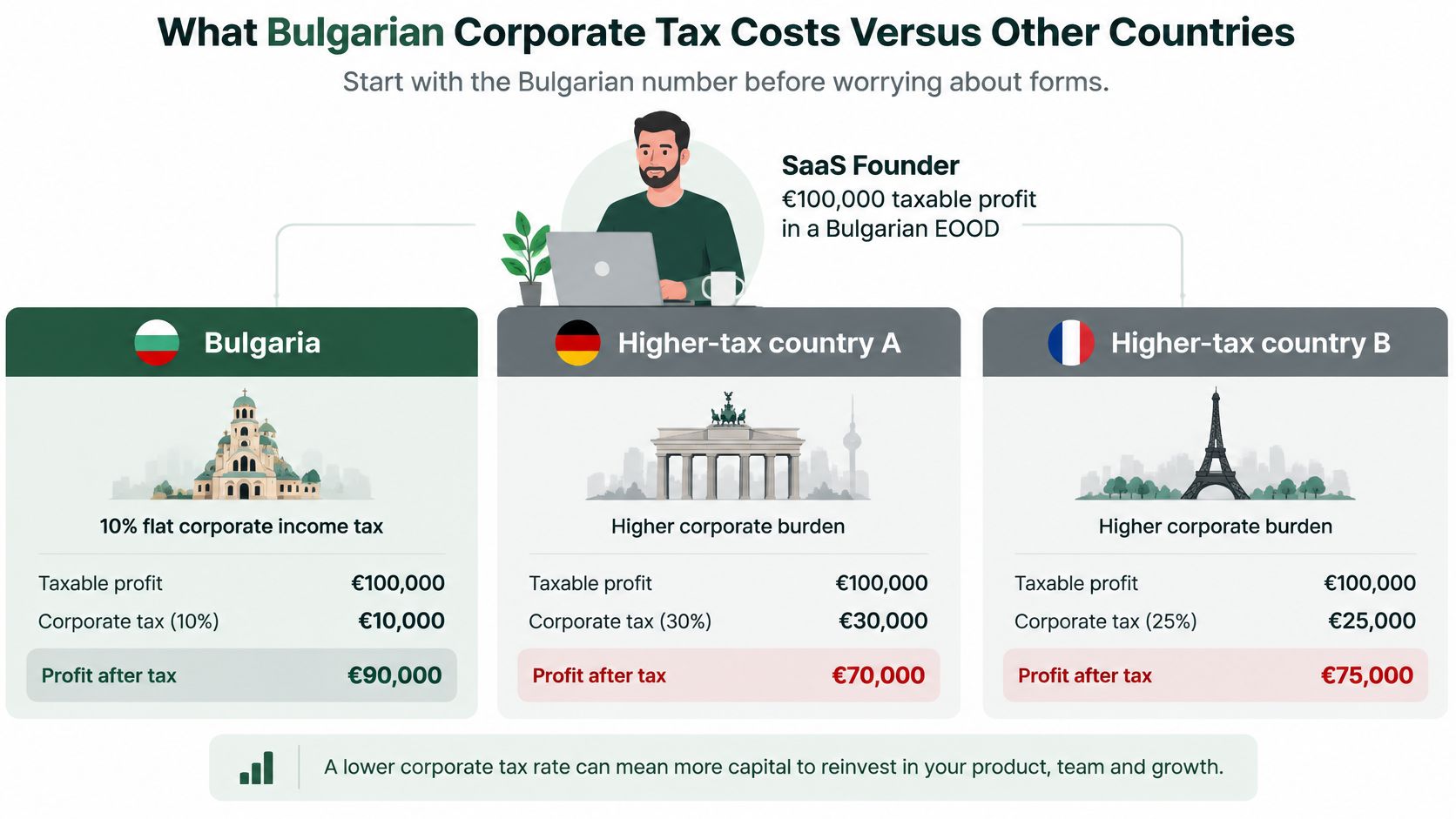
A SaaS founder with €100,000 of taxable profit in a Bulgarian EOOD starts with €10,000 of corporate tax, before other taxes, reliefs and credits. The Tax Foundation's 2026 comparison lists Bulgaria at 10%, against a European-country average of 21.6%, France at 25.8%, the United States at 25.6% and Germany at 30.1%.
Corporate tax on €100,000 of taxable profit
| Place | Statutory rate | Tax on €100,000 |
|---|---|---|
| Bulgaria | 10% | €10,000 |
| European-country average | 21.6% | €21,600 |
| France | 25.8% | €25,800 |
| United States | 25.6% | €25,600 |
| Germany | 30.1% | €30,100 |
These are headline statutory comparisons, with the tax column calculated by applying each rate to the same illustrative taxable profit. They aren't estimates of the cash an owner takes home, and the European-country average isn't a tax regime a company can choose.
Compare the business, not just the rate
The useful question is whether the proposed structure matches how you operate. A consulting company with documented business costs presents a different calculation from a shop carrying inventory, employing staff and selling to consumers across borders.
VAT, payroll, withholding on cross-border payments and non-deductible costs can all affect the overall result. Where the founder makes decisions and where employees work also deserve attention before choosing a company jurisdiction.
Our guide to corporate tax rates provides a starting point for country comparisons. Use those comparisons to shortlist structures, then test the shortlisted option against your customers, contracts, employees and management arrangements.
Start with profit rather than sales
Your first calculation should use taxable profit, not revenue. Customer receipts, unpaid invoices, operating expenses and tax adjustments need to be classified before the corporate-tax estimate means much.
Keep a simple forecast with separate lines for revenue, operating costs, payroll, book-to-tax adjustments and tax already paid. Don't put VAT collections into the same pot as money available for owner withdrawals.
Practical rule: Keep the initial corporate-tax estimate as a benchmark, then require the annual computation to explain every change.
This makes the comparison useful without turning it into a guarantee. You can see the potential corporate-tax cost while leaving room for the records and legal treatment that determine the final return.
The Online Calendar for VAT and Corporate Tax
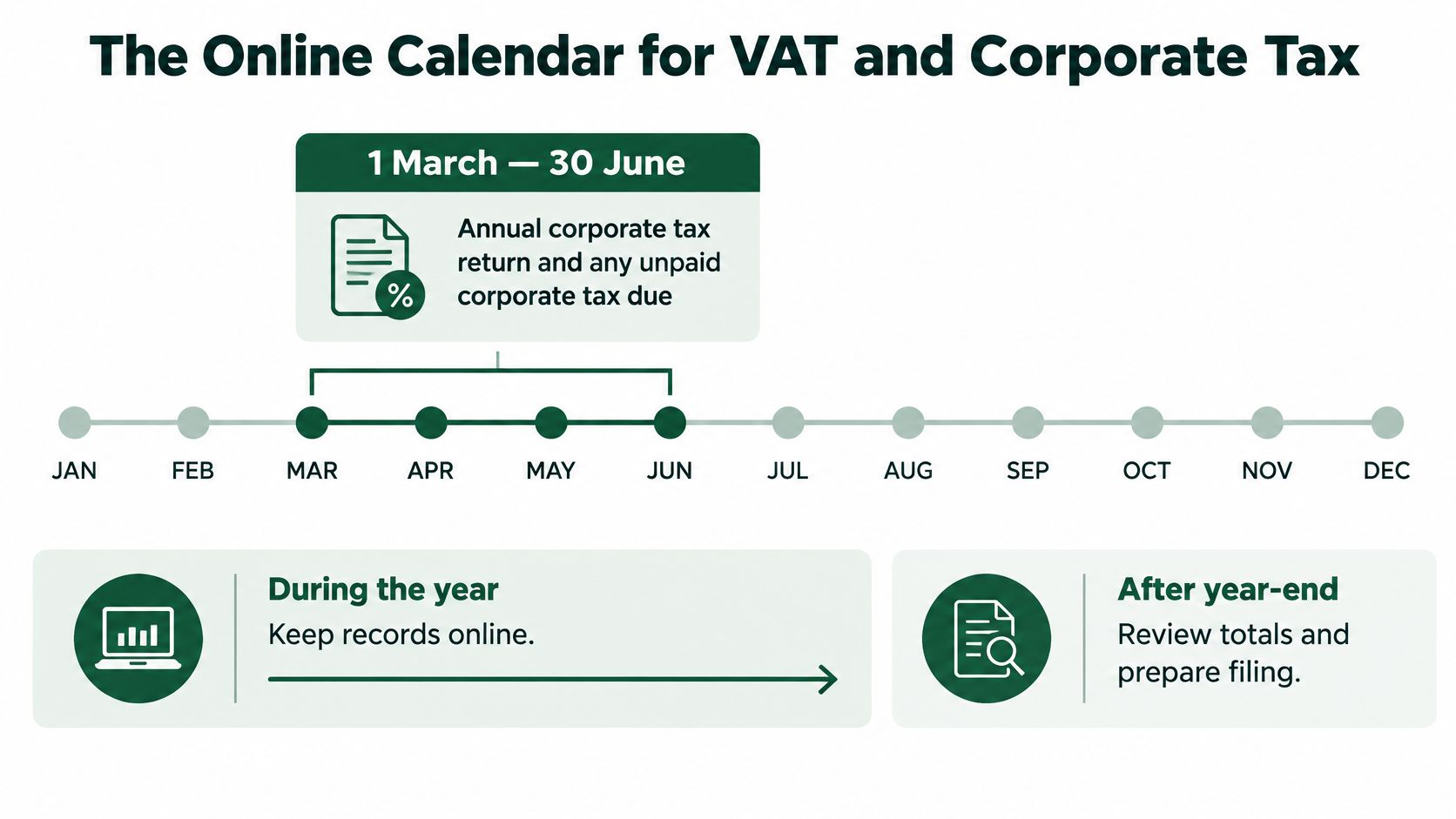
Bulgaria's annual corporate tax return and any remaining corporation tax are due between 1 March and 30 June of the following year, according to the Bulgarian Ministry of Economy's filing guidance. The same guidance confirms that filing is electronic, requires a qualified electronic signature, and credits advance payments against the final liability.
That makes online submission the legal route, not an optional convenience. Build your calendar around the recurring records that feed the annual return rather than treating the return as an isolated event.
Bulgarian limited company tax calendar
| Task | When | Channel | Must agree with |
|---|---|---|---|
| VAT return | Monthly or quarterly per registration; confirm the applicable Bulgarian obligation | NRA e-services with qualified electronic signature | Sales, purchases and bank payments |
| Payroll and social reports | Each month staff are paid | NRA electronic filing | Payroll ledger and payment proofs |
| Advance corporate tax | During the year when required | Online payment credited to the annual bill | Forecast of taxable profit |
| Annual corporate tax return | 1 March to 30 June of the next year | Electronic return with qualified electronic signature | Statutory accounts and tax computation |
| Inactive company | No activity and no corporate-tax liability | Generally no annual return, subject to inactive-company rules | Evidence the company truly had no activity |
Don't select a VAT cycle because your bookkeeping software offers it. Have the person handling registration confirm the applicable Bulgarian filing obligations, including any separate cross-border reporting.
Turn deadlines into assigned work
Give every calendar entry an owner, preparation date and completion record. A reminder saying “tax due” is less helpful than an entry naming who prepares the computation, who approves it and who checks the payment.
For VAT, prepare the sales and purchase records before the filing deadline. For payroll, agree when salary changes, leave and expense information must reach the payroll preparer.
Foreign payments need their own review point. Put the check before payment approval where possible, so a withholding question doesn't appear only after money has left the account.
Prepare early and keep the receipt
Block the opening week of the annual filing window to assemble the year-end folder. That's a practical internal target, not an extra statutory deadline, and it gives you time to resolve missing invoices or unexplained balances.
Keep submission acknowledgements and payment confirmations beside the completed return. A saved draft isn't proof of submission, and a bank transfer isn't proof that a return was accepted.
The corporate tax filing deadlines guide can support your calendar. For a company believed to be inactive, have its status checked rather than assuming that no sales automatically means no reporting obligations.
Getting Online Access and VAT Registration Ready
Settle access before the first reporting period closes. An organised ledger won't help on filing day if nobody has authority to submit it.
Prepare the signing and access arrangements
- Obtain a qualified electronic signature. Choose an accredited provider and confirm that the intended signatory can use it for the company's filings. Test the installation and signing process before a deadline.
- Confirm NRA e-services access. Check that the company registration appears correctly and that the director or authorised accountant has the necessary permissions. A personal login alone doesn't establish every company filing permission.
- Name the responsible people. Record who prepares, approves and submits each return. Where an accountant signs, keep the authorisation with the company records.
A non-resident founder can coordinate this work online. The important distinction is between possessing a signature and having the authority to use it for the relevant company.
Confirm VAT treatment before issuing invoices
- Check the registration grounds. Review the current domestic threshold and any transaction-specific registration obligations. Don't assume that being below a turnover threshold settles cross-border VAT.
- Confirm the reporting cycle. Record the obligations attached to the actual registration rather than copying another company's calendar.
- Classify EU customer transactions. Check customer status, relevant VAT details and the place-of-supply treatment before deciding whether reverse charge applies.
- Connect the records. Set up invoice numbering, bank imports and payroll categories so the accountant receives a consistent ledger.
Keep registration confirmations, authorisations and access instructions in a restricted company folder. Store passwords and recovery credentials securely, not in the shared invoice archive.
Online filing is easy to repeat once access works. Testing access while there's no deadline pressure is much easier than troubleshooting it on submission day.
How to File From Books to the Annual Return
The central calculation is a bridge from accounting profit to taxable profit. The OECD's Corporate Tax Statistics 2024 explains why statutory rates are only a starting point: the tax base also reflects deductions, depreciation, losses and other provisions.
The following sequence gives a remote founder a practical set of records to approve. Your accountant should apply Bulgarian rules to the company's particular transactions.
Complete the recurring records
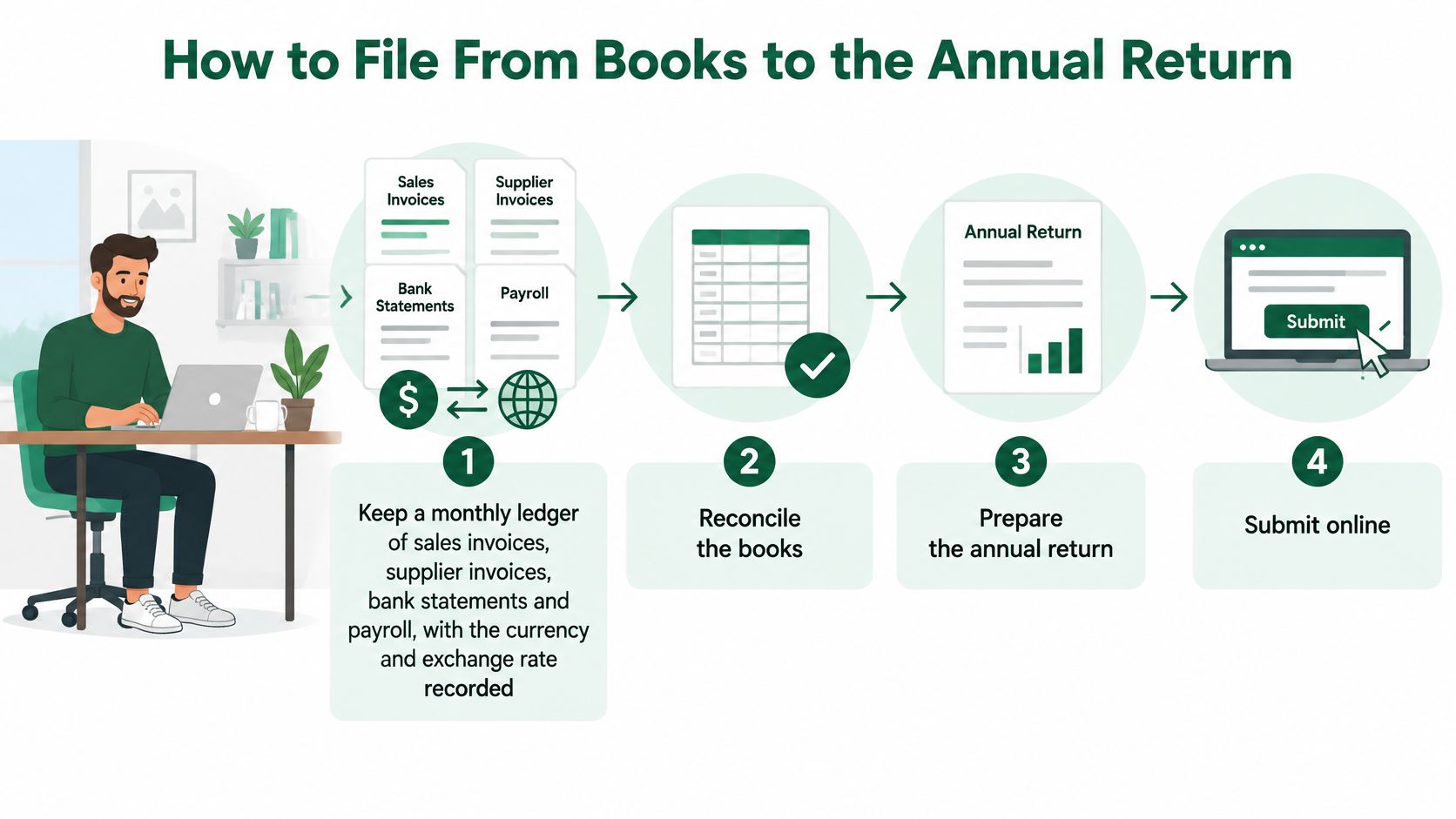
Keep the monthly ledger. Collect sales invoices, supplier invoices, bank statements and payroll records in your accounting system. Record the transaction currency and use the exchange treatment agreed with your accountant. Your tick-off record is a complete period folder with a ledger export.
Reconcile the bank account. Match each receipt and payment to its ledger entry and supporting document. Identify transfers, fees, loans and owner funding instead of forcing them into sales or expenses. Finish with a reconciliation that explains any outstanding items.
Prepare and submit the applicable VAT return. Use the sales and purchase records to establish the VAT treatment, checking supporting invoices before claiming input VAT. Submit through NRA e-services and arrange payment of any amount due. Save the submitted return, acknowledgement and payment evidence together.
Complete payroll and associated reporting. Process any salary, including director remuneration where applicable, using the correct employment or management arrangement. Keep the agreement, payroll calculation, statutory reports and payment proofs. Don't assume a transfer labelled “salary” establishes the correct tax treatment or deductibility.
Build and submit the year-end computation
Close the accounts and document tax adjustments. Start with accounting profit, then address non-taxable income, non-deductible expenses, tax depreciation and available losses. Separate adjustments that permanently change the tax result from timing differences that may reverse later. Keep a schedule explaining the legal treatment and evidence for each material adjustment.
Calculate corporate tax and reconcile advances. Apply the Bulgarian corporate rate to taxable profit, then account for eligible credits and advance payments. Verify payments against bank confirmations and the relevant tax account rather than relying only on a spreadsheet. Your output is a computation showing the annual liability and the remaining balance.
Approve, file and pay online. Have the director review the completed computation and unresolved questions before submission. File the annual return electronically with the qualified electronic signature during the statutory filing window, then pay any remainder using the correct taxpayer and payment references. Retain the acceptance confirmation.
Archive the complete filing package. Store the ledger, accounts, adjustment schedule, VAT records, payroll reports, annual return and payment confirmations together. Where figures differ, include a written explanation rather than leaving the next reviewer to reconstruct it. The final tick-off is a package another accountant could follow without guessing.
For the accounting close itself, use the guide to preparing financial statements. The accounts and tax return serve different purposes, but the numbers should connect through a clear reconciliation.
A Worked Year for a Consulting EOOD
Consider a hypothetical one-director consulting EOOD invoicing EU business clients. The following amounts are illustrative assumptions, not a claim about a typical company's costs or tax position.
Keep the accounts, tax calculation and owner payments visibly separate when reviewing the year.

Follow the money through the company
Suppose annual revenue is €180,000, deductible supplier costs supported by invoices are €40,000, and director salary plus employer payroll cost totals €40,000. Assume those costs meet the applicable requirements, leaving €100,000 of accounting profit.
In this simplified year, assume there are no private expenses, entertainment adjustments or differences between accounting and tax depreciation. Taxable profit therefore remains unchanged.
| Illustrative company calculation | Amount |
|---|---|
| Revenue | €180,000 |
| Deductible supplier costs | (€40,000) |
| Director salary and employer payroll cost | (€40,000) |
| Accounting profit | €100,000 |
| Net tax adjustments assumed | €0 |
| Taxable profit | €100,000 |
| Corporate tax | €10,000 |
| Advance corporate tax assumed paid | (€6,000) |
| Remaining annual payment | €4,000 |
The remaining payment is a settlement of the annual liability, not another tax on top. Confirm the assumed advances against actual payment records before approving the balance.
Keep VAT and distributions outside that calculation
VAT follows its own transaction treatment and periodic reporting. Output VAT on taxable supplies and recoverable input VAT generally pass through VAT accounts rather than acting as a discount against corporate income tax; irrecoverable VAT may need different accounting treatment.
EU client invoicing also requires a transaction-specific check. Don't assume that every foreign customer automatically means no Bulgarian VAT, and don't use the customer's postal address as the only evidence of their status.
This video provides another format for reviewing the topic alongside the written calculation.
Suppose the owner later proposes a €50,000 dividend from available distributable profits. Any applicable dividend withholding and the owner's personal tax treatment need a separate review; neither is included in the corporate-tax line above.
The same founder should document where the company is managed. Issuing invoices from Sofia doesn't, by itself, move a founder's personal tax residence or eliminate taxable-presence questions where decisions, staff and work remain elsewhere.
Copy this calculation using your own figures, then add a short variance list. Mark missing documents, uncertain expense treatment and unmatched advances so the preparer can resolve concrete questions instead of rebuilding the year.
Pitfalls That Upset an Otherwise Easy Filing
The most tempting mistake is treating every accounting expense as tax-deductible. A cost can belong in the books without receiving the same treatment in the tax computation, so private spending, entertainment and unsupported purchases need deliberate review.
Electronic filing doesn't remove that distinction. The OECD's Tax Administration 2024 reports that approximately 85% of administrations use electronic checks after submission, making consistent records important well beyond the moment a return is accepted.
Filing pitfalls and the record that fixes them
| Pitfall | Why it fails | Fix |
|---|---|---|
| Booking an expense as automatically deductible | Accounting profit is not taxable profit | List each tax adjustment with its reason |
| Claiming input VAT without an invoice | VAT fields are cross-matched | Keep the supplier invoice with the return |
| Skipping withholding on foreign contractors | Payment and withholding data diverge | Review contractor payments before filing |
| Undocumented related-party charges | No agreement or pricing support | File the contract and a short pricing note |
| Assuming a Sofia company moves your tax home | Management may still sit elsewhere | Record where decisions and work happen |
Fix the evidence before submitting
For uncertain expenses, record what was purchased, its business purpose and the proposed tax treatment. A payment confirmation proves money moved, but it doesn't necessarily establish what the company bought or why the cost qualifies.
For VAT, check the underlying invoice and applicable recovery conditions. If a document needs correction, place it on an exception list and resolve the treatment before claiming it.
Foreign contractor payments require classification, not an automatic withholding assumption. Review the payment's nature, recipient, applicable domestic rules and any treaty documentation before deciding what must be withheld or reported.
Before you approve: Every material difference should have an owner, an explanation and supporting evidence.
Don't leave cross-border activity outside the file
Related-party transactions need more than a bank reference reading “services.” Keep the agreement, describe the work delivered and document why the pricing is supportable.
A small SaaS business, online shop or consulting company can still raise VAT or permanent-establishment questions. Record where directors make decisions, where people work and which country's operations each contract supports.
Finish with a zero-unexplained-variance review: the accounts, computation, VAT reports, payroll records and payments must agree or contain a documented explanation. A difference isn't automatically an error, but an unexplained difference is unfinished work.
FastCorp is not a law firm or tax authority, and the client remains legally responsible for the company's activities, tax obligations and reporting accuracy. Delegating preparation helps organise the work; it doesn't remove the need to review what's being reported.
Keep the Calendar or Hand It to FastCorp
Stay hands-on when the company has few invoices, no staff, no foreign contractors and you have both working electronic access and time to reconcile the books. That means reviewing documents regularly, not just forwarding a bank statement when someone asks for it.
Delegate preparation when payroll, VAT classifications or cross-border payments begin competing for your attention. The sensible dividing line is whether you can explain the balances and meet the recurring obligations without rushing.
Choose who owns the recurring work
A useful handoff keeps the founder responsible for business facts and the preparer responsible for the agreed accounting work. You supply contracts, invoices, payment context and decisions promptly; the preparer identifies missing records, applies the relevant treatment and prepares the filings.
- Keep approval with the director. Read the final computation and ask about material adjustments before authorising submission.
- Agree a document routine. Decide where records go and how unresolved questions are tracked.
- Make access explicit. Confirm who can view the tax account, submit returns and retrieve acknowledgements.
- Keep a usable archive. Make sure the company retains its accounts and filing evidence, even when someone else manages preparation.
Make the handoff before the deadline feels urgent
Our bookkeeping and accounting services at FastCorp include VAT reporting, annual returns, payroll and tax compliance, and we offer a free consultation for people starting a business. Diana Dimova, Accounting & Sales at FastCorp, assists clients with accounting, VAT filings and service coordination.
Bring the ledger, VAT history, payroll records and foreign contracts to the conversation. Include outstanding questions and missing documents, because those usually matter more than a polished summary.
If the company is already trading, arrange the handoff before the annual filing window opens. You'll have time to establish access, agree responsibilities and resolve old balances without turning submission into a last-minute scramble.
The aim isn't to make the founder an expert in every tax rule. It's to make sure the right person receives the right evidence early enough to prepare a return you can confidently approve.
FastCorp offers accounting support for Bulgarian companies, including VAT reporting, payroll and annual corporate tax returns. Visit FastCorp to discuss your filing setup, and bring your ledger and cross-border contracts so the conversation starts with your actual obligations. If you're starting a business, book a free consultation to plan the records and online access you'll need.