IOSS VAT Explained: How the EU Scheme Works in 2026
IOSS VAT explained: EU rules for goods under €150, registration steps, monthly filing, country VAT rates and 2026 changes for online sellers.
One registration can replace VAT collection at 27 different borders, yet one missing number on a customs declaration can make your customer pay that VAT twice. That's the beautiful, frustrating truth about IOSS VAT. The scheme is simple when your data agrees, and painful when it doesn't.
The scale explains why the EU cares so much about that data. The Council document on the One Stop Shop schemes records that the Import OSS component recorded €6.3 billion of VAT in 2024, compared with €3.9 billion in 2023. That's not a niche filing shortcut. It's a major collection system for low-value parcels, and it's now a data and controls regime where your checkout, monthly return, and customs declaration have to tell the same story.
Get those three records aligned and IOSS feels almost effortless. Everything's handled online, your buyer sees a final price, and the parcel moves without a surprise bill at the door.
Table of Contents
- IOSS VAT at a Glance and Who Qualifies
- How IOSS Moves VAT From the Border to Checkout
- VAT Rates by Destination Country and Why They Matter
- How to Register and File IOSS Step by Step
- Using IOSS Through a Bulgarian Company or EU Logistics Partner
- Order Problems That Break IOSS and How to Fix Them
- What the 2025 VAT Reforms Change for IOSS Sellers
IOSS VAT at a Glance and Who Qualifies
IOSS, the Import One Stop Shop, lets you charge the buyer's EU country VAT rate at checkout for business-to-consumer sales of goods shipped from outside the EU, provided each consignment has an intrinsic value of no more than €150.
Run three eligibility checks before you touch a registration form. First, your buyer is a consumer, not a business buying for resale. Second, you're selling goods, not services. Third, the parcel is dispatched from outside the EU and imported into an EU country.
How the €150 limit actually works
The European Parliament legislative train page on VAT rules for e-commerce from third countries confirms IOSS covers consignments with an intrinsic value not exceeding €150, assessed per consignment or order. Goods above that value can't use the scheme and generally incur import VAT at importation instead.
Calculate intrinsic value before shipment, and exclude transport and insurance costs when separately stated. That split matters. A product priced under the limit can stay eligible if delivery is shown separately, while bundling everything into one headline price can push the same order over the line.
Your pricing, shipping consolidation, currency conversion, and customs data must produce one consistent value. If they don't, your system can apply the IOSS number incorrectly, and VAT collection shifts from you to customs or your customer at delivery.
Practical rule: Block IOSS automatically above €150. Don't let a staff member or a marketplace feed override that control manually.
Customs duties and product-specific rules still apply. IOSS handles VAT. It doesn't wipe away duty, restrictions, or other import obligations.
IOSS compared with standard import and separate EU registration
| Criterion | IOSS | Standard import | Separate EU registration |
|---|---|---|---|
| Who can use it | Non-EU sellers of B2C goods under €150 per consignment | Any importer, any consignment value | Sellers established in or selling into the EU |
| When VAT is collected | At checkout, at the buyer's country rate | At the border, before or on delivery | At checkout, in each destination country's system |
| Filing rhythm | One monthly IOSS return | Import declaration for each parcel | Returns per country under national rules |
| Value cap | €150 per consignment | No IOSS cap, import VAT applies above the limit | No value cap |
| Setup effort | One EU registration plus an intermediary if non-EU | Low for the seller, but delays and fees at delivery | Registration in every country where sales occur |
| Customs duties | Still apply | Still apply | Not a customs question for EU-shipped goods |
Your establishment decides your route in. EU-established companies, including Bulgarian ones, register directly through a Member State system. Non-EU sellers generally need an EU-established intermediary first.
Goods already held in an EU warehouse aren't IOSS goods. They fall under normal EU VAT rules because they aren't dispatched from outside the EU for that sale.
For founders setting up an EU base, we include VAT registration in all company formation packages, and our online company setup package costs €1,750 and is delivered 100% online.
Your three-question self-check
- Outside the EU: Are your goods shipped from outside the EU?
- At or below €150: Are average consignments at or below €150 after excluding separately stated transport and insurance?
- Mostly consumers: Do you sell mainly to EU consumers?
If all three answers are yes, IOSS is likely your route. I would set up the controls now, before volume makes cleanup expensive.
How IOSS Moves VAT From the Border to Checkout
Think of IOSS as moving the toll booth from the border onto the shop counter. Your customer pays the tax when she buys, not when a courier knocks with a card reader and a delay.
The visual below follows that shift from customs gate to delivered parcel.
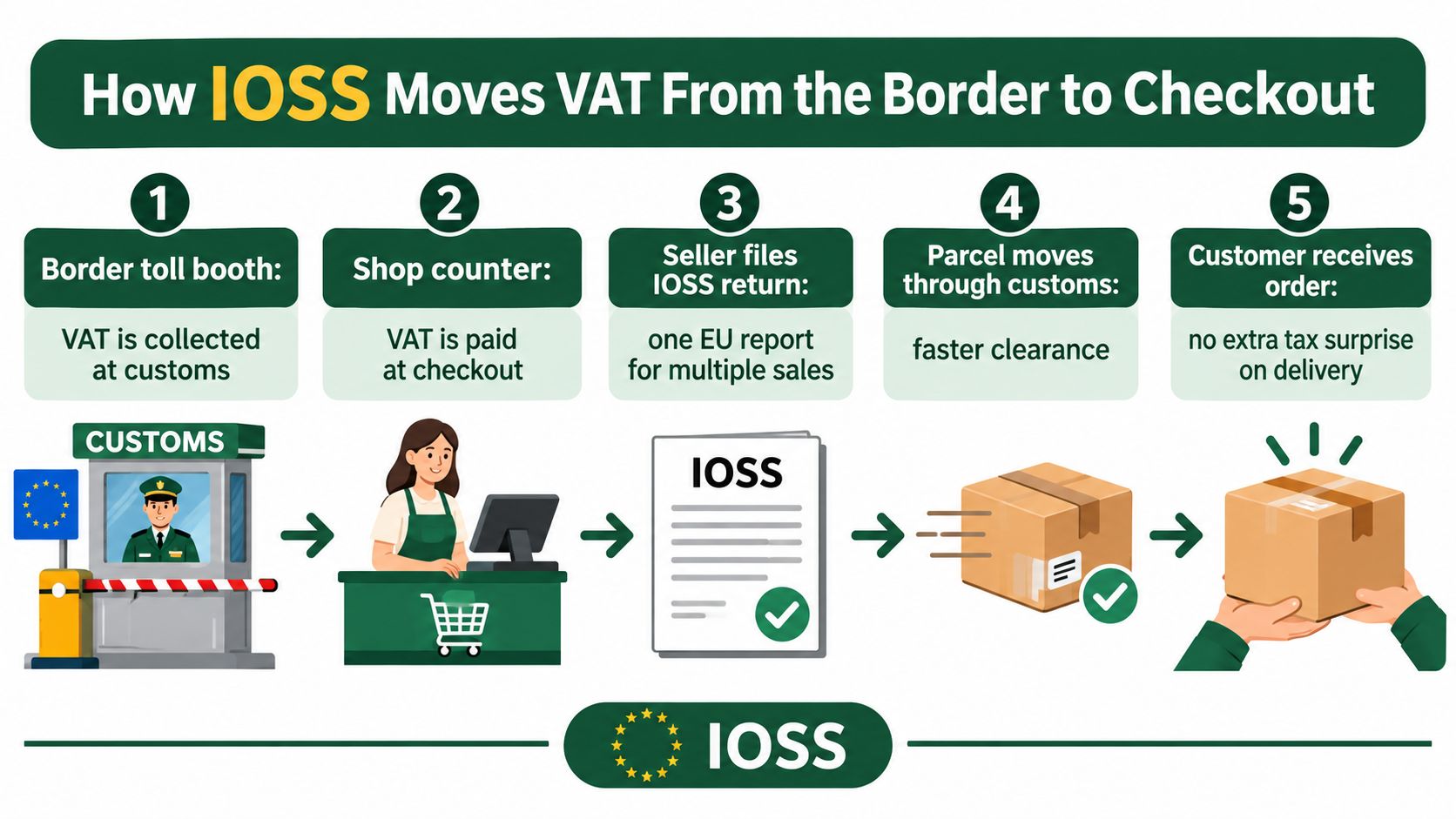
Say a buyer in Spain orders from your store and pays at checkout. You charge the destination-country VAT rate, record the sale at order level, and send your IOSS VAT identification number through your carrier into the customs declaration.
The European Commission VAT One Stop Shop portal describes how eligible sales are reported in a single monthly IOSS VAT return through one EU registration system. When a valid IOSS number is transmitted in the customs declaration, the importation can be VAT-exempt because VAT was already collected from the consumer.
That monthly rhythm matters. IOSS isn't quarterly filing, and non-EU sellers generally need that EU-established intermediary, while EU-established sellers register through a Member State system.
The short video below walks through the same checkout to customs flow.
The three records that must agree
- Checkout tax calculation: destination, intrinsic value, VAT rate, and VAT amount
- Monthly IOSS return: the same eligible sales, reconciled in total
- Customs declaration: the same value, currency, and IOSS identifier sent to the carrier
Any mismatch in order value, VAT amount, currency, or IOSS identifier can cause customs rejection or duplicate VAT collection. I've no patience for systems that retype this number by hand. Pass it securely and automatically to your carrier or customs broker, every time.
When checkout, return, and customs data agree, your buyer gets no unexpected VAT charge at the door. That's fewer refused parcels and much happier customers.
VAT Rates by Destination Country and Why They Matter
Sell the same €100 product to Germany and Hungary and you don't charge the same VAT. Germany's standard rate is 19% and Hungary's is 27%, an eight percentage point gap on one identical basket. That's destination-based VAT in action, and it's the engine of your IOSS VAT calculation.
Standard VAT rates by destination country
| Destination | Standard VAT rate | Practical note |
|---|---|---|
| Bulgaria | 20% | Home rate for Bulgarian companies, check reduced categories |
| Germany | 19% | Charge this rate for German buyers, not your home rate |
| France | 20% | Same headline rate as Bulgaria, verify reduced categories |
| Spain | 21% | Standard rate for Spanish buyers |
| Italy | 22% | Standard rate for Italian buyers |
| Ireland | 23% | Standard rate for Irish buyers |
| Finland | 25.5% | Standard rate for Finnish buyers |
| Hungary | 27% | Highest standard rate in this list |
| EU minimum standard rate | 15% | Floor set by EU law, no maximum |
The European Commission country table on VAT rules and rates lists Germany at 19%, France at 20%, Spain at 21%, Italy at 22%, Ireland at 23%, Finland at 25.5%, and Hungary at 27%, and notes EU law requires a standard rate of at least 15% with no maximum.
Your company's address doesn't set the rate. Your customer's delivery country does. If you're comparing structures, our guide to the EU VAT rate by country helps you keep that destination logic straight.
Reduced rates are where good stores slip
Standard rates are only the starting point. Some countries apply reduced-rate categories to products such as books or food, and your rate table needs product-level mapping, not just a country list.
Use tax software or a maintained rate table that connects each delivery country to the correct treatment for that product. Using one home-country rate everywhere looks tidy in a spreadsheet, then creates underpayments, corrections, and audit exposure.
Refresh habit: Update your rate table at least once a year and again before any major country expansion. Rates change, and stale tables don't announce themselves.
Test before you trust. Take one product, run test orders to three countries, and check that checkout VAT moves with the destination each time. If the VAT doesn't move, your mapping isn't working, whatever your settings screen claims.
I would also test a reduced-rate product separately. A store can handle standard rates perfectly and still misprice every book or food item it sells.
How to Register and File IOSS Step by Step
Good news first. Every step runs online, from the Member State registration form to the monthly return, so you can complete the setup without travel. The work isn't hard, but the order matters, because each step feeds the next record.
Steps 1 to 3 get you registered
- Confirm eligibility first: Check that each consignment is goods, sold to EU consumers, dispatched from outside the EU, and valued at €150 or less, excluding separately stated transport and insurance. The common slip is checking a typical order instead of your largest normal basket, bundles included.
- Decide your route: If you're established in the EU, register directly. If you're not, appoint an EU-established intermediary before you register. Forgetting the intermediary stalls everything, so don't leave this until launch week.
- Register online and protect the number: Register through the chosen Member State system and record your IOSS identification number in one controlled place. Share it only through secure carrier and broker connections. Our overview of VAT registration requirements is worth checking against your wider EU setup at this point.
Steps 4 to 6 make checkout and shipping agree
- Map destination rates in checkout: Connect every destination country to its correct standard or reduced rate, not your home rate. This step is why rate mapping comes before your first sale. I would test Germany, France, and Hungary first because their rates expose lazy single-rate settings quickly.
- Create order-level records: Store intrinsic value, VAT charged, currency, product category, and destination country for every order. Monthly totals alone won't help you find which parcel caused a mismatch. Keep these records auditable from day one.
- Pass the number to the carrier: Send the IOSS number to your carrier or customs broker on every eligible parcel, and block IOSS for orders above €150. Sending parcels without the number is the classic failure. Your registration exists, your customer paid VAT, and customs still charges her because the declaration says nothing.
Step 7 closes the month
- File, pay, and reconcile monthly: File and pay the monthly IOSS return, then reconcile refunds, returns, and currency differences against your order records. Don't file from your payment processor total alone. Reconcile to orders, then to carrier data, then file.
Registration is the easy part. Clean monthly reconciliation is what keeps you registered and trusted.
Finish with a verification routine before you scale. Place test orders to three different EU countries, then confirm the checkout VAT, carrier data, and return totals all agree for each one.
Check the unglamorous details too. Currency conversion should use one consistent method. Split shipments need a clear value rule. Marketplace sales need separating from your own store sales, because the marketplace may be responsible for VAT on its channel.
Set a monthly calendar owner as well. One named person should own rate table checks, carrier data checks, return preparation, and payment. Shared responsibility with no owner usually means nobody spots the missing number until customers complain.
Using IOSS Through a Bulgarian Company or EU Logistics Partner
Say a founder runs an online shop through a Bulgarian company and ships parcels from a non-EU supplier to customers across the EU. That structure can make IOSS VAT beautifully straightforward, provided the goods flow matches the scheme.
The comparison below shows how a Bulgarian company and an EU logistics partner change the setup.
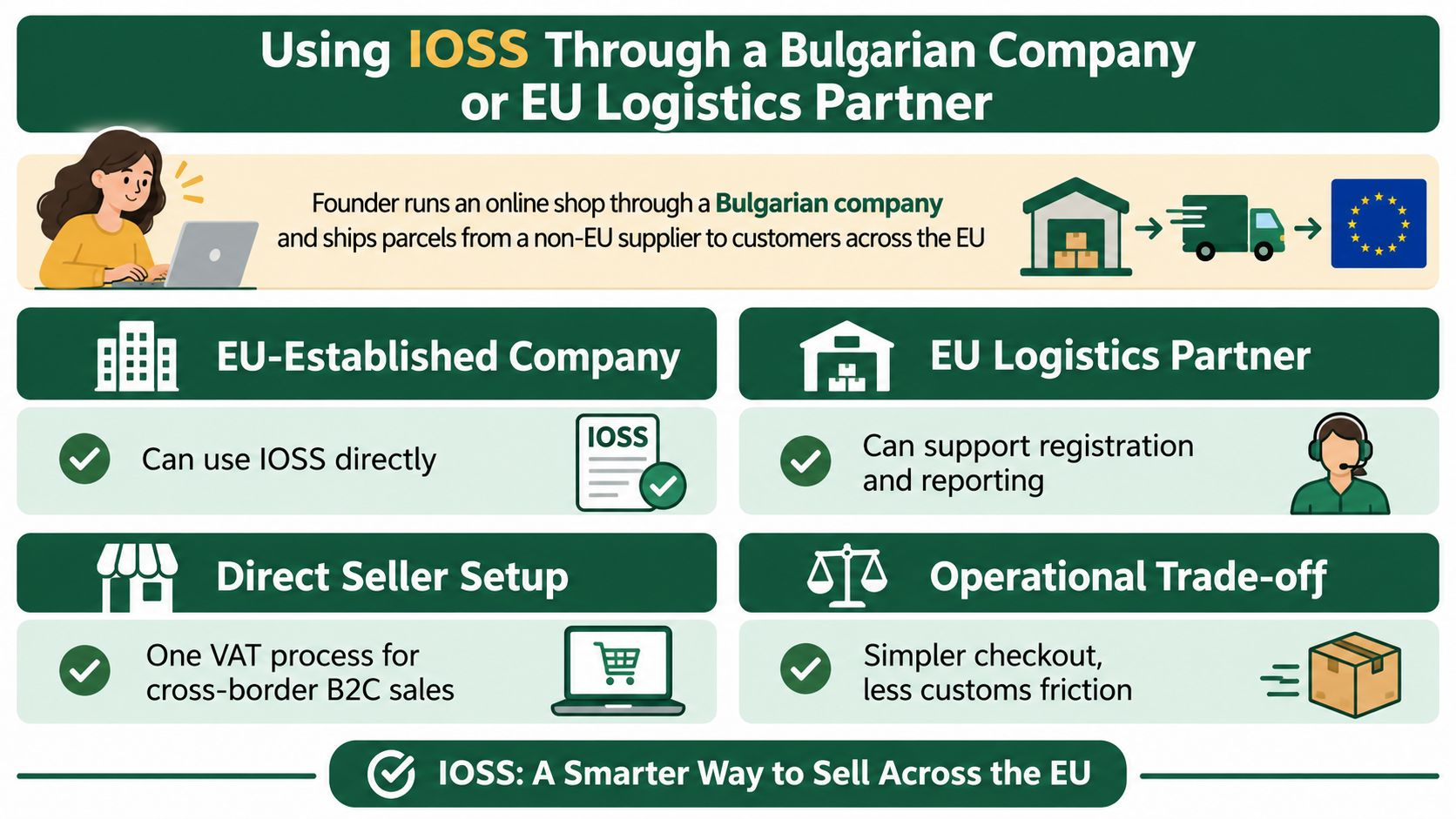
An EU-established company can register for IOSS directly through a Member State system, with no intermediary required. That removes one party, one fee, and one handoff from the chain. Your Bulgarian company charges destination VAT at checkout and files through its EU registration.
Draw the warehouse line clearly
IOSS covers goods dispatched from outside the EU. Stock already held in an EU warehouse falls under normal domestic and intra-EU VAT rules, so don't push those orders through IOSS just because the same store sells them.
You therefore have two operating models. Ship direct from abroad under IOSS, with strong customs data on every parcel. Or consolidate stock into an EU fulfilment partner first, accept EU VAT obligations for that stock, and gain faster local delivery.
Neither model wins automatically. Direct shipping keeps stock flexible but depends heavily on carrier data. EU fulfilment improves delivery speed but adds warehouse VAT complexity. Choose per product line if your order routing can reliably tell the two apart.
OECD VAT comparison, 2023 to 2024
| Measure | Value |
|---|---|
| OECD average standard VAT rate 2024 | 19.3% |
| OECD average standard VAT rate 2023 | 19.1% |
| Countries extending e-commerce VAT to low-value imported goods | 27 |
| Non-EU destinations named in the comparison | United Kingdom, Norway, Switzerland, Australia, New Zealand |
The OECD Consumption Tax Trends 2024 publication reports an average standard VAT rate of 19.3% across OECD countries with VAT in 2024, compared with 19.1% in 2023, and says 27 countries have extended e-commerce VAT regimes to low-value imported goods.
That's your global warning. IOSS is highly convenient for qualifying EU imports, but the UK, Norway, Switzerland, Australia, and New Zealand need their own registrations, rate logic, invoice rules, and filing calendars. A Bulgarian company with EU logistics gives you a simpler EU base, while non-EU sellers without that base use the intermediary route.
Order Problems That Break IOSS and How to Fix Them
The costliest failure is brutally simple. A parcel reaches customs without a valid IOSS number, so your buyer gets an unexpected VAT bill for tax she already paid at your checkout. She doesn't blame your carrier integration. She blames your store.
IOSS problems, causes and fixes
| Symptom | Likely cause | Fix |
|---|---|---|
| Customs asks for VAT on an IOSS parcel | IOSS number missing or not sent to the carrier | Transmit the valid IOSS number on every eligible shipment |
| Order over €150 handled under IOSS | Shipping or insurance counted in value when stated separately | Calculate intrinsic value without separately stated transport and insurance, and block IOSS above €150 |
| Buyer pays VAT twice | Checkout VAT and delivery charge both applied | Confirm checkout VAT covers the order and the IOSS number is on the declaration |
| Invoices show the wrong VAT | Home-country rate used for every buyer | Map each delivery country to its correct rate |
| Monthly return does not match orders | Refunds, returns or currency conversion not reconciled | Reconcile order-level records every month, including refunds |
| Destination reported incorrectly | Address changed after checkout or split shipment | Record the final delivery country and match it to carrier data |
Notice the pattern. Every fix is a process change, not a one-off apology and refund. If you only correct the parcel in front of you, the same defect produces the next complaint tomorrow.
Start with transmission. Your warehouse, marketplace connector, and carrier booking must all pass the IOSS number for eligible shipments and suppress it for ineligible ones. Marketplace orders need special care, because the marketplace's number and your own store number shouldn't be mixed.
Then fix value logic. Product pricing, discounts, bundles, consolidation, and currency conversion can move a consignment across €150 without anyone changing the product. Calculate intrinsic value at shipment level, not just at basket level.
Rate and return problems need monthly discipline. Our guide to VAT returns explained is useful background if your team keeps treating the return as a totals exercise instead of an order-level reconciliation.
Sample ten random orders every week and compare them with carrier data. Small weekly checks beat one heroic cleanup at month end.
Some fixes take a day, such as correcting a rate table or adding an automatic €150 block. Others need a few weeks, such as clearing a backlog of mismatched returns, rebuilding carrier mappings, or separating marketplace and direct sales.
I would prioritize in this order. Stop double VAT first, block over-limit IOSS shipments second, then clean the monthly reconciliation. Customer trust, eligibility, and filing accuracy. In that order, every time.
What the 2025 VAT Reforms Change for IOSS Sellers
Here's the surprise. IOSS did not become mandatory. If you've been waiting for a legal order before you act, you'll keep waiting, while avoiding the scheme gets more expensive.
The reform summary below shows that optional status and the rising cost of staying out.
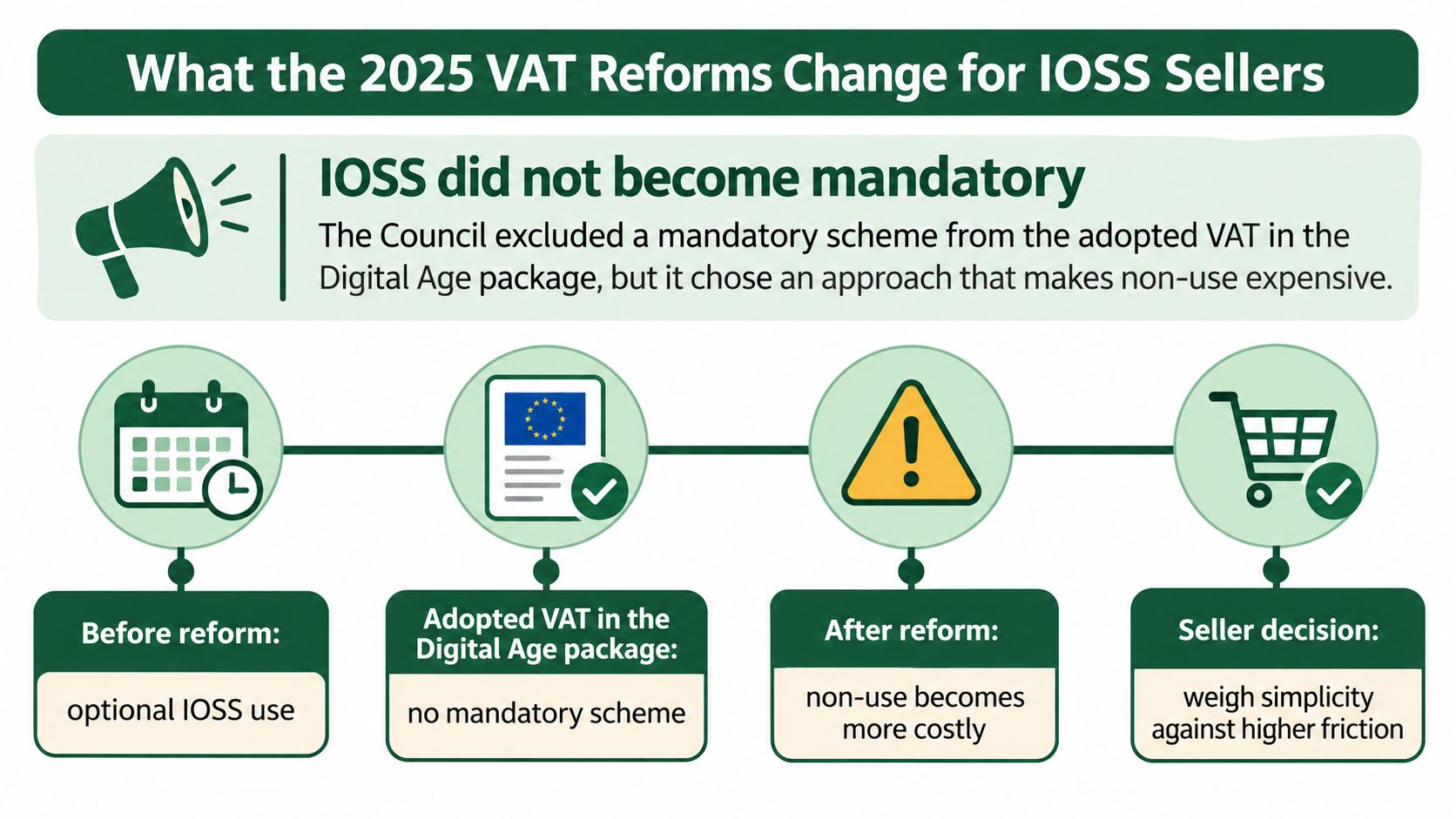
The European Commission announcement on adoption of the VAT in the Digital Age package records that ViDA was adopted on 11 March 2025, with some OSS and IOSS clarifications scheduled from 1 January 2027. Mandatory IOSS was excluded from the adopted package because it lacked sufficient support.
Instead, the direction is to incentivize IOSS by making foreign traders or platforms liable for import VAT in the destination Member State when they don't use the scheme. Businesses declining IOSS could face registration in each Member State where they make relevant sales.
That's a powerful nudge. One IOSS registration and monthly return starts to look very attractive beside multiple destination registrations, local filing calendars, and customers facing border collection.
Run your scenario check now
- Intermediary costs: What will EU representation cost against multiple registrations?
- Marketplace collection: Which channels already handle VAT as deemed supplier, and which don't?
- Customs data quality: Can your carriers transmit the IOSS number and order values reliably?
- Cash flow and eligibility: How do checkout collection, product values, and the €150 threshold affect your model?
Further customs reform work addresses the €150 threshold and related deemed-supplier rules, and broader reforms roll out progressively. Don't build a three-year fulfilment plan on today's rulebook alone.
I would model both routes before your next filing cycle. Compare total compliance cost, delivery experience, refused parcels, and future registration exposure. Treating today's IOSS VAT rules as permanent will mislead anyone planning beyond the next quarter.
If you're selling low-value goods into the EU and want a cleaner base for IOSS VAT, we can set up your Bulgarian company, EU VAT registration, banking, and ongoing bookkeeping through one online process. Visit FastCorp to get your EU structure and VAT setup handled properly from the start.