Open Company in Europe: The Fast Setup Guide
Learn how to open company in Europe with this practical guide. Compare tax rates, master VAT and banking, and launch your EU business online in days.
Most advice on how to open a company in Europe starts with the wrong promise, a single EU business setup that supposedly works everywhere. It doesn't. Europe is a dense market of national rules, and the founders who win are the ones who pick one jurisdiction, build the company correctly there, and then prepare for the work after registration, banking, VAT, filings, and substance.
The scale alone should change how you think about entry. Eurostat reported 3.5 million new businesses in the EU in 2024, out of 34 million enterprises overall, with an enterprise birth rate of 10.4% and a death rate of 9.2% Eurostat business demography data. That is not a niche environment. It's a live, crowded, constantly renewing commercial system where incorporation is normal, but sloppy compliance gets expensive fast.
Table of Contents
- European Company Formation in Practice
- Comparing European Tax Rates and Jurisdictions
- Executing the Remote Incorporation Workflow
- Solving the EU Banking and VAT Bottlenecks
- Managing Ongoing Compliance and Substance
- Accelerating Market Entry with FastCorp
European Company Formation in Practice
Founders lose time by treating Europe as a single legal market for company formation, when incorporation remains strictly national. Each company is registered under a national law, with its own registry, tax office, filing calendar, and banking checks. A “pan-European” business plan does not change those requirements.
Local law beats generic advice
The European Parliament reports around 24 million companies registered in the EU. About 80% are limited liability companies, and 98% to 99% of those are SMEs European Parliament statistics. Europe's corporate system is therefore built around smaller operating entities, not only multinational groups with internal legal and tax departments.
Practical rule: choose the country first, then design the operating model around its tax treatment, banking requirements, VAT rules, and filing obligations.
Company creation is routine across the region. In 2024, 19 of the 27 EU countries recorded more companies created than dissolved Eurostat business demography data. Your advantage will come from setting up correctly and keeping the entity operational, not from chasing a registration shortcut.
Build for operations after registration
Use a two-layer plan. First, complete incorporation and tax registration under the selected country's rules. Then test what happens when the company invoices foreign customers, hires outside its home market, stores goods abroad, or sells across borders. Banking access and VAT compliance can determine whether the company functions in practice, even after the registration certificate arrives.
The European Central Bank reports that more than 60% of EU firms must comply with different regulatory standards across Member States ECB article. That variation affects contracts, invoicing, payroll, tax reporting, and evidence of business activity. A national company registration is the starting point, not a passport to frictionless trading throughout Europe.
For the fastest workable route, select the national structure that matches your business model. Prioritise online formation, a bankable ownership and activity profile, clear VAT handling, and post-formation reporting that your team can maintain.
Comparing European Tax Rates and Jurisdictions
The cheapest corporate tax rate is a poor reason to incorporate if the company cannot open a bank account, register for VAT, or support its cross-border invoices. I use tax as the first filter with founders, then test the jurisdiction against the operational work that starts after registration. A low rate can improve cash flow, but a weak banking profile or slow VAT process can stop the business before that saving matters.
Where the corporate rates actually land
Tax Foundation's 2026 Europe corporate tax table lists Hungary at 9%, Bulgaria at 10%, and Cyprus and Ireland at 12.5% Tax Foundation corporate tax table. These figures make Bulgaria and Hungary the low-rate options in this comparison. The rate is useful, but it does not answer whether a bank will accept the business model or whether the company can handle foreign VAT obligations.
A European-company guide places France at 25%, Germany at about 30%, and Denmark at 22% European company guide. Those rates can fit a company with substantial local operations and strong margins. They are less attractive for a lean international business that needs controlled overhead, fast administration, and predictable retained cash.
| Country | Corporate Tax Rate | Digital Formation | Typical Setup Time |
|---|---|---|---|
| Bulgaria | 10% | Fully digital | 2 to 5 business days |
| Hungary | 9% | Varies by provider | Not stated in the verified data |
| Cyprus | 12.5% | Varies by provider | Not stated in the verified data |
| Ireland | 12.5% | Varies by provider | Not stated in the verified data |
| France | 25% | Varies by provider | Not stated in the verified data |
| Germany | About 30% | Varies by provider | Not stated in the verified data |
| Denmark | 22% | Varies by provider | Not stated in the verified data |
Why Bulgaria is usually the cleanest bet
Bulgaria combines a 10% corporate tax rate with fully digital company formation European company guide. That pairing gives founders a practical starting point: incorporation can be handled online, while the lower rate limits recurring tax pressure. The decision still depends on the company's activity, ownership structure, customers, and evidence of genuine business operations.
A low headline rate does not create a low-friction company. If the bank delays onboarding, VAT registration stalls, or the accounting records cannot support the invoices, the tax saving has little practical value.
The European Commission says many EU countries allow founders to set up a company in no more than 3 working days, through a single administrative body, with registration formalities completed online European Commission startup factsheet. Treat that as a benchmark for administrative maturity, not as a promise that every company will be operational within that period. Bank onboarding, tax registrations, beneficial ownership checks, and VAT evidence can take place outside the incorporation timeline.
For an international business, Bulgaria is often the more workable base than a higher-tax Western jurisdiction when remote execution, predictable administration, and controlled costs matter more than brand prestige. Founders should confirm the banking route and VAT treatment before filing, not after receiving the registration certificate.
Use this comparison of the lowest corporate tax rate in Europe to narrow the initial shortlist, then judge each option by its post-incorporation workload.
A practical comparison of common choices
Apply three tests to every jurisdiction: can the company be formed remotely, can it obtain a suitable business bank account, and can the owners maintain tax and compliance records after launch? A jurisdiction that passes only the first test is not a fast route to market.
That assessment usually places Bulgaria near the top of the shortlist. The right choice is the country that keeps the company bankable and compliant, not the one with the most attractive number in a comparison table.
Executing the Remote Incorporation Workflow
Once the country is chosen, don't improvise. Use a strict sequence and keep the paperwork tight. For a Bulgarian EOOD or OOD, the remote workflow is straightforward if you prepare properly, and it's far safer than trying to patch things together after the fact.
The order that actually works
Start with remote identity verification through a secure online notary. Then collect the corporate pack, which usually includes the incorporation documents, the constitutional documents, the register of members or directors, and the beneficial ownership filing where applicable Binderr workflow. After that, file the company and move immediately to the operational pieces, bank onboarding and tax registrations.
This order matters because founders often try to solve everything at once. That creates delays. Banks want the company documents first, tax authorities want the legal entity first, and any serious compliance provider will want the identity checks done before it touches filings.
Practical rule: do not chase the bank before the corporate pack is clean. Banking teams reject messy documents faster than founders expect.
For the certificate pack itself, use a provider that understands the sequence and prepares the incorporation file correctly from the beginning. This certificate of incorporation guide is useful if you want a clean document trail rather than a guess-and-check process.
Online or in Sofia
The fully online route is ideal when you want to stay remote and keep travel out of the equation. The in-person Sofia option can be slightly faster in practice, but the difference is operational, not philosophical. If you are already planning a visit, in-person execution can be efficient. If not, the remote route is the smarter default.
Documents you should have ready:
- Passport or ID, because identity verification comes first.
- Proof of address, since KYC teams will ask for it.
- Director and shareholder information, because beneficial ownership filings depend on it.
- Signed incorporation documents, because delays usually come from missing signatures, not from the registry itself.
When the file is prepared cleanly, remote incorporation stops feeling like bureaucracy and starts looking like project management. That's the right mindset for Europe.
Solving the EU Banking and VAT Bottlenecks
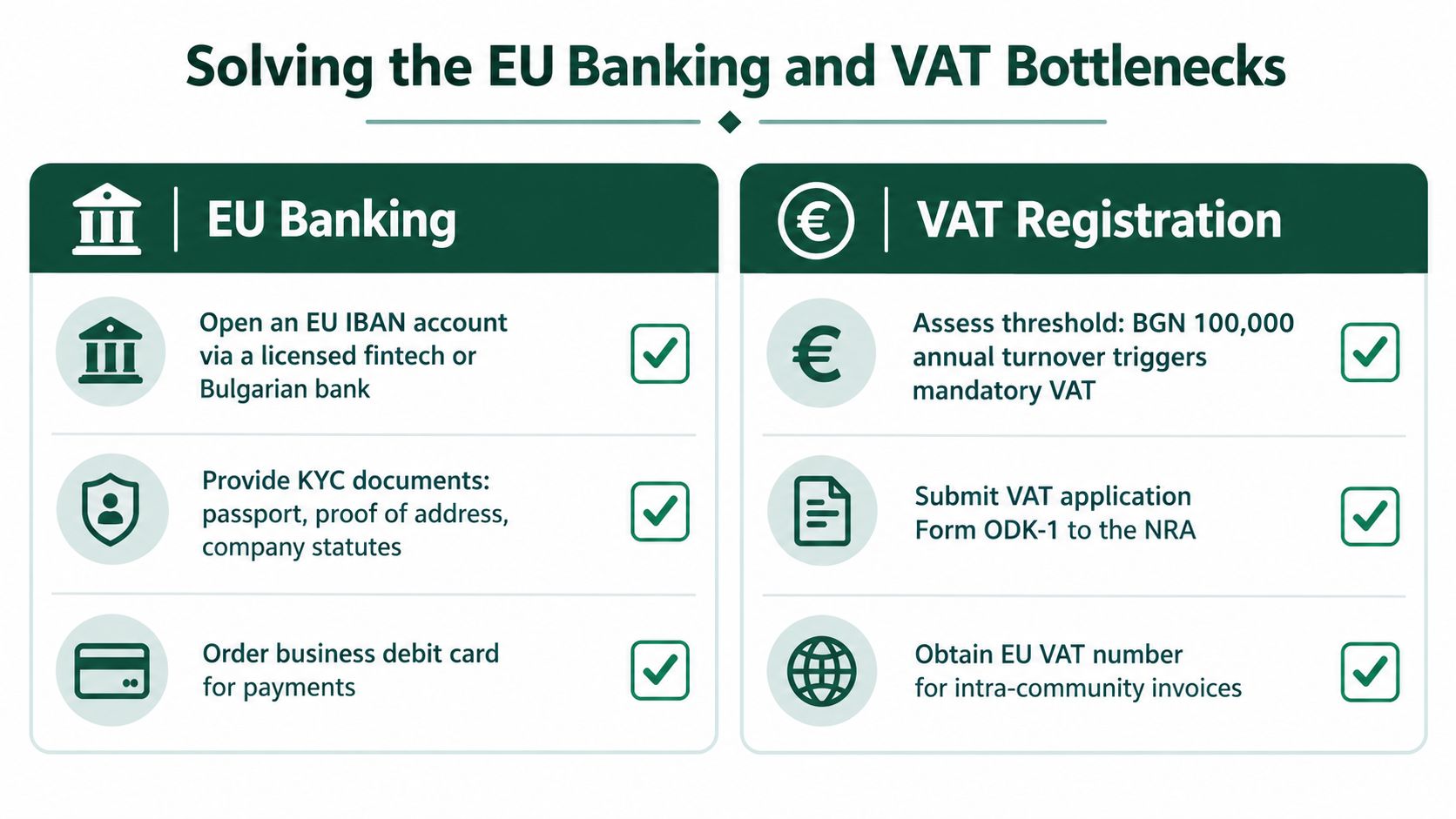
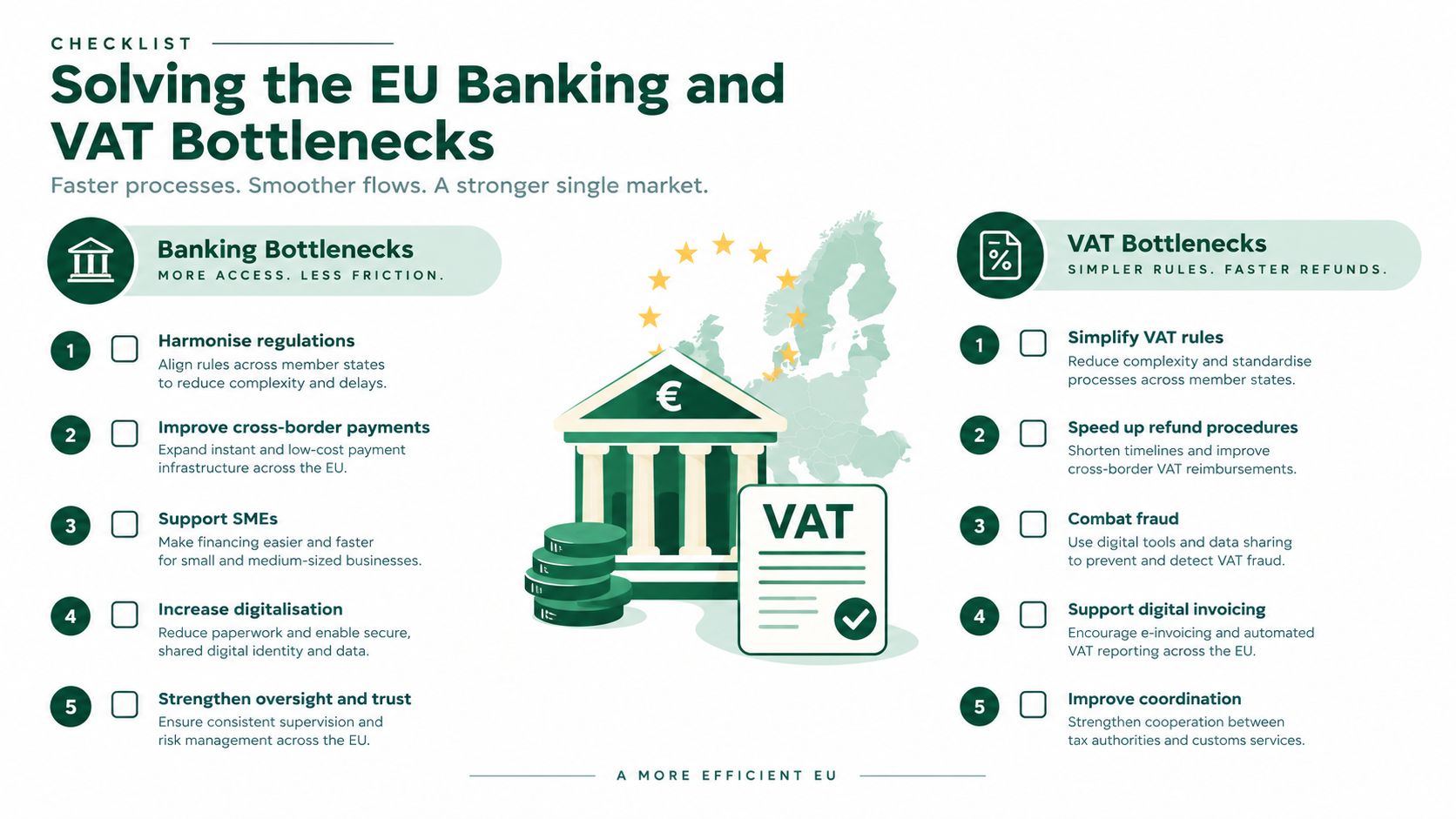
Europe does not give you a ready-made “EU company.” Registration creates the entity. Banking access and VAT compliance determine whether that entity can trade. Founders often celebrate incorporation, then discover that the bank starts a new KYC review while the tax authority applies a separate VAT process shaped by local rules.
Banking is the first real gate
Traditional banks scrutinize non-resident founders. Expect requests for incorporation documents, beneficial-owner details, director information, and KYC evidence before an account is approved. Cross-border or online-first business models can trigger extra questions and longer reviews iWorld banking and setup guide. Plan banking before incorporation is complete, or you may own a company that cannot receive or send money.
For operational speed, assess online providers and specialized Bulgarian banks. Prestige matters less than access to a usable EU IBAN for customer collections, payouts, and supplier payments. Add card access only after the account is active and the payment flow works reliably. Test incoming transfers, outgoing payments, and transaction limits before committing to the account as your primary operating channel.
VAT is where hidden cost shows up
VAT creates the recurring burden that registration brochures leave out. The EU VAT compliance gap was 9.5% of VAT total tax liability in 2023, while ongoing compliance costs were estimated at €2,400 to €8,000 per Member State per year. The same European Commission survey found that 90% of respondents still regarded multiple VAT registrations as a problem European Parliament VAT briefing. Treat those figures as a planning warning: map each trigger before invoicing, register only where the rules require it, and build the filing workload into your operating budget.
Keep the operating model tight
A workable setup has clear ownership and few moving parts:
- Map VAT triggers early, especially for digital services, goods, and cross-border subscriptions.
- Centralize invoices and payment dates, so deadlines do not sit in separate calendars.
- Avoid unnecessary registrations, because every additional VAT number creates recurring filings and records.
- Review country-specific substance requirements, since a bank account alone does not demonstrate operational readiness.
Use one invoicing system, one payment calendar, and one source of truth for registration thresholds and customer locations. The difference between a usable company and dormant paperwork is whether the banking and VAT stack is ready when the first client wants to pay.
Managing Ongoing Compliance and Substance
Incorporation is the opening move. After that, the company needs to look real, stay current, and remain defensible in front of banks, tax authorities, and counterparties. If you treat compliance as a one-time project, you'll eventually pay for the neglect.
Keep the company legible
Maintain a registered address, keep company records current, and make sure corporate documents are easy to produce when a bank, supplier, or authority asks. If a document needs apostille or an updated signature chain, handle it early. Waiting until a counterparty asks for it turns a simple admin job into a launch delay.
Many lean founders get sloppy. They keep the entity alive on paper but let the records drift. That's a bad habit in Europe, because local scrutiny can come from tax, banking, payroll, or contract counterparties, and each of them may ask for something slightly different.
Bookkeeping is not optional overhead
Centralized bookkeeping matters because missed filings usually start as small process failures. A late VAT return, a missing payroll report, or an untracked local expense category can snowball into administrative noise you don't need. If the company hires locally or internationally, payroll reporting and statutory filings need to be part of the same routine, not a separate panic cycle.
Keep one compliance owner, one filing calendar, and one document archive. If those three things are fragmented, the company will feel older and messier than it really is.
The safest model is to treat every quarter as an audit of the operating setup. Are the accounts current, are the filings done, and does the company still match the business reality? If the answer is no, fix it before the mismatch becomes expensive.
Accelerating Market Entry with FastCorp
If you want speed without improvisation, use a provider that handles the full chain, formation, banking support, VAT setup, virtual office, and ongoing compliance, instead of stitching together five vendors that don't coordinate with each other. That approach cuts down on missed filings, document gaps, and the usual back-and-forth between registry, bank, and tax office.
FastCorp publishes a clear formation workflow for Bulgarian companies and explains its company creation service in one place, which is exactly what many founders need when they want the job done cleanly rather than piecemeal FastCorp company creation. The operational advantage is simple, one team handles the registration, the VAT setup, the banking assistance, and the admin that follows.
What the package changes in practice
You get a single point of coordination for the steps that usually fragment:
- Incorporation of an EOOD or OOD, without managing a stack of separate vendors.
- EU VAT registration support, so the tax setup doesn't become an afterthought.
- Banking assistance, which matters because onboarding is often slower than incorporation.
- Virtual office and registered address, which helps keep the file complete.
- Ongoing accounting and compliance, which matters more than founders expect once trading starts.
FastCorp also offers transparent pricing, €1,750 for online setups and €1,500 for in-person packages with airport pickup, with legal and government fees included per package. That kind of clarity is valuable because hidden charges are one of the easiest ways for cross-border setup costs to become annoying.
The larger point is this. A company formation partner should reduce operational uncertainty, not add more of it. If your goal is to open company in Europe quickly, keep the structure compliant, and get to invoicing without running around different offices, a centralized provider is the cleanest route.
If you want a straight answer on the fastest practical setup for Bulgaria, FastCorp can handle the incorporation, VAT registration, banking assistance, and ongoing compliance in one workflow. Visit FastCorp if you want a remote, coordinated launch instead of piecing together the process yourself.