What Is Corporate Compliance? A 2026 Guide for Bulgaria
Discover what is corporate compliance for Bulgarian companies, from VAT and payroll to bookkeeping and filings. Practical steps to stay compliant in 2026.

Corporate compliance is the organized way a company follows the laws, regulations, contract terms, and internal rules that touch its everyday work. Think of it as the seatbelt and dashboard warning lights of your business. They keep you safe and catch small problems before they turn into expensive breakdowns.
Table of Contents
- What Corporate Compliance Means for Your Bulgarian Company
- Key Statutory Obligations and the Bookkeeping Behind Them
- Real-World Compliance Examples for Online Founders
- The Real Cost of Getting Compliance Wrong
- Why Bulgaria Stands Out for Online Compliance
- How Compliance Services Simplify Every Obligation
- Frequently Asked Questions About Corporate Compliance
What Corporate Compliance Means for Your Bulgarian Company
Plenty of founders believe compliance is just a tax return you file once a year. In reality, it's a steady routine that hums along in the background, much like an engine you rarely notice until something sounds off.
The National Revenue Agency is where Bulgarian companies go to find the rules behind their tax duties. Its website is packed with official guidance that many business owners never bother to bookmark.

Checking authority sources regularly is a smart habit. You'll spot changes early, long before they show up as penalties on your desk.
Core Areas You Need to Cover
For a Bulgarian limited company, compliance covers several areas that work together like gears in one machine. Paperwork, payroll, invoices, and data handling all tie back to the same calendar. Miss one date and the problem often ripples into the others.
Practical Steps for Staying Compliant
Start small and build good habits early. These three moves prevent most common problems:
- Build a compliance calendar with every filing and payment deadline.
- Reconcile your bookkeeping every month, so errors surface while they're still easy to fix.
- Keep digital copies of invoices, contracts, and IDs in one secure folder.
Tax Advantages and Online Convenience
Bulgaria's 10% corporate tax rate sits well below the roughly 25% in France and 30% in Germany, but only clean filings protect that advantage.
The good news is that most compliance tasks now happen entirely online. Secure remote identity checks and digital signatures mean you rarely have to queue at an office, which saves hours you can spend growing the business.
Quick-Answer Guide to Compliance Areas
Use this table as your cheat sheet before diving deeper into the guide.
| Area | What It Covers | Why It Matters |
|---|---|---|
| Corporate records | Registers, company documents, updates | Keeps your company legally visible |
| Beneficial owner identification | Who ultimately controls the company | Required for transparency checks |
| Data protection | Handling personal data of clients and staff | Helps you avoid heavy GDPR fines |
| Compliant invoices | Correct VAT and mandatory details | Supports your tax deductions |
| VAT filings | Regular returns to the tax authority | Prevents late penalties |
| Payroll | Salaries, contributions, withholding | Keeps staff paid and reported correctly |
| Reporting changes | Notifying authorities of updates | Keeps your records current |
Read it row by row and mark what applies to your company today. Anything you can't tick off is your starting point.
Corporate compliance isn't a burden to fear. It's a routine that protects your company and keeps your growth on track.
Key Statutory Obligations and the Bookkeeping Behind Them
Now that the big picture is clear, let's look at what a Bulgarian limited company, whether it's an EOOD or an OOD, actually has to handle. The list is shorter than most founders expect, but every item matters.
Here's the good news: these duties follow a calendar. They aren't a pile of random chores. Once you spot the rhythm, corporate compliance stops looking like a mystery and starts looking like a routine you can plan around.
Bookkeeping as the Foundation
Think of bookkeeping as a travel journal. Every invoice, payment, and transaction is a stamped entry that shows where your money went and why it went there.
Good records make VAT returns, annual submissions, and audits much easier to handle. When the journal is tidy, you rarely have to dig through old folders looking for proof.
The diagram below maps the eight statutory obligations a Bulgarian limited company manages, from registration updates to shareholder records. Notice how every one of them rests on bookkeeping.
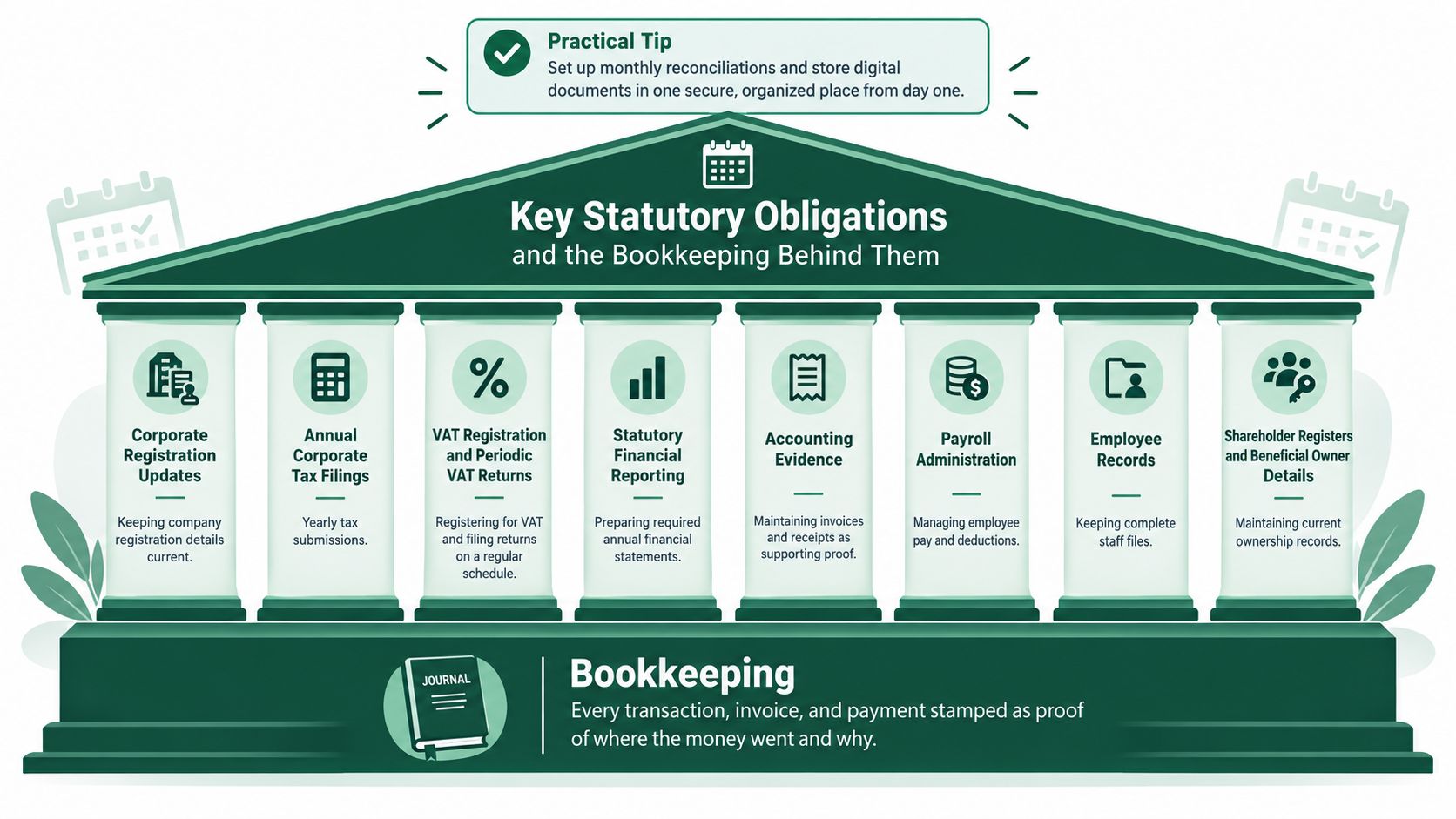
Here's the key takeaway: no pillar stands alone. One missing invoice can weaken your VAT filing, your tax submission, and your annual report all at once.
Working Through the Compliance Calendar
The calendar becomes much easier to manage once you group duties by frequency. Monthly tasks usually include bookkeeping, payroll, and VAT returns. Annual tasks cover corporate tax filings and financial statements.
- Mark monthly deadlines for bookkeeping, payroll, and VAT returns in one shared calendar.
- Add yearly dates for corporate tax filings and statutory financial statements.
- Set reminders two weeks before every deadline so preparation never turns into a last-minute panic.
Each step makes the next one easier. It works a lot like a relay race: the baton only passes cleanly when the runner before you arrives on time. Review your calendar every quarter, too, since deadlines and rules do shift now and then.
Payroll, Employee Records, and Ownership Details
Payroll and employee records are closely linked. Every payslip depends on accurate contracts, pay details, and deductions behind it.
Shareholder registers and beneficial owner details deserve the same attention. Update them whenever ownership changes. Outdated ownership data is easy to overlook, and it's the kind of gap that surfaces at the worst possible moment.
Practical tip: Set up monthly reconciliations and keep all digital documents in one secure, well-organized place from day one.
Handling Every Obligation Online
Going paperless changes the whole picture. Most of these tasks can now be handled online, from filing returns to storing documents safely.
Digital storage keeps every invoice within reach, so audits and deadlines stop feeling like emergencies. Imagine a founder working abroad who snaps a photo of a receipt the same day it arrives, instead of mailing paperwork home weeks later.
Secure online platforms also control access, so only authorized people can view sensitive files.
Want more detail on the annual side? Take a look at our guide on what statutory reporting involves for Bulgarian companies.
Common Bookkeeping Mistakes to Avoid
Most compliance problems start with small habits that seem harmless at the time.
- Skipping receipts creates gaps that become very hard to fill months later.
- Mixing personal and business payments blurs the trail of where your money went.
- Postponing reconciliation turns a quick check into a months-long cleanup.
- Scattering files across devices makes audits slow and stressful.
Avoiding these habits costs you nothing but a little attention. Your future self, facing an audit or a tight deadline, will be genuinely grateful. Pick just one habit to fix this week, and build from there.
Real-World Compliance Examples for Online Founders

So what does corporate compliance look like in practice? Rules on paper only get you so far, so let's meet four founders who each ran into a very different puzzle.
The Consultant Who Needed a VAT Number
Maria works from abroad and bills European clients every month. Her clients expected properly issued invoices, but she had no EU company and no VAT registration.
The fix started with a Bulgarian limited company and EU VAT registration. Her provider handled every step online, so she signed everything from her kitchen table.
Outcome: Maria started invoicing European clients correctly within one working week, without a single trip to an office.
The SaaS Founder Chasing Banking Access
Daniel runs a subscription software product with customers across the EU. His payments kept stalling, because his banking setup didn't match the European clients he was serving.
His fix came down to three clear steps:
- Incorporate a Bulgarian company online, with all documents prepared remotely.
- Open an EU IBAN through an online provider or a Bulgarian bank.
- Issue subscription invoices that show correct VAT details for every customer.
Payouts began settling smoothly, and his billing stayed clean from the very first invoice. Once the paperwork matched the business, the money started moving again.
The E-Commerce Seller Handling Cross-Border VAT
Lena sells physical products to customers in several EU countries. Every new border raised a VAT question she couldn't answer on her own.
Her approach was methodical. She mapped her sales by country, registered where required, and tracked every order from day one.
Consistent records turn cross-border VAT from a guessing game into a repeatable routine.
Returns became predictable, and Lena stopped losing evenings to spreadsheet detective work.
The Events Company Opening a Sofia Presence
A touring events company needed trusted local partners in Bulgaria. Its founders wanted a registered address and a real local footprint, not just a name on a website.
They tackled the setup with a practical checklist:
- Register a Sofia business address through a virtual office.
- Set up bookkeeping and payroll before the first partner contract.
- Place annual filings on one shared compliance calendar.
Partners gained confidence quickly, and the team could focus on shows instead of paperwork.
Finding Your Own Starting Point
Look closely at all four stories and you'll spot the same pattern. Coordinated support reduces errors, shortens the time it takes to start trading, and frees founders to grow.
Ask yourself which story sounds like yours. Then jot down your target markets, banking needs, and VAT exposure on a single page. That one page will tell you a lot about where to begin.
Check out our detailed guide on ultimate beneficial owner rules for Bulgarian companies to see which ownership details you'll need from day one.
The Real Cost of Getting Compliance Wrong

Skipping corporate compliance can feel like a smart shortcut. Right up until the bill lands on your desk, it just looks like money saved.
Think of it like a leaking roof. A few small drips seem harmless enough, but over time they soak the ceiling, warp the walls, and ruin everything beneath them.
Small Drips That Cause Big Damage
Most non-compliance starts quietly. Nobody notices the gap until a letter arrives from the authorities.
Common warning signs tend to look like this:
- Late filings that trigger penalties and interest
- Missing VAT documentation that blocks your input VAT claims
- Weak data protection that exposes client and staff information
- Unclear ownership records that stall banking and partner checks
Each item seems minor on its own. Together, they can drain cash and time faster than most founders ever expect.
Compliance mistakes rarely arrive as one big disaster. They build up quietly, one missed routine at a time.
Why Personal Data Raises the Stakes
Data protection is where costs can climb the fastest. European regulators have made it clear they are willing to act, and the figures are eye-opening.
By 1 March 2024, the GDPR Enforcement Tracker had recorded 2,086 fines with complete information, and 2,225 cases once records with limited details were included. The recorded fines added up to roughly €4.48 billion, and the average fine between 2018 and 2024 came to about €2.14 million. Read the full research about GDPR fines across Europe
Building One Integrated Shield
Picture a Bulgarian company serving customers across the border. Every part of its setup protects the others, much like the ribs of a good umbrella.
A virtual office gives you a registered Sofia address. EU VAT registration keeps your invoices valid across borders.
Accurate accounting records back up every number you report. Identity checks confirm who really controls the company. Timely filings keep the whole structure dry.
Pull out one piece and the rest start leaking fast. Keep all five working together, though, and your roof stays dry for years.
Simple Habits That Prevent Trouble
The good news? Most risks are preventable, and a few consistent routines do most of the heavy lifting.
- Review your filing calendar every Monday morning.
- Reconcile bookkeeping at month-end, not year-end.
- Store identity documents and contracts in one secure folder.
Start with just one of these today, and momentum will follow. Each habit you lock in makes the next one feel easier, and that's how a reliable compliance routine really takes shape.
Build a few simple habits now, and you'll sleep much better later.
Why Bulgaria Stands Out for Online Compliance
Bulgaria has quietly become a favorite for founders who want a foothold in the EU without the heavy overhead. The numbers are appealing, and the process is surprisingly smooth.
Start With the Headline Tax Rate
Bulgaria's headline corporate tax rate is 10%, one of the lowest in the European Union. Think of it as a big discount on the price tag. The final bill, though, still depends on how clean your paperwork is.
To see how that rate compares, the table below sets it beside approximate headline rates in several larger economies. Treat each figure as a snapshot, because rates and surcharges shift over time.
Headline Corporate Tax Rates Compared
| Jurisdiction | Approximate Headline Corporate Tax Rate | Typical Compliance Focus |
|---|---|---|
| Bulgaria | 10% | Online VAT returns, annual tax filing, bookkeeping |
| France | 25% | Monthly or quarterly VAT, detailed annual accounts |
| Germany | 30% | Combined corporate and trade tax filings, extensive reporting |
| Spain | 25% | Quarterly VAT and corporate tax prepayments |
| United Kingdom | 25% | Corporation tax returns and digital reporting |
| United States (federal) | 21% | Federal and state filings, multi-state reporting |
Lower rates don't mean less paperwork. Every jurisdiction in that table expects accurate, on-time records, so the real question is how much effort each one demands.
Compliance Online From Start to Finish
This is where Bulgaria really shines for founders who live far away. Most steps now run entirely online, from identity checks to signing documents.
Secure remote identity verification confirms who you are without an office visit. Digital document signing then turns a stack of paperwork into a few clicks.
No queues, no paper chase, and no need to be physically present for every step.
Weighing Tax Savings Against Admin Load
Before you pick a jurisdiction, compare the tax savings with the time your filings will eat up. A low rate loses its appeal fast if every return drains your evenings.
- List your filings for each country, including VAT, annual returns, and payroll.
- Estimate the hours each calendar will take, counting bookkeeping and reminders.
- Compare net savings after your advisor's fees and admin time.
Always check official sources such as the National Revenue Agency before you commit. It also helps to confirm current rates with a qualified advisor.
Where FastCorp Fits In
FastCorp, a Sofia-based provider, handles incorporation, EU VAT registration, and bookkeeping through one online workflow. Online setups usually finish in 3–5 working days, which is faster than most founders expect.
Online packages start at €1,750, including legal and government fees, so you know the full cost from day one. No surprise invoices halfway through the process.
That leaves you free to focus on growth while the paperwork runs quietly in the background. Picture a relay race where your provider carries the baton from one deadline to the next. Keep your records tidy, and the baton passes smoothly every time. Check each quarter that your details still match what the authorities have on file.
How Compliance Services Simplify Every Obligation
Picture an air traffic controller guiding dozens of flights in at once, safely and without confusion. Every pilot knows the route, and nobody is left guessing. A single compliance partner can bring that same sense of order to your company.
One Partner Instead of Many Providers
Most founders end up juggling a registration agent, an accountant, a bank, and a payroll tool. Each one keeps its own calendar and sends its own reminders. Miss a single message and the whole chain starts to slip.
One provider changes that picture entirely. A full-service partner gathers every piece under one roof, from the first day of setup through to daily operations.
What a Single Partner Typically Covers
Here's what that looks like in real life:
- Incorporation for your EOOD or OOD
- EU VAT registration and ongoing VAT returns
- Banking assistance for EU IBAN options
- Registered Sofia address through a virtual office
- Bookkeeping and annual tax filings kept on schedule
- Payroll administration and statutory reporting
Each item takes one more task off a to-do list that is probably already overflowing. That leaves you free to focus on growth.
Setup Timelines You Can Plan Around
Speed counts when you're eager to start trading. Fully online setups usually wrap up in 3–5 working days, while in-person setups in Sofia typically take 2–3 working days.
Think of the online route as the express lane and the in-person route as a guided tour. Both lead to the same destination, just at different speeds.
Transparent Pricing Without Surprises
Pricing is refreshingly clear, too. Online packages start at €1,750, and in-person packages start at €1,500. Both include legal and government fees, so the figure you see is the figure you pay.
Clear pricing up front means fewer surprises halfway through your setup.
Your Action Plan for Compliance
Ready to take control? Work through these three steps before you commit to any partner.
- Map your obligations. List every filing, payment, and report your company will need, from VAT to payroll.
- Build a compliance calendar. Add every deadline to one shared calendar, with reminders set well ahead of each date.
- Choose a reliable partner. Ask about deadlines, documentation, and communication before you sign anything.
Questions Worth Asking Before You Sign
Good partners welcome direct questions. Ask how they track deadlines and who handles each document.
- How do you track filing deadlines?
- Which documents will I receive, and when?
- How fast do you reply to urgent messages?
Want a closer look at the bookkeeping side? Read also: our guide on business bookkeeping services, which shows how monthly records keep every filing on track.
Staying Organized From Day One
And the best part? Everything runs online, and it's far easier than most people expect. You can sign documents from your laptop, with no printing, no couriers, and no weeks of waiting for paperwork to make its way across the city.
Ongoing support matters just as much as the launch. Your partner keeps bookkeeping, VAT returns, and payroll moving on schedule, so you can spend your energy on clients and steady growth.
Start with a plan, choose a partner you trust, and you'll trade with confidence from day one.
Frequently Asked Questions About Corporate Compliance
Can a Non-Resident Founder Stay Compliant Online?
Yes, and it happens more often than you might expect. Plenty of founders run Bulgarian companies from another country, and most of the work can be done remotely, from identity checks to signing documents.
Remote doesn't mean relaxed, though. You still need a steady filing calendar, and the routines we covered in the earlier obligations section still apply.
Secure remote identity verification and digital signatures take care of most of the paperwork. Your clients abroad rarely notice where you're sitting when you sign off on things.
How Does Corporate Compliance Differ From Tax Filing?
Tax filing is just one piece of compliance. Think of it as a warning light on your car's dashboard. Compliance is the whole car, including the engine, the brakes, and the oil you forgot to check.
Tax filing answers one question. Compliance keeps those answers consistent all year long.
A driving test proves you can drive on one afternoon. Daily driving, which is what compliance really is, depends on habits you repeat every week.
Which Mistakes Do New Companies Make Most Often?
Most newcomers wait far too long to set up bookkeeping. Others forget to update ownership details after a change, and that can cause headaches later.
- Missing receipts that quietly weaken your VAT claims
- Skipped deadlines because you assumed a provider would send a reminder
- Outdated ownership records that slow down banking or partner checks
Each of these feels small on its own. Together, though, they can stall a launch just when you need momentum. Catching them early keeps a minor slip from turning into a penalty.
Should You Manage Compliance In-House or Hire a Provider?
Start by asking how much time you can honestly spare each month. Handling filings yourself can work well for a simple setup with only a few deadlines.
A provider starts to make real sense when you trade across borders, hire staff, or register for VAT. At that point, the number of moving parts grows fast.
Compare your hours against a fixed fee, such as the €1,750 online package. Don't forget the hidden cost of your time, either. Chasing deadlines can quietly eat into evenings you'd rather spend with clients, so revisit this decision every year.
Ready to skip the guesswork? Let FastCorp handle setup, VAT, and filings in one place. Start your online setup today.