EU VAT Invoice Requirements: Every Field and Rule for 2026
Master EU VAT invoice requirements with a complete field checklist, country rate comparison, issuing deadlines and practical compliance checks for 2026.
The costliest field on a cross-border invoice is usually the one that isn't printed at all. A missing or mistyped customer VAT number doesn't stop you getting paid, and it doesn't make the sale disappear. It removes your customer's ability to apply the reverse charge and reclaim input VAT, so your routine invoice becomes their accounting problem first and your audit problem later.
That's why I treat an EU VAT invoice as a data record, not a document. Every field on it exists to answer one question a tax authority will eventually ask: who is being taxed, on what amount, at what rate, and at what moment in time. Get the data right and almost any layout works. Get the data wrong and the cleanest PDF on the market won't rescue the deduction.
Table of Contents
- Mandatory Fields on an EU VAT Invoice
- B2B, B2C and Reverse Charge Invoice Differences
- VAT Rates Across EU Countries Compared
- Issuing Deadlines and Correction Documents
- Electronic Invoicing and the 2030 Cross-Border Deadline
- One-Stop-Shop Reporting for Multi-Country Sales
- Common Invoice Errors and How to Fix Them
- Set Up Compliant EU Invoicing Before Your First Sale
Mandatory Fields on an EU VAT Invoice
Eleven fields carry the legal weight. Article 226 of the EU VAT Directive sets them out, and the European Commission's VAT invoicing rules explain what each one does: it links the commercial transaction to the parties, the taxable amount, the tax rate and the timing. Treat the table below as your pre-send checklist on every invoice, not as a description of a template.
| Field | What to Enter | Example Format |
|---|---|---|
| Issue date | Date the invoice is issued | 18 March 2026 |
| Unique sequential number | Never repeated, no gaps in the series | INV-2026-0041 |
| Supplier name and address | Full legal name and registered address | Company legal name, street, city, country |
| Supplier VAT number | VAT ID of the supplier | BG123456789 |
| Customer name and address | Full legal name and address | Company legal name, street, city, country |
| Customer VAT number | Required where the customer is liable for tax | DE123456789 |
| Description and quantity | Goods or services supplied and amount | 10 hours consulting |
| Unit price excluding VAT | Price before VAT and before discounts | €120.00 per hour |
| Supply date | Only if different from the issue date | 1 March 2026 |
| VAT rate and amount | Rate applied and VAT charged | 20% and €240.00 |
| VAT breakdown | Totals by rate or by exemption basis | Per rate subtotal and VAT |
The first four fields anchor the document itself. The issue date is the day you generate the invoice, which isn't always the day you supplied the goods or services. The number must be unique within your series and run in sequence, with no gaps and no duplicates; a series you reset annually or renumber by hand raises questions you can't answer two years later. Then the supplier's registered legal name and address, not a trading name or an office you left behind, and the supplier VAT number exactly as it appears in the register.
The customer block is where cross-border invoices fail. The name and address must match the customer's registration, and where the customer is liable for the tax, the customer VAT number is compulsory. That's the field that lets a German or Dutch client apply the reverse charge and reclaim input VAT. Leave it off and the deduction collapses in their books.
The transaction fields carry the money. Describe the supply precisely enough that a reviewer can see what was sold, including quantity or time: "10 hours consulting" beats "consulting services". State the unit price excluding VAT and apply any discount before VAT, never after. Show the rate and the VAT amount, then break the VAT down by rate or by exemption basis, because a mixed invoice with one blended total tells an auditor nothing.
The self-check I would run before every send
Compare the invoice against the table line by line, then confirm one arithmetic fact: the sum of the line-level VAT amounts equals the VAT total on the invoice, and the breakdown subtotals add back to the amount payable. If either figure disagrees, rebuild the breakdown from the line items. Never adjust the headline total by hand to make it balance.
Then assign a named owner to each group of fields. Sales owns the customer name, address and VAT number at capture. Finance owns numbering, rates and the breakdown. A controller owns the reconciliation check before the invoice leaves. When a field goes missing, the gap traces to one person instead of a shared assumption that someone else checked it.
B2B, B2C and Reverse Charge Invoice Differences
Nothing on an invoice changes more than when the customer's status changes. Same service, same amount, and the fields, the wording and the VAT line all differ between a domestic B2B sale, a cross-border B2B sale under the reverse charge, and a consumer sale.
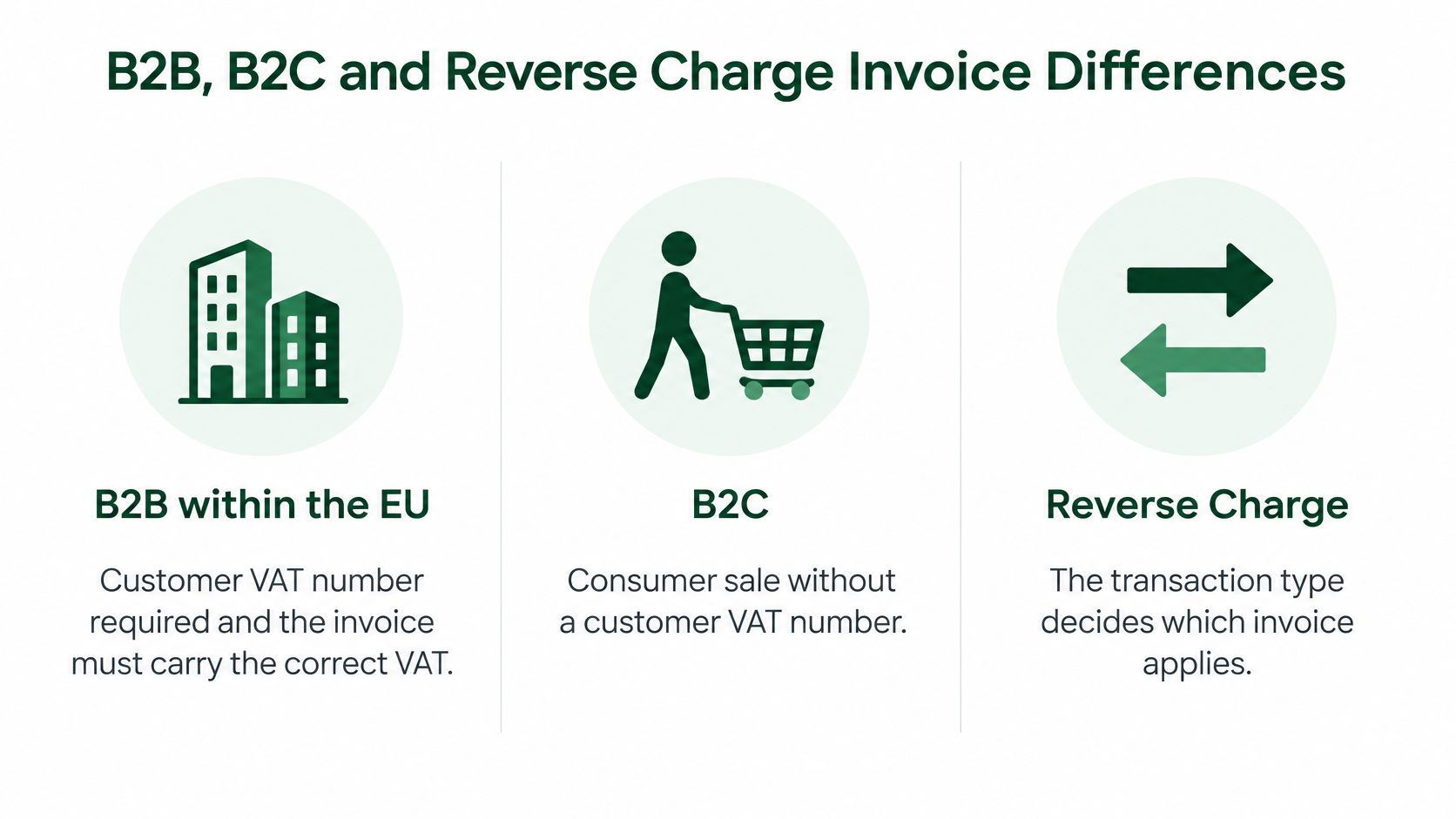
Take a freelance developer invoicing a German GmbH that quotes a valid VAT number. The invoice shows zero VAT, carries the customer's VAT number, states the supply date and includes a line naming the reverse-charge provision, with Article 196 of Directive 2006/112/EC as the standard reference. The German client self-assesses the tax and everyone is square. Invoice a domestic company for identical work and the local rate appears on the line with no reverse-charge wording anywhere. Invoice a private individual and there's no customer VAT number at all, because there's no business registration to validate.
| Sale type | Customer VAT number | VAT treatment and wording |
|---|---|---|
| Domestic B2B | Required | Local standard rate charged and shown on each line |
| Cross-border B2B reverse charge | Required | Zero VAT, with a note that the customer accounts for the tax |
| Domestic or B2C sale | Not required | Local rate charged and shown on the invoice |
| Simplified invoice | Set by national rules | Fewer fields, allowed only where national rules permit |
The simplified invoice is the shortcut with conditions attached. It holds fewer fields and it's allowed only where national rules permit it, so check the country before dropping the customer VAT number or the rate breakdown. For anything crossing a border I default to the full set, because a full invoice is never wrong for a scenario where a simplified one would also have been accepted.
The decision path is short. Identify the customer first: a business with a validated VAT number, a business without one, or a consumer. Then check whether an exemption, an intra-community supply or the reverse charge applies to that particular supply. Choose the wording and fields that match. If you want the middle step in detail, how the reverse charge works on an EU invoice covers the wording and the evidence worth keeping.
VAT Rates Across EU Countries Compared
The EU harmonises the mechanics of invoicing, not the number you type into the rate field. That single fact explains why a hard-coded VAT percentage is the most common silent error in cross-border billing.
| Country | Standard VAT Rate | Invoicing Note |
|---|---|---|
| Bulgaria | 20% | Store the rate per transaction and per supply type |
| Germany | 19% | Reduced rates apply to some goods and services |
| France | 20% | Check reduced rates for specific supply categories |
| Netherlands | 21% | Confirm the rate for the customer country on the supply date |
| Spain | 21% | Check Canary Islands and other special regimes separately |
| Italy | 22% | Record exemption basis where VAT is not charged |
| Ireland | 23% | Reduced rates apply to some supplies |
| Denmark | 25% | Store customer location for cross-border sales |
| Hungary | 27% | Highest standard rate in the EU; always confirm |
| Luxembourg | 17% | Lowest standard rate in the EU; still verify per supply |
Read that table as a lookup, not as authority. Rates move in both directions. Estonia raised its standard rate from 20% to 22% in 2024, and Switzerland moved from 7.7% to 8.1% in 2024, according to the OECD's Consumption Tax Trends 2024, which also put the average standard rate across OECD countries at 19.3% in 2024, up from 19.1% in 2023. A percentage that was correct in your billing system last year can be wrong this year, and the invoice still looks completely normal.
Which country's rate applies follows the customer rather than the seller in the situations that matter most here. A sale to a customer in another Member State can carry that country's rate rather than yours, which is why the rate belongs in your database as data instead of in the template as text.
Store five separate fields per transaction: customer jurisdiction, supply type, B2B or B2C status, the exemption or reverse-charge basis, and the applicable rate. The first four decide the fifth, and when one of them changes you update one record instead of hunting through a template.
Practical rule: confirm the rate for the customer's country on the date of supply, and record where you checked it. A dated note beside the rate turns an audit question into a one-minute answer.
If you need a working starting point rather than a template, EU VAT rates by country keeps the lookup in one place.
Issuing Deadlines and Correction Documents
Timing is part of the content. For cross-border transactions, the EU's 2025 VAT in the Digital Age rules set the invoice-issuance deadline at 10 days after the chargeable event, according to Council Directive (EU) 2025/516.
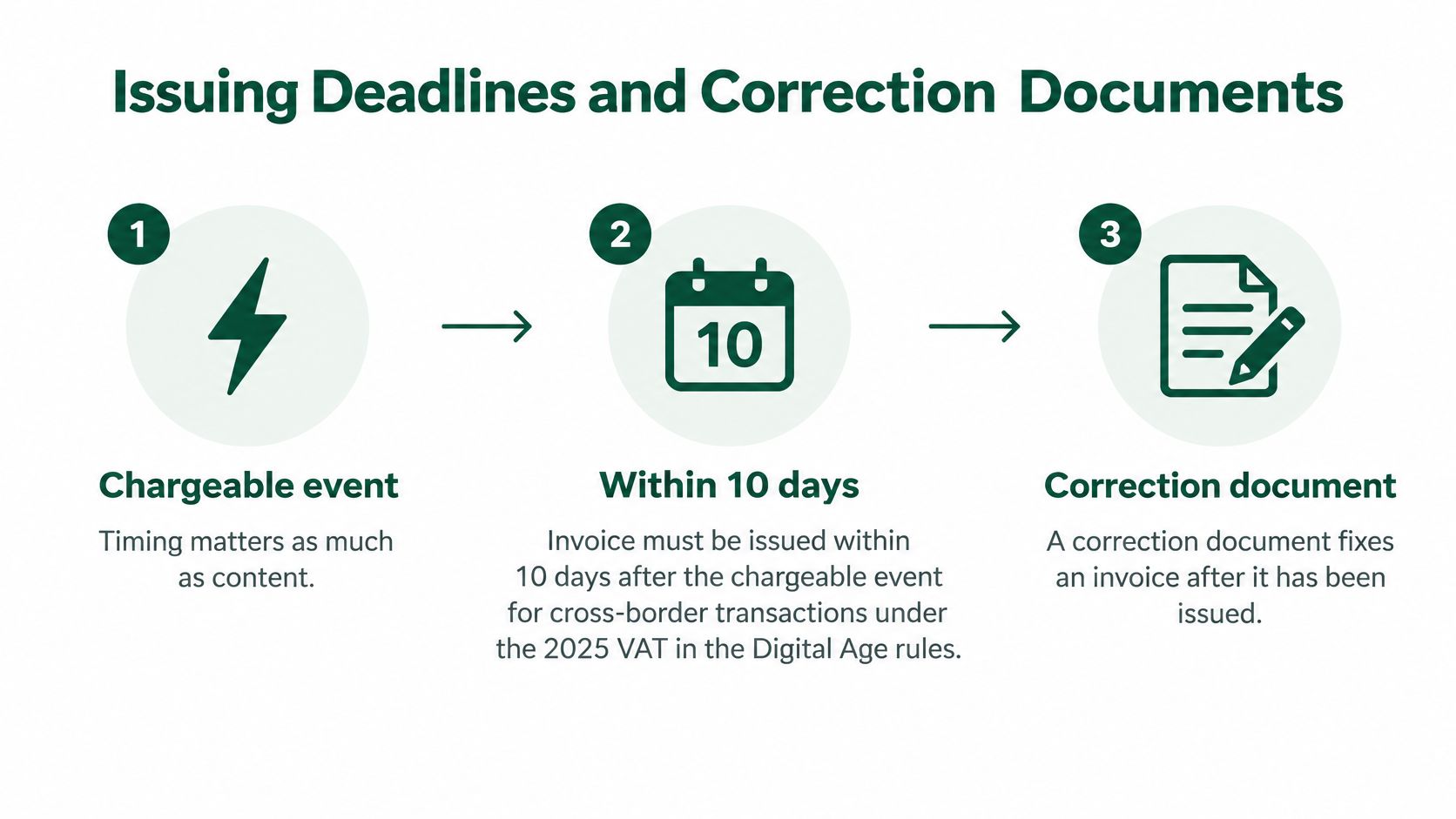
The sequence is simple and easy to break. The supply or the payment creates the chargeable event. The invoice goes out inside the 10-day window carrying its own issue date. The customer receives it, and both sides keep the record.
Supply date and issue date are two different facts
The supply date is when the goods or services went out. The issue date is when the document was created. Most invoices need only the issue date, but where the two differ, the supply date has to appear on the invoice, because that's the date that puts the transaction in the right VAT period on both sides of the border. Backdating the issue date to hide a late invoice doesn't fix anything. It creates two wrong dates instead of one.
Correcting an invoice is not editing it. A credit note, debit note or equivalent corrective document must refer clearly to the original invoice number and state what changed, and the original stays untouched in the ledger with its own place in the sequence. The European Commission's invoicing guidance makes the same point about correction references: the amendment has to be traceable to what it amends.
Say an invoice went out at the wrong rate because the customer's country changed its standard rate between quote and delivery. Issue a credit note that references the original number and reverses the full amount, then issue a new invoice with the correct rate and its own sequential number. Three documents, one traceable story, nothing deleted.
An invoice you had to correct is not a failure. An invoice you quietly edited is.
Before you close the month, confirm that every correction carries a reference to the original and a sequential number of its own.
Electronic Invoicing and the 2030 Cross-Border Deadline
A PDF can display every required invoice field and still fail as a structured e-invoice. For intra-EU cross-border B2B transactions, structured electronic invoicing and digital reporting are due to become mandatory from 1 July 2030, as set out in the EU Council's e-invoicing documentation. The system is designed to transmit standardised, machine-readable data so authorities can match supplier and customer reports.
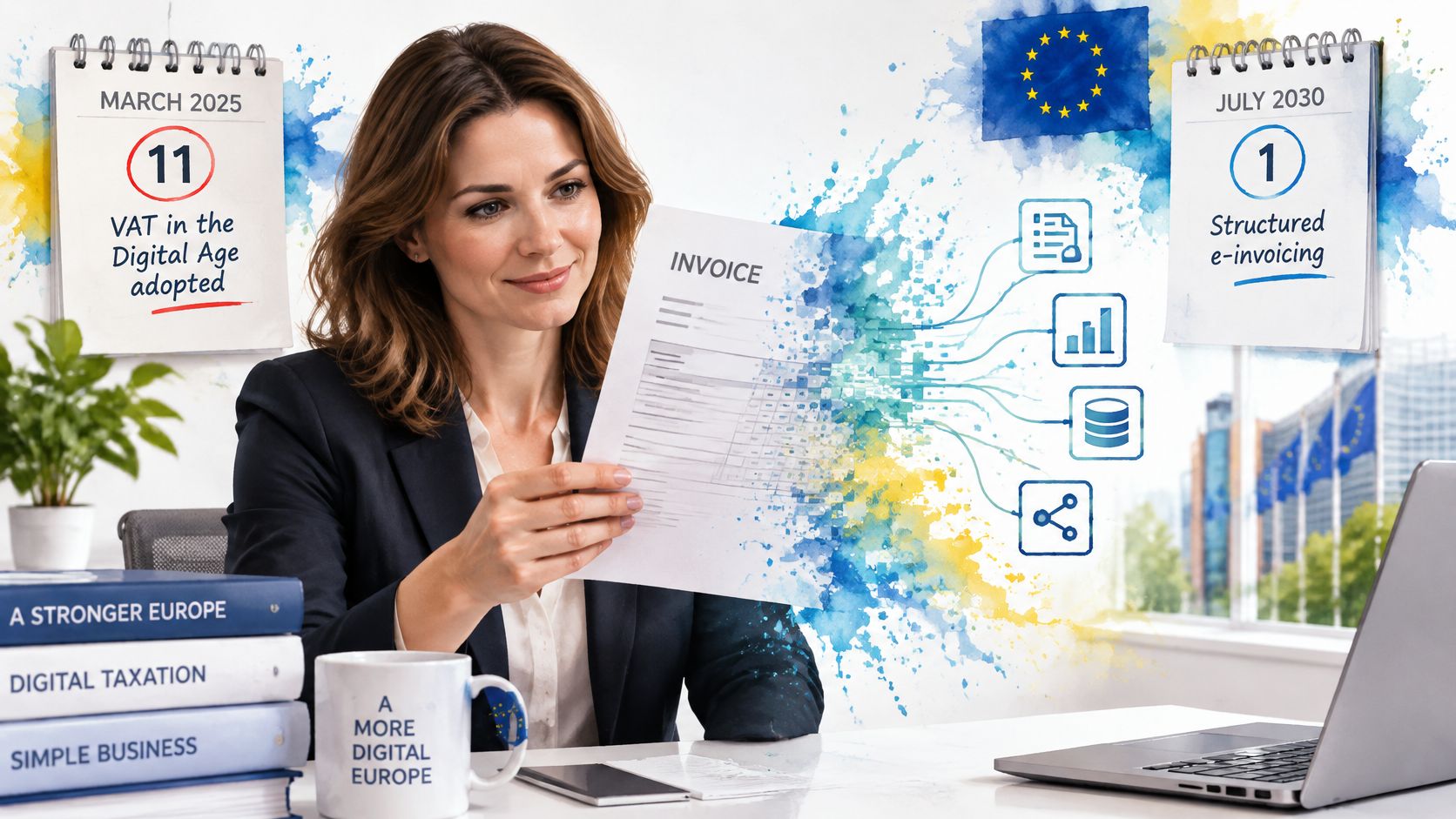
The VAT in the Digital Age (ViDA) package was adopted on 11 March 2025. It provides a framework for the EU's digital VAT changes, while Member States can also introduce domestic e-invoicing requirements under national rules, as the European Commission's ViDA overview explains. A structured e-invoice is machine-readable data, not a PDF sent by email.
The data model matters. EN 16931-1:2017 gives defined meanings to supplier, customer, document, tax, allowance, payment, line-item and total information. Map invoice data to that model and validate it before transmission, using the European standard and specifications for e-invoicing as a reference.
| Date | Scope | Status |
|---|---|---|
| 11 March 2025 | VAT in the Digital Age package adopted | Adopted |
| Since March 2025 | Member States may introduce domestic mandatory e-invoicing | Permitted, conditions set nationally |
| 2025 | Belgium B2B e-invoicing | Planned; confirm current status |
| 2026–2027 | France phased B2B e-invoicing | Planned; confirm phase dates |
| 1 July 2030 | Structured e-invoicing and near-real-time reporting for intra-EU cross-border B2B | Mandatory |
National timetables can change. Check the current rules for each country before configuring invoice workflows around a planned domestic start date.
Prepare invoice data for exchange, not just display. Keep required fields in structured form, validate VAT numbers when they are entered, record transaction dates accurately, and choose software that can export and exchange e-invoices in a recognised syntax. The guide to choosing an invoice management system covers practical points to assess when selecting software. Check national requirements too, since domestic rules may apply before the EU-wide cross-border deadline.
One-Stop-Shop Reporting for Multi-Country Sales
If you sell to consumers in more than one Member State, the reporting channel is the easy part. The EU One Stop Shop lets an eligible business register in one Member State, file a single electronic return and make one payment covering qualifying sales to consumers across the EU, as the European Commission's One Stop Shop portal explains.
It rests on one EU-wide threshold of EUR 10,000 covering intra-EU distance sales of goods and of telecommunications, broadcasting and electronic services. Below that figure, qualifying supplies may remain subject to VAT in the Member State where you're established. Once you exceed it, VAT is generally due in the customer's Member State.
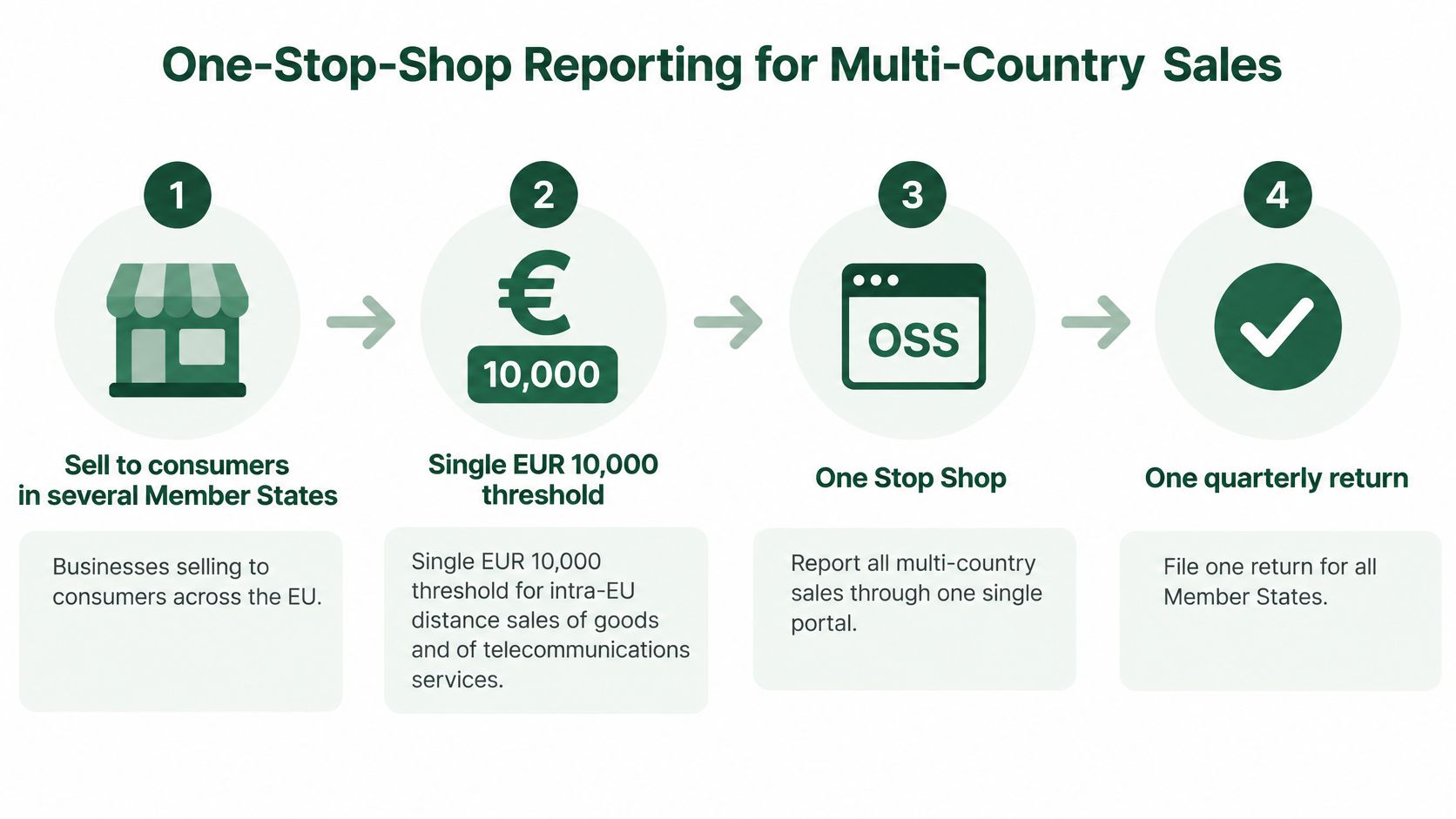
The flow runs in four moves. Monitor your cumulative EU-wide B2C sales continuously rather than at year end. Register for the scheme in one Member State. Apply the destination country's rate to each sale. File one return and make one payment per period.
The practical checks sit underneath those moves, and they're where businesses slip. Separate B2B and B2C transactions in the ledger, because only the B2C distance sales feed the threshold. Keep customer-location evidence for each sale, since the whole regime turns on where the customer is. Reconcile the return with the sales ledger every period, so a mismatch surfaces while you can still explain it.
What the One Stop Shop does not do: it doesn't pick the rate for you, and it doesn't remove the need for location evidence. The return is unified. The analysis behind it isn't.
Common Invoice Errors and How to Fix Them
The error that does the most damage on a cross-border invoice is a missing reverse-charge or exemption note, followed closely by a customer VAT number nobody validated. Both are cheap to prevent and expensive to unpick after the customer has filed.
- Missing reverse-charge or exemption wording: add the note and its legal basis before sending, and confirm the customer VAT number appears on the same document. A zero-rated line with no explanation looks like an under-declaration to any reviewer.
- No supply date where it differs from the issue date: add the supply date and check the invoice left inside the 10-day window. Two dates that disagree with your ledger are worse than one missing date.
- Totals that don't reconcile: rebuild the VAT breakdown from the line items. Adjusting the headline total by hand hides the error instead of fixing it.
- A wrong or missing customer VAT number on a reverse-charge sale: validate the number against the EU VAT register before issuing. If one slipped out, fix it with a credit note and a fresh invoice, never with an edit.
- A wrong rate on a cross-border sale: confirm the customer's country and the supply date, then correct through that same credit-note route.
Notice that four of the five fixes end in the same place. That's the argument for building one correction procedure and training everyone on it, rather than letting each person invent a workaround.
Then run a monthly sample. Pull a handful of issued invoices, including at least one cross-border sale, and check each against the field table from the top of this guide. Twenty minutes a month catches the drift before a customer's accountant does.
Set Up Compliant EU Invoicing Before Your First Sale
Set up invoicing around the VAT decisions each record must support. Before your first cross-border sale, note the countries you expect to sell into, whether your customers will be businesses or consumers, and which system will issue and store your invoices. These choices shape the rates, reporting requirements, invoice fields and system capabilities you need.
Use that information to configure the invoicing system: keep required fields consistent, add conditional fields where relevant, and map the applicable VAT rates. Check the output against the rules for the countries involved, since EU-wide requirements sit alongside national differences.
FastCorp's online package costs €1,750 and is delivered 100% online. It includes company registration, an EU VAT number, a bank account, a virtual office and business address, a certificate of incorporation, and legal and government fees. The setup process starts with a form about your business, followed by checkout and payment, then submission of the company details needed for formation.
Bookkeeping and VAT reporting are optional services available after setup. Visit FastCorp to start the company setup process. A well-configured invoice record gives you a clear basis for checking the VAT treatment and supporting your reporting.