EU VAT Number USA: Who Needs One and How to Get It
EU VAT number USA guide: which route fits your sales, how to register online, and how to stay compliant across EU countries.
Do you need an EU VAT number, or do you need a way to handle VAT on a particular kind of sale? That's the question most US founders skip, and it's the difference between a manageable online setup and unnecessary registrations.
If you're searching for EU VAT number USA guidance, start with your transactions, not an incorporation form. A consultant selling to EU businesses, a SaaS company selling to consumers, and an online store using European warehouses can need different solutions. You can handle the setup online without travel, but choosing the right route matters more than getting a number quickly.
Table of Contents
- What Your EU VAT Number Actually Covers
- Which EU VAT Route Fits Your US Business
- Tax Rates Compared Across Key EU Countries
- How to Get an EU VAT Number Online Step by Step
- Validating Customers and Keeping VAT Evidence
- What Ongoing EU VAT Compliance Requires
What Your EU VAT Number Actually Covers
The biggest misconception is that a US business applies for a single EU-wide VAT number issued from Brussels. Ordinary EU VAT registration is national: a Member State's tax authority issues the identifier, and that registration carries obligations in that country.
A national driving licence offers a helpful comparison. Another country may recognise it for specific purposes, but it isn't a passport that removes every local requirement. The analogy is useful because recognition across borders and responsibility within a country are different things.
A Bulgarian company's VAT number, for example, identifies that company within Bulgaria's VAT system. It doesn't automatically register the company wherever it stores goods, imports inventory, or makes taxable domestic supplies.
What recognition actually means
The European Commission provides VIES, the VAT Information Exchange System, to check whether a national VAT identification number is active for intra-EU transactions. That's a validation function, not a separate registration that expands the number's coverage.
Keep these distinctions clear:
- Company incorporation establishes the legal entity that signs contracts and conducts business.
- National VAT registration identifies the taxable person within a country's VAT system.
- A special reporting scheme can simplify reporting for eligible cross-border transactions.
- VIES validation checks a number's status for relevant intra-EU use.
Don't assume that completing one automatically completes the others. Your documents should identify which entity holds each registration and which transactions belong on each return.
Rates remain national too
Member States set their VAT rates and decide which goods and services qualify for reduced treatment. The European Commission's VAT rate table lists Bulgaria's standard VAT rate as 20% and its reduced rate as 9%.
A reduced rate isn't an optional discount you choose for competitive pricing. You need to classify the actual supply and establish which country's rules govern it.
For a US founder using a Bulgarian company, the practical conclusion is straightforward: the Bulgarian number is a genuine compliance credential, but it isn't a universal substitute for European tax registrations.
Practical rule: Before choosing a registration country, list where your customers, stock, staff, and business operations are located.
Add the contracting entity beside each revenue stream. That simple exercise prevents a common mistake: applying for a useful registration in one country while overlooking the obligation created by inventory somewhere else.
Which EU VAT Route Fits Your US Business
EU VAT routes by US business scenario
| Your situation | Route | Issued by | What it covers |
|---|---|---|---|
| B2B services sold to EU businesses | Reverse charge, customer accounts for the VAT | Usually no supplier EU registration needed solely for qualifying services | Validate the customer's VAT number in VIES and document the applicable treatment |
| B2C electronic or consultancy services to EU consumers | Non-Union OSS | Member State of identification issues an OSS VAT number | One portal return covering eligible EU consumer services |
| Goods shipped from the US to EU consumers, consignments up to EUR 150 | IOSS | Member State of identification | VAT collected at checkout and declared through one return |
| Stock held in an EU warehouse | National VAT registration | Tax authority of the country where the stock sits | Domestic returns, plus OSS for eligible B2C sales |
| Sales through an EU subsidiary such as a Bulgarian EOOD or OOD | National VAT registration in Bulgaria | Bulgarian National Revenue Agency | Bulgarian returns, with OSS for eligible EU consumer sales |
| Sales to UK consumers | UK VAT registration where required | HM Revenue & Customs | Separate from EU OSS and EU VIES checks |
Treat the table as a starting point, not permission to apply the same treatment to every sale. A business can occupy several rows at once.
Copy the row matching your largest revenue stream into your planning document. Then identify secondary activities, including marketplace sales, refunds, imports, and warehouse transfers.
Ask three operational questions
Who's buying? For qualifying B2B services, the reverse charge can put VAT accounting with the EU business customer. Don't apply it merely because someone enters a company name at checkout; establish customer status and check the place-of-supply rule.
What are you selling? Services and physical goods don't follow interchangeable routes. For consultancy services in particular, establish whether the service is taxable in the consumer's Member State before assuming it belongs in OSS.
Where's the stock? Goods shipped from the US create a different analysis from goods already sitting in a European fulfilment centre. Write down the importer of record and every permitted storage country.
The European Commission's OSS registration guidance explains that a US business with neither an EU place of business nor a fixed establishment can select a Member State of identification for Non-Union OSS, receiving an identifier in the format EUxxxyyyyyz.
That route centralises reporting and payment for covered B2C services. It doesn't turn the US business into a locally established EU company, and the applicable customer-country VAT treatment still needs to be determined.
Choose the route that matches the transaction
For a US software business selling directly to EU consumers, Non-Union OSS can be the appropriate reporting route. For an agency providing qualifying services to VAT-registered EU businesses, reverse charge may avoid a supplier registration solely for those services.
For eligible low-value goods dispatched from the US, IOSS addresses import-distance-sale VAT collection at checkout. Don't confuse it with Non-Union OSS, which addresses services, or assume it settles every customs and shipping responsibility.
A warehouse-based seller needs a different plan. Establish the local registration position before sending inventory, then assess whether Union OSS can cover eligible cross-border consumer sales.
The Commission's One Stop Shop guidance states that the EUR 10,000 threshold applies only to businesses established in the EU. A US-established seller can't treat that threshold as a small-sales exemption.
Exceptions that override the simple answer
The Commission's explanation of the OSS schemes makes clear that scheme identifiers cover specified supplies rather than replacing all domestic VAT obligations; transfers of your own goods between Member States can also trigger registration requirements in the departure and arrival countries.
Check these limits before registration:
- Stock movements: Ask your fulfilment provider which countries it may use, including automatic relocations.
- Input VAT: OSS doesn't create a general right to deduct business-purchase VAT through the scheme.
- Domestic transactions: Keep supplies outside OSS assigned to the correct national reporting process.
- Establishment changes: Reassess the route if you add an EU business establishment.
- Great Britain sales: Assess UK treatment separately rather than adding those sales to EU OSS.
My recommendation is to minimise unnecessary registrations, not necessary ones. Choose the simplest structure matching your actual transaction flow.
Tax Rates Compared Across Key EU Countries
Corporate and VAT rates by country
| Country | Corporate income tax | Standard VAT | Reduced VAT |
|---|---|---|---|
| Bulgaria | 10% | 20% | 9% |
| Ireland | 12.5% trading income | 23% | 13.5% |
| Cyprus | 12.5% | 19% | 9% |
| Hungary | 9% | 27% | 5% |
| Germany | About 30% combined | 19% | 7% |
| United Kingdom (non-EU) | 25% main rate | 20% | 5% |
These are reference values, not filing instructions. Reduced entries show a common reduced band, not every national category, and corporate tax can change with company size, residence and profit type. Use the country-by-country VAT rates guide as a comparison aid, then confirm the exact treatment before pricing or filing.
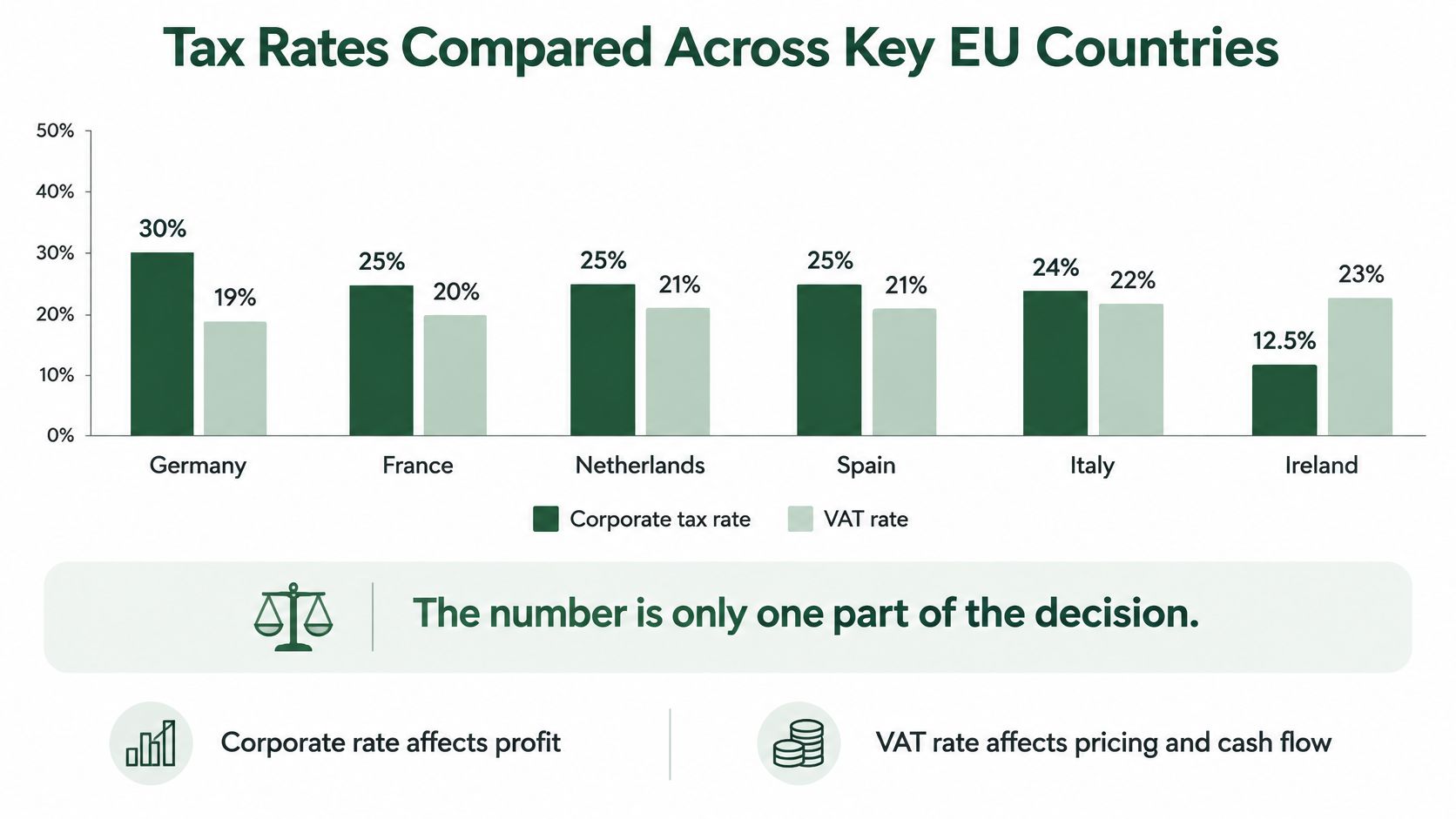
The visual comparison reinforces the distinction between profit taxation and transaction taxation.
Read corporate tax and VAT separately
Corporate income tax affects taxable profit. VAT affects transaction treatment, pricing, and cash flow. A lower corporate rate does not mean your customers pay that country's VAT rate on every cross-border purchase.
Bulgaria is a strong low-tax reference point, with Hungary slightly lower in this comparison and Germany substantially higher on a combined basis. Choosing an entity from that column alone ignores where the company operates, where stock sits, and where each supply is taxed.
A Bulgarian company selling subscriptions to consumers elsewhere in the EU still needs the correct VAT treatment for those consumers. The Bulgarian rate is not a blanket rate for the whole customer base.
The number is only one part of the decision. Match the company structure to the business before comparing headline rates.
The UK demonstrates the boundary
According to HM Revenue & Customs' VAT registration guidance, the domestic registration threshold is £90,000, but an overseas business without a UK establishment generally must register when it makes taxable supplies in the UK, even below that threshold.
That distinction matters for a US seller or Bulgarian subsidiary serving British consumers. An EU number does not satisfy UK obligations, and marketplace collection or import arrangements must be checked separately.
Keep EU, Northern Ireland, and Great Britain sales distinguishable in your accounts. Record where goods are stored, who imports them, and whether a platform accounts for VAT on the transaction.
Pick the jurisdiction after mapping customers, stock and staff. The cheapest headline rate is the wrong winner if it leaves sales taxed somewhere else.
How to Get an EU VAT Number Online Step by Step
The whole company setup can run online, with no travel. For a US founder choosing a Bulgarian company, we handle registration without requiring you to leave home, including remote identity verification and document signing.
The online process is easy to organise when your information is consistent. Before starting, confirm that incorporation is your chosen route rather than assuming every US seller needs an EU subsidiary.
Prepare the transaction map first
Write a short business description that explains who pays you, what you supply, and where goods move. Include sales channels, customer countries, warehouse locations, and the proposed contracting entity.
A useful description is specific: a US-owned Bulgarian company selling software subscriptions directly to consumers is clearer than an international technology business. Your accountant needs the commercial facts, not marketing copy.
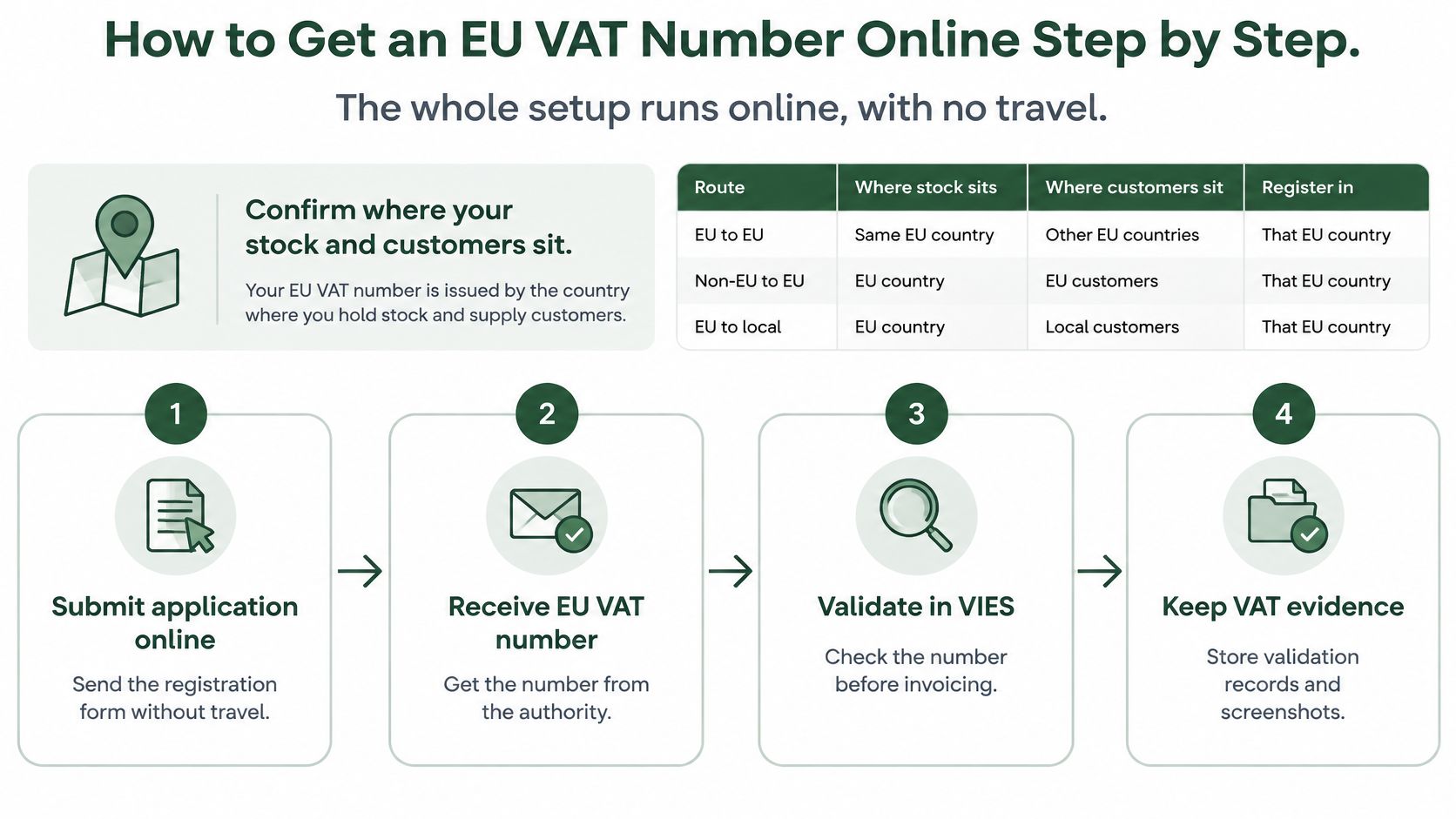
The workflow below shows the administrative sequence.
Complete the registration workflow
Submit the intake details.
We collect ID details, preferred company names, the business description, shareholder and director details, and the share capital amount. Make names match the identification documents exactly, including spelling and the order of names. Inconsistent names create avoidable clarification work across formation, banking, and tax applications.Complete identity verification and remote signing.
In our document-signing stage, you verify your identity and sign remotely during a 30–60 minute online session with a secure online notary. Have the requested identification ready and review the documents before the session. Remote signing removes travel, not your responsibility to understand what you're authorising.Prepare and organise the corporate documents.
We coordinate the formation paperwork, including the Certificate of Incorporation, and apostilled company documents where required. Keep a clearly labelled digital company folder. A bank request for a particular document should be answered with the correct version, not whichever scan is easiest to find.File the VAT application with the relevant authority.
For a Bulgarian national registration, the application goes to the Bulgarian National Revenue Agency. Save the submission and registration confirmation, and establish the effective date before deciding how to invoice. Company incorporation and VAT registration are separate administrative events.Set up the banking trail.
Use the company's banking arrangements for its business receipts and tax payments. Keep payment references and confirmations attached to the relevant accounting period. Don't mix the US owner's personal transactions with the Bulgarian company's VAT records.Configure bookkeeping before issuing invoices.
Assign sales to the correct customer category, country, product treatment, and reporting route. Test a normal sale, a refund, and a reverse-charge service invoice where relevant. A clean first invoice is easier than correcting a billing template after customers have received it.
Know what the package includes
Our FastCorp Online package costs €1,750 and includes EOOD or OOD company registration, an EU VAT number, an EU bank account with options such as Revolut, Wise or UniCredit, a virtual office and business address, apostilled company documents, the Certificate of Incorporation, and all legal and government fees. Identity verification and signing remain remote throughout.
The VAT number in that setup is the Bulgarian company's national identifier. It isn't an OSS identifier for your existing US company, and forming the subsidiary doesn't automatically move existing US contracts or sales into it.
Before launch: Make the entity on the contract, invoice, payment account, and VAT registration agree.
Confirm rates, registration scope, and filing duties with a qualified advisor. Your completed setup should include the incorporated company, its registration confirmation, a national VAT number whose relevant status can be checked in VIES, and an assigned filing calendar.
Pick your route this week and start the online intake. Send a complete transaction description at the outset so the paperwork reflects how you'll trade.
Validating Customers and Keeping VAT Evidence
VAT-number validation is a compliance control, not an invoice-format check. A number that looks plausible isn't enough to establish that your intended treatment is correct.
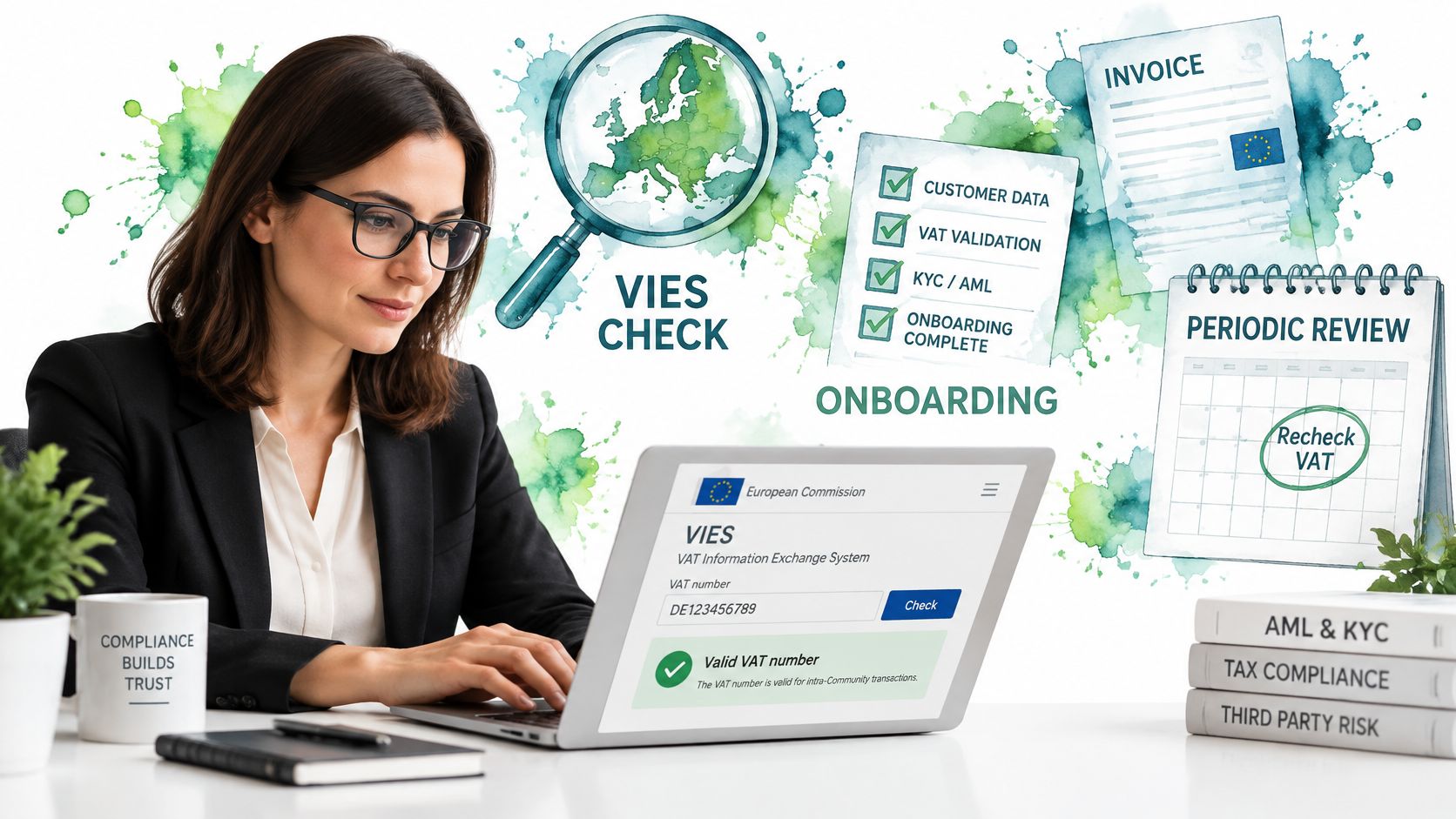
Make validation part of customer onboarding rather than a task left until filing day.
Build a repeatable validation routine
Use the European Commission's VIES service to select the issuing jurisdiction and submit the customer's number. Record the date and response, and match the legal name and address where available.
Repeat checks periodically and when customer details change. If the result fails or the customer identity doesn't match, investigate before issuing an invoice based on zero-rating or reverse charge; don't guess which treatment is safest.
Our European VAT number validation guide provides a practical companion for that workflow. Assign a named person to resolve failed checks so discrepancies don't remain in an unattended inbox.
A successful result supports customer-status evidence. It doesn't prove that your own company is registered, that the sale is exempt, or that the number supports every transaction type.
Use the video as a practical accompaniment to your validation routine.
Keep the evidence behind the invoice
Your records need to explain the transaction, not just contain a screenshot:
- Invoice data: Retain customer identity, supply details, dates, tax treatment, and correction history.
- Customer location: Preserve the evidence used to determine consumer location.
- Marketplace reports: Separate platform-accounted transactions from sales you report yourself.
- Import documents: Keep declarations and documents identifying the importer.
- Transport evidence: Retain relevant dispatch and delivery records for goods.
- Reconciliations: Match accounting totals to domestic and OSS reporting.
Store these in a controlled digital folder with sensible filenames and restricted access. Link credit notes and refunds to the original transaction so another person can reconstruct the treatment without asking you what happened.
If you can't produce the evidence from a coherent folder, don't treat the transaction as compliance-ready. A valid number helps, but the full audit trail is what makes your decision explainable.
What Ongoing EU VAT Compliance Requires
Getting the number completes an application, not your compliance work. Give someone responsibility for the calendar, source records, return review, and payment approval before trading begins.
The strongest routine connects those tasks. Filing a return while leaving its payment unapproved, or paying a balance that doesn't reconcile to the accounts, creates avoidable problems.
Turn obligations into a working calendar
Schedule each return separately. National VAT returns follow the registration country's timetable. OSS returns are quarterly and due by the end of the month following each quarter, and they're additional to domestic returns. Record preparation, approval, filing, and payment tasks separately rather than treating the deadline as the day work begins.
Control the payment process. Declare and pay VAT on eligible consumer sales through the OSS portal in the Member State of identification. Keep the return confirmation and payment evidence together, with the reporting period clearly identified.
Close the records before filing. Collect missing invoices, resolve unmatched marketplace settlements, and reconcile refunds. Apply the retention requirements governing the relevant scheme and country, rather than assuming a single rule covers every record.
Review classifications and rates. Check the applicable Member State's rate table before filing and investigate new products or changed supplies. Don't reuse a reduced-rate classification merely because a similar product received it previously.
Prepare for digital reporting. The European Parliament's VAT fact sheet describes the VAT in the Digital Age package adopted in March 2025, which moves toward single VAT registration, wider OSS coverage, and more digital reporting for cross-border B2B transactions. Build structured invoice and transaction records now instead of relying on manual summaries.
Make review part of normal operations
Use a written VAT compliance routine that identifies who handles exceptions and who signs off the final figures. Reassess your setup before adding warehouses, new countries, or a different contracting entity.
Correct incomplete records while the transaction is still easy to reconstruct. That's cheaper and less disruptive than trying to rebuild the explanation after an audit begins.
FastCorp offers online Bulgarian company formation, VAT registration, banking assistance, and ongoing accounting for global founders. Visit FastCorp to start your intake with your customer countries, sales channels, and stock locations, so your company setup matches the VAT route your business needs.