Virtual Office Registered Agent: Which Do You Need?
Compare a virtual office registered agent with a plain virtual office, see which address your company needs, and set everything up online.

A prestigious business address can still be the wrong place to send a lawsuit. An address provider may receive your everyday mail without being authorized to receive legal papers, and official registries distinguish between those functions. For remote founders, choosing the right setup starts with identifying who must receive each document, not choosing the smartest-looking postcode.
Table of Contents
- Why a Virtual Office Is Not a Registered Agent
- Virtual Office and Registered Agent Side by Side
- Which Address Each Part of Your Business Needs
- Checking Whether a Provider Can Legally Receive Your Notices
- Real Scenarios Where Each Setup Makes Sense
- Bulgaria's 10% Tax Rate Compared With Other Countries
- Setting Up Everything Online in Five Steps
- Choose Your Address Setup and Start Online
Why a Virtual Office Is Not a Registered Agent
A virtual office sells you an address. A registered agent accepts legal responsibility on your company's behalf. Treating them as interchangeable turns a simple address purchase into an expensive compliance problem.
A consultant running a company from abroad might buy an address, put it on the website and start receiving scanned customer letters. Months later, someone tries to serve the company with legal papers. The mail desk is friendly, but nobody there is appointed to accept them.
A virtual office supplies a business address and usually handles mail receipt, scanning and forwarding. A registered agent is a person or company formally named to accept lawsuits and official communications at an eligible physical address in the formation jurisdiction.
The legal recipient comes first
Registration regimes have long required a local agent or mechanism for receiving legal process, so a company stays reachable when its owners live elsewhere. Courts and public authorities need a recognized route to the company. Paying for mail forwarding does not, by itself, appoint the provider to that role.
Practical rule: Buy the address for correspondence. Confirm the legal appointment separately.
For the consultant, the failure could be an unread court document, an administrative penalty or lost good standing. The owner might discover the problem only when a bank requests updated records during onboarding, or when a filing is rejected because the registered details no longer match.
The address decision deserves more scrutiny than the postcode suggests. Banks check it during onboarding, tax authorities read it as a signal of where the company is managed, and online setup only works when the registry accepts what you submit.
Before paying, separate the decisions:
- Legal recipient: Who is formally authorized to accept official documents?
- Address eligibility: Does the registry accept that location for that purpose?
- Document handling: Who alerts you, and what happens if you don't respond?
Keep the answers in writing. A feature comparison, an address matrix and a jurisdiction check turn an ambiguous address subscription into an arrangement you can defend when a bank or registry asks questions.
Virtual Office and Registered Agent Side by Side
| Feature | Virtual office | Registered agent |
|---|---|---|
| Legal role | Mail handling and business address | Legally named to receive lawsuits and official notices |
| Accepts service of process | Usually no, unless separately authorized and appointed | Yes, where the applicable law assigns that duty |
| Address requirement | Often a shared business or mailing address | Eligible physical street address in the formation jurisdiction |
| Mail and document handling | Core service includes receipt, scanning, and forwarding | Forwards legal and official documents to the company |
| Required for registration | Optional where registration rules permit alternatives | Required for many U.S. corporations and LLCs |
| Typical cost | Monthly plan priced for the address and handling services | Annual fee per state, quoted for statutory coverage |
The visual comparison highlights the different jobs behind similar-looking addresses.
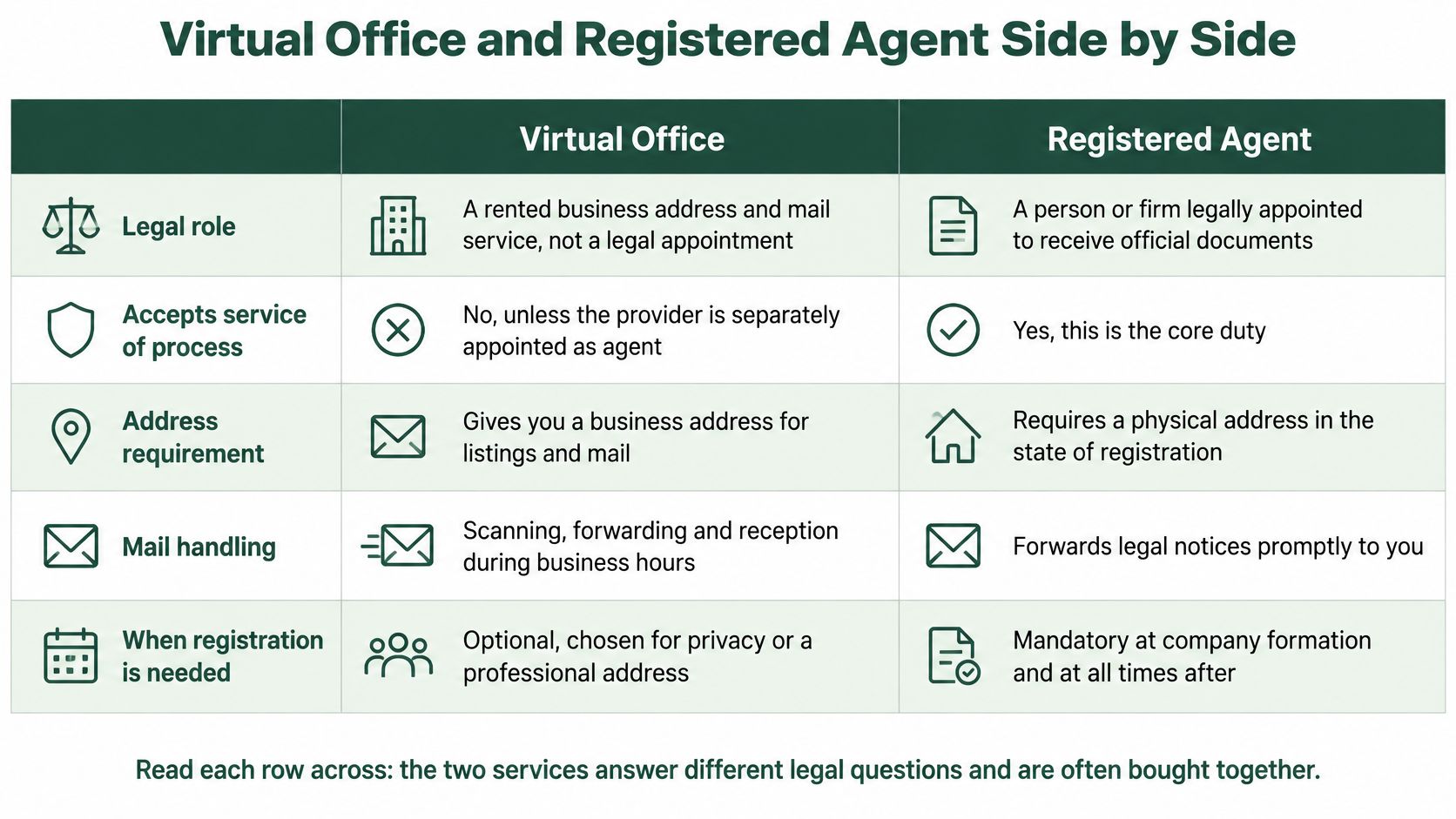
A virtual office handles correspondence. A registered agent accepts a legal appointment whose consequences fall on the company.
The service-of-process row matters most. Reception staff who can sign for a parcel aren't necessarily accepting personal service on your company's behalf. An attractive package name doesn't settle that question.
Read the contract, not the invoice label
Some providers offer both services under the same roof. That can simplify administration, but the contract should identify each duty independently: ordinary mail handling, registered-office provision, and registered-agent appointment where applicable.
A search for virtual office registered agent often produces bundled offers. Compare those offers against the rules of the formation jurisdiction, rather than assuming every advertised address is eligible everywhere.
For costs, request a written schedule covering:
- Recurring charges: Subscription, renewal, and any separate agent appointment.
- Handling charges: Scanning allowances, additional documents, postage, and original-document storage.
- Changes and exits: Address changes, cancellation, and forwarding after termination.
Don't compare a basic mailbox price with a fully staffed statutory service. Compare the total cost of meeting the same requirements.
Before signing, ask whether a named person will accept personal service during business hours and how legal notices reach you. Get the answer in writing, including what happens during holidays or staff absence.
Which Address Each Part of Your Business Needs
| Address type | What it must do | Can a virtual office cover it? |
|---|---|---|
| Registered office | Receive legal papers and registry correspondence at an eligible address | Only where the registry accepts the arrangement |
| Principal place of business | Identify where management or business activity actually occurs | Usually not without genuine operations there |
| Mailing address | Receive letters and permitted parcels | Yes, within the service's handling terms |
| VAT correspondence address | Receive tax-office communications | Where the tax authority accepts it |
| Bank address | Support know-your-customer checks | Sometimes, with supporting evidence of activity |
| Residential address | Identify the founder's actual home where required | No. Public disclosure exemptions require a separate registry check |
The same building can serve different purposes without giving those purposes the same legal status. A mailing address is a delivery destination. A registered office is a location used under a particular legal framework.
The National Association of Secretaries of State report on business-filing fraud discusses proposals to restrict commercial mail drops, virtual offices, and similar services as registered-office addresses in some contexts. That doesn't establish a universal ban, but it makes blanket eligibility claims unreliable.
The registered-office and bank-address traps
Start with the registered office. A provider's claim to offer a business address doesn't establish that it can receive service of process. Confirm the permitted address type and the provider's authority before putting the location on formation documents.
Bank onboarding asks a different question: where does this business operate? A registry-approved address may still require supporting contracts, invoices, management-location information, or other evidence when submitted to a bank or payment provider.
Don't solve that mismatch by inventing an operating location. State the actual working arrangement and distinguish the correspondence address from the management address.
For a location-based search, our guide to choosing a virtual office address near you can help frame the operational comparison. Proximity is useful for collecting originals or meeting visitors, but it doesn't establish legal eligibility.
Build an address register before incorporation:
- Identify the recipient: Registry, tax authority, bank, customers, or another institution.
- Record the permitted use: Registered office, correspondence, operations, or residence.
- Save the evidence: Address agreement, acceptance confirmation, and relevant supporting documents.
A virtual address may keep your home off particular public filings where the registry permits it. It doesn't turn that address into your residence or remove obligations to disclose personal details privately.
Checking Whether a Provider Can Legally Receive Your Notices
Legal deliverability is the useful benchmark: can the provider accept, log, and escalate an official notice while you still have time to act? Fast scanning means little if the document is refused at reception.
| Jurisdiction or address type | What qualifies or disqualifies it |
|---|---|
| Wyoming registered office | PO boxes, drop boxes, virtual addresses, mail-forwarding locations, and retail shipping stores aren't eligible |
| Delaware registered agent | Requires an eligible physical address in Delaware and an agent responsible for accepting and forwarding legal process |
| UK Companies House registered office | Requires a physical, appropriate address in the registration jurisdiction; Royal Mail PO Boxes aren't permitted; an accountant's or solicitor's address requires permission |
| Virtual office or mail-forwarding address | Suitable for correspondence; registered-office use requires jurisdiction-specific acceptance |
| Provider with many locations | Each jurisdiction needs its own eligibility check; location count doesn't establish compliance |
The Wyoming Secretary of State's registered-agent guidance expressly excludes those mailbox-style and virtual-address arrangements from qualifying as registered offices. Don't substitute a commercial address merely because it has a street number.
In the UK, Companies House's registered-office guidance requires an appropriate address where someone acting for the company becomes aware of correspondence and senders can obtain delivery confirmation. That's a registered-office test, not an instruction to import the U.S. registered-agent model into UK company administration.
Verify the delivery chain
- Confirm registry acceptance. Check the address type against the formation jurisdiction's official requirements.
- Identify the recipient. Where personal service applies, establish who accepts it during business hours.
- Require a receipt record. Ask for written confirmation that the provider records arrival time and delivery details.
- Agree an escalation deadline. Express it in days rather than a vague promise of periodic forwarding, and set an urgent-notice procedure.
- Test ordinary delivery. Send a sample letter and compare its tracking record with the provider's receipt and notification timestamps.
Keep a compliance matrix with a row for each jurisdiction and columns for acceptance, personal service, time-stamping, client transmission, and backup contacts. A sample letter tests handling, not legal eligibility.
FastCorp isn't a law firm or tax authority. The client remains legally responsible for the company's activities, tax obligations, and reporting accuracy.
Mail forwarding without the required authority to accept personal service remains a mail-handling arrangement. It can't independently satisfy a registered-agent duty.
Real Scenarios Where Each Setup Makes Sense
The best setup matches the company's actual activity, not just the founder's preference for privacy. Sphinx's shell-company red-flag commentary identifies reliance on a registered agent, mail drop, or virtual office alone as a possible concern when it isn't connected to a genuine principal office or business activity.
That doesn't make a remote business illegitimate. It means the founder should be ready to explain how the company earns money and where people manage it.
A consultant working from home
A remote consultant wants a professional correspondence address without publishing a home address unnecessarily. A virtual office can handle customer letters while the consultant continues working from home.
Recommendation: Use the virtual office for permitted public-facing and mailing purposes, adding a registered agent where required. The trade-off is privacy versus the continuing need to disclose a genuine residential or operating address privately.
An e-commerce founder selling into the EU
This founder needs dependable tax correspondence, but also has inventory, fulfillment arrangements, and marketplace onboarding to explain. A correspondence address doesn't establish where stock sits or which entity supplies the goods.
Recommendation: Coordinate the address with the actual supply chain and VAT registrations. Convenience improves, but banks and tax authorities may still need warehouse agreements, supplier invoices, and fulfillment records.
A SaaS company without employees
A software company can operate legitimately with founders and contractors rather than employees. Its evidence should explain the product, customers, ownership, and management arrangements.
Recommendation: Keep customer contracts, invoices, contractor agreements, and appropriate records of client meetings. The trade-off is low premises overhead versus more deliberate documentation during onboarding.
A holding-company owner who travels
A non-resident owner may have little ordinary mail but still receive consequential official documents. Sending every notice to a frequently changing travel address is a poor workflow.
Recommendation: Maintain the required registered address and legal recipient, with a named escalation contact and a backup. Convenience depends on someone monitoring the notifications.
Substance check: Keep beneficial-owner information consistent, explain the business model clearly, document where management happens, and retain address-service agreements.
Legal registration and operational presence are separate questions. Banks apply their own risk checks even when a registry has accepted the company's address.
Bulgaria's 10% Tax Rate Compared With Other Countries
Bulgaria applies a 10% nominal corporate income-tax rate, with the same combined all-in rate and no regional or local corporate-tax surcharge, according to the European Commission's tax database.
One flat rate, no surcharges stacked on top. That is what makes Bulgaria's headline easy to quote, and it is also what trips founders up: they compare a clean Bulgarian number against foreign headlines that hide profit bands, local levies, and income-type distinctions.
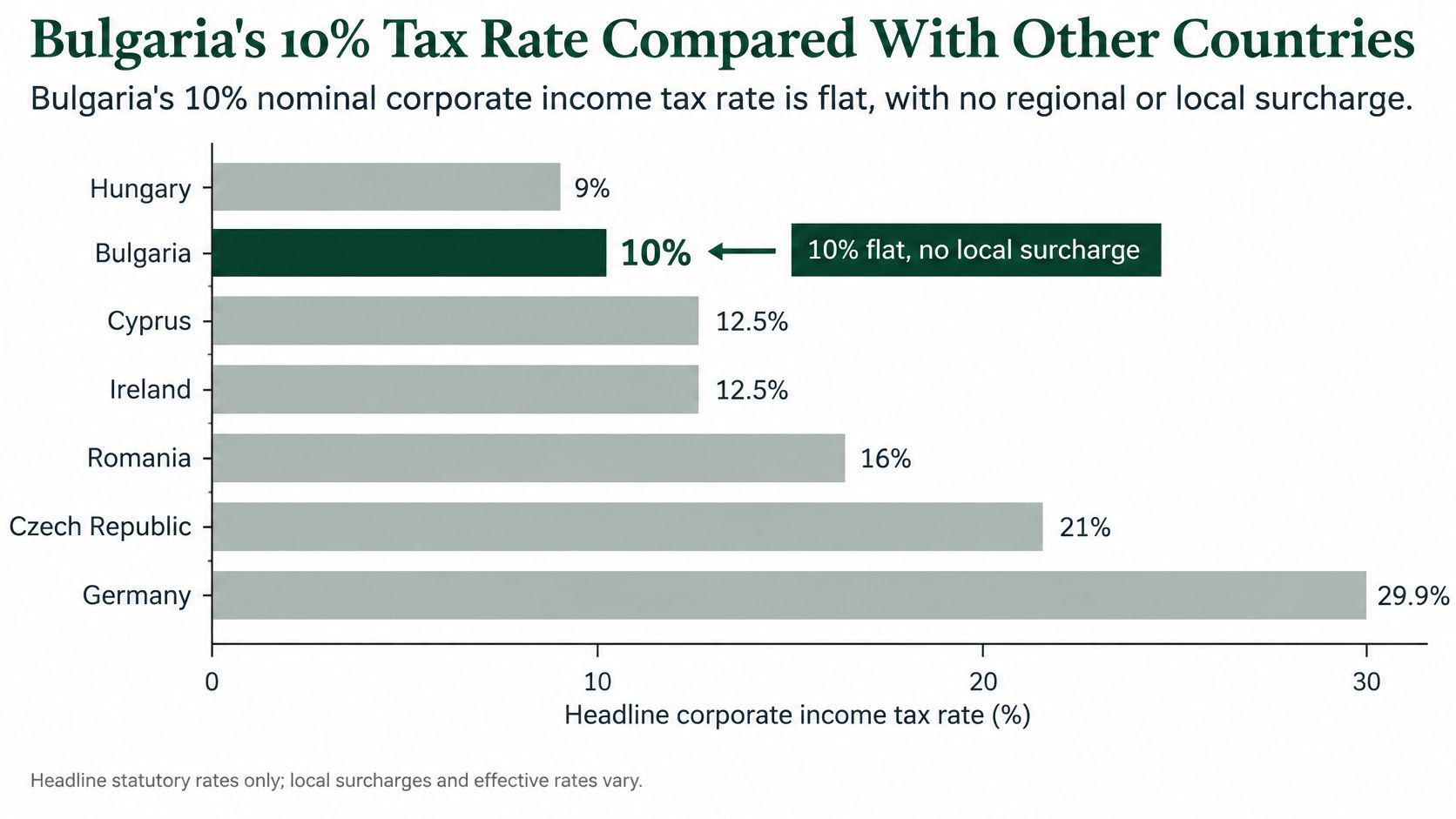
Treat the graphic as a starting orientation. A fair comparison checks what each country taxes, so the notes below matter more than the headline figure itself.
Country-by-country comparison checklist
| Country | What to verify before comparing |
|---|---|
| Bulgaria | Whether multinational minimum-tax rules apply to the group |
| Ireland | Which income qualifies as trading income versus other income |
| Cyprus | The enacted rate for the relevant accounting period rather than older charts |
| Hungary | Local business taxes levied separately from the national rate |
| United Kingdom | The applicable profit band and eligibility for reliefs |
| Germany | The combined burden across federal, trade, and solidarity components |
| France | Whether the company qualifies for a standard or reduced rate |
What changes the result
For smaller Bulgarian limited companies, the ordinary rate is the starting point. Certain large multinational groups face a 15% rate under rules implementing the EU Global Minimum Tax Directive, as explained in the U.S. Department of State's Bulgaria Investment Climate Statement.
The corporate rate is only one line of the bill. VAT, payroll contributions, withholding taxes, and obligations in other countries can move the final figure, while the owner's personal tax position needs its own review. A company paying a low headline rate on profits can still carry a heavier total burden once those layers are added.
A Bulgarian mailing address alone doesn't settle where a company is managed or whether another country has taxing rights. The registered address receives your notices; it does not create or remove taxing rights. Don't choose an address as a shortcut around that analysis.
Use our corporate tax rates guide to build the comparison around how the business earns:
- Profit tax: Identify the taxable company, income, and relevant jurisdiction.
- VAT: Map customers, supplies, stock locations, and registration duties.
- Employment: Establish where founders, employees, and contractors work.
- Owner taxation: Ask whether the owner's home country taxes distributions or foreign-company profits.
This video adds company-formation context to the comparison.
Setting Up Everything Online in Five Steps
Remote administration is practical: around 90% or more of tax administrations offer online services across functions including registration, filing, payments, and correspondence, according to the OECD's tax-administration digitalisation report.
We handle company registration without the customer needing to travel. You can complete the setup without leaving home, while we coordinate the paperwork.
The workflow is straightforward when the documents and address choices are ready.
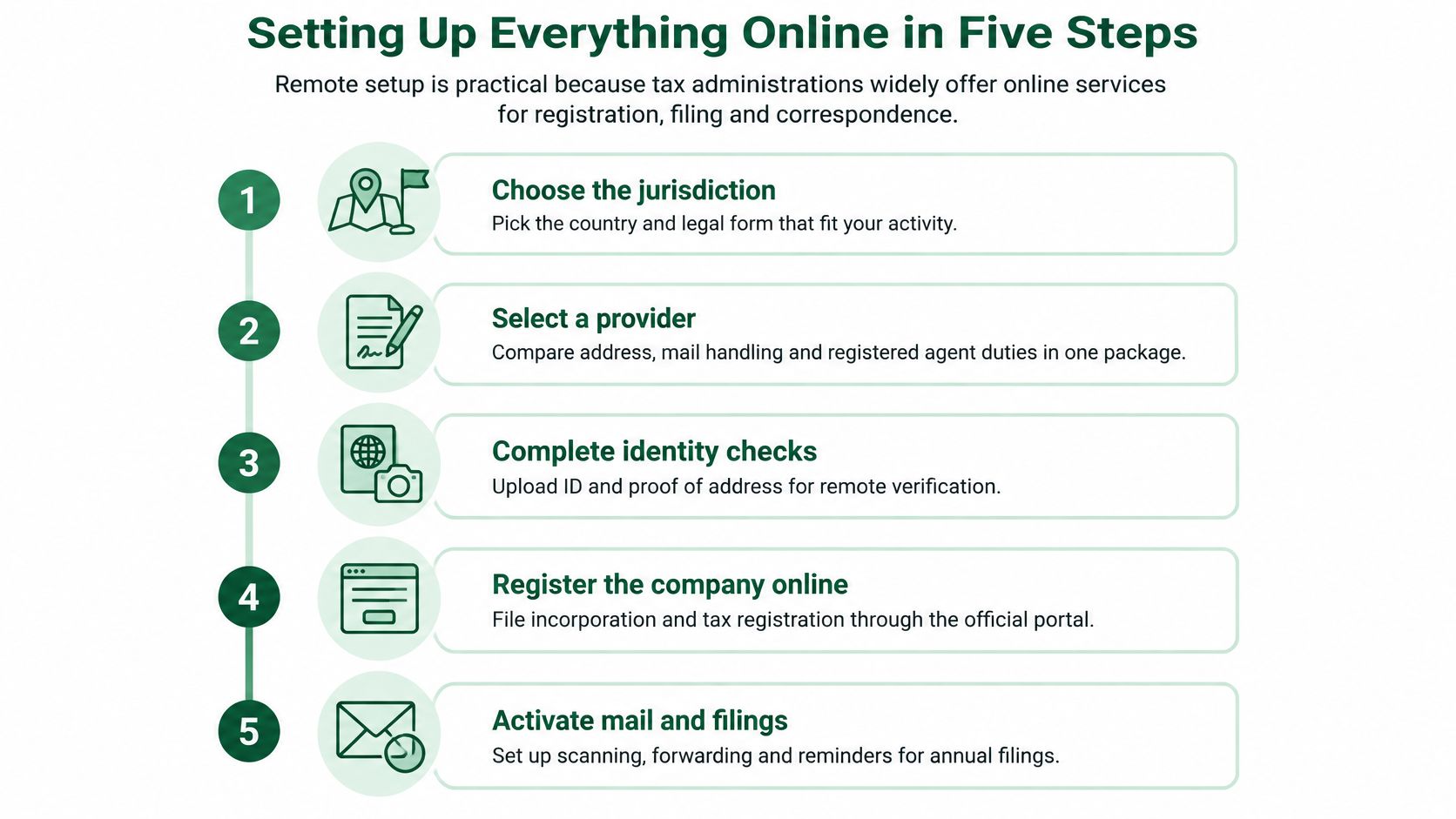
Choose the jurisdiction and address arrangement. Match the legal form and address uses to the actual business. A common slip is choosing a correspondence address before checking registration and banking requirements.
Collect the formation information. We collect ID details, preferred company names, the business description, shareholder and director details, and the share capital amount. Incomplete shareholder information prevents a clean filing.
Verify identity and sign remotely. The client completes a 30–60 minute online session with a secure online notary. This is the easy, concentrated part of the process when the identification documents and signing details are ready.
Allow for registry processing. Remote company formation takes 3–5 working days after all required documents and payments are received. Don't count from an initial enquiry or assume external onboarding follows the same timetable.
Activate correspondence and tax workflows. Establish scanning, forwarding, escalation contacts, and the relevant tax and VAT registrations. Check that each institution receives the correct address type rather than copying the registered address into every field.
Keep the completion file
Retain signed documents, submission receipts, registry confirmations, and address agreements in a secure shared folder. Confirm which institutions still require originals, notarized copies, or apostilles, because a scan won't satisfy every recipient.
Our guide to registering a company online explains the remote route. Online coordination makes the process easier, but document quality still determines whether the file is ready to submit.
Choose Your Address Setup and Start Online
Choose the smallest arrangement that meets every real requirement. Extra services won't repair an ineligible address, and a cheaper mailbox won't replace a statutory appointment.
You need privacy and ordinary correspondence only. Choose a virtual office if no separate legal-recipient appointment is required. Confirm the permitted public uses before changing your website, invoices, and customer records.
Your registry requires a named legal recipient. Appoint an eligible registered agent and reserve the virtual office for its agreed correspondence functions. If one provider handles both, record both obligations explicitly.
Your bank or VAT authority requests an operating address. Supply the genuine location with documents explaining the activity there. Keep that evidence separate from the agreement for your mailing address.
Compare the complete setup
FastCorp can coordinate company registration, EU VAT registration, and banking assistance for non-resident founders online, with a virtual office and business address included in the setup.
Our Online package costs €1,750 and includes EOOD or OOD registration, an EU VAT number, bank account, virtual office and business address, apostilled company documents, certificate of incorporation, and all legal and government fees. The In-person package costs €1,500 and includes EOOD or OOD registration, an EU VAT number, bank account, virtual office and business address, certificate of incorporation, all legal and government fees, and complimentary airport pickup.
Request the written package scope for the jurisdiction in question, including any ongoing services you'll need after formation. Banking assistance and incorporation coordination don't remove a bank's independent checks or the founder's responsibility to provide accurate information.
Start with a written address map, not a checkout page. List your jurisdictions, assign an address to each business purpose, and check each arrangement against the eligibility requirements before committing to the setup.
FastCorp offers Bulgarian company formation, EU VAT registration, banking assistance, and a virtual office to help remote founders build a coordinated address and compliance setup. Visit FastCorp to book a consultation, review your jurisdiction list, and start the online formation process with the right address arrangement.