Compliance with Tax Laws for EU Founders
See what compliance with tax laws means for Bulgarian and EU companies, with tax comparisons, online steps, penalties and a simple monthly plan.

You're outside Bulgaria, your Sofia company is registered, and your first EU customer has paid. Then your accountant asks for invoices, payment-provider exports and ownership documents, and you wonder why a business that runs online needs quite so many records.
The good news is that compliance with tax laws can become a manageable online routine. The trick is to connect the calendar, the invoices and the money, rather than treating each return as a separate administrative emergency.
Table of Contents
- Why Tax Compliance Feels Bigger Than One Return
- Bulgaria Beside Other Countries on Tax
- The Obligations a Sofia Company Actually Carries
- How to File Everything Online Without Travel
- Cross-Border Sales That Payment Data Can Catch
- Penalties and the Fixes That Limit Them
- Pick Ongoing Help and Book the Setup
Why Tax Compliance Feels Bigger Than One Return
Say you run a consultancy through a Bulgarian limited company. You can issue invoices from your laptop, but your first filing season brings a different question: what exactly must match?
Think of a restaurant's kitchen pass. The customer's order, the kitchen ticket and the till should describe the same meal. A busy kitchen isn't proof that the order was right.
Tax compliance works similarly. The tax legally due, the figures reported and the cash paid by the deadline must agree, supported by records an inspector can follow.

The founder's working map
A non-resident owner needs to distinguish:
- Corporate income tax, calculated on taxable profit rather than customer receipts alone.
- VAT, determined by the supply, customer and relevant jurisdiction.
- Payroll and insurance reporting, where employment creates those duties.
- Ownership information, supported by an identifiable chain of shareholders and control.
Registration, VAT applications, tax returns and many payment tasks can be coordinated online. You don't need to turn each filing into a flight to Sofia.
Practical rule: Judge a company location by both its tax treatment and the work needed to keep its records defensible.
Bulgaria Beside Other Countries on Tax
Corporate tax and standard VAT by country
| Country | Corporate income tax | Standard VAT | What changes the comparison |
|---|---|---|---|
| Bulgaria | 10% | 20% | EU company with online NRA filings and a qualified e-signature |
| Hungary | 9% | 27% | Lower headline profit tax but the EU's highest standard VAT |
| Ireland | 12.5% on trading profit | 23% | Low trading-profit tax with a higher standard VAT |
| Cyprus | 12.5% | 19% | Low headline profit tax; EU VAT still follows the supply |
| Romania | 16% | 19% | Higher headline profit tax and a historically wide VAT gap |
| Poland | 19% | 23% | Both headline rates sit above Bulgaria |
| France | 25% | 20% | Higher profit tax; standard VAT matches Bulgaria |
| Germany | About 30% with trade tax | 19% | Combined burden includes municipal trade tax |
| Netherlands | 19% up to €200,000 of profit; 25.8% above | 21% | Two-tier profit tax and VAT above Bulgaria's standard rate |
| United Kingdom | 25% | 20% | Outside the EU, so OSS and EU VAT rules differ |
Treat these as headline comparison figures, not a calculation of your company's effective tax. Confirm the applicable tax-year rules, reliefs and company-specific treatment before making a decision, using the corporate tax rates comparison as a starting point.
A Bulgarian company still files and pays on Bulgaria's national calendar. A favourable profit-tax rate doesn't replace bookkeeping, invoice checks or registration analysis.
Profit tax and VAT answer different questions
Corporate income tax concerns the company's taxable profit. VAT concerns taxable supplies and their treatment, so comparing the percentages as though both apply to profit leads to poor decisions.
Say a Bulgarian agency serves a business customer elsewhere in the EU. You shouldn't automatically add Bulgarian VAT just because the supplier is Bulgarian. The accountant needs to establish customer status, the nature of the service and the place-of-supply treatment.
The same caution applies to consumer sales. A founder selling subscriptions across borders needs a country-by-country reporting map, not just the standard VAT rate where the company was incorporated.
Administration matters alongside the rate
According to the European Commission's VAT compliance findings, EU Member States lost an estimated €89.3 billion in VAT revenue in 2022, equal to 7.0% of VAT Total Tax Liability, compared with an 11.2% gap in 2018. The Commission's earlier estimates also show the breadth of national differences, from 1.3% in Finland to 35.7% in Romania in 2020.
Those gaps aren't measures of deliberate evasion alone. They can include fraud, insolvency, payment problems, avoidance and administrative or statistical errors.
For a founder, the useful comparison is therefore practical: can you maintain accurate sales records, understand the relevant filing obligations and obtain reliable support? A low rate is useful only when you can administer the business properly.
The Obligations a Sofia Company Actually Carries
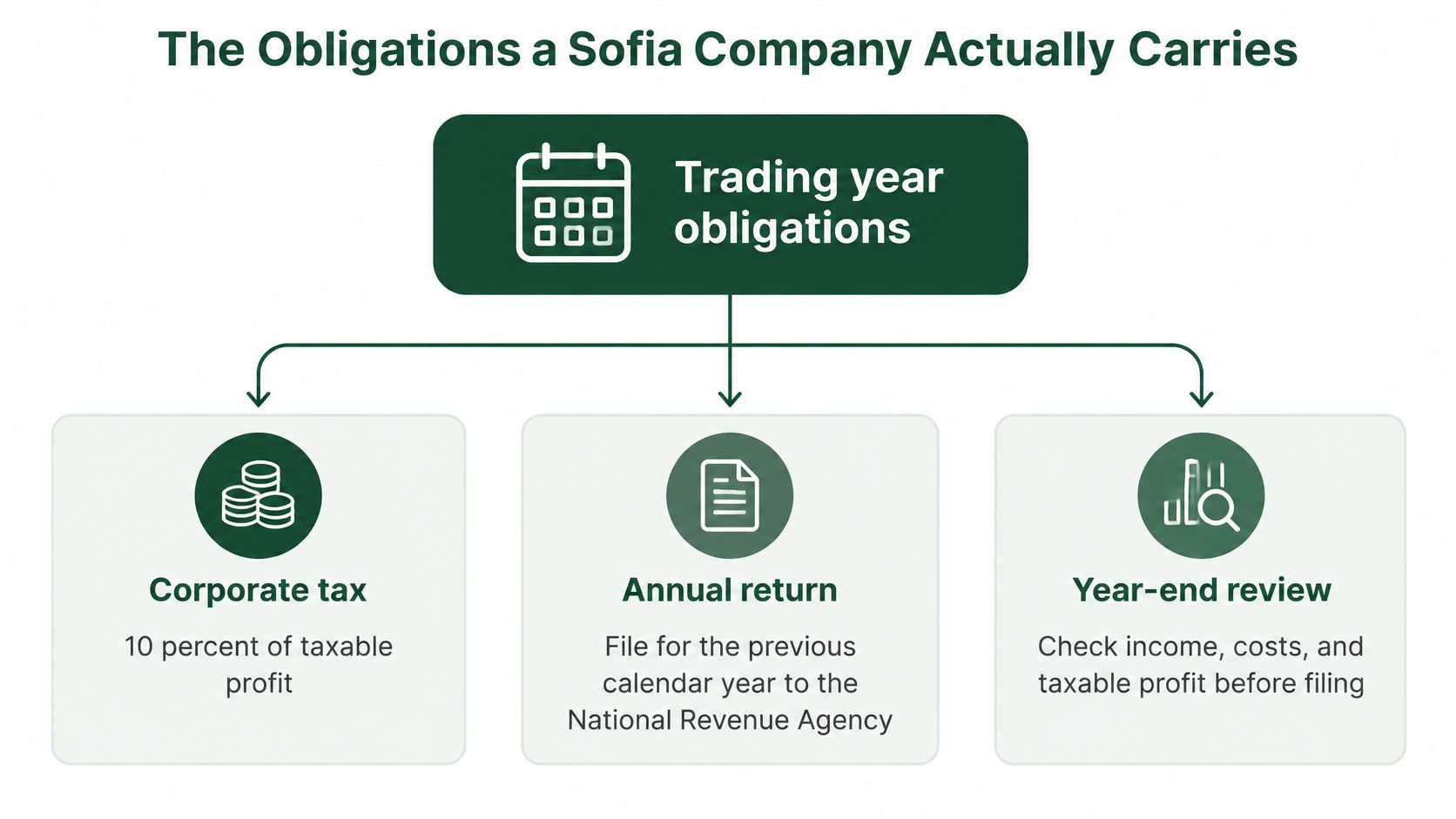
Start with a duty list, not a folder called “tax” containing every document the company has ever received. Each obligation needs its own inputs, reviewer and completion evidence.
Corporate profit and the annual return
The Bulgarian Ministry of Economy's corporate-tax guidance sets corporate tax at 10% of taxable profit and says companies generally submit the preceding calendar year's annual return between 1 March and 30 June, using a qualified electronic signature, with the tax balance payable by 30 June after advance payments. Companies with no activity and no corporate-tax liability are generally exempt from that annual return.
That last point needs an actual check. No sales doesn't necessarily mean no activity, and an empty bank account doesn't establish an exemption.
Before preparing the return, your accountant should resolve missing expense documents, unclear shareholder transactions and differences between recorded income and customer balances. Taxable profit isn't merely whatever cash remains in the bank.
VAT evidence and ownership records
For business-to-business sales, build an invoice checklist covering the supplier, customer, supply description and applicable tax treatment. Keep the contract, order, service or delivery evidence, customer VAT validation, invoice and any credit note together.
A useful transaction record also identifies customer status, customer location and the reason for the VAT treatment. Don't leave the accountant to infer those facts from a payment description.
Ownership deserves a separate file. The OECD's beneficial-ownership monitoring guidance describes the importance of accurate, adequate and current ownership information, supported by verification and underlying records.
Keep the ownership chain, control rights, identification documents and change history. Review the file when shareholders, directors, investors or control arrangements change.
Assign the duties before work starts
| Duty | Suggested accountable owner | Evidence to retain |
|---|---|---|
| Profit calculation and annual return | Accountant, with director approval | Working papers and accepted submission |
| VAT classification and reporting | VAT reviewer | Invoice records and transaction reconciliation |
| Ownership updates | Director or designated corporate administrator | Supporting documents and change log |
| Employment reporting | Payroll administrator | Payroll records and reporting confirmations |
For registration, we collect ID details, preferred company names, a business description, shareholder and director details, and the share capital amount. Clients must provide all requested documents and information promptly, including later changes that affect the company's records.
The return is the receipt for the work. It isn't the compliance system itself.
How to File Everything Online Without Travel
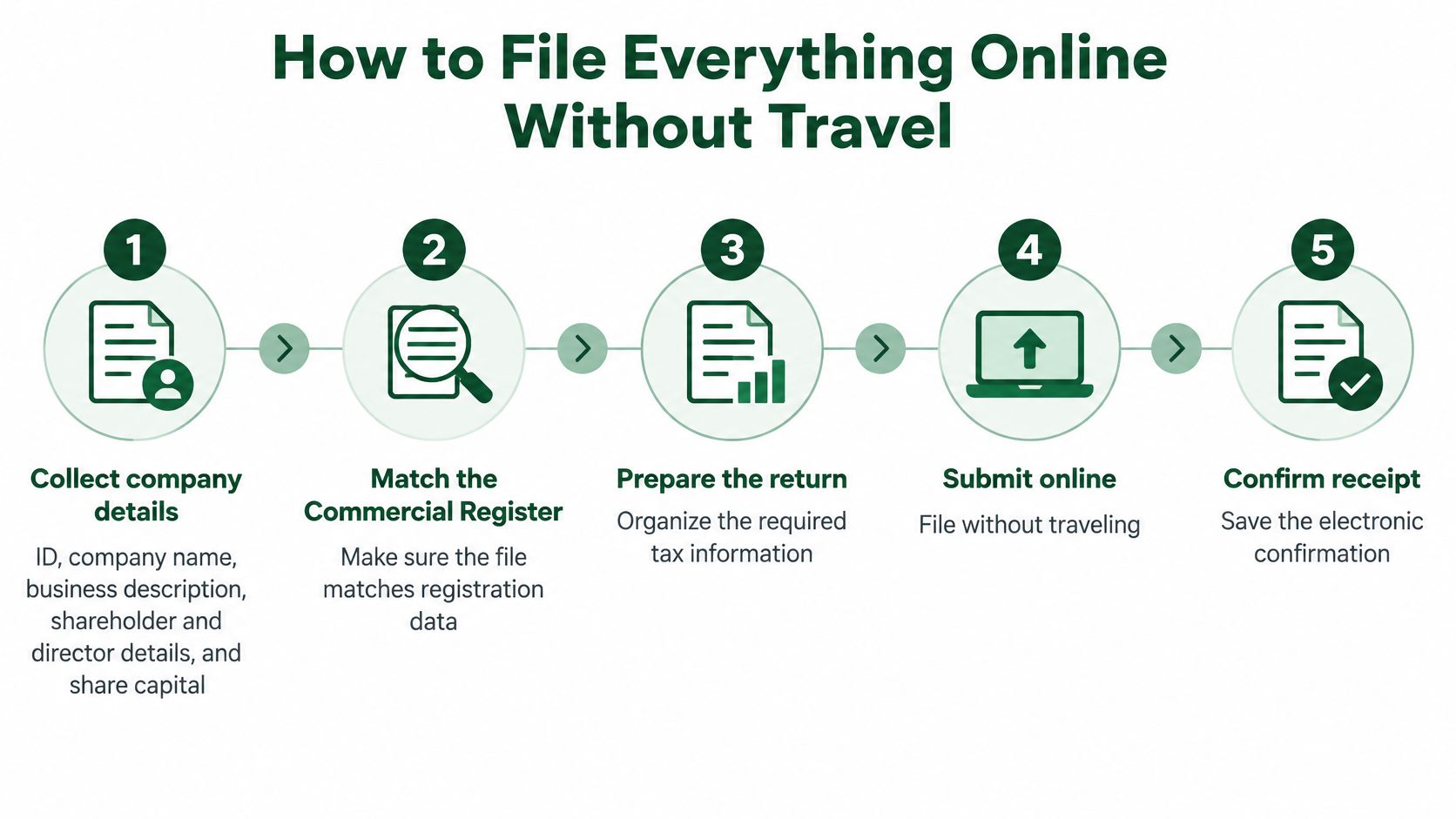
Remote filing becomes straightforward when the company details, electronic signature and permissions are ready before the deadline. The process is online, but it still needs a controlled handover between the founder and whoever submits the documents.
The NRA electronic-services portal provides income-tax services, VAT declarations, insurance and labour-contract reporting, payments and calculations, fiscal-terminal and online-store services, and SAF-T functionality.
A remote filing path
Collect the company details. Assemble identification, the company name, business description, shareholder and director information, and share capital details. Reconcile the working file with the Commercial Register rather than copying an old onboarding form.
Arrange the qualified electronic signature. Confirm who will sign and whether the authorised filer has the necessary permissions. Test access before a live filing becomes urgent.
Open the correct NRA service. Select the company and reporting obligation carefully. Check the period and identifier before uploading anything.
Prepare VAT registration electronically. Assemble the legal name, address, electronic contacts, tax identifiers, bank details, previous registrations and relevant fixed-establishment information. Have the responsible adviser confirm the competent territorial directorate before submission.
Connect software where appropriate. Bulgaria supports automated submission from business systems through a public API or system-to-system connection. Confirm that the particular service supports your intended report, then test the exported dataset against the accounting ledger.
Save evidence of acceptance. Retain the submitted version, supporting reconciliation and portal confirmation. A screenshot of a completed draft isn't proof that the NRA accepted the filing.
Remove obsolete access. Withdraw a former adviser's authorisation when the engagement ends. Where supported, use distinct user access rather than circulating shared credentials.
Less paper still needs an audit trail
The OECD's Tax Policy Reforms report reports that electronic filing covered 96% of corporate income tax returns and 99% of VAT returns in 2023 across the jurisdictions examined. It also describes the move towards standardised cross-border reporting under an EU directive adopted in 2025.
For a remote founder, the practical response is a governance file: who approved the figures, who submitted them, which dataset was used and what confirmation came back. Automation should eliminate retyping, not eliminate review.
Personal data may be shared with Bulgarian authorities, including the Commercial Register and the National Revenue Agency. Use controlled document storage and give advisers only the access their work requires.
We handle company registration without requiring customers to travel, coordinating trusted accountants, notaries and translators where needed. Setup can be completed from home, while the company's records remain organised and reviewable.
Cross-Border Sales That Payment Data Can Catch
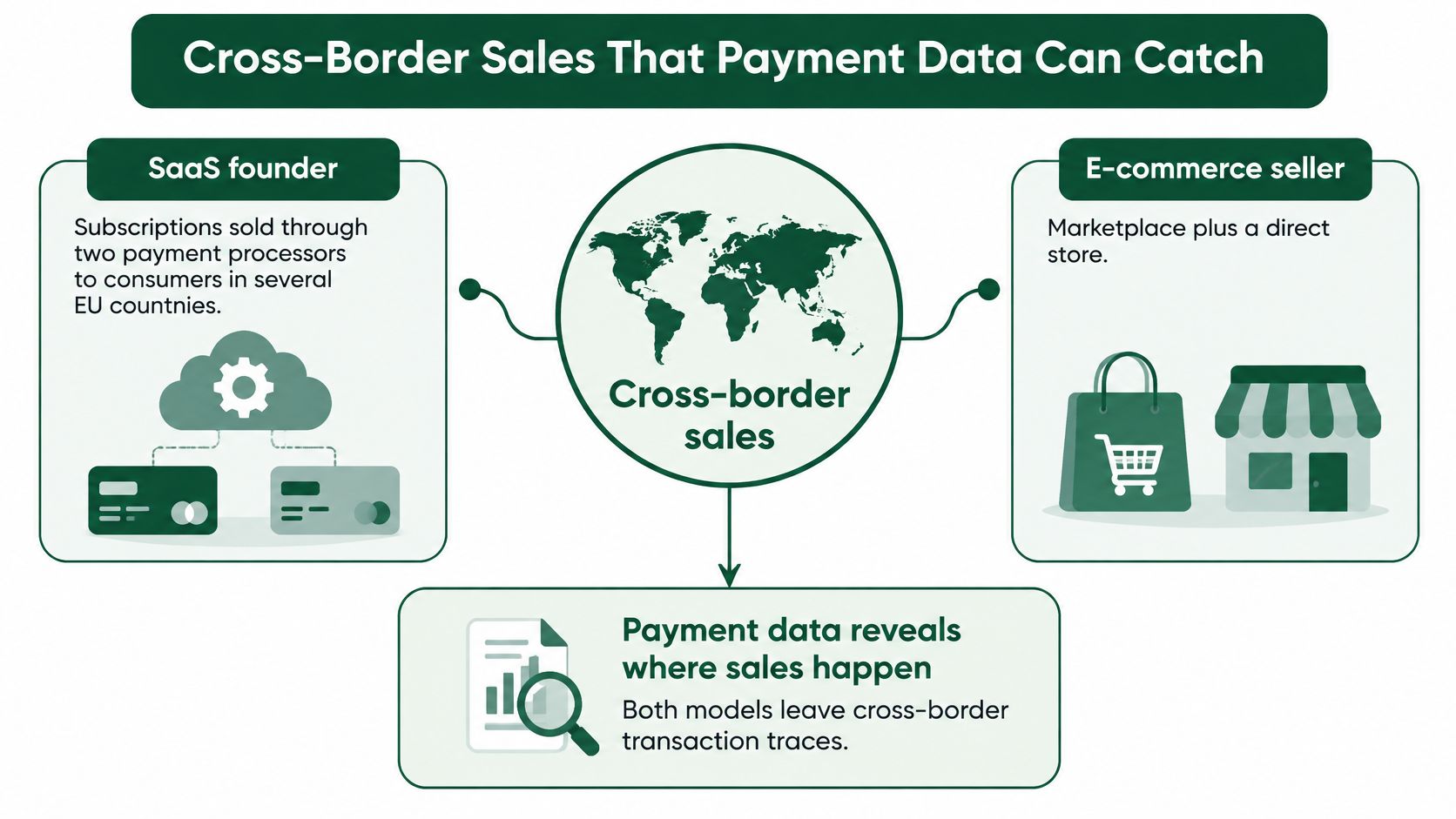
Say a SaaS founder sells subscriptions through several payment processors to consumers across the EU. The bank statement shows payouts after fees, but those deposits don't describe the underlying gross sales or their VAT treatment.
An e-commerce seller faces a similar problem with a marketplace and a direct store. Marketplace statements, store orders, refunds and bank receipts can describe different stages of the same transaction.
Both founders can submit a return on time and still report incomplete sales. Payment reconciliation is what connects the commercial activity to the tax figures.
Why third-party records matter
The Council of the European Union document on VAT administration describes CESOP, introduced in January 2024, which collects cross-border payment information from payment service providers for comparison with VAT reporting. The document also reports that VAT declared through the EU's e-commerce One Stop Shop schemes reached €38.8 billion in 2025, up €5.7 billion, or 17%, from 2024.
CESOP and OSS aren't interchangeable. CESOP concerns payment information used for control purposes; OSS provides reporting arrangements for eligible supplies.
A Bulgarian VAT registration also shouldn't be treated as the answer to every cross-border obligation. Use the European VAT registration guide to identify the questions your transaction map needs to resolve.
Reconcile the sale, not just the payout
Build a monthly worksheet with these fields:
- Gross sales by customer country, linked to order and invoice identifiers.
- VAT treatment and rate, including the evidence supporting customer location.
- Refunds and chargebacks, connected to the original transaction and any credit note.
- Platform fees, recorded separately rather than deducted from turnover.
- Currency conversion, with the method and conversion record retained.
- Business-customer VAT checks, saved with the transaction evidence.
- Reporting destination, identifying OSS, the relevant local return or another supported treatment.
Don't assume every chargeback automatically permits the same VAT adjustment as a completed refund. Have the reviewer establish what happened commercially and which correction is appropriate.
Make the match a monthly habit
Use an internal weekly rhythm, adapted to the company's actual statutory deadlines:
| Internal checkpoint | Work to complete |
|---|---|
| First week | Reconcile gross sales, fees, refunds, chargebacks and currencies |
| Second week | Resolve customer-status checks, invoice fields and reporting treatment |
| Third week | Complete employment reporting where applicable and process ownership changes |
| Fourth week | Approve the reporting pack, arrange payments and archive confirmations |
The reporting deadline takes priority over this suggested rhythm. Bring the review forward whenever a filing falls earlier.
Name a reviewer who can obtain records from the platform, bank and accountant, then require their sign-off before filing. Filing compliance increasingly depends on consistency across systems, not on pressing Submit.
Penalties and the Fixes That Limit Them
A late or missing Bulgarian VAT return can result in a penalty of BGN 500 to BGN 10,000, approximately EUR 255 to EUR 5,100, according to the European Commission's Bulgaria VAT rules. Those rules also confirm electronic registration through the NRA portal, with non-EU businesses applying to the Sofia territorial directorate and EU businesses using the competent directorate according to their establishment.
If you discover a missed return, establish what's outstanding immediately. Submitting it promptly won't guarantee that a penalty disappears, but leaving it unresolved creates another avoidable problem.
Common tax misses and the first fix
| Miss | What it can cost | First fix |
|---|---|---|
| Late or missing VAT return | A financial penalty within the range stated above | File at once and save the portal receipt |
| Corporate tax unpaid by the annual payment deadline | Outstanding tax after advances, plus applicable interest | Pay the balance and keep payment proof |
| Annual return skipped in error | Exposure if there was activity or tax due | Confirm whether both exemption conditions apply; file if they don't |
| Invoice or place of supply wrong | Assessment risk and potentially blocked customer VAT recovery | Correct the invoice and reconcile the reporting treatment |
| Ownership file out of date | Bank delays and authority evidence requests | Update the records after a share, director or control change |
| Return disagrees with payment data | A mismatch requiring explanation or correction | Reconcile sales, fees, refunds and location evidence |
Correct the source before the next submission
Suppose an invoice uses the wrong customer details. Editing the accounting entry alone leaves the customer holding a different document, so the correction needs to reach the invoice record and the customer as well.
For a payment mismatch, start with transaction identifiers. Identify whether the difference arose from a missing sale, payout timing, fees, currency conversion or a refund recorded in another period.
Don't force the numbers to agree by posting an unexplained adjustment. A reconciliation should explain the difference, not hide it.
Correction habit: Open the issue promptly, assign an owner, preserve the original records and document the correction route before changing a filed figure.
Some errors require an amended return, while others need a later-period adjustment or a separate response. Ask the responsible accountant to identify the applicable procedure rather than assuming every NRA submission can be overwritten.
Keep the corporate tax filing deadlines guide beside your compliance calendar. Use it to confirm which obligation has slipped, then assemble the working papers, submission confirmation and payment evidence needed to resolve it.
The table is an incident checklist, not a substitute for prevention. Your regular reviewer should track open corrections until the accounting records, customer documents and tax reporting agree.
Pick Ongoing Help and Book the Setup
Choose support after you know who owns the company's compliance decisions. Outsourcing the work doesn't transfer legal responsibility for the company's activities, tax obligations or reporting accuracy.
Keep responsibility visible
A useful handover states who prepares the records, who reviews the treatment, who approves payment and who submits the return. Keep a named person inside the business accountable for answering questions and supplying missing information.
- Send complete records. Provide contracts, invoices, payment reports and ownership changes promptly.
- Agree the scope. Establish whether bookkeeping, VAT, annual returns and payroll are included.
- Keep oversight. Review unresolved differences before approving a reporting pack.
At FastCorp, optional ongoing support includes bookkeeping, VAT reporting, annual corporate returns, payroll and tax-compliance coordination. We're not a law firm or tax authority, and the client remains responsible for the accuracy of the information reported.
Compliance with tax laws works best as a repeating online routine. Book a setup discussion or compliance review before the next deadline, with your current records and unresolved questions ready.
FastCorp offers online Bulgarian company formation and ongoing accounting support to help connect your registration, invoices, VAT reporting and tax filings. Visit FastCorp to arrange an online setup or compliance review and establish who will manage your next submission.