Corporate Tax Compliance Services: What You Get in 2026
Corporate tax compliance services explained: bookkeeping, VAT, annual filings, payroll, SLAs and Bulgaria's 10% rate, with a 2026 service map and checklist.

The World Bank's Paying Taxes 2015 study modeled a standard company across 189 economies and found it needed an average of 264 hours a year to meet tax obligations and made 25.9 tax payments. That's why corporate tax compliance isn't just about calculating what a company owes. It's also about keeping records complete, assigning responsibility, and making sure every return and payment gets handled on time.
For a Bulgarian company, a low headline corporate tax rate doesn't remove the work. The practical advantage comes from making the work routine: transactions reconciled each month, exceptions resolved before filing, and deadlines owned by a named provider.
Table of Contents
- Corporate Tax Compliance Services at a Glance
- What a Monthly Compliance Cycle Looks Like
- Service Levels and Tiers to Compare
- How the Online Workflow and Data Security Work
- Bulgaria Compared With Other Countries
- Mistakes That Trigger Penalties and How to Avoid Them
- Choose Your Compliance Provider and Start Now
Corporate Tax Compliance Services at a Glance
The useful question isn't merely which filings a provider can submit. It's whether someone takes responsibility for the records and deadlines that make those filings reliable. Use this table to map the core work for a Bulgarian company.
| Service | What It Covers | Frequency | Typical Deadline |
|---|---|---|---|
| Bookkeeping | Ledger entries, bank and payment platform reconciliation, invoices, expense receipts | Monthly | Monthly close on a date set by the provider |
| VAT returns | Output and input VAT, EU sales lists, counterparty VAT number checks | Monthly or quarterly, depending on registration | By the applicable filing deadline for the reporting period |
| Annual corporate tax return | Taxable profit after adjustments, annual corporate income tax declaration | Yearly | 30 June for the prior financial year |
| Payroll and social security | Salaries, withholding tax, social security contributions | Monthly | Per the NRA and social security calendar |
| Statutory reporting | Annual financial statements and their filing with the Commercial Register | Yearly | Within the statutory period after year end; confirm with the provider |
| Ongoing compliance management | Deadline calendar, document retention, advisory questions | Continuous | Reviewed monthly |
The work connects across services. Bookkeeping supplies the figures for VAT and annual accounts; payroll creates its own reporting and payment obligations; and the deadline calendar needs to cover each filing, not just the annual tax return. A mismatch between a bank settlement and ledger entry can travel through the whole process if nobody spots it early.
The World Bank's figures are global modeled averages, not a prediction of the hours or payments for any one company. They still make the main point: compliance consumes staff time and procedural attention even when tax due is modest. The burden includes finding source documents, applying the right treatment, checking calculations, submitting forms, and ensuring payment happens.
Practical rule: Ask one provider to own the calendar across all six services, even if specialists handle separate tasks. That gives you one person to contact when a deadline is approaching or a filing depends on missing information.
Before comparing providers, write down which services your company needs and the deadline that applies to each. Get the provider to confirm in writing who supplies the records, who prepares the filing, who approves it, and who makes sure payment is executed.
What a Monthly Compliance Cycle Looks Like
Treat compliance as a monthly data-control cycle, not a once-a-year return-preparation exercise. The OECD's work on tax administration digitalisation reports that about 80% of tax administrations obtain data directly from business systems, and nearly 95% use data science or analytical tools on electronic third-party and internal data to guide compliance work. Clean records and reconciliations matter because information in company systems can be compared with data held elsewhere.
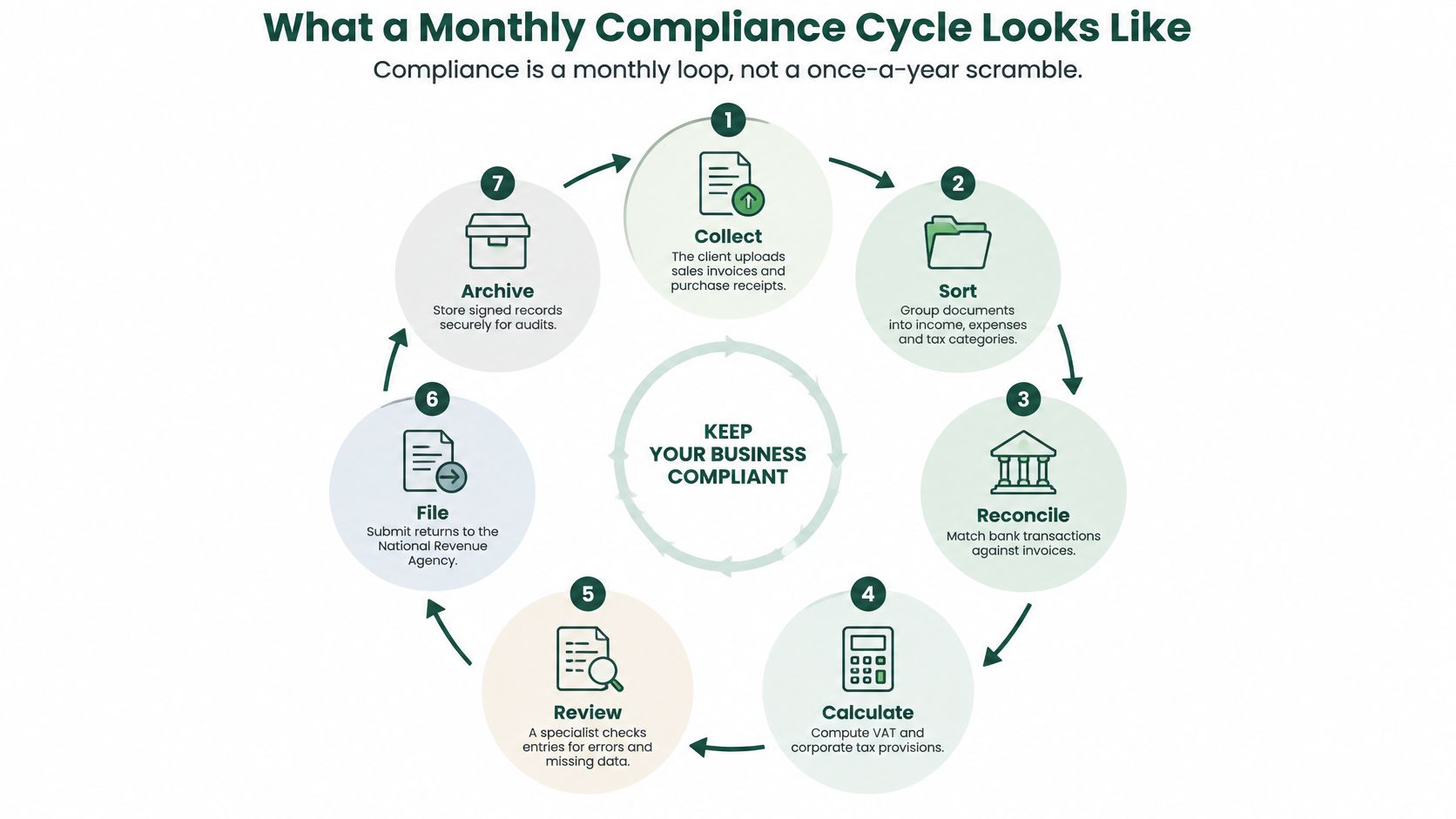
Collect. Upload sales invoices, purchase invoices, receipts, and payroll inputs through the secure portal by the agreed monthly cut-off, such as working day three. A clear cut-off gives the accountant enough time to ask for missing documents before a filing is due.
Import. Bring bank feeds and payment-platform payouts, including Stripe, PayPal, and marketplace settlements, into the ledger. Recording settlements as they reach the bank without accounting for platform activity can leave revenue, fees, and cash out of alignment.
Reconcile. Match bank and platform balances against ledger entries, then investigate anything unmatched. For example, a Sofia SaaS company with €40,000 in monthly Stripe payouts would have an €800 gap if fees equal 2% of payouts; that difference becomes visible when the settlement is reconciled, not when a return is filed.
Validate VAT. Check counterparty VAT numbers, customer location, and whether reverse-charge treatment applies. Those checks help the provider catch a classification or location mismatch before it flows into a return.
Review exceptions. Escalate unusual input-VAT claims, missing invoices, negative margins, and unexplained intercompany balances before filing. Reviewing exceptions concentrates attention on transactions that need judgment instead of treating every entry as equally risky.
Prepare and approve. Have the provider draft the VAT return and payroll declarations, then give the founder a clear approval record. Approval works best when the reviewer sees the filing, its supporting reconciliation, and any unresolved issues together.
File and archive. Submit the approved filing and retain the submission receipt with its supporting evidence. An organized archive makes it easier to answer questions later without rebuilding the file from email attachments.
Copy the routine: upload by the agreed cut-off, clear reconciliation exceptions, review the draft, approve, and save the receipt and evidence. Ask the provider to keep a trail from each reported figure back to its source document.
Service Levels and Tiers to Compare
Choose a service tier based on the work your company truly generates. The label matters less than the review rhythm and whether someone investigates exceptions rather than merely processing supplied documents.
| Service Level | Typical Coverage | Review Rhythm | Best Fit |
|---|---|---|---|
| Compliance only | Annual corporate tax return, VAT filing, statutory deadline monitoring | Quarterly review | Dormant or low-activity company with few transactions |
| Standard bookkeeping | Monthly ledger, VAT returns, payroll, annual return, statutory reporting | Monthly close | Active company with regular invoices and one or two employees |
| Full control | Standard bookkeeping plus platform reconciliation, exception reporting and year-end tie-out | Monthly close plus year-end tie-out | E-commerce, SaaS or multi-currency business with high transaction volume |
Compliance-only service can suit a company with little activity, but it leaves more day-to-day record keeping with the owner. Standard bookkeeping adds a regular close and payroll coordination. Full control is the better fit when several payment platforms, currencies, or sales channels must reconcile before the books are ready for filing.
A tier should also make clear who checks exceptions and how quickly questions get answered. Compare scope and pricing before signing, and use this guide to accounting services pricing to prepare questions about what a quoted fee includes.
Terms to put in the service-level agreement
Send the provider this checklist and ask for a written answer to every item:
- Named accountant: Identify the person responsible for your account and their backup.
- Response time: Set a target for routine questions and a separate urgent-response route.
- Deadline ownership: State who is responsible if a filing is late, including what the client must supply and by when.
- Record retention: Specify how long documents and filing evidence are retained, and how you can retrieve them.
- Data location: Identify where accounting records are stored and which third parties process them.
- Escalation path: Name who contacts you when a filing or payment deadline is at risk.
- Separate controls: Set out how the provider checks filing accuracy, executes payments, and monitors deadlines. These are distinct controls, not one vague promise to “handle compliance.”
The U.S. Internal Revenue Service's tax-gap estimate puts the corporate-tax gross tax gap at approximately $50 billion for tax year 2022. That U.S.-specific measure covers tax legally owed but not paid on time, including nonfiling, underreporting, and underpayment. It's a useful reminder to define responsibility for each failure mode, rather than assume a completed return means the payment and deadline were handled too.
Ask for a written fee schedule covering the monthly fee, any platform-feed charges, and any extra cost for a year-end tie-out or additional currencies. FastCorp offers end-to-end company formation and accounting support; its formation packages cover incorporation, while ongoing compliance fees should be confirmed in the written schedule.
How the Online Workflow and Data Security Work
Online compliance can make the process straightforward. A founder can complete remote identity verification and document signing through a secure online notary, then share accounting records through a controlled workflow rather than sending scattered files by email. Bulgaria supports taxpayer-data submission to the National Revenue Agency through a public application programming interface or a system-to-system connection, so structured information can be transmitted directly rather than manually entered in the NRA portal and uploaded.

A good portal should show which documents have arrived, which filing is being prepared, what needs your approval, and whether the submission receipt has been saved. That visibility reduces avoidable chasing. It also gives the founder a clear point to check before a return is submitted.
Digital doesn't automatically mean simple or secure. In Deloitte's 2026 global survey, only 36% of respondents expected e-invoicing to simplify compliance, down from 59% in 2024. Concerns included unauthorized access or breaches (61%), secure storage and retention of e-invoice data (58%), and controls over third-party providers (57%), as reported in this Deloitte survey coverage.
Questions to send any provider
Ask for direct answers, not a general assurance that the platform is secure:
- Storage location: Where are invoices and bank records stored, and are they held inside the EU?
- Access controls: Which staff and subcontractors can see company records, and how are access events logged?
- Backup and retention: How are records backed up, how long are they retained, and how can the company retrieve them?
- Corrections: How do amended invoices and credit notes remain linked to the original transaction and filing?
- Automated classifications: Does a qualified person review tax-sensitive automated classifications before submission?
Consider a non-resident founder whose accounting platform stores invoices outside the EU. The provider should be able to explain where the data goes, who can access it, what contractual and operational safeguards apply, and how the company can retrieve a complete record later. Don't settle for “the software handles it” when you need an accountable answer.
An online service should combine secure e-signatures, software integration, controlled access, and retained filing records. Scanned PDFs alone aren't an end-to-end process.
Bulgaria Compared With Other Countries
Bulgaria's standard corporate income tax rate is 10% on company profits under the Corporate Income Tax Act, according to the Bulgarian Ministry of Economy's tax guidance. That is a clear benchmark, but the headline rate does not show the full cost or work involved in staying compliant.
Bulgaria requires an annual electronic corporate tax return, with final payment due by 30 June for the prior financial year. Companies can transmit data online, as described in the Bulgarian Ministry of Finance's tax information. These processes support remote administration for owners working elsewhere. A low rate and online filing can simplify operations, but companies still need to confirm their obligations in every jurisdiction where they operate.
| Country | Headline Corporate Rate | Compliance Note |
|---|---|---|
| Bulgaria | 10% | Annual electronic return; final payment by 30 June; special minimum-tax rules may apply to certain groups |
| Hungary | 9% | Check local business tax and VAT reporting obligations |
| Ireland | 12.5% | Confirm which income-tax rate applies and whether minimum-tax rules are relevant |
| Cyprus | 12.5% | Check corporate tax and related filing obligations |
| Germany | 15% federal corporate tax, plus local trade tax | Check the combined federal and local tax position |
| United Kingdom | 25% main rate | Confirm the applicable rate for the company's profit level |
| United States | 21% federal rate, plus possible state tax | Check federal and state corporate tax obligations |
Compare the full operating picture, not rates alone. Confirm the statutory rate and whether the company's income qualifies for it. Then list the filings due during the year, payment dates, payroll and VAT obligations, and the cost of local accounting support. Only then estimate tax on a sample profit, such as €100,000, and compare like with like.
The headline rate isn't the whole tax position
Residency, worldwide-profit taxation, VAT, payroll obligations, and advance payments can change the result. Certain entities may also be subject to a minimum effective tax rate of 15% under rules implementing the EU Global Minimum Tax Directive. Confirm whether the ordinary regime or a special minimum-tax category applies before using the headline rate in a forecast.
Choose a jurisdiction based on the company's actual structure and obligations, not a rate chart alone. Use this corporate tax rates comparison as a starting point, then have a local adviser check the company's activities and filing responsibilities. For 2026 decisions, treat comparison figures as reference values and verify the rules in force before acting.
Mistakes That Trigger Penalties and How to Avoid Them
“Bookkeeping included” does not prove a company is compliant. Tax audits can add assessments beyond the amount reported on the original return, so a defensible corporate tax file needs more than routine data entry. Build the checks into the monthly data-control cycle, before errors reach a filing.
| Mistake | What It Triggers | Prevention |
|---|---|---|
| Late VAT returns | Missed filing deadline and possible consequences under local rules | Keep the filing date in a shared calendar and check progress before the deadline |
| Missing purchase invoices | Input-VAT claim may be denied on review | Upload invoices by the agreed monthly cut-off |
| Platform payouts not reconciled | Revenue in the ledger differs from payment data | Reconcile Stripe, PayPal, and marketplace settlements monthly |
| Corporate tax cash not reserved | Late payment despite a correct return | Forecast the annual liability and set funds aside before 30 June |
| Automated classification not reviewed | Misclassified expense or VAT treatment | Have a person review every flagged item before filing |
| Related-party balance unexplained | Audit query on intercompany transactions | Keep signed agreements and a running balance schedule |
Fix records before preparing the return. A missing invoice should trigger a document request, not a guess. Reconcile each platform settlement against gross sales, fees, refunds, and cash received. For related-party balances, keep the supporting agreement and a schedule showing how the balance changed.
Put filing dates in a corporate tax filing deadlines calendar, with a reminder three working days before each deadline. Use that check to confirm the provider has the records, the draft is ready for review, and someone owns any required payment. Put these steps in the provider's SLA: the monthly records cut-off, who follows up on missing documents, when drafts reach you, who reviews them, and who confirms submissions and payment responsibilities. A short monthly review catches gaps while the source records are still easy to find, rather than leaving them for a year-end scramble.
Choose Your Compliance Provider and Start Now
Thomson Reuters reports that 58% of corporate tax departments were under-resourced in 2025, up from 51% in 2024, in its global State of the Corporate Tax Department report. For a founder without an in-house tax team, outsourcing the deadline calendar and monthly close is a practical way to put ownership in place.
Before choosing a provider, answer five questions: How many transactions do you process each month? Which payment platforms and currencies do you use? Do you run payroll? Do you need VAT registration in another EU state? Who will review and sign the filings?
- Choose the service tier that matches your transaction volume and reconciliation needs.
- Request a written SLA and fee schedule, then check them against the responsibility, data, and deadline terms above.
- Prepare identity documents and bank statements for remote verification and e-signature.
- Confirm the filing route for each return, including which submissions use the NRA data link and which use the portal.
- Book the first monthly close for the month after onboarding, with a named contact responsible for collecting missing records.
A provider that handles company formation, bookkeeping, VAT reporting, annual filings, payroll, and statutory reporting can give you one workflow from setup into ongoing operations. Start by deciding whether the monthly close begins in the first full month after onboarding, and have the SLA signed before that date.

FastCorp supports Bulgarian company formation and ongoing accounting, including bookkeeping, VAT returns, annual corporate tax filings, payroll, and statutory reporting. If you want one online workflow for setup and compliance, visit FastCorp to discuss your company's needs and request a written service scope and fee schedule.