What Is Apostilled Documents for EU Founders
Learn what is apostilled documents, when EU founders need them for company setup, and how online apostille fits Bulgaria's 10% tax.
Your registry extract arrives with an official seal, the director's signature is genuine, and the document is perfectly valid at home. Then a Bulgarian bank or the registry asks for it "apostilled," and suddenly a paper you already trust needs one more certificate before anyone abroad will accept it.
An apostille works like a notarized photocopy of a signature. It confirms that the person who signed the document had the authority to do so and that the seal or stamp is real. The certificate comes from the Hague Convention of 5 October 1961, and it replaces the older, slower chain of diplomatic legalisation where a document passed through several offices before a foreign authority would look at it. More than a hundred countries now take part in the Convention, though the exact count shifts as new accessions enter into force.
One distinction saves founders real time. An apostille certifies the document's origin. Whether the receiving office accepts what the document says is a separate question, and some situations skip the stamp entirely. Public documents moving between EU member states, for example, can qualify for an exemption from legalisation and apostille requirements under EU rules, which changes the answer for many founders forming a Bulgarian company remotely.
So the practical question is rarely "what is an apostille" on its own. It is whether your specific document, heading to a specific destination, needs one before company registration, banking, and tax setup can begin.
Table of Contents
- Why Founders Ask What Is Apostilled Documents
- What an Apostille Certificate Actually Proves
- When Cross-Border Company Files Still Need One
- How to Prepare Documents Before You Apostille
- What an Apostille Does Not Guarantee
- Bulgaria Company Setup and Tax Compared
- Get Apostilled Company Documents Online
Why Founders Ask What Is Apostilled Documents
A founder is preparing to open a Bulgarian company. The parent company's registry extract looks official, the director's signature is valid at home, and the company authorization is ready. Then a bank or registry asks for apostilled documents, and the founder has to work out which paper needs the certificate, who can issue it, and whether a translation is part of the same process.
The uncertainty isn't just about a stamp. A receiving office may not be able to confirm a foreign signature or seal from the document alone. If the file doesn't meet that office's requirements, company registration, an EU VAT application, or an EU IBAN onboarding process may pause while you replace or re-certify paperwork.
An apostille is a trust stamp on a document's origin, not a verdict on your business plan.
This guide separates four practical questions: what the certificate verifies, whether a specific document and destination require one, how to prepare the file, and what approval an apostille doesn't replace. Those distinctions help you avoid paying for the wrong step or assuming that a stamped document will automatically satisfy a bank's onboarding checklist.
A remote founder can coordinate document review, identity checks, and signing online, but online handling doesn't remove the need to match the paperwork to the receiving office's instructions. The useful starting point is the exact document requested and the purpose for which it will be used.
The next section explains the certificate itself. This introduction stops short of giving a full definition so the practical problem stays in view.
What an Apostille Certificate Actually Proves
A border stamp can confirm that an officer with authority inspected a passport. It cannot confirm that the trip was well planned. An apostille plays a similar role for public documents: it gives a foreign office a reliable way to check where the paper came from.
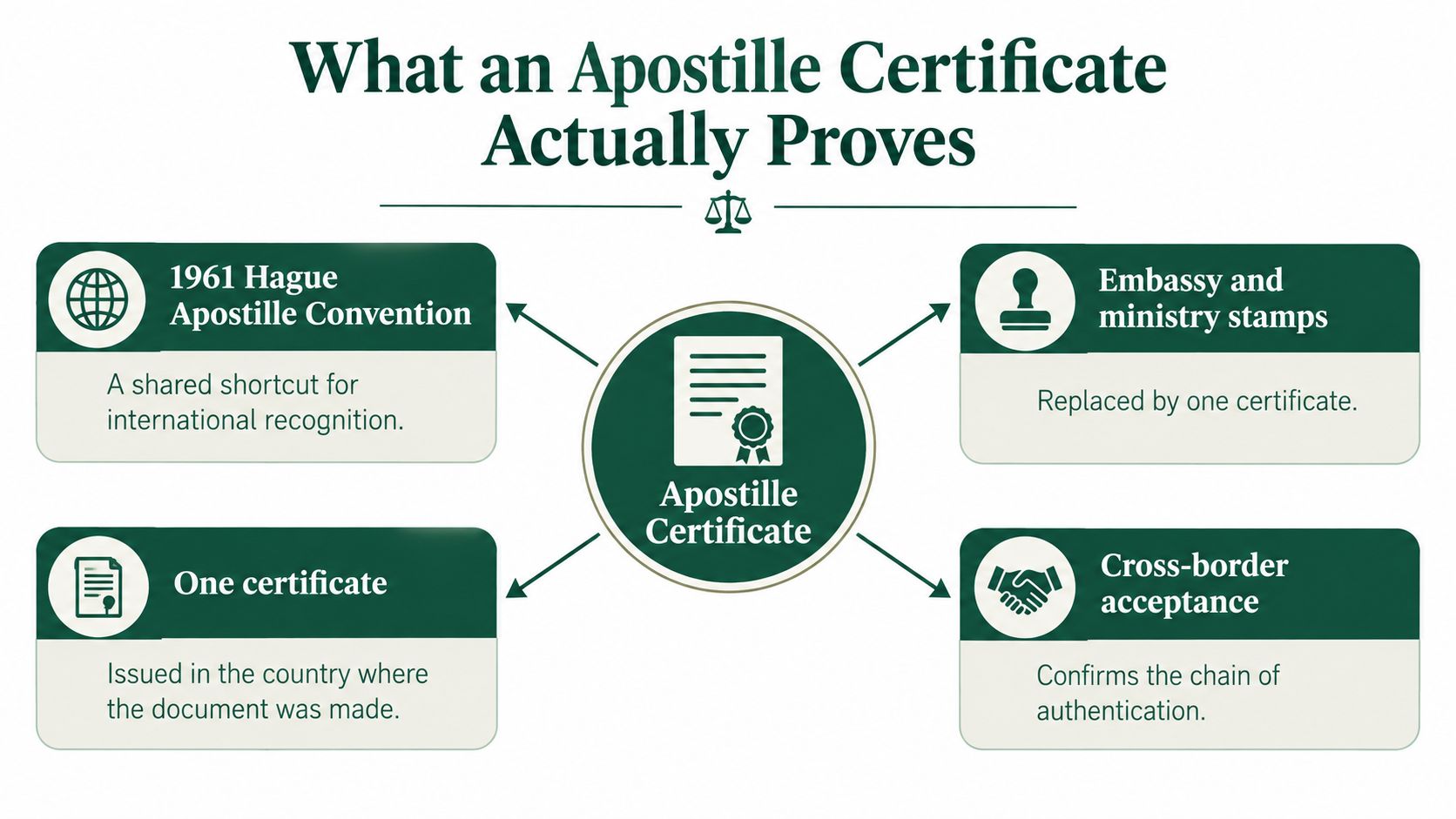
The Hague Apostille Convention of 5 October 1961 replaced a longer diplomatic legalisation chain with one standard certificate issued by a competent authority in the document's country of origin. The certificate confirms three limited points: the signature is authentic, the signer acted in the stated capacity, and any seal or stamp is the one it appears to be.
Documents founders may encounter
Company files can involve incorporation records, powers of attorney, notarized signatures, and extracts from public registers. A parent company extract may need the certificate in one file, while a notarized authorization needs it in another, depending on the receiving office's instructions.
The certificate does not make the contents true, and it does not decide whether the destination will give the document legal effect for a registry filing, EU VAT step, bank review, or Bulgarian company setup. A recipient can still ask for a certified translation, a certified copy, or extra evidence under its own rules.
A system, not a Bulgarian formality
The Convention reaches a large group of jurisdictions, and membership shifts as accessions are deposited and enter into force. That makes the apostille a shared authentication method rather than a Bulgaria-specific formation rule. Inside parts of the EU, some public documents are exempt from the stamp altogether; outside the Convention, consular legalisation may still apply.
The practical question is narrower than “is this document apostilled?” Ask who issued it, which authority can certify it, and what the receiving office will accept after certification. For papers signed online, check the online notary requirements for cross-border company documents before arranging the authorization. The stamp can support an online Bulgarian formation file, but it does not settle separate choices such as whether Bulgaria's 10% corporate tax rate fits the structure.
When Cross-Border Company Files Still Need One
Whether you need an apostille depends on four things: the destination country, the document type, the issuing authority, and the intended use. A certificate requested for a personal residence matter may follow different rules from a corporate authorization sent to a bank. Start with the office that will receive the paper, not with the founder's nationality.
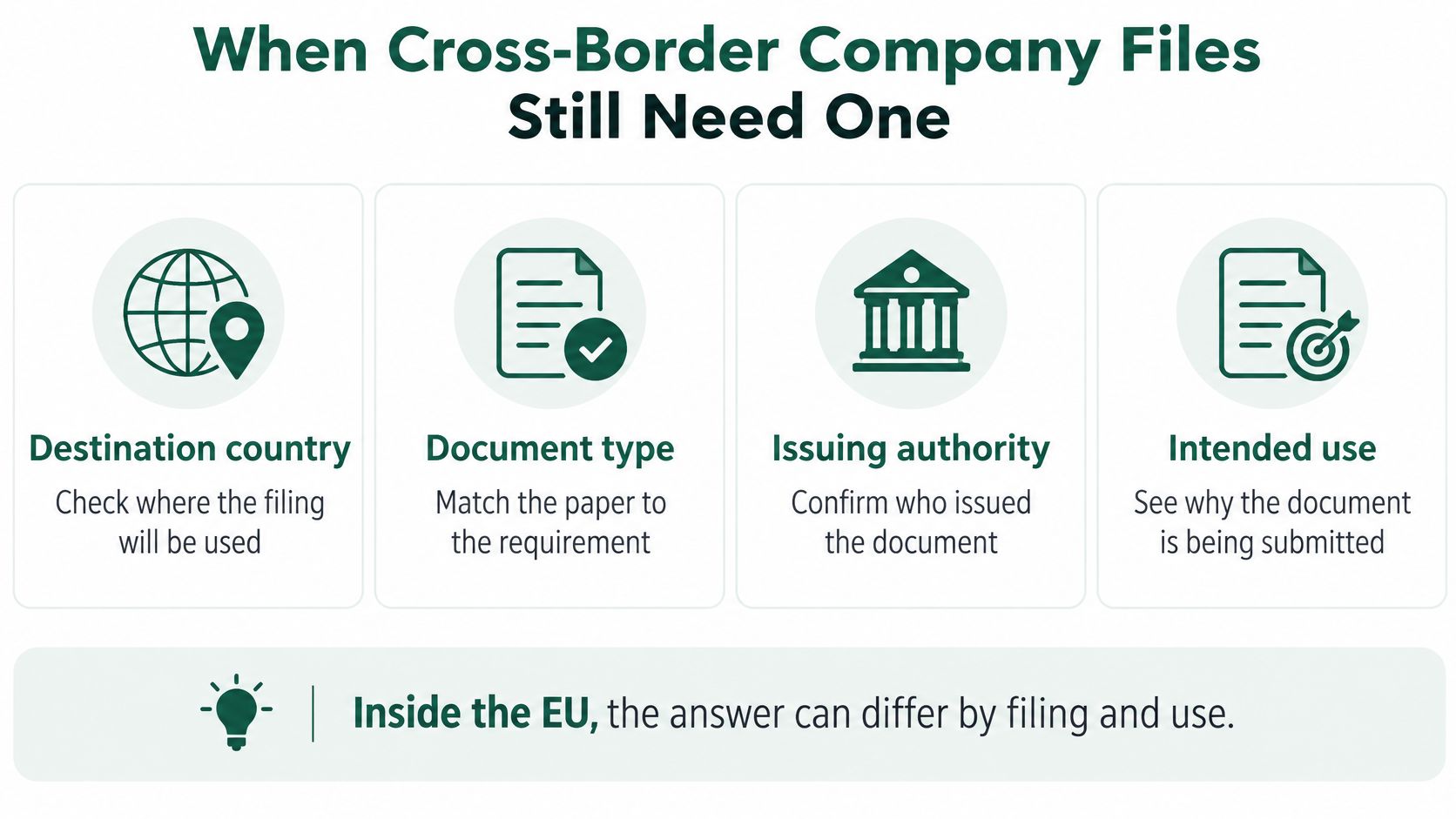
For certain civil-status and residence documents, the EU has removed the apostille requirement between Member States. Regulation (EU) 2016/1191 has applied since 16 February 2019. For documents in its scope, authorities in one Member State generally can't demand an apostille when another Member State issued the document. Covered matters include birth, name, marriage, registered partnership, domicile, and the absence of a criminal record. Multilingual standard forms can also reduce translation work (European Commission guidance on public documents).
Where founders still encounter the requirement
That exemption doesn't cover every cross-border business paper. A foreign parent company authorizing a Bulgarian EOOD or OOD may need to provide a notarized authorization or a registry extract. A bank may request a parent-company document in its onboarding pack, and a non-EU destination may apply different formalities. Documents outside the regulation's subject areas can also remain subject to apostille requirements.
The same civil document may also be treated differently depending on its intended use. The regulation addresses authenticity and administrative formalities, not whether a receiving authority must recognize the document's underlying legal effects. A bank, court, registry, or foreign authority may therefore ask for additional material.
When you're unsure, ask the receiving office to specify the document, format, and purpose it will accept. The apostille workflow follows the country where the document originated and the competent authority there, not the founder's passport or the country where the company will eventually operate.
How to Prepare Documents Before You Apostille
A founder sends a polished scan for a Bulgarian EOOD file, then the packet stalls because the registry signature cannot be traced to a named official. An apostille works like a passport control stamp for a signature: it confirms the officer was real, and it cannot create the missing officer, repair a smudged seal, or make a plain photocopy official. Start with the record the authority issued and the signature behind it (U.S. Department of State apostille requirements).
Run the chain in the right order
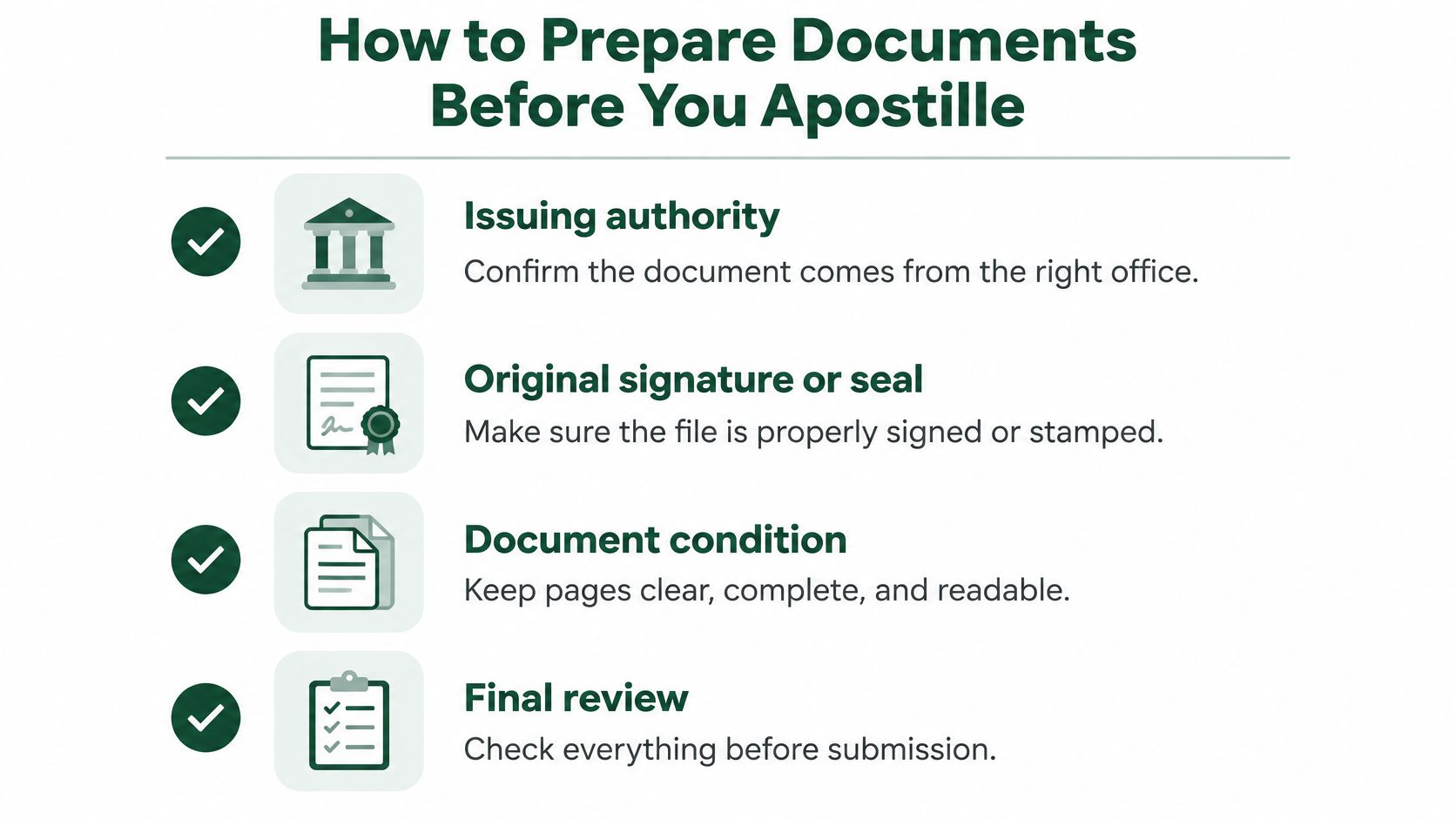
Identify the issuer and the competent authority. A state vital record, a court order, and a federal certificate follow different offices, so the country and level that issued the document decide where the apostille is requested.
Check the signature, seal, and date before paying. If the certifying officer is absent from the authority's register, the stamp will not rescue the file.
Ask what form the recipient accepts. Some files need the wet-ink original, others accept a certified copy, and an EU public document may not need the apostille at all.
Treat translation as a separate lane. The apostille attaches to the public document, while the translation may need its own translator certification or notarization; plan it through this guide to translating legal documents.
Keep digital convenience honest
A crisp PDF can still fail if the electronic apostille came from the wrong authority or the receiving bank wants a paper original. Verify the e-apostille source, keep the validation record with the file, and match the document name to the exact entity used in the Bulgarian setup. When a signature, copy, or language link breaks, repair that link first; the certificate only travels as far as the chain beneath it.
What an Apostille Does Not Guarantee
An apostille doesn't mean approved. The Convention applies to public documents, with that classification determined by the law of the country where the document was executed. The certificate confirms the document's origin, signature or seal, and the signer's authority. It doesn't verify that every statement in the document is true or require a foreign recipient to accept it for a particular transaction (HCCH explanatory material on the Convention).
Consider a foreign certificate of incorporation submitted during Bulgarian company setup. Its apostille may confirm that the issuing official's signature is authentic, yet the bank can still ask for a more recent record, a translation, or a separate authorization named in its own form. The document can pass the authenticity check and still fall short of the recipient's requirements.
That distinction matters for more than banks. A Bulgarian registry, notary, or tax authority may ask for documents that establish a different fact or satisfy a separate procedural rule. An apostille doesn't complete identity checks or beneficial-owner checks, and it doesn't guarantee that a document is sufficient for company onboarding.
Before you order the certificate, ask four things: Is this a public document under the law of its country of origin? Which authority can apostille it? Does the receiving institution accept this document type for this purpose? Are translation, issue-date, or additional authorization requirements still outstanding?
Knowing the gap early makes an online setup easier to coordinate. You can check the receiving office's requirements before commissioning translations or arranging a new notarization, instead of discovering late in the process that the stamped paper answers a different question from the one the institution asked.
Bulgaria Company Setup and Tax Compared
Founders encounter apostilled documents in different ways. A freelancer invoicing EU clients may need personal or business records for a particular registration. An e-commerce or SaaS founder seeking an EU IBAN may be asked for a parent-company extract or a notarized authorization. An agency opening a Sofia presence may need corporate records from abroad, while an EU civil-status document can fall under the EU public-documents exemption described earlier.
The exact document list belongs to the receiving office, but the formation path can be planned around it. FastCorp offers Bulgarian EOOD or OOD incorporation, EU VAT setup, banking assistance, a virtual office, remote notarized signing, and apostilled company documents where required. Its online Bulgarian incorporation service can be considered alongside other providers or direct local support.
Statutory tax rates, side by side
The comparison below concerns statutory corporate income-tax rates, not a company's complete effective tax burden. The Tax Foundation's 2025 dataset reports these rates across 181 jurisdictions (Tax Foundation corporate tax rates for 2025).
| Jurisdiction | Statutory corporate tax rate |
|---|---|
| Bulgaria | 10% |
| Worldwide average | 23.58% |
| United States, combined federal and state | 25.57% |
| France | 36.13% |
| Hungary | 9% |
| United Arab Emirates | 9% |
Bulgaria's 10% statutory rate appears low beside the worldwide average and the listed U.S. and French rates. But that comparison doesn't calculate the full cost of running a company. Dividends, payroll taxes, VAT, social-security contributions, withholding taxes, deductions, transfer-pricing rules, and tax residency can all affect the final position. Get advice based on your company's activity and where its owners and operations are located.
FastCorp lists its online setup at €1,750, completed in 3–5 working days, and its in-person Sofia setup at €1,500, completed in 2–3 working days; both prices include legal and government fees, and the in-person package includes airport pickup. The company states that it has operated since 2018, incorporated 3,000+ companies, and reports 98% client satisfaction. Treat provider timelines and service claims as specific to the package, and confirm what your receiving bank or registry will require before you begin.
Get Apostilled Company Documents Online
Start with the request, not the stamp. Write down the exact office that asked for the document, the country that issued it, and whether the recipient expects a paper original if an electronic apostille is available. If a bank requests a parent-company extract and a director's authorization, confirm whether it wants both documents apostilled and whether it needs translations.
Once those requirements are clear, coordinate the company file and its supporting documents together. FastCorp offers remote identity verification, secure online notary signing, Bulgarian limited-company registration, and preparation of the Certificate of Incorporation. It can also arrange apostilled company documents where the destination requires them, so the company paperwork and the recipient's document request can be checked within the same formation workflow.
Keep the rest of the setup moving
The online option requires no travel and is planned for 3–5 working days; founders who prefer an in-person visit can set up in Sofia in 2–3 working days. After incorporation, ongoing obligations may include bookkeeping, VAT returns, and annual corporate tax filings. Planning those services alongside the formation helps keep the post-registration work on the calendar rather than treating the apostille as the final step.
Before commissioning a translation, send the provider your document list and destination. That gives the team a chance to check which papers need certification, which authority handles them, and whether the company and EU VAT file can proceed together instead of waiting in separate queues.
For Bulgarian company formation, remote signing, VAT setup, and apostilled company documents where required, share your document list and destination with FastCorp. Start online without travelling, and coordinate the company file and its supporting documents in one workflow.