Business Bank Account Online: A Practical 2026 Guide
Open a business bank account online in 2026 with this practical guide. Compare online IBAN providers and Bulgarian banks, timelines, and tax tips.
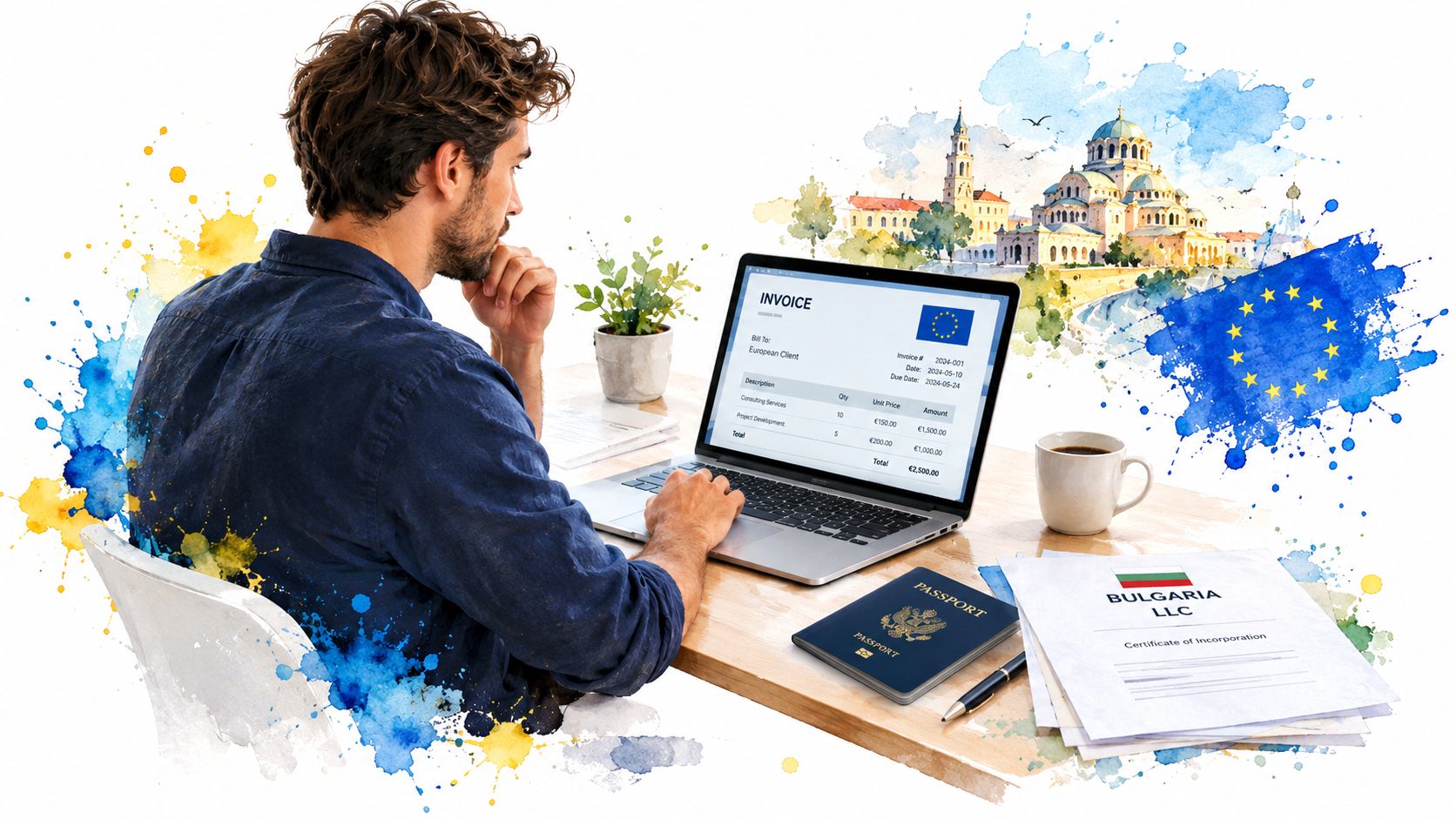
You've just incorporated a Bulgarian EOOD, your first European client wants an invoice this week, and the client's finance team is asking for company payment details. You're working from a kitchen table, with a passport beside your laptop and a business certificate still warm from the registration process. The company exists, but it can't trade properly until money has somewhere legitimate to land.
A business bank account online can solve that gap without a branch visit. The catch is that online doesn't automatically mean instant, universally accepted, or risk-free. The right account depends on your customers, currencies, payment rails, ownership structure, and ability to explain exactly how the company will operate.
Table of Contents
- Why Founders Are Racing to Open a Business Bank Account Online
- What an Online Business Bank Account Actually Is
- Online IBAN Providers Versus Bulgarian Banks
- How Online Onboarding Works in 2026
- Tax Comparison That Changes the Math
- The Hidden Frictions Nobody Talks About
- How FastCorp Supports Banking Onboarding for Bulgarian Companies
- A Practical Checklist Before You Click Apply
Why Founders Are Racing to Open a Business Bank Account Online
The founder in Berlin doesn't care that your company was formed efficiently. They need a professional invoice, a reliable way to pay you, and an account that their own finance system accepts. A personal account creates the wrong impression and can blur the line between company money and personal money from the first transaction.
That pressure reflects a much broader commercial shift. The World Bank's Global Findex 2025 reported that 61% of adults in low- and middle-income economies made or received a digital payment during 2024, up 27 percentage points from 2014, while 42% used digital merchant payments. The data measures individuals rather than companies, but it shows the environment in which companies now sell, collect, subscribe, refund, and pay suppliers.
The launch problem is operational
A remote SaaS founder may bill customers in euros, pay contractors in several countries, and connect invoices to accounting software without ever visiting Bulgaria. An agency may need to pay advertising platforms and freelancers from the same controlled company account. An e-commerce operator needs a payment flow that can separate customer receipts from personal spending and preserve a clean audit trail.
The account becomes launch-critical because it supports the basic operating loop:
- Receive revenue: Give clients company payment details that match the legal entity.
- Pay suppliers: Send contractor, software, advertising, and service payments from the business.
- Control access: Keep personal finances separate and assign permissions to bookkeepers or staff.
- Reconcile activity: Match invoices, expenses, refunds, and transfers against bank records.
Practical rule: Incorporation creates the legal vehicle. A properly selected account gives that vehicle an operating system.
FastCorp's 3 to 5 working day formation pipeline is useful only if banking preparation runs alongside incorporation. Founders should assemble the company documents, ownership information, operating address, and business explanation before the account application starts. That prevents a newly formed company from sitting idle while its owner waits for a second round of compliance questions.
What an Online Business Bank Account Actually Is
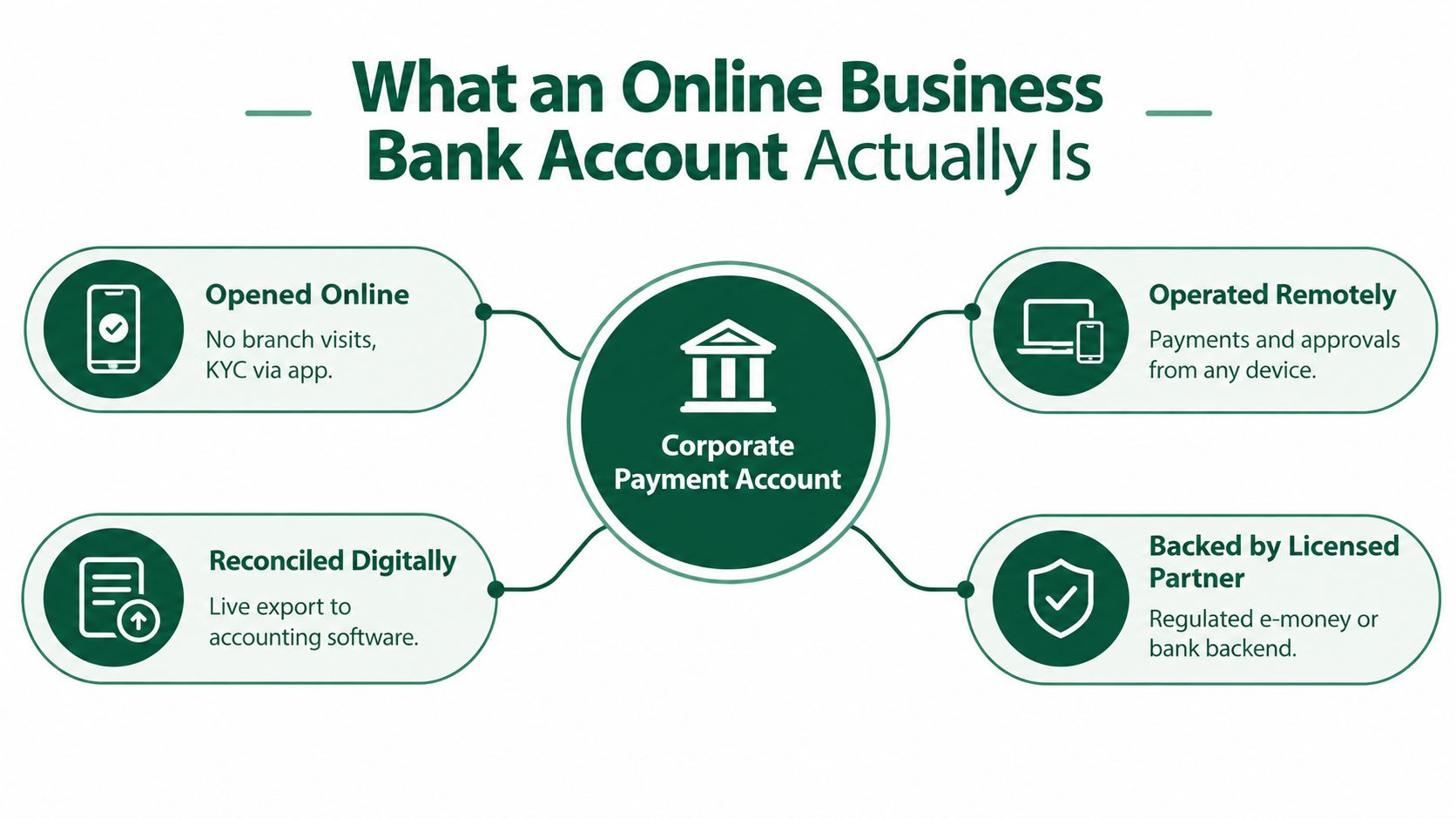
An online business bank account is a corporate payment account opened and operated remotely. You apply through a website or app, upload company and identity documents, complete remote verification, approve payments digitally, and export transaction records for bookkeeping.
Think of it as a digital storefront for money. It accepts customer payments, pays suppliers, holds operating funds, and sends transaction data to the accounting process. The account isn't just a dashboard with a balance. It's a regulated payment relationship connected to transfer, clearing, identity, and fraud-control systems.
The legal wrapper matters
Some providers are licensed banks. Others are electronic-money institutions or payment institutions. Both can provide useful business accounts, but they may differ in how funds are safeguarded, which services are available, how cash is handled, and how counterparties perceive the account.
Ask the provider precise questions before applying:
- Is this a bank account, a payment account, or an e-money account?
- Which legal entity holds customer funds?
- Is the IBAN issued directly by that institution or provided through a partner?
- Does the account support SEPA transfers, incoming payments, direct debits, cards, and accounting exports?
- Are there restrictions on countries, currencies, industries, or transaction volumes?
- Can the provider add multiple users, approval rules, and beneficiary controls?
An IBAN identifies the account for international payments. SEPA provides the framework for euro payments across participating European countries. An EU IBAN can make cross-border invoicing easier, but it isn't a guarantee that every platform, landlord, payroll system, or authority will accept the account without questions.
A freelancer wallet also isn't automatically suitable for an EOOD or OOD. If the legal owner, available payment functions, user permissions, and reporting tools don't match the company's needs, the cheap option becomes an operational limitation.
The rails underneath this experience have been developing for decades. The Bank for International Settlements' payment statistics have been collected since 1988, with cashless-payment volumes rising 11% in advanced economies and 34% in emerging-market and developing economies in 2021. That history explains why remote transfers, electronic identification, reconciliation, and real-time payment controls now feel normal rather than experimental.
Online IBAN Providers Versus Bulgarian Banks
For a Bulgarian EOOD or OOD, there are two sensible routes. An online IBAN provider usually prioritises remote onboarding, multi-currency operations, and fast digital administration. A Bulgarian bank usually offers stronger local familiarity, branch access, and better support for cash or domestic relationships.
Neither route wins for every founder.
| Dimension | Online IBAN providers | Bulgarian banks |
|---|---|---|
| Setup speed | Usually designed for remote application and digital document review | May involve branch steps, local appointments, or extended manual review |
| Fees | Often structured around digital transfers, cards, currencies, and account usage | May include account maintenance, domestic services, branch operations, and transaction charges |
| Multi-currency support | Commonly suited to international SaaS, e-commerce, and remote teams | Available options vary by bank and account package |
| Local credibility | An EU IBAN may work well, but some counterparties may prefer a domestic institution | Stronger recognition among Bulgarian suppliers, authorities, landlords, and local partners |
| Cash handling | Usually limited or unavailable | More practical where the business receives or deposits cash |
| Best fit | Non-resident founders, consultants, agencies, SaaS, and cross-border operators | Cash-based companies, local payroll, domestic suppliers, and founders needing branch support |
The important trade-off is speed versus acceptance. An online provider may suit a consultant invoicing clients in Germany and paying remote contractors. A Bulgarian bank may be the better anchor for a company renting premises in Sofia, handling local payroll, or depositing physical cash.
Read FastCorp's guide to banking in Bulgaria before choosing based only on a price page. The account has to work with the people and platforms that will pay you.
Choose for the first six months
Pick an online provider when your first revenue is cross-border, your activity is cashless, and you need remote access from outside Bulgaria. Pick a Bulgarian bank when local counterparties, cash deposits, domestic credibility, or branch assistance are central to the business.
Some founders should use both, but don't open multiple accounts without a purpose. Define the role of each rail, document transfers between them, and reconcile both accounts as company accounts. The right rule is simple: choose the account that matches your payment flows, not the one with the shortest application form.
How Online Onboarding Works in 2026
A digital application can still trigger a detailed compliance review. The provider must verify the company, directors, and beneficial owners, understand the proposed activity, and decide whether the payment profile fits its risk policy. An EU IBAN does not guarantee approval or acceptance by every counterparty. Risk-based rejection and extra verification remain practical possibilities.
FastCorp supports Bulgarian company formation fully online in 3 to 5 working days, with 3,000+ companies incorporated since 2026 according to the supplied company information. That timeline prepares the legal entity. It does not replace the provider's separate account approval process, so coordinate formation with banking preparation rather than promising clients an immediate active account.
Prepare one controlled data set
Create one folder and keep every answer consistent:
- Company evidence: Certificate of Incorporation, constitutional documents, register extracts, and registered address evidence.
- Ownership evidence: Ownership chart, shareholder details, beneficial-owner information, and director identification.
- Business explanation: What the company sells, who buys it, where customers and suppliers are located, and how money enters and leaves the account.
- Activity forecast: Expected transaction types, currencies, countries served, and approximate operating pattern.
- Source-of-funds evidence: Contracts, invoices, investment records, or other documents explaining initial funding when requested.
Use FastCorp's identity verification solutions guide to organise identity documents and verification steps before submitting the application. The BIS FATF-aligned compliance material reinforces the practical rule: remote account opening still requires reliable identification of customers and beneficial owners. A clean interface does not remove the documentation requirement.
Check every name, address, ownership detail, and transliteration before uploading. Mismatches, unexplained ownership changes, vague payment descriptions, or deposits that do not fit the stated business model can send the file to manual review.
A realistic timing model
| Stage | Best case | Typical reality |
|---|---|---|
| Company formation | Fast online submission with complete documents | Additional corrections may be needed |
| Account application | Immediate digital submission | Provider requests clarification or extra evidence |
| Verification | Automated identity and liveness checks | Manual review for ownership, country, sector, or activity |
| Approval | Quick decision after a clean file | Timing depends on the provider's risk queue |
| Activation | Digital access and payment details issued | Limits or feature restrictions may apply initially |
A 2025 Federation of Small Businesses report found that opening a business account took an average of 31 days, and 6% of businesses had a business account closed or withdrawn without requesting it. Build contingency time into contracts, payroll, and supplier payments. An application can be submitted today and still require manual review before the account becomes usable.
Tax Comparison That Changes the Math
Bulgaria's headline corporate tax is a major reason international founders examine a Bulgarian company. In 2025, Bulgaria's corporate rate was 10%, compared with an EU average combined corporate tax rate of approximately 21.9%, while Cyprus and Ireland were each at 12.5% and Hungary at 9%, according to the Tax Foundation's European corporate tax comparison.
The figure applies to taxable corporate profit, not every euro that passes through the account. That distinction changes how you should operate. Revenue needs invoices, expenses need evidence, and transfers to the owner need the correct legal and accounting treatment.
The dividend layer is where founders miscalculate
The same comparison shows that Bulgaria's 10% corporate tax combined with a 5% top personal dividend rate produces an integrated rate of about 14.5%. Romania's corresponding integrated rate was 24.4%. The comparison is useful, but it isn't a promise that every non-resident owner will face only the Bulgarian headline result.
Tax residence, permanent-establishment exposure, payroll, VAT, withholding obligations, treaties, social-security rules, and the location where the company is managed can all affect the final position. Large multinational groups also need to assess OECD Pillar Two rules, which can bring the effective rate to 15% for groups meeting the €750 million annual-revenue threshold.
Your online account supports the tax position only when the bookkeeping behind it is disciplined:
- Reconcile monthly: Match every bank entry to an invoice, expense, contract, payroll item, tax payment, or documented transfer.
- Separate categories: Don't label salary, dividend, shareholder loan, and expense reimbursement as interchangeable withdrawals.
- Keep evidence: Store invoices, receipts, contracts, and explanations for unusual payments.
- Review owner payments: Ask an accountant before transferring profit personally.
- Protect the company boundary: Don't use the corporate account as a personal wallet.
The low rate is an opportunity, not a substitute for records. A clean business bank account makes those records easier to produce, but it can't repair transactions that were never classified correctly.
The Hidden Frictions Nobody Talks About
The most dangerous assumption is that an EU IBAN works everywhere because it's legally valid. The European Commission says businesses and public administrations sometimes refuse payments to or from accounts in another EU member state despite the SEPA rules. The European Commission's SME project on IBAN discrimination also records that complaints to the Accept my IBAN platform fell by about half in 2024 compared with 2023, while the European Court of Auditors reported in 2025 that discrimination based on payment-account location persists.
A customer's platform may reject a non-domestic IBAN. A landlord may insist on a local account. A payroll provider may not support the account's direct-debit setup. An authority may ask for a Bulgarian account even when the account details satisfy the relevant payment framework.
The other friction is rejection. The Federation of Small Businesses report found that 19% of businesses had been refused a financial product or service, according to the same 2025 report. Risk-based decisions can reflect beneficial ownership, residence, sector, expected volumes, source of funds, sanctions exposure, and limited trading history. A lawful business can still fall outside a provider's appetite.
Build a contingency playbook
- Maintain a second rail: Keep a compliant backup account or payment route for essential receipts and supplier payments.
- Save the file: Preserve incorporation documents, tax records, ownership charts, contracts, and approval messages.
- Describe activity accurately: Don't inflate projected volume to appear established or understate a regulated activity to pass a form.
- Check acceptance early: Ask major customers, marketplaces, payroll providers, and landlords whether they accept the proposed account.
- Map escalation: Save the provider's complaint procedure, review contact, and account-closure instructions.
- Keep cash moving carefully: Don't make unusual transfers during onboarding unless you can explain their source and purpose.
“Online” describes the channel. It doesn't guarantee acceptance, speed, continuity, or a positive risk decision.
Treat the account as one part of the payment stack. That mindset prevents one rejection, restriction, or counterparty refusal from stopping the company's first month of trading.
How FastCorp Supports Banking Onboarding for Bulgarian Companies
FastCorp's banking assistance sits between company formation and the provider's independent decision. The practical value is document consistency. The legal company name, ownership percentages, director details, registered address, tax identifiers, and business activity should tell the same story in incorporation, VAT, and banking submissions.
FastCorp can support applications with online providers or Bulgarian banks, while the final account decision remains with the chosen institution. The fully online company setup takes 3 to 5 working days, and the in-person Sofia option takes 2 to 3 working days, based on the supplied service information. Both routes can feed into the same banking preparation process.
Send the right material at the start
Prepare:
- Certificate of Incorporation and constitutional documents
- Ownership chart and beneficial-owner details
- Passport or identity documents for directors and owners
- Proof of registered and operating address
- One-page description of the business model
- Expected customers, suppliers, countries, currencies, and payment types
- Contracts, invoices, or funding evidence where relevant
A concise business-model brief beats a vague phrase such as “consulting” or “online services.” Explain what you deliver, who pays, how you acquire customers, why the company is based in Bulgaria, and what transactions the provider should expect.
Security controls matter after approval. EBA payment-fraud data reported that Strong Customer Authentication covered approximately 77% of electronic-payment value, and SCA-authenticated transactions generally showed lower fraud rates than non-SCA transactions.
Select controls, not just convenience
Choose an account that supports:
- Device binding or an authenticator application
- Transaction-level step-up authentication
- Beneficiary verification
- Named users with limited permissions
- Dual approval for unusual or high-value transfers
- Alerts and downloadable records
SCA reduces credential-theft risk, but it doesn't stop a fraudster from persuading an authorised user to approve the wrong payment. Independently verify new supplier bank details, restrict administrator access, and require a second approver when the payment pattern changes.
Read FastCorp's guide to online company incorporation and start the banking file with one controlled set of information rather than separate versions prepared for different forms.
A Practical Checklist Before You Click Apply
Copy this list into your project tool and tick it off before submitting an application:
- Confirm the entity: Verify that the EOOD or OOD name, registration details, ownership, and director information are final.
- Define the tax position: Know where the company is managed, how profits may be distributed, and which VAT, payroll, withholding, or personal-residence questions need advice.
- Choose by counterparties: Ask clients, platforms, landlords, payroll providers, and suppliers whether they accept the proposed IBAN and payment features.
- Identify the institution: Confirm whether you're applying to a bank, payment institution, or electronic-money institution, and identify the legal entity holding funds.
- Prepare one data set: Use identical spellings, addresses, ownership percentages, tax identifiers, and activity descriptions everywhere.
- Explain the money flow: State who pays you, whom you pay, which countries are involved, which currencies you use, and where initial funds come from.
- Expect review: Online forms still lead to KYC, beneficial-owner, source-of-funds, and transaction-monitoring checks.
- Check controls: Require strong authentication, beneficiary verification, user permissions, and dual approval for unusual payments.
- Keep a backup rail: Don't let one account become the only route for customer receipts or urgent supplier payments.
- Reconcile monthly: Match statements to invoices and expenses, classify owner withdrawals correctly, and retain supporting records.
The best business bank account online is the one that fits your company's real activity and survives contact with customers, suppliers, tax records, and compliance reviews. Fast onboarding helps, but predictable acceptance and clean control matter more once money starts moving.
FastCorp helps global founders form Bulgarian EOODs and OODs, prepare consistent incorporation, VAT, and banking documents, and pursue an EU IBAN through online providers or Bulgarian banks. Visit FastCorp to start a fully online setup and coordinate the banking preparation before your first invoice is due.