EU Business Bank Account: The Complete Setup Guide
Learn how to open an EU business bank account remotely. Compare traditional banks and FinTechs, avoid rejections, and leverage Bulgaria's 10% tax rate.
Registering an EU company doesn't automatically give you a usable EU business bank account. That popular promise confuses company formation with financial onboarding, and non-resident founders discover the difference only after a bank requests local substance, ownership evidence, source-of-funds records, and an explanation of every expected transaction.
The practical route is more disciplined. Choose the entity and provider together, prepare the compliance file before applying, and decide whether you need a regulated bank relationship or reliable euro payments through an EU IBAN. For many international SMEs, a Bulgarian company paired with the right provider offers a strong balance of tax efficiency, operational access, and manageable onboarding.
Table of Contents
- Understanding the EU Business Bank Account Landscape
- Traditional Banks Versus Digital FinTech Providers
- Essential Documents and How to Avoid Rejection
- The Bulgarian Advantage for EU Company Formation
- Navigating the Remote and In-Person Onboarding Process
- Streamlining Setup with FastCorp End-to-End Services
Understanding the EU Business Bank Account Landscape
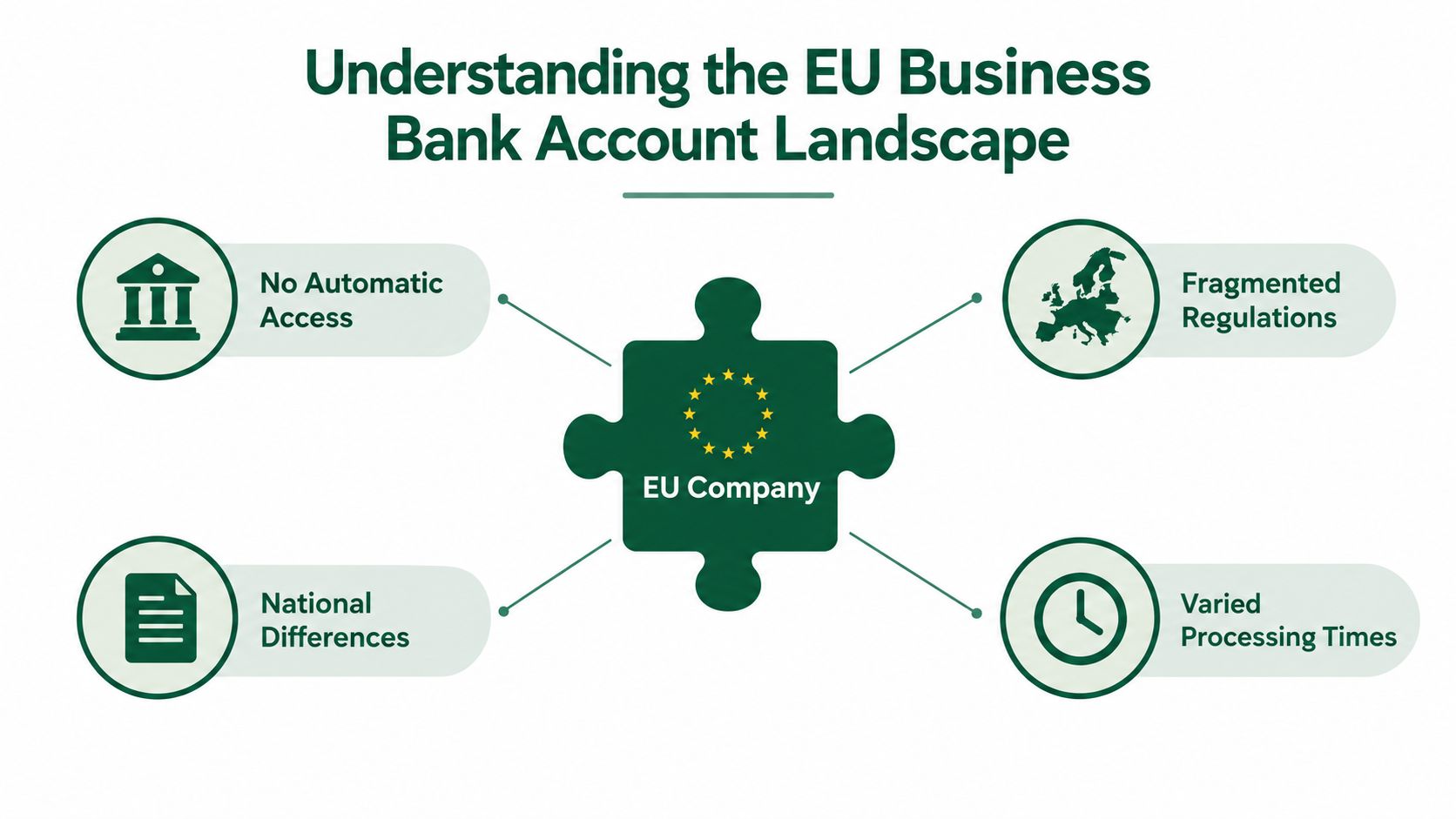
An EU company gives you a legal structure. It doesn't guarantee approval from a bank, an Electronic Money Institution, or a fintech provider. Those institutions assess the owners, business model, expected transaction flows, countries involved, source of funds, and connection to the jurisdiction before they activate an account.
SEPA makes euro payments operationally easier once an account is available. The framework covers all 27 EU member states plus 14 additional European countries and territories, allowing businesses to send and receive euro transfers under common basic rules. Accounts are identified through the IBAN, and customers haven't had to provide a BIC for qualifying transfers and direct debits within the area since 1 February 2016, as explained by the Bank of Greece overview of SEPA.
That creates a valuable foundation for cross-border invoicing, supplier payments, and payroll. It doesn't remove the provider's right to perform AML and KYC checks, and it doesn't force a bank to accept an applicant whose profile it considers unsuitable.
Why cross-border access remains difficult
The European banking market is still fragmented. The European Commission's 2026 banking-sector competitiveness consultation notes that cross-border banking activity in the euro area hasn't grown over the last decade and that consolidation has made limited progress. ECB research cited in the same policy area found that the cross-border share of lending rose only from 5% to 14% in a European banking-union context.
The result is a mismatch between legal payment rights and commercial reality. EU rules prohibit IBAN discrimination for euro payments, yet businesses operating in another member state have sometimes been pressured to open a domestic account. A business may legally be able to receive a euro transfer into an account from another member state, while a payer, platform, or bank employee still creates friction because the IBAN isn't local.
Practical rule: Treat an EU IBAN as an operating tool, not proof that you've secured a complete banking relationship.
Founders should therefore separate three needs:
- Payment access: An IBAN for receiving invoices and sending euro transfers.
- Banking depth: Credit facilities, overdrafts, cash management, card controls, and relationship support.
- Jurisdictional credibility: A company, address, directors, and transaction profile that make sense together.
A Bulgarian entity with a Sofia business address can make the third area easier than applying as a free-floating non-resident company. Before incorporation, review the practical differences in banking in Bulgaria for companies, then select a provider that accepts your ownership profile and target markets.
Traditional Banks Versus Digital FinTech Providers
The right provider depends on what you need the account to do. Traditional banks are usually the stronger choice for lending, branch support, cash deposits, and long-term relationship banking. Digital EMIs and fintech providers are often more practical for remote founders who need an EU IBAN, cards, international transfers, and faster digital administration.
Non-resident applicants shouldn't apply randomly. A traditional bank may expect a local company, local address, face-to-face verification, and a clear commercial connection to its country. A specialized EMI may accept remote onboarding, but it still has to understand the business and verify the people behind it.
One industry guide reports that traditional EU banks can reject non-EU applicants at rates ranging from 7% to 36%, while specialized EMIs approve approximately 70% to 90% when documentation is complete. Those figures come from the comparison of European business account providers and onboarding outcomes. They aren't a promise of approval. They show why provider selection matters.
| Feature | Traditional EU Banks | Digital EMIs / FinTechs |
|---|---|---|
| Best fit | Companies needing lending, cash management, or a long-term local relationship | Remote founders needing payments, cards, and an EU IBAN |
| Onboarding | More formal, often involving interviews or physical verification | Usually digital, with identity and document checks completed online |
| Local connection | Often expects a domestic company, address, or meaningful local activity | May accept cross-border structures if the business rationale is clear |
| Credit facilities | More likely to offer lending after assessment | Usually focused on payments rather than traditional credit |
| Transaction controls | Relationship manager and bank-specific review | Automated monitoring, app-based controls, and compliance requests |
| Non-resident suitability | Can be restrictive for owners without local presence | Often more flexible, but approval still depends on risk and documents |
| Operational risk | Slower onboarding can delay trading | Account reviews or restrictions can disrupt operations if records are weak |
Match the provider to your operating model
Choose a traditional bank when your business will hold substantial balances, seek finance, employ local staff, handle cash, or need a relationship manager who understands the local market. Expect more questions and plan for possible in-person attendance.
Choose a digital EMI when your immediate need is receiving invoices, paying suppliers, issuing cards, and moving euro funds across borders. Keep a second payment route where practical, and don't rely on an account until the provider confirms that your actual countries, currencies, and transaction types are supported.
The phrase “open a European business bank account online” also hides an important distinction. Traditional European banks typically want a business registered in their operating country and a local residential address, while fintech and EMI providers may onboard remotely, as explained in guidance on European business accounts for non-residents.
An EU IBAN may be all a consultant or SaaS company needs at the start. An exporter with financing needs requires more. Decide that before you submit documents, not after a provider rejects the application.
Essential Documents and How to Avoid Rejection
Incomplete documentation is the most avoidable reason a foreign-company application fails. An EU legal source citing a European Banking Authority-linked estimate reports that up to 36% of foreign-company applications are rejected because documentation is incomplete or inadequate. The business account documentation guide identifies outdated extracts, missing translations or apostilles, unclear ownership chains, weak source-of-funds evidence, and an unclear business model as common failure points.
Compliance officers aren't asking for paperwork merely to slow you down. They need to identify the legal entity, verify the ultimate beneficial owner, understand the commercial purpose of the account, and establish that incoming funds can be explained.
Build the file before submitting the form
Prepare a single, consistent document pack. Every name, address, ownership percentage, and company activity description should match across the records.
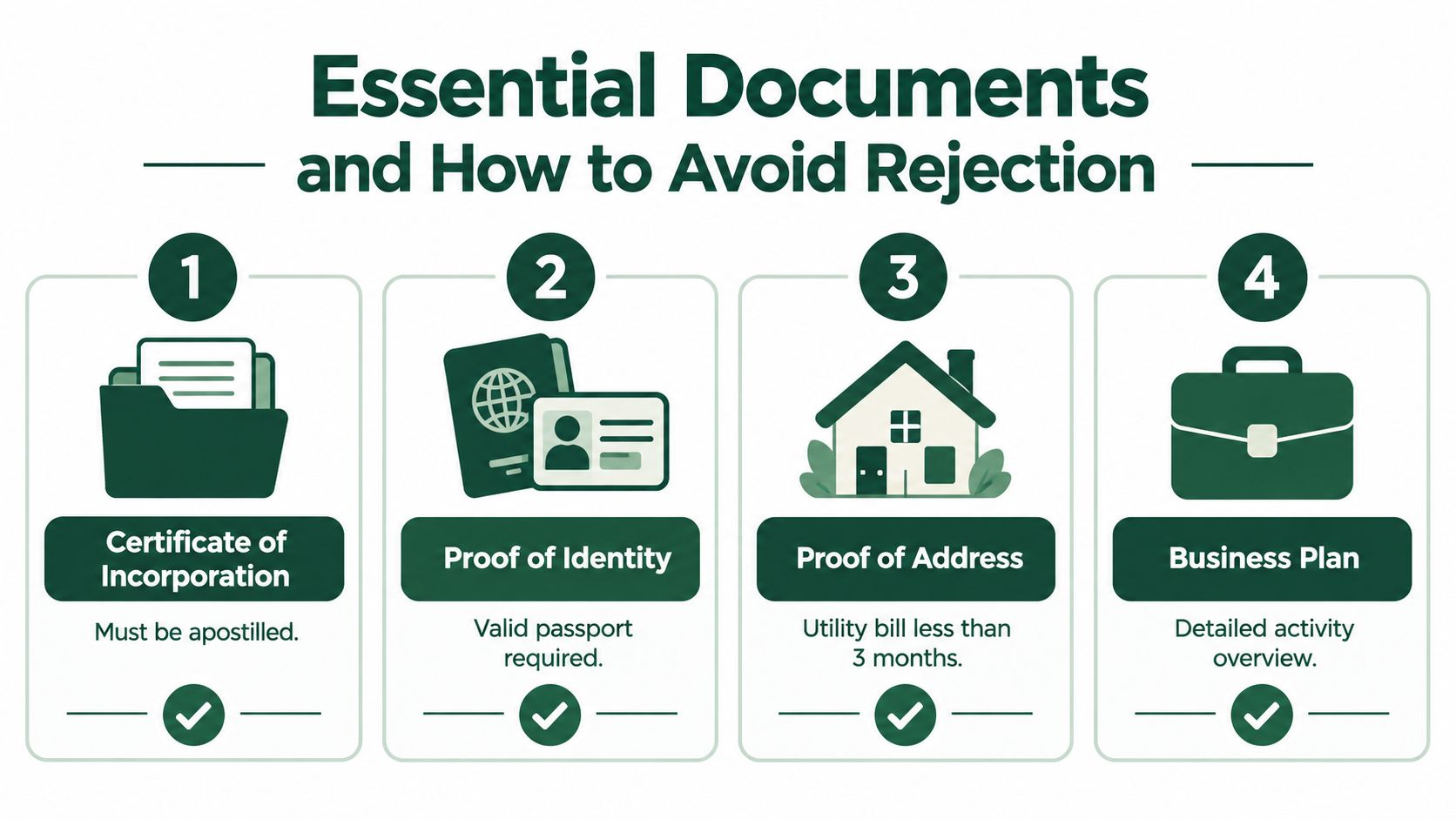
- Corporate identity: Certificate of Incorporation, current company extract, articles of association, registration number, tax identification, and registered address.
- Ownership evidence: A complete UBO declaration, ownership chart where relevant, director details, and identification for every person the provider must verify.
- Personal verification: Valid passport or national identity document, residential proof of address, and any requested evidence of professional or business background.
- Financial origin: Bank statements, sale agreements, investment records, employment income evidence, or other documents that explain the source of funds and source of wealth.
- Commercial rationale: A short description of customers, suppliers, countries served, pricing model, expected payment flows, and the reason the company needs an EU account.
Apostilles and translations matter when the provider or jurisdiction requires them. Don't assume that a scanned registry extract is sufficient just because it looks official. Use a documented process for apostilling company documents, and check whether the provider wants certified translation, a recent extract, or both.
Write the activity narrative like an examiner
Avoid vague wording such as “international trading” or “consulting services.” State what you sell, who buys it, how customers pay, which countries are involved, and why the company is based in the chosen jurisdiction. If the company is pre-revenue, say so and explain the launch plan rather than implying a trading history that doesn't exist.
The activity narrative should also match your website, contracts, invoices, and tax registrations. A mismatch between a software company's website and an application describing import and export activity will trigger questions. Answer those questions before submission by supplying contracts, draft invoices, partner details, or a clear explanation of the company's stage.
Submit one coherent file, respond quickly to follow-up requests, and never send contradictory explanations to different providers. Good preparation doesn't guarantee approval, but it removes the administrative reasons that cause avoidable rejection.
The Bulgarian Advantage for EU Company Formation
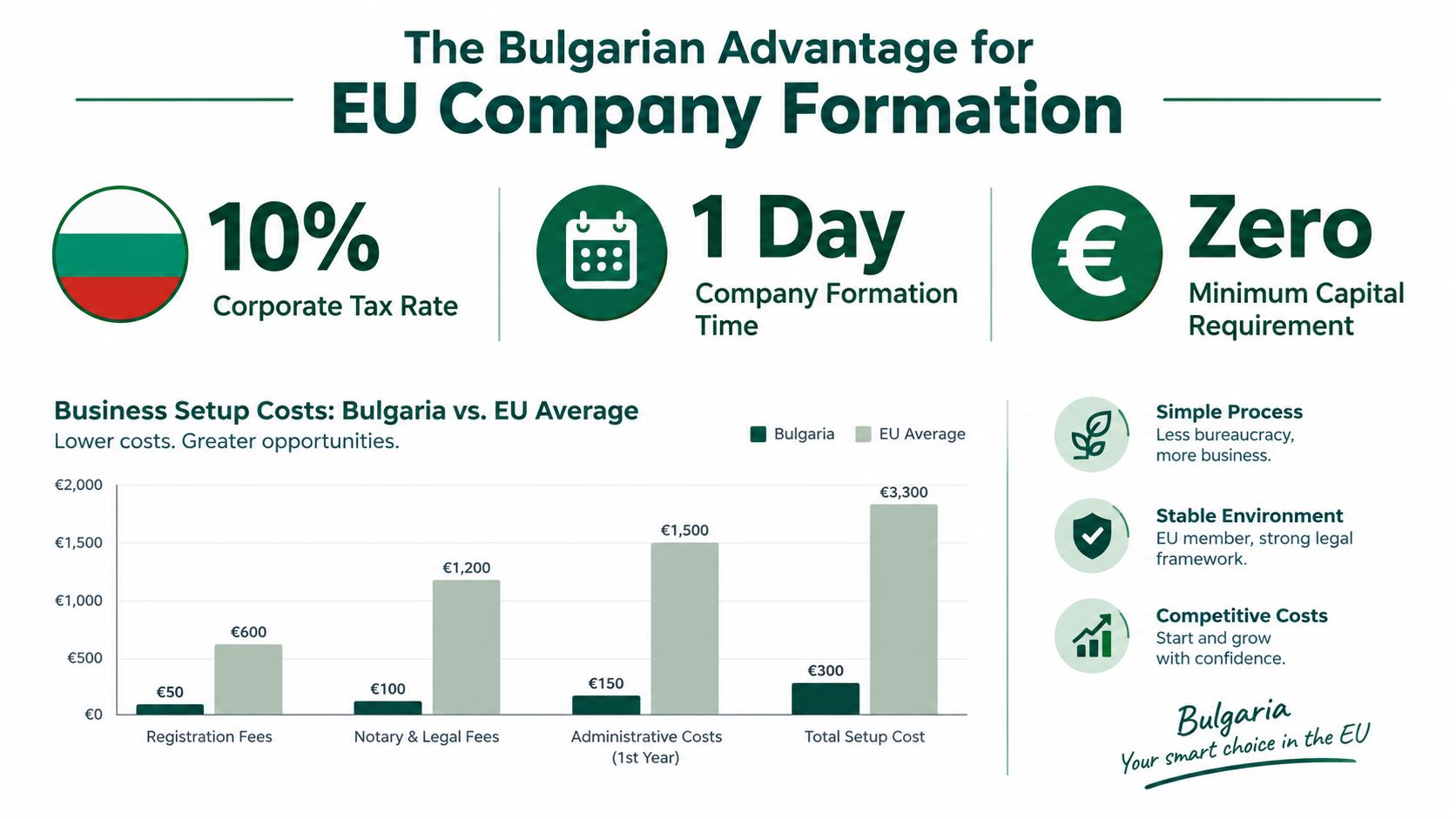
Bulgaria is compelling when the objective is an EU-compliant company, a defensible local structure, and a low headline corporate tax rate. Its statutory corporate income tax rate is 10%, and the Tax Foundation's 2026 comparison of European corporate tax rates ranks Bulgaria among Europe's lowest-tax jurisdictions, behind only Hungary at 9%. Ireland and Cyprus, both often marketed to international founders, apply a 12.5% corporate tax rate.
That difference matters most for profitable SMEs that can legitimately operate through Bulgaria and maintain proper accounting, VAT, substance, and reporting. Tax residence and taxable profit aren't determined by opening an account alone. The company needs a real commercial explanation, accurate books, and management that respects Bulgarian compliance obligations.
The tax calendar and its limits
Bulgaria's flat rate is simple, but simplicity isn't the same as exemption from administration. PwC's Bulgaria tax summary states that annual corporate tax returns are generally due between 1 March and 30 June of the following year, with final payment due by 30 June.
Founders should budget for bookkeeping, VAT analysis, payroll where applicable, annual accounts, and evidence supporting business expenses. A low rate won't protect a company that files late, misclassifies transactions, or treats the company account as a personal wallet.
Large groups need a separate analysis. Bulgaria has implemented the OECD Pillar Two framework, and a 15% global minimum tax can apply to groups with annual revenues above €750 million through a Qualified Domestic Minimum Top-up Tax, according to the overview of Bulgaria's corporate tax position and Pillar Two. The headline 10% rate therefore shouldn't be presented as the effective rate for very large multinational groups.
Why the local entity helps with banking
A Bulgarian EOOD or OOD gives the account application a domestic legal anchor. The company can have a Bulgarian registered address, local corporate records, Bulgarian tax documentation, and a business purpose connected to the country. That doesn't force a bank to approve the account, but it addresses one of the weaknesses found in applications from applicants with no local footprint.
Use Bulgaria because the structure fits the business, not because the tax rate looks attractive. A founder who invoices European clients, runs a digital service company, and can document the commercial reason for a Bulgarian entity has a much stronger application than someone seeking an account with no explainable activity.
Navigating the Remote and In-Person Onboarding Process
Remote onboarding is convenient, but it isn't frictionless. A digital provider may request a passport video check, proof of address, corporate records, UBO information, a source-of-funds explanation, and evidence supporting the projected transaction activity. A traditional bank may add a compliance interview, original or certified documents, and physical attendance by the UBO.

A non-resident owner of a Bulgarian limited company should assume that at least one provider will ask difficult questions about personal residence, management location, customers, expected transfers, and wealth accumulation. Independent banking guidance reports that non-resident-owned Bulgarian companies commonly face a requirement for in-person UBO presence, alongside KYC, source-of-funds, and source-of-wealth evidence, as described in guidance on choosing an EU company jurisdiction.
A practical onboarding sequence
Start by confirming eligibility. Ask the provider whether it accepts your nationality, company type, directors, customer countries, payment currencies, and industry. This single check prevents wasted applications to institutions that are structurally unsuitable.
Next, submit the corporate and personal file in one consistent package. Keep the company extract current, use the same spelling of names everywhere, and include a concise activity narrative. If the provider asks for a video call, the UBO should be ready to explain the business without reading a generic script.
For a traditional Bulgarian bank, plan for a possible trip to Sofia and bring original or properly certified documents. For a digital EMI, plan for live identity verification and follow-up requests through the provider's secure portal. Remote formation doesn't mean remote banking is guaranteed.
Prepare for the interview: Explain your first customers, your expected incoming payments, your largest suppliers, and the reason you selected Bulgaria in plain language.
Don't start trading heavily before the account is fully active and the provider confirms the permitted use. A provisional approval, pending verification, or partially enabled wallet isn't a substitute for a functioning operating account. If identity checks are a recurring obstacle, evaluate structured identity verification solutions for business onboarding before submitting applications.
Streamlining Setup with FastCorp End-to-End Services
Formation, VAT registration, banking, and accounting are connected compliance tasks. If different providers prepare inconsistent documents, use different addresses, or describe the business differently, the account application becomes harder to defend. A coordinated workflow keeps the company extract, UBO records, VAT profile, website description, invoices, and banking narrative aligned.
FastCorp handles Bulgarian EOOD and OOD incorporation, EU VAT registration setup, virtual office and registered address support in Sofia, corporate document preparation, apostilles where required, banking assistance with online providers or Bulgarian banks, and ongoing bookkeeping. Its support can also cover VAT returns, annual corporate tax filings, payroll administration, statutory reporting, remote identity verification, and document signing through a secure online notary.
Choose the setup route deliberately
A fully online process suits founders who can't travel and are comfortable completing identity checks digitally. An in-person process in Sofia suits owners who want direct assistance with bank interviews, original documents, and local administrative tasks. Neither route removes the provider's AML obligations, so the quality of the compliance file still determines the outcome.
The sensible sequence is straightforward:
- Define the activity: Document customers, suppliers, jurisdictions, payment flows, and the commercial reason for the Bulgarian entity.
- Form the company: Prepare incorporation records, UBO disclosures, tax details, and the registered address.
- Prepare banking evidence: Assemble identity, address, source-of-funds, source-of-wealth, and business documents before applying.
- Select the provider: Use an online EMI for payment access or approach a Bulgarian bank when relationship banking and credit are central.
- Maintain the structure: Keep accounting, VAT filings, payroll, corporate reporting, and banking records current.
The low Bulgarian tax rate is useful only when the company remains compliant. Ongoing accounting and statutory reporting protect the credibility that the bank assessed during onboarding, while a consistent local address and documented activity support continued operations.
FastCorp combines Bulgarian company formation, EU VAT setup, Sofia virtual office support, banking assistance, and ongoing accounting for non-resident founders who need a defensible EU operating structure. Visit FastCorp to discuss the right entity, documentation package, and banking route for your business.