Virtual Office Address Near Me: How to Choose One in Sofia
Virtual office address near me in Sofia: learn which address types registration accepts, what to check, and how Bulgaria's 10% tax compares.

The advice you'll read most often about finding a virtual office address near me is to pick the closest street address with the most impressive postcode and pay monthly. I'd start somewhere else entirely. Proximity is a sorting feature, not a compliance feature, and the address that looks best on an invoice is often the one that fails at the registry window.
Sofia registration, bank onboarding and tax correspondence all test the same three things. Is the address a real physical location in the city where the company is registered, can official post reach a person there, and can delivery be evidenced if a regulator asks? A prestigious address two streets from your apartment fails as hard as one in another district if the provider won't accept registered mail or won't let you use it on a filing.
Founders get this wrong because they shop the way they book a hotel: price, photos, location. Company formation doesn't work that way, and the paperwork is unforgiving about it.
Table of Contents
- Which Virtual Office Address Your Company Needs
- Virtual Office Address Checklist Before You Pay
- How to Register a Sofia Address Online
- Packages, Prices and What Each One Includes
- Bulgaria's 10% Tax Against Other Countries
- Annual Tax Return and Compliance Deadlines
- Confirm Your Sofia Address This Week
Which Virtual Office Address Your Company Needs
A virtual office address gives a company a recognised business location in Sofia for registration, official post, invoices and banking while the team works from anywhere. Address and workspace used to be one purchase, and now they're two. OECD regional data records that 29% of workers in cities worked from home in 2022, compared with 21% in towns and 18% in rural areas, and that 32% of employees in capital-city regions worked from home against 18% in other regions. Founders who never sit in a Sofia office still need an address that behaves like one.
The expensive mistake is treating address types as interchangeable. Guidance comparing virtual offices with virtual addresses sets out that a mailing address, a registered office, a registered-agent address, a principal business address and a tax address are distinct instruments with distinct acceptance rules, that banks may flag mailbox-style addresses during verification, and that the National Association of Secretaries of State reports some US states prohibit PO boxes and commercial mail-receiving agency addresses for registered-agent purposes (address type comparison).
Match the Address to the Filing
| Address type | Used for | Accepted for company registration |
|---|---|---|
| Registered office | Official company address on the register and statutory notices | Yes, required |
| Virtual office business address | Official post, invoices, website and banking correspondence | Yes, when the provider supports official mail |
| Registered-agent address | Receiving legal notices and service of process | Not a substitute for the registered office; some US states prohibit PO boxes and mail-receiving agencies for this role |
| Tax address | Tax notices and VAT correspondence | Must match the registered address |
| Mailing address or PO Box | Letters and parcels only | Usually no for registration |
Read down that last column before you read down a price list. The registered office is the row you can't improvise, and the rules around it are operational rather than decorative. The gov.uk guidance on company addresses requires a physical location in the company's registration jurisdiction, post or hand-delivered documents that can reasonably be expected to reach someone acting for the company, and delivery that can be evidenced. A non-compliant address can be replaced with a default Companies House address, and strike-off proceedings can follow if a compliant one isn't supplied within 28 days.
Take a freelance consultant in Lisbon registering an EOOD to invoice EU clients. She needs a Sofia location that receives a tax notice and an apostilled document from a bank, not a PO box that exists for parcels. That single distinction eliminates half the options on the first page of search results.
The test that matters comes before price, before prestige and before proximity: does this address type support the exact filing I'm making?
Virtual Office Address Checklist Before You Pay
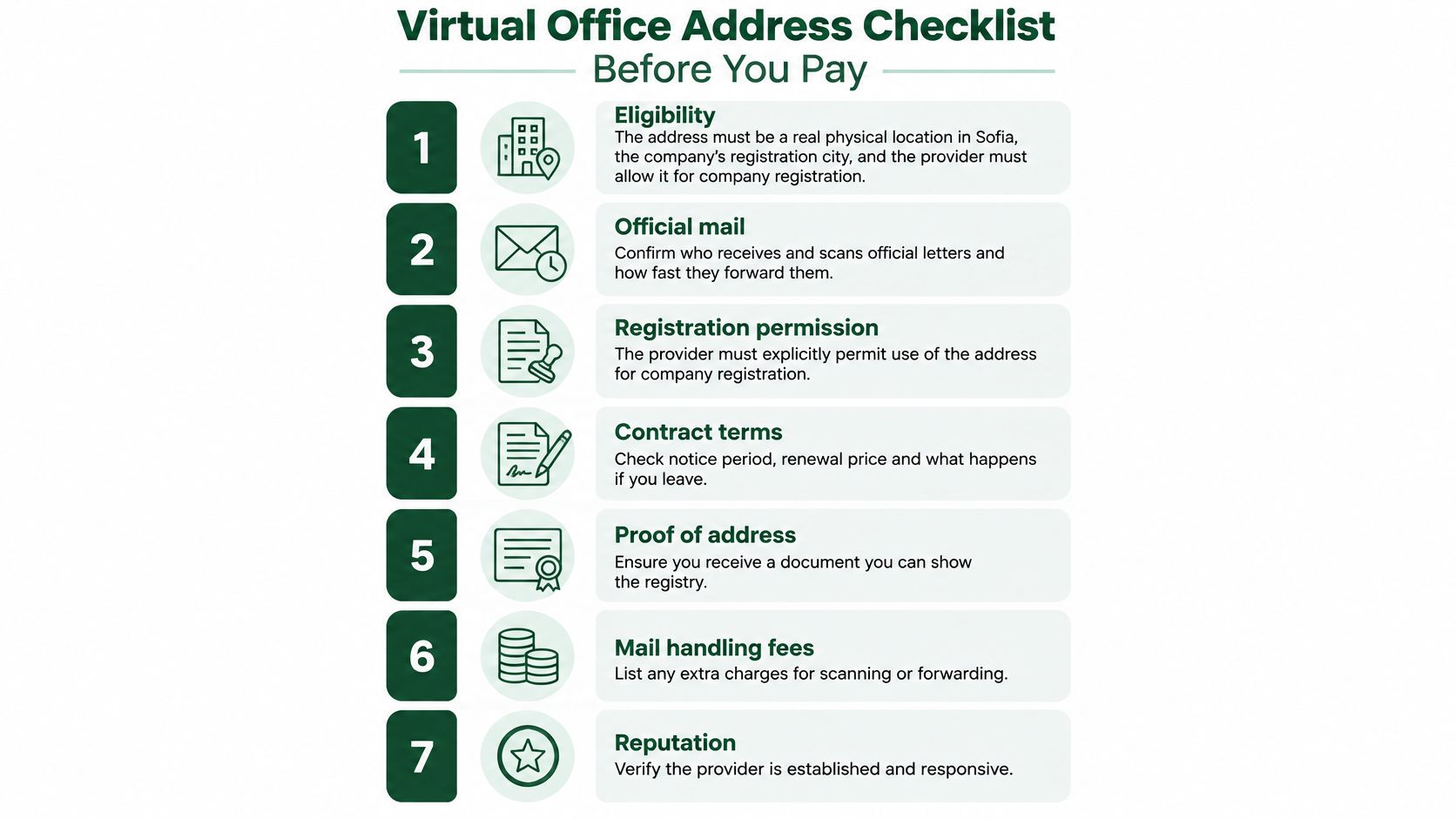
Seven checks, in the order that saves the most money. Each one has a specific failure attached to it, and the failure is what you're buying protection against.
- Eligibility. The address must be a real physical location in Sofia, the city where the company is registered, and the provider must allow it for company registration. If either condition fails, nothing further down this list rescues the file.
- Official mail. Ask who receives registered letters, who scans them and how quickly they're forwarded, then get the forwarding window in writing. Verbal reassurance collapses the first time a tax notice lands while nobody is at the desk.
- Staffed reception. Somebody has to sign for courier and registered deliveries during business hours. An unattended lobby turns a delivery into a returned envelope, and a returned envelope into a missed deadline.
- Evidence of delivery. Ask whether each item is logged with a date and acknowledged. If a regulator later asks when a notice arrived, a timestamped log beats a shrug.
- Consistency. The same address belongs on the certificate of incorporation, the VAT registration, the bank account, invoices and any directory listing. One stray variant is enough to trigger a verification query.
- Privacy versus verification. A virtual address keeps your home off public business records, but it doesn't make the owner or company anonymous. Guidance on virtual offices and company registration is blunt that banks, tax authorities, insurers and licensing bodies can demand separate identity, residential or operational-address evidence, and that authorities are tightening scrutiny of filing addresses, with restrictions on PO boxes and commercial mail-receiving agencies in some jurisdictions (Office Consumer guidance).
- In-person acceptance. Confirm whether any document has to be collected in person. Discovering that after you've booked a filing date costs you a fortnight.
| Check | What to confirm | Failure if missed |
|---|---|---|
| Eligibility | Real physical Sofia address accepted for company registration | Registration rejected or address later replaced |
| Official mail | Provider scans and forwards official letters, with forwarding time in writing | Notices missed or answered late |
| Staffed reception | Someone signs for deliveries | Unsigned delivery leaves notices unanswered |
| Delivery evidence | Each delivery logged and acknowledged | No proof that a legal notice arrived |
| Consistency | Same address on incorporation, VAT, bank account, invoices and Google Business Profile | Bank or registry mismatch flags |
| Privacy versus verification | Residential or operational evidence available on request | Rejected bank onboarding |
| In-person acceptance | Documents that must be collected in person | Delays or extra travel |
If you're comparing US-based services alongside Sofia ones, the postal side carries its own paperwork. A commercial mail receiving agency in the United States must collect identity information through USPS Form 1583, retain the supporting identification and address records, and represent the location as a private mailbox rather than a post-office box, with a PMB or # identifier in the address line (USPS commercial mail receiving agency guidance). Substituting a suite number can break postal format rules or leave delivery ambiguous, and banks do compare submissions against public records.
A missed official letter rarely announces itself. It surfaces months later as a penalty, a suspended VAT number or a bank asking why the registry shows a different address from the one on the account. The best address isn't the closest or the most impressive one. It's the one whose permitted use, mail handling and documentation match what the company does.
How to Register a Sofia Address Online
The good news is that the whole process can run from home. Seven steps, in the order they happen.
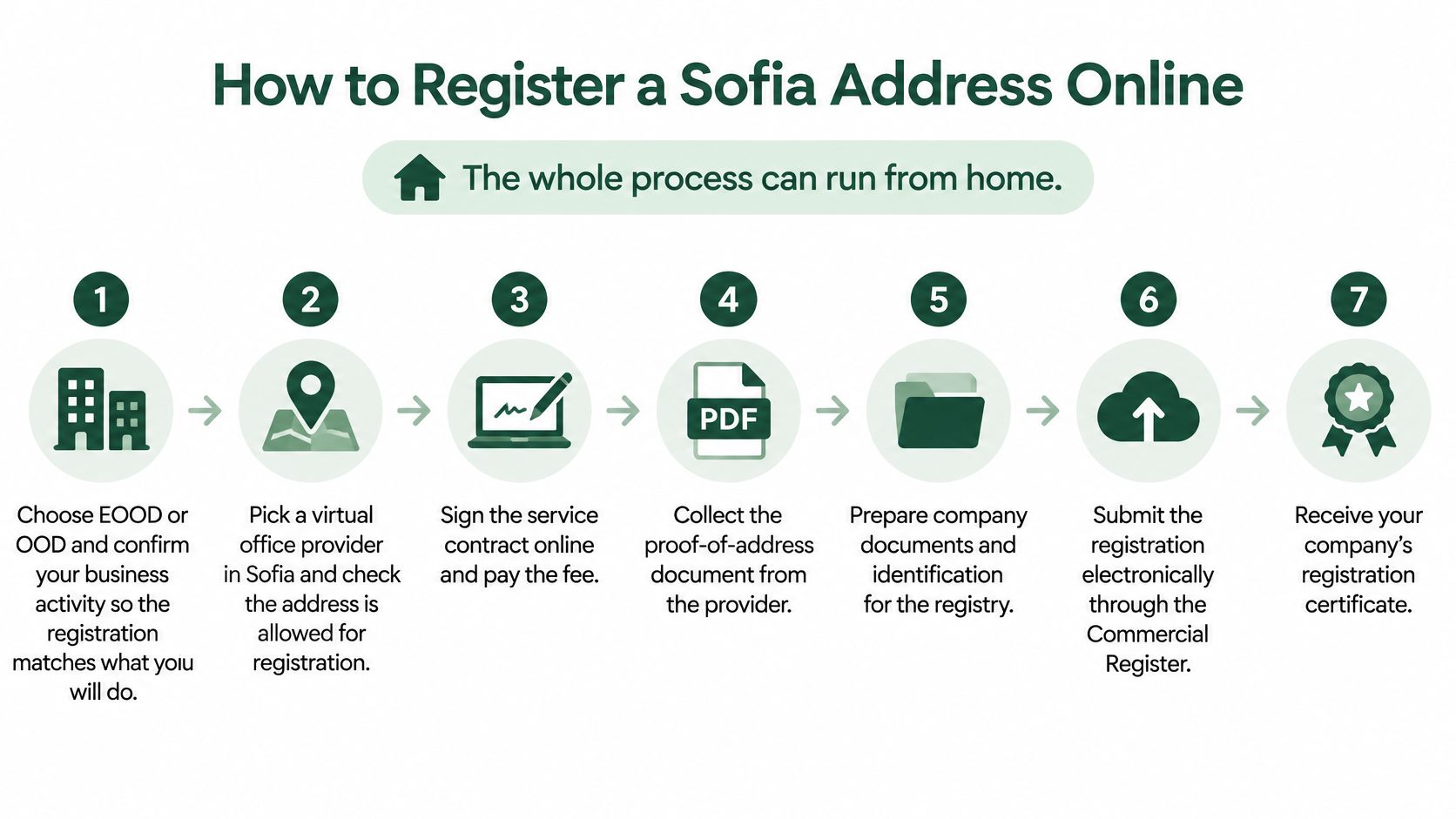
- Choose EOOD or OOD and describe the activity accurately. A single-member EOOD suits a solo founder, an OOD suits two or more. The activity field drives what the registry, the bank and the tax office expect to see, and a mismatch is the most common reason a file comes back for correction.
- Take a package that includes the virtual office and business address. The address is part of the setup rather than a separate purchase, so you're not negotiating a mailbox contract while the registry waits.
- Verify identity and sign remotely. You do this in a 30 to 60 minute online session with a secure online notary, which replaces the consular signature most non-residents used to need.
- Collect the certificate of incorporation, plus apostilled company documents where needed. Banks outside Bulgaria and some foreign registries ask for the apostille, and having it from day one avoids a second courier round later.
- Obtain the EU VAT number. It's what lets you invoice EU business clients without friction and reclaim input VAT on Sofia costs.
- Open the business bank account. Once the company exists, we help open an account online or with a local Bulgarian bank, which takes about an hour.
- Set up official mail monitoring. Confirm who watches the inbox, who signs for post and how fast a scanned notice reaches you.
Registration volume is part of why this route feels crowded. Eurostat recorded a 6.4% quarter-on-quarter rise in EU information and communication sector registrations in Q4 2025 (Eurostat business registration figures).
Everything runs from your laptop: identity verification with a secure online notary, electronic filing, and a bank account opened remotely. No flight to Sofia.
The full sequence is documented in this guide to registering a company online, and it's worth reading before you assemble documents so you don't gather the same paper twice.
A short walkthrough of the online route:
Say a SaaS founder based in Germany wants an EU company and an EU IBAN without leaving Berlin. The online route finishes in 3 to 5 working days, with identity verification done from a desk, the certificate arriving by email and no travel at any stage.
Packages, Prices and What Each One Includes
Two packages, largely the same core, different delivery.
| Package | Price | Setup time | Key inclusions |
|---|---|---|---|
| In-person package in Sofia | €1,500 | 2 to 3 working days | EOOD or OOD registration, EU VAT number, bank account, virtual office and business address, certificate of incorporation, all legal and government fees, airport pickup |
| Online package | €1,750 | 3 to 5 working days | EOOD or OOD registration, EU VAT number, bank account, virtual office and business address, apostilled company documents, certificate of incorporation, all legal and government fees |
The €250 difference buys the apostilled documents and the remote delivery, not a better address. Both packages carry the same virtual office and business address, the same EU VAT registration, the same bank account introduction and the same legal and government fees.
That bundling reflects how the market has moved. One estimate put the global flexible-office market at about USD 55.20 billion in 2021, projected to reach roughly USD 201.28 billion by 2030, a compound annual growth rate of 20.34% from 2022 to 2030 (Global Newswire flexible office market report). Forecasts of that type vary by methodology, but the direction is the useful part: founders buy an address, mail handling and occasional meeting space as separate pieces instead of signing a lease for a desk.
Three caveats, directly beside the price. Bookkeeping is ongoing, not one-off, so ask what the monthly figure is before you sign. VAT returns and the annual corporate return recur every year, and you want them quoted as a line item rather than discovered in month three. Residency assistance, legal advice and business consulting sit outside both packages as optional add-ons, useful if you plan to move to Bulgaria or need a contract reviewed.
Decision rule: can you get to Sofia and want the company trading this week? Take the in-person package. Working from another continent? Take the online one and stop comparing the two on price alone.
Bulgaria's 10% Tax Against Other Countries
Compare statutory rates, not figures quoted secondhand in a forum thread. The OECD corporate tax statistics treats the statutory rate as the headline rate corporations face and uses it to compare jurisdictions over time, and it records that Bulgaria reduced its statutory rate by at least 20 percentage points between 2000 and 2025. Here's where the main options sit.
| Country | Statutory corporate rate | What to check next |
|---|---|---|
| Bulgaria | 10% | Tax base is the tax-adjusted result; check withholding and social charges |
| Hungary | 9% | Check local special rules and any minimum tax |
| Ireland | 12.5% | Check rules separating trading and passive income |
| France | 25% | Check the surtax that applies to large companies |
| United Kingdom | 25% | Main rate; check the small-profits rules |
| Germany | about 30% combined | Rate varies by municipality because of trade tax |
| United States | 21% federal | Add state corporate taxes where applicable |
Bulgaria sits among the lowest rates in Europe, and it isn't the only low-rate jurisdiction globally: the same OECD report notes that Barbados, Hungary and the United Arab Emirates reported rates below 10% in 2025. So the headline number is a starting advantage, not a finished argument.
What the Headline Rate Leaves Out
- Tax-base rules. The taxable base is the tax-adjusted financial result, so deductions and disallowed costs change what you pay.
- Minimum-tax regimes. Several countries layer a floor under the headline rate, which compresses the benefit for large or low-margin groups.
- Withholding taxes. Dividends and interest moving out of the country can carry tax that never appears in the headline rate.
- Social charges and VAT. Employer contributions and VAT registration obligations sit alongside corporate tax and are easy to forget when comparing one number against another.
- Substance requirements. An EU structure needs real decision-making and record-keeping, which costs money to maintain properly.
- Treaty access. Double-tax treaties decide how profits are taxed twice or not at all, and they differ by country pair.
Run the arithmetic on a worked figure: a company with €100,000 of taxable profit pays €10,000 at 10% before any withholding, substance or compliance costs. Compare that against Ireland's 12.5% on the same base (€12,500) or France's 25% (€25,000), then add the costs each structure brings. If you want the full breakdown of domestic rates and deductions, this piece on corporate tax rates in Bulgaria goes deeper.
A moderate rate on a tax base that fits your business beats a low rate on one that doesn't.
Annual Tax Return and Compliance Deadlines
The Bulgarian annual corporate return can be filed electronically, and the window runs from 1 March to 30 June of the following year, per the Bulgarian Ministry of Economy guidance on declaring and paying corporate tax. Filing requires a qualified electronic signature, and any tax due goes out by bank transfer by that same 30 June date.
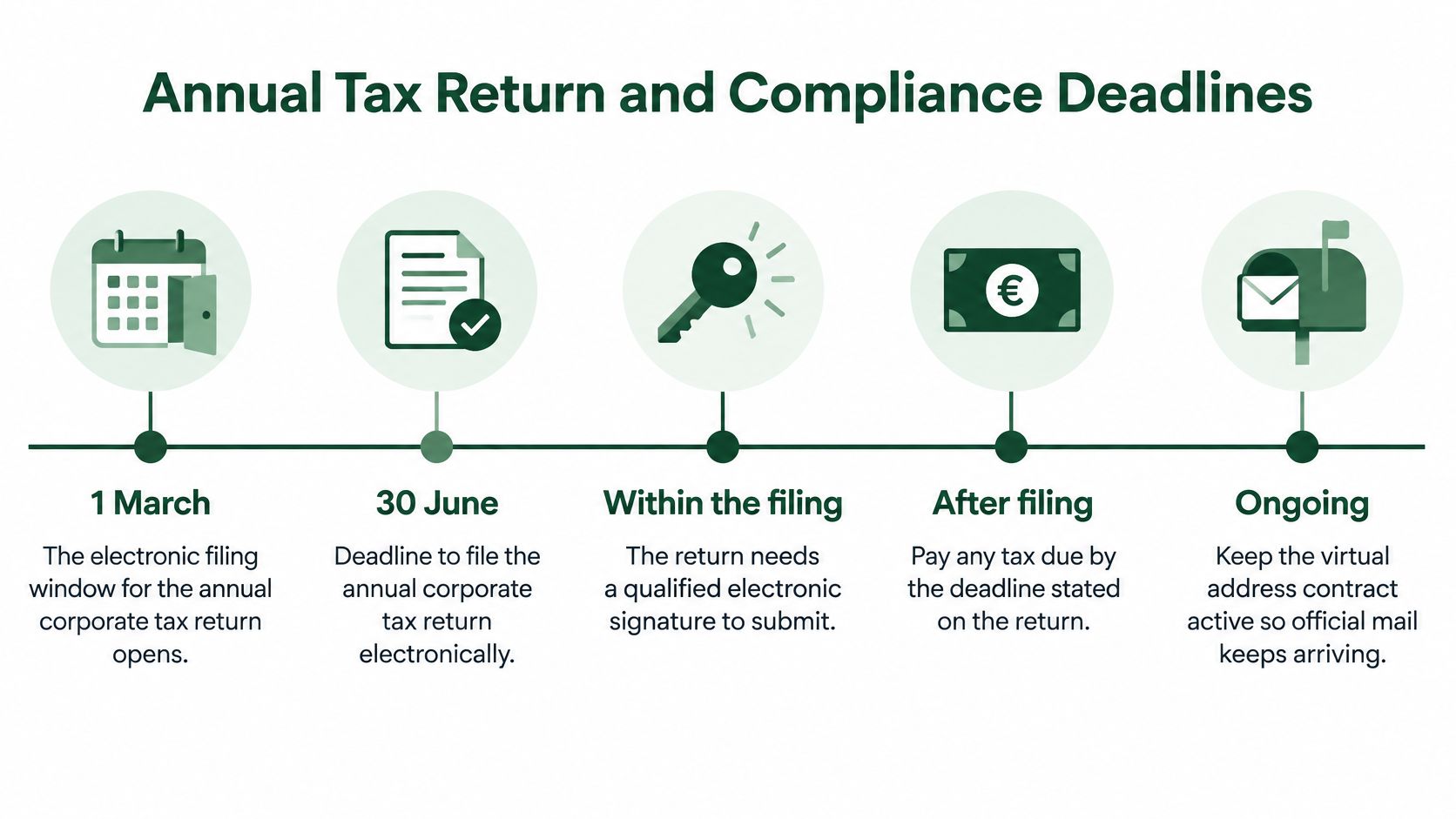
Two details change how you plan the year. The taxable base is the tax-adjusted financial result, not raw accounting profit, so adjustments have to be recorded as they happen rather than reconstructed in May. And companies whose turnover exceeded BGN 300,000 in the relevant prior period may owe quarterly advance-tax payments, which pulls cash out during the year instead of once in summer.
Keep four things ready before the window opens:
- Clean bookkeeping. Monthly categorisation of invoices and bank lines, so the year-end adjustment is a review rather than an archaeology project.
- A working qualified e-signature. Test it in February, not on 29 June.
- Deadline monitoring. Calendar entries for 1 March, each quarterly advance date and 30 June.
- A Bulgarian payment route. A local bank account, so tax reaches the treasury on time and the transfer can be evidenced.
We handle registration, VAT, banking and bookkeeping for the companies we set up, which takes most of this calendar off your desk. If you're filing independently, the process is set out in this guide to annual filing requirements.
Habit: set three recurring reminders in January, one for 1 March, one for the advance-payment quarters if turnover puts you there, and one for 30 June.
Confirm Your Sofia Address This Week
Three moves, in this order.

- Run the seven checks against your planned address type. Start with eligibility and official-mail handling. If either fails, change the address before you pay, because refunding a subscription is simpler than correcting a registry entry.
- Choose the package that fits your calendar. In person in Sofia at €1,500 with setup in 2 to 3 working days if you can travel, or online at €1,750 with setup in 3 to 5 working days if you can't. Both include the virtual office and business address, the EU VAT number and the bank account.
- Book the free consultation if timing is tight. It's the fastest route to the team for anything urgent.
Reach us at Ul. Byala 10, Sofia 1421, Bulgaria, by email at info@fastcorp.eu, or by phone on +359 886 822 733. Contact hours are Monday to Friday, 9:00 to 18:00 EET.
Then build the one habit that keeps the address compliant from day one: use the same registered address on every certificate, VAT registration, bank account, invoice and filing, and check each month that official letters are arriving inside the forwarding window. An address is only as good as the last letter it delivered on time.
FastCorp sets up Bulgarian EOODs and OODs with a Sofia virtual office and business address built into the package, then keeps official mail, VAT filings and the annual return on schedule once the company exists. If your near-me search has turned into a shortlist of addresses you can't quite verify, FastCorp can confirm eligibility, register the company online in 3 to 5 working days, or complete it face to face in Sofia in 2 to 3.