Business Bookkeeping Help That Actually Works in 2026
Get practical business bookkeeping help for Bulgarian companies. Step-by-step setup, tax comparison, and remote workflows that keep your books clean.
You've got the company open, the bank account is live, and the first invoices are already landing in three currencies. Then the payment processor statement shows one balance, the bank shows another, a supplier invoice is missing a VAT number, and your accountant is asking for source documents before the filing deadline gets any closer. That's the moment most non-resident founders realize they don't need “bookkeeping software”, they need business bookkeeping help that keeps the company clean.
The mistake is treating bookkeeping as a back-office chore that can wait until the month ends. In real life, the work starts the day money moves, and it only gets messier when you're remote, cross-border, and trying to sell while someone else is chasing receipts. Good bookkeeping is not about pretty reports, it's about making sure every transaction can be proved, every balance can be reconciled, and every filing can be defended.
Table of Contents
- Why Founders Search for Business Bookkeeping Help in the First Place
- Assessing Your Bookkeeping Needs Before You Sign Anything
- Onboarding a Bookkeeping Provider Fully Online
- Tax Comparison That Goes Beyond the Headline Rate
- Running the Monthly Close Without Lifting a Spreadsheet
- Where Automation Stops and Human Review Starts
- Your First 90 Days With Remote Bookkeeping Help
Why Founders Search for Business Bookkeeping Help in the First Place
The first chaotic month usually looks the same. A founder opens the company, starts invoicing, pays for software subscriptions, receives contractor bills in a foreign currency, and gets one payment processor payout that doesn't match the sales dashboard. The VAT deadline appears faster than expected, and now someone has to explain why the figures in the ledger don't match the live cash position.
That's why the question comes after incorporation, not before. Most founders are focused on getting to first revenue, and the bookkeeping problem only becomes visible when the first deadline, tax check, or investor question lands. In my experience, that is exactly when weak recordkeeping gets expensive, because the company has to rebuild history instead of closing the month.
The three pressure points that matter
Evidence is the first one. Every booking needs a trail back to an invoice, receipt, contract, bank record, or payroll document, because a neat ledger with no support is just decoration. Deadlines are next, because tax, VAT, payroll, and statutory filings don't care that the founder was busy selling. Review is the last piece, because software can import and classify, but it can't decide whether a transaction belongs in the books without human judgment.
Practical rule: if a transaction can change tax treatment, ownership exposure, or cash control, it needs a person checking it, not just a rule in software.
The historical logic behind this is older than most firms themselves. Double-entry bookkeeping was already being used in northern Italy by about 1300 to balance what was given and received, and that same structure still underpins modern reconciliations and audit trails today (BBC). That's the reason founders need help. They're not buying admin support, they're buying a control system.
Assessing Your Bookkeeping Needs Before You Sign Anything
A founder who can answer four questions already has a workable scope: monthly transaction volume, number of currencies, VAT exposure, and whether payroll exists. That is the starting point. If those answers are fuzzy, a provider will sell you the wrong package and you will pay for it later in cleanup.
A basic monthly package fits a company that is simple, domestic, and low-volume. A managed close fits a business where reconciliations, VAT, and payment platforms all need attention. A full-service retainer is the right setup when filings, payroll, and recurring compliance are part of the weekly routine.
Use this decision rule
Cross more than two currencies, employ at least one person, or sell to EU consumers, and the entry-level package is the wrong buy. At that point, the work is control, reconciliation, and filing support. The cheap option usually looks fine until someone asks for a clean evidence trail.
| Founder Profile | Recommended Package | Monthly Close Includes |
|---|---|---|
| Single-currency freelancer with no payroll | Basic bookkeeping support | Transaction coding, simple ledger review, basic reporting |
| Cross-border service firm with VAT exposure | Managed close | Bank and payment reconciliation, VAT checks, aged receivables and payables |
| Company with payroll, multiple currencies, and filings | Full-service accounting retainer | Close, reconciliations, payroll tie-out, statutory filing support |
The IRS is clear on the structure of good records, journals capture transactions from supporting documents, ledgers aggregate by account, and daily recording is recommended where practicable (IRS Publication 583). DIY software often fails at this point. The first time an auditor or tax office asks for proof, you find out whether the books can stand on their own.
If you are comparing packages, focus on service scope and the monthly close, not the headline price. A pricing guide like FastCorp's accounting services overview helps because it forces the right question, what gets reconciled, filed, and reviewed. That is the difference between paying for posting and paying for bookkeeping help that removes work from the founder's day instead of adding it.
Onboarding a Bookkeeping Provider Fully Online
The cleanest onboarding happens when the founder sends the right documents once and grants the right access once. You don't need a flight to Sofia for that if the provider has a remote process built properly. What you do need is a complete file, because incomplete onboarding is what turns a simple setup into a week of back-and-forth.
Start with the core documents: certificate of incorporation, identification, proof of address, beneficial-owner declaration, VAT certificate if one exists, and access to the bank and payment processor. If the provider asks for them in a structured list, that's a good sign. If they start booking transactions before they understand ownership, banking, and tax status, that's a bad one.
What to grant, and what not to grant
Give read access to bank feeds, payment processor statements, invoicing systems, and accounting software. Keep payment release and approval rights separate from bookkeeping access. The bookkeeper should record and reconcile, not move money.
Don't blur accounting access with payment authority. One person should not be able to create a payment and approve the same payment.
Remote identity verification and online notarial signing handle the legal formality side when the provider is set up for it. That removes the need to travel just to sign routine formation or compliance documents, which is exactly where online onboarding saves the most time. For a provider that handles the setup end to end, FastCorp's online bookkeeping and company support process is the kind of workflow worth copying even if you don't use the same firm.
The timeline should be tight. Day one is intake and document collection, days two to three are for chart-of-accounts setup and platform access, and days four to five are for the first reconciliations. If onboarding drifts beyond that without a good reason, the provider is either understaffed or improvising.

Tax Comparison That Goes Beyond the Headline Rate
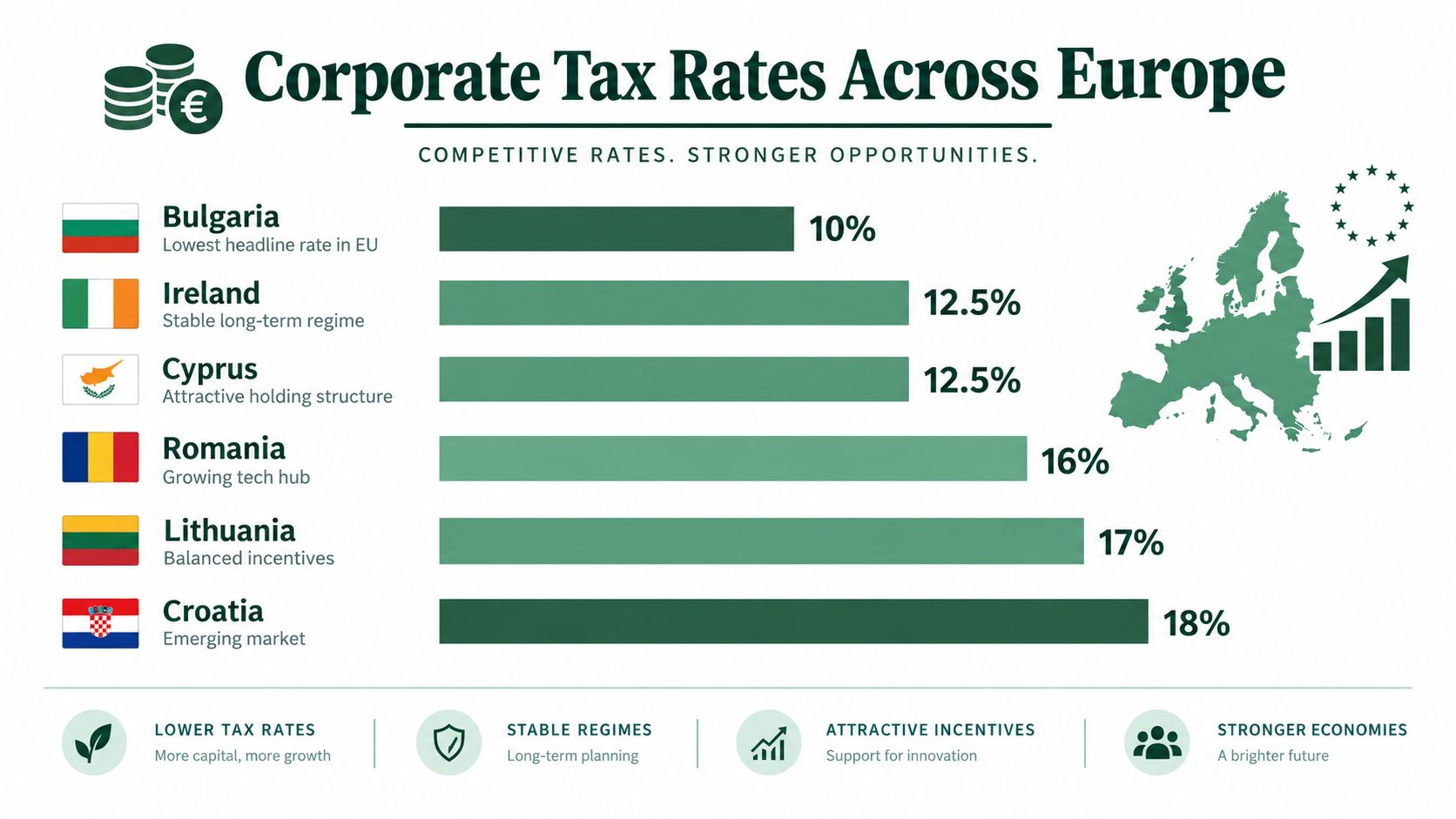
Bulgaria's 10% corporate income-tax rate is a real edge for small and mid-sized companies, but the headline only matters if you compare it against the full field. Ireland and Cyprus sit at 12.5%, Romania at 16%, Lithuania at 17%, Croatia at 18%, Estonia at 22%, and Belgium at 25%. Hungary is lower at 9% (Tax Foundation). For a non-resident founder, that spread changes where profit feels cheap and where it starts to get expensive.
What the headline rate does not tell you
The statutory rate is only the starting point. Deductible expenses, payroll taxes, dividend treatment, substance expectations, and anti-avoidance rules can change the true cost of operating a company. For large multinational groups, Bulgaria's 10% rate may also sit beside a 15% domestic minimum top-up tax under OECD Pillar Two (Tax Foundation).
That is why tax planning has to follow the entity, not the slogan. A small service company with straightforward expenses and clean records can use the Bulgarian setup well. A larger group needs profit calculations, related-party data, ownership records, and tax adjustments kept in the books so the filed position can be tested later.
Bulgaria works for the typical remote founder because the rate is low and the compliance structure is manageable. The key question is which structure can be run cleanly, reported correctly, and supported by evidence.
Running the Monthly Close Without Lifting a Spreadsheet
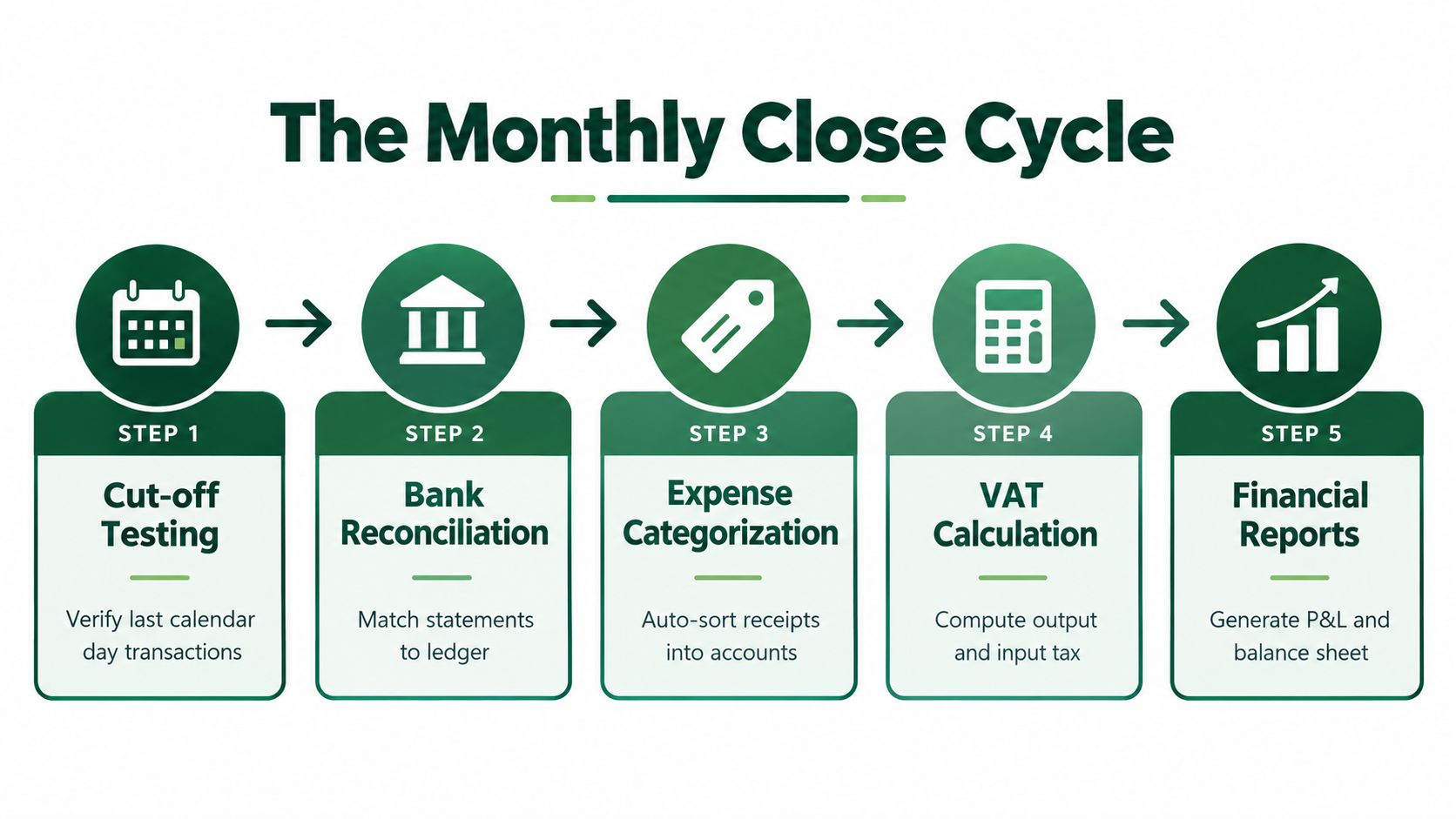
A monthly close should run the same way every time. Cut-off testing happens on the last calendar day, then bank and payment-processor reconciliation follows in the first few working days. After that come VAT input and output checks, receivables and payables aging, payroll-to-ledger tie-out, fixed-asset roll-forward, accrual review, and final management sign-off before the period is locked.
That rhythm keeps the founder out of the weeds. The provider should handle matching, exception review, and ledger cleanup. The founder should only be pulled in for judgment calls, such as unusual invoices, missing approvals, or payments that may involve a related party.
What a proper close delivers
- Cut-off testing: Verifies that invoices, revenue, and expenses land in the correct period.
- Bank and processor reconciliation: Matches statements to the ledger and catches omitted or duplicated entries.
- VAT checks: Confirms that input and output tax are captured correctly and that support exists.
- Aging review: Shows which customers and suppliers need follow-up, and which balances are stale.
- Sign-off: Locks the period so backdated edits do not corrupt next month's numbers.
Retention rules make this discipline mandatory. Cross-border OSS records can need to be kept for up to 10 years (EU One Stop Shop guidance).
Where Automation Stops and Human Review Starts
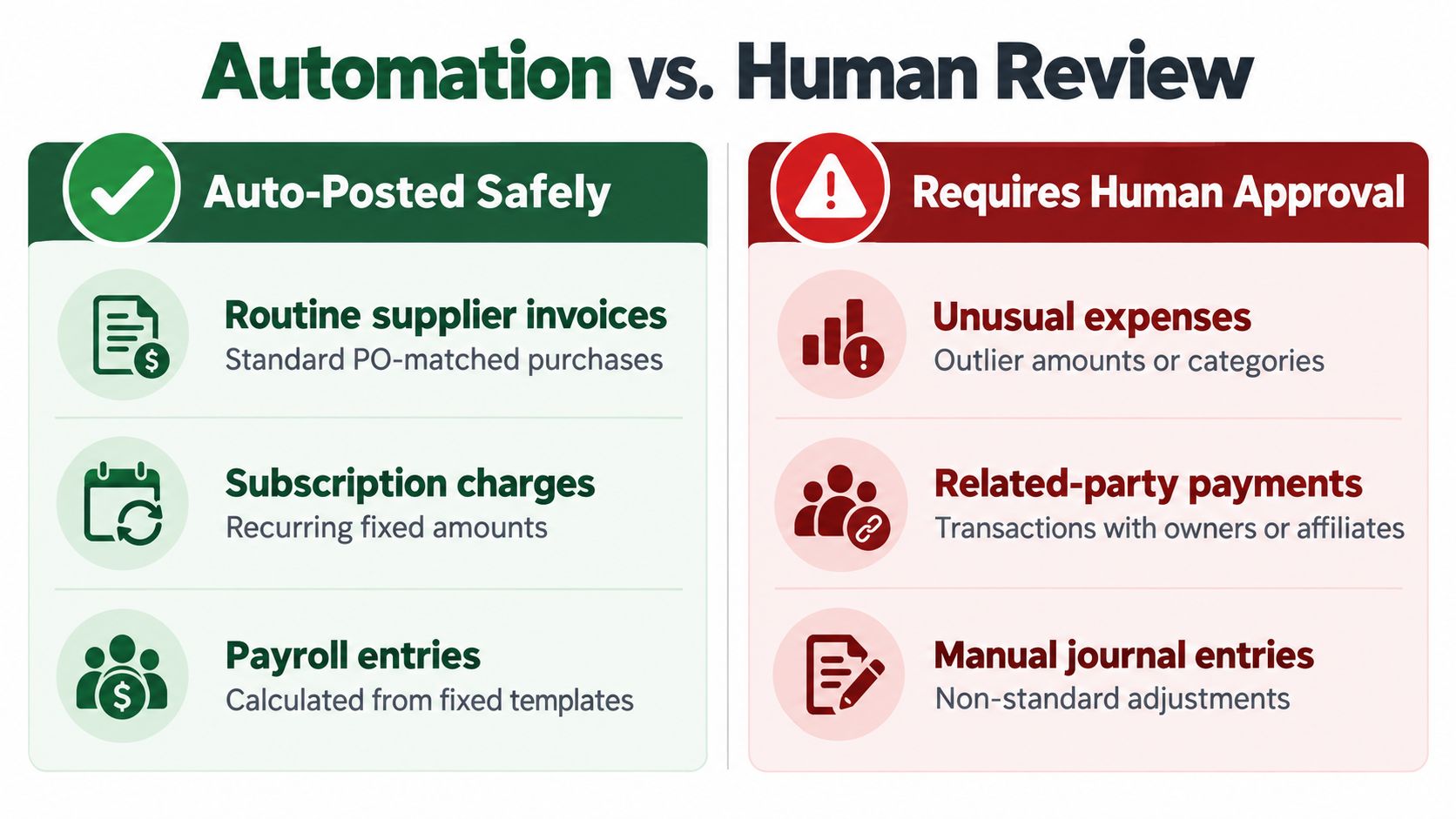
Automation should capture, sort, and match. It should not be allowed to make tax judgments on its own. Unusual expenses, related-party payments, reverse-charge VAT, payroll entries, and period-end adjustments all need human approval before they hit the ledger.
The recent small-business AI adoption data shows why this matters. Reported use declined from 42% in 2024 to 28% in 2025, with 55% citing cost and 62% saying they didn't understand the benefits (survey summary). That decline is not a software story alone. It's a workflow story, because bad source data and weak review habits make automation look unreliable very quickly.
The right split is simple
Automate capture and matching. Require human sign-off on anything that affects a tax position or a related party. Log every override.
Routine supplier invoices can be posted automatically when they match the expected pattern. Subscription charges can too, if they're recurring and fixed. Payroll calculations can be automated when the inputs are stable and the approvals are clean. But once a transaction changes VAT treatment, ownership exposure, or period-end results, someone has to check it.
If you want a more rigid control structure, automation in accounting should always be framed as a helper, not the final approver. The provider's real value is in knowing where the machine stops and the accountant starts.
Your First 90 Days With Remote Bookkeeping Help
Spend the first 7 days collecting documents, mapping currencies, and deciding who approves payments. Use the next 30 days to finish onboarding, close the first month, and lock the approval thresholds that stop messy entries from spreading. Use the final 60 days to tighten VAT evidence rules, add another currency only if the business needs it, and prepare for the first quarterly OSS or annual filing.
Three warning signs mean the setup is failing. Bank items older than 30 days unreconciled, VAT-relevant transactions with no source documents, and shared login credentials. If any of those show up, the provider is not running control, they're just entering data.
The founder-friendly outcome is simple. You should hand over the bank line, the processor line, the VAT evidence trail, and the month-end checklist, then stop touching the spreadsheet. If you're still doing reconciliations yourself after the first close, the service hasn't been built properly.
FastCorp handles Bulgarian company formation, VAT registration, bookkeeping, payroll, and ongoing compliance for global founders, so you don't have to stitch together three vendors to keep the books clean. If you want remote setup, monthly close support, and a provider that works around cross-border realities, visit FastCorp and see how the workflow fits your company.