What Is a Corporate Tax Return Explained Simply
What is a corporate tax return? Learn what it contains, deadlines, Bulgaria's 10% rate and how to file online without mistakes.
A corporate tax return is the annual filing where a company reports profits, deductions, and credits to calculate its own corporate income tax. In Bulgaria, the annual return is filed online from 1 March to 30 June of the following year, using the country's 10% corporate tax rate.
You've just incorporated, opened a business account, and sent your first invoices. Then your accountant asks for bookkeeping records, expense receipts, and details of any foreign customers. Suddenly, “year-end compliance” feels much bigger than a simple form.
The good news is that the underlying idea is straightforward. A company tells the tax authority what it earned, which business costs it can claim, whether it has credits or losses, and what tax position follows from that calculation. The return becomes the official record of the company's taxable result.
That record matters even when the company has made a loss or owes no tax. The UK requires a Company Tax Return in those circumstances, and Canada generally requires resident corporations to file a T2 even when no tax is payable, as explained by the UK government's company tax return guidance and the Canada Revenue Agency's corporate income tax return guidance.
For founders considering Bulgaria, the process is particularly practical. The filing is electronic, a qualified electronic signature is required, and the local rate sits among Europe's lowest. This guide will explain the return as a self-assessment story, show what goes inside it, compare Bulgaria with selected European countries, and finish with a practical checklist for filing confidently.
Table of Contents
- Introduction to Corporate Tax Returns for New Founders
- What a Corporate Tax Return Really Means
- Inside Your Return and What It Contains
- Bulgaria Corporate Tax in European Context
- Common Filing Pitfalls and How to Avoid Them
- How FastCorp Prepares and Files Your Return Online
- Your Next Steps to Confident Compliance
Introduction to Corporate Tax Returns for New Founders
Maya has formed a Bulgarian company for her consulting business. During the year, clients paid invoices, the business paid software subscriptions, and Maya occasionally reimbursed herself for expenses. She understands her revenue, but she's less certain about the number the tax authority cares about.
That number isn't the balance in the bank account. The company must organize its financial activity, identify relevant deductions, account for applicable credits, and calculate its taxable profit or loss. The corporate tax return is where that calculation becomes a formal submission.
A corporate tax return therefore serves several purposes at once:
- It reports the company's activity: Revenue, expenses, assets, financing, and other relevant transactions create the factual basis for the filing.
- It calculates the tax position: The company applies the rules for taxable income, deductions, credits, and losses.
- It preserves important tax attributes: A recorded loss may support future relief, while a correctly filed return can protect refund eligibility.
- It creates an official compliance record: The tax authority can see how the company arrived at its declared position.
This is why the return isn't just paperwork after the accounts are finished. It's the legal mechanism that applies corporate tax rules to the company's actual earnings. OECD corporate income tax data covers more than 160 countries and jurisdictions, reflecting how central this type of filing is across major markets (OECD corporate income tax rates database).
Why founders notice the filing first
New founders often make one of two assumptions. They either expect tax to be calculated automatically by the authorities, or they assume that no tax is due because the company made little profit. Both assumptions can cause trouble.
Corporate tax usually works through self-assessment. The company, often with an accountant, prepares the calculation and submits it. The authority may review or challenge the filing, but the company doesn't normally wait for the authority to prepare the original return.
Bulgaria's electronic process makes the practical side easier. You can prepare documents remotely, sign the filing with a qualified electronic signature, and submit it through the relevant online channels. The work still requires care, but the process doesn't require paper delivery or a routine trip to an office.
What a Corporate Tax Return Really Means
The simplest answer to what is a corporate tax return is this: it's the company's annual calculation of taxable profit and corporate income tax, submitted to the relevant tax authority.
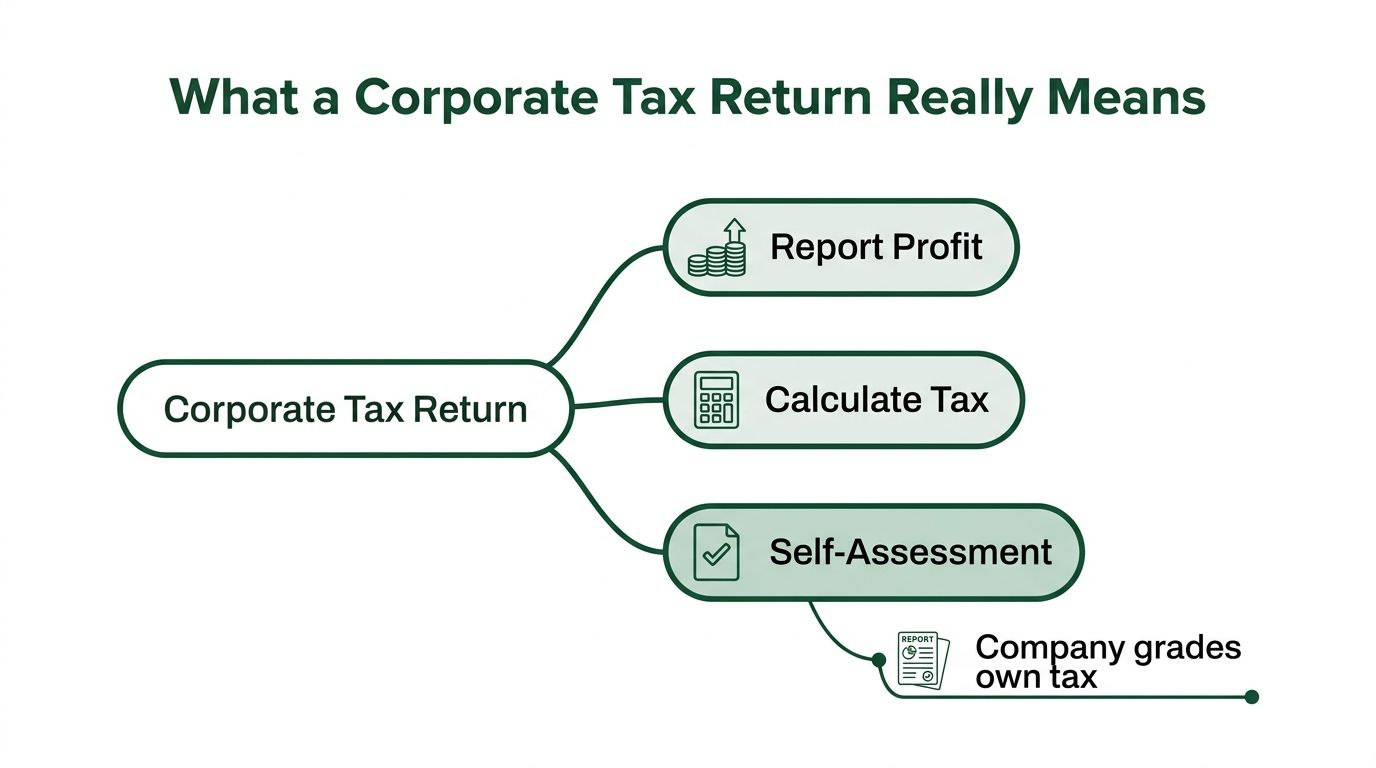
Think of it as grading your own homework, with evidence attached. The company gathers its financial records, applies the tax rules, calculates the result, and submits the completed work. The tax authority can check the calculation, but the company has responsibility for making the initial declaration accurate.
The three ideas behind the return
Report profit. The company starts with its financial activity for the accounting period. That includes income earned and expenses recorded in the books.
Calculate tax. Accounting profit and taxable profit may not be identical. Tax law decides which costs qualify, how certain income is treated, and whether credits or loss rules affect the result.
Self-assess. The company declares the final position itself. It doesn't send a payment and hope the authority understands the numbers. The return explains the calculation behind the payment, nil result, or loss.
Practical rule: “No tax payable” describes the result. It doesn't automatically describe the filing obligation.
The threshold issue catches many first-time founders. The UK requires a Company Tax Return even where the company makes a loss or owes no Corporation Tax. Canada also requires resident corporations to file a T2 in most situations, even when no tax is payable. This means a dormant, loss-making, or zero-tax company may still need to submit an information return.
Who usually needs to file
Most incorporated companies have an annual corporate filing obligation, but the exact form, deadline, exemptions, and electronic requirements depend on the country. In the United States, domestic corporations must file an annual return even if they have no taxable income, and the general deadline is the 15th day of the 4th month after year-end, according to IRS guidance for corporations.
A return can also matter when the company's result is negative. Filing may preserve a loss position, document foreign income, support a refund claim, or establish the basis for future calculations. Missing the filing can therefore affect more than penalties.
Inside Your Return and What It Contains
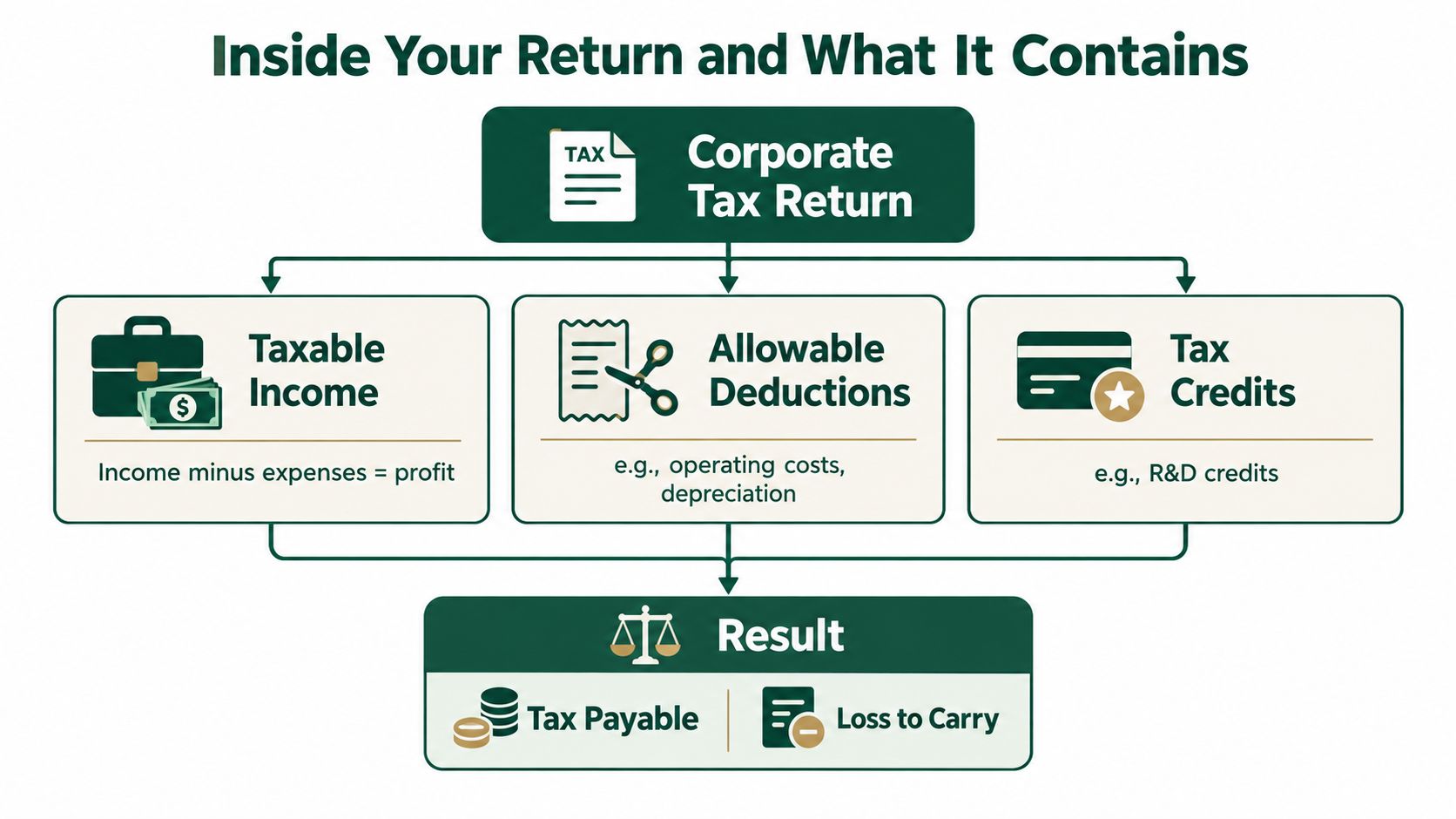
A return translates business activity into a tax calculation. The exact schedules vary by jurisdiction, but most corporate filings revolve around four questions: what came in, what costs qualify, what credits apply, and what result remains.
Taxable income
The company begins by identifying business income for the relevant accounting period. This may include sales, service fees, licensing income, interest, or other receipts, depending on the company's activities and local rules.
The tax calculation may then adjust the accounting result. Some income may receive special treatment, while some accounting entries may not be treated as taxable income in the same way. That's why the bookkeeping records are the starting point, not always the final tax answer.
Allowable deductions
Deductions reduce the amount of profit exposed to corporate tax when the law allows them. Common categories can include operating costs, employee-related expenses, depreciation, and other expenses connected with earning business income.
The key question isn't whether the company spent money. It's whether the cost is properly documented, connected to the business, recorded in the correct period, and permitted under the applicable tax rules.
A business that buys design software for client work has a clearer deduction trail than a founder who pays a personal subscription from the company account and labels it “business tools.” Good records make the distinction easier to defend.
Credits and final result
Tax credits work differently from deductions. A deduction generally affects taxable profit, while a credit may reduce tax calculated under the relevant rules. The return may also record a loss, which can be important for later periods or refund eligibility.
The return is the explanation behind the number, not just the number itself.
Foreign income and intercompany transactions need particular attention. A company selling services across borders may need to identify where income arose, while related-company charges may require supporting agreements and allocation records. These items can turn a basic domestic filing into a more technical compliance exercise.
For a helpful companion explanation of the wider annual reporting framework, see statutory reporting requirements. The practical preparation usually ends with reconciliation between the accounting records, tax schedules, supporting documents, and the amount submitted.
Bulgaria Corporate Tax in European Context
Bulgaria gives founders a clear example of how a corporate tax return applies a local rate to a company's taxable result. The statutory corporate income tax rate is 10.0%, and Bulgaria is consistently identified as one of Europe's lowest-rate jurisdictions. The Tax Foundation's European comparison lists Bulgaria at 10.0%, compared with Belgium at 25.0% and Hungary at 9%.
The rate doesn't remove the need to calculate taxable profit. It provides the percentage applied after the company's income, deductions, adjustments, and other relevant items have been determined.
A side-by-side comparison
| Country | Statutory Corporate Tax Rate | Filing Note |
|---|---|---|
| Bulgaria | 10.0% | Annual return filed electronically from 1 March to 30 June of the following year, with a qualified electronic signature |
| Belgium | 25.0% | Local corporate filing requirements and electronic rules apply |
| Hungary | 9% | Local corporate filing requirements and electronic rules apply |
The comparison shows why founders often examine Bulgaria when choosing an EU operating base. A lower statutory rate can be commercially relevant, but it doesn't replace substance, accurate accounts, VAT compliance, payroll obligations, or correct treatment of cross-border activity.
Bulgaria's online filing process
Bulgaria's annual corporate tax return is filed between 1 March and 30 June of the following year. Normal filing is electronic only, and the company uses a qualified electronic signature, according to the Bulgarian government's corporate tax declaration guidance.
That makes the process fully online rather than paper-based for ordinary filings. The OECD Investment Policy Review of Bulgaria also notes that corporate tax declaration information and forms can be submitted and signed electronically through the National Revenue Agency's online channels.
Electronic filing is common in many major markets, but the exact mandate differs. OECD research documents broad or compulsory corporate e-filing approaches in countries including Austria, France, Hungary, Italy, Mexico, the Netherlands, Spain, and the United States (OECD research on electronic tax filing). For a broader rate discussion, founders can review corporate tax rates and country comparisons.
Common Filing Pitfalls and How to Avoid Them
A founder can follow the tax calculation correctly and still create a problem by missing an administrative step. The usual causes are an unchecked assumption, an unavailable document, or a deadline with no named owner.
Tax payable and filing responsibility are separate questions. A company may report a loss, have no taxable profit, or owe no tax, yet still need to submit a return. The United Kingdom requires a Company Tax Return from a loss-making or zero-tax company, while Canada generally requires resident corporations to file a T2 even when no tax is payable.
The checklist founders should use
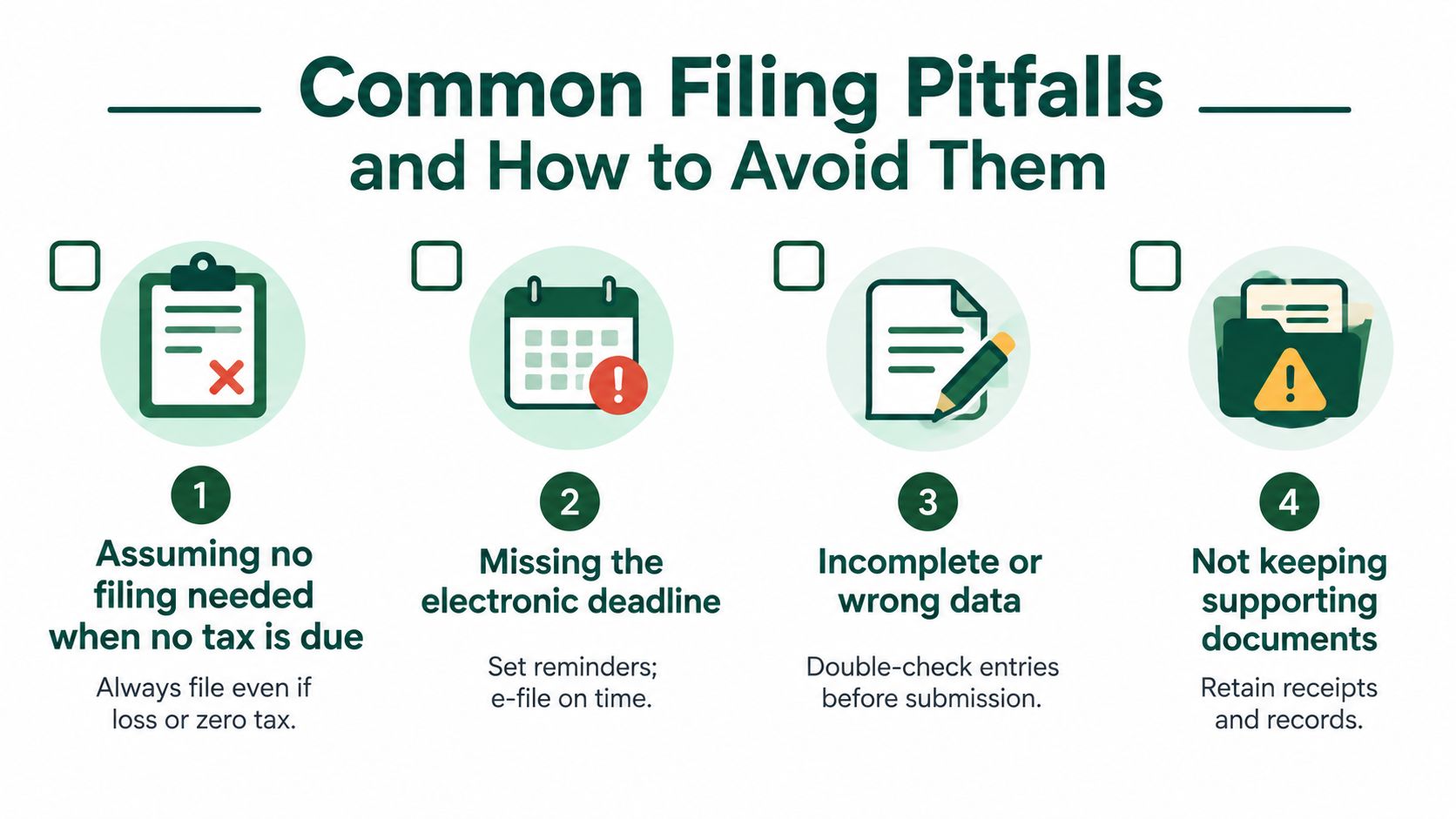
- Assuming no filing is needed: Confirm the obligation before treating a dormant, loss-making, or zero-tax company as exempt.
- Missing the electronic deadline: Add the filing window to the company calendar, assign responsibility, and check access to the qualified electronic signature.
- Submitting incomplete data: Compare sales, expenses, bank movements, payroll, VAT records, and related-party entries before signing.
- Losing supporting documents: Store invoices, receipts, contracts, bank records, and explanations for unusual transactions in one organized folder.
Use the return as a self-assessment story. Each figure should have a source, each unusual transaction should have an explanation, and the final result should match the company's records. This simple approach makes review easier and highlights questions before submission.
Poor bookkeeping adds another layer of risk. Differences between the accounts and bank records can leave unexplained amounts in the return. Intercompany charges without agreements, or incorrectly classified foreign invoices, may require a correction later.
Why late filing can cost more than a penalty
A missed return can weaken the company's tax position. The legal record may help preserve loss carryforwards, support refund eligibility, or document foreign income and treaty-sensitive positions. Canada allows a three-year window to file when a company wants a refund, according to Canada Revenue Agency guidance. Keep that reference separate from the linked citation used earlier in the article.
The safest process is practical: complete the records, confirm filing status, flag unusual transactions early, and reserve time for a final review before electronic submission. A checklist turns compliance from a last-minute scramble into a documented account of what the company earned, spent, and owes.
How FastCorp Prepares and Files Your Return Online
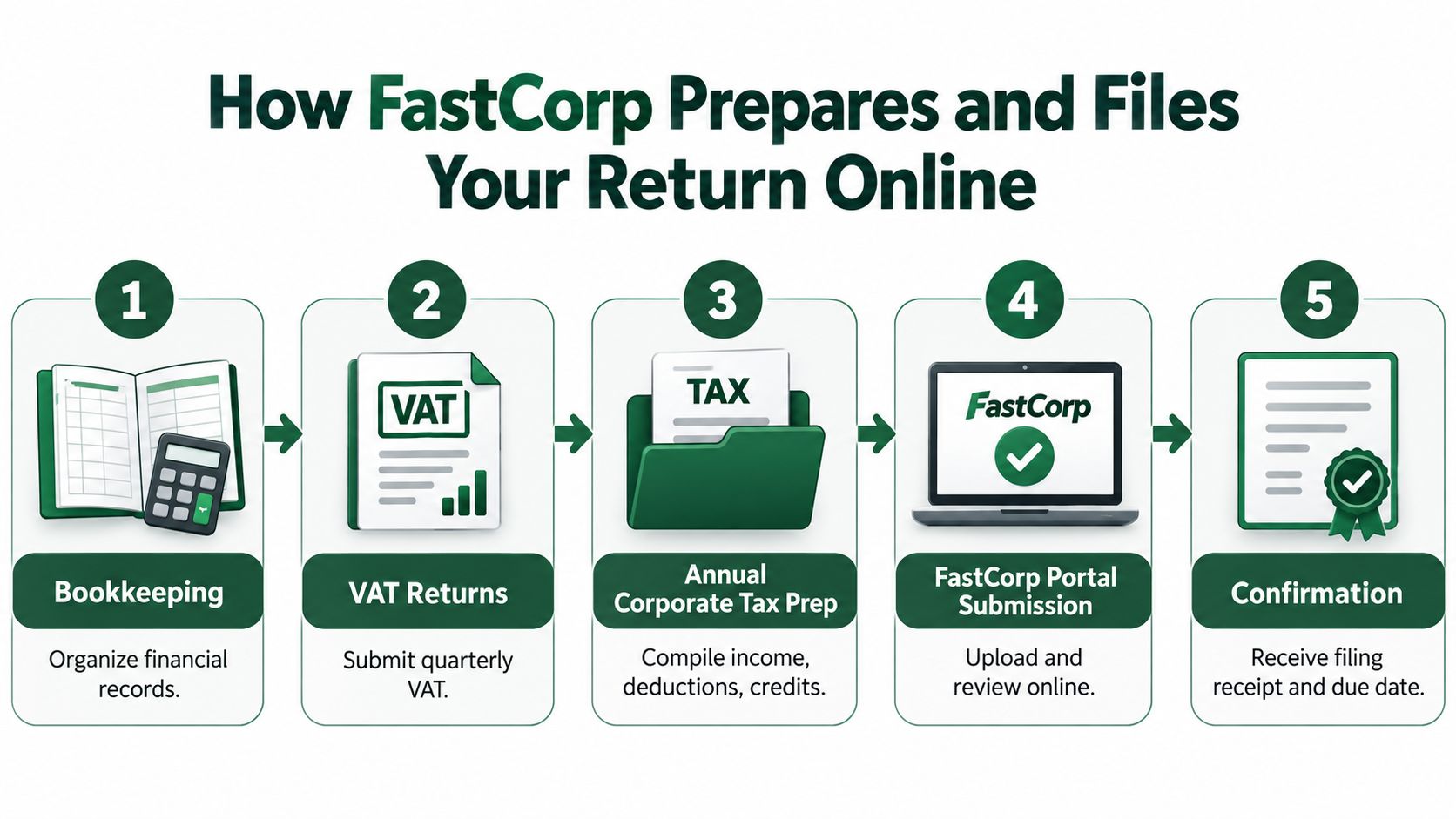
A smooth filing process starts long before the annual form opens. FastCorp combines bookkeeping, VAT returns, annual corporate tax filings, and related compliance support through an online workflow for Bulgarian companies.
The preparation sequence
Bookkeeping comes first. Financial records are organized throughout the year, so income, expenses, bank activity, and supporting documents are available when the annual calculation begins.
VAT records are kept aligned. Where the business is VAT registered, VAT reporting creates another important record of sales and purchases. Keeping those records consistent with the accounting system helps identify mismatches early.
The annual calculation follows. The preparation stage compiles income, allowable deductions, credits, loss positions, and relevant foreign or intercompany information. The draft should be reconciled before anyone signs it.
The company reviews the submission online. FastCorp uses remote identity verification and secure document signing, then submits through the National Revenue Agency's electronic channels. The founder can complete the process without routine travel.
Confirmation closes the loop. Keep the electronic filing receipt, submitted return, schedules, and supporting records together. Record the next compliance date immediately.
For founders who need continuing support, FastCorp's accounting services cover bookkeeping, VAT returns, annual reporting, and corporate income tax filings. The provider also supports Bulgarian limited company incorporation, EU VAT registration, banking assistance, virtual office arrangements, and ongoing compliance through online processes.
The online incorporation workflow is designed for completion in 3–5 working days, according to the publisher's service information. The important point for tax compliance is continuity. The same organized records that support day-to-day bookkeeping should feed the VAT work and the annual corporate tax return.
Your Next Steps to Confident Compliance
You don't need to memorize every tax schedule to understand your responsibility. You need a reliable process that answers four questions clearly:
- What did the company earn?
- Which expenses and adjustments are permitted?
- Does the company have credits, losses, or cross-border items to report?
- Who will review, sign, submit, and retain the filing evidence?
For a Bulgarian company, mark the annual filing period from 1 March to 30 June of the following year. Make sure the company has access to a qualified electronic signature and that someone has responsibility for the National Revenue Agency submission.
A practical founder routine
Keep business and personal spending separate. Upload invoices and receipts as transactions happen rather than trying to reconstruct the year from bank statements. Flag foreign customers, related-company payments, loans, shareholder expenses, and unusual asset purchases for review.
Don't wait until the deadline to discover that a document is missing or a transaction has been recorded in the wrong period. A short monthly review gives your accountant a cleaner record and gives you more time to resolve questions before the return is signed.
Bulgaria's 10% corporate tax rate can make the country attractive for eligible businesses, but the benefit depends on correct taxable-profit calculations and ongoing compliance. The rate is only one part of the decision. Filing accuracy, VAT treatment, business substance, documentation, and reliable administration matter just as much.
A corporate tax return is best understood as the company's annual self-assessment. Once you treat it as a documented financial story rather than an intimidating form, the process becomes much easier to manage.
FastCorp can help with Bulgarian company formation, bookkeeping, VAT returns, annual corporate tax filings, and online compliance support. Visit FastCorp to discuss your company's filing needs and set up a practical process before the next return is due.