Company Tax Compliance Certificate: Bulgaria Guide 2026
Get a company tax compliance certificate in Bulgaria: requirements, online NRA application steps, timelines, and common rejections. Plan yours with FastCorp.
Your Sofia bank asks for a company tax compliance certificate before it can finish opening your corporate account. You've already sent the incorporation documents and explained your business, but this document wasn't on your checklist. What does the bank want, and can you get it without travelling to Bulgaria?
The online request is usually the straightforward part. The important work is checking what sits on your company's tax account before you press submit.
Table of Contents
- What a Company Tax Compliance Certificate Proves
- Records to Clear Before You Request Anything
- How to Apply Through the NRA Portal, Step by Step
- Timeline From Filing Calendar to Certificate in Hand
- Rejections and Delays That Stop Most Applications
- How Bulgaria's 10% Rate Compares Across the EU
- Book the Certificate With FastCorp Support
What a Company Tax Compliance Certificate Proves
A Bulgarian company tax compliance certificate is an official National Revenue Agency (NRA) document confirming whether a business has outstanding public obligations, including taxes and social-security contributions. A clean certificate provides evidence of the company's fiscal position at a particular date. It isn't a promise that the business will remain compliant afterwards.
The World Bank's archived Doing Business description of Bulgarian procedures identifies the requirement under Article 87(6) of the Taxation and Insurance Procedure Code, effective from 1 January 2006, and describes an online NRA request with no issuance fee and a stated processing time of 7 days. Those service details are historical reference points, not a current turnaround guarantee.
For the founder dealing with the bank, the practical question is simple: does the recipient want evidence of unpaid public liabilities, tax residence, or VAT registration? Those documents answer different questions.
NRA certificates founders confuse
| Document | What it confirms | Typical use |
|---|---|---|
| Company tax compliance certificate | No outstanding taxes or social-security contributions at a given date, where the certificate records a clean position | Banking, property deals, public tenders, regulated activity |
| Certificate of tax residence | Where the company is resident for tax purposes | Double-tax-treaty claims abroad |
| VAT registration certificate | The company holds a Bulgarian VAT number | Cross-border VAT invoicing and EU sales |
A property buyer may need assurance about public liabilities. A customer applying treaty treatment to a payment may instead need tax residence evidence. Sending either recipient a VAT registration certificate won't answer their question.
The certificate also doesn't replace the bookkeeping behind it. A recipient may ask for supporting filings, payment evidence or additional declarations, particularly when assessing a company rather than checking a specific debt position.
Practical rule: Ask the recipient to confirm the exact document name, purpose and acceptable format before you request anything.
Get that confirmation in writing, ideally with a sample or the recipient's checklist. Ordering the wrong document creates avoidable processing time, even when the application itself is easy.
Records to Clear Before You Request Anything
Aim for zero unresolved items in the ledger before submission. The OECD's compliance-management guidance describes electronic validation and matching as important compliance controls. Use the same discipline in your own reconciliation.
- Corporate income-tax returns. Confirm filing acknowledgements for every relevant year. Treat a missing return as a stop signal, not something to investigate after applying.
- VAT returns and payments. Check the NRA account rather than relying on memory. The European Commission's Bulgarian VAT guidance lists penalties of BGN 500 to BGN 10,000 for late or missing Bulgarian VAT returns.
- Payroll contributions. Match payroll and social-security declarations to payment confirmations so unmatched contributions don't remain unexplained.
- Payment allocation. Verify the tax type and period against each payment.
- Legal identity. Match the company name exactly to the Commercial Register.
- Interest and penalties. Clear residual charges, not just principal tax.
- Signing access. Confirm that the authorised signatory has a valid qualified electronic signature.
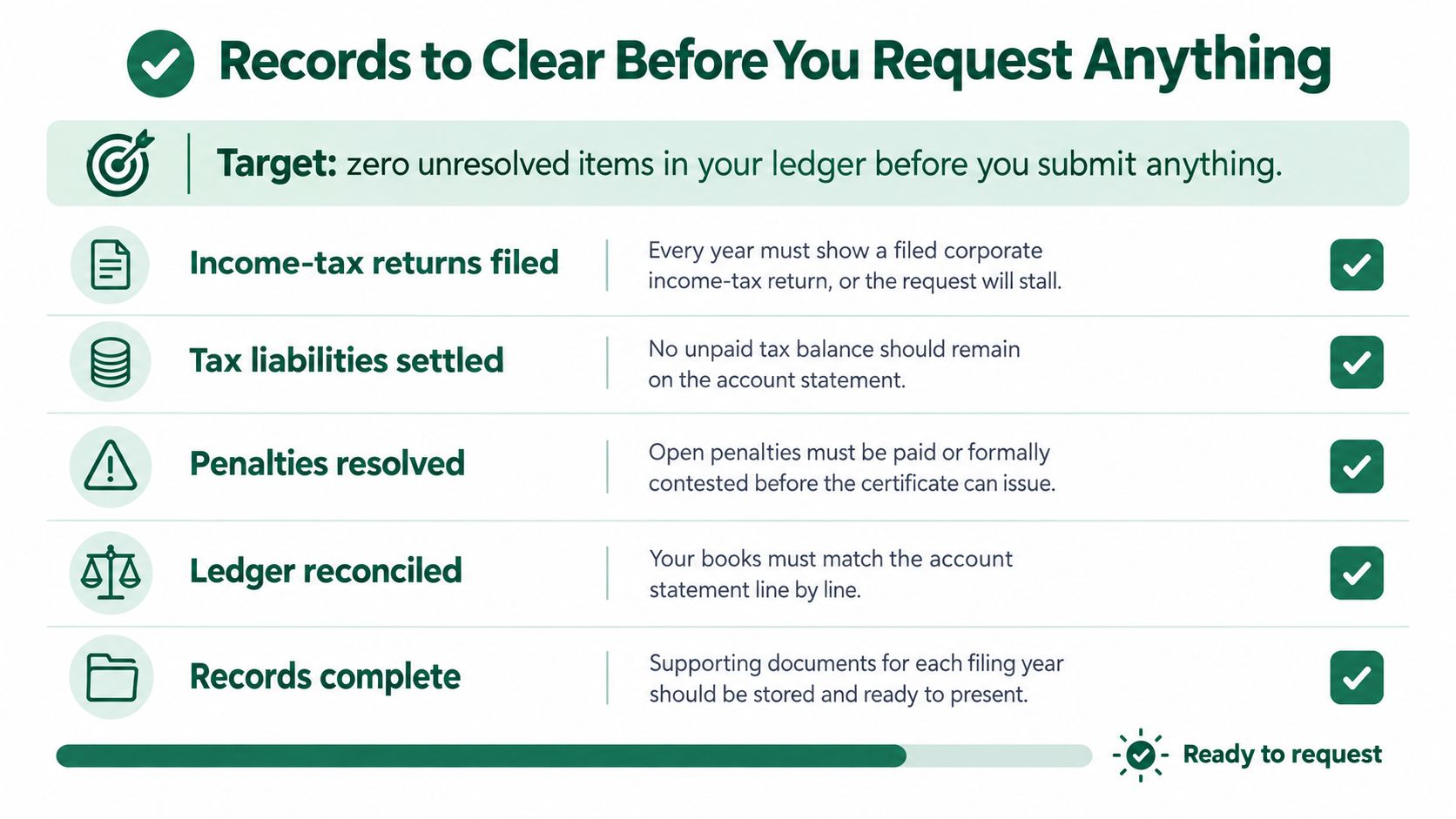
Export the account statement into Excel or Google Sheets, match it line by line, and save a dated copy. Include relevant statutory reporting obligations in the review rather than checking tax payments alone.
Have another person approve the reconciliation before submission. Preserve the application, authorisation, returns, payment evidence, authority correspondence, issued certificate and delivery record together.
How to Apply Through the NRA Portal, Step by Step
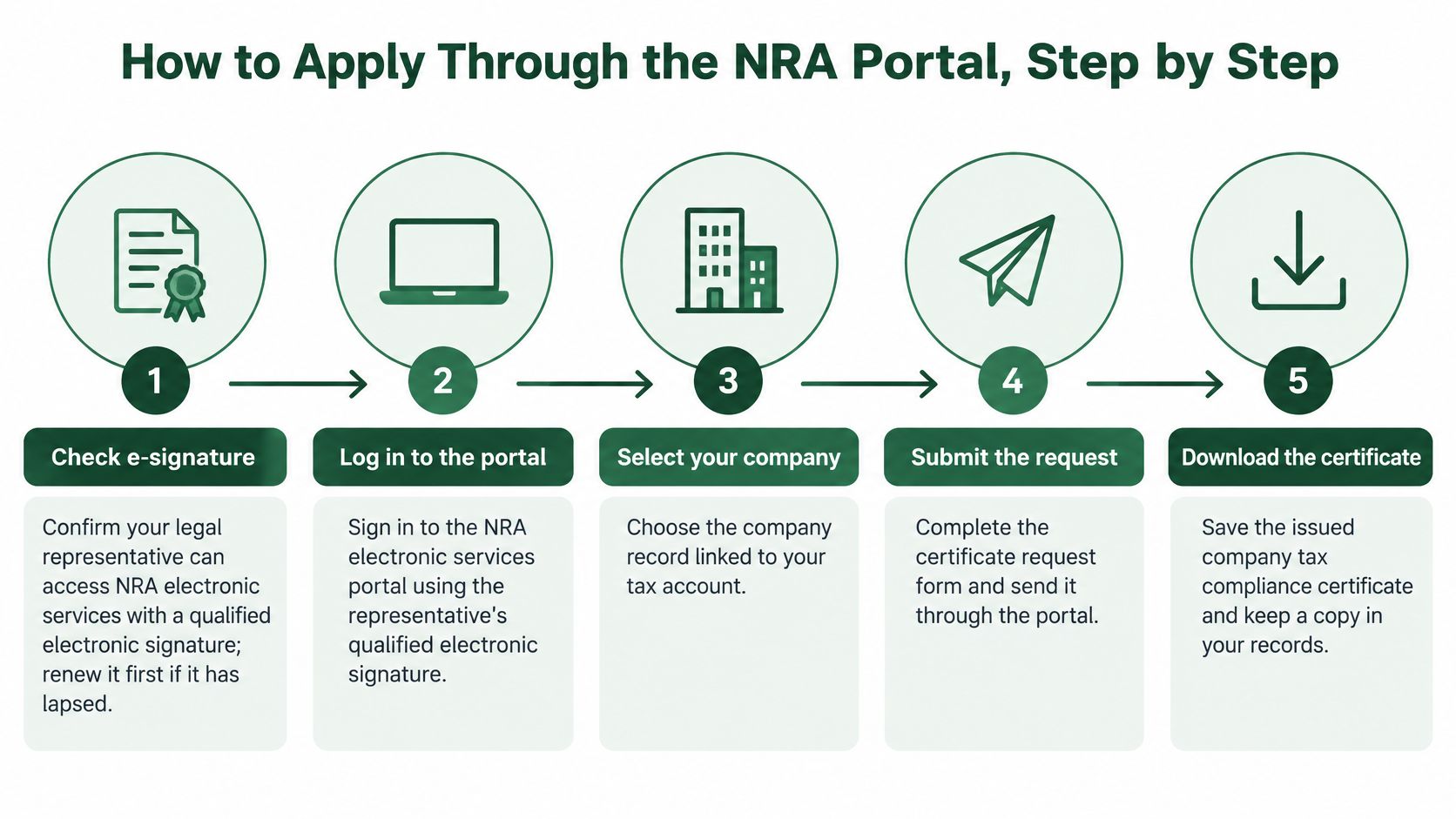
For a company with reconciled records and working signing access, the Bulgarian request can be handled online. You don't need to turn a straightforward electronic application into a trip to an office. Foreign-document formalities may still require separate arrangements.
Prepare access before opening the form
- Check the representative's qualified electronic signature. Renew it first if it has expired. A valid signature and authority to act for the company are separate checks.
- Log in to NRA electronic services. Use the official portal reached through the NRA website, rather than a bookmarked third-party application page.
- Select the company account. Open the service dealing with certificates on public obligations and verify that you're acting for the company, not in a personal capacity.
- Complete the purpose and date fields. Request the current position rather than a future date. Describe the intended use clearly enough to distinguish debt-status evidence from tax residence.
Menu wording can change. Compare these actions with the live screens and service description rather than searching for an identical button label.
Submit and validate the result
- Attach agent authorisation where applicable. Use the signed authorisation required for the person submitting the request. Don't assume an accounting engagement automatically grants every portal permission.
- Submit the application. Check the preview before signing, especially the company identifier and selected service.
- Save the submission acknowledgement. Retain the reference number and submission timestamp in the company's compliance folder.
- Download the issued certificate. Keep the original electronic file rather than only a screenshot or a scanned printout.
- Validate its contents. Check the legal name, tax number, certified date, language, and electronic signature or seal.
- Arrange foreign-use formalities. Order any required apostille, legalisation or certified translation only after the Bulgarian certificate passes your checks and the recipient confirms the required sequence.
Keep both the electronic PDF and a printout if the recipient uses paper files. The printout is convenient, but it may not preserve the electronic validation available in the original file.
The certified date matters more than the day you happen to download the document. Read what period or date the authority certifies; don't infer it from your application date.
The portal submission is an administrative step. Acceptance by your bank or contracting authority is a separate check.
For budgeting, the archived procedure supports treating the request itself as fee-free, but confirm the current NRA service charge before submitting. Translation, legalisation and professional assistance are separate services, so ask for those costs separately rather than assuming they're included.
Timeline From Filing Calendar to Certificate in Hand
According to the National Revenue Agency's corporate-tax guidance, Bulgarian corporate income tax is a flat 10% under Article 20 of the Corporate Income Tax Act, and the annual return is filed electronically with a qualified electronic signature from 1 March through 30 June of the following calendar year, with tax due paid by 30 June.
That calendar affects preparation capacity. If you request a certificate while your accountant is finalising annual accounts, you're asking the same person to reconcile balances, investigate exceptions and meet filing deadlines simultaneously.
Stage-by-stage timing for a Bulgarian certificate
The preparation and overall durations below are planning allowances for an uncomplicated file, not NRA service commitments. Confirm the current authority turnaround before promising a delivery date.
| Stage | Typical time | What stretches it |
|---|---|---|
| Reconcile ledger and close open items | 1–3 working days if clean | Open assessments and unallocated payments |
| Submit online request | Same day | Expired qualified e-signature or missing agent authorisation |
| NRA issuance | About 7 days, using the archived World Bank reference; confirm current service time | Name mismatch or open balance flagged on review |
| Apostille or legalisation | Obtain a completion date from the relevant service before booking | Destination country and document type |
| Certified translation | Agree delivery after confirming the final document format | Translator availability and language pair |
| Full clean file, Bulgaria only | About 1–2 weeks as a planning allowance | Any of the factors listed above |
The biggest scheduling mistake is treating reconciliation time as issuance time. If the account contains an unexplained assessment, the accountant must resolve that issue before a clean result becomes realistic.
Payment also needs to appear correctly on the authority account. A bank transfer confirmation is useful evidence, but it doesn't prove that the NRA allocated the money to the intended liability.
Build the request into your closing calendar
Maintain a shared deadline list covering annual accounts, corporate tax filing deadlines, signature renewal and any transaction requiring a certificate. Assign an owner to each unresolved balance so questions don't sit unanswered in a shared inbox.
I would start at least two to three weeks before a contract deadline for a straightforward domestic file. That's a planning buffer, not an assurance of delivery, and it should grow when the recipient needs foreign-use formalities.
Ask the recipient how recent the certificate must be before ordering it too early. A document delivered comfortably ahead of your transaction may still be unacceptable if the recipient requires a more recent certified position.
Rejections and Delays That Stop Most Applications
Start with the company name. An old spelling in application data can produce a mismatch with the Commercial Register, and that's an avoidable reason for the file to be questioned.
Certificate problems, causes and fixes
| Symptom | Likely cause | Fix |
|---|---|---|
| Certificate shows another company name | Legal name differs from the Commercial Register | Correct the registry entry or application data before resubmitting |
| Request refused for the period | Future date or a period the NRA cannot certify | Request as of the current date only |
| Liabilities still shown after tax was paid | Penalties or late-payment interest still open | Pay the penalty and interest, then request again |
| Submission refused | Agent filed without signed authorisation | Attach the authorisation or sign with your own qualified e-signature |
| Foreign bank rejects the document | It wanted tax residence or its own form | Get the exact form and wording from the recipient first |
| Clean certificate, but file questioned | Returns and VAT status are not shown on the certificate | Add filing evidence and VAT confirmation to the file |
For cross-border use, faster delivery doesn't guarantee acceptance. The OECD's report on tax-administration digitalisation describes continuing investment in digital services, but recipients still apply their own documentary requirements.
Before applying, map the document to the institution requesting it: debt status or broader filing compliance, required date range, validation method, and any notarisation, apostille or translation requirements.
A Bulgarian certificate can be correctly issued and still fail a foreign bank's checklist. The receiving institution decides whether it answers the question being asked.
How Bulgaria's 10% Rate Compares Across the EU
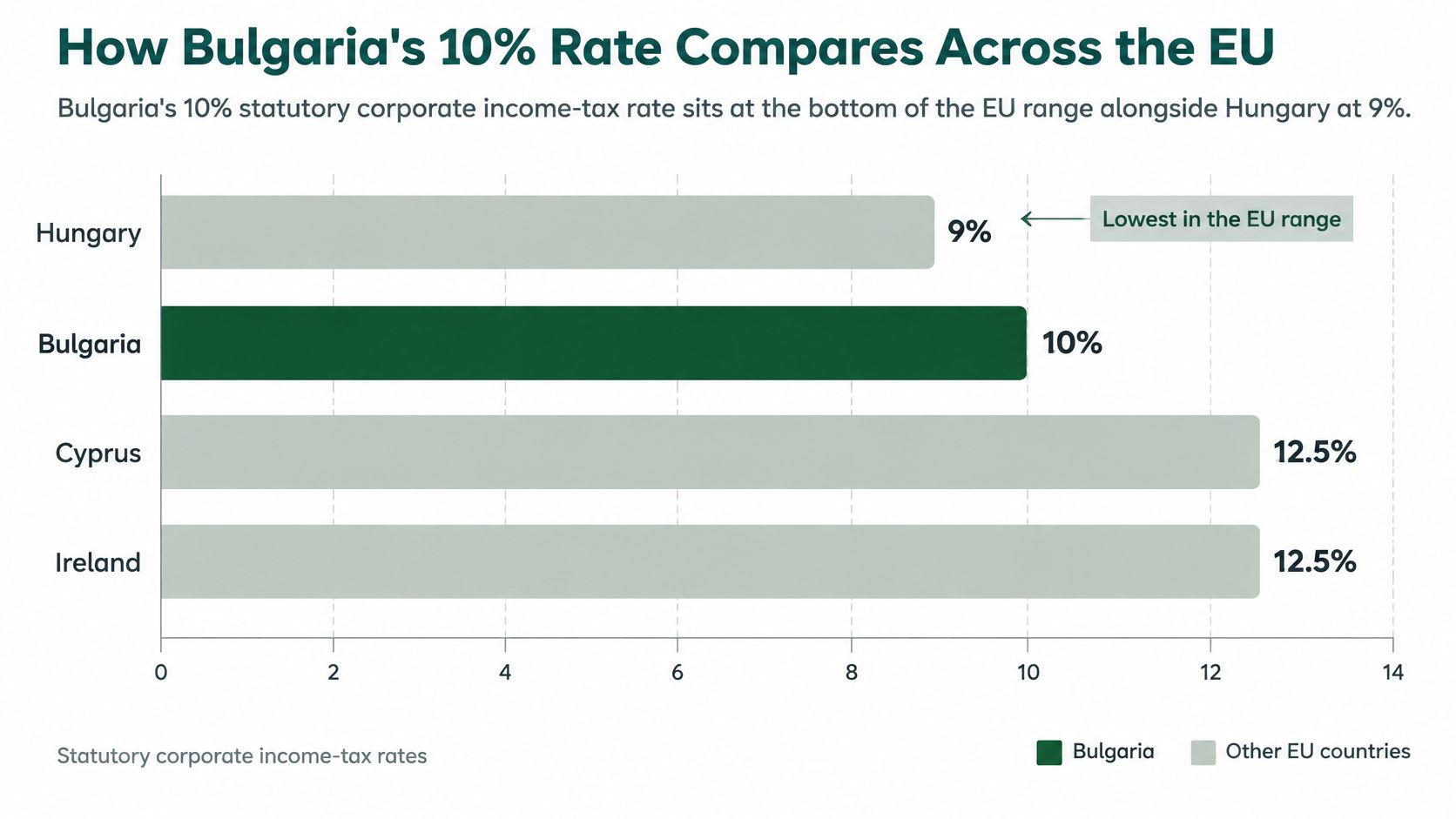
Bulgaria's statutory corporate-tax rate is low by EU standards, but the headline percentage shows only one part of the cost of operating a company. The Tax Foundation's European comparison lists these 2025 statutory rates. They offer a dated comparison, not a forecast of any company's effective tax burden.
Statutory corporate income-tax rates, 2025
| Country | Statutory CIT rate 2025 |
|---|---|
| Hungary | 9% |
| Bulgaria | 10% |
| Cyprus | 12.5% |
| Ireland | 12.5% |
| Italy | 27.8% |
| Portugal | 29.5% |
| Germany | 30.06% |
| Malta | 35% |
Bulgaria's 10% rate is close to Hungary's 9% and below the other listed rates. Use the table to identify jurisdictions for further comparison, not to choose a company location on tax rate alone.
Compare what the founder actually keeps
Build the calculation around profit before tax, company-level tax, and tax on distributions. Add operating costs such as bookkeeping, payroll, VAT administration, and recordkeeping. The certificate itself is only a snapshot of the company's tax position when requested; regular reconciliation and filings are part of the ongoing cost.
Taxable-profit rules affect the company-level result. Withholding taxes and the owner's residence can change the amount received from distributions. If the founder works or manages the business elsewhere, transfer pricing and permanent-establishment exposure also need to be considered.
Assess VAT separately from the corporate-tax percentage. Payroll contributions depend on the people and working arrangements involved, not only on the country where the company is incorporated.
Decision test: Compare the full compliance and repatriation model, not just the percentage beside the country name.
A low rate does not settle where an agency's management takes place. For a SaaS business, evidence of customer locations and VAT reporting may take more operational attention than the annual corporate-tax calculation.
Use this corporate tax rates comparison to shortlist jurisdictions, then cost the structure you plan to run. Include recurring filings and reconciliations alongside the tax calculation.
Book the Certificate With FastCorp Support
If you need the certificate within weeks, start with the ledger, not the portal. Sending an application before investigating an unexplained balance rarely saves useful time.
Use this working order:
- Obtain the account statement from the NRA account.
- Reconcile the ledger against recorded liabilities and payments.
- Resolve penalties and interest alongside principal balances.
- Check signing access for the authorised representative.
- Request the current position using the appropriate service.
- Archive the checked certificate with the supporting evidence.
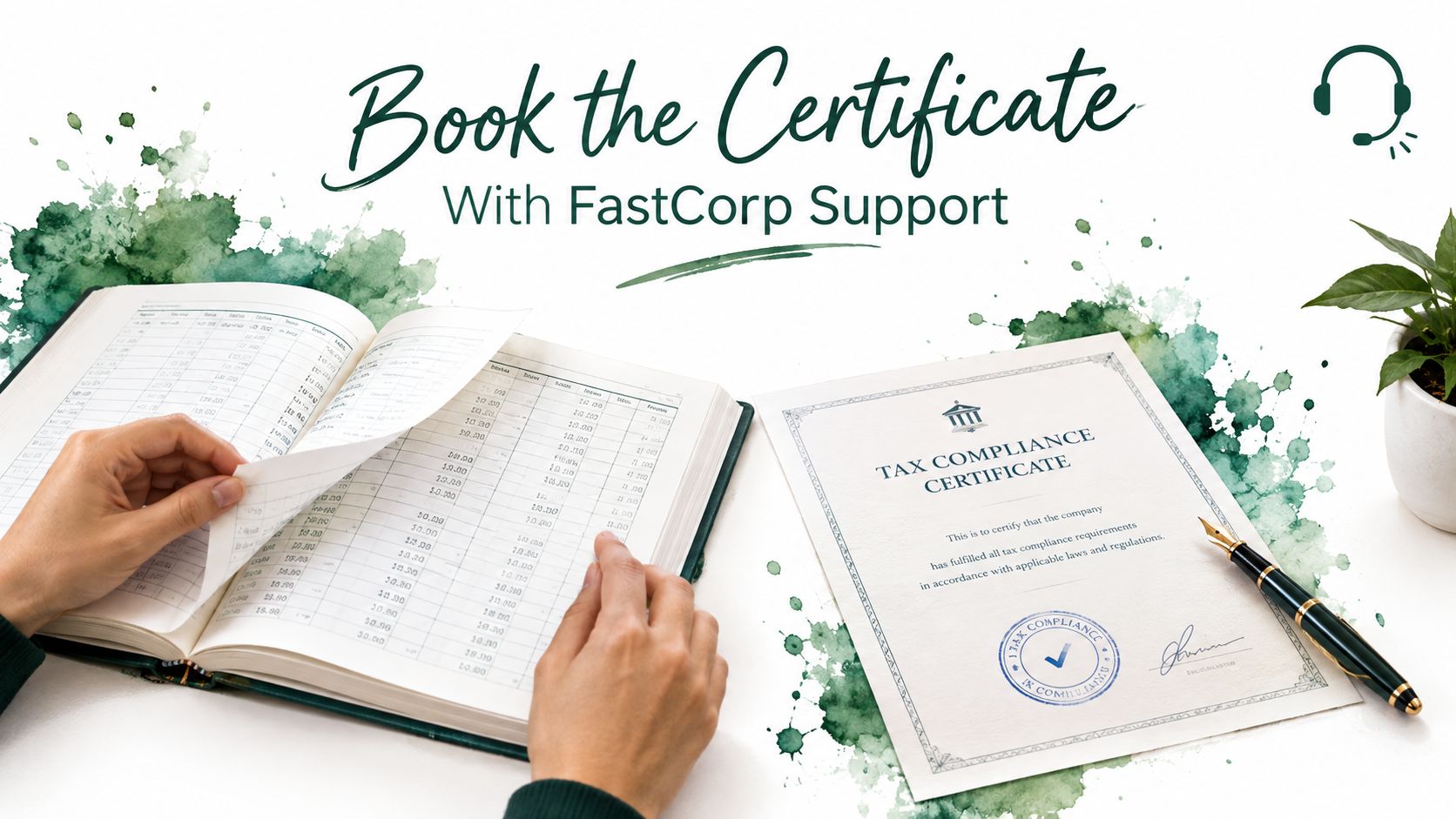
You can prepare that file internally, use your existing accountant, or engage FastCorp for reconciliation support and ongoing bookkeeping, VAT returns, annual corporate-tax filings, payroll and compliance management. Your authorised signatory still submits the NRA request.
Keep formation and certificate services separate
The provider's published formation packages offer fully online incorporation in 3–5 working days for EUR 1,750, or an in-person Sofia option in 2–3 working days for EUR 1,500, including legal and government fees, with airport pickup on the in-person package. Those are formation package prices and timelines, not certificate issuance terms or a quote for ongoing accounting.
The online submission is the easy part when the account is ready. Reconciliation is where the professional work goes, so send your ledger for review before ordering the certificate and agree the scope of any corrective work first.
FastCorp offers Bulgarian company formation and ongoing accounting support, including the reconciliation work that helps you prepare for a company tax compliance certificate request. Visit FastCorp to arrange a ledger review and confirm what your authorised signatory needs before applying.